
FedEx Scales Autonomous Trailer Loading Beyond Pilot, Growing Robotics Push
FedEx is expanding on a robotics pilot to bring autonomous trailer loading and unloading capabilities…
FedEx is expanding on a robotics pilot to bring autonomous trailer loading and unloading capabilities…
The price of eggs has become a marker of the state of the economy. But how about the cost of making eggs? Sure, you might be able to do it for next to nothing in your kitchen with nothing but a pan and a burner. But you could also pay $400 for a robot that will do it for you—as long as you don’t want your eggs scrambled, that is.
A new Kickstarter project has finally given us a Juicero for the robotics era, and it’s called E.G.O.R. (that’s Efficient Gastronomic Operational Robot), brought to you by the startup Cheffy. It’s an automated egg maker that promises perfect cracks every time with no shell in the yolk. It has seven different ways that it can cook them up for you, or you can just use it to do the cracking. You can also pair it with a toaster so your eggs and toast finish at the exact right time.
NEW: Cheffy just launched a robot that cracks and cooks your eggs.
Egor automates breakfast by cooking eggs 7 ways, while Toastr syncs your toast so everything finishes together.
-Automatically cracks eggs with no shells or mess
-Cooks eggs 7 ways, from sunny-side up to hard… pic.twitter.com/auE3SnfrS3— Ritwik Pavan (@ritwikpavan) July 30, 2026
This isn’t something anyone really needs. Cooking an egg over easy takes about two minutes, so calling this a time-saver is a stretch. And if you really don’t want to use the stove, you can buy a basic egg cooker for around $20 almost anywhere. Maybe you’re bad at cracking eggs, but $400 (well, $200 if you get in on the early bird deal) is a lot to pay to not have to pick the occasional shell pieces out.
But hey, the robotics era needed its Juicero moment. To the creator’s credit: it seems like they’re treating this more like a fun novelty (albeit a pretty pricey one) rather than something revolutionary. They also aren’t making you buy proprietary eggs that are required to make the machine work, so they’ve got the Juicero bros beat there.
We’re increasingly seeing robots positioned to do basic tasks. A company called Weave got attention earlier this year with an $8,000 robot that folds clothes. There’s a company in San Francisco offering house cleanings performed by humanoid robots. Last year, 1x made waves by introducing its Neo humanoid robot, which the Wall Street Journal reported “nearly toppled over” while closing a dishwasher and struggled to open the refrigerator.
All of these machines cost an inordinate amount of money to do things that do not cost the average person that much time or money to accomplish. They’re novel, sure. But you don’t have to pay a premium to be a beta tester.

The price of eggs has become a marker of the state of the economy. But how about the cost of making eggs? Sure, you might be able to do it for next to nothing in your kitchen with nothing but a pan and a burner. But you could also pay $400 for a robot that will do it for you—as long as you don’t want your eggs scrambled, that is.
A new Kickstarter project has finally given us a Juicero for the robotics era, and it’s called E.G.O.R. (that’s Efficient Gastronomic Operational Robot), brought to you by the startup Cheffy. It’s an automated egg maker that promises perfect cracks every time with no shell in the yolk. It has seven different ways that it can cook them up for you, or you can just use it to do the cracking. You can also pair it with a toaster so your eggs and toast finish at the exact right time.
NEW: Cheffy just launched a robot that cracks and cooks your eggs.
Egor automates breakfast by cooking eggs 7 ways, while Toastr syncs your toast so everything finishes together.
-Automatically cracks eggs with no shells or mess
-Cooks eggs 7 ways, from sunny-side up to hard… pic.twitter.com/auE3SnfrS3— Ritwik Pavan (@ritwikpavan) July 30, 2026
This isn’t something anyone really needs. Cooking an egg over easy takes about two minutes, so calling this a time-saver is a stretch. And if you really don’t want to use the stove, you can buy a basic egg cooker for around $20 almost anywhere. Maybe you’re bad at cracking eggs, but $400 (well, $200 if you get in on the early bird deal) is a lot to pay to not have to pick the occasional shell pieces out.
But hey, the robotics era needed its Juicero moment. To the creator’s credit: it seems like they’re treating this more like a fun novelty (albeit a pretty pricey one) rather than something revolutionary. They also aren’t making you buy proprietary eggs that are required to make the machine work, so they’ve got the Juicero bros beat there.
We’re increasingly seeing robots positioned to do basic tasks. A company called Weave got attention earlier this year with an $8,000 robot that folds clothes. There’s a company in San Francisco offering house cleanings performed by humanoid robots. Last year, 1x made waves by introducing its Neo humanoid robot, which the Wall Street Journal reported “nearly toppled over” while closing a dishwasher and struggled to open the refrigerator.
All of these machines cost an inordinate amount of money to do things that do not cost the average person that much time or money to accomplish. They’re novel, sure. But you don’t have to pay a premium to be a beta tester.
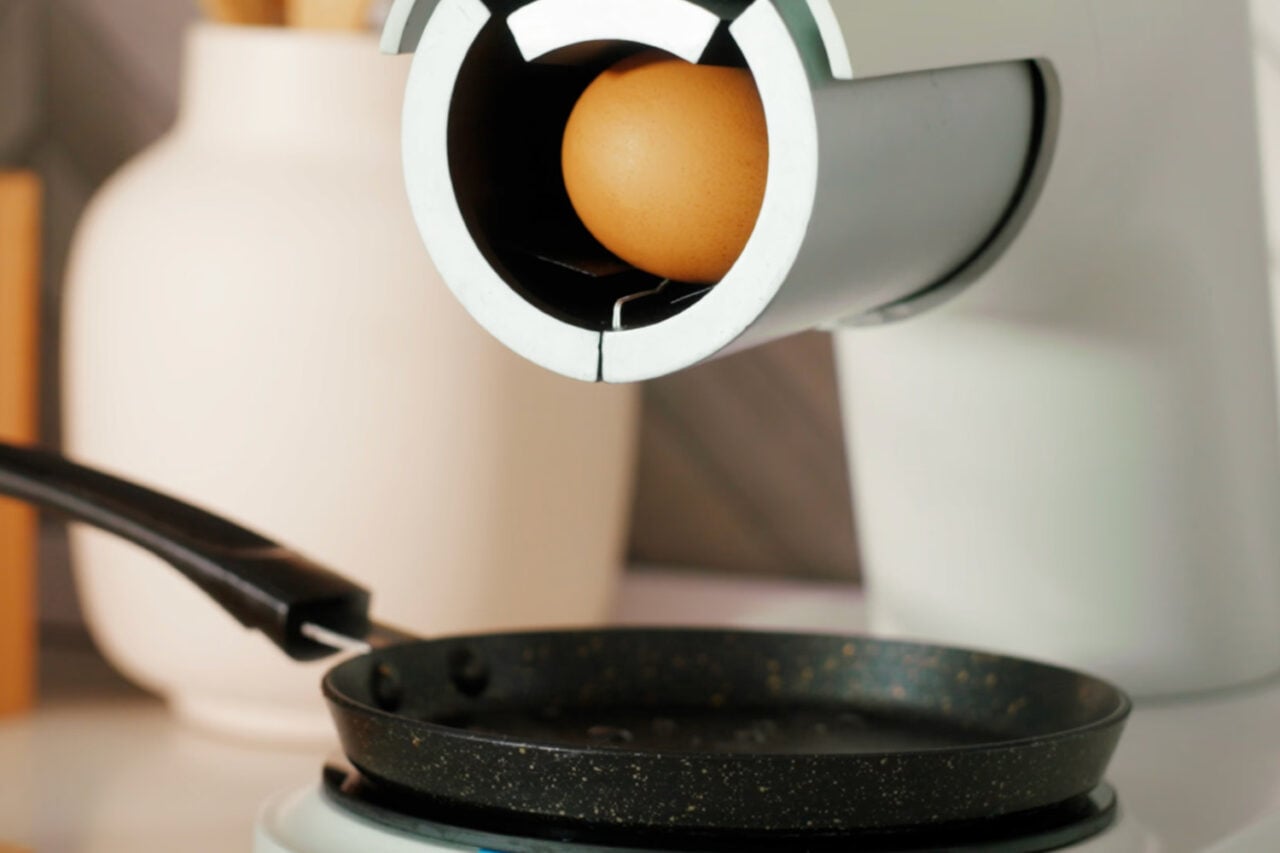
The price of eggs has become a marker of the state of the economy. But how about the cost of making eggs? Sure, you might be able to do it for next to nothing in your kitchen with nothing but a pan and a burner. But you could also pay $400 for a robot that will do it for you—as long as you don’t want your eggs scrambled, that is.
A new Kickstarter project has finally given us a Juicero for the robotics era, and it’s called E.G.O.R. (that’s Efficient Gastronomic Operational Robot), brought to you by the startup Cheffy. It’s an automated egg maker that promises perfect cracks every time with no shell in the yolk. It has seven different ways that it can cook them up for you, or you can just use it to do the cracking. You can also pair it with a toaster so your eggs and toast finish at the exact right time.
NEW: Cheffy just launched a robot that cracks and cooks your eggs.
Egor automates breakfast by cooking eggs 7 ways, while Toastr syncs your toast so everything finishes together.
-Automatically cracks eggs with no shells or mess
-Cooks eggs 7 ways, from sunny-side up to hard… pic.twitter.com/auE3SnfrS3— Ritwik Pavan (@ritwikpavan) July 30, 2026
This isn’t something anyone really needs. Cooking an egg over easy takes about two minutes, so calling this a time-saver is a stretch. And if you really don’t want to use the stove, you can buy a basic egg cooker for around $20 almost anywhere. Maybe you’re bad at cracking eggs, but $400 (well, $200 if you get in on the early bird deal) is a lot to pay to not have to pick the occasional shell pieces out.
But hey, the robotics era needed its Juicero moment. To the creator’s credit: it seems like they’re treating this more like a fun novelty (albeit a pretty pricey one) rather than something revolutionary. They also aren’t making you buy proprietary eggs that are required to make the machine work, so they’ve got the Juicero bros beat there.
We’re increasingly seeing robots positioned to do basic tasks. A company called Weave got attention earlier this year with an $8,000 robot that folds clothes. There’s a company in San Francisco offering house cleanings performed by humanoid robots. Last year, 1x made waves by introducing its Neo humanoid robot, which the Wall Street Journal reported “nearly toppled over” while closing a dishwasher and struggled to open the refrigerator.
All of these machines cost an inordinate amount of money to do things that do not cost the average person that much time or money to accomplish. They’re novel, sure. But you don’t have to pay a premium to be a beta tester.
The price of eggs has become a marker of the state of the economy. But…
The logistics industry has spent the past few years talking about robots, warehouse automation and…
Something remarkable happened at the Texprocess 2026 trade show in Frankfurt this past spring. In…
When you purchase through links in our articles, we may earn a small commission. This doesn’t affect our editorial independence.
#Theker #raised #85M #build #factory #robot #doesnt #specialize #TechCrunchAutomation,theker">
That’s the bet behind Theker, an AI robotics startup that aims to go beyond robots trained for a single task. “If you always have to put the same cookie in the same box, that works perfectly, but most processes aren’t like that,” co-founder Carla Gómez Cano told TechCrunch.
Theker is designed for that messier reality. Unlike humanoid robots designed around a fixed form — think Boston Dynamics — Theker’s machines are built to be reconfigured. Their hands, arms, and overall form can be swapped out or resized depending on the task, whether that’s sorting packages, packing clothing, or handling bottles and cans in a warehouse.
That Inditex, Zara’s parent company, signed on as an early backer is a signal of where Theker’s ambitions start, not where they end. The company’s broader goal is to move beyond retail into heavier industrial settings like manufacturing, where the complexity and scale of manual tasks is even greater.
This generalist ambition has helped cement Theker’s status as one of Europe’s hot startups to watch — and raise capital accordingly. The Barcelona-based startup has just raised $85 million in what it’s calling “Europe’s largest ever robotics Series A.” (We haven’t found a larger one in our records, either.)
Less than a year after a record seed round, this Series A was led by American VC firm CRV and backed by a mix of traditional and strategic investors, including Samsung and Aglaé Ventures, the investment vehicle tied to LVMH chairman Bernard Arnault.
Gómez Cano said Samsung is not a client yet but that the two are in advanced discussions. Theker would welcome having the Korean company as a customer, supplier, and investor simultaneously — a trifecta that would give the startup both revenue and credibility in manufacturing at scale.
She also noted that she and co-founder Jiaqiang Ye Zhu “didn’t build Theker to run pilots,” so the team skips innovation departments entirely and goes straight to logistics or operations, where deals are real and timelines are shorter.
To demonstrate that the company can actually deliver on that, Theker has a showroom in central Barcelona, and plans to open others as it expands across Europe, the U.S. and Asia. It will also grow its headcount across tech, deployment, and sales.
“We already received 15,000 job applications and have to filter like crazy,” Gómez Cano said. She estimated that the team could grow from dozens to up to 120 people by the end of the year, then caught herself: “I am saying that, but I also said that we’d raise $30 or $40 million!”
That Theker managed to raise twice its target also reinforces the startup’s conviction in keeping its HQ in Barcelona, a growing robotics hub, and in Europe’s tech ecosystem more broadly. “It has never been a barrier to acceleration for us, so we are making the most of it,” Gómez Cano said.
When you purchase through links in our articles, we may earn a small commission. This doesn’t affect our editorial independence.
#Theker #raised #85M #build #factory #robot #doesnt #specialize #TechCrunchAutomation,theker">Theker just raised $85M to build the factory robot that doesn’t specialize in anything | TechCrunchHumanoids aren’t quite ready to replace factory workers, but the industry can’t wait. Faced with labor shortages, manufacturers have shown growing interest in startups that promise faster automation without the usual tradeoffs.
That’s the bet behind Theker, an AI robotics startup that aims to go beyond robots trained for a single task. “If you always have to put the same cookie in the same box, that works perfectly, but most processes aren’t like that,” co-founder Carla Gómez Cano told TechCrunch.
Theker is designed for that messier reality. Unlike humanoid robots designed around a fixed form — think Boston Dynamics — Theker’s machines are built to be reconfigured. Their hands, arms, and overall form can be swapped out or resized depending on the task, whether that’s sorting packages, packing clothing, or handling bottles and cans in a warehouse.
That Inditex, Zara’s parent company, signed on as an early backer is a signal of where Theker’s ambitions start, not where they end. The company’s broader goal is to move beyond retail into heavier industrial settings like manufacturing, where the complexity and scale of manual tasks is even greater.
This generalist ambition has helped cement Theker’s status as one of Europe’s hot startups to watch — and raise capital accordingly. The Barcelona-based startup has just raised $85 million in what it’s calling “Europe’s largest ever robotics Series A.” (We haven’t found a larger one in our records, either.)
Less than a year after a record seed round, this Series A was led by American VC firm CRV and backed by a mix of traditional and strategic investors, including Samsung and Aglaé Ventures, the investment vehicle tied to LVMH chairman Bernard Arnault.
Gómez Cano said Samsung is not a client yet but that the two are in advanced discussions. Theker would welcome having the Korean company as a customer, supplier, and investor simultaneously — a trifecta that would give the startup both revenue and credibility in manufacturing at scale.
She also noted that she and co-founder Jiaqiang Ye Zhu “didn’t build Theker to run pilots,” so the team skips innovation departments entirely and goes straight to logistics or operations, where deals are real and timelines are shorter.
To demonstrate that the company can actually deliver on that, Theker has a showroom in central Barcelona, and plans to open others as it expands across Europe, the U.S. and Asia. It will also grow its headcount across tech, deployment, and sales.
“We already received 15,000 job applications and have to filter like crazy,” Gómez Cano said. She estimated that the team could grow from dozens to up to 120 people by the end of the year, then caught herself: “I am saying that, but I also said that we’d raise $30 or $40 million!”
That Theker managed to raise twice its target also reinforces the startup’s conviction in keeping its HQ in Barcelona, a growing robotics hub, and in Europe’s tech ecosystem more broadly. “It has never been a barrier to acceleration for us, so we are making the most of it,” Gómez Cano said.
When you purchase through links in our articles, we may earn a small commission. This doesn’t affect our editorial independence.
#Theker #raised #85M #build #factory #robot #doesnt #specialize #TechCrunchAutomation,thekerHumanoids aren’t quite ready to replace factory workers, but the industry can’t wait. Faced with…
There are an estimated 4,664,000 working industrial robots in the world, according to the International…
While many robotics companies are building human-sized robots, or working to automate entire factories, MicroFactory…


