
Live Updates: U.S. fires on 2 Iran-flagged tankers as Rubio says U.S. expects response on peace deal today
The Israeli military told people living in seven villages in southern Lebanon to evacuate their…
The Israeli military told people living in seven villages in southern Lebanon to evacuate their…
The U.S. has had "very good talks over the past 24 hours" aimed at reaching…
President Trump threatened Iran on Wednesday with new attacks, warning they would be at a…
The U.S. Embassy in Beirut has called on Lebanon's government to further its engagement with…
World shares were mixed Monday as the price of Brent Crude oil jumped $2.50 a…
04:58 AM, 27-Apr-2026 मस्कट में ईरानी विदेश मंत्री और ओमान के सुल्तान ने सुरक्षित पारगमन…

In a phone interview with The Associated Press on Thursday, Zampolli said his “request is not a political request,” but rather meant as a contingency plan in case Iran could not participate in the soccer tournament.
After suggesting to the FT that, with four previous titles, the Italian national team’s appearance in the World Cup would be justified, he told the AP it was his “dream … for the Italian people and the American-Italian people.”
Italian officials pushed back hard at the suggestion, with Sports Minister Andrea Abodi saying Thursday, “first of all, it’s not possible. Secondly, it’s not a good idea.”
Luciano Buonfiglio, the president of the Italian Olympic Committee, which oversees all sports in Italy, also dismissed the idea, saying he “would feel offended,” as “you need to deserve to go to the World Cup.”
CBS/AP
Sports officials in four-time world champion Italy say the country is not interested in replacing Iran at the upcoming 2026 World Cup, following a suggestion of the move by a Trump administration official.
Iran has not withdrawn from the World Cup, and the team is preparing to play in the championship taking place this year in the U.S., Mexico and Canada despite the ongoing war in the Middle East.
FIFA, the global soccer authority behind the World Cup, has insisted that Iran’s group stage games in California and Washington state will go ahead as planned in June.
The Financial Times reported this week that Paolo Zampolli, the U.S. special envoy for global partnerships, had suggested the swap to President Trump and FIFA president Gianni Infantino.
In a phone interview with The Associated Press on Thursday, Zampolli said his “request is not a political request,” but rather meant as a contingency plan in case Iran could not participate in the soccer tournament.
After suggesting to the FT that, with four previous titles, the Italian national team’s appearance in the World Cup would be justified, he told the AP it was his “dream … for the Italian people and the American-Italian people.”
Italian officials pushed back hard at the suggestion, with Sports Minister Andrea Abodi saying Thursday, “first of all, it’s not possible. Secondly, it’s not a good idea.”
Luciano Buonfiglio, the president of the Italian Olympic Committee, which oversees all sports in Italy, also dismissed the idea, saying he “would feel offended,” as “you need to deserve to go to the World Cup.”
CBS/AP
Sports officials in four-time world champion Italy say the country is not interested in replacing…

“The planned consolidation of the European network is being carried out across Lufthansa Group’s six hubs in Frankfurt, Munich, Zurich, Vienna, Brussels, and Rome,” the airline said. “Passengers will therefore continue to have access to the global route network, particularly long-haul connections.”
Several other major airlines — in both Europe and the U.S., which is far less reliant on fuel supplies from the Middle East — had already announced temporary flight cuts.
Air Canada, Delta, and other airlines announced cancellations earlier this month.
“The spike in oil prices is big news in general and the impact on jet fuel prices is pronounced,” Stephen Rooney, lead economist at Tourism Economics, told CBS News last week. “Jet fuel is a huge cost for airlines, especially on longer-haul flights.”
Germany’s flag carrier airline Lufthansa said Wednesday that it was canceling 20,000 short-haul flights within Europe to save money, citing the dramatic spike in the price of jet fuel caused by the U.S.-Israeli war with Iran, which has dramatically constrained the flow of petroleum products through the Strait of Hormuz.
“In total, 20,000 short-haul flights will be removed from the schedule through October, equivalent to approximately 40,000 metric tons of jet fuel, the price of which has doubled since the outbreak of the Iran conflict,” the airline said in a statement.
“The planned consolidation of the European network is being carried out across Lufthansa Group’s six hubs in Frankfurt, Munich, Zurich, Vienna, Brussels, and Rome,” the airline said. “Passengers will therefore continue to have access to the global route network, particularly long-haul connections.”
Several other major airlines — in both Europe and the U.S., which is far less reliant on fuel supplies from the Middle East — had already announced temporary flight cuts.
Air Canada, Delta, and other airlines announced cancellations earlier this month.
“The spike in oil prices is big news in general and the impact on jet fuel prices is pronounced,” Stephen Rooney, lead economist at Tourism Economics, told CBS News last week. “Jet fuel is a huge cost for airlines, especially on longer-haul flights.”
Germany's flag carrier airline Lufthansa said Wednesday that it was canceling 20,000 short-haul flights within…

In the Gulf, the ceasefire is holding. But only just. For Edward Hobart, British Ambassador to the United Arab Emirates, that fragile pause is the only thing standing between contained tension and renewed escalation.
 ADVERTISEMENT
ADVERTISEMENT
ADVERTISEMENT
In an interview with Euronews, Hobart said that “the important thing is that there is a ceasefire still… we’re not going to resolve the war while we’re still fighting.”
The message is blunt. Diplomacy does not begin in parallel with conflict. It follows it. And for now, the region is suspended in that narrow gap between the two.
“I think we don’t know yet… but we hope, of course, that it’s part of the beginning step into something which brings us to a sustainable resolution.”
Whether that hope holds depends largely on a stretch of water just 33 kilometres wide. The Strait of Hormuz is not just a regional flashpoint. It is a global pressure point, carrying a significant share of the world’s oil supply. When it closes, the consequences are immediate and far-reaching.
“You can’t talk very easily while you’re firing missiles across the Straits of Hormuz,” Hobart said.
That urgency is already shaping diplomatic engagement between London and Abu Dhabi, particularly in recent talks between the UK Foreign Secretary and the UAE Foreign Minister.
“They obviously focused fundamentally on the current regional situation and Iran and in particular on the critical importance of getting the Straits of Hormuz open again,” according to Hobart.
Behind that sits a broader strategic calibration. Security cooperation is being reinforced, but so too are the systems that underpin long-term resilience, from energy transition to financial security.
“We agreed a framework of cooperation between our countries,” Hobart says, including work “not just in foreign policy and in defence, but also in AI… in the energy transition… in tackling global crime and illicit finance.”
On the ground, that partnership has already been tested. The recent attacks were not incremental. They marked a step change, “unprecedented, unwarranted and hugely dangerous, risking lives.”
And yet, the outcome could have been significantly worse. The UAE’s defensive systems held. “They’ve intercepted 95% of the projectiles fired at this country.”
That figure is more than a statistic. It is a signal of preparedness, coordination, and a defence architecture functioning under pressure.
For the UK, the response has been deliberately controlled. Support without escalation. “This wasn’t the UK’s war… but particularly in defence of the Gulf countries, we have enabled the US to help support that defence.”
At the same time, the crisis has triggered a wider international alignment. Maritime security, once a technical issue, has become a geopolitical priority. “What we want is the law of the sea to be followed… these international thoroughfares… open and flowing.”
That position is now backed by scale. “There were over 50 countries taking part… who are there to support freedom of navigation… in the Straits de Hormuz.”
Even so, the underlying risk has not disappeared. It has been managed, not removed. “I think the risk is there… the risk is reduced while there isn’t fighting and while there is a prospect of talking.”
For residents in the UAE, that translates into a cautious normality. Daily life continues, but with an awareness that conditions can shift quickly. “For expats that are here… at the moment you can live a pretty normal life, but you need to pay attention to what the authorities are saying.”
That balance, between reassurance and realism, has defined the response. “I think it’s getting the balance right between a kind of calming message… but also the need to respond to a very unusual situation.”
Zoom out, and a more structural picture emerges. The UAE operates in a region it cannot control. Its strength lies in how it responds. “The UAE can’t control the whole of that environment, so it’s about how does it flex and respond to that overall.”
And despite the pressure, those fundamentals remain intact. “The fundamentals for the UAE haven’t changed… it also has a brilliant geography… and a business environment which is very conducive and open.”
For now, that balance is holding.
In the Gulf, the ceasefire is holding. But only just. For Edward Hobart, British Ambassador to the United Arab Emirates, that fragile pause is the only thing standing between contained tension and renewed escalation.
ADVERTISEMENT
ADVERTISEMENT
In an interview with Euronews, Hobart said that “the important thing is that there is a ceasefire still… we’re not going to resolve the war while we’re still fighting.”
The message is blunt. Diplomacy does not begin in parallel with conflict. It follows it. And for now, the region is suspended in that narrow gap between the two.
“I think we don’t know yet… but we hope, of course, that it’s part of the beginning step into something which brings us to a sustainable resolution.”
Whether that hope holds depends largely on a stretch of water just 33 kilometres wide. The Strait of Hormuz is not just a regional flashpoint. It is a global pressure point, carrying a significant share of the world’s oil supply. When it closes, the consequences are immediate and far-reaching.
“You can’t talk very easily while you’re firing missiles across the Straits of Hormuz,” Hobart said.
That urgency is already shaping diplomatic engagement between London and Abu Dhabi, particularly in recent talks between the UK Foreign Secretary and the UAE Foreign Minister.
“They obviously focused fundamentally on the current regional situation and Iran and in particular on the critical importance of getting the Straits of Hormuz open again,” according to Hobart.
Behind that sits a broader strategic calibration. Security cooperation is being reinforced, but so too are the systems that underpin long-term resilience, from energy transition to financial security.
“We agreed a framework of cooperation between our countries,” Hobart says, including work “not just in foreign policy and in defence, but also in AI… in the energy transition… in tackling global crime and illicit finance.”
On the ground, that partnership has already been tested. The recent attacks were not incremental. They marked a step change, “unprecedented, unwarranted and hugely dangerous, risking lives.”
And yet, the outcome could have been significantly worse. The UAE’s defensive systems held. “They’ve intercepted 95% of the projectiles fired at this country.”
That figure is more than a statistic. It is a signal of preparedness, coordination, and a defence architecture functioning under pressure.
For the UK, the response has been deliberately controlled. Support without escalation. “This wasn’t the UK’s war… but particularly in defence of the Gulf countries, we have enabled the US to help support that defence.”
At the same time, the crisis has triggered a wider international alignment. Maritime security, once a technical issue, has become a geopolitical priority. “What we want is the law of the sea to be followed… these international thoroughfares… open and flowing.”
That position is now backed by scale. “There were over 50 countries taking part… who are there to support freedom of navigation… in the Straits de Hormuz.”
Even so, the underlying risk has not disappeared. It has been managed, not removed. “I think the risk is there… the risk is reduced while there isn’t fighting and while there is a prospect of talking.”
For residents in the UAE, that translates into a cautious normality. Daily life continues, but with an awareness that conditions can shift quickly. “For expats that are here… at the moment you can live a pretty normal life, but you need to pay attention to what the authorities are saying.”
That balance, between reassurance and realism, has defined the response. “I think it’s getting the balance right between a kind of calming message… but also the need to respond to a very unusual situation.”
Zoom out, and a more structural picture emerges. The UAE operates in a region it cannot control. Its strength lies in how it responds. “The UAE can’t control the whole of that environment, so it’s about how does it flex and respond to that overall.”
And despite the pressure, those fundamentals remain intact. “The fundamentals for the UAE haven’t changed… it also has a brilliant geography… and a business environment which is very conducive and open.”
For now, that balance is holding.
In the Gulf, the ceasefire is holding. But only just. For Edward Hobart, British Ambassador…
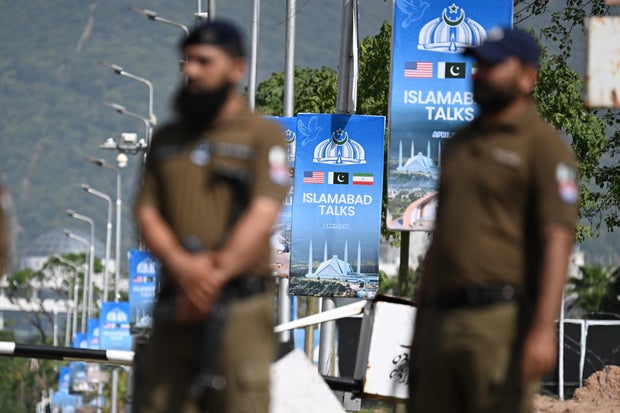
Iranian state TV on Tuesday rejected reports suggesting a lower-level preliminary delegation had arrived in Pakistan’s capital ahead of possible peace talks with Trump administration officials.
“Since Saturday, numerous reports have circulated about the ‘departure’ or ‘arrival’ of an Iranian delegation to Pakistan, and even announcements of the meeting time as ‘Monday afternoon’ or ‘Tuesday morning’ by international and regional media — all of which are inaccurate,” the state TV broadcast said.
The report then reiterated a remark by the speaker of Iran’s parliament, Mohammad-Bagher Ghalibaf, who said Monday: “We do not accept negotiations under the shadow of threats.”
“Continuing participation in the talks depends on a change in the behavior and positions of the Americans,” the state TV report said.
President Trump said late Monday that obtaining uranium from Iran would be “long” and “difficult” in the aftermath of last year’s U.S. strikes on Tehran’s nuclear sites.
“Operation Midnight Hammer was a complete and total obliteration of the Nuclear Dust sites in Iran,” he wrote on his Truth Social platform, adding: “Therefore, digging it out will be a long and difficult process.”
Mr. Trump regularly uses the term “nuclear dust” to refer to Iran’s stock of enriched uranium, which the United States accuses Iran of hoarding in order to use in a nuclear bomb. But he has also sometimes used it to refer to material left over from U.S. strikes on Iran’s nuclear facilities in June last year.
Mr. Trump has said Iran’s stockpile of enriched uranium will ultimately be transferred to U.S. territory, despite Iran’s foreign ministry disputing any such plans.
Israeli officials say Tehran had stepped up efforts to acquire a nuclear weapon since the end of the 12-day war last June, which was launched by Israel and included U.S. bombings of three nuclear facilities, including an enrichment plant.
Speaking on the John Fredericks radio show, President Trump predicted Monday that Iran will negotiate with the U.S., but “if they don’t, they’re going to see problems like they’ve never seen before.”
He also reiterated that he believes the Iran war is “very close to being over.”
Mr. Trump has said his Vice President JD Vance, senior envoy Steve Witkoff and son-in-law Jared Kushner will travel to Pakistan for another possible round of U.S.-Iran peace talks, as a two-week ceasefire between the two countries is set to expire this week. It’s not clear whether Iran plans to send a delegation to Islamabad.
Iran’s parliament speaker, Mohammad-Bagher Ghalibaf, cast further doubt on future negotiations with the U.S. on Monday, saying: “We do not accept negotiations under the shadow of threats.”
“Trump, by imposing a siege and violating the ceasefire, seeks to turn this negotiating table — in his own imagination — into a table of surrender or to justify renewed warmongering,” Ghalibaf said on X.
“In the past two weeks, we have prepared to reveal new cards on the battlefield.”
Ghalibaf was among the Iranian officials who met with Vice President JD Vance, President Trump’s son-in-law Jared Kushner, and special envoy Steve Witkoff earlier this month for direct talks in Pakistan that did not result in a breakthrough.
In less than 48 hours this weekend, President Trump went from saying Iran has “agreed to everything,” including working with the U.S. to remove its enriched uranium, to warning that if Iran doesn’t sign a U.S.-backed deal, the “whole country is getting blown up.”
The president’s rapid shifts in messaging, expressed in phone calls with individual reporters and on Truth Social, come as the two-week ceasefire in the war with Iran enters its final days, and as the state of negotiations with Iran is uncertain.
Only a day after threatening that Iran would be “getting blown up” unless the regime signed a U.S.-backed deal, the president on Monday said he’s in no rush to reach an agreement with Tehran.
“The Democrats are doing everything possible to hurt the very strong position we are in with respect to Iran,” Mr. Trump wrote on Truth Social, noting that Democrats “like to say that I promised 6 weeks to defeat Iran.”
The president insisted that from a military standpoint, it was “far faster” than six weeks to defeat Iran. Still, he said, “I’m not going to let them rush the United States into making a deal that is not as good as it could have been.”
“I read the Fake News saying that I am under ‘pressure’ to make a Deal,” he wrote. “THIS IS NOT TRUE! I am under no pressure whatsoever, although, it will all happen, relatively quickly! Time is not my adversary, the only thing that matters is that we finally, after 47 years, straighten out the MESS that other Presidents let happen because they didn’t have the Courage or Foresight to do what had to be done with respect to Iran.”

The Greek maritime risk management firm MARISKS has warned mariners in the Middle East of fraudulent messages being issued to shipping companies offering vessels safe passage through the Strait of Hormuz in exchange for cryptocurrency, according to the Reuters news agency.
After a brief reopening of the vital waterway, Iran reimposed restrictions on vessels transiting the strait in response to the U.S. naval blockade of its own ships and ports over the weekend. As of now, Iran demands that any commercial vessel seeking passage do so in direct coordination with its military authorities, and that it use a designated route that passes close to its Larak Island in the far north of the narrow strait.
MARISKS issued an alert to shipowners on Monday warning that unknown actors claiming to represent Iranian authorities were sending some shipping companies messages demanding fees payable in cryptocurrencies such as Bitcoin for permission to transit the strait.
“These specific messages are a scam,” and not actually sent by Iranian authorities, the firm warned.
Reuters said there was no comment from Tehran about the messages, noting that hundreds of ships, with about 20,000 seafarers on board, remained stranded in the Gulf as of Tuesday.
CBS News has seen the gridlock first-hand. Journalists are not meant to be on the waters of the strait, so correspondent Imtiaz Tyab and producer Sohel Uddin posed as tourists to get a short journey into the choked waterway on a pleasure boat.
They saw dozens of cargo ships and tankers, all of which have sat idle for weeks, waiting and hoping for passage through the strait.
Iranian state TV on Tuesday rejected reports suggesting a lower-level preliminary delegation had arrived in Pakistan’s capital ahead of possible peace talks with Trump administration officials.
“Since Saturday, numerous reports have circulated about the ‘departure’ or ‘arrival’ of an Iranian delegation to Pakistan, and even announcements of the meeting time as ‘Monday afternoon’ or ‘Tuesday morning’ by international and regional media — all of which are inaccurate,” the state TV broadcast said.
The report then reiterated a remark by the speaker of Iran’s parliament, Mohammad-Bagher Ghalibaf, who said Monday: “We do not accept negotiations under the shadow of threats.”
“Continuing participation in the talks depends on a change in the behavior and positions of the Americans,” the state TV report said.
President Trump said late Monday that obtaining uranium from Iran would be “long” and “difficult” in the aftermath of last year’s U.S. strikes on Tehran’s nuclear sites.
“Operation Midnight Hammer was a complete and total obliteration of the Nuclear Dust sites in Iran,” he wrote on his Truth Social platform, adding: “Therefore, digging it out will be a long and difficult process.”
Mr. Trump regularly uses the term “nuclear dust” to refer to Iran’s stock of enriched uranium, which the United States accuses Iran of hoarding in order to use in a nuclear bomb. But he has also sometimes used it to refer to material left over from U.S. strikes on Iran’s nuclear facilities in June last year.
Mr. Trump has said Iran’s stockpile of enriched uranium will ultimately be transferred to U.S. territory, despite Iran’s foreign ministry disputing any such plans.
Israeli officials say Tehran had stepped up efforts to acquire a nuclear weapon since the end of the 12-day war last June, which was launched by Israel and included U.S. bombings of three nuclear facilities, including an enrichment plant.
Speaking on the John Fredericks radio show, President Trump predicted Monday that Iran will negotiate with the U.S., but “if they don’t, they’re going to see problems like they’ve never seen before.”
He also reiterated that he believes the Iran war is “very close to being over.”
Mr. Trump has said his Vice President JD Vance, senior envoy Steve Witkoff and son-in-law Jared Kushner will travel to Pakistan for another possible round of U.S.-Iran peace talks, as a two-week ceasefire between the two countries is set to expire this week. It’s not clear whether Iran plans to send a delegation to Islamabad.
Iran’s parliament speaker, Mohammad-Bagher Ghalibaf, cast further doubt on future negotiations with the U.S. on Monday, saying: “We do not accept negotiations under the shadow of threats.”
“Trump, by imposing a siege and violating the ceasefire, seeks to turn this negotiating table — in his own imagination — into a table of surrender or to justify renewed warmongering,” Ghalibaf said on X.
“In the past two weeks, we have prepared to reveal new cards on the battlefield.”
Ghalibaf was among the Iranian officials who met with Vice President JD Vance, President Trump’s son-in-law Jared Kushner, and special envoy Steve Witkoff earlier this month for direct talks in Pakistan that did not result in a breakthrough.
In less than 48 hours this weekend, President Trump went from saying Iran has “agreed to everything,” including working with the U.S. to remove its enriched uranium, to warning that if Iran doesn’t sign a U.S.-backed deal, the “whole country is getting blown up.”
The president’s rapid shifts in messaging, expressed in phone calls with individual reporters and on Truth Social, come as the two-week ceasefire in the war with Iran enters its final days, and as the state of negotiations with Iran is uncertain.
Only a day after threatening that Iran would be “getting blown up” unless the regime signed a U.S.-backed deal, the president on Monday said he’s in no rush to reach an agreement with Tehran.
“The Democrats are doing everything possible to hurt the very strong position we are in with respect to Iran,” Mr. Trump wrote on Truth Social, noting that Democrats “like to say that I promised 6 weeks to defeat Iran.”
The president insisted that from a military standpoint, it was “far faster” than six weeks to defeat Iran. Still, he said, “I’m not going to let them rush the United States into making a deal that is not as good as it could have been.”
“I read the Fake News saying that I am under ‘pressure’ to make a Deal,” he wrote. “THIS IS NOT TRUE! I am under no pressure whatsoever, although, it will all happen, relatively quickly! Time is not my adversary, the only thing that matters is that we finally, after 47 years, straighten out the MESS that other Presidents let happen because they didn’t have the Courage or Foresight to do what had to be done with respect to Iran.”
The Greek maritime risk management firm MARISKS has warned mariners in the Middle East of fraudulent messages being issued to shipping companies offering vessels safe passage through the Strait of Hormuz in exchange for cryptocurrency, according to the Reuters news agency.
After a brief reopening of the vital waterway, Iran reimposed restrictions on vessels transiting the strait in response to the U.S. naval blockade of its own ships and ports over the weekend. As of now, Iran demands that any commercial vessel seeking passage do so in direct coordination with its military authorities, and that it use a designated route that passes close to its Larak Island in the far north of the narrow strait.
MARISKS issued an alert to shipowners on Monday warning that unknown actors claiming to represent Iranian authorities were sending some shipping companies messages demanding fees payable in cryptocurrencies such as Bitcoin for permission to transit the strait.
“These specific messages are a scam,” and not actually sent by Iranian authorities, the firm warned.
Reuters said there was no comment from Tehran about the messages, noting that hundreds of ships, with about 20,000 seafarers on board, remained stranded in the Gulf as of Tuesday.
CBS News has seen the gridlock first-hand. Journalists are not meant to be on the waters of the strait, so correspondent Imtiaz Tyab and producer Sohel Uddin posed as tourists to get a short journey into the choked waterway on a pleasure boat.
They saw dozens of cargo ships and tankers, all of which have sat idle for weeks, waiting and hoping for passage through the strait.
Iranian state TV on Tuesday rejected reports suggesting a lower-level preliminary delegation had arrived in Pakistan’s capital ahead of possible peace talks with Trump administration officials.
“Since Saturday, numerous reports have circulated about the ‘departure’ or ‘arrival’ of an Iranian delegation to Pakistan, and even announcements of the meeting time as ‘Monday afternoon’ or ‘Tuesday morning’ by international and regional media — all of which are inaccurate,” the state TV broadcast said.
The report then reiterated a remark by the speaker of Iran’s parliament, Mohammad-Bagher Ghalibaf, who said Monday: “We do not accept negotiations under the shadow of threats.”
“Continuing participation in the talks depends on a change in the behavior and positions of the Americans,” the state TV report said.
President Trump said late Monday that obtaining uranium from Iran would be “long” and “difficult” in the aftermath of last year’s U.S. strikes on Tehran’s nuclear sites.
“Operation Midnight Hammer was a complete and total obliteration of the Nuclear Dust sites in Iran,” he wrote on his Truth Social platform, adding: “Therefore, digging it out will be a long and difficult process.”
Mr. Trump regularly uses the term “nuclear dust” to refer to Iran’s stock of enriched uranium, which the United States accuses Iran of hoarding in order to use in a nuclear bomb. But he has also sometimes used it to refer to material left over from U.S. strikes on Iran’s nuclear facilities in June last year.
Mr. Trump has said Iran’s stockpile of enriched uranium will ultimately be transferred to U.S. territory, despite Iran’s foreign ministry disputing any such plans.
Israeli officials say Tehran had stepped up efforts to acquire a nuclear weapon since the end of the 12-day war last June, which was launched by Israel and included U.S. bombings of three nuclear facilities, including an enrichment plant.
Speaking on the John Fredericks radio show, President Trump predicted Monday that Iran will negotiate with the U.S., but “if they don’t, they’re going to see problems like they’ve never seen before.”
He also reiterated that he believes the Iran war is “very close to being over.”
Mr. Trump has said his Vice President JD Vance, senior envoy Steve Witkoff and son-in-law Jared Kushner will travel to Pakistan for another possible round of U.S.-Iran peace talks, as a two-week ceasefire between the two countries is set to expire this week. It’s not clear whether Iran plans to send a delegation to Islamabad.
Iran’s parliament speaker, Mohammad-Bagher Ghalibaf, cast further doubt on future negotiations with the U.S. on Monday, saying: “We do not accept negotiations under the shadow of threats.”
“Trump, by imposing a siege and violating the ceasefire, seeks to turn this negotiating table — in his own imagination — into a table of surrender or to justify renewed warmongering,” Ghalibaf said on X.
“In the past two weeks, we have prepared to reveal new cards on the battlefield.”
Ghalibaf was among the Iranian officials who met with Vice President JD Vance, President Trump’s son-in-law Jared Kushner, and special envoy Steve Witkoff earlier this month for direct talks in Pakistan that did not result in a breakthrough.
In less than 48 hours this weekend, President Trump went from saying Iran has “agreed to everything,” including working with the U.S. to remove its enriched uranium, to warning that if Iran doesn’t sign a U.S.-backed deal, the “whole country is getting blown up.”
The president’s rapid shifts in messaging, expressed in phone calls with individual reporters and on Truth Social, come as the two-week ceasefire in the war with Iran enters its final days, and as the state of negotiations with Iran is uncertain.
Only a day after threatening that Iran would be “getting blown up” unless the regime signed a U.S.-backed deal, the president on Monday said he’s in no rush to reach an agreement with Tehran.
“The Democrats are doing everything possible to hurt the very strong position we are in with respect to Iran,” Mr. Trump wrote on Truth Social, noting that Democrats “like to say that I promised 6 weeks to defeat Iran.”
The president insisted that from a military standpoint, it was “far faster” than six weeks to defeat Iran. Still, he said, “I’m not going to let them rush the United States into making a deal that is not as good as it could have been.”
“I read the Fake News saying that I am under ‘pressure’ to make a Deal,” he wrote. “THIS IS NOT TRUE! I am under no pressure whatsoever, although, it will all happen, relatively quickly! Time is not my adversary, the only thing that matters is that we finally, after 47 years, straighten out the MESS that other Presidents let happen because they didn’t have the Courage or Foresight to do what had to be done with respect to Iran.”
23m ago Greek firm warns ships of "fraudulent messages" offering safe Strait of Hormuz…


