
Sports news
#Aronyak #Ghosh #Indias #95th #Grandmaster #landmark #week #Indian #chess">Aronyak Ghosh becomes India’s 95th Grandmaster in landmark week for Indian chess The week has offered back-to-back reasons for celebration in the chess fraternity. R. Vaishali secured qualification for the FIDE Women’s World Championship, A. S. Sharvaanica won the FIDE Under-12 Rapid title, and on Sunday, there was another milestone as Aronyak Ghosh became India’s 95th Grandmaster, achieving his final norm at the Bangkok Chess Club Open 2026.
The Kolkata native scored 7.0 out of 9 to finish tied for first place.
The achievement has been a long time coming for the National Rapid champion, who earned his first GM norm at the Sants Open in 2023 and followed it up with his second at the Annemasse Masters in 2024.
ALSO READ: A. S. Sharvaanica crowned FIDE World Rapid Under-12 Girls’ Champion
Aronyak also qualified for the FIDE World Cup 2025, where he beat Poland’s Mateusz Bartel in the first round before losing to Levon Aronian.
He is currently ranked 401 in the world, with a standard rating of 2533.
Published on Apr 19, 2026
The week has offered back-to-back reasons for celebration in the chess fraternity. R. Vaishali secured…

Sports news
#Womens #Candidates #winner #Vaishali #returns #home #lukewarm #Chennai">Women’s Candidates winner R. Vaishali returns home to lukewarm welcome in Chennai
After 14 rounds of draining, exacting chess, and a final-round victory over former World Rapid and Blitz champion Kateryna Lagno to win the FIDE Women’s Candidates 2026, Grandmaster R. Vaishali returned home in the early hours of Sunday.
Despite the odd hour and the restrictions in place owing to the Tamil Nadu Assembly election week, the welcome was relatively subdued, though around 50 students from Velammal were still at the airport to receive her.
Carrying placards with messages for the newly crowned challenger, they gathered to greet her, cut a cake and pose for photographs. Nearby stood Vaishali’s family. Her father, Rameshbabu, watched quietly from a corner, taking it all in, before Vaishali spotted him, rushed across and posed with her family and the winner’s medal.
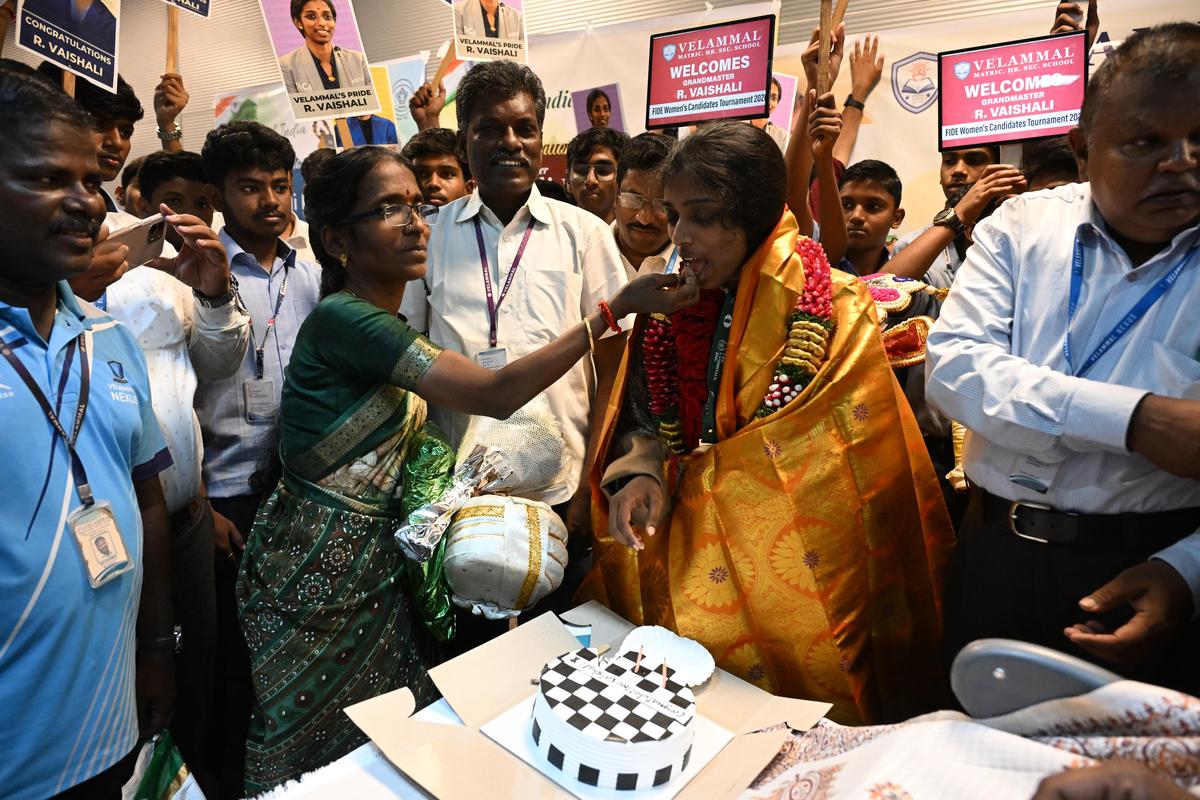
The Women’s Candidates remained open almost until the very end, and Vaishali’s patience and resilience saw her finally lift the title in Cyprus.
| Photo Credit:
M. Srinath

The Women’s Candidates remained open almost until the very end, and Vaishali’s patience and resilience saw her finally lift the title in Cyprus.
| Photo Credit:
M. Srinath
For Vaishali, the moment completion of a full circle.
Back in 2013, as a 12-year-old, she had been in attendance when Viswanathan Anand faced Magnus Carlsen in Chennai for the World Championship title. More than a decade later, she now finds herself on the verge of that same stage.
“It is a dream moment for me. I’m very happy. I’ve followed many World Championship matches, and now I’ll be playing one. I’m really looking forward to it,” Vaishali told Sportstar on her arrival in the city.
The Women’s Candidates remained open almost until the very end, with multiple players still in contention deep into the tournament.
Going into the final round, Vaishali needed to beat Lagno, while Bibisara Assaubayeva, who eventually finished second, had to either lose or draw against fellow Indian Divya Deshmukh. Divya held Bibisara, leaving Vaishali needing a win over Lagno to clinch the title that very day.
“Before the tournament, we had worked on different openings, and we had narrowed it down to two that we thought could come up in the final round. As expected, one of them did, and thankfully it worked out,” said Grandmaster M. Pranesh, who travelled with Vaishali as a sparring partner.
The opening was the Sicilian Dragon. Lagno gave up a pawn early to generate attacking chances against Vaishali’s king, but Vaishali defended precisely, stayed calm under pressure and gradually turned the position in her favour, using her bishop actively to keep Lagno’s queen under watch.
“It was a very close tournament. It could have gone either way, and I won the last game, which was very crucial in that situation,” Vaishali said.
Her path to the title had been anything but smooth. Vaishali began with four consecutive draws and then suffered a loss to Zhu Jiner in Round 5. When the two met again in Round 12, Vaishali went in with a one-point lead, only to lose once more. Yet that defeat, paradoxically, would come to be seen by her camp as a turning point rather than a setback.
“The second loss was actually crucial,” said coach R.B. Ramesh. “She went into Round 12 with a one-point lead and then lost to Zhu, which brought them level. I told her to treat it as if she had drawn the game, because she was still in joint lead going into Round 13 against Tan Zhongyi. The idea was to take it positively and move on.”
Almost everyone around Vaishali in Cyprus echoed that view. The loss to Zhu did not derail her campaign. If anything, it released some of the tension that had built up around the burden of leading and allowed her to reset for the final push.
Now comes the biggest match of her career: a World Championship clash against reigning champion Ju Wenjun. The two met at last year’s Norway Chess Women, where their classical game ended in a draw before Vaishali won the Armageddon tiebreak, her first victory over Ju in any format.
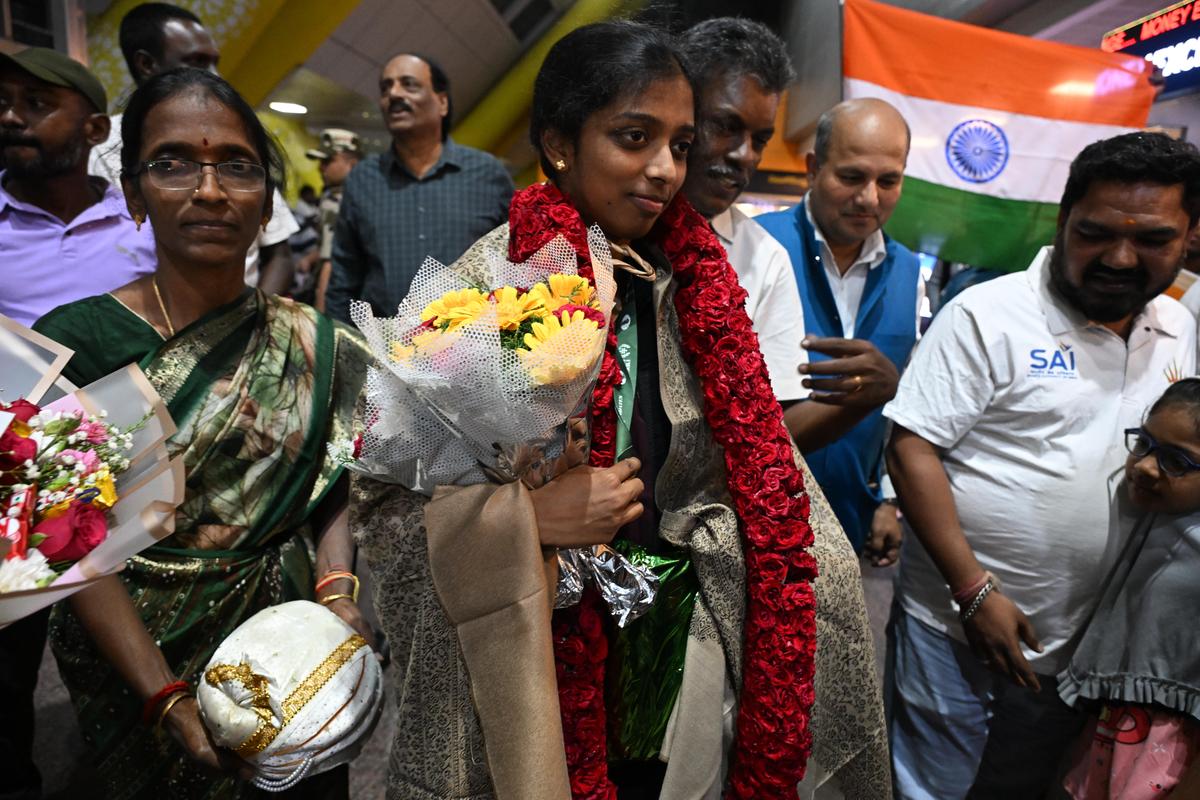
R. Vaishali’s challenges will only go steeper from here, for her next big match is against reigning world champion Ju Wenjun.
| Photo Credit:
M. Srinath
R. Vaishali’s challenges will only go steeper from here, for her next big match is against reigning world champion Ju Wenjun.
| Photo Credit:
M. Srinath
“I have played only a few classical games against her, and I’m very excited to face her for the title next,” Vaishali said.
For Ramesh and the team around her, the scale of what lies ahead is still sinking in. Planning, he said, will begin soon, with discussions around building a support team, identifying areas of improvement and deciding the structure of the training camp, likely from the first week of May.
“It will be her first match on such a big stage, and even for all of us it will be a new experience,” Ramesh said. “We will take suggestions from experienced people around us, listen to feedback and then move forward from there.”
Published on Apr 19, 2026
The Women’s Candidates remained open almost until the very end, and Vaishali’s patience and resilience saw her finally lift the title in Cyprus. | Photo Credit: M. Srinath
The Women’s Candidates remained open almost until the very end, and Vaishali’s patience and resilience saw her finally lift the title in Cyprus. | Photo Credit: M. Srinath
R. Vaishali’s challenges will only go steeper from here, for her next big match is against reigning world champion Ju Wenjun. | Photo Credit: M. Srinath
R. Vaishali’s challenges will only go steeper from here, for her next big match is against reigning world champion Ju Wenjun. | Photo Credit: M. Srinath
After 14 rounds of draining, exacting chess, and a final-round victory over former World Rapid and Blitz champion Kateryna Lagno to win the FIDE Women’s Candidates 2026, Grandmaster R. Vaishali returned home in the early hours of Sunday.
Despite the odd hour and the restrictions in place owing to the Tamil Nadu Assembly election week, the welcome was relatively subdued, though around 50 students from Velammal were still at the airport to receive her.
Carrying placards with messages for the newly crowned challenger, they gathered to greet her, cut a cake and pose for photographs. Nearby stood Vaishali’s family. Her father, Rameshbabu, watched quietly from a corner, taking it all in, before Vaishali spotted him, rushed across and posed with her family and the winner’s medal.
The Women’s Candidates remained open almost until the very end, and Vaishali’s patience and resilience saw her finally lift the title in Cyprus. | Photo Credit: M. Srinath
The Women’s Candidates remained open almost until the very end, and Vaishali’s patience and resilience saw her finally lift the title in Cyprus. | Photo Credit: M. Srinath
For Vaishali, the moment completion of a full circle.
Back in 2013, as a 12-year-old, she had been in attendance when Viswanathan Anand faced Magnus Carlsen in Chennai for the World Championship title. More than a decade later, she now finds herself on the verge of that same stage.
“It is a dream moment for me. I’m very happy. I’ve followed many World Championship matches, and now I’ll be playing one. I’m really looking forward to it,” Vaishali told Sportstar on her arrival in the city.
The Women’s Candidates remained open almost until the very end, with multiple players still in contention deep into the tournament.
Going into the final round, Vaishali needed to beat Lagno, while Bibisara Assaubayeva, who eventually finished second, had to either lose or draw against fellow Indian Divya Deshmukh. Divya held Bibisara, leaving Vaishali needing a win over Lagno to clinch the title that very day.
“Before the tournament, we had worked on different openings, and we had narrowed it down to two that we thought could come up in the final round. As expected, one of them did, and thankfully it worked out,” said Grandmaster M. Pranesh, who travelled with Vaishali as a sparring partner.
The opening was the Sicilian Dragon. Lagno gave up a pawn early to generate attacking chances against Vaishali’s king, but Vaishali defended precisely, stayed calm under pressure and gradually turned the position in her favour, using her bishop actively to keep Lagno’s queen under watch.
“It was a very close tournament. It could have gone either way, and I won the last game, which was very crucial in that situation,” Vaishali said.
Her path to the title had been anything but smooth. Vaishali began with four consecutive draws and then suffered a loss to Zhu Jiner in Round 5. When the two met again in Round 12, Vaishali went in with a one-point lead, only to lose once more. Yet that defeat, paradoxically, would come to be seen by her camp as a turning point rather than a setback.
“The second loss was actually crucial,” said coach R.B. Ramesh. “She went into Round 12 with a one-point lead and then lost to Zhu, which brought them level. I told her to treat it as if she had drawn the game, because she was still in joint lead going into Round 13 against Tan Zhongyi. The idea was to take it positively and move on.”
Almost everyone around Vaishali in Cyprus echoed that view. The loss to Zhu did not derail her campaign. If anything, it released some of the tension that had built up around the burden of leading and allowed her to reset for the final push.
Now comes the biggest match of her career: a World Championship clash against reigning champion Ju Wenjun. The two met at last year’s Norway Chess Women, where their classical game ended in a draw before Vaishali won the Armageddon tiebreak, her first victory over Ju in any format.
R. Vaishali’s challenges will only go steeper from here, for her next big match is against reigning world champion Ju Wenjun. | Photo Credit: M. Srinath
R. Vaishali’s challenges will only go steeper from here, for her next big match is against reigning world champion Ju Wenjun. | Photo Credit: M. Srinath
“I have played only a few classical games against her, and I’m very excited to face her for the title next,” Vaishali said.
For Ramesh and the team around her, the scale of what lies ahead is still sinking in. Planning, he said, will begin soon, with discussions around building a support team, identifying areas of improvement and deciding the structure of the training camp, likely from the first week of May.
“It will be her first match on such a big stage, and even for all of us it will be a new experience,” Ramesh said. “We will take suggestions from experienced people around us, listen to feedback and then move forward from there.”
Published on Apr 19, 2026
After 14 rounds of draining, exacting chess, and a final-round victory over former World Rapid…
![Candidates 2026 review: Vaishali finds her moment, Sindarov owns the field For a long time, Indian chess Grandmaster R. Vaishali existed in the shadows, and thrived there.First, it was the presence of her brother, R. Praggnanandhaa, who garnered the lion’s share of attention owing to his prodigious talent.Even in Indian women’s chess, Vaishali was never the centrepiece. The more experienced Koneru Humpy and D. Harika remained the country’s flagbearers.Following Divya Deshmukh’s swift ascent after her FIDE World Cup 2025 triumph, Vaishali was pushed further into the background.But over a fortnight in Cyprus, battling through an elite field, Vaishali stepped out of the shadows and into the spotlight reserved for the elite.By becoming the first Indian to win the FIDE Women’s Candidates title, the 24-year-old qualified for the World Championship final against China’s Ju Wenjun later this year.Vaishali entered the Candidates as the lowest-ranked player in the women’s section. Her performance in the opening rounds reflected that: she began with four draws.A defeat to Zhu Jiner in Round 5 triggered a shift in approach. From Round 6 to 11, Vaishali won four games and drew the other two to surge into the lead.“I think in the first half, my games were super shaky. I was just scoring points by luck. The loss against Zhu was very crucial. In the second half, my game started to become better,” explained Vaishali in the post-tournament press conference.Zhu would return later to halt Vaishali’s momentum with a dominant win in Round 12, setting up a thrilling finish. Heading into the final round, Vaishali was in joint lead with Kazakhstan’s Bibisara Assaubayeva.But Vaishali benefited from her compatriot Divya, who held Assaubayeva to a draw. The equation was simple: the Candidates was Vaishali’s if she beat Kateryna Lagno.With all eyes on her, Vaishali held her nerve to systematically dismantle Lagno’s defence and claim the requisite point. The spotlight had never shone brighter.When asked what changed for her in Cyprus, Vaishali replied: “I think it’s just [the result of] continuous hard work. Somehow, I was not getting results in the last couple of years. I think everything came together here in this tournament.”The chaotic unfolding of the women’s section stood in contrast to the procession-like nature of the open section. Javokhir Sindarov dominated the Candidates, tallying 10 points, the most any player has accumulated in a single edition. Uzbekistan’s Javokhir Sindarov’s unbeaten run, sealed with a round to spare, sets up a World Chess Championship clash against D. Gukesh later this year.
| Photo Credit:
Niki Riga / FIDE
Uzbekistan’s Javokhir Sindarov’s unbeaten run, sealed with a round to spare, sets up a World Chess Championship clash against D. Gukesh later this year.
| Photo Credit:
Niki Riga / FIDE
The Uzbek GM, playing his maiden Candidates, blazed through the opening rounds, winning five of his first six games to open up a sizeable lead.What stood out most in those early games was Sindarov’s razor-sharp opening preparation, which helped him outfox his experienced opponents. This often gave him a significant advantage on the clock, allowing him to dictate the middlegame and steer games towards inevitable wins.In Round 5, Sindarov drew World No. 2 Hikaru Nakamura into a compromised position with precise opening play. The American struggled to untangle himself and ended up spending over 67 minutes on a move, the second-longest any player has taken for a single move in Candidates history.Despite burning time on the clock, Hikaru chose a move (13. h4) that only worsened his position. Sindarov seized the advantage and coasted to a comfortable win.Such was Sindarov’s dominance that even a mid-tournament accidental leak of his opening routines on the online chess portal Lichess barely slowed his charge.With the title almost secured, the 20-year-old shifted into a pragmatic mode in the latter half of the Candidates. There were no desperate pushes or unnecessary experiments as he steered games into comfortable draws to seal the biggest triumph of his career with a round to spare.For the quietly confident Sindarov, this was a performance he always believed he was capable of.“In my opinion, I’m one of the [most] talented players. But you can never predict that you will become the world champion, because it is very hard and you need to be lucky.”“I have always believed I can be one of the strongest players in the world and cross the 2800 rating. I’m very happy, but I’m not surprised to win this tournament because I always believed in myself,” said Sindarov.As Sindarov claimed the spotlight emphatically, the much-hyped Fabiano Caruana and Nakamura receded into the background.The American GMs entered as favourites, backed by their experience against a comparatively inexperienced field.But both Caruana and Nakamura flattered to deceive, withering under Sindarov’s onslaught. It remains to be seen whether the two veterans have the energy and motivation to navigate another Candidates cycle in pursuit of a long-overdue World title.India’s sole hope in the open category, Praggnanandhaa, was left behind as well. The 20-year-old began with a confident opening-round win against Dutch GM Anish Giri but fell away from there, failing to win another game to finish seventh in the eight-man standings.Sindarov will now square off against India’s D. Gukesh for the world title in a 14-game match scheduled for later this year. Their clash has already created history, as it will be the youngest World Chess Championship final of all time, with both players under 21 and Gukesh six months younger than his rival.This will also be the second consecutive all-Asian World Championship final, signalling a shift in the balance of global chess.With Gukesh’s recent form in decline, Sindarov has already been labelled the favourite.Meanwhile, Gukesh has announced that he will scale back his tournament commitments as he prepares for the title defence.Sindarov, however, is wary of underestimating his opponent.“I will play against one of the strongest players in the world, and we both have equal chances. Probably, because he played in a [World Championship] match, he has more experience, so a little bit more chance [for him]. Our playing strengths are very close. It will be a very interesting match,” explained Sindarov.Published on Apr 16, 2026 #Candidates #review #Vaishali #finds #moment #Sindarov #owns #field](https://i1.wp.com/ss-i.thgim.com/public/chess/vz72fx/article70868814.ece/alternates/FREE_1200/55207201433_5116d50e6c_o.jpg?ssl=1 "Candidates 2026 review: Vaishali finds her moment, Sindarov owns the field For a long time, Indian chess Grandmaster R. Vaishali existed in the shadows, and thrived there.First, it was the presence of her brother, R. Praggnanandhaa, who garnered the lion’s share of attention owing to his prodigious talent.Even in Indian women’s chess, Vaishali was never the centrepiece. The more experienced Koneru Humpy and D. Harika remained the country’s flagbearers.Following Divya Deshmukh’s swift ascent after her FIDE World Cup 2025 triumph, Vaishali was pushed further into the background.But over a fortnight in Cyprus, battling through an elite field, Vaishali stepped out of the shadows and into the spotlight reserved for the elite.By becoming the first Indian to win the FIDE Women’s Candidates title, the 24-year-old qualified for the World Championship final against China’s Ju Wenjun later this year.Vaishali entered the Candidates as the lowest-ranked player in the women’s section. Her performance in the opening rounds reflected that: she began with four draws.A defeat to Zhu Jiner in Round 5 triggered a shift in approach. From Round 6 to 11, Vaishali won four games and drew the other two to surge into the lead.“I think in the first half, my games were super shaky. I was just scoring points by luck. The loss against Zhu was very crucial. In the second half, my game started to become better,” explained Vaishali in the post-tournament press conference.Zhu would return later to halt Vaishali’s momentum with a dominant win in Round 12, setting up a thrilling finish. Heading into the final round, Vaishali was in joint lead with Kazakhstan’s Bibisara Assaubayeva.But Vaishali benefited from her compatriot Divya, who held Assaubayeva to a draw. The equation was simple: the Candidates was Vaishali’s if she beat Kateryna Lagno.With all eyes on her, Vaishali held her nerve to systematically dismantle Lagno’s defence and claim the requisite point. The spotlight had never shone brighter.When asked what changed for her in Cyprus, Vaishali replied: “I think it’s just [the result of] continuous hard work. Somehow, I was not getting results in the last couple of years. I think everything came together here in this tournament.”The chaotic unfolding of the women’s section stood in contrast to the procession-like nature of the open section. Javokhir Sindarov dominated the Candidates, tallying 10 points, the most any player has accumulated in a single edition. Uzbekistan’s Javokhir Sindarov’s unbeaten run, sealed with a round to spare, sets up a World Chess Championship clash against D. Gukesh later this year.
| Photo Credit:
Niki Riga / FIDE
Uzbekistan’s Javokhir Sindarov’s unbeaten run, sealed with a round to spare, sets up a World Chess Championship clash against D. Gukesh later this year.
| Photo Credit:
Niki Riga / FIDE
The Uzbek GM, playing his maiden Candidates, blazed through the opening rounds, winning five of his first six games to open up a sizeable lead.What stood out most in those early games was Sindarov’s razor-sharp opening preparation, which helped him outfox his experienced opponents. This often gave him a significant advantage on the clock, allowing him to dictate the middlegame and steer games towards inevitable wins.In Round 5, Sindarov drew World No. 2 Hikaru Nakamura into a compromised position with precise opening play. The American struggled to untangle himself and ended up spending over 67 minutes on a move, the second-longest any player has taken for a single move in Candidates history.Despite burning time on the clock, Hikaru chose a move (13. h4) that only worsened his position. Sindarov seized the advantage and coasted to a comfortable win.Such was Sindarov’s dominance that even a mid-tournament accidental leak of his opening routines on the online chess portal Lichess barely slowed his charge.With the title almost secured, the 20-year-old shifted into a pragmatic mode in the latter half of the Candidates. There were no desperate pushes or unnecessary experiments as he steered games into comfortable draws to seal the biggest triumph of his career with a round to spare.For the quietly confident Sindarov, this was a performance he always believed he was capable of.“In my opinion, I’m one of the [most] talented players. But you can never predict that you will become the world champion, because it is very hard and you need to be lucky.”“I have always believed I can be one of the strongest players in the world and cross the 2800 rating. I’m very happy, but I’m not surprised to win this tournament because I always believed in myself,” said Sindarov.As Sindarov claimed the spotlight emphatically, the much-hyped Fabiano Caruana and Nakamura receded into the background.The American GMs entered as favourites, backed by their experience against a comparatively inexperienced field.But both Caruana and Nakamura flattered to deceive, withering under Sindarov’s onslaught. It remains to be seen whether the two veterans have the energy and motivation to navigate another Candidates cycle in pursuit of a long-overdue World title.India’s sole hope in the open category, Praggnanandhaa, was left behind as well. The 20-year-old began with a confident opening-round win against Dutch GM Anish Giri but fell away from there, failing to win another game to finish seventh in the eight-man standings.Sindarov will now square off against India’s D. Gukesh for the world title in a 14-game match scheduled for later this year. Their clash has already created history, as it will be the youngest World Chess Championship final of all time, with both players under 21 and Gukesh six months younger than his rival.This will also be the second consecutive all-Asian World Championship final, signalling a shift in the balance of global chess.With Gukesh’s recent form in decline, Sindarov has already been labelled the favourite.Meanwhile, Gukesh has announced that he will scale back his tournament commitments as he prepares for the title defence.Sindarov, however, is wary of underestimating his opponent.“I will play against one of the strongest players in the world, and we both have equal chances. Probably, because he played in a [World Championship] match, he has more experience, so a little bit more chance [for him]. Our playing strengths are very close. It will be a very interesting match,” explained Sindarov.Published on Apr 16, 2026 #Candidates #review #Vaishali #finds #moment #Sindarov #owns #field")
Sports news
#Candidates #review #Vaishali #finds #moment #Sindarov #owns #field">Candidates 2026 review: Vaishali finds her moment, Sindarov owns the field
For a long time, Indian chess Grandmaster R. Vaishali existed in the shadows, and thrived there.
First, it was the presence of her brother, R. Praggnanandhaa, who garnered the lion’s share of attention owing to his prodigious talent.
Even in Indian women’s chess, Vaishali was never the centrepiece. The more experienced Koneru Humpy and D. Harika remained the country’s flagbearers.
Following Divya Deshmukh’s swift ascent after her FIDE World Cup 2025 triumph, Vaishali was pushed further into the background.
But over a fortnight in Cyprus, battling through an elite field, Vaishali stepped out of the shadows and into the spotlight reserved for the elite.
By becoming the first Indian to win the FIDE Women’s Candidates title, the 24-year-old qualified for the World Championship final against China’s Ju Wenjun later this year.
Vaishali entered the Candidates as the lowest-ranked player in the women’s section. Her performance in the opening rounds reflected that: she began with four draws.
A defeat to Zhu Jiner in Round 5 triggered a shift in approach. From Round 6 to 11, Vaishali won four games and drew the other two to surge into the lead.
“I think in the first half, my games were super shaky. I was just scoring points by luck. The loss against Zhu was very crucial. In the second half, my game started to become better,” explained Vaishali in the post-tournament press conference.
Zhu would return later to halt Vaishali’s momentum with a dominant win in Round 12, setting up a thrilling finish. Heading into the final round, Vaishali was in joint lead with Kazakhstan’s Bibisara Assaubayeva.
But Vaishali benefited from her compatriot Divya, who held Assaubayeva to a draw. The equation was simple: the Candidates was Vaishali’s if she beat Kateryna Lagno.
With all eyes on her, Vaishali held her nerve to systematically dismantle Lagno’s defence and claim the requisite point. The spotlight had never shone brighter.
When asked what changed for her in Cyprus, Vaishali replied: “I think it’s just [the result of] continuous hard work. Somehow, I was not getting results in the last couple of years. I think everything came together here in this tournament.”
The chaotic unfolding of the women’s section stood in contrast to the procession-like nature of the open section. Javokhir Sindarov dominated the Candidates, tallying 10 points, the most any player has accumulated in a single edition.
![Candidates 2026 review: Vaishali finds her moment, Sindarov owns the field For a long time, Indian chess Grandmaster R. Vaishali existed in the shadows, and thrived there.First, it was the presence of her brother, R. Praggnanandhaa, who garnered the lion’s share of attention owing to his prodigious talent.Even in Indian women’s chess, Vaishali was never the centrepiece. The more experienced Koneru Humpy and D. Harika remained the country’s flagbearers.Following Divya Deshmukh’s swift ascent after her FIDE World Cup 2025 triumph, Vaishali was pushed further into the background.But over a fortnight in Cyprus, battling through an elite field, Vaishali stepped out of the shadows and into the spotlight reserved for the elite.By becoming the first Indian to win the FIDE Women’s Candidates title, the 24-year-old qualified for the World Championship final against China’s Ju Wenjun later this year.Vaishali entered the Candidates as the lowest-ranked player in the women’s section. Her performance in the opening rounds reflected that: she began with four draws.A defeat to Zhu Jiner in Round 5 triggered a shift in approach. From Round 6 to 11, Vaishali won four games and drew the other two to surge into the lead.“I think in the first half, my games were super shaky. I was just scoring points by luck. The loss against Zhu was very crucial. In the second half, my game started to become better,” explained Vaishali in the post-tournament press conference.Zhu would return later to halt Vaishali’s momentum with a dominant win in Round 12, setting up a thrilling finish. Heading into the final round, Vaishali was in joint lead with Kazakhstan’s Bibisara Assaubayeva.But Vaishali benefited from her compatriot Divya, who held Assaubayeva to a draw. The equation was simple: the Candidates was Vaishali’s if she beat Kateryna Lagno.With all eyes on her, Vaishali held her nerve to systematically dismantle Lagno’s defence and claim the requisite point. The spotlight had never shone brighter.When asked what changed for her in Cyprus, Vaishali replied: “I think it’s just [the result of] continuous hard work. Somehow, I was not getting results in the last couple of years. I think everything came together here in this tournament.”The chaotic unfolding of the women’s section stood in contrast to the procession-like nature of the open section. Javokhir Sindarov dominated the Candidates, tallying 10 points, the most any player has accumulated in a single edition. Uzbekistan’s Javokhir Sindarov’s unbeaten run, sealed with a round to spare, sets up a World Chess Championship clash against D. Gukesh later this year.
| Photo Credit:
Niki Riga / FIDE
Uzbekistan’s Javokhir Sindarov’s unbeaten run, sealed with a round to spare, sets up a World Chess Championship clash against D. Gukesh later this year.
| Photo Credit:
Niki Riga / FIDE
The Uzbek GM, playing his maiden Candidates, blazed through the opening rounds, winning five of his first six games to open up a sizeable lead.What stood out most in those early games was Sindarov’s razor-sharp opening preparation, which helped him outfox his experienced opponents. This often gave him a significant advantage on the clock, allowing him to dictate the middlegame and steer games towards inevitable wins.In Round 5, Sindarov drew World No. 2 Hikaru Nakamura into a compromised position with precise opening play. The American struggled to untangle himself and ended up spending over 67 minutes on a move, the second-longest any player has taken for a single move in Candidates history.Despite burning time on the clock, Hikaru chose a move (13. h4) that only worsened his position. Sindarov seized the advantage and coasted to a comfortable win.Such was Sindarov’s dominance that even a mid-tournament accidental leak of his opening routines on the online chess portal Lichess barely slowed his charge.With the title almost secured, the 20-year-old shifted into a pragmatic mode in the latter half of the Candidates. There were no desperate pushes or unnecessary experiments as he steered games into comfortable draws to seal the biggest triumph of his career with a round to spare.For the quietly confident Sindarov, this was a performance he always believed he was capable of.“In my opinion, I’m one of the [most] talented players. But you can never predict that you will become the world champion, because it is very hard and you need to be lucky.”“I have always believed I can be one of the strongest players in the world and cross the 2800 rating. I’m very happy, but I’m not surprised to win this tournament because I always believed in myself,” said Sindarov.As Sindarov claimed the spotlight emphatically, the much-hyped Fabiano Caruana and Nakamura receded into the background.The American GMs entered as favourites, backed by their experience against a comparatively inexperienced field.But both Caruana and Nakamura flattered to deceive, withering under Sindarov’s onslaught. It remains to be seen whether the two veterans have the energy and motivation to navigate another Candidates cycle in pursuit of a long-overdue World title.India’s sole hope in the open category, Praggnanandhaa, was left behind as well. The 20-year-old began with a confident opening-round win against Dutch GM Anish Giri but fell away from there, failing to win another game to finish seventh in the eight-man standings.Sindarov will now square off against India’s D. Gukesh for the world title in a 14-game match scheduled for later this year. Their clash has already created history, as it will be the youngest World Chess Championship final of all time, with both players under 21 and Gukesh six months younger than his rival.This will also be the second consecutive all-Asian World Championship final, signalling a shift in the balance of global chess.With Gukesh’s recent form in decline, Sindarov has already been labelled the favourite.Meanwhile, Gukesh has announced that he will scale back his tournament commitments as he prepares for the title defence.Sindarov, however, is wary of underestimating his opponent.“I will play against one of the strongest players in the world, and we both have equal chances. Probably, because he played in a [World Championship] match, he has more experience, so a little bit more chance [for him]. Our playing strengths are very close. It will be a very interesting match,” explained Sindarov.Published on Apr 16, 2026 #Candidates #review #Vaishali #finds #moment #Sindarov #owns #field](https://ss-i.thgim.com/public/chess/vz72fx/article70868814.ece/alternates/FREE_1200/55207201433_5116d50e6c_o.jpg "Candidates 2026 review: Vaishali finds her moment, Sindarov owns the field For a long time, Indian chess Grandmaster R. Vaishali existed in the shadows, and thrived there.First, it was the presence of her brother, R. Praggnanandhaa, who garnered the lion’s share of attention owing to his prodigious talent.Even in Indian women’s chess, Vaishali was never the centrepiece. The more experienced Koneru Humpy and D. Harika remained the country’s flagbearers.Following Divya Deshmukh’s swift ascent after her FIDE World Cup 2025 triumph, Vaishali was pushed further into the background.But over a fortnight in Cyprus, battling through an elite field, Vaishali stepped out of the shadows and into the spotlight reserved for the elite.By becoming the first Indian to win the FIDE Women’s Candidates title, the 24-year-old qualified for the World Championship final against China’s Ju Wenjun later this year.Vaishali entered the Candidates as the lowest-ranked player in the women’s section. Her performance in the opening rounds reflected that: she began with four draws.A defeat to Zhu Jiner in Round 5 triggered a shift in approach. From Round 6 to 11, Vaishali won four games and drew the other two to surge into the lead.“I think in the first half, my games were super shaky. I was just scoring points by luck. The loss against Zhu was very crucial. In the second half, my game started to become better,” explained Vaishali in the post-tournament press conference.Zhu would return later to halt Vaishali’s momentum with a dominant win in Round 12, setting up a thrilling finish. Heading into the final round, Vaishali was in joint lead with Kazakhstan’s Bibisara Assaubayeva.But Vaishali benefited from her compatriot Divya, who held Assaubayeva to a draw. The equation was simple: the Candidates was Vaishali’s if she beat Kateryna Lagno.With all eyes on her, Vaishali held her nerve to systematically dismantle Lagno’s defence and claim the requisite point. The spotlight had never shone brighter.When asked what changed for her in Cyprus, Vaishali replied: “I think it’s just [the result of] continuous hard work. Somehow, I was not getting results in the last couple of years. I think everything came together here in this tournament.”The chaotic unfolding of the women’s section stood in contrast to the procession-like nature of the open section. Javokhir Sindarov dominated the Candidates, tallying 10 points, the most any player has accumulated in a single edition. Uzbekistan’s Javokhir Sindarov’s unbeaten run, sealed with a round to spare, sets up a World Chess Championship clash against D. Gukesh later this year.
| Photo Credit:
Niki Riga / FIDE
Uzbekistan’s Javokhir Sindarov’s unbeaten run, sealed with a round to spare, sets up a World Chess Championship clash against D. Gukesh later this year.
| Photo Credit:
Niki Riga / FIDE
The Uzbek GM, playing his maiden Candidates, blazed through the opening rounds, winning five of his first six games to open up a sizeable lead.What stood out most in those early games was Sindarov’s razor-sharp opening preparation, which helped him outfox his experienced opponents. This often gave him a significant advantage on the clock, allowing him to dictate the middlegame and steer games towards inevitable wins.In Round 5, Sindarov drew World No. 2 Hikaru Nakamura into a compromised position with precise opening play. The American struggled to untangle himself and ended up spending over 67 minutes on a move, the second-longest any player has taken for a single move in Candidates history.Despite burning time on the clock, Hikaru chose a move (13. h4) that only worsened his position. Sindarov seized the advantage and coasted to a comfortable win.Such was Sindarov’s dominance that even a mid-tournament accidental leak of his opening routines on the online chess portal Lichess barely slowed his charge.With the title almost secured, the 20-year-old shifted into a pragmatic mode in the latter half of the Candidates. There were no desperate pushes or unnecessary experiments as he steered games into comfortable draws to seal the biggest triumph of his career with a round to spare.For the quietly confident Sindarov, this was a performance he always believed he was capable of.“In my opinion, I’m one of the [most] talented players. But you can never predict that you will become the world champion, because it is very hard and you need to be lucky.”“I have always believed I can be one of the strongest players in the world and cross the 2800 rating. I’m very happy, but I’m not surprised to win this tournament because I always believed in myself,” said Sindarov.As Sindarov claimed the spotlight emphatically, the much-hyped Fabiano Caruana and Nakamura receded into the background.The American GMs entered as favourites, backed by their experience against a comparatively inexperienced field.But both Caruana and Nakamura flattered to deceive, withering under Sindarov’s onslaught. It remains to be seen whether the two veterans have the energy and motivation to navigate another Candidates cycle in pursuit of a long-overdue World title.India’s sole hope in the open category, Praggnanandhaa, was left behind as well. The 20-year-old began with a confident opening-round win against Dutch GM Anish Giri but fell away from there, failing to win another game to finish seventh in the eight-man standings.Sindarov will now square off against India’s D. Gukesh for the world title in a 14-game match scheduled for later this year. Their clash has already created history, as it will be the youngest World Chess Championship final of all time, with both players under 21 and Gukesh six months younger than his rival.This will also be the second consecutive all-Asian World Championship final, signalling a shift in the balance of global chess.With Gukesh’s recent form in decline, Sindarov has already been labelled the favourite.Meanwhile, Gukesh has announced that he will scale back his tournament commitments as he prepares for the title defence.Sindarov, however, is wary of underestimating his opponent.“I will play against one of the strongest players in the world, and we both have equal chances. Probably, because he played in a [World Championship] match, he has more experience, so a little bit more chance [for him]. Our playing strengths are very close. It will be a very interesting match,” explained Sindarov.Published on Apr 16, 2026 #Candidates #review #Vaishali #finds #moment #Sindarov #owns #field")
Uzbekistan’s Javokhir Sindarov’s unbeaten run, sealed with a round to spare, sets up a World Chess Championship clash against D. Gukesh later this year.
| Photo Credit:
Niki Riga / FIDE
Uzbekistan’s Javokhir Sindarov’s unbeaten run, sealed with a round to spare, sets up a World Chess Championship clash against D. Gukesh later this year.
| Photo Credit:
Niki Riga / FIDE
The Uzbek GM, playing his maiden Candidates, blazed through the opening rounds, winning five of his first six games to open up a sizeable lead.
What stood out most in those early games was Sindarov’s razor-sharp opening preparation, which helped him outfox his experienced opponents. This often gave him a significant advantage on the clock, allowing him to dictate the middlegame and steer games towards inevitable wins.
In Round 5, Sindarov drew World No. 2 Hikaru Nakamura into a compromised position with precise opening play. The American struggled to untangle himself and ended up spending over 67 minutes on a move, the second-longest any player has taken for a single move in Candidates history.
Despite burning time on the clock, Hikaru chose a move (13. h4) that only worsened his position. Sindarov seized the advantage and coasted to a comfortable win.
Such was Sindarov’s dominance that even a mid-tournament accidental leak of his opening routines on the online chess portal Lichess barely slowed his charge.
With the title almost secured, the 20-year-old shifted into a pragmatic mode in the latter half of the Candidates. There were no desperate pushes or unnecessary experiments as he steered games into comfortable draws to seal the biggest triumph of his career with a round to spare.
For the quietly confident Sindarov, this was a performance he always believed he was capable of.
“In my opinion, I’m one of the [most] talented players. But you can never predict that you will become the world champion, because it is very hard and you need to be lucky.”
“I have always believed I can be one of the strongest players in the world and cross the 2800 rating. I’m very happy, but I’m not surprised to win this tournament because I always believed in myself,” said Sindarov.
As Sindarov claimed the spotlight emphatically, the much-hyped Fabiano Caruana and Nakamura receded into the background.
The American GMs entered as favourites, backed by their experience against a comparatively inexperienced field.
But both Caruana and Nakamura flattered to deceive, withering under Sindarov’s onslaught. It remains to be seen whether the two veterans have the energy and motivation to navigate another Candidates cycle in pursuit of a long-overdue World title.
India’s sole hope in the open category, Praggnanandhaa, was left behind as well. The 20-year-old began with a confident opening-round win against Dutch GM Anish Giri but fell away from there, failing to win another game to finish seventh in the eight-man standings.
Sindarov will now square off against India’s D. Gukesh for the world title in a 14-game match scheduled for later this year. Their clash has already created history, as it will be the youngest World Chess Championship final of all time, with both players under 21 and Gukesh six months younger than his rival.
This will also be the second consecutive all-Asian World Championship final, signalling a shift in the balance of global chess.
With Gukesh’s recent form in decline, Sindarov has already been labelled the favourite.
Meanwhile, Gukesh has announced that he will scale back his tournament commitments as he prepares for the title defence.
Sindarov, however, is wary of underestimating his opponent.
“I will play against one of the strongest players in the world, and we both have equal chances. Probably, because he played in a [World Championship] match, he has more experience, so a little bit more chance [for him]. Our playing strengths are very close. It will be a very interesting match,” explained Sindarov.
Published on Apr 16, 2026
Uzbekistan’s Javokhir Sindarov’s unbeaten run, sealed with a round to spare, sets up a World Chess Championship clash against D. Gukesh later this year. | Photo Credit: Niki Riga / FIDE
Uzbekistan’s Javokhir Sindarov’s unbeaten run, sealed with a round to spare, sets up a World Chess Championship clash against D. Gukesh later this year. | Photo Credit: Niki Riga / FIDE
For a long time, Indian chess Grandmaster R. Vaishali existed in the shadows, and thrived there.
First, it was the presence of her brother, R. Praggnanandhaa, who garnered the lion’s share of attention owing to his prodigious talent.
Even in Indian women’s chess, Vaishali was never the centrepiece. The more experienced Koneru Humpy and D. Harika remained the country’s flagbearers.
Following Divya Deshmukh’s swift ascent after her FIDE World Cup 2025 triumph, Vaishali was pushed further into the background.
But over a fortnight in Cyprus, battling through an elite field, Vaishali stepped out of the shadows and into the spotlight reserved for the elite.
By becoming the first Indian to win the FIDE Women’s Candidates title, the 24-year-old qualified for the World Championship final against China’s Ju Wenjun later this year.
Vaishali entered the Candidates as the lowest-ranked player in the women’s section. Her performance in the opening rounds reflected that: she began with four draws.
A defeat to Zhu Jiner in Round 5 triggered a shift in approach. From Round 6 to 11, Vaishali won four games and drew the other two to surge into the lead.
“I think in the first half, my games were super shaky. I was just scoring points by luck. The loss against Zhu was very crucial. In the second half, my game started to become better,” explained Vaishali in the post-tournament press conference.
Zhu would return later to halt Vaishali’s momentum with a dominant win in Round 12, setting up a thrilling finish. Heading into the final round, Vaishali was in joint lead with Kazakhstan’s Bibisara Assaubayeva.
But Vaishali benefited from her compatriot Divya, who held Assaubayeva to a draw. The equation was simple: the Candidates was Vaishali’s if she beat Kateryna Lagno.
With all eyes on her, Vaishali held her nerve to systematically dismantle Lagno’s defence and claim the requisite point. The spotlight had never shone brighter.
When asked what changed for her in Cyprus, Vaishali replied: “I think it’s just [the result of] continuous hard work. Somehow, I was not getting results in the last couple of years. I think everything came together here in this tournament.”
The chaotic unfolding of the women’s section stood in contrast to the procession-like nature of the open section. Javokhir Sindarov dominated the Candidates, tallying 10 points, the most any player has accumulated in a single edition.
Uzbekistan’s Javokhir Sindarov’s unbeaten run, sealed with a round to spare, sets up a World Chess Championship clash against D. Gukesh later this year. | Photo Credit: Niki Riga / FIDE
Uzbekistan’s Javokhir Sindarov’s unbeaten run, sealed with a round to spare, sets up a World Chess Championship clash against D. Gukesh later this year. | Photo Credit: Niki Riga / FIDE
The Uzbek GM, playing his maiden Candidates, blazed through the opening rounds, winning five of his first six games to open up a sizeable lead.
What stood out most in those early games was Sindarov’s razor-sharp opening preparation, which helped him outfox his experienced opponents. This often gave him a significant advantage on the clock, allowing him to dictate the middlegame and steer games towards inevitable wins.
In Round 5, Sindarov drew World No. 2 Hikaru Nakamura into a compromised position with precise opening play. The American struggled to untangle himself and ended up spending over 67 minutes on a move, the second-longest any player has taken for a single move in Candidates history.
Despite burning time on the clock, Hikaru chose a move (13. h4) that only worsened his position. Sindarov seized the advantage and coasted to a comfortable win.
Such was Sindarov’s dominance that even a mid-tournament accidental leak of his opening routines on the online chess portal Lichess barely slowed his charge.
With the title almost secured, the 20-year-old shifted into a pragmatic mode in the latter half of the Candidates. There were no desperate pushes or unnecessary experiments as he steered games into comfortable draws to seal the biggest triumph of his career with a round to spare.
For the quietly confident Sindarov, this was a performance he always believed he was capable of.
“In my opinion, I’m one of the [most] talented players. But you can never predict that you will become the world champion, because it is very hard and you need to be lucky.”
“I have always believed I can be one of the strongest players in the world and cross the 2800 rating. I’m very happy, but I’m not surprised to win this tournament because I always believed in myself,” said Sindarov.
As Sindarov claimed the spotlight emphatically, the much-hyped Fabiano Caruana and Nakamura receded into the background.
The American GMs entered as favourites, backed by their experience against a comparatively inexperienced field.
But both Caruana and Nakamura flattered to deceive, withering under Sindarov’s onslaught. It remains to be seen whether the two veterans have the energy and motivation to navigate another Candidates cycle in pursuit of a long-overdue World title.
India’s sole hope in the open category, Praggnanandhaa, was left behind as well. The 20-year-old began with a confident opening-round win against Dutch GM Anish Giri but fell away from there, failing to win another game to finish seventh in the eight-man standings.
Sindarov will now square off against India’s D. Gukesh for the world title in a 14-game match scheduled for later this year. Their clash has already created history, as it will be the youngest World Chess Championship final of all time, with both players under 21 and Gukesh six months younger than his rival.
This will also be the second consecutive all-Asian World Championship final, signalling a shift in the balance of global chess.
With Gukesh’s recent form in decline, Sindarov has already been labelled the favourite.
Meanwhile, Gukesh has announced that he will scale back his tournament commitments as he prepares for the title defence.
Sindarov, however, is wary of underestimating his opponent.
“I will play against one of the strongest players in the world, and we both have equal chances. Probably, because he played in a [World Championship] match, he has more experience, so a little bit more chance [for him]. Our playing strengths are very close. It will be a very interesting match,” explained Sindarov.
Published on Apr 16, 2026
For a long time, Indian chess Grandmaster R. Vaishali existed in the shadows, and thrived…


