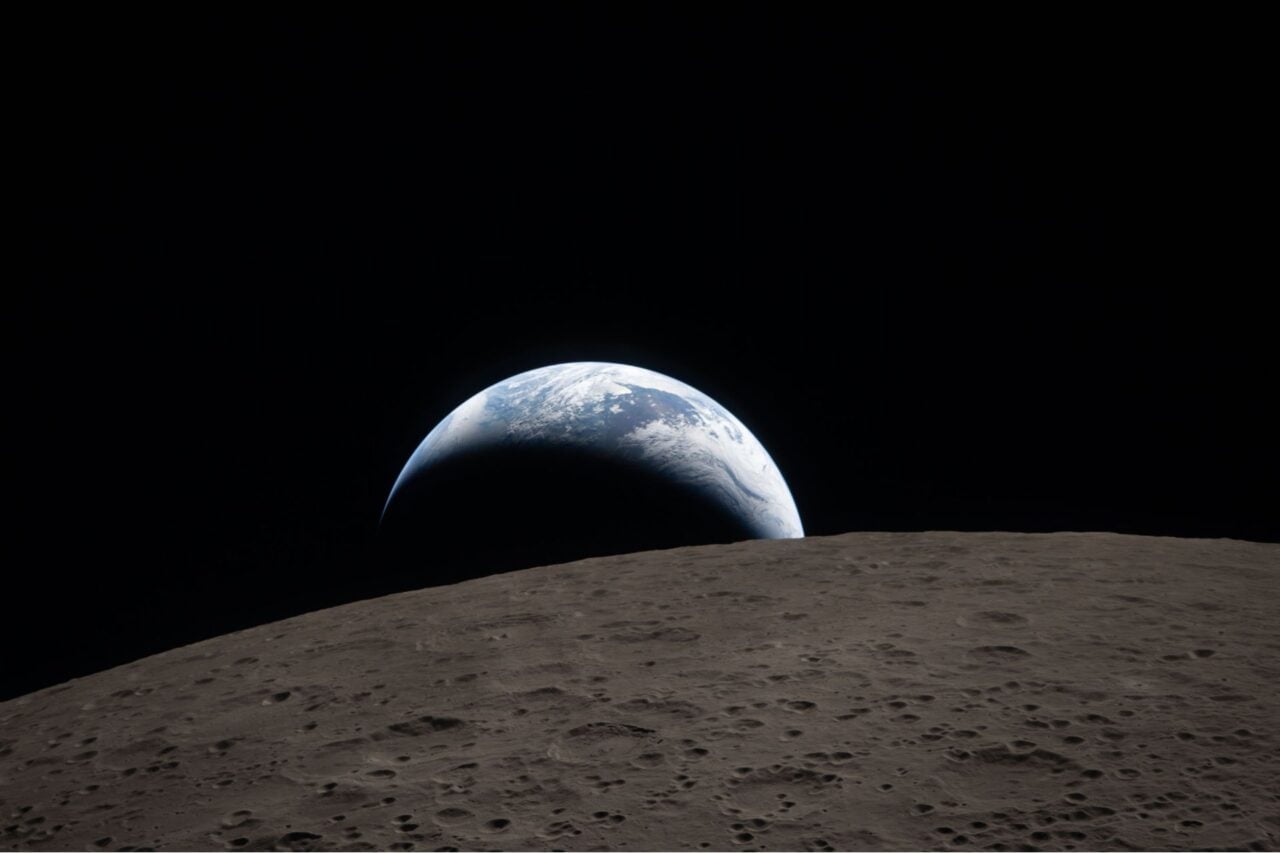
The rocket set for moon impact is the upper stage of a Falcon 9 that transported a pair of lunar landers. While the landers successfully reached the surface, the rocket was left adrift since it did not have enough fuel to return to Earth or enter a stable orbit.
Weighing 4 metric tons, the rocket is expected to strike the lunar surface at a speed of approximately 5,400 mph—about seven times the speed of sound. Without an atmosphere to slow the projectile down, the impact will cause an explosion equivalent to 3 metric tons of TNT, leaving a crater that’s projected to be up to 27 meters in diameter and 5 meters deep.
The upper stage is expected to hit the surface around 6:34 am UTC on Wednesday, likely making impact near Einstein Crater on the western edge of the moon’s near side. The Americas will have the best view of this impact. While it won’t be visible to the naked eye, viewers should be able to spot the debris plume through a good telescope for a few minutes.
A lunar crash landing visible from Earth will be a spectacle, one that raises concerns about the future of the moon. Multiple countries are planning uncrewed lunar missions, which could clutter the area around the moon. This SpaceX rocket won’t be the first to accidentally crash into the moon. In March 2022, a Chinese Long March 3C rocket also struck the lunar surface and left a crater that’s 29 meters wide.
China and the US are also pushing to build bases on the surface in the coming decades.
Bill Gray, the creator of the Project Pluto initiative to develop software and tools to track the orbits of asteroids, comets, and artificial satellites, was the first to calculate the trajectory of the impending Falcon 9 crash. He was also part of a team that worked on a preprint study released last month detailing the collision.
The crash landing is ”an opportunity to test pipelines for measuring flash properties to locate impact events seismically, and to better understand the multi-modal hazards posed to future lunar infrastructure and astronauts from space debris impacting the Moon,” the study states.
Although building a moon research center capable of supporting a sustained human presence will take at least a decade, NASA’s missions to construct the first facilities are expected to launch in the coming years as part of the Artemis program.
“These sorts of things are going to happen more and more often. And as we have more astronauts on the lunar surface, more lunar infrastructure habitats, for example, we need to understand how much of a risk these impact events actually pose,” Benjamin Fernando, a researcher at Los Alamos National Laboratory in New Mexico and coauthor of the preprint study, tells ABC News.
The risk posed by space debris is part of a growing list of hazards that cast doubt on the safety of any long-term project on the moon. In addition to the potential for space junk to wreak havoc on the lunar surface, natural events such as meteorite strikes also threaten any future activities. But with any potential lunar bases still a decade or more away, there’s ample time for researchers to look at the hazards and plan for them.
“This is an ideal way of studying both the direct risks, the risk of being hit by debris or being blinded by a flash of light, but also the indirect risk, the risk of being hit by a cloud of ejected material and having that disrupt or interfere with spacecraft functions in lunar orbit as well,” Fernando says.
The rocket set for moon impact is the upper stage of a Falcon 9 that transported a pair of lunar landers. While the landers successfully reached the surface, the rocket was left adrift since it did not have enough fuel to return to Earth or enter a stable orbit.
Weighing 4 metric tons, the rocket is expected to strike the lunar surface at a speed of approximately 5,400 mph—about seven times the speed of sound. Without an atmosphere to slow the projectile down, the impact will cause an explosion equivalent to 3 metric tons of TNT, leaving a crater that’s projected to be up to 27 meters in diameter and 5 meters deep.
The upper stage is expected to hit the surface around 6:34 am UTC on Wednesday, likely making impact near Einstein Crater on the western edge of the moon’s near side. The Americas will have the best view of this impact. While it won’t be visible to the naked eye, viewers should be able to spot the debris plume through a good telescope for a few minutes.
A lunar crash landing visible from Earth will be a spectacle, one that raises concerns about the future of the moon. Multiple countries are planning uncrewed lunar missions, which could clutter the area around the moon. This SpaceX rocket won’t be the first to accidentally crash into the moon. In March 2022, a Chinese Long March 3C rocket also struck the lunar surface and left a crater that’s 29 meters wide.
China and the US are also pushing to build bases on the surface in the coming decades.
Bill Gray, the creator of the Project Pluto initiative to develop software and tools to track the orbits of asteroids, comets, and artificial satellites, was the first to calculate the trajectory of the impending Falcon 9 crash. He was also part of a team that worked on a preprint study released last month detailing the collision.
The crash landing is ”an opportunity to test pipelines for measuring flash properties to locate impact events seismically, and to better understand the multi-modal hazards posed to future lunar infrastructure and astronauts from space debris impacting the Moon,” the study states.
Although building a moon research center capable of supporting a sustained human presence will take at least a decade, NASA’s missions to construct the first facilities are expected to launch in the coming years as part of the Artemis program.
“These sorts of things are going to happen more and more often. And as we have more astronauts on the lunar surface, more lunar infrastructure habitats, for example, we need to understand how much of a risk these impact events actually pose,” Benjamin Fernando, a researcher at Los Alamos National Laboratory in New Mexico and coauthor of the preprint study, tells ABC News.
The risk posed by space debris is part of a growing list of hazards that cast doubt on the safety of any long-term project on the moon. In addition to the potential for space junk to wreak havoc on the lunar surface, natural events such as meteorite strikes also threaten any future activities. But with any potential lunar bases still a decade or more away, there’s ample time for researchers to look at the hazards and plan for them.
“This is an ideal way of studying both the direct risks, the risk of being hit by debris or being blinded by a flash of light, but also the indirect risk, the risk of being hit by a cloud of ejected material and having that disrupt or interfere with spacecraft functions in lunar orbit as well,” Fernando says.
#SpaceX #Falcon #Lunar #Crash #Warning #Moon #Basesspace,spacecraft,moon,spacex">The SpaceX Falcon Lunar Crash Is a Warning for Moon Bases
A SpaceX rocket that has been drifting in space for a year and a half is set to crash into the moon on Wednesday, stirring up a debris cloud that could be visible from Earth. The impact raises questions on the future of lunar exploration, including how to protect any future moon bases from space junk.
The rocket set for moon impact is the upper stage of a Falcon 9 that transported a pair of lunar landers. While the landers successfully reached the surface, the rocket was left adrift since it did not have enough fuel to return to Earth or enter a stable orbit.
Weighing 4 metric tons, the rocket is expected to strike the lunar surface at a speed of approximately 5,400 mph—about seven times the speed of sound. Without an atmosphere to slow the projectile down, the impact will cause an explosion equivalent to 3 metric tons of TNT, leaving a crater that’s projected to be up to 27 meters in diameter and 5 meters deep.
The upper stage is expected to hit the surface around 6:34 am UTC on Wednesday, likely making impact near Einstein Crater on the western edge of the moon’s near side. The Americas will have the best view of this impact. While it won’t be visible to the naked eye, viewers should be able to spot the debris plume through a good telescope for a few minutes.
A lunar crash landing visible from Earth will be a spectacle, one that raises concerns about the future of the moon. Multiple countries are planning uncrewed lunar missions, which could clutter the area around the moon. This SpaceX rocket won’t be the first to accidentally crash into the moon. In March 2022, a Chinese Long March 3C rocket also struck the lunar surface and left a crater that’s 29 meters wide.
China and the US are also pushing to build bases on the surface in the coming decades.
Bill Gray, the creator of the Project Pluto initiative to develop software and tools to track the orbits of asteroids, comets, and artificial satellites, was the first to calculate the trajectory of the impending Falcon 9 crash. He was also part of a team that worked on a preprint study released last month detailing the collision.
The crash landing is ”an opportunity to test pipelines for measuring flash properties to locate impact events seismically, and to better understand the multi-modal hazards posed to future lunar infrastructure and astronauts from space debris impacting the Moon,” the study states.
Although building a moon research center capable of supporting a sustained human presence will take at least a decade, NASA’s missions to construct the first facilities are expected to launch in the coming years as part of the Artemis program.
“These sorts of things are going to happen more and more often. And as we have more astronauts on the lunar surface, more lunar infrastructure habitats, for example, we need to understand how much of a risk these impact events actually pose,” Benjamin Fernando, a researcher at Los Alamos National Laboratory in New Mexico and coauthor of the preprint study, tells ABC News.
The risk posed by space debris is part of a growing list of hazards that cast doubt on the safety of any long-term project on the moon. In addition to the potential for space junk to wreak havoc on the lunar surface, natural events such as meteorite strikes also threaten any future activities. But with any potential lunar bases still a decade or more away, there’s ample time for researchers to look at the hazards and plan for them.
“This is an ideal way of studying both the direct risks, the risk of being hit by debris or being blinded by a flash of light, but also the indirect risk, the risk of being hit by a cloud of ejected material and having that disrupt or interfere with spacecraft functions in lunar orbit as well,” Fernando says.
A typical proposed rule from the OMB garners less than 100 public comments. This rule has netted over 500,000 comments, the large majority of which appear to be negative, including a response from respected nonprofit The Planetary Society, which has criticized everything from the proposal’s rules around publication to its move away from peer review to its chilling effect on scientists in every field.
“Nearly every proposed aspect of these rule changes has some deleterious or negative consequence for the practice of science,” Casey Dreier, chief of space policy at The Planetary Society, tells The Verge.
“There’s concrete harm, even if you’re not a scientist,” he points out. The biggest obstacle is the restrictions on the funding of open-access publication, which is the method through which space science papers are made freely available to the public.
“There’s concrete harm, even if you’re not a scientist.”
— Casey Dreier, chief of space policy at The Planetary Society
For more than a decade, NASA has prided itself on making public the data collected with NASA instruments, as well as the science papers that come from studying that data. The new changes reverse that trend, making science data more difficult for everyone to access. Forbidding the use of grant funding for open-access publication means it’ll be harder for the public to see the research that their tax money helped fund.
“There’s no really good argument for that, unless you’re trying to use it as a means of control over the scientists themselves,” Dreier says.
Then there’s the ability to terminate grants because of the associations or political leanings of the scientists themselves. Consider the data collected by the Mars rovers — precious data that cost billions of dollars and took decades of expertise to acquire — and a scientist, who doesn’t even work for NASA directly, who wants to study that data and has a novel idea for research that their fellow scientists think is worthwhile and important. Hypothetically, the new regulations would allow a partisan non-expert employed by the White House to nix that scientist’s funding because they posted an anti-Trump meme on X years ago.
It gets worse. “You don’t even have to be in violation of a rule” to have your funding cut, Dreier says. Grants can be revoked at any time, for any reason, if they are deemed against the interests of the president’s whims: “There’s a capriciousness that is enabled by these changes, and an opacity of the decision process.”
The problems with the regulations are not just ideological. They largely impose a bureaucratic burden: Is any scientist going to want to set up an international partnership, or attend a conference, or try to publish their data publicly and for free, when doing so requires time and paperwork applying for exemptions that may or may not be granted by a government body that has no expertise or interest in their work? Are they going to set up a potentially fruitful collaboration with other scientists in China, or Russia, or even Canada, when doing so introduces a risk to their own work, knowing their livelihood could be yanked away when the president decides he doesn’t like another nation tomorrow?
“There’s no really good argument for that, unless you’re trying to use it as a means of control over the scientists themselves.”
— Casey Dreier
This is a separate, though perhaps even more dangerous, attack on science than the proposed cuts to NASA funding that are affecting programs like the operation of the Mars rovers. Under the proposed OMB rules, the contracts through which NASA builds spacecraft and collects data would remain, but the grants for scientists to analyze that data would be under political threat.
“There’s a distinction between data collection and science,” Dreier says. Building amazing tools like the Mars rovers or the James Webb Space Telescope and using them to collect data is only the first step in making progress: “The science is what happens when you pay a scientist to sit down and look at the data, interpret it, model it, test it, and then present it and go through the process of arguing about it.”
“What are we collecting data for, if we’re not going to support the scientists to study it?”
Despite the significant public pushback against the move, including a Senate hearing with the director of the OMB, Russell Vought, in which Democratic senators described the effects of the rule as “absurdity” and “bias,” the OMB does not seem disposed to back down and withdraw its proposed rule. Instead, it will likely face a series of legal challenges, including from a group of 24 governors and attorneys general who argue that the rule is unconstitutional and a violation of the separation of powers.
What is at stake here is bigger than slashed funds or a temporary refocusing on Earthly concerns over space research. “This is not a budget cut,” Dreier points out. Budget cuts are easy to understand and easy to argue against. What is happening here is more pernicious: “This is a surgical, scalpel-like attack on the actual process of science that is buried under procedural rules and boring-sounding language.”
Update July 17th: The OMB proposal has received over 500,000 comments, not 50,000 as stated in a previous version of this story.
Follow topics and authors from this story to see more like this in your personalized homepage feed and to receive email updates.
A typical proposed rule from the OMB garners less than 100 public comments. This rule has netted over 500,000 comments, the large majority of which appear to be negative, including a response from respected nonprofit The Planetary Society, which has criticized everything from the proposal’s rules around publication to its move away from peer review to its chilling effect on scientists in every field.
“Nearly every proposed aspect of these rule changes has some deleterious or negative consequence for the practice of science,” Casey Dreier, chief of space policy at The Planetary Society, tells The Verge.
“There’s concrete harm, even if you’re not a scientist,” he points out. The biggest obstacle is the restrictions on the funding of open-access publication, which is the method through which space science papers are made freely available to the public.
“There’s concrete harm, even if you’re not a scientist.”
— Casey Dreier, chief of space policy at The Planetary Society
For more than a decade, NASA has prided itself on making public the data collected with NASA instruments, as well as the science papers that come from studying that data. The new changes reverse that trend, making science data more difficult for everyone to access. Forbidding the use of grant funding for open-access publication means it’ll be harder for the public to see the research that their tax money helped fund.
“There’s no really good argument for that, unless you’re trying to use it as a means of control over the scientists themselves,” Dreier says.
Then there’s the ability to terminate grants because of the associations or political leanings of the scientists themselves. Consider the data collected by the Mars rovers — precious data that cost billions of dollars and took decades of expertise to acquire — and a scientist, who doesn’t even work for NASA directly, who wants to study that data and has a novel idea for research that their fellow scientists think is worthwhile and important. Hypothetically, the new regulations would allow a partisan non-expert employed by the White House to nix that scientist’s funding because they posted an anti-Trump meme on X years ago.
It gets worse. “You don’t even have to be in violation of a rule” to have your funding cut, Dreier says. Grants can be revoked at any time, for any reason, if they are deemed against the interests of the president’s whims: “There’s a capriciousness that is enabled by these changes, and an opacity of the decision process.”
The problems with the regulations are not just ideological. They largely impose a bureaucratic burden: Is any scientist going to want to set up an international partnership, or attend a conference, or try to publish their data publicly and for free, when doing so requires time and paperwork applying for exemptions that may or may not be granted by a government body that has no expertise or interest in their work? Are they going to set up a potentially fruitful collaboration with other scientists in China, or Russia, or even Canada, when doing so introduces a risk to their own work, knowing their livelihood could be yanked away when the president decides he doesn’t like another nation tomorrow?
“There’s no really good argument for that, unless you’re trying to use it as a means of control over the scientists themselves.”
— Casey Dreier
This is a separate, though perhaps even more dangerous, attack on science than the proposed cuts to NASA funding that are affecting programs like the operation of the Mars rovers. Under the proposed OMB rules, the contracts through which NASA builds spacecraft and collects data would remain, but the grants for scientists to analyze that data would be under political threat.
“There’s a distinction between data collection and science,” Dreier says. Building amazing tools like the Mars rovers or the James Webb Space Telescope and using them to collect data is only the first step in making progress: “The science is what happens when you pay a scientist to sit down and look at the data, interpret it, model it, test it, and then present it and go through the process of arguing about it.”
“What are we collecting data for, if we’re not going to support the scientists to study it?”
Despite the significant public pushback against the move, including a Senate hearing with the director of the OMB, Russell Vought, in which Democratic senators described the effects of the rule as “absurdity” and “bias,” the OMB does not seem disposed to back down and withdraw its proposed rule. Instead, it will likely face a series of legal challenges, including from a group of 24 governors and attorneys general who argue that the rule is unconstitutional and a violation of the separation of powers.
What is at stake here is bigger than slashed funds or a temporary refocusing on Earthly concerns over space research. “This is not a budget cut,” Dreier points out. Budget cuts are easy to understand and easy to argue against. What is happening here is more pernicious: “This is a surgical, scalpel-like attack on the actual process of science that is buried under procedural rules and boring-sounding language.”
Update July 17th: The OMB proposal has received over 500,000 comments, not 50,000 as stated in a previous version of this story.
Follow topics and authors from this story to see more like this in your personalized homepage feed and to receive email updates.
Georgina Torbet
#war #woke #science #space #researchNews,Policy,Politics,Science,Space">The war on ‘woke science’ comes for space research
The Trump administration is waging a culture war on science, and the latest salvo is in the form of a dry, bureaucratic proposal from the Office of Management and Budget (OMB) that could threaten the future of US science as we know it.
A typical proposed rule from the OMB garners less than 100 public comments. This rule has netted over 500,000 comments, the large majority of which appear to be negative, including a response from respected nonprofit The Planetary Society, which has criticized everything from the proposal’s rules around publication to its move away from peer review to its chilling effect on scientists in every field.
“Nearly every proposed aspect of these rule changes has some deleterious or negative consequence for the practice of science,” Casey Dreier, chief of space policy at The Planetary Society, tells The Verge.
“There’s concrete harm, even if you’re not a scientist,” he points out. The biggest obstacle is the restrictions on the funding of open-access publication, which is the method through which space science papers are made freely available to the public.
“There’s concrete harm, even if you’re not a scientist.”
— Casey Dreier, chief of space policy at The Planetary Society
For more than a decade, NASA has prided itself on making public the data collected with NASA instruments, as well as the science papers that come from studying that data. The new changes reverse that trend, making science data more difficult for everyone to access. Forbidding the use of grant funding for open-access publication means it’ll be harder for the public to see the research that their tax money helped fund.
“There’s no really good argument for that, unless you’re trying to use it as a means of control over the scientists themselves,” Dreier says.
Then there’s the ability to terminate grants because of the associations or political leanings of the scientists themselves. Consider the data collected by the Mars rovers — precious data that cost billions of dollars and took decades of expertise to acquire — and a scientist, who doesn’t even work for NASA directly, who wants to study that data and has a novel idea for research that their fellow scientists think is worthwhile and important. Hypothetically, the new regulations would allow a partisan non-expert employed by the White House to nix that scientist’s funding because they posted an anti-Trump meme on X years ago.
It gets worse. “You don’t even have to be in violation of a rule” to have your funding cut, Dreier says. Grants can be revoked at any time, for any reason, if they are deemed against the interests of the president’s whims: “There’s a capriciousness that is enabled by these changes, and an opacity of the decision process.”
The problems with the regulations are not just ideological. They largely impose a bureaucratic burden: Is any scientist going to want to set up an international partnership, or attend a conference, or try to publish their data publicly and for free, when doing so requires time and paperwork applying for exemptions that may or may not be granted by a government body that has no expertise or interest in their work? Are they going to set up a potentially fruitful collaboration with other scientists in China, or Russia, or even Canada, when doing so introduces a risk to their own work, knowing their livelihood could be yanked away when the president decides he doesn’t like another nation tomorrow?
“There’s no really good argument for that, unless you’re trying to use it as a means of control over the scientists themselves.”
— Casey Dreier
This is a separate, though perhaps even more dangerous, attack on science than the proposed cuts to NASA funding that are affecting programs like the operation of the Mars rovers. Under the proposed OMB rules, the contracts through which NASA builds spacecraft and collects data would remain, but the grants for scientists to analyze that data would be under political threat.
“There’s a distinction between data collection and science,” Dreier says. Building amazing tools like the Mars rovers or the James Webb Space Telescope and using them to collect data is only the first step in making progress: “The science is what happens when you pay a scientist to sit down and look at the data, interpret it, model it, test it, and then present it and go through the process of arguing about it.”
“What are we collecting data for, if we’re not going to support the scientists to study it?”
Despite the significant public pushback against the move, including a Senate hearing with the director of the OMB, Russell Vought, in which Democratic senators described the effects of the rule as “absurdity” and “bias,” the OMB does not seem disposed to back down and withdraw its proposed rule. Instead, it will likely face a series of legal challenges, including from a group of 24 governors and attorneys general who argue that the rule is unconstitutional and a violation of the separation of powers.
What is at stake here is bigger than slashed funds or a temporary refocusing on Earthly concerns over space research. “This is not a budget cut,” Dreier points out. Budget cuts are easy to understand and easy to argue against. What is happening here is more pernicious: “This is a surgical, scalpel-like attack on the actual process of science that is buried under procedural rules and boring-sounding language.”
Update July 17th: The OMB proposal has received over 500,000 comments, not 50,000 as stated in a previous version of this story.
Follow topics and authors from this story to see more like this in your personalized homepage feed and to receive email updates.
But whereas previous special versions had only a sliver of the shiny stuff, this new model doesn’t hold back, featuring a dial, hands, crown, and pushers all made from Omega’s 18K Moonshine Gold alloy, with a combined weight of 11 grams.
Called the Mission to the Moon 1969, the watch commemorates the Apollo 11 moon landing on July 21, 1969. It’s limited, rather appropriately, to 1,969 numbered pieces and comes with a black-and-gold version of Swatch’s upgraded rubber MoonSwatch straps.
Photograph: Courtesy of Swatch
Swatch says the gold used for these limited-edition pieces dates from around 1969, coming from old Omega spare parts that have been melted down in the company’s own foundry. In 1969, 11 grams of 18K gold apparently cost $11, so Swatch decided to price the gold in this MoonSwatch based on the price of gold on July 21, 1969, instead of today’s gold price. This means the Mission to the Moon 1969 retails for around $620.
But whereas previous special versions had only a sliver of the shiny stuff, this new model doesn’t hold back, featuring a dial, hands, crown, and pushers all made from Omega’s 18K Moonshine Gold alloy, with a combined weight of 11 grams.
Called the Mission to the Moon 1969, the watch commemorates the Apollo 11 moon landing on July 21, 1969. It’s limited, rather appropriately, to 1,969 numbered pieces and comes with a black-and-gold version of Swatch’s upgraded rubber MoonSwatch straps.
Photograph: Courtesy of Swatch
Swatch says the gold used for these limited-edition pieces dates from around 1969, coming from old Omega spare parts that have been melted down in the company’s own foundry. In 1969, 11 grams of 18K gold apparently cost $11, so Swatch decided to price the gold in this MoonSwatch based on the price of gold on July 21, 1969, instead of today’s gold price. This means the Mission to the Moon 1969 retails for around $620.
#Swatchs #Gold #MoonSwatch #Solves #Problem #Nightmare #Royal #Pop #Launchwatches,apparel,space,design">Swatch’s New Gold MoonSwatch Solves the Problem of the Nightmare Royal Pop Launch
Ever looking to underline its space-faring pedigree, Omega has again joined forces with Swatch to release another limited-edition MoonSwatch featuring Omega’s proprietary 18K Moonshine Gold alloy.
But whereas previous special versions had only a sliver of the shiny stuff, this new model doesn’t hold back, featuring a dial, hands, crown, and pushers all made from Omega’s 18K Moonshine Gold alloy, with a combined weight of 11 grams.
Called the Mission to the Moon 1969, the watch commemorates the Apollo 11 moon landing on July 21, 1969. It’s limited, rather appropriately, to 1,969 numbered pieces and comes with a black-and-gold version of Swatch’s upgraded rubber MoonSwatch straps.
Photograph: Courtesy of Swatch
Swatch says the gold used for these limited-edition pieces dates from around 1969, coming from old Omega spare parts that have been melted down in the company’s own foundry. In 1969, 11 grams of 18K gold apparently cost $11, so Swatch decided to price the gold in this MoonSwatch based on the price of gold on July 21, 1969, instead of today’s gold price. This means the Mission to the Moon 1969 retails for around $620.
The satellite, named Eärendil-1 in reference to a Tolkien character, will attempt to redirect sunlight to specific areas on Earth after dark using a 59-foot (18-meter) reflective surface. If successful, Reflect Orbital plans to launch and operate a constellation of 50,000 satellites by 2035, with enough reflected light to illuminate areas up to 3 miles (5 kilometers) on the ground. The company says this technology will be available “on demand” and could be used across a variety of industries, including solar energy, agriculture, and emergency response sectors.
“Imagine the endless possibilities when sunlight is not limited by geography or time of day,” Reflect Orbital says on its website. “A search-and-rescue team locates a missing person in minutes. A city has safer, evenly-lit streets without the carbon emissions. Construction projects complete in half the time with teams able to work through the night safely.”
The growing number of satellite constellations orbiting Earth are driving concerns regarding space junk and light pollution. Reflect Orbital’s plans are already facing objections that the space mirrors could make astronomical observations more difficult. There are also concerns about how the reflected light could interfere with wildlife that depend on natural light cycles and impact the safety of aircraft pilots.
Wired reports that the FCC received nearly 2,000 public comments opposing the space mirror plans, with the American Astronomical Society, DarkSky International, and the Royal Astronomical Society among the most notable critics. “For optical astronomy, this is an existential threat, and we hope that the regulators will share that view,” Betty Kioko, institutional affairs officer for the European Southern Observatory (ESO), said to Wired, ahead of the FCC clearance.
The satellite, named Eärendil-1 in reference to a Tolkien character, will attempt to redirect sunlight to specific areas on Earth after dark using a 59-foot (18-meter) reflective surface. If successful, Reflect Orbital plans to launch and operate a constellation of 50,000 satellites by 2035, with enough reflected light to illuminate areas up to 3 miles (5 kilometers) on the ground. The company says this technology will be available “on demand” and could be used across a variety of industries, including solar energy, agriculture, and emergency response sectors.
“Imagine the endless possibilities when sunlight is not limited by geography or time of day,” Reflect Orbital says on its website. “A search-and-rescue team locates a missing person in minutes. A city has safer, evenly-lit streets without the carbon emissions. Construction projects complete in half the time with teams able to work through the night safely.”
The growing number of satellite constellations orbiting Earth are driving concerns regarding space junk and light pollution. Reflect Orbital’s plans are already facing objections that the space mirrors could make astronomical observations more difficult. There are also concerns about how the reflected light could interfere with wildlife that depend on natural light cycles and impact the safety of aircraft pilots.
Wired reports that the FCC received nearly 2,000 public comments opposing the space mirror plans, with the American Astronomical Society, DarkSky International, and the Royal Astronomical Society among the most notable critics. “For optical astronomy, this is an existential threat, and we hope that the regulators will share that view,” Betty Kioko, institutional affairs officer for the European Southern Observatory (ESO), said to Wired, ahead of the FCC clearance.
#sunlight #reflecting #space #mirror #cleared #launchNews,Science,Space,Tech">The first sunlight reflecting space mirror has been cleared for launch
Reflect Orbital has been given the green light to launch its first space mirror that aims to redirect sunlight down to Earth at night. The US Federal Communications Commission (FCC) has authorized the California-based startup to build and operate a single prototype satellite in low-Earth orbit later this year, despite concerns over how the technology could impact optical astronomy.
The satellite, named Eärendil-1 in reference to a Tolkien character, will attempt to redirect sunlight to specific areas on Earth after dark using a 59-foot (18-meter) reflective surface. If successful, Reflect Orbital plans to launch and operate a constellation of 50,000 satellites by 2035, with enough reflected light to illuminate areas up to 3 miles (5 kilometers) on the ground. The company says this technology will be available “on demand” and could be used across a variety of industries, including solar energy, agriculture, and emergency response sectors.
“Imagine the endless possibilities when sunlight is not limited by geography or time of day,” Reflect Orbital says on its website. “A search-and-rescue team locates a missing person in minutes. A city has safer, evenly-lit streets without the carbon emissions. Construction projects complete in half the time with teams able to work through the night safely.”
The growing number of satellite constellations orbiting Earth are driving concerns regarding space junk and light pollution. Reflect Orbital’s plans are already facing objections that the space mirrors could make astronomical observations more difficult. There are also concerns about how the reflected light could interfere with wildlife that depend on natural light cycles and impact the safety of aircraft pilots.
Wired reports that the FCC received nearly 2,000 public comments opposing the space mirror plans, with the American Astronomical Society, DarkSky International, and the Royal Astronomical Society among the most notable critics. “For optical astronomy, this is an existential threat, and we hope that the regulators will share that view,” Betty Kioko, institutional affairs officer for the European Southern Observatory (ESO), said to Wired, ahead of the FCC clearance.
Using a three-armed spacecraft to lift a satellite 150 miles higher into orbit is challenging enough, but the speed with which Katalyst pulled the mission together makes it even more impressive. NASA required the company to rush the job because Swift would be too low to save by October. $30 million and nine months later, help is on the way for the $500 million Swift.
Using a three-armed spacecraft to lift a satellite 150 miles higher into orbit is challenging enough, but the speed with which Katalyst pulled the mission together makes it even more impressive. NASA required the company to rush the job because Swift would be too low to save by October. $30 million and nine months later, help is on the way for the $500 million Swift.
#NASA #launched #emergency #mission #stop #Swift #Observatory #crashing #EarthNews,Science,Space">NASA launched an emergency mission to stop the Swift Observatory from crashing to Earth
The Swift Observatory was launched in 2004, but recent solar storms have pushed its orbit lower, and it’s in danger of burning up in Earth’s atmosphere as soon as this year. To try and stave off its demise, NASA has enlisted Katalyst Space Technologies. The company’s Link spacecraft launched Friday with the goal of intercepting Swift, which has no propulsion system, and boosting its orbit back to its original position. Right now, Swift is circling at an altitude of 224 miles, and Link is aiming to raise that by about 150 miles.
Using a three-armed spacecraft to lift a satellite 150 miles higher into orbit is challenging enough, but the speed with which Katalyst pulled the mission together makes it even more impressive. NASA required the company to rush the job because Swift would be too low to save by October. $30 million and nine months later, help is on the way for the $500 million Swift.
The LCVG is the all-important base layer that will keep the crew cool and comfortable while inside the AxEMU and on spacewalks. Cold water is circulated through tubes embedded in the suit to whisk heat away from astronauts’ bodies. And, should the primary system fail, there is a backup, unlike older cooling suits. The LCVG also houses the ventilation system that supplies fresh oxygen to the AxEMU helmet and directs exhaled CO2 to a scrubber for recirculation.
The collaboration between Axiom Space and Prada isn’t the first time NASA has gotten involved with a project that blended high-tech materials and manufacturing with high-fashion design. It also funded the BioSuit concept created by MIT professor Dava Newman with help from renowned architect Guillermo Trotti.
The LCVG is the all-important base layer that will keep the crew cool and comfortable while inside the AxEMU and on spacewalks. Cold water is circulated through tubes embedded in the suit to whisk heat away from astronauts’ bodies. And, should the primary system fail, there is a backup, unlike older cooling suits. The LCVG also houses the ventilation system that supplies fresh oxygen to the AxEMU helmet and directs exhaled CO2 to a scrubber for recirculation.
The collaboration between Axiom Space and Prada isn’t the first time NASA has gotten involved with a project that blended high-tech materials and manufacturing with high-fashion design. It also funded the BioSuit concept created by MIT professor Dava Newman with help from renowned architect Guillermo Trotti.
#NASA #wear #hightech #Prada #long #johns #MoonDesign,News,Science,Space,Tech">NASA will wear high-tech Prada long johns to the Moon
We’ve seen Axiom Space and Prada’s collaboration on the Axiom Extravehicular Mobility Unit (AxEMU) spacesuit. Now the company has revealed the Liquid Cooling and Ventilation Garment (LCVG) that astronauts will wear underneath it when Artemis IV returns humans to the Moon in 2028.
The LCVG is the all-important base layer that will keep the crew cool and comfortable while inside the AxEMU and on spacewalks. Cold water is circulated through tubes embedded in the suit to whisk heat away from astronauts’ bodies. And, should the primary system fail, there is a backup, unlike older cooling suits. The LCVG also houses the ventilation system that supplies fresh oxygen to the AxEMU helmet and directs exhaled CO2 to a scrubber for recirculation.
The collaboration between Axiom Space and Prada isn’t the first time NASA has gotten involved with a project that blended high-tech materials and manufacturing with high-fashion design. It also funded the BioSuit concept created by MIT professor Dava Newman with help from renowned architect Guillermo Trotti.
For months, rumors have swirled that SpaceX was preparing a historic market debut, with whispers of a $1.75 trillion valuation and a record-shattering $75 billion raise. Now that the paperwork is public, we finally have our first real look at the financials behind the company that normalized reusable rockets, built a space internet monopoly, and absorbed Musk’s xAI and the dredges of Twitter into its orbit.
Several of our anticipated market opportunities, including certain AI, orbital, lunar, and interplanetary transportation and industrial activities, are still emerging and evolving or do not currently exist, and such markets may not develop as we expect, or at all.
It also says its “substantial level of indebtedness could materially adversely affect our financial condition.”
According to the WSJ, Musk’s supervoting shares will give him 85 percent control over the company. In addition to Musk, SpaceX president Gwynne Shotwell, and CFO Bret Johnson, the SEC filing lists several other members of SpaceX’s board of directors, including Google executive Donald Harrison, Tesla board member Ira Ehrenpreis, as well as investors Randy Glein, Antonio Gracias, Steve Jurvetson, and Luke Nosek.
SpaceX describes its mission to investors as:
Our mission is to build the systems and technologies necessary to make life multiplanetary, to understand the true nature of the universe, and to extend the light of consciousness to the stars. To do this, we have formed the most ambitious, vertically integrated innovation engine on (and off) Earth with unmatched capabilities to rapidly manufacture and launch space-based communications that connect the world, to harness the Sun to power a truth-seeking artificial intelligence that advances scientific discovery, and ultimately to build a base on the Moon and cities on other planets.
SpaceX currently leads the industry in commercial space launches, with its massive Starship V3 rocket scheduled for flight on Thursday following a delay. The document repeatedly brings up establishing “orbital AI compute” by putting servers in space as a massive opportunity for revenue and one that it is uniquely positioned to deliver. In January, SpaceX asked the Federal Communications Commission for permission to launch one million data center satellites into space to support a growing AI buildout.
It’s telling investors that SpaceX believes it has “identified the largest actionable total addressable market (TAM) in human history,” potentially worth $28.5 trillion, with $370 billion from space, $1.6 trillion in connectivity with Starlink Broadband and Starlink Mobile, and $26.5 trillion in AI, which includes AI infrastructure, subscriptions, advertising, and $22.7 trillion in enterprise applications.
For months, rumors have swirled that SpaceX was preparing a historic market debut, with whispers of a $1.75 trillion valuation and a record-shattering $75 billion raise. Now that the paperwork is public, we finally have our first real look at the financials behind the company that normalized reusable rockets, built a space internet monopoly, and absorbed Musk’s xAI and the dredges of Twitter into its orbit.
Several of our anticipated market opportunities, including certain AI, orbital, lunar, and interplanetary transportation and industrial activities, are still emerging and evolving or do not currently exist, and such markets may not develop as we expect, or at all.
It also says its “substantial level of indebtedness could materially adversely affect our financial condition.”
According to the WSJ, Musk’s supervoting shares will give him 85 percent control over the company. In addition to Musk, SpaceX president Gwynne Shotwell, and CFO Bret Johnson, the SEC filing lists several other members of SpaceX’s board of directors, including Google executive Donald Harrison, Tesla board member Ira Ehrenpreis, as well as investors Randy Glein, Antonio Gracias, Steve Jurvetson, and Luke Nosek.
SpaceX describes its mission to investors as:
Our mission is to build the systems and technologies necessary to make life multiplanetary, to understand the true nature of the universe, and to extend the light of consciousness to the stars. To do this, we have formed the most ambitious, vertically integrated innovation engine on (and off) Earth with unmatched capabilities to rapidly manufacture and launch space-based communications that connect the world, to harness the Sun to power a truth-seeking artificial intelligence that advances scientific discovery, and ultimately to build a base on the Moon and cities on other planets.
SpaceX currently leads the industry in commercial space launches, with its massive Starship V3 rocket scheduled for flight on Thursday following a delay. The document repeatedly brings up establishing “orbital AI compute” by putting servers in space as a massive opportunity for revenue and one that it is uniquely positioned to deliver. In January, SpaceX asked the Federal Communications Commission for permission to launch one million data center satellites into space to support a growing AI buildout.
It’s telling investors that SpaceX believes it has “identified the largest actionable total addressable market (TAM) in human history,” potentially worth $28.5 trillion, with $370 billion from space, $1.6 trillion in connectivity with Starlink Broadband and Starlink Mobile, and $26.5 trillion in AI, which includes AI infrastructure, subscriptions, advertising, and $22.7 trillion in enterprise applications.
#SpaceX #filed #biggest #IPOBusiness,Elon Musk,News,Science,Space,SpaceX,Tech">SpaceX just filed for what could be the biggest IPO ever
SpaceX generated $18.67 billion in revenue in 2025, driven largely by its Starlink satellite internet service, which brought in more than $11 billion, as reported by The Wall Street Journal. The company lost over $4.9 billion last year, with capital expenditures soaring to $20.7 billion last year, a leap from $11.2 billion in 2024, as reported by The New York Times. xAI, which recently merged with SpaceX, lost billions last year, while growing revenue by 22 percent, according to TechCrunch.
For months, rumors have swirled that SpaceX was preparing a historic market debut, with whispers of a $1.75 trillion valuation and a record-shattering $75 billion raise. Now that the paperwork is public, we finally have our first real look at the financials behind the company that normalized reusable rockets, built a space internet monopoly, and absorbed Musk’s xAI and the dredges of Twitter into its orbit.
Several of our anticipated market opportunities, including certain AI, orbital, lunar, and interplanetary transportation and industrial activities, are still emerging and evolving or do not currently exist, and such markets may not develop as we expect, or at all.
It also says its “substantial level of indebtedness could materially adversely affect our financial condition.”
According to the WSJ, Musk’s supervoting shares will give him 85 percent control over the company. In addition to Musk, SpaceX president Gwynne Shotwell, and CFO Bret Johnson, the SEC filing lists several other members of SpaceX’s board of directors, including Google executive Donald Harrison, Tesla board member Ira Ehrenpreis, as well as investors Randy Glein, Antonio Gracias, Steve Jurvetson, and Luke Nosek.
SpaceX describes its mission to investors as:
Our mission is to build the systems and technologies necessary to make life multiplanetary, to understand the true nature of the universe, and to extend the light of consciousness to the stars. To do this, we have formed the most ambitious, vertically integrated innovation engine on (and off) Earth with unmatched capabilities to rapidly manufacture and launch space-based communications that connect the world, to harness the Sun to power a truth-seeking artificial intelligence that advances scientific discovery, and ultimately to build a base on the Moon and cities on other planets.
SpaceX currently leads the industry in commercial space launches, with its massive Starship V3 rocket scheduled for flight on Thursday following a delay. The document repeatedly brings up establishing “orbital AI compute” by putting servers in space as a massive opportunity for revenue and one that it is uniquely positioned to deliver. In January, SpaceX asked the Federal Communications Commission for permission to launch one million data center satellites into space to support a growing AI buildout.
It’s telling investors that SpaceX believes it has “identified the largest actionable total addressable market (TAM) in human history,” potentially worth $28.5 trillion, with $370 billion from space, $1.6 trillion in connectivity with Starlink Broadband and Starlink Mobile, and $26.5 trillion in AI, which includes AI infrastructure, subscriptions, advertising, and $22.7 trillion in enterprise applications.
#SpaceX #cuts #deal #buy #Cursor #billionAI,Business,Elon Musk,News,Science,Space,SpaceX,Tech,Twitter – X,xAI">SpaceX cuts a deal to maybe buy Cursor for $60 billion
SpaceX and Cursor are now working closely together to create the world’s best coding and knowledge work AI.
The combination of Cursor’s leading product and distribution to expert software engineers with SpaceX’s million H100 equivalent Colossus training supercomputer will allow us to build the world’s most useful models.
Cursor has also given SpaceX the right to acquire Cursor later this year for $60 billion or pay $10 billion for our work together.
SpaceX and Cursor are now working closely together to create the world’s best coding and…
Successfully flying around the Moon and returning to Earth in a historic 10-day journey? Easy-peasy for NASA’s Artemis 2 astronauts. Now the really hard part that everybody on Earth can relate to begins: sorting out their phone’s camera roll.
Mission specialist Christina Koch and Commander Reid Wiseman had already stunned the public with their epic Earth photos taken from the Orion spacecraft’s main hatch. While they shared a gallery of shots taken with a Nikon DSLR and GoPro action camera, it was their “selfies,” shot with the iPhone 17 Pro Max’s front-facing camera, that captured everyone’s imagination.
How do you top that? On Sunday, Wiseman shared a video of a view that no human has ever shared before. No big deal, it’s just a “cell phone video of Earthset,” showing our humble Blue Planet setting behind the Moon.
Like watching sunset at the beach from the most foreign seat in the cosmos, I couldn’t resist a cell phone video of Earthset. You can hear the shutter on the Nikon as @Astro_Christina is hammering away on 3-shot brackets and capturing those… pic.twitter.com/8aWnaFJ69c
“I could barely see the Moon through the docking hatch window but the iPhone was the perfect size to catch the view…this is uncropped, uncut with 8x zoom which is quite comparable to the view of the human eye,” Wiseman said in a post on X. “Enjoy.”
The footage immediately started going viral as jaws dropped to the floor, and likes, reposts, and comments poured in from around the world.
The video is breaking the internet for good reason—it’s as authentic as it gets. The footage isn’t edited and there’s no music. There’s zero polish to it. Just an astronaut zooming in on the Moon through Orion’s window, blurry autofocusing and all, as the iPhone 17 Pro Max’s 8x optical-quality telephoto locks onto the celestial bodies.
Wiseman’s honest reaction only added to the moment. “Would you look at that, man? Wowww. Dude… No wayy. Fin,” he said before the view of Earth disappeared behind the lunar surface.
Dude, we would have reacted in the same exact way.
Successfully flying around the Moon and returning to Earth in a historic 10-day journey? Easy-peasy for NASA’s Artemis 2 astronauts. Now the really hard part that everybody on Earth can relate to begins: sorting out their phone’s camera roll.
Mission specialist Christina Koch and Commander Reid Wiseman had already stunned the public with their epic Earth photos taken from the Orion spacecraft’s main hatch. While they shared a gallery of shots taken with a Nikon DSLR and GoPro action camera, it was their “selfies,” shot with the iPhone 17 Pro Max’s front-facing camera, that captured everyone’s imagination.
How do you top that? On Sunday, Wiseman shared a video of a view that no human has ever shared before. No big deal, it’s just a “cell phone video of Earthset,” showing our humble Blue Planet setting behind the Moon.
Like watching sunset at the beach from the most foreign seat in the cosmos, I couldn’t resist a cell phone video of Earthset. You can hear the shutter on the Nikon as @Astro_Christina is hammering away on 3-shot brackets and capturing those… pic.twitter.com/8aWnaFJ69c
“I could barely see the Moon through the docking hatch window but the iPhone was the perfect size to catch the view…this is uncropped, uncut with 8x zoom which is quite comparable to the view of the human eye,” Wiseman said in a post on X. “Enjoy.”
The footage immediately started going viral as jaws dropped to the floor, and likes, reposts, and comments poured in from around the world.
The video is breaking the internet for good reason—it’s as authentic as it gets. The footage isn’t edited and there’s no music. There’s zero polish to it. Just an astronaut zooming in on the Moon through Orion’s window, blurry autofocusing and all, as the iPhone 17 Pro Max’s 8x optical-quality telephoto locks onto the celestial bodies.
Wiseman’s honest reaction only added to the moment. “Would you look at that, man? Wowww. Dude… No wayy. Fin,” he said before the view of Earth disappeared behind the lunar surface.
Dude, we would have reacted in the same exact way.
#JawDropping #iPhone #Video #Earth #Setting #Moon #Rightfully #Breaking #InternetApple,Artemis 2,iPhone,moon,NASA,Space">Jaw-Dropping iPhone Video of Earth Setting Behind the Moon Is Rightfully Breaking the Internet
Successfully flying around the Moon and returning to Earth in a historic 10-day journey? Easy-peasy for NASA’s Artemis 2 astronauts. Now the really hard part that everybody on Earth can relate to begins: sorting out their phone’s camera roll.
Mission specialist Christina Koch and Commander Reid Wiseman had already stunned the public with their epic Earth photos taken from the Orion spacecraft’s main hatch. While they shared a gallery of shots taken with a Nikon DSLR and GoPro action camera, it was their “selfies,” shot with the iPhone 17 Pro Max’s front-facing camera, that captured everyone’s imagination.
How do you top that? On Sunday, Wiseman shared a video of a view that no human has ever shared before. No big deal, it’s just a “cell phone video of Earthset,” showing our humble Blue Planet setting behind the Moon.
Like watching sunset at the beach from the most foreign seat in the cosmos, I couldn’t resist a cell phone video of Earthset. You can hear the shutter on the Nikon as @Astro_Christina is hammering away on 3-shot brackets and capturing those… pic.twitter.com/8aWnaFJ69c
“I could barely see the Moon through the docking hatch window but the iPhone was the perfect size to catch the view…this is uncropped, uncut with 8x zoom which is quite comparable to the view of the human eye,” Wiseman said in a post on X. “Enjoy.”
The footage immediately started going viral as jaws dropped to the floor, and likes, reposts, and comments poured in from around the world.
The video is breaking the internet for good reason—it’s as authentic as it gets. The footage isn’t edited and there’s no music. There’s zero polish to it. Just an astronaut zooming in on the Moon through Orion’s window, blurry autofocusing and all, as the iPhone 17 Pro Max’s 8x optical-quality telephoto locks onto the celestial bodies.
Wiseman’s honest reaction only added to the moment. “Would you look at that, man? Wowww. Dude… No wayy. Fin,” he said before the view of Earth disappeared behind the lunar surface.
Dude, we would have reacted in the same exact way.