On Wednesday, CEO Rishit Jhunjhunwala (pictured above) took to X to publicly challenge the Telecom Regulatory Authority of India (TRAI), accusing the watchdog of preventing Truecaller from displaying community-reported spam information for calls from the country’s dedicated 1400 and 1600 number series, a restriction he said had enabled abuse of those numbers and eroded trust in legitimate business calls.
The dispute stems from a framework introduced in 2024 under which India’s telecom authorities designated the 1400 and 1600 number series for commercial communications, with businesses using the former for telemarketing calls and the latter for service- and transaction-related calls. TRAI later mandated the migration to the dedicated numbering series, saying the move would help consumers identify legitimate business communications and curb spam and scam calls.
The framework was rolled out amid growing concerns over spam and scam calls in India, one of the world’s largest telecom markets, where regulators and telecom operators have rolled out multiple measures to curb fraudulent communications. Last year, the Indian communications ministry said authorities disconnected more than 2.1 million fraudulent mobile numbers and took action against more than 100,000 entities over the preceding year, underscoring the scale of the challenge.
Jhunjhunwala argued the policy has produced unintended consequences. Citing internal company data, he said consumers have increasingly lost trust in the designated number series, with Truecaller users ignoring 81% of calls from the 1400 series and 79% from the 1600 series over the past eight months. During the same period, users manually blocked 74 million calls from the two number series, while daily blocking actions against 1600-series numbers have more than tripled since October 2025, he said.
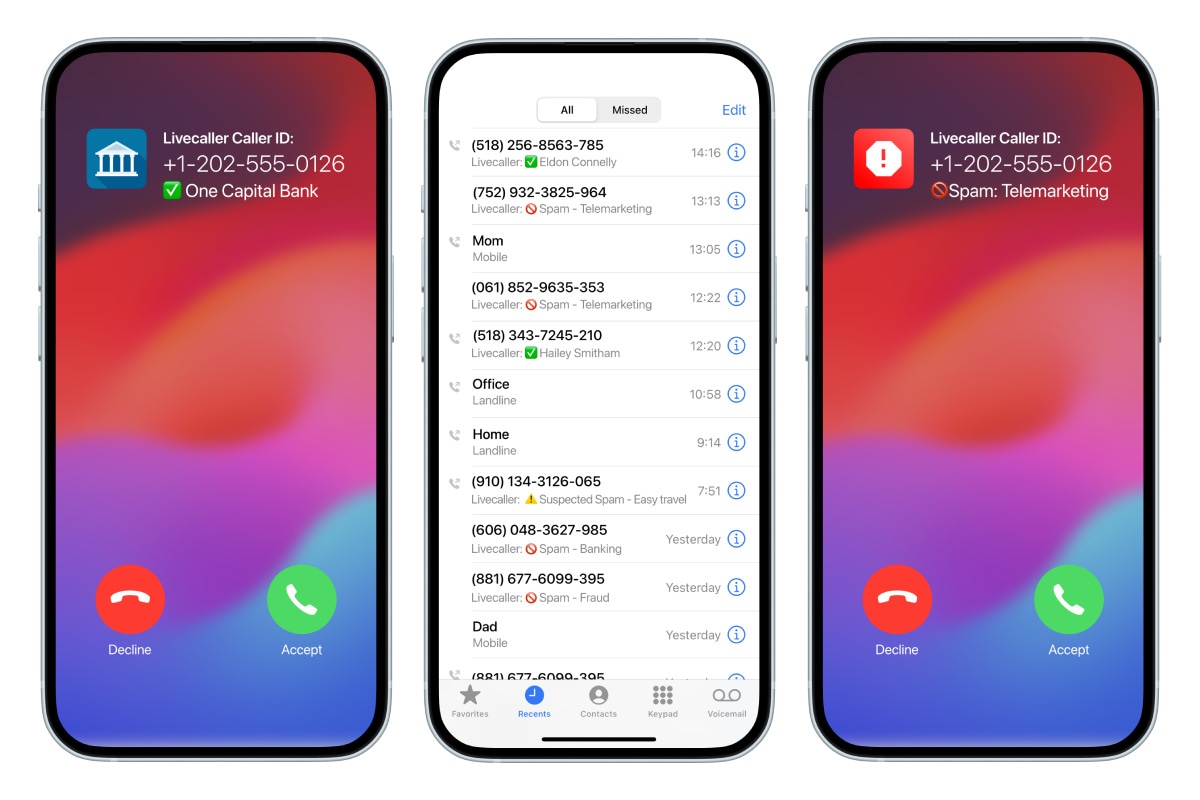
Unable to mark those numbers as spam, Truecaller instead introduced a “Frequently Blocked” badge to alert users when a number from the designated series has been blocked by many people.
The unusually public criticism came after Indian business daily The Economic Times reported that TRAI had sought powers under India’s Information Technology Act to take action against caller ID apps such as Truecaller, Hiya, and Whoscall for labeling numbers from the designated 1400 and 1600 series as spam.
TRAI and India’s Ministry of Electronics and Information Technology, which would consider any such proposal, did not immediately respond to requests for comment.
Jhunjhunwala said Truecaller would share its data with the Indian IT ministry as part of the regulatory process, arguing that any decision on caller ID apps should be evidence-based.
“Penalize the bad actors, not the ones like Truecaller that make a significant positive impact,” he wrote.
When you purchase through links in our articles, we may earn a small commission. This doesn’t affect our editorial independence.
On Wednesday, CEO Rishit Jhunjhunwala (pictured above) took to X to publicly challenge the Telecom Regulatory Authority of India (TRAI), accusing the watchdog of preventing Truecaller from displaying community-reported spam information for calls from the country’s dedicated 1400 and 1600 number series, a restriction he said had enabled abuse of those numbers and eroded trust in legitimate business calls.
The dispute stems from a framework introduced in 2024 under which India’s telecom authorities designated the 1400 and 1600 number series for commercial communications, with businesses using the former for telemarketing calls and the latter for service- and transaction-related calls. TRAI later mandated the migration to the dedicated numbering series, saying the move would help consumers identify legitimate business communications and curb spam and scam calls.
The framework was rolled out amid growing concerns over spam and scam calls in India, one of the world’s largest telecom markets, where regulators and telecom operators have rolled out multiple measures to curb fraudulent communications. Last year, the Indian communications ministry said authorities disconnected more than 2.1 million fraudulent mobile numbers and took action against more than 100,000 entities over the preceding year, underscoring the scale of the challenge.
Jhunjhunwala argued the policy has produced unintended consequences. Citing internal company data, he said consumers have increasingly lost trust in the designated number series, with Truecaller users ignoring 81% of calls from the 1400 series and 79% from the 1600 series over the past eight months. During the same period, users manually blocked 74 million calls from the two number series, while daily blocking actions against 1600-series numbers have more than tripled since October 2025, he said.
Unable to mark those numbers as spam, Truecaller instead introduced a “Frequently Blocked” badge to alert users when a number from the designated series has been blocked by many people.
The unusually public criticism came after Indian business daily The Economic Times reported that TRAI had sought powers under India’s Information Technology Act to take action against caller ID apps such as Truecaller, Hiya, and Whoscall for labeling numbers from the designated 1400 and 1600 series as spam.
TRAI and India’s Ministry of Electronics and Information Technology, which would consider any such proposal, did not immediately respond to requests for comment.
Jhunjhunwala said Truecaller would share its data with the Indian IT ministry as part of the regulatory process, arguing that any decision on caller ID apps should be evidence-based.
“Penalize the bad actors, not the ones like Truecaller that make a significant positive impact,” he wrote.
When you purchase through links in our articles, we may earn a small commission. This doesn’t affect our editorial independence.
#Truecaller #clashes #Indias #telecom #regulator #antispam #rules #TechCrunchTruecaller,MeitY,TRAI">Truecaller clashes with India’s telecom regulator over anti-spam rules | TechCrunch
Truecaller has opened a public fight with India’s telecom regulator over rules governing caller ID apps, saying the country’s anti-spam framework is making it harder to protect consumers from unwanted calls in its biggest market.
On Wednesday, CEO Rishit Jhunjhunwala (pictured above) took to X to publicly challenge the Telecom Regulatory Authority of India (TRAI), accusing the watchdog of preventing Truecaller from displaying community-reported spam information for calls from the country’s dedicated 1400 and 1600 number series, a restriction he said had enabled abuse of those numbers and eroded trust in legitimate business calls.
The dispute stems from a framework introduced in 2024 under which India’s telecom authorities designated the 1400 and 1600 number series for commercial communications, with businesses using the former for telemarketing calls and the latter for service- and transaction-related calls. TRAI later mandated the migration to the dedicated numbering series, saying the move would help consumers identify legitimate business communications and curb spam and scam calls.
The framework was rolled out amid growing concerns over spam and scam calls in India, one of the world’s largest telecom markets, where regulators and telecom operators have rolled out multiple measures to curb fraudulent communications. Last year, the Indian communications ministry said authorities disconnected more than 2.1 million fraudulent mobile numbers and took action against more than 100,000 entities over the preceding year, underscoring the scale of the challenge.
Jhunjhunwala argued the policy has produced unintended consequences. Citing internal company data, he said consumers have increasingly lost trust in the designated number series, with Truecaller users ignoring 81% of calls from the 1400 series and 79% from the 1600 series over the past eight months. During the same period, users manually blocked 74 million calls from the two number series, while daily blocking actions against 1600-series numbers have more than tripled since October 2025, he said.
Unable to mark those numbers as spam, Truecaller instead introduced a “Frequently Blocked” badge to alert users when a number from the designated series has been blocked by many people.
The unusually public criticism came after Indian business daily The Economic Times reported that TRAI had sought powers under India’s Information Technology Act to take action against caller ID apps such as Truecaller, Hiya, and Whoscall for labeling numbers from the designated 1400 and 1600 series as spam.
TRAI and India’s Ministry of Electronics and Information Technology, which would consider any such proposal, did not immediately respond to requests for comment.
Jhunjhunwala said Truecaller would share its data with the Indian IT ministry as part of the regulatory process, arguing that any decision on caller ID apps should be evidence-based.
“Penalize the bad actors, not the ones like Truecaller that make a significant positive impact,” he wrote.
When you purchase through links in our articles, we may earn a small commission. This doesn’t affect our editorial independence.
Much of Truecaller’s growth has been driven by India, which accounts for over 350 million users, or about 70% of its global base. The volume of spam and unwanted calls has turned the app from a simple caller ID service into a more embedded layer of everyday communication.
As competition increases, Truecaller’s growth is starting to slow. Data shared with TechCrunch from Sensor Tower shows downloads from India fell 16% year-over-year in 2025, while global downloads declined 5%, marking a reversal after several years of growth. Separate data from Appfigures shows downloads peaked at 175 million in 2021, dropped sharply in 2022 and have since hovered around 120 million annually.
Image Credits:Jagmeet Singh / TechCrunch
India remains Truecaller’s largest market, but its share of downloads has declined from over 70% at its peak to the mid-50s in recent years, pointing to a gradual shift in new user growth toward other markets.
Truecaller’s shift in growth dynamics is being closely watched by investors. The company’s shares have fallen about 78% since its 2021 IPO and are down around 37% so far this year, underscoring investor concerns about its growth outlook and business model. Chief Executive Rishit Jhunjhunwala told TechCrunch that one of the key questions from investors has been around the impact of CNAP in India. He also acknowledged recent headwinds in parts of the business, without elaborating further.
Truecaller’s Jhunjhunwala said the company does not see CNAP as a disruption but as validation of the problem.
“Truecaller operates as a global platform with a much richer and dynamic intelligence layer — spanning spam detection, fraud prevention, business identity, and user context across calls and messages,” he said. “This allows us to go significantly beyond basic caller ID.”
Truecaller’s Community Suggestions show user-generated context about incoming callersImage Credits:Truecaller
Bharath Nagaraj, director of equity research at Cantor Fitzgerald, said CNAP could slow user growth but is unlikely to materially disrupt Truecaller’s core business in the near term. Instead, he pointed to pressure in the company’s advertising segment — driven in part by changes from Google — as the more immediate challenge.
“If you look at the earnings for the company, 65%–70% of it now comes from ad revenue. And that impacted recently,” Nagaraj told TechCrunch.
In its last earnings call (PDF), Truecaller said that it lost roughly one-third of ad traffic from its largest partner in August 2025 — a partner analysts on the call identified as Google. Jhunjhunwala attributed the drop to an unresolved “algorithm issue,” while CFO Odd Bolin said the partner still accounts for more than a third of total revenue. The company is now adding new partners and building its own ad exchange to reduce dependence on any single platform.
But even moving to an in-house ad exchange may not fully address the challenge. Advertising remains highly competitive, with brands able to spend across multiple digital platforms, said Nagaraj. “You can show your ads on Truecaller, but you can also show them on Facebook,” he said.
In-app revenue continues to grow
The pressure on advertising comes even as other parts of Truecaller’s business are on a different trajectory. Data from Appfigures shows that while downloads have plateaued in recent years, gross in-app revenue has risen sharply — from $600,000 in 2017 to $39.3 million in 2025. It has already reached $13.4 million this year as of April 20.
Monthly revenue generated by in-app purchases on Truecaller is now consistently above $2 million and still climbing, per Appfigures.
Image Credits:Jagmeet Singh / TechCrunch
Truecaller’s presence on iOS has also grown from less than 5% of its total downloads in 2020–2021 to around 11–12% in recent years, per Appfigures, highlighting a shift toward higher-value markets. The company has stepped up efforts on Apple’s platform, including launching real-time caller ID for iPhone in early 2025 and rolling out feature updates to improve parity with its Android app.
Nonetheless, Apple recently expanded its call-screening capabilities, which could reduce the need for third-party apps among iPhone users.
Another key pillar of Truecaller’s monetization strategy is its enterprise offering, Truecaller for Business, which enables companies to verify their identities and communicate with customers via calls and messaging. The segment has been growing steadily, with revenue rising 39% in constant currency in 2025. Truecaller’s Jhunjhunwala said the company is expanding the platform globally by opening its chat services to partners and offering tools such as verified business caller ID to help enterprises verify identity and reach customers.
Alongside its enterprise push, Truecaller has also been expanding its consumer subscription business, which has over 4 million paid subscribers globally, as more users opt for features such as advanced spam protection, AI-based call screening, and an ad-free experience.
In the past, Truecaller has been criticized over how it builds and maintains its vast database of phone identities. An investigation by The Caravan raised questions about consent and data collection practices, particularly in India, where data protection laws have so far been less stringent. Truecaller has denied wrongdoing and maintains that it complies with applicable regulations, but the debate underlines the broader challenge of balancing utility, scale, and user privacy.
Despite all these challenges, Truecaller sees significant room for growth. The company is focused on addressing the rising complexity of communication, Jhunjhunwala said, as spam and scam calls become more sophisticated with advances in AI. Similarly, it plans to expand across all three revenue streams — advertising, enterprise services, and premium subscriptions — as it looks to sustain growth across markets. Whether that will be enough, however, may depend on how quickly it can adapt as caller identification shifts from standalone apps to the network, and to the phone itself.
When you purchase through links in our articles, we may earn a small commission. This doesn’t affect our editorial independence.
Much of Truecaller’s growth has been driven by India, which accounts for over 350 million users, or about 70% of its global base. The volume of spam and unwanted calls has turned the app from a simple caller ID service into a more embedded layer of everyday communication.
As competition increases, Truecaller’s growth is starting to slow. Data shared with TechCrunch from Sensor Tower shows downloads from India fell 16% year-over-year in 2025, while global downloads declined 5%, marking a reversal after several years of growth. Separate data from Appfigures shows downloads peaked at 175 million in 2021, dropped sharply in 2022 and have since hovered around 120 million annually.
Image Credits:Jagmeet Singh / TechCrunch
India remains Truecaller’s largest market, but its share of downloads has declined from over 70% at its peak to the mid-50s in recent years, pointing to a gradual shift in new user growth toward other markets.
Truecaller’s shift in growth dynamics is being closely watched by investors. The company’s shares have fallen about 78% since its 2021 IPO and are down around 37% so far this year, underscoring investor concerns about its growth outlook and business model. Chief Executive Rishit Jhunjhunwala told TechCrunch that one of the key questions from investors has been around the impact of CNAP in India. He also acknowledged recent headwinds in parts of the business, without elaborating further.
Truecaller’s Jhunjhunwala said the company does not see CNAP as a disruption but as validation of the problem.
“Truecaller operates as a global platform with a much richer and dynamic intelligence layer — spanning spam detection, fraud prevention, business identity, and user context across calls and messages,” he said. “This allows us to go significantly beyond basic caller ID.”
Truecaller’s Community Suggestions show user-generated context about incoming callersImage Credits:Truecaller
Bharath Nagaraj, director of equity research at Cantor Fitzgerald, said CNAP could slow user growth but is unlikely to materially disrupt Truecaller’s core business in the near term. Instead, he pointed to pressure in the company’s advertising segment — driven in part by changes from Google — as the more immediate challenge.
“If you look at the earnings for the company, 65%–70% of it now comes from ad revenue. And that impacted recently,” Nagaraj told TechCrunch.
In its last earnings call (PDF), Truecaller said that it lost roughly one-third of ad traffic from its largest partner in August 2025 — a partner analysts on the call identified as Google. Jhunjhunwala attributed the drop to an unresolved “algorithm issue,” while CFO Odd Bolin said the partner still accounts for more than a third of total revenue. The company is now adding new partners and building its own ad exchange to reduce dependence on any single platform.
But even moving to an in-house ad exchange may not fully address the challenge. Advertising remains highly competitive, with brands able to spend across multiple digital platforms, said Nagaraj. “You can show your ads on Truecaller, but you can also show them on Facebook,” he said.
In-app revenue continues to grow
The pressure on advertising comes even as other parts of Truecaller’s business are on a different trajectory. Data from Appfigures shows that while downloads have plateaued in recent years, gross in-app revenue has risen sharply — from $600,000 in 2017 to $39.3 million in 2025. It has already reached $13.4 million this year as of April 20.
Monthly revenue generated by in-app purchases on Truecaller is now consistently above $2 million and still climbing, per Appfigures.
Image Credits:Jagmeet Singh / TechCrunch
Truecaller’s presence on iOS has also grown from less than 5% of its total downloads in 2020–2021 to around 11–12% in recent years, per Appfigures, highlighting a shift toward higher-value markets. The company has stepped up efforts on Apple’s platform, including launching real-time caller ID for iPhone in early 2025 and rolling out feature updates to improve parity with its Android app.
Nonetheless, Apple recently expanded its call-screening capabilities, which could reduce the need for third-party apps among iPhone users.
Another key pillar of Truecaller’s monetization strategy is its enterprise offering, Truecaller for Business, which enables companies to verify their identities and communicate with customers via calls and messaging. The segment has been growing steadily, with revenue rising 39% in constant currency in 2025. Truecaller’s Jhunjhunwala said the company is expanding the platform globally by opening its chat services to partners and offering tools such as verified business caller ID to help enterprises verify identity and reach customers.
Alongside its enterprise push, Truecaller has also been expanding its consumer subscription business, which has over 4 million paid subscribers globally, as more users opt for features such as advanced spam protection, AI-based call screening, and an ad-free experience.
In the past, Truecaller has been criticized over how it builds and maintains its vast database of phone identities. An investigation by The Caravan raised questions about consent and data collection practices, particularly in India, where data protection laws have so far been less stringent. Truecaller has denied wrongdoing and maintains that it complies with applicable regulations, but the debate underlines the broader challenge of balancing utility, scale, and user privacy.
Despite all these challenges, Truecaller sees significant room for growth. The company is focused on addressing the rising complexity of communication, Jhunjhunwala said, as spam and scam calls become more sophisticated with advances in AI. Similarly, it plans to expand across all three revenue streams — advertising, enterprise services, and premium subscriptions — as it looks to sustain growth across markets. Whether that will be enough, however, may depend on how quickly it can adapt as caller identification shifts from standalone apps to the network, and to the phone itself.
When you purchase through links in our articles, we may earn a small commission. This doesn’t affect our editorial independence.
#Truecaller #faces #mounting #pressures #growth #matures #TechCrunchcaller id,Truecaller">Truecaller faces mounting pressures as its growth matures | TechCrunch
Truecaller is one of the world’s most widely used caller identification platforms, with more than 500 million users. Now it’s entering a more challenging phase as growth slows in its largest market and competition intensifies across telecom networks and smartphone platforms.
Much of Truecaller’s growth has been driven by India, which accounts for over 350 million users, or about 70% of its global base. The volume of spam and unwanted calls has turned the app from a simple caller ID service into a more embedded layer of everyday communication.
As competition increases, Truecaller’s growth is starting to slow. Data shared with TechCrunch from Sensor Tower shows downloads from India fell 16% year-over-year in 2025, while global downloads declined 5%, marking a reversal after several years of growth. Separate data from Appfigures shows downloads peaked at 175 million in 2021, dropped sharply in 2022 and have since hovered around 120 million annually.
Image Credits:Jagmeet Singh / TechCrunch
India remains Truecaller’s largest market, but its share of downloads has declined from over 70% at its peak to the mid-50s in recent years, pointing to a gradual shift in new user growth toward other markets.
Truecaller’s shift in growth dynamics is being closely watched by investors. The company’s shares have fallen about 78% since its 2021 IPO and are down around 37% so far this year, underscoring investor concerns about its growth outlook and business model. Chief Executive Rishit Jhunjhunwala told TechCrunch that one of the key questions from investors has been around the impact of CNAP in India. He also acknowledged recent headwinds in parts of the business, without elaborating further.
Truecaller’s Jhunjhunwala said the company does not see CNAP as a disruption but as validation of the problem.
“Truecaller operates as a global platform with a much richer and dynamic intelligence layer — spanning spam detection, fraud prevention, business identity, and user context across calls and messages,” he said. “This allows us to go significantly beyond basic caller ID.”
Truecaller’s Community Suggestions show user-generated context about incoming callersImage Credits:Truecaller
Bharath Nagaraj, director of equity research at Cantor Fitzgerald, said CNAP could slow user growth but is unlikely to materially disrupt Truecaller’s core business in the near term. Instead, he pointed to pressure in the company’s advertising segment — driven in part by changes from Google — as the more immediate challenge.
“If you look at the earnings for the company, 65%–70% of it now comes from ad revenue. And that impacted recently,” Nagaraj told TechCrunch.
In its last earnings call (PDF), Truecaller said that it lost roughly one-third of ad traffic from its largest partner in August 2025 — a partner analysts on the call identified as Google. Jhunjhunwala attributed the drop to an unresolved “algorithm issue,” while CFO Odd Bolin said the partner still accounts for more than a third of total revenue. The company is now adding new partners and building its own ad exchange to reduce dependence on any single platform.
But even moving to an in-house ad exchange may not fully address the challenge. Advertising remains highly competitive, with brands able to spend across multiple digital platforms, said Nagaraj. “You can show your ads on Truecaller, but you can also show them on Facebook,” he said.
In-app revenue continues to grow
The pressure on advertising comes even as other parts of Truecaller’s business are on a different trajectory. Data from Appfigures shows that while downloads have plateaued in recent years, gross in-app revenue has risen sharply — from $600,000 in 2017 to $39.3 million in 2025. It has already reached $13.4 million this year as of April 20.
Monthly revenue generated by in-app purchases on Truecaller is now consistently above $2 million and still climbing, per Appfigures.
Image Credits:Jagmeet Singh / TechCrunch
Truecaller’s presence on iOS has also grown from less than 5% of its total downloads in 2020–2021 to around 11–12% in recent years, per Appfigures, highlighting a shift toward higher-value markets. The company has stepped up efforts on Apple’s platform, including launching real-time caller ID for iPhone in early 2025 and rolling out feature updates to improve parity with its Android app.
Nonetheless, Apple recently expanded its call-screening capabilities, which could reduce the need for third-party apps among iPhone users.
Another key pillar of Truecaller’s monetization strategy is its enterprise offering, Truecaller for Business, which enables companies to verify their identities and communicate with customers via calls and messaging. The segment has been growing steadily, with revenue rising 39% in constant currency in 2025. Truecaller’s Jhunjhunwala said the company is expanding the platform globally by opening its chat services to partners and offering tools such as verified business caller ID to help enterprises verify identity and reach customers.
Alongside its enterprise push, Truecaller has also been expanding its consumer subscription business, which has over 4 million paid subscribers globally, as more users opt for features such as advanced spam protection, AI-based call screening, and an ad-free experience.
In the past, Truecaller has been criticized over how it builds and maintains its vast database of phone identities. An investigation by The Caravan raised questions about consent and data collection practices, particularly in India, where data protection laws have so far been less stringent. Truecaller has denied wrongdoing and maintains that it complies with applicable regulations, but the debate underlines the broader challenge of balancing utility, scale, and user privacy.
Despite all these challenges, Truecaller sees significant room for growth. The company is focused on addressing the rising complexity of communication, Jhunjhunwala said, as spam and scam calls become more sophisticated with advances in AI. Similarly, it plans to expand across all three revenue streams — advertising, enterprise services, and premium subscriptions — as it looks to sustain growth across markets. Whether that will be enough, however, may depend on how quickly it can adapt as caller identification shifts from standalone apps to the network, and to the phone itself.
When you purchase through links in our articles, we may earn a small commission. This doesn’t affect our editorial independence.