Apr 12, 2026; Newark, New Jersey, USA; New Jersey Devils center Nico Hischier (13) celebrates with teammates after scoring the game-winning goal in overtime against the Ottawa Senators at Prudential Center. Mandatory Credit: John Jones-Imagn Images
Nico Hischier scored a power-play goal with 1:42 remaining in overtime and the New Jersey Devils earned a 4-3 victory over the Ottawa Senators on Sunday night in Newark, N.J.
Hischier collected two goals and an assist and finished off his fifth three-point game of the season by getting to the net after winning an offensive zone faceoff from Shane Pinto.
The Devils moved the puck around and goalie James Reimer stopped a shot by Jack Hughes. Reimer could not control the rebound as Hischier beat Ottawa defensemen Artem Zub and Nikolas Matinpalo to the loose puck and slid it under his pads for his ninth career overtime goal.
Dawson Mercer scored the tying goal on a short-handed breakaway with 7:32 remaining in regulation after getting a tally disallowed due to an offsides call in the first period. Connor Brown also scored on a short-handed breakaway as the Devils held a 2-0 lead through the opening 20 minutes.
Hughes notched two assists to reach 50 assists for the second time in his career as the Devils (42-36-3, 87 points) improved to 14-7-1 in their past 22 games.
Ottawa countered New Jersey’s early lead with three goals in a span of 6:32 during the second period.
Michael Amadio scored on a redirection of Zub’s point shot with 12:18 remaining, Pinto buried a one-timer from the right circle with 9:35 left and Fabian Zetterlund put a puck into the open net after forcing a turnover by Hughes near the crease with 5:46 to go.
New Jersey goalie Nico Daws made 27 saves in his second appearance this season and highlighted his effort with a point-blank stop on Drake Batherson in the final minute before overtime.
Reimer made 26 saves for the Senators (43-27-11, 97 points), who saw a four-game winning streak stopped and are one point behind Boston for the first wild-card spot in the Eastern Conference. If the teams finish tied, Ottawa would win the tiebreaker due to their 37 regulation wins.
A day after clinching a playoff spot with Saturday afternoon’s 3-0 win over the New York Islanders, the Senators rested Brady Tkachuk and Tim Stuztle along with defensemen Thomas Chabot and Jake Sanderson.
#FIDE #Womens #Candidates #Vaishali #break #alltime #points #record #single #edition">FIDE Women’s Candidates 2026: Can Vaishali break all-time points record for a single edition?
The FIDE Women’s Candidates 2026 is heading towards its business end, and India’s R Vaishali is on course to clinch the title.
Vaishali is also inching closer towards breaking an all-time record after having secured seven points at the end of Round 11.
Here’s the best individual score in Women’s Candidates:
The record for the most points scored in the history of the Women’s Candidates under the current double round-robin structure is held by Russia’s Aleksandra Goryachkina, who scored 9.5 points in the 2019 edition.
Vaishali has to score three points in the next three rounds to break the record and 2.5 points to go level with Goryachkina.
A tournament win will secure Vaishali’s qualification for the World Championship Final.
#Deadspin #Bruins #defeat #Blue #Jackets #James #Hagenss #debut">Deadspin | Bruins defeat Blue Jackets in James Hagens’s debut
Apr 12, 2026; Columbus, Ohio, USA; Columbus Blue Jackets center Adam Fantilli (19) takes the puck away from Boston Bruins center Mark Kastelic (47) during the first period at Nationwide Arena. Mandatory Credit: Russell LaBounty-Imagn Images
Sean Kuraly scored and set up two others, leading the Boston Bruins to a 3-2 win over the host Columbus Blue Jackets on Sunday night.
Boston (44-27-10, 98 points) clinched an Eastern Conference wild-card berth on Saturday. The first wild-card seed is still within reach with the Bruins battling the Senators for seeding.
Henri Jokiharju and Mark Kastelic added a goal and a helper each for Boston, which swept the three-game season series against Columbus and snapped a five-game skid overall (0-3-2).
Joonas Korpisalo made 35 saves in the win.
Mason Marchment and Adam Fantilli responded for the Blue Jackets (40-29-12, 92 points). With the loss, Columbus’ chances at the third seed in the Metropolitan Division took a substantial blow.
Jet Greaves stopped 19 shots.
Kastelic scored the eventual game-winner at 10:22 of the third, putting his shot from a bad angle far-side past Greaves for his 10th of the season.
Fantilli tied it 2-2, on a breakaway, snapping a shot glove side past Korpisalo for his 24th at 1:27 of the third.
Boston took a 2-1 lead with just 19 seconds remaining in the middle frame as Jokiharju snapped a Kuraly feed short-side past a screened Greaves for his second of the season.
With the secondary assist, James Hagens (19 years, 160 days) scored a point in his NHL debut.
Marchment opened the scoring at 3:59, redirecting a Dante Fabbro point shot at the side of the net past Korpisalo for his 19th of the season.
Boston responded at 10:31 on their first shot of the game as Mark Kastelic’s tip of Henri Jokiharju’s point shot went off the skate of Kuraly and in for his sixth of the season.
Sunday was the third and final meeting of the season between the Blue Jackets and Bruins.
Boston doubled up Columbus 4-2 on Feb. 26 before squeezing out a 4-3 shootout victory on March 29.
As the war raged on, Zare says the team tried to be there for each other.
“All the guys in the team supported each other. We cheered for each other. We also understood, however hard it was, that what we were doing, it wasn’t harder than what others were facing. We were wrestling. They were having bombs dropped on them.
“There were children who were martyred. There were young people who were killed and people who were made homeless. There were people in the cities and on the border who slept with stress. They faced things that were much harder than anything we faced. With their love, we faced whatever challenges we had to face,” he says.
Missiles were still flying (the ceasefire between Iran and the USA was only brokered one day into the start of the Asian Championships) when the team left for Bishkek – a challenge in itself.
With every international airport in Iran heavily bombed, and the transport hub of Dubai declaring that Iranians were not permitted to use transit facilities, Dorostkar says the team had to travel by road to leave the country. “We were on the bus for 22 hours on the way from the north to the border,” says Dorostkar.
Despite the nature of their preparation, it says something of the standard of wrestling in that country that Iran still managed to win team titles in both the Greco-Roman and Freestyle categories at the Asian Championships.
Winning for the people
Zare, who won Iran’s final gold medal of the tournament, says nothing less would have done.
“We are not rich people. But we will always perform at the highest level against any competition. We have a tradition of wrestling. Our coaches protected and guided us. If it wasn’t for who we are, we wouldn’t have been able to form a team and even come to this competition. We have pride in our country. This pride gives us a sense of nationalism,” he says.
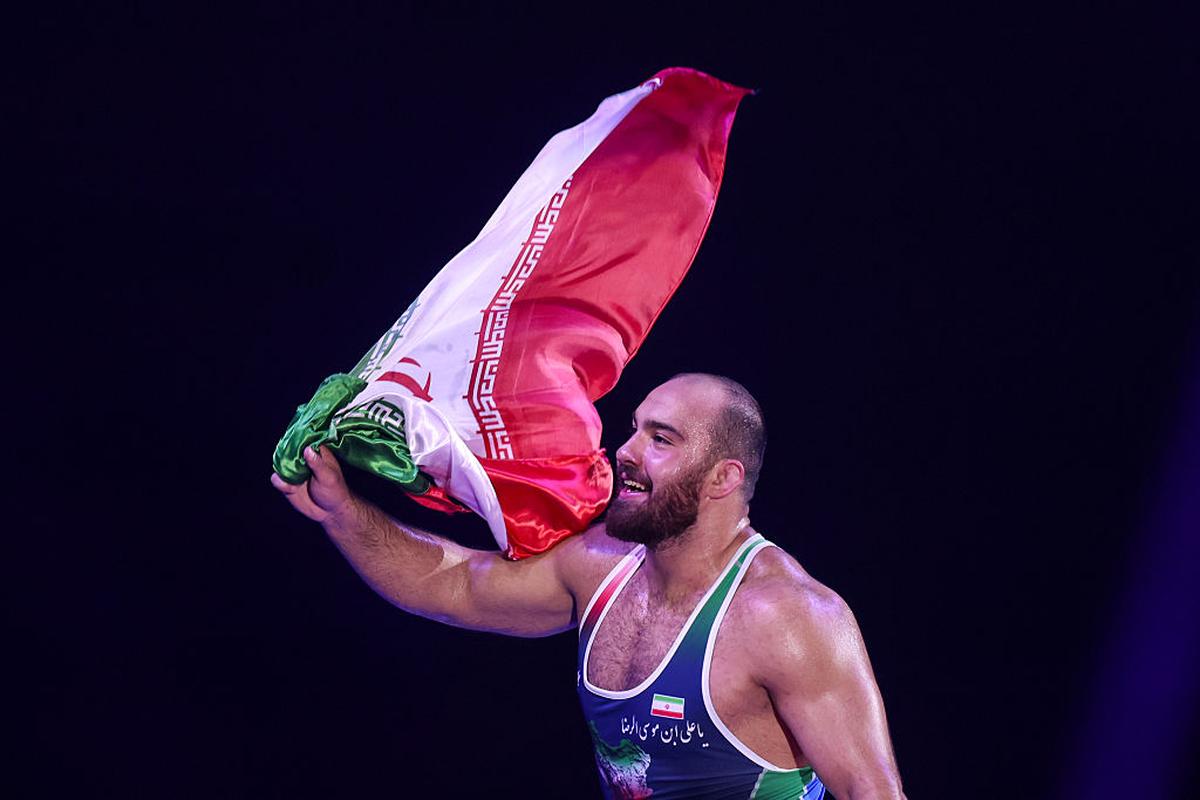
After Zare secured his win and then held his country’s flag aloft, he says he was thinking of his countrymen. “I know whenever I fight, the people of my country support me. That is what gives me strength. For me, lifting the flag is the least I can do,” he says.
File photo: Amir Hossein Zare celebrated his win by holding Iran’s flag aloft and spared a thought for his countrymen, who were bearing the brunt of the war back home.
| Photo Credit:
Getty Images
File photo: Amir Hossein Zare celebrated his win by holding Iran’s flag aloft and spared a thought for his countrymen, who were bearing the brunt of the war back home.
| Photo Credit:
Getty Images
While he is uncertain about the future, there is also a sense of defiance.
“I don’t know what will happen in the future. Only God knows what will happen. I’m not sure whether it will be good for the people of Iran or not. So many children have died. So many innocent people have died. I have nothing to do with any sect or political side, but I condemn every form of oppression in the world. Our country was attacked. We did not attack anyone’s country. Our country is miles away from the United States,” he says.
“It has nothing to do with whether you want to enter our region or rule it, no matter how rich or powerful you are. And we are Iranian. In my opinion, my country has done the right thing and responded well to the actions against it. I don’t want even a little bit of my country’s soil to be lost. I want the borders of my country to be preserved. Iran will be the winner of this war,” he says.
Uncertain future
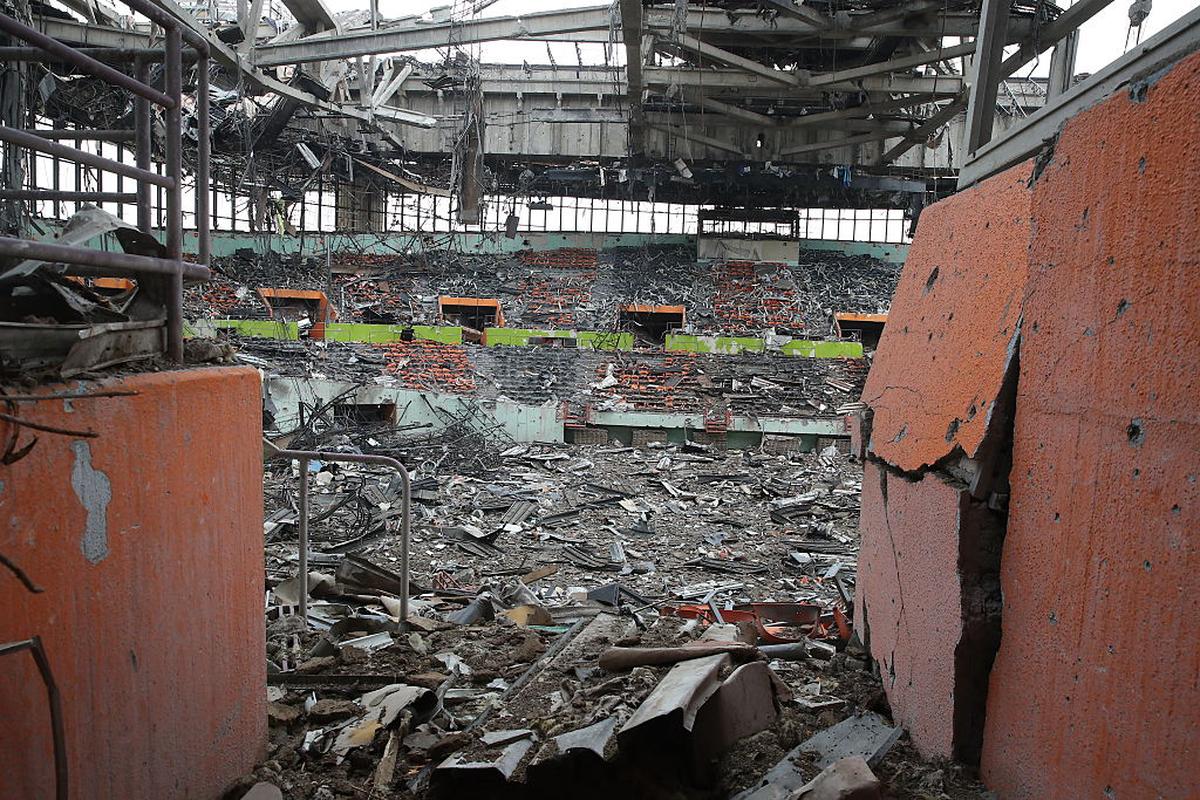
As his team returns home, Coach Dorostkar rues the damage to his shattered nation but also remains optimistic about the future. The damage dealt to Tehran’s Azadi stadium following a bombing on March 5, at the start of the war, he feels is emblematic of the destruction his country will have to recover from.
“Azadi Stadium was a piece of history. I don’t know why they attacked it. In war, you aren’t supposed to attack stadiums. You don’t attack historic places. Azadi Stadium was something that held a lot of memories for the people of Iran, and especially the wrestlers who have competed there. There have been five World Cups that were held in this venue,” he says.
“We became champions of the world twice in that venue. But we are not worried. Our enemies can’t cut out our roots (for the sport). That stadium will be rebuilt. it will be better, and I hope we will be champions again.”
As the war raged on, Zare says the team tried to be there for each other.
“All the guys in the team supported each other. We cheered for each other. We also understood, however hard it was, that what we were doing, it wasn’t harder than what others were facing. We were wrestling. They were having bombs dropped on them.
“There were children who were martyred. There were young people who were killed and people who were made homeless. There were people in the cities and on the border who slept with stress. They faced things that were much harder than anything we faced. With their love, we faced whatever challenges we had to face,” he says.
Missiles were still flying (the ceasefire between Iran and the USA was only brokered one day into the start of the Asian Championships) when the team left for Bishkek – a challenge in itself.
With every international airport in Iran heavily bombed, and the transport hub of Dubai declaring that Iranians were not permitted to use transit facilities, Dorostkar says the team had to travel by road to leave the country. “We were on the bus for 22 hours on the way from the north to the border,” says Dorostkar.
Despite the nature of their preparation, it says something of the standard of wrestling in that country that Iran still managed to win team titles in both the Greco-Roman and Freestyle categories at the Asian Championships.
Winning for the people
Zare, who won Iran’s final gold medal of the tournament, says nothing less would have done.
“We are not rich people. But we will always perform at the highest level against any competition. We have a tradition of wrestling. Our coaches protected and guided us. If it wasn’t for who we are, we wouldn’t have been able to form a team and even come to this competition. We have pride in our country. This pride gives us a sense of nationalism,” he says.
After Zare secured his win and then held his country’s flag aloft, he says he was thinking of his countrymen. “I know whenever I fight, the people of my country support me. That is what gives me strength. For me, lifting the flag is the least I can do,” he says.
File photo: Amir Hossein Zare celebrated his win by holding Iran’s flag aloft and spared a thought for his countrymen, who were bearing the brunt of the war back home.
| Photo Credit:
Getty Images
File photo: Amir Hossein Zare celebrated his win by holding Iran’s flag aloft and spared a thought for his countrymen, who were bearing the brunt of the war back home.
| Photo Credit:
Getty Images
While he is uncertain about the future, there is also a sense of defiance.
“I don’t know what will happen in the future. Only God knows what will happen. I’m not sure whether it will be good for the people of Iran or not. So many children have died. So many innocent people have died. I have nothing to do with any sect or political side, but I condemn every form of oppression in the world. Our country was attacked. We did not attack anyone’s country. Our country is miles away from the United States,” he says.
“It has nothing to do with whether you want to enter our region or rule it, no matter how rich or powerful you are. And we are Iranian. In my opinion, my country has done the right thing and responded well to the actions against it. I don’t want even a little bit of my country’s soil to be lost. I want the borders of my country to be preserved. Iran will be the winner of this war,” he says.
Uncertain future
As his team returns home, Coach Dorostkar rues the damage to his shattered nation but also remains optimistic about the future. The damage dealt to Tehran’s Azadi stadium following a bombing on March 5, at the start of the war, he feels is emblematic of the destruction his country will have to recover from.
“Azadi Stadium was a piece of history. I don’t know why they attacked it. In war, you aren’t supposed to attack stadiums. You don’t attack historic places. Azadi Stadium was something that held a lot of memories for the people of Iran, and especially the wrestlers who have competed there. There have been five World Cups that were held in this venue,” he says.
“We became champions of the world twice in that venue. But we are not worried. Our enemies can’t cut out our roots (for the sport). That stadium will be rebuilt. it will be better, and I hope we will be champions again.”
Published on Apr 13, 2026
#times #war #Iran #Amir #Hossein #Zare #inspires #optimism #wrestling #gold">In times of war in Iran, Amir Hossein Zare inspires optimism with wrestling gold
Iranian wrestler Amir Hossein Abbas Zare has no shortage of laurels.
The 25-year-old, who competes in the men’s 125kg freestyle division, is the reigning world champion – a title he’s won three times. He’s also a two-time Olympic medallist, with a bronze from Tokyo and a silver at the 2024 Games in Paris.
Of all these medals, Zare counts the gold he won on Sunday evening — in Bishkek at the Asian Championships — as the one that means the most to him
“This gold medal is 100 per cent the most emotional one for him. I was able to win this despite the situation my country is in,” Zare said after beating Bahrain’s Shamil Sharipov 4-0 to claim the Asian 125kg freestyle title.
The past few weeks have indeed been difficult for Zare’s nation.
Attacks by the USA and Israel in early March have affected thousands of civilians and have led to widespread destruction of infrastructure across the country.
The Iranian wrestling community has not been unscathed. The national camp before the Asian Championships, which was initially to be held in Tehran, was shifted to Mazandaran, on the Caspian coast in the north of the country, after the Iranian capital was made subject to heavy bombings.
The national home of Iranian wrestling — Azadi Indoor Stadium — in Tehran was also destroyed in a bombing.
Rows of destroyed seating visible among the debris of the Azadi Sports Complex indoor arena in Tehran, following a wave of strikes by the United States and Israel in mid-March 2026.
| Photo Credit:
Getty Images
Rows of destroyed seating visible among the debris of the Azadi Sports Complex indoor arena in Tehran, following a wave of strikes by the United States and Israel in mid-March 2026.
| Photo Credit:
Getty Images
“It was a very difficult situation because Tehran, which is the base of our national teams, was under bombardment and the war that was imposed on us caused even our home and the base of our national teams to be damaged,” says Iranian freestyle chief coach Pejman Dorostkar.
“The security situation was very poor. We spent many days trying to find a safe place to practise. With the help of the head of the federation, we were able to find a place to practice in the north of Iran (Mazandaran). But we were nowhere close to the kind of readiness and calm we needed to be before a major competition,” he added.
While Mazandaran, some 200 kilometres north of Tehran, was spared attack, Dorostkar says it was still hard to keep their minds on training. “It was a very difficult situation. It was something that we hadn’t ever faced before. We were in a state of war. Our country was under bombardment. Our guys were worried about their families,” he says.
As the war raged on, Zare says the team tried to be there for each other.
“All the guys in the team supported each other. We cheered for each other. We also understood, however hard it was, that what we were doing, it wasn’t harder than what others were facing. We were wrestling. They were having bombs dropped on them.
“There were children who were martyred. There were young people who were killed and people who were made homeless. There were people in the cities and on the border who slept with stress. They faced things that were much harder than anything we faced. With their love, we faced whatever challenges we had to face,” he says.
Missiles were still flying (the ceasefire between Iran and the USA was only brokered one day into the start of the Asian Championships) when the team left for Bishkek – a challenge in itself.
With every international airport in Iran heavily bombed, and the transport hub of Dubai declaring that Iranians were not permitted to use transit facilities, Dorostkar says the team had to travel by road to leave the country. “We were on the bus for 22 hours on the way from the north to the border,” says Dorostkar.
Despite the nature of their preparation, it says something of the standard of wrestling in that country that Iran still managed to win team titles in both the Greco-Roman and Freestyle categories at the Asian Championships.
Winning for the people
Zare, who won Iran’s final gold medal of the tournament, says nothing less would have done.
“We are not rich people. But we will always perform at the highest level against any competition. We have a tradition of wrestling. Our coaches protected and guided us. If it wasn’t for who we are, we wouldn’t have been able to form a team and even come to this competition. We have pride in our country. This pride gives us a sense of nationalism,” he says.
After Zare secured his win and then held his country’s flag aloft, he says he was thinking of his countrymen. “I know whenever I fight, the people of my country support me. That is what gives me strength. For me, lifting the flag is the least I can do,” he says.
File photo: Amir Hossein Zare celebrated his win by holding Iran’s flag aloft and spared a thought for his countrymen, who were bearing the brunt of the war back home.
| Photo Credit:
Getty Images
File photo: Amir Hossein Zare celebrated his win by holding Iran’s flag aloft and spared a thought for his countrymen, who were bearing the brunt of the war back home.
| Photo Credit:
Getty Images
While he is uncertain about the future, there is also a sense of defiance.
“I don’t know what will happen in the future. Only God knows what will happen. I’m not sure whether it will be good for the people of Iran or not. So many children have died. So many innocent people have died. I have nothing to do with any sect or political side, but I condemn every form of oppression in the world. Our country was attacked. We did not attack anyone’s country. Our country is miles away from the United States,” he says.
“It has nothing to do with whether you want to enter our region or rule it, no matter how rich or powerful you are. And we are Iranian. In my opinion, my country has done the right thing and responded well to the actions against it. I don’t want even a little bit of my country’s soil to be lost. I want the borders of my country to be preserved. Iran will be the winner of this war,” he says.
Uncertain future
As his team returns home, Coach Dorostkar rues the damage to his shattered nation but also remains optimistic about the future. The damage dealt to Tehran’s Azadi stadium following a bombing on March 5, at the start of the war, he feels is emblematic of the destruction his country will have to recover from.
“Azadi Stadium was a piece of history. I don’t know why they attacked it. In war, you aren’t supposed to attack stadiums. You don’t attack historic places. Azadi Stadium was something that held a lot of memories for the people of Iran, and especially the wrestlers who have competed there. There have been five World Cups that were held in this venue,” he says.
“We became champions of the world twice in that venue. But we are not worried. Our enemies can’t cut out our roots (for the sport). That stadium will be rebuilt. it will be better, and I hope we will be champions again.”
#Deadspin #Baylor #Scheierman #Celtics #top #Magic #enter #playoffs #winning #note">Deadspin | Baylor Scheierman, Celtics top Magic, enter playoffs on winning note
Apr 12, 2026; Boston, Massachusetts, USA; Boston Celtics guard Baylor Scheierman (55) shoots over Orlando Magic center Goga Bitadze (35) during the first half at TD Garden. Mandatory Credit: Paul Rutherford-Imagn Images
Baylor Scheierman tossed in a career-high 30 points to lead the Boston Celtics to a 113-108 victory over the visiting Orlando Magic on Sunday in the final regular-season game for each team.
The Celtics (56-26), who had already secured the No. 2 seed for the Eastern Conference playoffs, rested eight players, including their top seven scorers. Boston’s first playoff opponent will be the team that earns the No. 7 seed in the play-in tournament.
Boston’s starting lineup was Ron Harper Jr., Max Shulga, Jordan Wash, Luka Garza and Scheierman.
Garza made a 3-pointer to give Boston a 111-108 lead with 31 seconds to play. After Orlando’s Jalen Suggs missed a 3-pointer with 19 seconds left, Walsh finalized the scoring by making two free throws.
The Celtics received 27 points apiece from both Garza and Harper.
The loss ended Orlando’s five-game winning streak. The Magic (45-37) had won three in a row on the road.
Paolo Banchero and Suggs each scored a team-high 23 for Orlando.
Boston trailed by nine at halftime but outscored Orlando 42-20 in the third quarter.
The Magic needed a win plus a Toronto victory over Brooklyn to finish sixth in the Eastern Conference and avoid the play-in tournament.
The game was tied until Orlando went on an 11-0 run to take a 29-18 lead late in the first quarter. The Magic had a 29-20 advantage entering the second.
The Celtics were within four early in the second but trailed 61-52 at halftime even though they made each of their 17 free-throw attempts in the first half.
Boston tied the game, 73-73, on a Scheierman 3-pointer, and led 75-73 following a Harper dunk with 4:41 left in the third. The Celtics extended their lead to 94-79 on a John Tonje basket with 30 seconds remaining in the third, and had a 94-81 lead when the quarter ended.
Apr 12, 2026; Boston, Massachusetts, USA; Boston Celtics guard Baylor Scheierman (55) shoots over Orlando…
For obvious reasons, I’ve had Moon on the mind all week. So I was trying to figure out what I should recommend this week that would thematically fit. Brian Eno’s Apollo: Atmospheres and Soundtracks is incredible, and if you haven’t listened to it, go do that now. But it also seemed a bit on the nose. Radiohead’s A Moon Shaped Pool also came to mind. But it also felt a bit obvious. Then I remembered Kate NV’s Room for the Moon, a record I had on repeat in 2020.
Russian artist Kate Shilonosova chases ideas across 11 tracks inspired by Russian and Japanese pop from the ‘70s and ‘80s, as well as children’s movies. This obviously leads Room for the Moon to indulge its most whimsical impulses. It’s a fairytale rendered in snappy Talking Heads-esque bass, proggy synths, and reverbed drum machines.
The opener “Not Not Not” is almost goofy, its chaotic melodies constantly dancing around each other in a perpetually disorienting way. It lurches forward asymetrically, grooving like a flat tire. The instrumental “Da Na” follows, drawing on a familiar yet slightly uncanny palette of sounds. The clarinet (?) drifts in and out of dissonance as if drunk. The tuned percussion elements flit around what might be a kenari seed shell shaker or someone running their fingers over the tines of a comb. It’s truly impossible to tell, and both seem as likely as the other.
“Sayonara (Full Moon Version)” is the fantastical daydream counterpart to Oingo Boingo’s nightmare new wave theatrics. The least strange track on the record is probably “Plans,” which fully embraces 80s dance pop aesthetics. But even that song finds room for a minute-long instrumental passage featuring a bleating, almost atonal saxophone solo.
While the sounds are strange, uneasy, and almost queasy at times, the songs are light and fantastical. Despite not understanding the lyrics, which are mostly in Russian, it’s impossible not to get a sense of hope from them. Kate NV’s Room for the Moon is not a somber lunar lullaby, but the pleasant dreams of an innocent mind.
For obvious reasons, I’ve had Moon on the mind all week. So I was trying to figure out what I should recommend this week that would thematically fit. Brian Eno’s Apollo: Atmospheres and Soundtracks is incredible, and if you haven’t listened to it, go do that now. But it also seemed a bit on the nose. Radiohead’s A Moon Shaped Pool also came to mind. But it also felt a bit obvious. Then I remembered Kate NV’s Room for the Moon, a record I had on repeat in 2020.
Russian artist Kate Shilonosova chases ideas across 11 tracks inspired by Russian and Japanese pop from the ‘70s and ‘80s, as well as children’s movies. This obviously leads Room for the Moon to indulge its most whimsical impulses. It’s a fairytale rendered in snappy Talking Heads-esque bass, proggy synths, and reverbed drum machines.
The opener “Not Not Not” is almost goofy, its chaotic melodies constantly dancing around each other in a perpetually disorienting way. It lurches forward asymetrically, grooving like a flat tire. The instrumental “Da Na” follows, drawing on a familiar yet slightly uncanny palette of sounds. The clarinet (?) drifts in and out of dissonance as if drunk. The tuned percussion elements flit around what might be a kenari seed shell shaker or someone running their fingers over the tines of a comb. It’s truly impossible to tell, and both seem as likely as the other.
“Sayonara (Full Moon Version)” is the fantastical daydream counterpart to Oingo Boingo’s nightmare new wave theatrics. The least strange track on the record is probably “Plans,” which fully embraces 80s dance pop aesthetics. But even that song finds room for a minute-long instrumental passage featuring a bleating, almost atonal saxophone solo.
While the sounds are strange, uneasy, and almost queasy at times, the songs are light and fantastical. Despite not understanding the lyrics, which are mostly in Russian, it’s impossible not to get a sense of hope from them. Kate NV’s Room for the Moon is not a somber lunar lullaby, but the pleasant dreams of an innocent mind.
#Room #Moon #thrillingly #weird #experimental #popColumn,Entertainment,Music,Music Review">Room for the Moon is thrillingly weird experimental pop
For obvious reasons, I’ve had Moon on the mind all week. So I was trying to figure out what I should recommend this week that would thematically fit. Brian Eno’s Apollo: Atmospheres and Soundtracks is incredible, and if you haven’t listened to it, go do that now. But it also seemed a bit on the nose. Radiohead’s A Moon Shaped Pool also came to mind. But it also felt a bit obvious. Then I remembered Kate NV’s Room for the Moon, a record I had on repeat in 2020.
Russian artist Kate Shilonosova chases ideas across 11 tracks inspired by Russian and Japanese pop from the ‘70s and ‘80s, as well as children’s movies. This obviously leads Room for the Moon to indulge its most whimsical impulses. It’s a fairytale rendered in snappy Talking Heads-esque bass, proggy synths, and reverbed drum machines.
The opener “Not Not Not” is almost goofy, its chaotic melodies constantly dancing around each other in a perpetually disorienting way. It lurches forward asymetrically, grooving like a flat tire. The instrumental “Da Na” follows, drawing on a familiar yet slightly uncanny palette of sounds. The clarinet (?) drifts in and out of dissonance as if drunk. The tuned percussion elements flit around what might be a kenari seed shell shaker or someone running their fingers over the tines of a comb. It’s truly impossible to tell, and both seem as likely as the other.
“Sayonara (Full Moon Version)” is the fantastical daydream counterpart to Oingo Boingo’s nightmare new wave theatrics. The least strange track on the record is probably “Plans,” which fully embraces 80s dance pop aesthetics. But even that song finds room for a minute-long instrumental passage featuring a bleating, almost atonal saxophone solo.
While the sounds are strange, uneasy, and almost queasy at times, the songs are light and fantastical. Despite not understanding the lyrics, which are mostly in Russian, it’s impossible not to get a sense of hope from them. Kate NV’s Room for the Moon is not a somber lunar lullaby, but the pleasant dreams of an innocent mind.

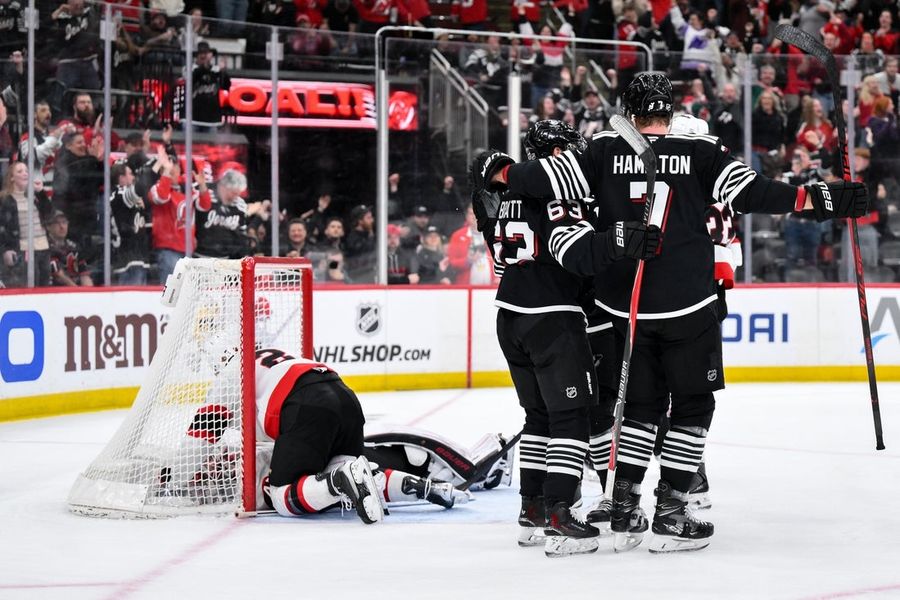 Apr 12, 2026; Newark, New Jersey, USA; New Jersey Devils center Nico Hischier (13) celebrates with teammates after scoring the game-winning goal in overtime against the Ottawa Senators at Prudential Center. Mandatory Credit: John Jones-Imagn Images