
John Forté, the Grammy-nominated recording artist best known for his work with The Fugees, has died at the age of 50. His death marks the loss of a quiet but influential figure whose creative imprint shaped one of hip-hop’s most important eras.
Forté was found unresponsive in his home in Chilmark, Martha’s Vineyard, according to reports from MV Times. Local authorities confirmed that a neighbor discovered him on the kitchen floor and contacted police shortly after 2:25 p.m. He was pronounced dead at the scene.
Details Surrounding John Forté’s Death
John Forté has reportedly passed away at the age of 50.
According to TMZ, the former Fugees collaborator died suddenly on Monday (Jan. 12) in Chilmark, Mass. The cause of death is unclear at this time. However, TMZ reports local authorities do not suspect foul play.
XXL has… pic.twitter.com/kWIFKX0GGZ
— XXL Magazine (@XXL) January 13, 2026
John Forté died on Monday, January 12, at his home in Chilmark, Martha’s Vineyard. He was 50 years old.
According to MV Times, local authorities said a neighbor discovered Forté alone on the kitchen floor and contacted police at approximately 2:25 p.m. Emergency responders arrived shortly after. Still, he was found unresponsive and not breathing. He was pronounced dead at the scene.
The Chilmark Police Department confirmed that no foul play was suspected. However, a cause of death has not yet been determined.
Police Chief Sean Slavin described the loss as deeply felt within the tight-knit island community, noting that deaths in small towns often resonate on a personal level. Reports also indicate that Forté had experienced a serious health setback the previous year after being hospitalized following a seizure.
Authorities have not released additional medical details at this time.
From Brooklyn Beginnings to the Fugees’ The Score
John Forté’s musical foundation was built long before fame entered the picture. Raised in Brooklyn, he began with classical training, playing violin in a youth orchestra and performing at the Brooklyn Academy of Music as a child. Music, for Forté, was always communal rather than solitary.
His path shifted during his teenage years as hip-hop culture took hold. While he gravitated toward rap’s creative energy, he was drawn more to the ecosystem around it. Entrepreneurs, graffiti artists, and producers caught his attention before the microphone did. That curiosity led him to Phillips Exeter Academy, then later to New York University, where he roomed with Talib Kweli.
By the early 1990s, Forté was working as an A&R executive at Rawkus Records, an influential underground label that would later help launch artists like Mos Def and Pharoahe Monch. It was during this period that Lauryn Hill introduced him to the Fugees.
His creative chemistry with the group proved immediate. Forté went on to co-write and produce multiple tracks on the Fugees’ 1996 album “The Score,” which became a global phenomenon and sold more than 22 million copies worldwide. At just 21 years old, Forté earned his first Grammy nomination.
He later toured with the group and contributed to Wyclef Jean’s debut solo album, “The Carnival.” His presence on tracks like Cowboys and “We Trying to Stay Alive” positioned him as a lyrical anchor during hip-hop’s most competitive decade.
Prison, Redemption, and a Life Rebuilt Through Music
Forté’s ascent was abruptly derailed in July 2000, when he was arrested at Newark International Airport in connection with a drug trafficking operation involving liquid cocaine. Under mandatory minimum sentencing laws, he received a 14-year federal prison sentence in 2001.
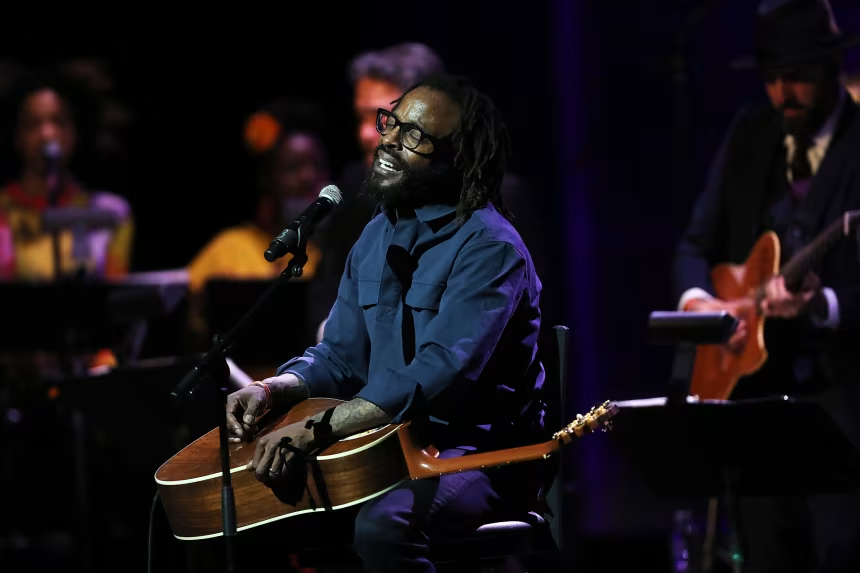
While incarcerated at FCI Loretto in Pennsylvania, Forté continued to write and create. Music became both refuge and reinvention. He taught himself to play the guitar, studied law in the prison library, and recorded his second album, “I, John,” which featured collaborations with Carly Simon and Herbie Hancock.
Simon, along with her son Ben Taylor, became a vocal advocate for Forté’s release. She later described him as her “godson” in a Vanity Fair essay, calling his sentence “hugely unfair.” Their efforts drew national attention and ultimately led to President George W. Bush commuting Forté’s sentence in November 2008.
After his release, Forté rebuilt his life away from the spotlight. He settled on Martha’s Vineyard with his wife and two children, becoming an active presence in the local music community. His later work reflected clarity rather than chaos.
In 2021, he released “Vessels, Angels & Ancestors,” an album shaped by reflection and freedom. Speaking to Billboard, Forté described the project as a turning point, one where self-doubt was replaced by trust in experience. He also composed the original score for the Breonna Taylor documentary, “Bree Wayy: Promise, Witness, Remembrance.”
John Forté’s legacy resists easy framing. He was never loud about his influence, yet it remains undeniable. His story lives in the music he helped shape, the artists he supported, and the second chances he turned into meaning.
Featured image: Getty Images
James Ransone, ‘The Wire’ Actor Known For His Raw Humanity, Dies At 46

Source link
#John #Forté #Dies #Remembering #Fugees #Collaborator #GrammyNominated #Artist


Post Comment