The conversational AI market has exploded since ChatGPT was released in November 2022 and is predicted to grow into a nearly $50 billion global industry by 2031, according to MarketsAndMarkets.
Synthflow AI is just one of many companies building in this space that hopes to stand out from the pack because of its focus on being enterprise-grade and easy to set up.
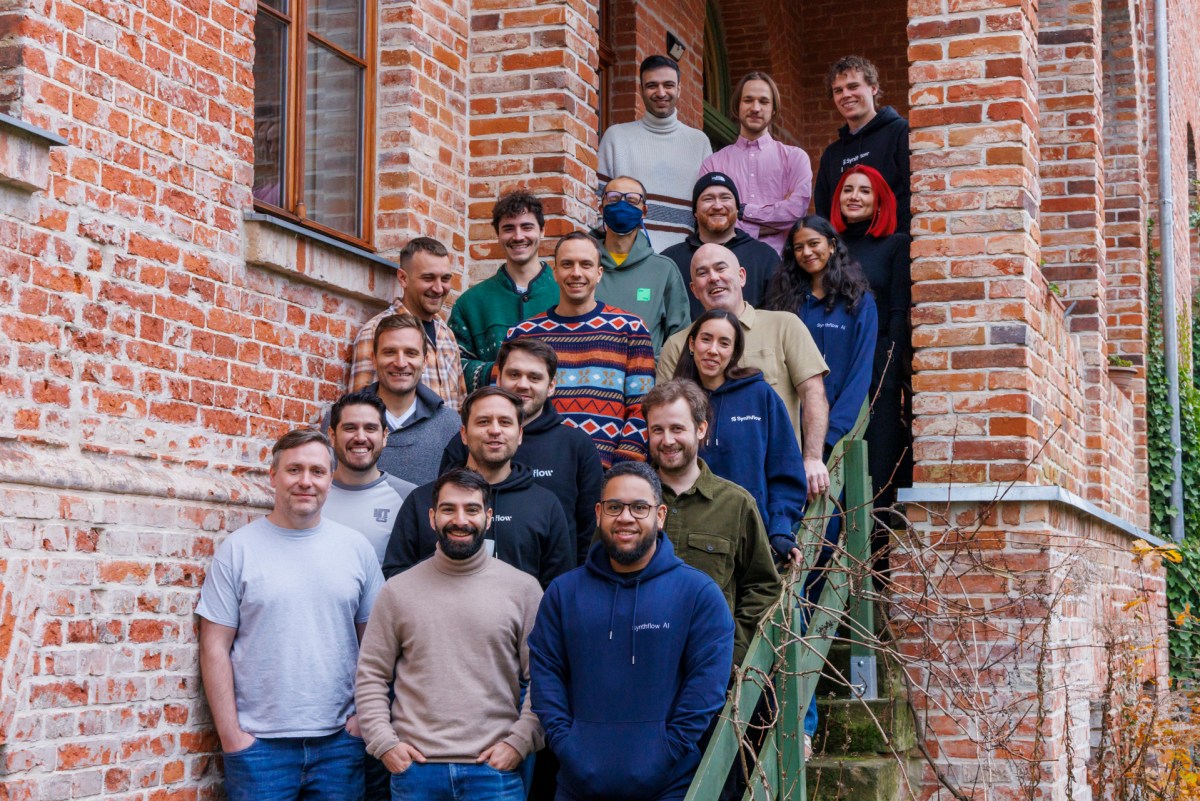
Berlin-based Synthflow is a no-code platform that lets enterprises build and deploy customized white-labeled voice AI customer service agents. The company, which launched in 2023, has amassed more than 1,000 customers and has handled more than 45 million calls.
The startup’s voice agents are both HIPAA and GDPR compliant and can be plugged into more than 200 integrations with other enterprise platforms, including Salesforce, Twilio, and HubSpot, among others.
Hakob Astabatsyan, co-founder and CEO, told TechCrunch that he and his co-founders, Albert Astabatsyan, now CPO, and Sassun Mirzakhan-Saky, now CTO, started messing around with OpenAI’s ChatGPT API back in early 2023 to find potential ways to build no-code business applications on top of the AI model.
They started with a text-to-text AI bot and then tried to build a voice bot. When they realized how much harder voice was, they got excited about the potential.
“We realized, oh my god, voice is really complicated, right? To actually make AI speak in real time like we do, having this 400 milliseconds latency, and handling interruptions, it turned out to be such a complicated task,” Astabatsyan said. “We fell in love with this problem, and we said, look, we’re gonna work only on voice bots from now on.”
The group formed Synthflow and spent the rest of 2023 building. They launched Synthflow’s first version of the product at the beginning of 2024 before releasing an enterprise-grade version of the tech at the end of the year. The company grew 15x last year and has seen over 90% retention from its enterprise customers, according to Astabatsyan.
“We process 5 million calls monthly,” he said. “Last year, it was like, I don’t know, 1 million, 2 million, and then we started growing very quickly. This is where Synthflow started really getting better and better because we had this velocity.”
The startup also recently raised a $20 million Series A round led by Accel with participation from existing investors Atlantic Labs and Singular. Astabatsyan said the company raised this recent round so that it could expand its team, boost research and development, and open its first U.S. office in an undecided location.
Luca Bocchio, a partner at Accel, told TechCrunch that the Accel team had been tracking Synthflow since it started developing its first product. What stood out to Bocchio was the founding team’s drive and its early push into building enterprise-friendly integrations.
“This team has [had] really strong views since the get-go about creating more depth with the technology and extensive integrations across CRMs, across tools enterprises may use to really provide enterprise-grade compliance,” Bocchio said.
Regardless of the company’s traction, conversational AI seems poised to be a tough category. There are numerous other companies building in the space, including Bret Taylor’s Sierra, which has raised $285 million in VC money, and Bland AI, which has raised more than $50 million in venture funding, to name a couple.
“AI is moving so fast, and sometimes things happen faster than you would expect,” Astabatsyan said. “But for us, it’s very clear. We’re at this stage where, I would say, [we’re] in a post-product-market-fit era, where we know who our customers are. We have a pretty clear idea what’s our product roadmap, and where we want to be in the next three to five years.”
Source link
#Synthflow #cutting #noise #loud #voice #category
![Scientists Say Some Black Holes Are Born From Other Black Holes
Since LIGO’s Nobel-winning discovery of gravitational waves—ripples in spacetime—the U.S.-based detector has been picking up on hundreds of signals from black hole mergers. And, after a decade of studying gravitational waves, researchers believe a significant fraction of black holes may come from cosmic chain reactions. A recent paper published in Physical Review Letters describes an analysis of 155 pairs of binary black holes, identified by LIGO and its sisters, Virgo and KAGRA, in Italy and Japan, respectively. According to the study, about 14% of merging black holes may be what’s called “second-generation black holes,” or black holes that form from previous mergers of two smaller black holes. This “hierarchical” backstory is vastly different from the textbook version of how black holes emerge from the explosive death of a star. “Overall in the universe, black holes are merging all the time,” Cailin Plunkett, the study’s first author and a graduate student at the Massachusetts Institute of Technology, told MIT News. “Now we’re seeing a relatively consistent picture where there’s a decent percentage of black holes that are coming from this repeated pathway.”
Tracking the invisible Gravitational waves that reach Earth’s detectors typically come from extremely intense events. Over the years, LIGO has picked up some truly perplexing signals. For example, last summer it found the most colossal black hole merger ever—and if that wasn’t wild enough, the black holes that took part in the merger lie within a cosmic “dead zone” for black holes.
This zone refers to a range of black hole masses in which, physically speaking, black holes can’t form through ordinary stellar collapse. From these discoveries, astronomers realized just how little we knew about black holes, which are challenging to investigate directly. In that sense, it was a no-brainer that the ever-growing catalog of LIGO’s gravitational signals would turn up entirely new insights about black holes. “It is increasingly clear, both from individual events and population analyses, that massive black holes exist in [this] range,” the researchers wrote in the latest paper. “These observations have spurred further investigation into mechanisms that can populate this gap.”
A wobbly imprint The latest research represents one such investigation. During mergers, the two black holes spiral toward each other along an orbital plane. When one or both black hole spins are misaligned, the orbital plane can wobble, or “precess,” the researchers explained to MIT News. The degree to which the disk wobbles acts as a parameter from which researchers can measure the masses and spins of the merging black holes. One telling sign of hierarchical mergers is that they’re “lopsided,” meaning one of the pair has a much higher spin and mass than the other. For the study, the team created an analytic model to capture the kind of wobble that would have emerged from second-generation black holes. Around 14% of merging black holes followed this pattern, and the second-generation black holes identified had a very specific range of masses, at around 20 solar masses or 40 solar masses and above. Of mysterious origins To be fair, that might not sound like a whole lot. But it demonstrates that a sizeable portion of known black holes indeed follow this pattern. As for why, the team suspects hierarchical mergers emerge from dense stellar environments. Simply, when multiple neighboring stars die and collapse into black holes, the dense environment can make it easier for those black holes to find each other and merge. That could further lead to the formation of second-generation black holes. Theoretically, this could “repeat potentially ad infinitum, by virtue of the fact that you have a ton of stars and black holes in this really dense environment,” Plunkett said.
But an ensuing mystery concerns those black holes in the 40-and-above regime, which coincides with the aforementioned “death zones” for black hole masses. According to stellar evolution theory, black holes born of supernovas shouldn’t leave any black holes above roughly 45 solar masses, explained Plunkett. “Yet we have seen black holes that are that massive,” she mused. “And the question is: Where did they come from?” For now, it’s hard to say when we’ll get an answer to that question, if ever. But one thing seems to be clear: black holes are a lot weirder than we could ever imagine. #Scientists #Black #Holes #Born #Black #HolesBlack holes,Gravitational wave,LIGO](https://i0.wp.com/gizmodo.com/app/uploads/2026/07/black-hole-hierarchial-mergers-1280x853.jpg?ssl=1 "Scientists Say Some Black Holes Are Born From Other Black Holes
Since LIGO’s Nobel-winning discovery of gravitational waves—ripples in spacetime—the U.S.-based detector has been picking up on hundreds of signals from black hole mergers. And, after a decade of studying gravitational waves, researchers believe a significant fraction of black holes may come from cosmic chain reactions. A recent paper published in Physical Review Letters describes an analysis of 155 pairs of binary black holes, identified by LIGO and its sisters, Virgo and KAGRA, in Italy and Japan, respectively. According to the study, about 14% of merging black holes may be what’s called “second-generation black holes,” or black holes that form from previous mergers of two smaller black holes. This “hierarchical” backstory is vastly different from the textbook version of how black holes emerge from the explosive death of a star. “Overall in the universe, black holes are merging all the time,” Cailin Plunkett, the study’s first author and a graduate student at the Massachusetts Institute of Technology, told MIT News. “Now we’re seeing a relatively consistent picture where there’s a decent percentage of black holes that are coming from this repeated pathway.”
Tracking the invisible Gravitational waves that reach Earth’s detectors typically come from extremely intense events. Over the years, LIGO has picked up some truly perplexing signals. For example, last summer it found the most colossal black hole merger ever—and if that wasn’t wild enough, the black holes that took part in the merger lie within a cosmic “dead zone” for black holes.
This zone refers to a range of black hole masses in which, physically speaking, black holes can’t form through ordinary stellar collapse. From these discoveries, astronomers realized just how little we knew about black holes, which are challenging to investigate directly. In that sense, it was a no-brainer that the ever-growing catalog of LIGO’s gravitational signals would turn up entirely new insights about black holes. “It is increasingly clear, both from individual events and population analyses, that massive black holes exist in [this] range,” the researchers wrote in the latest paper. “These observations have spurred further investigation into mechanisms that can populate this gap.”
A wobbly imprint The latest research represents one such investigation. During mergers, the two black holes spiral toward each other along an orbital plane. When one or both black hole spins are misaligned, the orbital plane can wobble, or “precess,” the researchers explained to MIT News. The degree to which the disk wobbles acts as a parameter from which researchers can measure the masses and spins of the merging black holes. One telling sign of hierarchical mergers is that they’re “lopsided,” meaning one of the pair has a much higher spin and mass than the other. For the study, the team created an analytic model to capture the kind of wobble that would have emerged from second-generation black holes. Around 14% of merging black holes followed this pattern, and the second-generation black holes identified had a very specific range of masses, at around 20 solar masses or 40 solar masses and above. Of mysterious origins To be fair, that might not sound like a whole lot. But it demonstrates that a sizeable portion of known black holes indeed follow this pattern. As for why, the team suspects hierarchical mergers emerge from dense stellar environments. Simply, when multiple neighboring stars die and collapse into black holes, the dense environment can make it easier for those black holes to find each other and merge. That could further lead to the formation of second-generation black holes. Theoretically, this could “repeat potentially ad infinitum, by virtue of the fact that you have a ton of stars and black holes in this really dense environment,” Plunkett said.
But an ensuing mystery concerns those black holes in the 40-and-above regime, which coincides with the aforementioned “death zones” for black hole masses. According to stellar evolution theory, black holes born of supernovas shouldn’t leave any black holes above roughly 45 solar masses, explained Plunkett. “Yet we have seen black holes that are that massive,” she mused. “And the question is: Where did they come from?” For now, it’s hard to say when we’ll get an answer to that question, if ever. But one thing seems to be clear: black holes are a lot weirder than we could ever imagine. #Scientists #Black #Holes #Born #Black #HolesBlack holes,Gravitational wave,LIGO")
![Scientists Say Some Black Holes Are Born From Other Black Holes
Since LIGO’s Nobel-winning discovery of gravitational waves—ripples in spacetime—the U.S.-based detector has been picking up on hundreds of signals from black hole mergers. And, after a decade of studying gravitational waves, researchers believe a significant fraction of black holes may come from cosmic chain reactions. A recent paper published in Physical Review Letters describes an analysis of 155 pairs of binary black holes, identified by LIGO and its sisters, Virgo and KAGRA, in Italy and Japan, respectively. According to the study, about 14% of merging black holes may be what’s called “second-generation black holes,” or black holes that form from previous mergers of two smaller black holes. This “hierarchical” backstory is vastly different from the textbook version of how black holes emerge from the explosive death of a star. “Overall in the universe, black holes are merging all the time,” Cailin Plunkett, the study’s first author and a graduate student at the Massachusetts Institute of Technology, told MIT News. “Now we’re seeing a relatively consistent picture where there’s a decent percentage of black holes that are coming from this repeated pathway.”
Tracking the invisible Gravitational waves that reach Earth’s detectors typically come from extremely intense events. Over the years, LIGO has picked up some truly perplexing signals. For example, last summer it found the most colossal black hole merger ever—and if that wasn’t wild enough, the black holes that took part in the merger lie within a cosmic “dead zone” for black holes.
This zone refers to a range of black hole masses in which, physically speaking, black holes can’t form through ordinary stellar collapse. From these discoveries, astronomers realized just how little we knew about black holes, which are challenging to investigate directly. In that sense, it was a no-brainer that the ever-growing catalog of LIGO’s gravitational signals would turn up entirely new insights about black holes. “It is increasingly clear, both from individual events and population analyses, that massive black holes exist in [this] range,” the researchers wrote in the latest paper. “These observations have spurred further investigation into mechanisms that can populate this gap.”
A wobbly imprint The latest research represents one such investigation. During mergers, the two black holes spiral toward each other along an orbital plane. When one or both black hole spins are misaligned, the orbital plane can wobble, or “precess,” the researchers explained to MIT News. The degree to which the disk wobbles acts as a parameter from which researchers can measure the masses and spins of the merging black holes. One telling sign of hierarchical mergers is that they’re “lopsided,” meaning one of the pair has a much higher spin and mass than the other. For the study, the team created an analytic model to capture the kind of wobble that would have emerged from second-generation black holes. Around 14% of merging black holes followed this pattern, and the second-generation black holes identified had a very specific range of masses, at around 20 solar masses or 40 solar masses and above. Of mysterious origins To be fair, that might not sound like a whole lot. But it demonstrates that a sizeable portion of known black holes indeed follow this pattern. As for why, the team suspects hierarchical mergers emerge from dense stellar environments. Simply, when multiple neighboring stars die and collapse into black holes, the dense environment can make it easier for those black holes to find each other and merge. That could further lead to the formation of second-generation black holes. Theoretically, this could “repeat potentially ad infinitum, by virtue of the fact that you have a ton of stars and black holes in this really dense environment,” Plunkett said.
But an ensuing mystery concerns those black holes in the 40-and-above regime, which coincides with the aforementioned “death zones” for black hole masses. According to stellar evolution theory, black holes born of supernovas shouldn’t leave any black holes above roughly 45 solar masses, explained Plunkett. “Yet we have seen black holes that are that massive,” she mused. “And the question is: Where did they come from?” For now, it’s hard to say when we’ll get an answer to that question, if ever. But one thing seems to be clear: black holes are a lot weirder than we could ever imagine. #Scientists #Black #Holes #Born #Black #HolesBlack holes,Gravitational wave,LIGO](https://gizmodo.com/app/uploads/2026/07/black-hole-hierarchial-mergers-1280x853.jpg "Scientists Say Some Black Holes Are Born From Other Black Holes
Since LIGO’s Nobel-winning discovery of gravitational waves—ripples in spacetime—the U.S.-based detector has been picking up on hundreds of signals from black hole mergers. And, after a decade of studying gravitational waves, researchers believe a significant fraction of black holes may come from cosmic chain reactions. A recent paper published in Physical Review Letters describes an analysis of 155 pairs of binary black holes, identified by LIGO and its sisters, Virgo and KAGRA, in Italy and Japan, respectively. According to the study, about 14% of merging black holes may be what’s called “second-generation black holes,” or black holes that form from previous mergers of two smaller black holes. This “hierarchical” backstory is vastly different from the textbook version of how black holes emerge from the explosive death of a star. “Overall in the universe, black holes are merging all the time,” Cailin Plunkett, the study’s first author and a graduate student at the Massachusetts Institute of Technology, told MIT News. “Now we’re seeing a relatively consistent picture where there’s a decent percentage of black holes that are coming from this repeated pathway.”
Tracking the invisible Gravitational waves that reach Earth’s detectors typically come from extremely intense events. Over the years, LIGO has picked up some truly perplexing signals. For example, last summer it found the most colossal black hole merger ever—and if that wasn’t wild enough, the black holes that took part in the merger lie within a cosmic “dead zone” for black holes.
This zone refers to a range of black hole masses in which, physically speaking, black holes can’t form through ordinary stellar collapse. From these discoveries, astronomers realized just how little we knew about black holes, which are challenging to investigate directly. In that sense, it was a no-brainer that the ever-growing catalog of LIGO’s gravitational signals would turn up entirely new insights about black holes. “It is increasingly clear, both from individual events and population analyses, that massive black holes exist in [this] range,” the researchers wrote in the latest paper. “These observations have spurred further investigation into mechanisms that can populate this gap.”
A wobbly imprint The latest research represents one such investigation. During mergers, the two black holes spiral toward each other along an orbital plane. When one or both black hole spins are misaligned, the orbital plane can wobble, or “precess,” the researchers explained to MIT News. The degree to which the disk wobbles acts as a parameter from which researchers can measure the masses and spins of the merging black holes. One telling sign of hierarchical mergers is that they’re “lopsided,” meaning one of the pair has a much higher spin and mass than the other. For the study, the team created an analytic model to capture the kind of wobble that would have emerged from second-generation black holes. Around 14% of merging black holes followed this pattern, and the second-generation black holes identified had a very specific range of masses, at around 20 solar masses or 40 solar masses and above. Of mysterious origins To be fair, that might not sound like a whole lot. But it demonstrates that a sizeable portion of known black holes indeed follow this pattern. As for why, the team suspects hierarchical mergers emerge from dense stellar environments. Simply, when multiple neighboring stars die and collapse into black holes, the dense environment can make it easier for those black holes to find each other and merge. That could further lead to the formation of second-generation black holes. Theoretically, this could “repeat potentially ad infinitum, by virtue of the fact that you have a ton of stars and black holes in this really dense environment,” Plunkett said.
But an ensuing mystery concerns those black holes in the 40-and-above regime, which coincides with the aforementioned “death zones” for black hole masses. According to stellar evolution theory, black holes born of supernovas shouldn’t leave any black holes above roughly 45 solar masses, explained Plunkett. “Yet we have seen black holes that are that massive,” she mused. “And the question is: Where did they come from?” For now, it’s hard to say when we’ll get an answer to that question, if ever. But one thing seems to be clear: black holes are a lot weirder than we could ever imagine. #Scientists #Black #Holes #Born #Black #HolesBlack holes,Gravitational wave,LIGO")


Post Comment