×
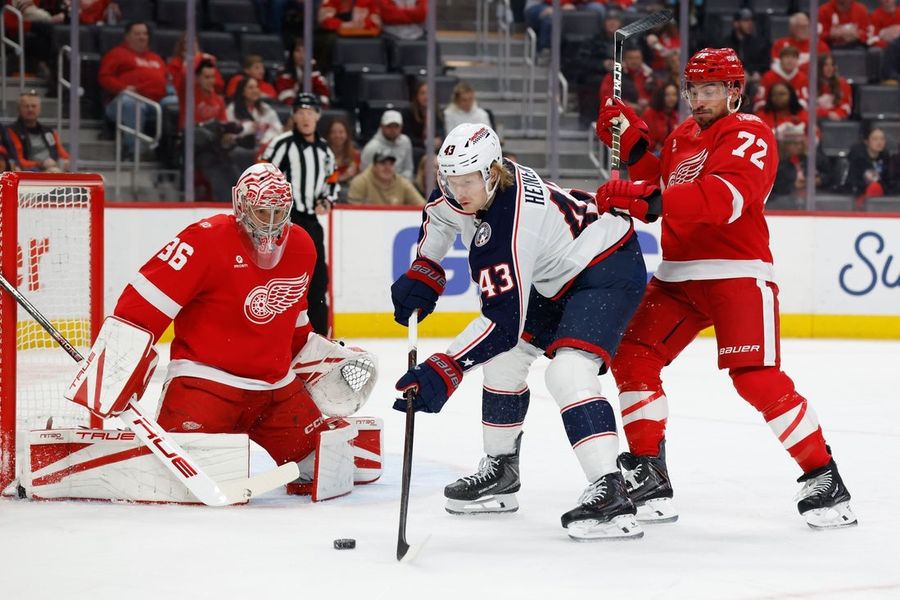
Deadspin | Zach Werenski, Blue Jackets collect critical win against Red Wings  Apr 7, 2026; Detroit, Michigan, USA;  Columbus Blue Jackets left wing Danton Heinen (43) tries to score on Detroit Red Wings goaltender John Gibson (36) defended by defenseman Justin Faulk (72) in the first period at Little Caesars Arena. Mandatory Credit: Rick Osentoski-Imagn Images   Zach Werenski had a goal and an assist in regulation, then scored the decisive goal in the shootout as the visiting Columbus Blue Jackets snapped a six-game losing streak with a 4-3 win over the Detroit Red Wings on Tuesday.  Adam Fantilli scored with 17 seconds left to force overtime, and Columbus won the shootout 3-2 in a game between teams fighting for the last wild card in the Eastern Conference. Danton Heinen also scored while goalie Jet Greaves made 34 saves and also had an assist for Columbus (39-27-12, 90 points).  Justin Faulk scored two goals and Dylan Larkin added the other for Detroit (40-29-9, 89 points). John Gibson made 32 saves.  Heinen gave Columbus the lead just 2:06 into the contest. Detroit turned the puck over behind its own net and Mason Marchment pounced on it and slid it to Heinen, who scored from the slot.  Detroit took advantage of a Conor Garland interference penalty to tie it. Larkin scored his 31st goal on the power play. He tried to pass the puck near the crease to Alex DeBrincat but it was blocked. The puck came right back to him and Larkin beat Graves.   Faulk gave Detroit a 2-1 lead at 6:27 of the second period. Faulk collected a pass from Larkin at center ice and skated into the Blue Jackets zone. He split two defenders and beat Graeves on the glove side. Ben Chiarot had the second assist.  Werenski scored a power play goal at 10:59 of the period to tie it. He ripped a shot from the point off a feed from Denton Mateychuk. Greaves was credited with the second assist.  Faulk scored his second goal with 4:46 remaining. Andrew Copp won a draw in Columbus’ zone and DeBrincat passed the puck to Faulk, who beat Greaves on the stick side.  Fantilli tied it with a slapshot from the right circle that beat Gibson on the short side. Werenski and Kirill Marchenko had the assists.  –Field Level Media    #Deadspin #Zach #Werenski #Blue #Jackets #collect #critical #win #Red #Wings
Deadspin | Zach Werenski, Blue Jackets collect critical win against Red Wings
Deadspin | Zach Werenski, Blue Jackets collect critical win against Red Wings  Apr 7, 2026; Detroit, Michigan, USA;  Columbus Blue Jackets left wing Danton Heinen (43) tries to score on Detroit Red Wings goaltender John Gibson (36) defended by defenseman Justin Faulk (72) in the first period at Little Caesars Arena. Mandatory Credit: Rick Osentoski-Imagn Images   Zach Werenski had a goal and an assist in regulation, then scored the decisive goal in the shootout as the visiting Columbus Blue Jackets snapped a six-game losing streak with a 4-3 win over the Detroit Red Wings on Tuesday.  Adam Fantilli scored with 17 seconds left to force overtime, and Columbus won the shootout 3-2 in a game between teams fighting for the last wild card in the Eastern Conference. Danton Heinen also scored while goalie Jet Greaves made 34 saves and also had an assist for Columbus (39-27-12, 90 points).  Justin Faulk scored two goals and Dylan Larkin added the other for Detroit (40-29-9, 89 points). John Gibson made 32 saves.  Heinen gave Columbus the lead just 2:06 into the contest. Detroit turned the puck over behind its own net and Mason Marchment pounced on it and slid it to Heinen, who scored from the slot.  Detroit took advantage of a Conor Garland interference penalty to tie it. Larkin scored his 31st goal on the power play. He tried to pass the puck near the crease to Alex DeBrincat but it was blocked. The puck came right back to him and Larkin beat Graves.   Faulk gave Detroit a 2-1 lead at 6:27 of the second period. Faulk collected a pass from Larkin at center ice and skated into the Blue Jackets zone. He split two defenders and beat Graeves on the glove side. Ben Chiarot had the second assist.  Werenski scored a power play goal at 10:59 of the period to tie it. He ripped a shot from the point off a feed from Denton Mateychuk. Greaves was credited with the second assist.  Faulk scored his second goal with 4:46 remaining. Andrew Copp won a draw in Columbus’ zone and DeBrincat passed the puck to Faulk, who beat Greaves on the stick side.  Fantilli tied it with a slapshot from the right circle that beat Gibson on the short side. Werenski and Kirill Marchenko had the assists.  –Field Level Media    #Deadspin #Zach #Werenski #Blue #Jackets #collect #critical #win #Red #WingsApr 7, 2026; Detroit, Michigan, USA; Columbus Blue Jackets left wing Danton Heinen (43) tries to score on Detroit Red Wings goaltender John Gibson (36) defended by defenseman Justin Faulk (72) in the first period at Little Caesars Arena. Mandatory Credit: Rick Osentoski-Imagn Images

Zach Werenski had a goal and an assist in regulation, then scored the decisive goal in the shootout as the visiting Columbus Blue Jackets snapped a six-game losing streak with a 4-3 win over the Detroit Red Wings on Tuesday.

Adam Fantilli scored with 17 seconds left to force overtime, and Columbus won the shootout 3-2 in a game between teams fighting for the last wild card in the Eastern Conference. Danton Heinen also scored while goalie Jet Greaves made 34 saves and also had an assist for Columbus (39-27-12, 90 points).

Justin Faulk scored two goals and Dylan Larkin added the other for Detroit (40-29-9, 89 points). John Gibson made 32 saves.

Heinen gave Columbus the lead just 2:06 into the contest. Detroit turned the puck over behind its own net and Mason Marchment pounced on it and slid it to Heinen, who scored from the slot.


Detroit took advantage of a Conor Garland interference penalty to tie it. Larkin scored his 31st goal on the power play. He tried to pass the puck near the crease to Alex DeBrincat but it was blocked. The puck came right back to him and Larkin beat Graves.

Faulk gave Detroit a 2-1 lead at 6:27 of the second period. Faulk collected a pass from Larkin at center ice and skated into the Blue Jackets zone. He split two defenders and beat Graeves on the glove side. Ben Chiarot had the second assist.

Werenski scored a power play goal at 10:59 of the period to tie it. He ripped a shot from the point off a feed from Denton Mateychuk. Greaves was credited with the second assist.

Faulk scored his second goal with 4:46 remaining. Andrew Copp won a draw in Columbus’ zone and DeBrincat passed the puck to Faulk, who beat Greaves on the stick side.

Fantilli tied it with a slapshot from the right circle that beat Gibson on the short side. Werenski and Kirill Marchenko had the assists.


–Field Level Media

#Deadspin #Zach #Werenski #Blue #Jackets #collect #critical #win #Red #Wings

Apr 7, 2026; Detroit, Michigan, USA; Columbus Blue Jackets left wing Danton Heinen (43) tries to score on Detroit Red Wings goaltender John Gibson (36) defended by defenseman Justin Faulk (72) in the first period at Little Caesars Arena. Mandatory Credit: Rick Osentoski-Imagn Images

Zach Werenski had a goal and an assist in regulation, then scored the decisive goal in the shootout as the visiting Columbus Blue Jackets snapped a six-game losing streak with a 4-3 win over the Detroit Red Wings on Tuesday.

Adam Fantilli scored with 17 seconds left to force overtime, and Columbus won the shootout 3-2 in a game between teams fighting for the last wild card in the Eastern Conference. Danton Heinen also scored while goalie Jet Greaves made 34 saves and also had an assist for Columbus (39-27-12, 90 points).

Justin Faulk scored two goals and Dylan Larkin added the other for Detroit (40-29-9, 89 points). John Gibson made 32 saves.

Heinen gave Columbus the lead just 2:06 into the contest. Detroit turned the puck over behind its own net and Mason Marchment pounced on it and slid it to Heinen, who scored from the slot.

Detroit took advantage of a Conor Garland interference penalty to tie it. Larkin scored his 31st goal on the power play. He tried to pass the puck near the crease to Alex DeBrincat but it was blocked. The puck came right back to him and Larkin beat Graves.

Faulk gave Detroit a 2-1 lead at 6:27 of the second period. Faulk collected a pass from Larkin at center ice and skated into the Blue Jackets zone. He split two defenders and beat Graeves on the glove side. Ben Chiarot had the second assist.

Werenski scored a power play goal at 10:59 of the period to tie it. He ripped a shot from the point off a feed from Denton Mateychuk. Greaves was credited with the second assist.

Faulk scored his second goal with 4:46 remaining. Andrew Copp won a draw in Columbus’ zone and DeBrincat passed the puck to Faulk, who beat Greaves on the stick side.

Fantilli tied it with a slapshot from the right circle that beat Gibson on the short side. Werenski and Kirill Marchenko had the assists.

–Field Level Media

Source link
#Deadspin #Zach #Werenski #Blue #Jackets #collect #critical #win #Red #Wings

Previous post

Juventus’ Dusan Vlahovic suffers latest injury setback <div id="content-body-70834266" itemprop="articleBody"><p>Juventus’ Serbia attacker Dusan Vlahovic is set to be sidelined for three weeks due to a calf issue, having recently recovered from a groin injury.</p><p>Vlahovic, 26, had been out since December but returned to action in mid-March before suffering this latest setback during Monday’s 2-0 Serie A win over Genoa.</p><p>According to Italian media, Vlahovic will be out for at least three weeks.</p><p><b>ALSO READ | <a href="https://sportstar.thehindu.com/football/aaron-ramsey-retirement-arsenal-wales-juventus-football-club-international/article70833902.ece" target="_blank" rel="nofollow">Aaron Ramsey, former Arsenal and Wales player, retires</a></b></p><p>“During the warm-up held in the second half of the match against Genoa, Dusan Vlahovic felt an issue in his left calf,” Juventus said.</p><p>“As a result, this morning he underwent diagnostic tests. The examinations revealed low-grade damage,” it added.</p><p>Juventus is fifth in the Italian table, one point behind Como in the final Champions League spot with seven games of the season to play.</p><p class="publish-time" id="end-of-article">Published on Apr 07, 2026</p></div> #Juventus #Dusan #Vlahovic #suffers #latest #injury #setback

Next post

Sanori Is Hiring A Brand & Creative Associate In New York, NY

Rory McIlroy won the Masters. It is an unbelievable sentence. The golfing world is still astounded that we have said it out loud in consecutive years now.

A popular take in the aftermath of the 90th edition of the Masters (this most recent one) is that Rory would not have been able to win it without first capturing the 89th. The experience from winning at Augusta clearly mattered to Rory, but so did the psychological freedom that came from finally ridding himself of the burden associated with doing so.

Rory spoke openly all last week about how he was more comfortable on the grounds at Augusta National than he ever had been. Following Saturday’s round specifically where he lost the 6-shot lead he began the day with, he noted that he would remember on Sunday that he was a Masters Champion. His point, not to speak for him, was that he would walk with confidence in knowing he had already climbed the mountain ahead of him.

He also knew the terrain very well.

The debate around Rory’s Masters prep is absurd

It is well understood that there are scores of traditions associated with the Masters. One of the more notables here is that the tournament is played at Augusta National on an annual basis.

Rory, who last played competitively before Augusta at Bay Hill where he withdrew, winning the tournament for a second straight year has seemingly taken things even more mainstream than they have been becoming as of late. Golf is having a a boom and more people are learning of specifics involved with it.

It is for these reasons that what he said on Sunday evening after defending his title that has the rest of the world acting silly.

McIlroy noted that he prepared quite diligently for the Masters. At one point throughout the weekend he even noted that there were instances where he would drop his daughter off at school, make it to Augusta for a round, and be back home in the same day.

For some reason… the idea that Rory prepared for the Masters by practicing on the grounds has become a flashpoint for people.

Part of the issue here is likely the lore associated with the Masters. It seems people (incorrectly) assumed that Rory had some special privilege as a previous winner. That is not the case.

Anyone involved in the Masters had the ability to practice on the grounds as much as he did. This was noted in detail by a post from Michael Kim on X (shout out to him for some much-needed context).

We can (hopefully) put to bed the idea that Rory had some inside track that his competitors did not. It is obviously true that he was not in Houston or San Antonio participating in the PGA Tour events that led up to the Masters the way that others were, but that is all a part of his own schedule and preparations as all players are able to adjust to their own rhythms.

What’s more is even if we step past the fact that no rules were broken and no lines were crossed… is it not awesome that Rory put so much time and effort into winning the Masters?

As noted the event has reached a level of fanfare that is only superseded by the Super Bowl now. It is an epic thing. Beyond epic. We revere it in such esteem for reasons that we all share or are unique to us individually, but we all recognize that it is something beyond the normal realm in sports or life at large.

Rory treated it that way. And he did so after already taming it. He gave the event its proper respect and his entire self in the name of tasting the sweetness that he so clearly did not want to ever let go of. That is so cool.

So often in sports things are disillusioned by the realities of life. Sports are a profession for so many and the level of care is not the same between athletes and fans. That isn’t to blame anyone at all, but that is just the way it goes.

Rory approached the Masters the way we as fans do. He obsessed over it the way that people who apply for the lottery every year do, or the people who filmed merch haul videos do, or the way that anyone who has their own “Masters” around the same time of year with their local golfing group does. He was one of us out there.

Do not let anyone convince you that this is a thing. It is silly. At absolute best.

#debate #Rory #McIlroys #Masters #prep #silly #worth #time">The debate about Rory McIlroy’s Masters prep is silly and not worth your time  Rory McIlroy won the Masters. It is an unbelievable sentence. The golfing world is still astounded that we have said it out loud in consecutive years now.A popular take in the aftermath of the 90th edition of the Masters (this most recent one) is that Rory would not have been able to win it without first capturing the 89th. The experience from winning at Augusta clearly mattered to Rory, but so did the psychological freedom that came from finally ridding himself of the burden associated with doing so.Rory spoke openly all last week about how he was more comfortable on the grounds at Augusta National than he ever had been. Following Saturday’s round specifically where he lost the 6-shot lead he began the day with, he noted that he would remember on Sunday that he was a Masters Champion. His point, not to speak for him, was that he would walk with confidence in knowing he had already climbed the mountain ahead of him.He also knew the terrain very well.The debate around Rory’s Masters prep is absurdIt is well understood that there are scores of traditions associated with the Masters. One of the more notables here is that the tournament is played at Augusta National on an annual basis.Rory, who last played competitively before Augusta at Bay Hill where he withdrew, winning the tournament for a second straight year has seemingly taken things even more mainstream than they have been becoming as of late. Golf is having a a boom and more people are learning of specifics involved with it.It is for these reasons that what he said on Sunday evening after defending his title that has the rest of the world acting silly.McIlroy noted that he prepared quite diligently for the Masters. At one point throughout the weekend he even noted that there were instances where he would drop his daughter off at school, make it to Augusta for a round, and be back home in the same day.For some reason… the idea that Rory prepared for the Masters by practicing on the grounds has become a flashpoint for people.Part of the issue here is likely the lore associated with the Masters. It seems people (incorrectly) assumed that Rory had some special privilege as a previous winner. That is not the case.Anyone involved in the Masters had the ability to practice on the grounds as much as he did. This was noted in detail by a post from Michael Kim on X (shout out to him for some much-needed context).We can (hopefully) put to bed the idea that Rory had some inside track that his competitors did not. It is obviously true that he was not in Houston or San Antonio participating in the PGA Tour events that led up to the Masters the way that others were, but that is all a part of his own schedule and preparations as all players are able to adjust to their own rhythms.What’s more is even if we step past the fact that no rules were broken and no lines were crossed… is it not awesome that Rory put so much time and effort into winning the Masters?As noted the event has reached a level of fanfare that is only superseded by the Super Bowl now. It is an epic thing. Beyond epic. We revere it in such esteem for reasons that we all share or are unique to us individually, but we all recognize that it is something beyond the normal realm in sports or life at large.Rory treated it that way. And he did so after already taming it. He gave the event its proper respect and his entire self in the name of tasting the sweetness that he so clearly did not want to ever let go of. That is so cool.So often in sports things are disillusioned by the realities of life. Sports are a profession for so many and the level of care is not the same between athletes and fans. That isn’t to blame anyone at all, but that is just the way it goes.Rory approached the Masters the way we as fans do. He obsessed over it the way that people who apply for the lottery every year do, or the people who filmed merch haul videos do, or the way that anyone who has their own “Masters” around the same time of year with their local golfing group does. He was one of us out there.Do not let anyone convince you that this is a thing. It is silly. At absolute best.  #debate #Rory #McIlroys #Masters #prep #silly #worth #time

When he called time on his international career in 2017, Moritz Fuerste was one of the most accomplished field hockey players of all time. He’d been capped 268 times for Germany, scored 112 goals and won three Olympic medals, including gold at Beijing and London and a bronze at his final Games in Rio.

And while many elite athletes struggle for meaning post-retirement, Fuerste had long been planning for life after professional sport. He’d go on to found HYROX, a fitness brand that organises mass-participation indoor competitions combining running and functional workouts in a standardised format.

These days, HYROX is one of the fastest-growing global fitness brands. It closed 2025 with an estimated 150 million dollars in revenue and had over 600,000 athletes competing annually in competitions it organises in cities across the world. HYROX Bengaluru, which concluded last Sunday, drew over 8,200 participants across two days – a nearly fivefold jump from its first India edition in Mumbai last year, when it drew 1,650 participants.

In an interview with Sportstar, Fuertse, now 41, spoke on his journey from elite sport to founding one of the most successful fitness startups in the world today and how the lessons he learned while competing in the Hockey India League translated to the world of business.

It’s not common in India for high level athletes to make the plunge into the business world. How did that come about for you?

I’ve spent a lot of time in India, so I know how things work here in regard to hockey. I think it’s important to understand that in Germany, hockey is not a professional sport. Players don’t make a living from playing. You can’t provide for your family or even for the rest of your life. I knew I was going to have to leave the game at some point in time, and I was always preparing for that eventuality.

I did my university degree by the time I was 30, and I knew I was going to leave international hockey after the Rio Olympics. I knew it was going to be a big shock if I switched suddenly from being a full-time athlete who wasn’t making any money to a full-time employee. I didn’t want to go down that road, so I’d already started working a little bit during my playing days, and after the Olympics, I decided I was going to start a company with my business partner. But that turnaround from being a professional player to a business owner was a tough step.

While you were preparing for the next chapter, were you ever concerned that you were going to end up crunching numbers in a cubicle?

That’s true. A corporate job would never have suited me. But I always believed I’d be able to find something that I enjoyed as much as I loved being a hockey player. I knew I had to find something that I would have the same energy and fire for that I had for being a hockey player.

It was always going to take something special to replace the role that hockey had in my life.

How did the idea for HYROX come about?

When I was founding a company, I wanted to do something that allowed me to stay in the world of sport. But even within sport, I noticed a void. If you’re a tennis player, you play tennis. If you’re a runner, there are marathons or half marathons. And if you’re a rower, then there are rowing competitions. If you are a hockey player, of course, you play hockey.

But if you’re a gym goer, there is literally no competition directly for that, and there was no competition or race for that. I felt that was crazy because most people in the world who are doing any kind of fitness activities are gym goers. There are hundreds of millions of these people. They go to a gym, and there is no way, no race or sport for these people to compete. That was a huge void that I thought could be filled.

I would compare starting HYROX to playing my first season in Hockey India League: Moritz Fuertse  When he called time on his international career in 2017, Moritz Fuerste was one of the most accomplished field hockey players of all time. He’d been capped 268 times for Germany, scored 112 goals and won three Olympic medals, including gold at Beijing and London and a bronze at his final Games in Rio.And while many elite athletes struggle for meaning post-retirement, Fuerste had long been planning for life after professional sport. He’d go on to found HYROX, a fitness brand that organises mass-participation indoor competitions combining running and functional workouts in a standardised format.These days, HYROX is one of the fastest-growing global fitness brands. It closed 2025 with an estimated 150 million dollars in revenue and had over 600,000 athletes competing annually in competitions it organises in cities across the world. HYROX Bengaluru, which concluded last Sunday, drew over 8,200 participants across two days – a nearly fivefold jump from its first India edition in Mumbai last year, when it drew 1,650 participants.In an interview with        Sportstar, Fuertse, now 41, spoke on his journey from elite sport to founding one of the most successful fitness startups in the world today and how the lessons he learned while competing in the Hockey India League translated to the world of business.It’s not common in India for high level athletes to make the plunge into the business world. How did that come about for you?I’ve spent a lot of time in India, so I know how things work here in regard to hockey. I think it’s important to understand that in Germany, hockey is not a professional sport. Players don’t make a living from playing. You can’t provide for your family or even for the rest of your life. I knew I was going to have to leave the game at some point in time, and I was always preparing for that eventuality.I did my university degree by the time I was 30, and I knew I was going to leave international hockey after the Rio Olympics. I knew it was going to be a big shock if I switched suddenly from being a full-time athlete who wasn’t making any money to a full-time employee. I didn’t want to go down that road, so I’d already started working a little bit during my playing days, and after the Olympics, I decided I was going to start a company with my business partner. But that turnaround from being a professional player to a business owner was a tough step.While you were preparing for the next chapter, were you ever concerned that you were going to end up crunching numbers in a cubicle?That’s true. A corporate job would never have suited me. But I always believed I’d be able to find something that I enjoyed as much as I loved being a hockey player. I knew I had to find something that I would have the same energy and fire for that I had for being a hockey player.It was always going to take something special to replace the role that hockey had in my life.How did the idea for HYROX come about?When I was founding a company, I wanted to do something that allowed me to stay in the world of sport. But even within sport, I noticed a void. If you’re a tennis player, you play tennis. If you’re a runner, there are marathons or half marathons. And if you’re a rower, then there are rowing competitions. If you are a hockey player, of course, you play hockey.But if you’re a gym goer, there is literally no competition directly for that, and there was no competition or race for that. I felt that was crazy because most people in the world who are doing any kind of fitness activities are gym goers. There are hundreds of millions of these people. They go to a gym, and there is no way, no race or sport for these people to compete. That was a huge void that I thought could be filled. The Ultrahuman Hyrox Bengaluru race was held at the Bangalore International Exhibition Centre on April 11 and 12.
                                                            | Photo Credit: 
                                Instagram/hyroxindia
                            

                            The Ultrahuman Hyrox Bengaluru race was held at the Bangalore International Exhibition Centre on April 11 and 12.
                                                            | Photo Credit: 
                                Instagram/hyroxindia
                                                    Even at the time I started, I thought this could be as big as marathon running at some point in time, but it’s been absolutely crazy how well HYROX has done. We ended up outperforming our most optimistic business models by over 100 per cent. I thought we would eventually get to where we were, but I didn’t think it would happen as quickly as it did.In what ways did the skills you picked up in your playing career translate to running a business?In both of these worlds, what matters is putting together a team. I think one of my strengths as a player was that I was able to create successful teams. You have to understand leadership structures and hierarchies within the company. You have to work with feedback, negative feedback, and criticism. These are all things that we are very used to from the playing field, and especially the hockey field.Other things, I mean, obviously, as a player in professional sports, you have to be very organised, you have to be very structured, you have to be disciplined. You also have to be relentless, and you have to never give up because that’s just how it is. You fight till the last whistle, and until then, you just keep fighting.And I think as a business founder, that’s also very important because there are many ups and downs and many low points and many things where you question yourself, and you just can’t question yourself all the time. You just have to get into the working mode. And I think that’s something I learned a lot in hockey.But there has to be a difference between being part of a German team that was already a really strong team and starting something from nothing, like with HYROX.I think that’s true. I would actually compare starting HYROX with the time I came to India and competed in the HIL for Ranchi Rhinos. That’s a closer comparison. When I came to India the first year, we started putting a team together that in the end ended up winning the league. A couple of years later, I switched to the Kalinga Lancers, and we did the same thing again. In Europe, I played in a few leagues, and I ended up doing the same thing.File photo: Moritz Fuerste has represented Ranchi Rhinos and Kalinga Lancers in the Hockey India League.
                                                            | Photo Credit: 
                                Biswaranjan Rout
                            File photo: Moritz Fuerste has represented Ranchi Rhinos and Kalinga Lancers in the Hockey India League.
                                                            | Photo Credit: 
                                Biswaranjan Rout
                                                    I think that the ability to lead new teams was one of my strengths, and that was the main asset I brought into founding the company as well. I think I’m quite good at putting the right people together to achieve a common goal.You were actually one of the highest paid players in the HIL. What do you remember of your time there?My first year was very special. It was almost spiritual for me to come here and stay here for eight weeks and have the experience with all these young players. I played with Manpreet, Mandeep, and all these young Indian players in the first year. We didn’t have a single senior Indian player in that team. I got to both work with and shape these guys.The next years were a little bit more about business, focusing on doing the job and experiencing what I never experienced usually, which is these big crowds in stadiums and being very much in the focus. I got my 15 minutes of fame, which I enjoyed a lot.What did you mean when you described the first season of the HIL as ‘spiritual’?I’d actually been to India before, when I was playing the Champions Trophy in Chennai in 2005. At that time, we literally didn’t leave the hotel. In that first season of the HIL, we did things like going to the Golden Temple in Amritsar. We visited a few other temples and did a lot of cultural things. I went to Mandeep’s home, and he showed me around his family.There were a lot of life lessons I took from that experience. It helped me understand how people in different parts of the world live and handle their lives. There were many things that came together that year that made me a better person and also helped me become a better player.You’ve spoken of what lessons you carried over from hockey to business. What did you have to learn when running a business?It’s not different, but I think the most important thing in business, as in sport, is to find out very quickly what your personal strength is and what are the things you can drive. I knew in sports that you could wake me at 3 a.m., and I would know what to do with the ball. When I started HYROX, I knew the challenge was to also find my strength.What also mattered was really finding my place and getting that respect that I had initially as a hockey player that I earned over the course of my career. Getting that respect on that business level was also a challenge for me because if you want people to respect you, you need to give them a reason why they should respect you. That combination was quite a challenge at the beginning.ALSO READ | How Ironman and HYROX are redefining fitness culture in IndiaWhen you found a company, you are going to make a lot of mistakes. Of course, in hindsight, you think you could have done things differently, but that’s when you understand the importance of never giving up. You just need to be relentless, and you need to have a certain thick skin that doesn’t let you fall. And if you do, pick yourself up.Do you think there is any advantage to being a sportsperson when you’re running a business? Do you look for a sportsperson when you are hiring?I actually never look at a CV while hiring. I don’t look at grades. I’m not really interested in that. I care about who people are, and sport is a very important piece of that puzzle. If I understand that someone likes to do sports or has done sports, that’s a very valuable ingredient in whether I hire someone.HYROX is one of the fastest-growing sports brands in the world. How does that compare to winning three Olympic medals? Which gives you more satisfaction?I can’t compare the two. I gave 25 years of my life to hockey. My first life was being a hockey player, and I’m very grateful for that. I had an amazing decade with a team that I’d say would be one of the top five of all time.I had some great career highlights. I remember the quarterfinals of the Rio Olympics, where we were just seconds away from losing the quarterfinals to New Zealand and when I scored twice in the last 45 seconds to win the match. There was the semifinals against Australia in the London Olympics when we completely outplayed what I felt was another all-time great team. But every chapter has to end at some point in time. Moritz Fuerste has won three Olympic medals, gold at Beijing and London and a bronze at his final Games in Rio.
                                                            | Photo Credit: 
                                Getty Images
                            

                            Moritz Fuerste has won three Olympic medals, gold at Beijing and London and a bronze at his final Games in Rio.
                                                            | Photo Credit: 
                                Getty Images
                                                    What I’m doing now is a completely different kind of thing. We are all over the world, and we crossed half a million participants last season. HYROX is huge, but I don’t know if it’s ‘bigger’ than my hockey life.It’s not just that I have a soft spot for hockey. It will always be my first love. Also, my daughters play hockey, so hopefully they will do well as well.You have three Olympic medals. Do you show them off to investors or is that something you keep to yourself?My medals are with me at home, but they aren’t on display. People who visit me at home get a chance to get a glimpse of them, but they aren’t something I show off.While you retired from international hockey in 2017, you continued to play at the club level in Europe for a couple of more years while you were starting your business. How difficult was it to do both?It is a completely different ball game to play club hockey in Germany in comparison to playing international hockey. At the international level, I was doing one or two training sessions daily. And I was a pretty decent player even when I retired from international hockey at 33 or so. So the move to club hockey, where I was training maybe two or three times a week, wasn’t difficult at all. I could go to the office for the entire day and then just come to the training sessions at night.ALSO READ | IND vs ARG: India gets Savita boost ahead of Argentina tour but will miss Salima’s servicesI tried to keep myself fit to a certain extent, but I just basically played until I started to feel that it was time for me to step down because I knew that even though I was doing ok with training two or three times a week, it wasn’t helping any more. And I didn’t want to get to the level where I was going to be a problem for the team, so I quit early enough.Do you still play hockey from time to time?I actually founded a team with my former teammates from my hometown of Hamburg. Last year, we were playing in the 4th division of Germany. Our opponents are some 20 years younger than us but we still enjoy it. And we still beat them!Do you miss the bit about playing? Do you sometimes wish you could go into the field again?I have such amazing memories being a player and getting the chance to step on that pitch. I’m very grateful that I had the chance to experience that for the better part of my life. There are no regrets, there’s just happiness and joy when I remember the old times. But it’s a part of my life that’s over now, otherwise I’d be trying to do it again! It’s over, and that’s good. A new chapter is on now. Of course, when I watch games now, I have a lot of memories popping up in my head of me playing myself.I don’t watch many games live, but I watch them all on        YouTube, and I follow hockey a lot. I still think it’s a very beautiful sport that needs a lot of attention and should have much more attention. It’s already kind of big in India, but I want it to be big elsewhere in the world.Have you ever taken part in HYROX as well?I do. I think I’m physically about as fit as I was back in my playing days because I focus only on athleticism and because I’m very competitive. I always want to beat my personal record time in Hyrox. I train a lot, and my goal is to beat the hour – do something like 58 or 59.But mostly I’m a doubles athlete. It’s not because of my age or anything, but because it’s much more fun to share the workload and go through the tactics of being teamed up with someone. I just enjoy that very much.Published on Apr 14, 2026  #compare #starting #HYROX #playing #season #Hockey #India #League #Moritz #Fuertse

The Ultrahuman Hyrox Bengaluru race was held at the Bangalore International Exhibition Centre on April 11 and 12. | Photo Credit: Instagram/hyroxindia

lightbox-info

The Ultrahuman Hyrox Bengaluru race was held at the Bangalore International Exhibition Centre on April 11 and 12. | Photo Credit: Instagram/hyroxindia

Even at the time I started, I thought this could be as big as marathon running at some point in time, but it’s been absolutely crazy how well HYROX has done. We ended up outperforming our most optimistic business models by over 100 per cent. I thought we would eventually get to where we were, but I didn’t think it would happen as quickly as it did.

In what ways did the skills you picked up in your playing career translate to running a business?

In both of these worlds, what matters is putting together a team. I think one of my strengths as a player was that I was able to create successful teams. You have to understand leadership structures and hierarchies within the company. You have to work with feedback, negative feedback, and criticism. These are all things that we are very used to from the playing field, and especially the hockey field.

Other things, I mean, obviously, as a player in professional sports, you have to be very organised, you have to be very structured, you have to be disciplined. You also have to be relentless, and you have to never give up because that’s just how it is. You fight till the last whistle, and until then, you just keep fighting.

And I think as a business founder, that’s also very important because there are many ups and downs and many low points and many things where you question yourself, and you just can’t question yourself all the time. You just have to get into the working mode. And I think that’s something I learned a lot in hockey.

But there has to be a difference between being part of a German team that was already a really strong team and starting something from nothing, like with HYROX.

I think that’s true. I would actually compare starting HYROX with the time I came to India and competed in the HIL for Ranchi Rhinos. That’s a closer comparison. When I came to India the first year, we started putting a team together that in the end ended up winning the league. A couple of years later, I switched to the Kalinga Lancers, and we did the same thing again. In Europe, I played in a few leagues, and I ended up doing the same thing.

File photo: Moritz Fuerste has represented Ranchi Rhinos and Kalinga Lancers in the Hockey India League.

File photo: Moritz Fuerste has represented Ranchi Rhinos and Kalinga Lancers in the Hockey India League. | Photo Credit: Biswaranjan Rout

lightbox-info

File photo: Moritz Fuerste has represented Ranchi Rhinos and Kalinga Lancers in the Hockey India League. | Photo Credit: Biswaranjan Rout

I think that the ability to lead new teams was one of my strengths, and that was the main asset I brought into founding the company as well. I think I’m quite good at putting the right people together to achieve a common goal.

You were actually one of the highest paid players in the HIL. What do you remember of your time there?

My first year was very special. It was almost spiritual for me to come here and stay here for eight weeks and have the experience with all these young players. I played with Manpreet, Mandeep, and all these young Indian players in the first year. We didn’t have a single senior Indian player in that team. I got to both work with and shape these guys.

The next years were a little bit more about business, focusing on doing the job and experiencing what I never experienced usually, which is these big crowds in stadiums and being very much in the focus. I got my 15 minutes of fame, which I enjoyed a lot.

What did you mean when you described the first season of the HIL as ‘spiritual’?

I’d actually been to India before, when I was playing the Champions Trophy in Chennai in 2005. At that time, we literally didn’t leave the hotel. In that first season of the HIL, we did things like going to the Golden Temple in Amritsar. We visited a few other temples and did a lot of cultural things. I went to Mandeep’s home, and he showed me around his family.

There were a lot of life lessons I took from that experience. It helped me understand how people in different parts of the world live and handle their lives. There were many things that came together that year that made me a better person and also helped me become a better player.

You’ve spoken of what lessons you carried over from hockey to business. What did you have to learn when running a business?

It’s not different, but I think the most important thing in business, as in sport, is to find out very quickly what your personal strength is and what are the things you can drive. I knew in sports that you could wake me at 3 a.m., and I would know what to do with the ball. When I started HYROX, I knew the challenge was to also find my strength.

What also mattered was really finding my place and getting that respect that I had initially as a hockey player that I earned over the course of my career. Getting that respect on that business level was also a challenge for me because if you want people to respect you, you need to give them a reason why they should respect you. That combination was quite a challenge at the beginning.

ALSO READ | How Ironman and HYROX are redefining fitness culture in India

When you found a company, you are going to make a lot of mistakes. Of course, in hindsight, you think you could have done things differently, but that’s when you understand the importance of never giving up. You just need to be relentless, and you need to have a certain thick skin that doesn’t let you fall. And if you do, pick yourself up.

Do you think there is any advantage to being a sportsperson when you’re running a business? Do you look for a sportsperson when you are hiring?

I actually never look at a CV while hiring. I don’t look at grades. I’m not really interested in that. I care about who people are, and sport is a very important piece of that puzzle. If I understand that someone likes to do sports or has done sports, that’s a very valuable ingredient in whether I hire someone.

HYROX is one of the fastest-growing sports brands in the world. How does that compare to winning three Olympic medals? Which gives you more satisfaction?

I can’t compare the two. I gave 25 years of my life to hockey. My first life was being a hockey player, and I’m very grateful for that. I had an amazing decade with a team that I’d say would be one of the top five of all time.

I had some great career highlights. I remember the quarterfinals of the Rio Olympics, where we were just seconds away from losing the quarterfinals to New Zealand and when I scored twice in the last 45 seconds to win the match. There was the semifinals against Australia in the London Olympics when we completely outplayed what I felt was another all-time great team. But every chapter has to end at some point in time.

Moritz Fuerste has won three Olympic medals, gold at Beijing and London and a bronze at his final Games in Rio.

Moritz Fuerste has won three Olympic medals, gold at Beijing and London and a bronze at his final Games in Rio. | Photo Credit: Getty Images

lightbox-info

Moritz Fuerste has won three Olympic medals, gold at Beijing and London and a bronze at his final Games in Rio. | Photo Credit: Getty Images

What I’m doing now is a completely different kind of thing. We are all over the world, and we crossed half a million participants last season. HYROX is huge, but I don’t know if it’s ‘bigger’ than my hockey life.

It’s not just that I have a soft spot for hockey. It will always be my first love. Also, my daughters play hockey, so hopefully they will do well as well.

You have three Olympic medals. Do you show them off to investors or is that something you keep to yourself?

My medals are with me at home, but they aren’t on display. People who visit me at home get a chance to get a glimpse of them, but they aren’t something I show off.

While you retired from international hockey in 2017, you continued to play at the club level in Europe for a couple of more years while you were starting your business. How difficult was it to do both?

It is a completely different ball game to play club hockey in Germany in comparison to playing international hockey. At the international level, I was doing one or two training sessions daily. And I was a pretty decent player even when I retired from international hockey at 33 or so. So the move to club hockey, where I was training maybe two or three times a week, wasn’t difficult at all. I could go to the office for the entire day and then just come to the training sessions at night.

ALSO READ | IND vs ARG: India gets Savita boost ahead of Argentina tour but will miss Salima’s services

I tried to keep myself fit to a certain extent, but I just basically played until I started to feel that it was time for me to step down because I knew that even though I was doing ok with training two or three times a week, it wasn’t helping any more. And I didn’t want to get to the level where I was going to be a problem for the team, so I quit early enough.

Do you still play hockey from time to time?

I actually founded a team with my former teammates from my hometown of Hamburg. Last year, we were playing in the 4th division of Germany. Our opponents are some 20 years younger than us but we still enjoy it. And we still beat them!

Do you miss the bit about playing? Do you sometimes wish you could go into the field again?

I have such amazing memories being a player and getting the chance to step on that pitch. I’m very grateful that I had the chance to experience that for the better part of my life. There are no regrets, there’s just happiness and joy when I remember the old times. But it’s a part of my life that’s over now, otherwise I’d be trying to do it again! It’s over, and that’s good. A new chapter is on now. Of course, when I watch games now, I have a lot of memories popping up in my head of me playing myself.

I don’t watch many games live, but I watch them all on YouTube, and I follow hockey a lot. I still think it’s a very beautiful sport that needs a lot of attention and should have much more attention. It’s already kind of big in India, but I want it to be big elsewhere in the world.

Have you ever taken part in HYROX as well?

I do. I think I’m physically about as fit as I was back in my playing days because I focus only on athleticism and because I’m very competitive. I always want to beat my personal record time in Hyrox. I train a lot, and my goal is to beat the hour – do something like 58 or 59.

But mostly I’m a doubles athlete. It’s not because of my age or anything, but because it’s much more fun to share the workload and go through the tactics of being teamed up with someone. I just enjoy that very much.

Published on Apr 14, 2026

#compare #starting #HYROX #playing #season #Hockey #India #League #Moritz #Fuertse">I would compare starting HYROX to playing my first season in Hockey India League: Moritz Fuertse  When he called time on his international career in 2017, Moritz Fuerste was one of the most accomplished field hockey players of all time. He’d been capped 268 times for Germany, scored 112 goals and won three Olympic medals, including gold at Beijing and London and a bronze at his final Games in Rio.And while many elite athletes struggle for meaning post-retirement, Fuerste had long been planning for life after professional sport. He’d go on to found HYROX, a fitness brand that organises mass-participation indoor competitions combining running and functional workouts in a standardised format.These days, HYROX is one of the fastest-growing global fitness brands. It closed 2025 with an estimated 150 million dollars in revenue and had over 600,000 athletes competing annually in competitions it organises in cities across the world. HYROX Bengaluru, which concluded last Sunday, drew over 8,200 participants across two days – a nearly fivefold jump from its first India edition in Mumbai last year, when it drew 1,650 participants.In an interview with        Sportstar, Fuertse, now 41, spoke on his journey from elite sport to founding one of the most successful fitness startups in the world today and how the lessons he learned while competing in the Hockey India League translated to the world of business.It’s not common in India for high level athletes to make the plunge into the business world. How did that come about for you?I’ve spent a lot of time in India, so I know how things work here in regard to hockey. I think it’s important to understand that in Germany, hockey is not a professional sport. Players don’t make a living from playing. You can’t provide for your family or even for the rest of your life. I knew I was going to have to leave the game at some point in time, and I was always preparing for that eventuality.I did my university degree by the time I was 30, and I knew I was going to leave international hockey after the Rio Olympics. I knew it was going to be a big shock if I switched suddenly from being a full-time athlete who wasn’t making any money to a full-time employee. I didn’t want to go down that road, so I’d already started working a little bit during my playing days, and after the Olympics, I decided I was going to start a company with my business partner. But that turnaround from being a professional player to a business owner was a tough step.While you were preparing for the next chapter, were you ever concerned that you were going to end up crunching numbers in a cubicle?That’s true. A corporate job would never have suited me. But I always believed I’d be able to find something that I enjoyed as much as I loved being a hockey player. I knew I had to find something that I would have the same energy and fire for that I had for being a hockey player.It was always going to take something special to replace the role that hockey had in my life.How did the idea for HYROX come about?When I was founding a company, I wanted to do something that allowed me to stay in the world of sport. But even within sport, I noticed a void. If you’re a tennis player, you play tennis. If you’re a runner, there are marathons or half marathons. And if you’re a rower, then there are rowing competitions. If you are a hockey player, of course, you play hockey.But if you’re a gym goer, there is literally no competition directly for that, and there was no competition or race for that. I felt that was crazy because most people in the world who are doing any kind of fitness activities are gym goers. There are hundreds of millions of these people. They go to a gym, and there is no way, no race or sport for these people to compete. That was a huge void that I thought could be filled. The Ultrahuman Hyrox Bengaluru race was held at the Bangalore International Exhibition Centre on April 11 and 12.
                                                            | Photo Credit: 
                                Instagram/hyroxindia
                            

                            The Ultrahuman Hyrox Bengaluru race was held at the Bangalore International Exhibition Centre on April 11 and 12.
                                                            | Photo Credit: 
                                Instagram/hyroxindia
                                                    Even at the time I started, I thought this could be as big as marathon running at some point in time, but it’s been absolutely crazy how well HYROX has done. We ended up outperforming our most optimistic business models by over 100 per cent. I thought we would eventually get to where we were, but I didn’t think it would happen as quickly as it did.In what ways did the skills you picked up in your playing career translate to running a business?In both of these worlds, what matters is putting together a team. I think one of my strengths as a player was that I was able to create successful teams. You have to understand leadership structures and hierarchies within the company. You have to work with feedback, negative feedback, and criticism. These are all things that we are very used to from the playing field, and especially the hockey field.Other things, I mean, obviously, as a player in professional sports, you have to be very organised, you have to be very structured, you have to be disciplined. You also have to be relentless, and you have to never give up because that’s just how it is. You fight till the last whistle, and until then, you just keep fighting.And I think as a business founder, that’s also very important because there are many ups and downs and many low points and many things where you question yourself, and you just can’t question yourself all the time. You just have to get into the working mode. And I think that’s something I learned a lot in hockey.But there has to be a difference between being part of a German team that was already a really strong team and starting something from nothing, like with HYROX.I think that’s true. I would actually compare starting HYROX with the time I came to India and competed in the HIL for Ranchi Rhinos. That’s a closer comparison. When I came to India the first year, we started putting a team together that in the end ended up winning the league. A couple of years later, I switched to the Kalinga Lancers, and we did the same thing again. In Europe, I played in a few leagues, and I ended up doing the same thing.File photo: Moritz Fuerste has represented Ranchi Rhinos and Kalinga Lancers in the Hockey India League.
                                                            | Photo Credit: 
                                Biswaranjan Rout
                            File photo: Moritz Fuerste has represented Ranchi Rhinos and Kalinga Lancers in the Hockey India League.
                                                            | Photo Credit: 
                                Biswaranjan Rout
                                                    I think that the ability to lead new teams was one of my strengths, and that was the main asset I brought into founding the company as well. I think I’m quite good at putting the right people together to achieve a common goal.You were actually one of the highest paid players in the HIL. What do you remember of your time there?My first year was very special. It was almost spiritual for me to come here and stay here for eight weeks and have the experience with all these young players. I played with Manpreet, Mandeep, and all these young Indian players in the first year. We didn’t have a single senior Indian player in that team. I got to both work with and shape these guys.The next years were a little bit more about business, focusing on doing the job and experiencing what I never experienced usually, which is these big crowds in stadiums and being very much in the focus. I got my 15 minutes of fame, which I enjoyed a lot.What did you mean when you described the first season of the HIL as ‘spiritual’?I’d actually been to India before, when I was playing the Champions Trophy in Chennai in 2005. At that time, we literally didn’t leave the hotel. In that first season of the HIL, we did things like going to the Golden Temple in Amritsar. We visited a few other temples and did a lot of cultural things. I went to Mandeep’s home, and he showed me around his family.There were a lot of life lessons I took from that experience. It helped me understand how people in different parts of the world live and handle their lives. There were many things that came together that year that made me a better person and also helped me become a better player.You’ve spoken of what lessons you carried over from hockey to business. What did you have to learn when running a business?It’s not different, but I think the most important thing in business, as in sport, is to find out very quickly what your personal strength is and what are the things you can drive. I knew in sports that you could wake me at 3 a.m., and I would know what to do with the ball. When I started HYROX, I knew the challenge was to also find my strength.What also mattered was really finding my place and getting that respect that I had initially as a hockey player that I earned over the course of my career. Getting that respect on that business level was also a challenge for me because if you want people to respect you, you need to give them a reason why they should respect you. That combination was quite a challenge at the beginning.ALSO READ | How Ironman and HYROX are redefining fitness culture in IndiaWhen you found a company, you are going to make a lot of mistakes. Of course, in hindsight, you think you could have done things differently, but that’s when you understand the importance of never giving up. You just need to be relentless, and you need to have a certain thick skin that doesn’t let you fall. And if you do, pick yourself up.Do you think there is any advantage to being a sportsperson when you’re running a business? Do you look for a sportsperson when you are hiring?I actually never look at a CV while hiring. I don’t look at grades. I’m not really interested in that. I care about who people are, and sport is a very important piece of that puzzle. If I understand that someone likes to do sports or has done sports, that’s a very valuable ingredient in whether I hire someone.HYROX is one of the fastest-growing sports brands in the world. How does that compare to winning three Olympic medals? Which gives you more satisfaction?I can’t compare the two. I gave 25 years of my life to hockey. My first life was being a hockey player, and I’m very grateful for that. I had an amazing decade with a team that I’d say would be one of the top five of all time.I had some great career highlights. I remember the quarterfinals of the Rio Olympics, where we were just seconds away from losing the quarterfinals to New Zealand and when I scored twice in the last 45 seconds to win the match. There was the semifinals against Australia in the London Olympics when we completely outplayed what I felt was another all-time great team. But every chapter has to end at some point in time. Moritz Fuerste has won three Olympic medals, gold at Beijing and London and a bronze at his final Games in Rio.
                                                            | Photo Credit: 
                                Getty Images
                            

                            Moritz Fuerste has won three Olympic medals, gold at Beijing and London and a bronze at his final Games in Rio.
                                                            | Photo Credit: 
                                Getty Images
                                                    What I’m doing now is a completely different kind of thing. We are all over the world, and we crossed half a million participants last season. HYROX is huge, but I don’t know if it’s ‘bigger’ than my hockey life.It’s not just that I have a soft spot for hockey. It will always be my first love. Also, my daughters play hockey, so hopefully they will do well as well.You have three Olympic medals. Do you show them off to investors or is that something you keep to yourself?My medals are with me at home, but they aren’t on display. People who visit me at home get a chance to get a glimpse of them, but they aren’t something I show off.While you retired from international hockey in 2017, you continued to play at the club level in Europe for a couple of more years while you were starting your business. How difficult was it to do both?It is a completely different ball game to play club hockey in Germany in comparison to playing international hockey. At the international level, I was doing one or two training sessions daily. And I was a pretty decent player even when I retired from international hockey at 33 or so. So the move to club hockey, where I was training maybe two or three times a week, wasn’t difficult at all. I could go to the office for the entire day and then just come to the training sessions at night.ALSO READ | IND vs ARG: India gets Savita boost ahead of Argentina tour but will miss Salima’s servicesI tried to keep myself fit to a certain extent, but I just basically played until I started to feel that it was time for me to step down because I knew that even though I was doing ok with training two or three times a week, it wasn’t helping any more. And I didn’t want to get to the level where I was going to be a problem for the team, so I quit early enough.Do you still play hockey from time to time?I actually founded a team with my former teammates from my hometown of Hamburg. Last year, we were playing in the 4th division of Germany. Our opponents are some 20 years younger than us but we still enjoy it. And we still beat them!Do you miss the bit about playing? Do you sometimes wish you could go into the field again?I have such amazing memories being a player and getting the chance to step on that pitch. I’m very grateful that I had the chance to experience that for the better part of my life. There are no regrets, there’s just happiness and joy when I remember the old times. But it’s a part of my life that’s over now, otherwise I’d be trying to do it again! It’s over, and that’s good. A new chapter is on now. Of course, when I watch games now, I have a lot of memories popping up in my head of me playing myself.I don’t watch many games live, but I watch them all on        YouTube, and I follow hockey a lot. I still think it’s a very beautiful sport that needs a lot of attention and should have much more attention. It’s already kind of big in India, but I want it to be big elsewhere in the world.Have you ever taken part in HYROX as well?I do. I think I’m physically about as fit as I was back in my playing days because I focus only on athleticism and because I’m very competitive. I always want to beat my personal record time in Hyrox. I train a lot, and my goal is to beat the hour – do something like 58 or 59.But mostly I’m a doubles athlete. It’s not because of my age or anything, but because it’s much more fun to share the workload and go through the tactics of being teamed up with someone. I just enjoy that very much.Published on Apr 14, 2026  #compare #starting #HYROX #playing #season #Hockey #India #League #Moritz #Fuertse

How Ironman and HYROX are redefining fitness culture in India

When you found a company, you are going to make a lot of mistakes. Of course, in hindsight, you think you could have done things differently, but that’s when you understand the importance of never giving up. You just need to be relentless, and you need to have a certain thick skin that doesn’t let you fall. And if you do, pick yourself up.

Do you think there is any advantage to being a sportsperson when you’re running a business? Do you look for a sportsperson when you are hiring?

I actually never look at a CV while hiring. I don’t look at grades. I’m not really interested in that. I care about who people are, and sport is a very important piece of that puzzle. If I understand that someone likes to do sports or has done sports, that’s a very valuable ingredient in whether I hire someone.

HYROX is one of the fastest-growing sports brands in the world. How does that compare to winning three Olympic medals? Which gives you more satisfaction?

I can’t compare the two. I gave 25 years of my life to hockey. My first life was being a hockey player, and I’m very grateful for that. I had an amazing decade with a team that I’d say would be one of the top five of all time.

I had some great career highlights. I remember the quarterfinals of the Rio Olympics, where we were just seconds away from losing the quarterfinals to New Zealand and when I scored twice in the last 45 seconds to win the match. There was the semifinals against Australia in the London Olympics when we completely outplayed what I felt was another all-time great team. But every chapter has to end at some point in time.

Moritz Fuerste has won three Olympic medals, gold at Beijing and London and a bronze at his final Games in Rio.

Moritz Fuerste has won three Olympic medals, gold at Beijing and London and a bronze at his final Games in Rio. | Photo Credit: Getty Images

lightbox-info

Moritz Fuerste has won three Olympic medals, gold at Beijing and London and a bronze at his final Games in Rio. | Photo Credit: Getty Images

What I’m doing now is a completely different kind of thing. We are all over the world, and we crossed half a million participants last season. HYROX is huge, but I don’t know if it’s ‘bigger’ than my hockey life.

It’s not just that I have a soft spot for hockey. It will always be my first love. Also, my daughters play hockey, so hopefully they will do well as well.

You have three Olympic medals. Do you show them off to investors or is that something you keep to yourself?

My medals are with me at home, but they aren’t on display. People who visit me at home get a chance to get a glimpse of them, but they aren’t something I show off.

While you retired from international hockey in 2017, you continued to play at the club level in Europe for a couple of more years while you were starting your business. How difficult was it to do both?

It is a completely different ball game to play club hockey in Germany in comparison to playing international hockey. At the international level, I was doing one or two training sessions daily. And I was a pretty decent player even when I retired from international hockey at 33 or so. So the move to club hockey, where I was training maybe two or three times a week, wasn’t difficult at all. I could go to the office for the entire day and then just come to the training sessions at night.

ALSO READ | IND vs ARG: India gets Savita boost ahead of Argentina tour but will miss Salima’s services

I tried to keep myself fit to a certain extent, but I just basically played until I started to feel that it was time for me to step down because I knew that even though I was doing ok with training two or three times a week, it wasn’t helping any more. And I didn’t want to get to the level where I was going to be a problem for the team, so I quit early enough.

Do you still play hockey from time to time?

I actually founded a team with my former teammates from my hometown of Hamburg. Last year, we were playing in the 4th division of Germany. Our opponents are some 20 years younger than us but we still enjoy it. And we still beat them!

Do you miss the bit about playing? Do you sometimes wish you could go into the field again?

I have such amazing memories being a player and getting the chance to step on that pitch. I’m very grateful that I had the chance to experience that for the better part of my life. There are no regrets, there’s just happiness and joy when I remember the old times. But it’s a part of my life that’s over now, otherwise I’d be trying to do it again! It’s over, and that’s good. A new chapter is on now. Of course, when I watch games now, I have a lot of memories popping up in my head of me playing myself.

I don’t watch many games live, but I watch them all on YouTube, and I follow hockey a lot. I still think it’s a very beautiful sport that needs a lot of attention and should have much more attention. It’s already kind of big in India, but I want it to be big elsewhere in the world.

Have you ever taken part in HYROX as well?

I do. I think I’m physically about as fit as I was back in my playing days because I focus only on athleticism and because I’m very competitive. I always want to beat my personal record time in Hyrox. I train a lot, and my goal is to beat the hour – do something like 58 or 59.

But mostly I’m a doubles athlete. It’s not because of my age or anything, but because it’s much more fun to share the workload and go through the tactics of being teamed up with someone. I just enjoy that very much.

Published on Apr 14, 2026

#compare #starting #HYROX #playing #season #Hockey #India #League #Moritz #Fuertse">I would compare starting HYROX to playing my first season in Hockey India League: Moritz Fuertse

When he called time on his international career in 2017, Moritz Fuerste was one of the most accomplished field hockey players of all time. He’d been capped 268 times for Germany, scored 112 goals and won three Olympic medals, including gold at Beijing and London and a bronze at his final Games in Rio.

And while many elite athletes struggle for meaning post-retirement, Fuerste had long been planning for life after professional sport. He’d go on to found HYROX, a fitness brand that organises mass-participation indoor competitions combining running and functional workouts in a standardised format.

These days, HYROX is one of the fastest-growing global fitness brands. It closed 2025 with an estimated 150 million dollars in revenue and had over 600,000 athletes competing annually in competitions it organises in cities across the world. HYROX Bengaluru, which concluded last Sunday, drew over 8,200 participants across two days – a nearly fivefold jump from its first India edition in Mumbai last year, when it drew 1,650 participants.

In an interview with Sportstar, Fuertse, now 41, spoke on his journey from elite sport to founding one of the most successful fitness startups in the world today and how the lessons he learned while competing in the Hockey India League translated to the world of business.

It’s not common in India for high level athletes to make the plunge into the business world. How did that come about for you?

I’ve spent a lot of time in India, so I know how things work here in regard to hockey. I think it’s important to understand that in Germany, hockey is not a professional sport. Players don’t make a living from playing. You can’t provide for your family or even for the rest of your life. I knew I was going to have to leave the game at some point in time, and I was always preparing for that eventuality.

I did my university degree by the time I was 30, and I knew I was going to leave international hockey after the Rio Olympics. I knew it was going to be a big shock if I switched suddenly from being a full-time athlete who wasn’t making any money to a full-time employee. I didn’t want to go down that road, so I’d already started working a little bit during my playing days, and after the Olympics, I decided I was going to start a company with my business partner. But that turnaround from being a professional player to a business owner was a tough step.

While you were preparing for the next chapter, were you ever concerned that you were going to end up crunching numbers in a cubicle?

That’s true. A corporate job would never have suited me. But I always believed I’d be able to find something that I enjoyed as much as I loved being a hockey player. I knew I had to find something that I would have the same energy and fire for that I had for being a hockey player.

It was always going to take something special to replace the role that hockey had in my life.

How did the idea for HYROX come about?

When I was founding a company, I wanted to do something that allowed me to stay in the world of sport. But even within sport, I noticed a void. If you’re a tennis player, you play tennis. If you’re a runner, there are marathons or half marathons. And if you’re a rower, then there are rowing competitions. If you are a hockey player, of course, you play hockey.

But if you’re a gym goer, there is literally no competition directly for that, and there was no competition or race for that. I felt that was crazy because most people in the world who are doing any kind of fitness activities are gym goers. There are hundreds of millions of these people. They go to a gym, and there is no way, no race or sport for these people to compete. That was a huge void that I thought could be filled.

I would compare starting HYROX to playing my first season in Hockey India League: Moritz Fuertse  When he called time on his international career in 2017, Moritz Fuerste was one of the most accomplished field hockey players of all time. He’d been capped 268 times for Germany, scored 112 goals and won three Olympic medals, including gold at Beijing and London and a bronze at his final Games in Rio.And while many elite athletes struggle for meaning post-retirement, Fuerste had long been planning for life after professional sport. He’d go on to found HYROX, a fitness brand that organises mass-participation indoor competitions combining running and functional workouts in a standardised format.These days, HYROX is one of the fastest-growing global fitness brands. It closed 2025 with an estimated 150 million dollars in revenue and had over 600,000 athletes competing annually in competitions it organises in cities across the world. HYROX Bengaluru, which concluded last Sunday, drew over 8,200 participants across two days – a nearly fivefold jump from its first India edition in Mumbai last year, when it drew 1,650 participants.In an interview with        Sportstar, Fuertse, now 41, spoke on his journey from elite sport to founding one of the most successful fitness startups in the world today and how the lessons he learned while competing in the Hockey India League translated to the world of business.It’s not common in India for high level athletes to make the plunge into the business world. How did that come about for you?I’ve spent a lot of time in India, so I know how things work here in regard to hockey. I think it’s important to understand that in Germany, hockey is not a professional sport. Players don’t make a living from playing. You can’t provide for your family or even for the rest of your life. I knew I was going to have to leave the game at some point in time, and I was always preparing for that eventuality.I did my university degree by the time I was 30, and I knew I was going to leave international hockey after the Rio Olympics. I knew it was going to be a big shock if I switched suddenly from being a full-time athlete who wasn’t making any money to a full-time employee. I didn’t want to go down that road, so I’d already started working a little bit during my playing days, and after the Olympics, I decided I was going to start a company with my business partner. But that turnaround from being a professional player to a business owner was a tough step.While you were preparing for the next chapter, were you ever concerned that you were going to end up crunching numbers in a cubicle?That’s true. A corporate job would never have suited me. But I always believed I’d be able to find something that I enjoyed as much as I loved being a hockey player. I knew I had to find something that I would have the same energy and fire for that I had for being a hockey player.It was always going to take something special to replace the role that hockey had in my life.How did the idea for HYROX come about?When I was founding a company, I wanted to do something that allowed me to stay in the world of sport. But even within sport, I noticed a void. If you’re a tennis player, you play tennis. If you’re a runner, there are marathons or half marathons. And if you’re a rower, then there are rowing competitions. If you are a hockey player, of course, you play hockey.But if you’re a gym goer, there is literally no competition directly for that, and there was no competition or race for that. I felt that was crazy because most people in the world who are doing any kind of fitness activities are gym goers. There are hundreds of millions of these people. They go to a gym, and there is no way, no race or sport for these people to compete. That was a huge void that I thought could be filled. The Ultrahuman Hyrox Bengaluru race was held at the Bangalore International Exhibition Centre on April 11 and 12.
                                                            | Photo Credit: 
                                Instagram/hyroxindia
                            

                            The Ultrahuman Hyrox Bengaluru race was held at the Bangalore International Exhibition Centre on April 11 and 12.
                                                            | Photo Credit: 
                                Instagram/hyroxindia
                                                    Even at the time I started, I thought this could be as big as marathon running at some point in time, but it’s been absolutely crazy how well HYROX has done. We ended up outperforming our most optimistic business models by over 100 per cent. I thought we would eventually get to where we were, but I didn’t think it would happen as quickly as it did.In what ways did the skills you picked up in your playing career translate to running a business?In both of these worlds, what matters is putting together a team. I think one of my strengths as a player was that I was able to create successful teams. You have to understand leadership structures and hierarchies within the company. You have to work with feedback, negative feedback, and criticism. These are all things that we are very used to from the playing field, and especially the hockey field.Other things, I mean, obviously, as a player in professional sports, you have to be very organised, you have to be very structured, you have to be disciplined. You also have to be relentless, and you have to never give up because that’s just how it is. You fight till the last whistle, and until then, you just keep fighting.And I think as a business founder, that’s also very important because there are many ups and downs and many low points and many things where you question yourself, and you just can’t question yourself all the time. You just have to get into the working mode. And I think that’s something I learned a lot in hockey.But there has to be a difference between being part of a German team that was already a really strong team and starting something from nothing, like with HYROX.I think that’s true. I would actually compare starting HYROX with the time I came to India and competed in the HIL for Ranchi Rhinos. That’s a closer comparison. When I came to India the first year, we started putting a team together that in the end ended up winning the league. A couple of years later, I switched to the Kalinga Lancers, and we did the same thing again. In Europe, I played in a few leagues, and I ended up doing the same thing.File photo: Moritz Fuerste has represented Ranchi Rhinos and Kalinga Lancers in the Hockey India League.
                                                            | Photo Credit: 
                                Biswaranjan Rout
                            File photo: Moritz Fuerste has represented Ranchi Rhinos and Kalinga Lancers in the Hockey India League.
                                                            | Photo Credit: 
                                Biswaranjan Rout
                                                    I think that the ability to lead new teams was one of my strengths, and that was the main asset I brought into founding the company as well. I think I’m quite good at putting the right people together to achieve a common goal.You were actually one of the highest paid players in the HIL. What do you remember of your time there?My first year was very special. It was almost spiritual for me to come here and stay here for eight weeks and have the experience with all these young players. I played with Manpreet, Mandeep, and all these young Indian players in the first year. We didn’t have a single senior Indian player in that team. I got to both work with and shape these guys.The next years were a little bit more about business, focusing on doing the job and experiencing what I never experienced usually, which is these big crowds in stadiums and being very much in the focus. I got my 15 minutes of fame, which I enjoyed a lot.What did you mean when you described the first season of the HIL as ‘spiritual’?I’d actually been to India before, when I was playing the Champions Trophy in Chennai in 2005. At that time, we literally didn’t leave the hotel. In that first season of the HIL, we did things like going to the Golden Temple in Amritsar. We visited a few other temples and did a lot of cultural things. I went to Mandeep’s home, and he showed me around his family.There were a lot of life lessons I took from that experience. It helped me understand how people in different parts of the world live and handle their lives. There were many things that came together that year that made me a better person and also helped me become a better player.You’ve spoken of what lessons you carried over from hockey to business. What did you have to learn when running a business?It’s not different, but I think the most important thing in business, as in sport, is to find out very quickly what your personal strength is and what are the things you can drive. I knew in sports that you could wake me at 3 a.m., and I would know what to do with the ball. When I started HYROX, I knew the challenge was to also find my strength.What also mattered was really finding my place and getting that respect that I had initially as a hockey player that I earned over the course of my career. Getting that respect on that business level was also a challenge for me because if you want people to respect you, you need to give them a reason why they should respect you. That combination was quite a challenge at the beginning.ALSO READ | How Ironman and HYROX are redefining fitness culture in IndiaWhen you found a company, you are going to make a lot of mistakes. Of course, in hindsight, you think you could have done things differently, but that’s when you understand the importance of never giving up. You just need to be relentless, and you need to have a certain thick skin that doesn’t let you fall. And if you do, pick yourself up.Do you think there is any advantage to being a sportsperson when you’re running a business? Do you look for a sportsperson when you are hiring?I actually never look at a CV while hiring. I don’t look at grades. I’m not really interested in that. I care about who people are, and sport is a very important piece of that puzzle. If I understand that someone likes to do sports or has done sports, that’s a very valuable ingredient in whether I hire someone.HYROX is one of the fastest-growing sports brands in the world. How does that compare to winning three Olympic medals? Which gives you more satisfaction?I can’t compare the two. I gave 25 years of my life to hockey. My first life was being a hockey player, and I’m very grateful for that. I had an amazing decade with a team that I’d say would be one of the top five of all time.I had some great career highlights. I remember the quarterfinals of the Rio Olympics, where we were just seconds away from losing the quarterfinals to New Zealand and when I scored twice in the last 45 seconds to win the match. There was the semifinals against Australia in the London Olympics when we completely outplayed what I felt was another all-time great team. But every chapter has to end at some point in time. Moritz Fuerste has won three Olympic medals, gold at Beijing and London and a bronze at his final Games in Rio.
                                                            | Photo Credit: 
                                Getty Images
                            

                            Moritz Fuerste has won three Olympic medals, gold at Beijing and London and a bronze at his final Games in Rio.
                                                            | Photo Credit: 
                                Getty Images
                                                    What I’m doing now is a completely different kind of thing. We are all over the world, and we crossed half a million participants last season. HYROX is huge, but I don’t know if it’s ‘bigger’ than my hockey life.It’s not just that I have a soft spot for hockey. It will always be my first love. Also, my daughters play hockey, so hopefully they will do well as well.You have three Olympic medals. Do you show them off to investors or is that something you keep to yourself?My medals are with me at home, but they aren’t on display. People who visit me at home get a chance to get a glimpse of them, but they aren’t something I show off.While you retired from international hockey in 2017, you continued to play at the club level in Europe for a couple of more years while you were starting your business. How difficult was it to do both?It is a completely different ball game to play club hockey in Germany in comparison to playing international hockey. At the international level, I was doing one or two training sessions daily. And I was a pretty decent player even when I retired from international hockey at 33 or so. So the move to club hockey, where I was training maybe two or three times a week, wasn’t difficult at all. I could go to the office for the entire day and then just come to the training sessions at night.ALSO READ | IND vs ARG: India gets Savita boost ahead of Argentina tour but will miss Salima’s servicesI tried to keep myself fit to a certain extent, but I just basically played until I started to feel that it was time for me to step down because I knew that even though I was doing ok with training two or three times a week, it wasn’t helping any more. And I didn’t want to get to the level where I was going to be a problem for the team, so I quit early enough.Do you still play hockey from time to time?I actually founded a team with my former teammates from my hometown of Hamburg. Last year, we were playing in the 4th division of Germany. Our opponents are some 20 years younger than us but we still enjoy it. And we still beat them!Do you miss the bit about playing? Do you sometimes wish you could go into the field again?I have such amazing memories being a player and getting the chance to step on that pitch. I’m very grateful that I had the chance to experience that for the better part of my life. There are no regrets, there’s just happiness and joy when I remember the old times. But it’s a part of my life that’s over now, otherwise I’d be trying to do it again! It’s over, and that’s good. A new chapter is on now. Of course, when I watch games now, I have a lot of memories popping up in my head of me playing myself.I don’t watch many games live, but I watch them all on        YouTube, and I follow hockey a lot. I still think it’s a very beautiful sport that needs a lot of attention and should have much more attention. It’s already kind of big in India, but I want it to be big elsewhere in the world.Have you ever taken part in HYROX as well?I do. I think I’m physically about as fit as I was back in my playing days because I focus only on athleticism and because I’m very competitive. I always want to beat my personal record time in Hyrox. I train a lot, and my goal is to beat the hour – do something like 58 or 59.But mostly I’m a doubles athlete. It’s not because of my age or anything, but because it’s much more fun to share the workload and go through the tactics of being teamed up with someone. I just enjoy that very much.Published on Apr 14, 2026  #compare #starting #HYROX #playing #season #Hockey #India #League #Moritz #Fuertse

The Ultrahuman Hyrox Bengaluru race was held at the Bangalore International Exhibition Centre on April 11 and 12. | Photo Credit: Instagram/hyroxindia

lightbox-info

The Ultrahuman Hyrox Bengaluru race was held at the Bangalore International Exhibition Centre on April 11 and 12. | Photo Credit: Instagram/hyroxindia

Even at the time I started, I thought this could be as big as marathon running at some point in time, but it’s been absolutely crazy how well HYROX has done. We ended up outperforming our most optimistic business models by over 100 per cent. I thought we would eventually get to where we were, but I didn’t think it would happen as quickly as it did.

In what ways did the skills you picked up in your playing career translate to running a business?

In both of these worlds, what matters is putting together a team. I think one of my strengths as a player was that I was able to create successful teams. You have to understand leadership structures and hierarchies within the company. You have to work with feedback, negative feedback, and criticism. These are all things that we are very used to from the playing field, and especially the hockey field.

Other things, I mean, obviously, as a player in professional sports, you have to be very organised, you have to be very structured, you have to be disciplined. You also have to be relentless, and you have to never give up because that’s just how it is. You fight till the last whistle, and until then, you just keep fighting.

And I think as a business founder, that’s also very important because there are many ups and downs and many low points and many things where you question yourself, and you just can’t question yourself all the time. You just have to get into the working mode. And I think that’s something I learned a lot in hockey.

But there has to be a difference between being part of a German team that was already a really strong team and starting something from nothing, like with HYROX.

I think that’s true. I would actually compare starting HYROX with the time I came to India and competed in the HIL for Ranchi Rhinos. That’s a closer comparison. When I came to India the first year, we started putting a team together that in the end ended up winning the league. A couple of years later, I switched to the Kalinga Lancers, and we did the same thing again. In Europe, I played in a few leagues, and I ended up doing the same thing.

File photo: Moritz Fuerste has represented Ranchi Rhinos and Kalinga Lancers in the Hockey India League.

File photo: Moritz Fuerste has represented Ranchi Rhinos and Kalinga Lancers in the Hockey India League. | Photo Credit: Biswaranjan Rout

lightbox-info

File photo: Moritz Fuerste has represented Ranchi Rhinos and Kalinga Lancers in the Hockey India League. | Photo Credit: Biswaranjan Rout

I think that the ability to lead new teams was one of my strengths, and that was the main asset I brought into founding the company as well. I think I’m quite good at putting the right people together to achieve a common goal.

You were actually one of the highest paid players in the HIL. What do you remember of your time there?

My first year was very special. It was almost spiritual for me to come here and stay here for eight weeks and have the experience with all these young players. I played with Manpreet, Mandeep, and all these young Indian players in the first year. We didn’t have a single senior Indian player in that team. I got to both work with and shape these guys.

The next years were a little bit more about business, focusing on doing the job and experiencing what I never experienced usually, which is these big crowds in stadiums and being very much in the focus. I got my 15 minutes of fame, which I enjoyed a lot.

What did you mean when you described the first season of the HIL as ‘spiritual’?

I’d actually been to India before, when I was playing the Champions Trophy in Chennai in 2005. At that time, we literally didn’t leave the hotel. In that first season of the HIL, we did things like going to the Golden Temple in Amritsar. We visited a few other temples and did a lot of cultural things. I went to Mandeep’s home, and he showed me around his family.

There were a lot of life lessons I took from that experience. It helped me understand how people in different parts of the world live and handle their lives. There were many things that came together that year that made me a better person and also helped me become a better player.

You’ve spoken of what lessons you carried over from hockey to business. What did you have to learn when running a business?

It’s not different, but I think the most important thing in business, as in sport, is to find out very quickly what your personal strength is and what are the things you can drive. I knew in sports that you could wake me at 3 a.m., and I would know what to do with the ball. When I started HYROX, I knew the challenge was to also find my strength.

What also mattered was really finding my place and getting that respect that I had initially as a hockey player that I earned over the course of my career. Getting that respect on that business level was also a challenge for me because if you want people to respect you, you need to give them a reason why they should respect you. That combination was quite a challenge at the beginning.

ALSO READ | How Ironman and HYROX are redefining fitness culture in India

When you found a company, you are going to make a lot of mistakes. Of course, in hindsight, you think you could have done things differently, but that’s when you understand the importance of never giving up. You just need to be relentless, and you need to have a certain thick skin that doesn’t let you fall. And if you do, pick yourself up.

Do you think there is any advantage to being a sportsperson when you’re running a business? Do you look for a sportsperson when you are hiring?

I actually never look at a CV while hiring. I don’t look at grades. I’m not really interested in that. I care about who people are, and sport is a very important piece of that puzzle. If I understand that someone likes to do sports or has done sports, that’s a very valuable ingredient in whether I hire someone.

HYROX is one of the fastest-growing sports brands in the world. How does that compare to winning three Olympic medals? Which gives you more satisfaction?

I can’t compare the two. I gave 25 years of my life to hockey. My first life was being a hockey player, and I’m very grateful for that. I had an amazing decade with a team that I’d say would be one of the top five of all time.

I had some great career highlights. I remember the quarterfinals of the Rio Olympics, where we were just seconds away from losing the quarterfinals to New Zealand and when I scored twice in the last 45 seconds to win the match. There was the semifinals against Australia in the London Olympics when we completely outplayed what I felt was another all-time great team. But every chapter has to end at some point in time.

Moritz Fuerste has won three Olympic medals, gold at Beijing and London and a bronze at his final Games in Rio.

Moritz Fuerste has won three Olympic medals, gold at Beijing and London and a bronze at his final Games in Rio. | Photo Credit: Getty Images

lightbox-info

Moritz Fuerste has won three Olympic medals, gold at Beijing and London and a bronze at his final Games in Rio. | Photo Credit: Getty Images

What I’m doing now is a completely different kind of thing. We are all over the world, and we crossed half a million participants last season. HYROX is huge, but I don’t know if it’s ‘bigger’ than my hockey life.

It’s not just that I have a soft spot for hockey. It will always be my first love. Also, my daughters play hockey, so hopefully they will do well as well.

You have three Olympic medals. Do you show them off to investors or is that something you keep to yourself?

My medals are with me at home, but they aren’t on display. People who visit me at home get a chance to get a glimpse of them, but they aren’t something I show off.

While you retired from international hockey in 2017, you continued to play at the club level in Europe for a couple of more years while you were starting your business. How difficult was it to do both?

It is a completely different ball game to play club hockey in Germany in comparison to playing international hockey. At the international level, I was doing one or two training sessions daily. And I was a pretty decent player even when I retired from international hockey at 33 or so. So the move to club hockey, where I was training maybe two or three times a week, wasn’t difficult at all. I could go to the office for the entire day and then just come to the training sessions at night.

ALSO READ | IND vs ARG: India gets Savita boost ahead of Argentina tour but will miss Salima’s services

I tried to keep myself fit to a certain extent, but I just basically played until I started to feel that it was time for me to step down because I knew that even though I was doing ok with training two or three times a week, it wasn’t helping any more. And I didn’t want to get to the level where I was going to be a problem for the team, so I quit early enough.

Do you still play hockey from time to time?

I actually founded a team with my former teammates from my hometown of Hamburg. Last year, we were playing in the 4th division of Germany. Our opponents are some 20 years younger than us but we still enjoy it. And we still beat them!

Do you miss the bit about playing? Do you sometimes wish you could go into the field again?

I have such amazing memories being a player and getting the chance to step on that pitch. I’m very grateful that I had the chance to experience that for the better part of my life. There are no regrets, there’s just happiness and joy when I remember the old times. But it’s a part of my life that’s over now, otherwise I’d be trying to do it again! It’s over, and that’s good. A new chapter is on now. Of course, when I watch games now, I have a lot of memories popping up in my head of me playing myself.

I don’t watch many games live, but I watch them all on YouTube, and I follow hockey a lot. I still think it’s a very beautiful sport that needs a lot of attention and should have much more attention. It’s already kind of big in India, but I want it to be big elsewhere in the world.

Have you ever taken part in HYROX as well?

I do. I think I’m physically about as fit as I was back in my playing days because I focus only on athleticism and because I’m very competitive. I always want to beat my personal record time in Hyrox. I train a lot, and my goal is to beat the hour – do something like 58 or 59.

But mostly I’m a doubles athlete. It’s not because of my age or anything, but because it’s much more fun to share the workload and go through the tactics of being teamed up with someone. I just enjoy that very much.

Published on Apr 14, 2026

#compare #starting #HYROX #playing #season #Hockey #India #League #Moritz #Fuertse

Post Comment