×
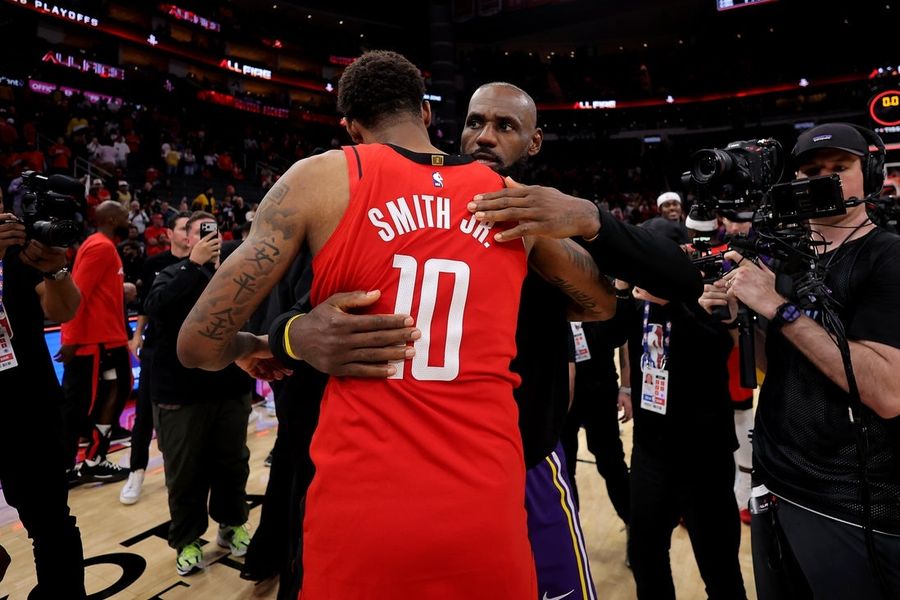
Deadspin | NBA roundup: Lakers end Rockets’ comeback dreams, win series in 6  May 1, 2026; Houston, Texas, USA; Los Angeles Lakers forward Lebron James (23) greets Houston Rockets forward Jabari Smith Jr. (10) following game six of the first round of the 2026 NBA Playoffs at Toyota Center. Mandatory Credit: Erik Williams-Imagn Images   LeBron James scored 18 of his 28 points in a runaway first half for the visiting Los Angeles Lakers, who cruised to a 98-78 victory over the Houston Rockets on Friday and claimed their Western Conference first-round playoff series in six games.  By virtue of the 4-2 series victory, the Lakers advance to the Western Conference semifinals and will travel to face the top-seeded Oklahoma City Thunder for Game 1 on Tuesday.  James added seven rebounds and eight assists to his ledger. Teammate Rui Hachimura put up 21 points, hitting 5 of 7 from the 3-point arc. Austin Reaves, who started for the first time in the series, added 15 points for the Lakers.  Undermined by turnovers throughout the series, the Lakers committed just 11 giveaways while limiting Houston to 35% shooting. Alperen Sengun paired 17 points with 11 rebounds for the Rockets, who played without leading scorer Kevin Durant for the fifth time in the series. Houston finished 5 of 28 (17.9%) from deep.  Raptors 112, Cavaliers 110 (OT)  RJ Barrett made a dramatic 3-pointer with 1.2 seconds left in overtime as Toronto defeated visiting Cleveland to force Game 7 of their first-round Eastern Conference playoff series.  Barrett’s bucket from straight away hit the back of the rim, bounced high into the air and fell in between the mesh. Scottie Barnes had 25 points and 14 assists for the Raptors. Barrett finished with 24 points, as did Ja’Kobe Walter.   Evan Mobley had 26 points and 14 rebounds for the Cavaliers, who will play host to the deciding game on Sunday. Donovan Mitchell added 24 points, and James Harden had 16 points, nine assists and nine rebounds.  Pistons 93, Magic 79  Cade Cunningham scored 32 points as Detroit came back from a 24-point deficit to stun host Orlando and force a decisive Game 7 in their Eastern Conference first-round playoff series.  The top-seeded Pistons began the fourth quarter on an 18-1 run to build an eight-point lead and ended up outscoring Orlando 55-19 in the second half. The eighth-seeded Magic missed 23 consecutive shots from the field during one stretch covering about 15 minutes in the second half.  Desmond Bane and Paolo Banchero each scored 17 points for Orlando, which was held to 12 points over the first 19 minutes of the second half as Detroit pulled ahead at 74-72 more than seven minutes to play after trailing by 22 at the half.  –Field Level Media   #Deadspin #NBA #roundup #Lakers #Rockets #comeback #dreams #win #series
Deadspin | NBA roundup: Lakers end Rockets’ comeback dreams, win series in 6
Deadspin | NBA roundup: Lakers end Rockets’ comeback dreams, win series in 6  May 1, 2026; Houston, Texas, USA; Los Angeles Lakers forward Lebron James (23) greets Houston Rockets forward Jabari Smith Jr. (10) following game six of the first round of the 2026 NBA Playoffs at Toyota Center. Mandatory Credit: Erik Williams-Imagn Images   LeBron James scored 18 of his 28 points in a runaway first half for the visiting Los Angeles Lakers, who cruised to a 98-78 victory over the Houston Rockets on Friday and claimed their Western Conference first-round playoff series in six games.  By virtue of the 4-2 series victory, the Lakers advance to the Western Conference semifinals and will travel to face the top-seeded Oklahoma City Thunder for Game 1 on Tuesday.  James added seven rebounds and eight assists to his ledger. Teammate Rui Hachimura put up 21 points, hitting 5 of 7 from the 3-point arc. Austin Reaves, who started for the first time in the series, added 15 points for the Lakers.  Undermined by turnovers throughout the series, the Lakers committed just 11 giveaways while limiting Houston to 35% shooting. Alperen Sengun paired 17 points with 11 rebounds for the Rockets, who played without leading scorer Kevin Durant for the fifth time in the series. Houston finished 5 of 28 (17.9%) from deep.  Raptors 112, Cavaliers 110 (OT)  RJ Barrett made a dramatic 3-pointer with 1.2 seconds left in overtime as Toronto defeated visiting Cleveland to force Game 7 of their first-round Eastern Conference playoff series.  Barrett’s bucket from straight away hit the back of the rim, bounced high into the air and fell in between the mesh. Scottie Barnes had 25 points and 14 assists for the Raptors. Barrett finished with 24 points, as did Ja’Kobe Walter.   Evan Mobley had 26 points and 14 rebounds for the Cavaliers, who will play host to the deciding game on Sunday. Donovan Mitchell added 24 points, and James Harden had 16 points, nine assists and nine rebounds.  Pistons 93, Magic 79  Cade Cunningham scored 32 points as Detroit came back from a 24-point deficit to stun host Orlando and force a decisive Game 7 in their Eastern Conference first-round playoff series.  The top-seeded Pistons began the fourth quarter on an 18-1 run to build an eight-point lead and ended up outscoring Orlando 55-19 in the second half. The eighth-seeded Magic missed 23 consecutive shots from the field during one stretch covering about 15 minutes in the second half.  Desmond Bane and Paolo Banchero each scored 17 points for Orlando, which was held to 12 points over the first 19 minutes of the second half as Detroit pulled ahead at 74-72 more than seven minutes to play after trailing by 22 at the half.  –Field Level Media   #Deadspin #NBA #roundup #Lakers #Rockets #comeback #dreams #win #seriesMay 1, 2026; Houston, Texas, USA; Los Angeles Lakers forward Lebron James (23) greets Houston Rockets forward Jabari Smith Jr. (10) following game six of the first round of the 2026 NBA Playoffs at Toyota Center. Mandatory Credit: Erik Williams-Imagn Images

LeBron James scored 18 of his 28 points in a runaway first half for the visiting Los Angeles Lakers, who cruised to a 98-78 victory over the Houston Rockets on Friday and claimed their Western Conference first-round playoff series in six games.

By virtue of the 4-2 series victory, the Lakers advance to the Western Conference semifinals and will travel to face the top-seeded Oklahoma City Thunder for Game 1 on Tuesday.

James added seven rebounds and eight assists to his ledger. Teammate Rui Hachimura put up 21 points, hitting 5 of 7 from the 3-point arc. Austin Reaves, who started for the first time in the series, added 15 points for the Lakers.

Undermined by turnovers throughout the series, the Lakers committed just 11 giveaways while limiting Houston to 35% shooting. Alperen Sengun paired 17 points with 11 rebounds for the Rockets, who played without leading scorer Kevin Durant for the fifth time in the series. Houston finished 5 of 28 (17.9%) from deep.

Raptors 112, Cavaliers 110 (OT)

RJ Barrett made a dramatic 3-pointer with 1.2 seconds left in overtime as Toronto defeated visiting Cleveland to force Game 7 of their first-round Eastern Conference playoff series.


Barrett’s bucket from straight away hit the back of the rim, bounced high into the air and fell in between the mesh. Scottie Barnes had 25 points and 14 assists for the Raptors. Barrett finished with 24 points, as did Ja’Kobe Walter.

Evan Mobley had 26 points and 14 rebounds for the Cavaliers, who will play host to the deciding game on Sunday. Donovan Mitchell added 24 points, and James Harden had 16 points, nine assists and nine rebounds.

Pistons 93, Magic 79

Cade Cunningham scored 32 points as Detroit came back from a 24-point deficit to stun host Orlando and force a decisive Game 7 in their Eastern Conference first-round playoff series.

The top-seeded Pistons began the fourth quarter on an 18-1 run to build an eight-point lead and ended up outscoring Orlando 55-19 in the second half. The eighth-seeded Magic missed 23 consecutive shots from the field during one stretch covering about 15 minutes in the second half.

Desmond Bane and Paolo Banchero each scored 17 points for Orlando, which was held to 12 points over the first 19 minutes of the second half as Detroit pulled ahead at 74-72 more than seven minutes to play after trailing by 22 at the half.

–Field Level Media

#Deadspin #NBA #roundup #Lakers #Rockets #comeback #dreams #win #series

May 1, 2026; Houston, Texas, USA; Los Angeles Lakers forward Lebron James (23) greets Houston Rockets forward Jabari Smith Jr. (10) following game six of the first round of the 2026 NBA Playoffs at Toyota Center. Mandatory Credit: Erik Williams-Imagn Images

LeBron James scored 18 of his 28 points in a runaway first half for the visiting Los Angeles Lakers, who cruised to a 98-78 victory over the Houston Rockets on Friday and claimed their Western Conference first-round playoff series in six games.

By virtue of the 4-2 series victory, the Lakers advance to the Western Conference semifinals and will travel to face the top-seeded Oklahoma City Thunder for Game 1 on Tuesday.

James added seven rebounds and eight assists to his ledger. Teammate Rui Hachimura put up 21 points, hitting 5 of 7 from the 3-point arc. Austin Reaves, who started for the first time in the series, added 15 points for the Lakers.

Undermined by turnovers throughout the series, the Lakers committed just 11 giveaways while limiting Houston to 35% shooting. Alperen Sengun paired 17 points with 11 rebounds for the Rockets, who played without leading scorer Kevin Durant for the fifth time in the series. Houston finished 5 of 28 (17.9%) from deep.

Raptors 112, Cavaliers 110 (OT)

RJ Barrett made a dramatic 3-pointer with 1.2 seconds left in overtime as Toronto defeated visiting Cleveland to force Game 7 of their first-round Eastern Conference playoff series.

Barrett’s bucket from straight away hit the back of the rim, bounced high into the air and fell in between the mesh. Scottie Barnes had 25 points and 14 assists for the Raptors. Barrett finished with 24 points, as did Ja’Kobe Walter.

Evan Mobley had 26 points and 14 rebounds for the Cavaliers, who will play host to the deciding game on Sunday. Donovan Mitchell added 24 points, and James Harden had 16 points, nine assists and nine rebounds.

Pistons 93, Magic 79

Cade Cunningham scored 32 points as Detroit came back from a 24-point deficit to stun host Orlando and force a decisive Game 7 in their Eastern Conference first-round playoff series.

The top-seeded Pistons began the fourth quarter on an 18-1 run to build an eight-point lead and ended up outscoring Orlando 55-19 in the second half. The eighth-seeded Magic missed 23 consecutive shots from the field during one stretch covering about 15 minutes in the second half.

Desmond Bane and Paolo Banchero each scored 17 points for Orlando, which was held to 12 points over the first 19 minutes of the second half as Detroit pulled ahead at 74-72 more than seven minutes to play after trailing by 22 at the half.

–Field Level Media

Source link
#Deadspin #NBA #roundup #Lakers #Rockets #comeback #dreams #win #series

Previous post

Kylie Jenner Hit With Second Lawsuit From Ex-Housekeeper

Next post

Madrid Open: Zverev beats Blockx to set up final against Sinner <div id="content-body-70930775" itemprop="articleBody"><p>World No. 3 Alexander Zverev, in strong form, dispatched promising Belgian Alexander Blockx 6-2, 7-5 to set up a summit clash against World No. 1 Jannik Sinner in the Madrid Open on Friday.</p><p>“I’m very happy of course to be in a final,” said Zverev, who lifted the trophy in Madrid in 2018 and 2021. There were a lot of tough matches, a lot of tough battles… and I’m looking forward to playing Jannik again.</p><p>“Tennis is very very easy for him right now, the way he is playing. Maybe on Sunday I will make it a bit more difficult for him.</p><p>“He’s the best player in the world for sure and I’m just trying to give him a tough battle.”</p><p><b>ALSO READ | <a href="https://sportstar.thehindu.com/tennis/jannik-sinner-on-schedule-reaching-madrid-open-final-french-open-roland-garros-preparation/article70930826.ece" target="_blank" rel="nofollow">Jannik Sinner says adrenaline drives him past fatigue in run to Madrid Open final</a></b></p><p>The 29-year-old broke in the first and fifth games to surge into a 5-1 lead against his unseeded opponent.</p><p>Underdog Blockx, ranked 69th in the world, resisted strong pressure on his next service game, saving three set points to hold.</p><p>However the dominant Zverev made no mistake with his fourth chance to wrap up the fourth stanza, laying down an ace.</p><p>Blockx survived two break points in the first game of the second set and another in the third as Zverev worked him hard.</p><p>The Belgian, who defeated Casper Ruud in the quarterfinals, put up a brave display as he saved two more break points in each of the seventh and ninth games.</p><p>Eventually Zverev took his eighth break point of the second set to nose 6-5 ahead, with a fortuitous net cord that broke Blockx’s resistance.</p><p>The German, who has suffered a string of semifinal defeats this season, made it to his first final with a powerful overhead winner.</p><p class="publish-time" id="end-of-article">Published on May 02, 2026</p></div> #Madrid #Open #Zverev #beats #Blockx #set #final #Sinner

Deadspin | Red-hot Carson Hocevar tops Kyle Busch to win Truck race in Texas  Mar 22, 2026; Darlington, South Carolina, USA; Spire Motorsports Carson Hocevar (77) comes out for the Goodyear 400 at Darlington Raceway. Mandatory Credit: Scott Kinser-Imagn Images   FORT WORTH, Texas — The glass slipper still firmly on his foot from last Sunday’s NASCAR Cup Series win at Talladega, Carson Hocevar mashed the gas in overtime on Friday night and ran away to victory in the SpeedyCash.com 250 at Texas Motor Speedway.  Beating runner-up and Spire Motorsports teammate Kyle Busch to the finish line by 0.730 seconds in overtime, Hocevar notched his sixth career NASCAR Craftsman Truck Series victory at the 1.5-mile intermediate track that gave him his first in the series in 2023.  The triumph reversed a 1-2 finish from earlier this season at EchoPark Speedway near Atlanta, where Busch beat Hocevar to the stripe by 0.114 seconds.  “It’s unbelievable — what a fun race,” Hocevar said after climbing from his No. 77 Chevrolet on the frontstretch. “We had to reverse the order, obviously the 1-2 with Kyle. I watched him win a lot of truck races, and it’s finally good to put an end to his Texas streak.”  Busch had won his last four Truck Series starts at Texas, but an early brush with the outside wall forced him to regain a lost lap as the beneficiary under caution for Cole Butcher’s crash in Turn 2 on Lap 51.  Busch fought through the field and challenged for the lead in the late going but failed to add to his record 68 Truck Series wins.  “We had an eventful night,” Busch said. “We didn’t start off very well. We were really, really loose and made a lot of adjustments to get it close. When we put the last set off tires on, we were really fast, felt really good.  “I was struggling with grip all night long, but (crew chief) Brian (Pattie) and the guys made a lot of good calls to get us dialed back in. It would have been nice to be in Victory Lane, but it’s good to have a teammate in there and have him get his shot. I got one, he got one, so now we’re even there.”  After the second stage break, Hocevar thought he might have a loose wheel, but that didn’t prevent him from going all-out during a succession of restarts late in the race.  Gio Ruggiero led the field to the overtime restart on Lap 171, but he lost impetus in the middle of a three-wide situation on the white-flag lap, as Hocevar charged into the lead and opened a gap of 10 car-lengths.  Kaden Honeycutt finished third, right behind Busch’s Silverado, with Brandon Jones and pole winner Ben Rhodes in fourth and fifth, respectively, as Ruggiero fell to 14th. Layne Riggs, Daniel Hemric, Christian Eckes, Ty Majeski and Chandler Smith completed the top 10.  Though Honeycutt left with the series lead — by 14 points over Smith — he remained frustrated with his inability to close out a victory.  “I’m proud to be able to drive a truck like this,” said Honeycutt, who is winless in 66 Truck Series starts. “It’s disappointing that I just keep failing. There’s no excuse for it. As soon as I got the lead (on Lap 149), I didn’t protect it right. I didn’t do the right things and ultimately that’s what led us to lose.  “Just got to figure out how to get restarts done. I’ve got to figure out how to win races. It’s eating me alive, I can promise you that.”  Ruggiero likewise missed an opportunity. He had passed Hocevar for the lead on Lap 165 of a scheduled 167, but a violent, five-truck accident on the frontstretch caused the eighth caution, necessitated a red flag for cleanup and forced the overtime.  Hocevar won the second stage and led a race-high 76 laps to 41 for Rhodes, who won the first stage wire-to-wire.  *****  NASCAR CRAFTSMAN Truck Series Race – SpeedyCash.com 250  Texas Motor Speedway  Fort Worth, Texas  Friday, May 1, 2026  1. (11)  Carson Hocevar(i), Chevrolet, 172.  2. (6)  Kyle Busch(i), Chevrolet, 172.  3. (10)  Kaden Honeycutt, Toyota, 172.  4. (18)  Brandon Jones(i), Toyota, 172.  5. (1)  Ben Rhodes, Ford, 172.  6. (34)  Layne Riggs, Ford, 172.  7. (14)  Daniel Hemric, Chevrolet, 172.  8. (12)  Christian Eckes, Chevrolet, 172.  9. (20)  Ty Majeski, Ford, 172.  10. (8)  Chandler Smith, Ford, 172.  11. (19)  Parker Kligerman, RAM, 172.  12. (23)  Ross Chastain(i), Chevrolet, 172.   13. (17)  Brenden Queen #, RAM, 172.  14. (3)  Giovanni Ruggiero, Toyota, 172.  15. (13)  Tyler Ankrum, Chevrolet, 172.  16. (22)  Dawson Sutton, Chevrolet, 172.  17. (21)  William Sawalich(i), Toyota, 171.  18. (27)  Toni Breidinger, Chevrolet, 171.  19. (7)  Stewart Friesen, Toyota, 171.  20. (30)  Spencer Boyd, Chevrolet, 170.  21. (28)  Mini Tyrrell #, RAM, 170.  22. (31)  Josh Reaume, Ford, 169.  23. (32)  Frankie Muniz, Ford, 168.  24. (33)  Caleb Costner, Chevrolet, 168.  25. (25)  Corey LaJoie, RAM, 165.  26. (29)  Clayton Green, Ford, 165.  27. (24)  Justin Haley, RAM, Accident, 164.  28. (5)  Tanner Gray, Toyota, Accident, 164.  29. (2)  Jake Garcia, Ford, Accident, 163.  30. (15)  Andres Perez De Lara, Chevrolet, Accident, 163.  31. (26)  Kris Wright, Chevrolet, 163.  32. (9)  Grant Enfinger, Chevrolet, Accident, 156.  33. (16)  Conner Jones, Chevrolet, Accident, 155.  34. (35)  Cory Roper, Toyota, Suspension, 123.  35. (4)  Cole Butcher #, Ford, Accident, 51.  Average Speed of Race Winner:  112.924 mph.  Time of Race:  2 Hrs, 17 Mins, 5 Secs. Margin of Victory:  0.730 Seconds.  Caution Flags:  8 for 39 laps.  Lead Changes:  14 among 9 drivers.  Lap Leaders:   B. Rhodes 1-41;C. Hocevar(i) 42;B. Jones(i) 43-58;C. Hocevar(i) 59-75;D. Sutton 76-77;M. Tyrrell # 78;C. Hocevar(i) 79-121;L. Riggs 122-127;T. Gray 128-129;D. Sutton 130-132;G. Ruggiero 133-148;K. Honeycutt 149-151;C. Hocevar(i) 152-164;G. Ruggiero 165-170;C. Hocevar(i) 171-172.  Leaders Summary (Driver, Times Lead, Laps Led):  Carson Hocevar(i) 5 times for 76 laps; Ben Rhodes 1 time for 41 laps; Giovanni Ruggiero 2 times for 22 laps; Brandon Jones(i) 1 time for 16 laps; Layne Riggs 1 time for 6 laps; Dawson Sutton 2 times for 5 laps; Kaden Honeycutt 1 time for 3 laps; Tanner Gray 1 time for 2 laps; Mini Tyrrell # 1 time for 1 lap.  Stage #1 Top Ten: 99,77,17,11,38,52,9,34,88,45  Stage #2 Top Ten: 77,11,17,26,18,14,9,15,38,4  –By Reid Spencer, NASCAR Wire Service. Special to Field Level Media   #Deadspin #Redhot #Carson #Hocevar #tops #Kyle #Busch #win #Truck #race #TexasMar 22, 2026; Darlington, South Carolina, USA; Spire Motorsports Carson Hocevar (77) comes out for the Goodyear 400 at Darlington Raceway. Mandatory Credit: Scott Kinser-Imagn Images

FORT WORTH, Texas — The glass slipper still firmly on his foot from last Sunday’s NASCAR Cup Series win at Talladega, Carson Hocevar mashed the gas in overtime on Friday night and ran away to victory in the SpeedyCash.com 250 at Texas Motor Speedway.

Beating runner-up and Spire Motorsports teammate Kyle Busch to the finish line by 0.730 seconds in overtime, Hocevar notched his sixth career NASCAR Craftsman Truck Series victory at the 1.5-mile intermediate track that gave him his first in the series in 2023.

The triumph reversed a 1-2 finish from earlier this season at EchoPark Speedway near Atlanta, where Busch beat Hocevar to the stripe by 0.114 seconds.

“It’s unbelievable — what a fun race,” Hocevar said after climbing from his No. 77 Chevrolet on the frontstretch. “We had to reverse the order, obviously the 1-2 with Kyle. I watched him win a lot of truck races, and it’s finally good to put an end to his Texas streak.”

Busch had won his last four Truck Series starts at Texas, but an early brush with the outside wall forced him to regain a lost lap as the beneficiary under caution for Cole Butcher’s crash in Turn 2 on Lap 51.

Busch fought through the field and challenged for the lead in the late going but failed to add to his record 68 Truck Series wins.

“We had an eventful night,” Busch said. “We didn’t start off very well. We were really, really loose and made a lot of adjustments to get it close. When we put the last set off tires on, we were really fast, felt really good.

“I was struggling with grip all night long, but (crew chief) Brian (Pattie) and the guys made a lot of good calls to get us dialed back in. It would have been nice to be in Victory Lane, but it’s good to have a teammate in there and have him get his shot. I got one, he got one, so now we’re even there.”

After the second stage break, Hocevar thought he might have a loose wheel, but that didn’t prevent him from going all-out during a succession of restarts late in the race.

Gio Ruggiero led the field to the overtime restart on Lap 171, but he lost impetus in the middle of a three-wide situation on the white-flag lap, as Hocevar charged into the lead and opened a gap of 10 car-lengths.

Kaden Honeycutt finished third, right behind Busch’s Silverado, with Brandon Jones and pole winner Ben Rhodes in fourth and fifth, respectively, as Ruggiero fell to 14th. Layne Riggs, Daniel Hemric, Christian Eckes, Ty Majeski and Chandler Smith completed the top 10.

Though Honeycutt left with the series lead — by 14 points over Smith — he remained frustrated with his inability to close out a victory.

“I’m proud to be able to drive a truck like this,” said Honeycutt, who is winless in 66 Truck Series starts. “It’s disappointing that I just keep failing. There’s no excuse for it. As soon as I got the lead (on Lap 149), I didn’t protect it right. I didn’t do the right things and ultimately that’s what led us to lose.

“Just got to figure out how to get restarts done. I’ve got to figure out how to win races. It’s eating me alive, I can promise you that.”

Ruggiero likewise missed an opportunity. He had passed Hocevar for the lead on Lap 165 of a scheduled 167, but a violent, five-truck accident on the frontstretch caused the eighth caution, necessitated a red flag for cleanup and forced the overtime.

Hocevar won the second stage and led a race-high 76 laps to 41 for Rhodes, who won the first stage wire-to-wire.

*****

NASCAR CRAFTSMAN Truck Series Race – SpeedyCash.com 250

Texas Motor Speedway

Fort Worth, Texas

Friday, May 1, 2026

1. (11) Carson Hocevar(i), Chevrolet, 172.

2. (6) Kyle Busch(i), Chevrolet, 172.

3. (10) Kaden Honeycutt, Toyota, 172.

4. (18) Brandon Jones(i), Toyota, 172.

5. (1) Ben Rhodes, Ford, 172.

6. (34) Layne Riggs, Ford, 172.

7. (14) Daniel Hemric, Chevrolet, 172.

8. (12) Christian Eckes, Chevrolet, 172.

9. (20) Ty Majeski, Ford, 172.

10. (8) Chandler Smith, Ford, 172.

11. (19) Parker Kligerman, RAM, 172.


12. (23) Ross Chastain(i), Chevrolet, 172.

13. (17) Brenden Queen #, RAM, 172.

14. (3) Giovanni Ruggiero, Toyota, 172.

15. (13) Tyler Ankrum, Chevrolet, 172.

16. (22) Dawson Sutton, Chevrolet, 172.

17. (21) William Sawalich(i), Toyota, 171.

18. (27) Toni Breidinger, Chevrolet, 171.

19. (7) Stewart Friesen, Toyota, 171.

20. (30) Spencer Boyd, Chevrolet, 170.

21. (28) Mini Tyrrell #, RAM, 170.

22. (31) Josh Reaume, Ford, 169.

23. (32) Frankie Muniz, Ford, 168.

24. (33) Caleb Costner, Chevrolet, 168.

25. (25) Corey LaJoie, RAM, 165.

26. (29) Clayton Green, Ford, 165.

27. (24) Justin Haley, RAM, Accident, 164.

28. (5) Tanner Gray, Toyota, Accident, 164.

29. (2) Jake Garcia, Ford, Accident, 163.

30. (15) Andres Perez De Lara, Chevrolet, Accident, 163.

31. (26) Kris Wright, Chevrolet, 163.

32. (9) Grant Enfinger, Chevrolet, Accident, 156.

33. (16) Conner Jones, Chevrolet, Accident, 155.

34. (35) Cory Roper, Toyota, Suspension, 123.

35. (4) Cole Butcher #, Ford, Accident, 51.

Average Speed of Race Winner: 112.924 mph.

Time of Race: 2 Hrs, 17 Mins, 5 Secs. Margin of Victory: 0.730 Seconds.

Caution Flags: 8 for 39 laps.

Lead Changes: 14 among 9 drivers.

Lap Leaders: B. Rhodes 1-41;C. Hocevar(i) 42;B. Jones(i) 43-58;C. Hocevar(i) 59-75;D. Sutton 76-77;M. Tyrrell # 78;C. Hocevar(i) 79-121;L. Riggs 122-127;T. Gray 128-129;D. Sutton 130-132;G. Ruggiero 133-148;K. Honeycutt 149-151;C. Hocevar(i) 152-164;G. Ruggiero 165-170;C. Hocevar(i) 171-172.

Leaders Summary (Driver, Times Lead, Laps Led): Carson Hocevar(i) 5 times for 76 laps; Ben Rhodes 1 time for 41 laps; Giovanni Ruggiero 2 times for 22 laps; Brandon Jones(i) 1 time for 16 laps; Layne Riggs 1 time for 6 laps; Dawson Sutton 2 times for 5 laps; Kaden Honeycutt 1 time for 3 laps; Tanner Gray 1 time for 2 laps; Mini Tyrrell # 1 time for 1 lap.

Stage #1 Top Ten: 99,77,17,11,38,52,9,34,88,45

Stage #2 Top Ten: 77,11,17,26,18,14,9,15,38,4

–By Reid Spencer, NASCAR Wire Service. Special to Field Level Media

#Deadspin #Redhot #Carson #Hocevar #tops #Kyle #Busch #win #Truck #race #Texas">Deadspin | Red-hot Carson Hocevar tops Kyle Busch to win Truck race in Texas  Mar 22, 2026; Darlington, South Carolina, USA; Spire Motorsports Carson Hocevar (77) comes out for the Goodyear 400 at Darlington Raceway. Mandatory Credit: Scott Kinser-Imagn Images   FORT WORTH, Texas — The glass slipper still firmly on his foot from last Sunday’s NASCAR Cup Series win at Talladega, Carson Hocevar mashed the gas in overtime on Friday night and ran away to victory in the SpeedyCash.com 250 at Texas Motor Speedway.  Beating runner-up and Spire Motorsports teammate Kyle Busch to the finish line by 0.730 seconds in overtime, Hocevar notched his sixth career NASCAR Craftsman Truck Series victory at the 1.5-mile intermediate track that gave him his first in the series in 2023.  The triumph reversed a 1-2 finish from earlier this season at EchoPark Speedway near Atlanta, where Busch beat Hocevar to the stripe by 0.114 seconds.  “It’s unbelievable — what a fun race,” Hocevar said after climbing from his No. 77 Chevrolet on the frontstretch. “We had to reverse the order, obviously the 1-2 with Kyle. I watched him win a lot of truck races, and it’s finally good to put an end to his Texas streak.”  Busch had won his last four Truck Series starts at Texas, but an early brush with the outside wall forced him to regain a lost lap as the beneficiary under caution for Cole Butcher’s crash in Turn 2 on Lap 51.  Busch fought through the field and challenged for the lead in the late going but failed to add to his record 68 Truck Series wins.  “We had an eventful night,” Busch said. “We didn’t start off very well. We were really, really loose and made a lot of adjustments to get it close. When we put the last set off tires on, we were really fast, felt really good.  “I was struggling with grip all night long, but (crew chief) Brian (Pattie) and the guys made a lot of good calls to get us dialed back in. It would have been nice to be in Victory Lane, but it’s good to have a teammate in there and have him get his shot. I got one, he got one, so now we’re even there.”  After the second stage break, Hocevar thought he might have a loose wheel, but that didn’t prevent him from going all-out during a succession of restarts late in the race.  Gio Ruggiero led the field to the overtime restart on Lap 171, but he lost impetus in the middle of a three-wide situation on the white-flag lap, as Hocevar charged into the lead and opened a gap of 10 car-lengths.  Kaden Honeycutt finished third, right behind Busch’s Silverado, with Brandon Jones and pole winner Ben Rhodes in fourth and fifth, respectively, as Ruggiero fell to 14th. Layne Riggs, Daniel Hemric, Christian Eckes, Ty Majeski and Chandler Smith completed the top 10.  Though Honeycutt left with the series lead — by 14 points over Smith — he remained frustrated with his inability to close out a victory.  “I’m proud to be able to drive a truck like this,” said Honeycutt, who is winless in 66 Truck Series starts. “It’s disappointing that I just keep failing. There’s no excuse for it. As soon as I got the lead (on Lap 149), I didn’t protect it right. I didn’t do the right things and ultimately that’s what led us to lose.  “Just got to figure out how to get restarts done. I’ve got to figure out how to win races. It’s eating me alive, I can promise you that.”  Ruggiero likewise missed an opportunity. He had passed Hocevar for the lead on Lap 165 of a scheduled 167, but a violent, five-truck accident on the frontstretch caused the eighth caution, necessitated a red flag for cleanup and forced the overtime.  Hocevar won the second stage and led a race-high 76 laps to 41 for Rhodes, who won the first stage wire-to-wire.  *****  NASCAR CRAFTSMAN Truck Series Race – SpeedyCash.com 250  Texas Motor Speedway  Fort Worth, Texas  Friday, May 1, 2026  1. (11)  Carson Hocevar(i), Chevrolet, 172.  2. (6)  Kyle Busch(i), Chevrolet, 172.  3. (10)  Kaden Honeycutt, Toyota, 172.  4. (18)  Brandon Jones(i), Toyota, 172.  5. (1)  Ben Rhodes, Ford, 172.  6. (34)  Layne Riggs, Ford, 172.  7. (14)  Daniel Hemric, Chevrolet, 172.  8. (12)  Christian Eckes, Chevrolet, 172.  9. (20)  Ty Majeski, Ford, 172.  10. (8)  Chandler Smith, Ford, 172.  11. (19)  Parker Kligerman, RAM, 172.  12. (23)  Ross Chastain(i), Chevrolet, 172.   13. (17)  Brenden Queen #, RAM, 172.  14. (3)  Giovanni Ruggiero, Toyota, 172.  15. (13)  Tyler Ankrum, Chevrolet, 172.  16. (22)  Dawson Sutton, Chevrolet, 172.  17. (21)  William Sawalich(i), Toyota, 171.  18. (27)  Toni Breidinger, Chevrolet, 171.  19. (7)  Stewart Friesen, Toyota, 171.  20. (30)  Spencer Boyd, Chevrolet, 170.  21. (28)  Mini Tyrrell #, RAM, 170.  22. (31)  Josh Reaume, Ford, 169.  23. (32)  Frankie Muniz, Ford, 168.  24. (33)  Caleb Costner, Chevrolet, 168.  25. (25)  Corey LaJoie, RAM, 165.  26. (29)  Clayton Green, Ford, 165.  27. (24)  Justin Haley, RAM, Accident, 164.  28. (5)  Tanner Gray, Toyota, Accident, 164.  29. (2)  Jake Garcia, Ford, Accident, 163.  30. (15)  Andres Perez De Lara, Chevrolet, Accident, 163.  31. (26)  Kris Wright, Chevrolet, 163.  32. (9)  Grant Enfinger, Chevrolet, Accident, 156.  33. (16)  Conner Jones, Chevrolet, Accident, 155.  34. (35)  Cory Roper, Toyota, Suspension, 123.  35. (4)  Cole Butcher #, Ford, Accident, 51.  Average Speed of Race Winner:  112.924 mph.  Time of Race:  2 Hrs, 17 Mins, 5 Secs. Margin of Victory:  0.730 Seconds.  Caution Flags:  8 for 39 laps.  Lead Changes:  14 among 9 drivers.  Lap Leaders:   B. Rhodes 1-41;C. Hocevar(i) 42;B. Jones(i) 43-58;C. Hocevar(i) 59-75;D. Sutton 76-77;M. Tyrrell # 78;C. Hocevar(i) 79-121;L. Riggs 122-127;T. Gray 128-129;D. Sutton 130-132;G. Ruggiero 133-148;K. Honeycutt 149-151;C. Hocevar(i) 152-164;G. Ruggiero 165-170;C. Hocevar(i) 171-172.  Leaders Summary (Driver, Times Lead, Laps Led):  Carson Hocevar(i) 5 times for 76 laps; Ben Rhodes 1 time for 41 laps; Giovanni Ruggiero 2 times for 22 laps; Brandon Jones(i) 1 time for 16 laps; Layne Riggs 1 time for 6 laps; Dawson Sutton 2 times for 5 laps; Kaden Honeycutt 1 time for 3 laps; Tanner Gray 1 time for 2 laps; Mini Tyrrell # 1 time for 1 lap.  Stage #1 Top Ten: 99,77,17,11,38,52,9,34,88,45  Stage #2 Top Ten: 77,11,17,26,18,14,9,15,38,4  –By Reid Spencer, NASCAR Wire Service. Special to Field Level Media   #Deadspin #Redhot #Carson #Hocevar #tops #Kyle #Busch #win #Truck #race #Texas

Film star-turned sports administrator Rahul Bose wears many hats, from being an award-winning actor to now, being the President of Rugby India.

Before the second edition of the Rugby Premier League (RPL), planned in Hyderabad next month, the 58-year-old discusses the present state of Rugby in India and the future of the sport, in an exclusive chat with Sportstar.

Q: How do you look at the second edition of the league? How different will it be from the first?

A: Yes, we were always wanting to have an RPL Women last year also. But because there was so much to look at, which was new to us, we decided to stay with RPL Men. But this year, the franchises have been very, very forthcoming.

We have dug into our pockets, and we have made sure that we have created the financial as well as operational space to run a women’s league at the same time as the men’s. So in effect, the same two weeks that we had last year, when the men’s league was running, the women’s league will run at the same time. Instead of two games a day, we’ll have four, sometimes five games a day.

It will build for a longer, more interesting evening for people who are coming to the stadium as well as those who are viewing it online. That’s one big difference. The second big difference is that our partners — Jio Hotstar and Star Sports have now partnered to have it on YouTube and TV.

ALSO READ: RPL 2026 — Second season of Rugby Premier League to be played in Hyderabad in June

We were always certain that the venue would move from city to city. From Mumbai, it has come to Hyderabad and will move to other venues in future.

Q: How do you see Hyderabad as a venue?

A: It’s a city where the scale of the stadium is bigger than what we had in Mumbai. So we are very much looking forward to having experiences for fans and things in the stadium, along with the fact that it’s a longer evening. So we are very clear that we are setting our sights on creating not one but two world-class products.

Rahul Bose bats for Rugby Revolution with RPL 2, Women’s League and Olympic ambitions on the horizon  Film star-turned sports administrator Rahul Bose wears many hats, from being an award-winning actor to now, being the President of Rugby India.Before the second edition of the Rugby Premier League (RPL), planned in Hyderabad next month, the 58-year-old discusses the present state of Rugby in India and the future of the sport, in an exclusive chat with        Sportstar.Q: How do you look at the second edition of the league? How different will it be from the first?A: Yes, we were always wanting to have an RPL Women last year also. But because there was so much to look at, which was new to us, we decided to stay with RPL Men. But this year, the franchises have been very, very forthcoming.We have dug into our pockets, and we have made sure that we have created the financial as well as operational space to run a women’s league at the same time as the men’s. So in effect, the same two weeks that we had last year, when the men’s league was running, the women’s league will run at the same time. Instead of two games a day, we’ll have four, sometimes five games a day.It will build for a longer, more interesting evening for people who are coming to the stadium as well as those who are viewing it online. That’s one big difference. The second big difference is that our partners — Jio Hotstar and Star Sports have now partnered to have it on YouTube and TV.ALSO READ: RPL 2026 — Second season of Rugby Premier League to be played in Hyderabad in JuneWe were always certain that the venue would move from city to city. From Mumbai, it has come to Hyderabad and will move to other venues in future.Q: How do you see Hyderabad as a venue?A: It’s a city where the scale of the stadium is bigger than what we had in Mumbai. So we are very much looking forward to having experiences for fans and things in the stadium, along with the fact that it’s a longer evening. So we are very clear that we are setting our sights on creating not one but two world-class products. The second season of Rugby Premier League will take place at the Gachibowli Stadium, which has also hosted football matches in the past.
                                                            | Photo Credit: 
                                Nagara Gopal
                            

                            The second season of Rugby Premier League will take place at the Gachibowli Stadium, which has also hosted football matches in the past.
                                                            | Photo Credit: 
                                Nagara Gopal
                                                    Q: What are the major challenges involved in getting franchises for the Women’s League?A: I think almost everybody was ideologically very, very certain that they wanted to be part of it. But the economics had to work. And we are a league where we run a very tight ship. We are very, very collaborative and fair with our franchise owners.At the same time, we cannot expect, should I say, generosity that’s unreasonable. So everybody was ideologically in line with us. So, what we did was we made a lot of attractive benefits for franchises, more attractive than they were last year, so that they would come to the women’s game this year. Thankfully, our franchises understood that.We didn’t want to go for six or eight franchises because of the operational difficulties. So four is very solid, and we’ll have 48 players, 24 foreigners, 24 Indians. And yet, it will be operationally manageable.Q: How is the pace of the sport across India?A: India has 760 districts. Rugby is in 322 districts. 40 per cent of India plays rugby. So our grassroots are strong. For the last five years, we’ve had 320 districts. We had the option to either spread the districts or to deepen the involvement of the players in those districts. We’ve chosen the latter. We’ve chosen to deepen involvement in the 322 districts. We want those players to stay with the game.Q: Any major initiatives to take the sport to the next level?A: We are not taking it to more unexplored regions. We are (already) in 322 districts, which is a lot. It’s a captive population of 650 million people. But in terms of initiatives, we’ve had the Asmita Women’s League. Players in action during an ASMITA Rugby State League Jammu and Kashmir at the Multipurpose Indoor Sports Stadium.
                                                            | Photo Credit: 
                                Imran Nissar
                            

                            Players in action during an ASMITA Rugby State League Jammu and Kashmir at the Multipurpose Indoor Sports Stadium.
                                                            | Photo Credit: 
                                Imran Nissar
                                                    The Government of India has given us solid support, and between 30 and 50 cities across India have had a women’s rugby league last year. We have over 30 national tournaments that happen.I would say that this is probably the most played, least known game in India.Q: What are the realistic goals?A: One is to make sure that something like the RPL happens, which brings rugby to the eyes of people through mass media. The second is for our (national) teams to do well. The moment our teams begin to win, it will automatically begin to become popular.So for the teams to do well, you have to put a lot of money into high performance. Right now, our women are sixth in Asia out of 36 nations. Rahul Bose feels the Indian women’s national team has a quicker chance to make it to the Olympics because of its higher ranking in Asia.
                                                            | Photo Credit: 
                                Nissar Ahmad
                            

                            Rahul Bose feels the Indian women’s national team has a quicker chance to make it to the Olympics because of its higher ranking in Asia.
                                                            | Photo Credit: 
                                Nissar Ahmad
                                                    For perspective, if you get to the top two, you make the Olympics. We are hopeful of making the Olympics in 2032. And we will be the first team sport, after hockey, in 90 years to get to the Olympics.Of course, cricket is in the Olympics, but it’s a very small pool. But, making it to the Olympics in rugby out of over 100, to be one of the 14-15 nations will be very prestigious. Our men’s team, 12th in Asia, has to wait for one more cycle to get there.Q: A roadmap for the sport?A: We’ve had the road map in place for five years, month by month. In fact, when we submitted the road map to the government or the Ministry of Sports, they said they had never seen anything like it in their lives.We submitted this in 2020 on what was planned up to 2030. We’ll be following that. We are slightly ahead in some things, and we’re slightly behind in others. Anyone can track us month by month. Students in a training session at Universal Engineering College at Vallivattom, in Thrissur, Kerala.
                                                            | Photo Credit: 
                                K.K. Najeeb
                            

                            Students in a training session at Universal Engineering College at Vallivattom, in Thrissur, Kerala.
                                                            | Photo Credit: 
                                K.K. Najeeb
                                                    The Government has always asked for accountability, and we never shy away from being transparent and accountable. In fact, we were awarded the best Federation in the country by the FICCI last year because of our transparency, our ethics and our processes.Q: On areas of focus?A: It’s not in the big cities but in the districts, a cluster of schools, PETs (Physical Education Teachers) through our State Associations that are doing very good work. So we don’t go to one school.ALSO READ: Rugby Premier League Season 2 squads finalised; women’s league set for historic debutYou cannot think of this as a metro sport but as a hinterland sport instead. Most of our players come from the bottom of the social pyramid. We don’t do a caste census. But socio-economically, they are the poorest of the poor.Q: How are the players supported in the Rubgy ecosystem?A: We are one of the few federations that give a yearly purse to every state to spend on development, for national tournaments, on jerseys, on transport and on food. That is what they spend in their districts, and all the State Associations have to submit detailed reports on follow-up actions.Q: Tell us the state of sponsorship in Rugby.A: Normally, all our tournaments are funded by us. We have sponsors like Capgemini and DHL, who fund Indian Rugby. We’ve had some government states supporting us in the past. Chennai Bull’s Vaafauese Apelu Maliko in action in the first season of Indian Rugby Premier League (RPL) final against Delhi Redz.
                                                            | Photo Credit: 
                                Getty Images
                            

                            Chennai Bull’s Vaafauese Apelu Maliko in action in the first season of Indian Rugby Premier League (RPL) final against Delhi Redz.
                                                            | Photo Credit: 
                                Getty Images
                                                    We get money from the Central Government, World Rugby, and small amounts from the Capri Group and Jamuna Auto. So, we raise the money and spend it on national tournaments.Q: What are the major changes you’re looking at from the Indian players’ perspective?A: This is the Federation’s responsibility. It has to raise more money, work harder and build a 365-day-a-year ecosystem around our players. Right now, we can only afford to do it maybe 100 days a year.We would like to build an ecosystem around our 30-40 best players from each team – Under-18 boys, under-18 girls, under-20 boys, under-20 girls, men and women.Q: What are you looking for after the Rugby Premier League?A: I think a real mark of success will be when the six franchises begin to do more work in developing an interest and creating infrastructure in the cities. We don’t have a (major) presence in the cities as a sport. So in these big six cities, we will start to have what we have never had before.Published on May 02, 2026  #Rahul #Bose #bats #Rugby #Revolution #RPL #Womens #League #Olympic #ambitions #horizon

The second season of Rugby Premier League will take place at the Gachibowli Stadium, which has also hosted football matches in the past. | Photo Credit: Nagara Gopal

lightbox-info

The second season of Rugby Premier League will take place at the Gachibowli Stadium, which has also hosted football matches in the past. | Photo Credit: Nagara Gopal

Q: What are the major challenges involved in getting franchises for the Women’s League?

A: I think almost everybody was ideologically very, very certain that they wanted to be part of it. But the economics had to work. And we are a league where we run a very tight ship. We are very, very collaborative and fair with our franchise owners.

At the same time, we cannot expect, should I say, generosity that’s unreasonable. So everybody was ideologically in line with us. So, what we did was we made a lot of attractive benefits for franchises, more attractive than they were last year, so that they would come to the women’s game this year. Thankfully, our franchises understood that.

We didn’t want to go for six or eight franchises because of the operational difficulties. So four is very solid, and we’ll have 48 players, 24 foreigners, 24 Indians. And yet, it will be operationally manageable.

Q: How is the pace of the sport across India?

A: India has 760 districts. Rugby is in 322 districts. 40 per cent of India plays rugby. So our grassroots are strong. For the last five years, we’ve had 320 districts. We had the option to either spread the districts or to deepen the involvement of the players in those districts. We’ve chosen the latter. We’ve chosen to deepen involvement in the 322 districts. We want those players to stay with the game.

Q: Any major initiatives to take the sport to the next level?

A: We are not taking it to more unexplored regions. We are (already) in 322 districts, which is a lot. It’s a captive population of 650 million people. But in terms of initiatives, we’ve had the Asmita Women’s League.

Players in action during an ASMITA Rugby State League Jammu and Kashmir at the Multipurpose Indoor Sports Stadium.

Players in action during an ASMITA Rugby State League Jammu and Kashmir at the Multipurpose Indoor Sports Stadium. | Photo Credit: Imran Nissar

lightbox-info

Players in action during an ASMITA Rugby State League Jammu and Kashmir at the Multipurpose Indoor Sports Stadium. | Photo Credit: Imran Nissar

The Government of India has given us solid support, and between 30 and 50 cities across India have had a women’s rugby league last year. We have over 30 national tournaments that happen.

I would say that this is probably the most played, least known game in India.

Q: What are the realistic goals?

A: One is to make sure that something like the RPL happens, which brings rugby to the eyes of people through mass media. The second is for our (national) teams to do well. The moment our teams begin to win, it will automatically begin to become popular.

So for the teams to do well, you have to put a lot of money into high performance. Right now, our women are sixth in Asia out of 36 nations.

Rahul Bose feels the Indian women’s national team has a quicker chance to make it to the Olympics because of its higher ranking in Asia.

Rahul Bose feels the Indian women’s national team has a quicker chance to make it to the Olympics because of its higher ranking in Asia. | Photo Credit: Nissar Ahmad

lightbox-info

Rahul Bose feels the Indian women’s national team has a quicker chance to make it to the Olympics because of its higher ranking in Asia. | Photo Credit: Nissar Ahmad

For perspective, if you get to the top two, you make the Olympics. We are hopeful of making the Olympics in 2032. And we will be the first team sport, after hockey, in 90 years to get to the Olympics.

Of course, cricket is in the Olympics, but it’s a very small pool. But, making it to the Olympics in rugby out of over 100, to be one of the 14-15 nations will be very prestigious. Our men’s team, 12th in Asia, has to wait for one more cycle to get there.

Q: A roadmap for the sport?

A: We’ve had the road map in place for five years, month by month. In fact, when we submitted the road map to the government or the Ministry of Sports, they said they had never seen anything like it in their lives.

We submitted this in 2020 on what was planned up to 2030. We’ll be following that. We are slightly ahead in some things, and we’re slightly behind in others. Anyone can track us month by month.

Students in a training session at Universal Engineering College at Vallivattom, in Thrissur, Kerala.

Students in a training session at Universal Engineering College at Vallivattom, in Thrissur, Kerala. | Photo Credit: K.K. Najeeb

lightbox-info

Students in a training session at Universal Engineering College at Vallivattom, in Thrissur, Kerala. | Photo Credit: K.K. Najeeb

The Government has always asked for accountability, and we never shy away from being transparent and accountable. In fact, we were awarded the best Federation in the country by the FICCI last year because of our transparency, our ethics and our processes.

Q: On areas of focus?

A: It’s not in the big cities but in the districts, a cluster of schools, PETs (Physical Education Teachers) through our State Associations that are doing very good work. So we don’t go to one school.

ALSO READ: Rugby Premier League Season 2 squads finalised; women’s league set for historic debut

You cannot think of this as a metro sport but as a hinterland sport instead. Most of our players come from the bottom of the social pyramid. We don’t do a caste census. But socio-economically, they are the poorest of the poor.

Q: How are the players supported in the Rubgy ecosystem?

A: We are one of the few federations that give a yearly purse to every state to spend on development, for national tournaments, on jerseys, on transport and on food. That is what they spend in their districts, and all the State Associations have to submit detailed reports on follow-up actions.

Q: Tell us the state of sponsorship in Rugby.

A: Normally, all our tournaments are funded by us. We have sponsors like Capgemini and DHL, who fund Indian Rugby. We’ve had some government states supporting us in the past.

Chennai Bull's Vaafauese Apelu Maliko in action in the first season of Indian Rugby Premier League (RPL) final against Delhi Redz.

Chennai Bull’s Vaafauese Apelu Maliko in action in the first season of Indian Rugby Premier League (RPL) final against Delhi Redz. | Photo Credit: Getty Images

lightbox-info

Chennai Bull’s Vaafauese Apelu Maliko in action in the first season of Indian Rugby Premier League (RPL) final against Delhi Redz. | Photo Credit: Getty Images

We get money from the Central Government, World Rugby, and small amounts from the Capri Group and Jamuna Auto. So, we raise the money and spend it on national tournaments.

Q: What are the major changes you’re looking at from the Indian players’ perspective?

A: This is the Federation’s responsibility. It has to raise more money, work harder and build a 365-day-a-year ecosystem around our players. Right now, we can only afford to do it maybe 100 days a year.

We would like to build an ecosystem around our 30-40 best players from each team – Under-18 boys, under-18 girls, under-20 boys, under-20 girls, men and women.

Q: What are you looking for after the Rugby Premier League?

A: I think a real mark of success will be when the six franchises begin to do more work in developing an interest and creating infrastructure in the cities. We don’t have a (major) presence in the cities as a sport. So in these big six cities, we will start to have what we have never had before.

Published on May 02, 2026

#Rahul #Bose #bats #Rugby #Revolution #RPL #Womens #League #Olympic #ambitions #horizon">Rahul Bose bats for Rugby Revolution with RPL 2, Women’s League and Olympic ambitions on the horizon  Film star-turned sports administrator Rahul Bose wears many hats, from being an award-winning actor to now, being the President of Rugby India.Before the second edition of the Rugby Premier League (RPL), planned in Hyderabad next month, the 58-year-old discusses the present state of Rugby in India and the future of the sport, in an exclusive chat with        Sportstar.Q: How do you look at the second edition of the league? How different will it be from the first?A: Yes, we were always wanting to have an RPL Women last year also. But because there was so much to look at, which was new to us, we decided to stay with RPL Men. But this year, the franchises have been very, very forthcoming.We have dug into our pockets, and we have made sure that we have created the financial as well as operational space to run a women’s league at the same time as the men’s. So in effect, the same two weeks that we had last year, when the men’s league was running, the women’s league will run at the same time. Instead of two games a day, we’ll have four, sometimes five games a day.It will build for a longer, more interesting evening for people who are coming to the stadium as well as those who are viewing it online. That’s one big difference. The second big difference is that our partners — Jio Hotstar and Star Sports have now partnered to have it on YouTube and TV.ALSO READ: RPL 2026 — Second season of Rugby Premier League to be played in Hyderabad in JuneWe were always certain that the venue would move from city to city. From Mumbai, it has come to Hyderabad and will move to other venues in future.Q: How do you see Hyderabad as a venue?A: It’s a city where the scale of the stadium is bigger than what we had in Mumbai. So we are very much looking forward to having experiences for fans and things in the stadium, along with the fact that it’s a longer evening. So we are very clear that we are setting our sights on creating not one but two world-class products. The second season of Rugby Premier League will take place at the Gachibowli Stadium, which has also hosted football matches in the past.
                                                            | Photo Credit: 
                                Nagara Gopal
                            

                            The second season of Rugby Premier League will take place at the Gachibowli Stadium, which has also hosted football matches in the past.
                                                            | Photo Credit: 
                                Nagara Gopal
                                                    Q: What are the major challenges involved in getting franchises for the Women’s League?A: I think almost everybody was ideologically very, very certain that they wanted to be part of it. But the economics had to work. And we are a league where we run a very tight ship. We are very, very collaborative and fair with our franchise owners.At the same time, we cannot expect, should I say, generosity that’s unreasonable. So everybody was ideologically in line with us. So, what we did was we made a lot of attractive benefits for franchises, more attractive than they were last year, so that they would come to the women’s game this year. Thankfully, our franchises understood that.We didn’t want to go for six or eight franchises because of the operational difficulties. So four is very solid, and we’ll have 48 players, 24 foreigners, 24 Indians. And yet, it will be operationally manageable.Q: How is the pace of the sport across India?A: India has 760 districts. Rugby is in 322 districts. 40 per cent of India plays rugby. So our grassroots are strong. For the last five years, we’ve had 320 districts. We had the option to either spread the districts or to deepen the involvement of the players in those districts. We’ve chosen the latter. We’ve chosen to deepen involvement in the 322 districts. We want those players to stay with the game.Q: Any major initiatives to take the sport to the next level?A: We are not taking it to more unexplored regions. We are (already) in 322 districts, which is a lot. It’s a captive population of 650 million people. But in terms of initiatives, we’ve had the Asmita Women’s League. Players in action during an ASMITA Rugby State League Jammu and Kashmir at the Multipurpose Indoor Sports Stadium.
                                                            | Photo Credit: 
                                Imran Nissar
                            

                            Players in action during an ASMITA Rugby State League Jammu and Kashmir at the Multipurpose Indoor Sports Stadium.
                                                            | Photo Credit: 
                                Imran Nissar
                                                    The Government of India has given us solid support, and between 30 and 50 cities across India have had a women’s rugby league last year. We have over 30 national tournaments that happen.I would say that this is probably the most played, least known game in India.Q: What are the realistic goals?A: One is to make sure that something like the RPL happens, which brings rugby to the eyes of people through mass media. The second is for our (national) teams to do well. The moment our teams begin to win, it will automatically begin to become popular.So for the teams to do well, you have to put a lot of money into high performance. Right now, our women are sixth in Asia out of 36 nations. Rahul Bose feels the Indian women’s national team has a quicker chance to make it to the Olympics because of its higher ranking in Asia.
                                                            | Photo Credit: 
                                Nissar Ahmad
                            

                            Rahul Bose feels the Indian women’s national team has a quicker chance to make it to the Olympics because of its higher ranking in Asia.
                                                            | Photo Credit: 
                                Nissar Ahmad
                                                    For perspective, if you get to the top two, you make the Olympics. We are hopeful of making the Olympics in 2032. And we will be the first team sport, after hockey, in 90 years to get to the Olympics.Of course, cricket is in the Olympics, but it’s a very small pool. But, making it to the Olympics in rugby out of over 100, to be one of the 14-15 nations will be very prestigious. Our men’s team, 12th in Asia, has to wait for one more cycle to get there.Q: A roadmap for the sport?A: We’ve had the road map in place for five years, month by month. In fact, when we submitted the road map to the government or the Ministry of Sports, they said they had never seen anything like it in their lives.We submitted this in 2020 on what was planned up to 2030. We’ll be following that. We are slightly ahead in some things, and we’re slightly behind in others. Anyone can track us month by month. Students in a training session at Universal Engineering College at Vallivattom, in Thrissur, Kerala.
                                                            | Photo Credit: 
                                K.K. Najeeb
                            

                            Students in a training session at Universal Engineering College at Vallivattom, in Thrissur, Kerala.
                                                            | Photo Credit: 
                                K.K. Najeeb
                                                    The Government has always asked for accountability, and we never shy away from being transparent and accountable. In fact, we were awarded the best Federation in the country by the FICCI last year because of our transparency, our ethics and our processes.Q: On areas of focus?A: It’s not in the big cities but in the districts, a cluster of schools, PETs (Physical Education Teachers) through our State Associations that are doing very good work. So we don’t go to one school.ALSO READ: Rugby Premier League Season 2 squads finalised; women’s league set for historic debutYou cannot think of this as a metro sport but as a hinterland sport instead. Most of our players come from the bottom of the social pyramid. We don’t do a caste census. But socio-economically, they are the poorest of the poor.Q: How are the players supported in the Rubgy ecosystem?A: We are one of the few federations that give a yearly purse to every state to spend on development, for national tournaments, on jerseys, on transport and on food. That is what they spend in their districts, and all the State Associations have to submit detailed reports on follow-up actions.Q: Tell us the state of sponsorship in Rugby.A: Normally, all our tournaments are funded by us. We have sponsors like Capgemini and DHL, who fund Indian Rugby. We’ve had some government states supporting us in the past. Chennai Bull’s Vaafauese Apelu Maliko in action in the first season of Indian Rugby Premier League (RPL) final against Delhi Redz.
                                                            | Photo Credit: 
                                Getty Images
                            

                            Chennai Bull’s Vaafauese Apelu Maliko in action in the first season of Indian Rugby Premier League (RPL) final against Delhi Redz.
                                                            | Photo Credit: 
                                Getty Images
                                                    We get money from the Central Government, World Rugby, and small amounts from the Capri Group and Jamuna Auto. So, we raise the money and spend it on national tournaments.Q: What are the major changes you’re looking at from the Indian players’ perspective?A: This is the Federation’s responsibility. It has to raise more money, work harder and build a 365-day-a-year ecosystem around our players. Right now, we can only afford to do it maybe 100 days a year.We would like to build an ecosystem around our 30-40 best players from each team – Under-18 boys, under-18 girls, under-20 boys, under-20 girls, men and women.Q: What are you looking for after the Rugby Premier League?A: I think a real mark of success will be when the six franchises begin to do more work in developing an interest and creating infrastructure in the cities. We don’t have a (major) presence in the cities as a sport. So in these big six cities, we will start to have what we have never had before.Published on May 02, 2026  #Rahul #Bose #bats #Rugby #Revolution #RPL #Womens #League #Olympic #ambitions #horizon

RPL 2026 — Second season of Rugby Premier League to be played in Hyderabad in June

We were always certain that the venue would move from city to city. From Mumbai, it has come to Hyderabad and will move to other venues in future.

Q: How do you see Hyderabad as a venue?

A: It’s a city where the scale of the stadium is bigger than what we had in Mumbai. So we are very much looking forward to having experiences for fans and things in the stadium, along with the fact that it’s a longer evening. So we are very clear that we are setting our sights on creating not one but two world-class products.

Rahul Bose bats for Rugby Revolution with RPL 2, Women’s League and Olympic ambitions on the horizon  Film star-turned sports administrator Rahul Bose wears many hats, from being an award-winning actor to now, being the President of Rugby India.Before the second edition of the Rugby Premier League (RPL), planned in Hyderabad next month, the 58-year-old discusses the present state of Rugby in India and the future of the sport, in an exclusive chat with        Sportstar.Q: How do you look at the second edition of the league? How different will it be from the first?A: Yes, we were always wanting to have an RPL Women last year also. But because there was so much to look at, which was new to us, we decided to stay with RPL Men. But this year, the franchises have been very, very forthcoming.We have dug into our pockets, and we have made sure that we have created the financial as well as operational space to run a women’s league at the same time as the men’s. So in effect, the same two weeks that we had last year, when the men’s league was running, the women’s league will run at the same time. Instead of two games a day, we’ll have four, sometimes five games a day.It will build for a longer, more interesting evening for people who are coming to the stadium as well as those who are viewing it online. That’s one big difference. The second big difference is that our partners — Jio Hotstar and Star Sports have now partnered to have it on YouTube and TV.ALSO READ: RPL 2026 — Second season of Rugby Premier League to be played in Hyderabad in JuneWe were always certain that the venue would move from city to city. From Mumbai, it has come to Hyderabad and will move to other venues in future.Q: How do you see Hyderabad as a venue?A: It’s a city where the scale of the stadium is bigger than what we had in Mumbai. So we are very much looking forward to having experiences for fans and things in the stadium, along with the fact that it’s a longer evening. So we are very clear that we are setting our sights on creating not one but two world-class products. The second season of Rugby Premier League will take place at the Gachibowli Stadium, which has also hosted football matches in the past.
                                                            | Photo Credit: 
                                Nagara Gopal
                            

                            The second season of Rugby Premier League will take place at the Gachibowli Stadium, which has also hosted football matches in the past.
                                                            | Photo Credit: 
                                Nagara Gopal
                                                    Q: What are the major challenges involved in getting franchises for the Women’s League?A: I think almost everybody was ideologically very, very certain that they wanted to be part of it. But the economics had to work. And we are a league where we run a very tight ship. We are very, very collaborative and fair with our franchise owners.At the same time, we cannot expect, should I say, generosity that’s unreasonable. So everybody was ideologically in line with us. So, what we did was we made a lot of attractive benefits for franchises, more attractive than they were last year, so that they would come to the women’s game this year. Thankfully, our franchises understood that.We didn’t want to go for six or eight franchises because of the operational difficulties. So four is very solid, and we’ll have 48 players, 24 foreigners, 24 Indians. And yet, it will be operationally manageable.Q: How is the pace of the sport across India?A: India has 760 districts. Rugby is in 322 districts. 40 per cent of India plays rugby. So our grassroots are strong. For the last five years, we’ve had 320 districts. We had the option to either spread the districts or to deepen the involvement of the players in those districts. We’ve chosen the latter. We’ve chosen to deepen involvement in the 322 districts. We want those players to stay with the game.Q: Any major initiatives to take the sport to the next level?A: We are not taking it to more unexplored regions. We are (already) in 322 districts, which is a lot. It’s a captive population of 650 million people. But in terms of initiatives, we’ve had the Asmita Women’s League. Players in action during an ASMITA Rugby State League Jammu and Kashmir at the Multipurpose Indoor Sports Stadium.
                                                            | Photo Credit: 
                                Imran Nissar
                            

                            Players in action during an ASMITA Rugby State League Jammu and Kashmir at the Multipurpose Indoor Sports Stadium.
                                                            | Photo Credit: 
                                Imran Nissar
                                                    The Government of India has given us solid support, and between 30 and 50 cities across India have had a women’s rugby league last year. We have over 30 national tournaments that happen.I would say that this is probably the most played, least known game in India.Q: What are the realistic goals?A: One is to make sure that something like the RPL happens, which brings rugby to the eyes of people through mass media. The second is for our (national) teams to do well. The moment our teams begin to win, it will automatically begin to become popular.So for the teams to do well, you have to put a lot of money into high performance. Right now, our women are sixth in Asia out of 36 nations. Rahul Bose feels the Indian women’s national team has a quicker chance to make it to the Olympics because of its higher ranking in Asia.
                                                            | Photo Credit: 
                                Nissar Ahmad
                            

                            Rahul Bose feels the Indian women’s national team has a quicker chance to make it to the Olympics because of its higher ranking in Asia.
                                                            | Photo Credit: 
                                Nissar Ahmad
                                                    For perspective, if you get to the top two, you make the Olympics. We are hopeful of making the Olympics in 2032. And we will be the first team sport, after hockey, in 90 years to get to the Olympics.Of course, cricket is in the Olympics, but it’s a very small pool. But, making it to the Olympics in rugby out of over 100, to be one of the 14-15 nations will be very prestigious. Our men’s team, 12th in Asia, has to wait for one more cycle to get there.Q: A roadmap for the sport?A: We’ve had the road map in place for five years, month by month. In fact, when we submitted the road map to the government or the Ministry of Sports, they said they had never seen anything like it in their lives.We submitted this in 2020 on what was planned up to 2030. We’ll be following that. We are slightly ahead in some things, and we’re slightly behind in others. Anyone can track us month by month. Students in a training session at Universal Engineering College at Vallivattom, in Thrissur, Kerala.
                                                            | Photo Credit: 
                                K.K. Najeeb
                            

                            Students in a training session at Universal Engineering College at Vallivattom, in Thrissur, Kerala.
                                                            | Photo Credit: 
                                K.K. Najeeb
                                                    The Government has always asked for accountability, and we never shy away from being transparent and accountable. In fact, we were awarded the best Federation in the country by the FICCI last year because of our transparency, our ethics and our processes.Q: On areas of focus?A: It’s not in the big cities but in the districts, a cluster of schools, PETs (Physical Education Teachers) through our State Associations that are doing very good work. So we don’t go to one school.ALSO READ: Rugby Premier League Season 2 squads finalised; women’s league set for historic debutYou cannot think of this as a metro sport but as a hinterland sport instead. Most of our players come from the bottom of the social pyramid. We don’t do a caste census. But socio-economically, they are the poorest of the poor.Q: How are the players supported in the Rubgy ecosystem?A: We are one of the few federations that give a yearly purse to every state to spend on development, for national tournaments, on jerseys, on transport and on food. That is what they spend in their districts, and all the State Associations have to submit detailed reports on follow-up actions.Q: Tell us the state of sponsorship in Rugby.A: Normally, all our tournaments are funded by us. We have sponsors like Capgemini and DHL, who fund Indian Rugby. We’ve had some government states supporting us in the past. Chennai Bull’s Vaafauese Apelu Maliko in action in the first season of Indian Rugby Premier League (RPL) final against Delhi Redz.
                                                            | Photo Credit: 
                                Getty Images
                            

                            Chennai Bull’s Vaafauese Apelu Maliko in action in the first season of Indian Rugby Premier League (RPL) final against Delhi Redz.
                                                            | Photo Credit: 
                                Getty Images
                                                    We get money from the Central Government, World Rugby, and small amounts from the Capri Group and Jamuna Auto. So, we raise the money and spend it on national tournaments.Q: What are the major changes you’re looking at from the Indian players’ perspective?A: This is the Federation’s responsibility. It has to raise more money, work harder and build a 365-day-a-year ecosystem around our players. Right now, we can only afford to do it maybe 100 days a year.We would like to build an ecosystem around our 30-40 best players from each team – Under-18 boys, under-18 girls, under-20 boys, under-20 girls, men and women.Q: What are you looking for after the Rugby Premier League?A: I think a real mark of success will be when the six franchises begin to do more work in developing an interest and creating infrastructure in the cities. We don’t have a (major) presence in the cities as a sport. So in these big six cities, we will start to have what we have never had before.Published on May 02, 2026  #Rahul #Bose #bats #Rugby #Revolution #RPL #Womens #League #Olympic #ambitions #horizon

The second season of Rugby Premier League will take place at the Gachibowli Stadium, which has also hosted football matches in the past. | Photo Credit: Nagara Gopal

lightbox-info

The second season of Rugby Premier League will take place at the Gachibowli Stadium, which has also hosted football matches in the past. | Photo Credit: Nagara Gopal

Q: What are the major challenges involved in getting franchises for the Women’s League?

A: I think almost everybody was ideologically very, very certain that they wanted to be part of it. But the economics had to work. And we are a league where we run a very tight ship. We are very, very collaborative and fair with our franchise owners.

At the same time, we cannot expect, should I say, generosity that’s unreasonable. So everybody was ideologically in line with us. So, what we did was we made a lot of attractive benefits for franchises, more attractive than they were last year, so that they would come to the women’s game this year. Thankfully, our franchises understood that.

We didn’t want to go for six or eight franchises because of the operational difficulties. So four is very solid, and we’ll have 48 players, 24 foreigners, 24 Indians. And yet, it will be operationally manageable.

Q: How is the pace of the sport across India?

A: India has 760 districts. Rugby is in 322 districts. 40 per cent of India plays rugby. So our grassroots are strong. For the last five years, we’ve had 320 districts. We had the option to either spread the districts or to deepen the involvement of the players in those districts. We’ve chosen the latter. We’ve chosen to deepen involvement in the 322 districts. We want those players to stay with the game.

Q: Any major initiatives to take the sport to the next level?

A: We are not taking it to more unexplored regions. We are (already) in 322 districts, which is a lot. It’s a captive population of 650 million people. But in terms of initiatives, we’ve had the Asmita Women’s League.

Players in action during an ASMITA Rugby State League Jammu and Kashmir at the Multipurpose Indoor Sports Stadium.

Players in action during an ASMITA Rugby State League Jammu and Kashmir at the Multipurpose Indoor Sports Stadium. | Photo Credit: Imran Nissar

lightbox-info

Players in action during an ASMITA Rugby State League Jammu and Kashmir at the Multipurpose Indoor Sports Stadium. | Photo Credit: Imran Nissar

The Government of India has given us solid support, and between 30 and 50 cities across India have had a women’s rugby league last year. We have over 30 national tournaments that happen.

I would say that this is probably the most played, least known game in India.

Q: What are the realistic goals?

A: One is to make sure that something like the RPL happens, which brings rugby to the eyes of people through mass media. The second is for our (national) teams to do well. The moment our teams begin to win, it will automatically begin to become popular.

So for the teams to do well, you have to put a lot of money into high performance. Right now, our women are sixth in Asia out of 36 nations.

Rahul Bose feels the Indian women’s national team has a quicker chance to make it to the Olympics because of its higher ranking in Asia.

Rahul Bose feels the Indian women’s national team has a quicker chance to make it to the Olympics because of its higher ranking in Asia. | Photo Credit: Nissar Ahmad

lightbox-info

Rahul Bose feels the Indian women’s national team has a quicker chance to make it to the Olympics because of its higher ranking in Asia. | Photo Credit: Nissar Ahmad

For perspective, if you get to the top two, you make the Olympics. We are hopeful of making the Olympics in 2032. And we will be the first team sport, after hockey, in 90 years to get to the Olympics.

Of course, cricket is in the Olympics, but it’s a very small pool. But, making it to the Olympics in rugby out of over 100, to be one of the 14-15 nations will be very prestigious. Our men’s team, 12th in Asia, has to wait for one more cycle to get there.

Q: A roadmap for the sport?

A: We’ve had the road map in place for five years, month by month. In fact, when we submitted the road map to the government or the Ministry of Sports, they said they had never seen anything like it in their lives.

We submitted this in 2020 on what was planned up to 2030. We’ll be following that. We are slightly ahead in some things, and we’re slightly behind in others. Anyone can track us month by month.

Students in a training session at Universal Engineering College at Vallivattom, in Thrissur, Kerala.

Students in a training session at Universal Engineering College at Vallivattom, in Thrissur, Kerala. | Photo Credit: K.K. Najeeb

lightbox-info

Students in a training session at Universal Engineering College at Vallivattom, in Thrissur, Kerala. | Photo Credit: K.K. Najeeb

The Government has always asked for accountability, and we never shy away from being transparent and accountable. In fact, we were awarded the best Federation in the country by the FICCI last year because of our transparency, our ethics and our processes.

Q: On areas of focus?

A: It’s not in the big cities but in the districts, a cluster of schools, PETs (Physical Education Teachers) through our State Associations that are doing very good work. So we don’t go to one school.

ALSO READ: Rugby Premier League Season 2 squads finalised; women’s league set for historic debut

You cannot think of this as a metro sport but as a hinterland sport instead. Most of our players come from the bottom of the social pyramid. We don’t do a caste census. But socio-economically, they are the poorest of the poor.

Q: How are the players supported in the Rubgy ecosystem?

A: We are one of the few federations that give a yearly purse to every state to spend on development, for national tournaments, on jerseys, on transport and on food. That is what they spend in their districts, and all the State Associations have to submit detailed reports on follow-up actions.

Q: Tell us the state of sponsorship in Rugby.

A: Normally, all our tournaments are funded by us. We have sponsors like Capgemini and DHL, who fund Indian Rugby. We’ve had some government states supporting us in the past.

Chennai Bull's Vaafauese Apelu Maliko in action in the first season of Indian Rugby Premier League (RPL) final against Delhi Redz.

Chennai Bull’s Vaafauese Apelu Maliko in action in the first season of Indian Rugby Premier League (RPL) final against Delhi Redz. | Photo Credit: Getty Images

lightbox-info

Chennai Bull’s Vaafauese Apelu Maliko in action in the first season of Indian Rugby Premier League (RPL) final against Delhi Redz. | Photo Credit: Getty Images

We get money from the Central Government, World Rugby, and small amounts from the Capri Group and Jamuna Auto. So, we raise the money and spend it on national tournaments.

Q: What are the major changes you’re looking at from the Indian players’ perspective?

A: This is the Federation’s responsibility. It has to raise more money, work harder and build a 365-day-a-year ecosystem around our players. Right now, we can only afford to do it maybe 100 days a year.

We would like to build an ecosystem around our 30-40 best players from each team – Under-18 boys, under-18 girls, under-20 boys, under-20 girls, men and women.

Q: What are you looking for after the Rugby Premier League?

A: I think a real mark of success will be when the six franchises begin to do more work in developing an interest and creating infrastructure in the cities. We don’t have a (major) presence in the cities as a sport. So in these big six cities, we will start to have what we have never had before.

Published on May 02, 2026

#Rahul #Bose #bats #Rugby #Revolution #RPL #Womens #League #Olympic #ambitions #horizon">Rahul Bose bats for Rugby Revolution with RPL 2, Women’s League and Olympic ambitions on the horizon

Film star-turned sports administrator Rahul Bose wears many hats, from being an award-winning actor to now, being the President of Rugby India.

Before the second edition of the Rugby Premier League (RPL), planned in Hyderabad next month, the 58-year-old discusses the present state of Rugby in India and the future of the sport, in an exclusive chat with Sportstar.

Q: How do you look at the second edition of the league? How different will it be from the first?

A: Yes, we were always wanting to have an RPL Women last year also. But because there was so much to look at, which was new to us, we decided to stay with RPL Men. But this year, the franchises have been very, very forthcoming.

We have dug into our pockets, and we have made sure that we have created the financial as well as operational space to run a women’s league at the same time as the men’s. So in effect, the same two weeks that we had last year, when the men’s league was running, the women’s league will run at the same time. Instead of two games a day, we’ll have four, sometimes five games a day.

It will build for a longer, more interesting evening for people who are coming to the stadium as well as those who are viewing it online. That’s one big difference. The second big difference is that our partners — Jio Hotstar and Star Sports have now partnered to have it on YouTube and TV.

ALSO READ: RPL 2026 — Second season of Rugby Premier League to be played in Hyderabad in June

We were always certain that the venue would move from city to city. From Mumbai, it has come to Hyderabad and will move to other venues in future.

Q: How do you see Hyderabad as a venue?

A: It’s a city where the scale of the stadium is bigger than what we had in Mumbai. So we are very much looking forward to having experiences for fans and things in the stadium, along with the fact that it’s a longer evening. So we are very clear that we are setting our sights on creating not one but two world-class products.

Rahul Bose bats for Rugby Revolution with RPL 2, Women’s League and Olympic ambitions on the horizon  Film star-turned sports administrator Rahul Bose wears many hats, from being an award-winning actor to now, being the President of Rugby India.Before the second edition of the Rugby Premier League (RPL), planned in Hyderabad next month, the 58-year-old discusses the present state of Rugby in India and the future of the sport, in an exclusive chat with        Sportstar.Q: How do you look at the second edition of the league? How different will it be from the first?A: Yes, we were always wanting to have an RPL Women last year also. But because there was so much to look at, which was new to us, we decided to stay with RPL Men. But this year, the franchises have been very, very forthcoming.We have dug into our pockets, and we have made sure that we have created the financial as well as operational space to run a women’s league at the same time as the men’s. So in effect, the same two weeks that we had last year, when the men’s league was running, the women’s league will run at the same time. Instead of two games a day, we’ll have four, sometimes five games a day.It will build for a longer, more interesting evening for people who are coming to the stadium as well as those who are viewing it online. That’s one big difference. The second big difference is that our partners — Jio Hotstar and Star Sports have now partnered to have it on YouTube and TV.ALSO READ: RPL 2026 — Second season of Rugby Premier League to be played in Hyderabad in JuneWe were always certain that the venue would move from city to city. From Mumbai, it has come to Hyderabad and will move to other venues in future.Q: How do you see Hyderabad as a venue?A: It’s a city where the scale of the stadium is bigger than what we had in Mumbai. So we are very much looking forward to having experiences for fans and things in the stadium, along with the fact that it’s a longer evening. So we are very clear that we are setting our sights on creating not one but two world-class products. The second season of Rugby Premier League will take place at the Gachibowli Stadium, which has also hosted football matches in the past.
                                                            | Photo Credit: 
                                Nagara Gopal
                            

                            The second season of Rugby Premier League will take place at the Gachibowli Stadium, which has also hosted football matches in the past.
                                                            | Photo Credit: 
                                Nagara Gopal
                                                    Q: What are the major challenges involved in getting franchises for the Women’s League?A: I think almost everybody was ideologically very, very certain that they wanted to be part of it. But the economics had to work. And we are a league where we run a very tight ship. We are very, very collaborative and fair with our franchise owners.At the same time, we cannot expect, should I say, generosity that’s unreasonable. So everybody was ideologically in line with us. So, what we did was we made a lot of attractive benefits for franchises, more attractive than they were last year, so that they would come to the women’s game this year. Thankfully, our franchises understood that.We didn’t want to go for six or eight franchises because of the operational difficulties. So four is very solid, and we’ll have 48 players, 24 foreigners, 24 Indians. And yet, it will be operationally manageable.Q: How is the pace of the sport across India?A: India has 760 districts. Rugby is in 322 districts. 40 per cent of India plays rugby. So our grassroots are strong. For the last five years, we’ve had 320 districts. We had the option to either spread the districts or to deepen the involvement of the players in those districts. We’ve chosen the latter. We’ve chosen to deepen involvement in the 322 districts. We want those players to stay with the game.Q: Any major initiatives to take the sport to the next level?A: We are not taking it to more unexplored regions. We are (already) in 322 districts, which is a lot. It’s a captive population of 650 million people. But in terms of initiatives, we’ve had the Asmita Women’s League. Players in action during an ASMITA Rugby State League Jammu and Kashmir at the Multipurpose Indoor Sports Stadium.
                                                            | Photo Credit: 
                                Imran Nissar
                            

                            Players in action during an ASMITA Rugby State League Jammu and Kashmir at the Multipurpose Indoor Sports Stadium.
                                                            | Photo Credit: 
                                Imran Nissar
                                                    The Government of India has given us solid support, and between 30 and 50 cities across India have had a women’s rugby league last year. We have over 30 national tournaments that happen.I would say that this is probably the most played, least known game in India.Q: What are the realistic goals?A: One is to make sure that something like the RPL happens, which brings rugby to the eyes of people through mass media. The second is for our (national) teams to do well. The moment our teams begin to win, it will automatically begin to become popular.So for the teams to do well, you have to put a lot of money into high performance. Right now, our women are sixth in Asia out of 36 nations. Rahul Bose feels the Indian women’s national team has a quicker chance to make it to the Olympics because of its higher ranking in Asia.
                                                            | Photo Credit: 
                                Nissar Ahmad
                            

                            Rahul Bose feels the Indian women’s national team has a quicker chance to make it to the Olympics because of its higher ranking in Asia.
                                                            | Photo Credit: 
                                Nissar Ahmad
                                                    For perspective, if you get to the top two, you make the Olympics. We are hopeful of making the Olympics in 2032. And we will be the first team sport, after hockey, in 90 years to get to the Olympics.Of course, cricket is in the Olympics, but it’s a very small pool. But, making it to the Olympics in rugby out of over 100, to be one of the 14-15 nations will be very prestigious. Our men’s team, 12th in Asia, has to wait for one more cycle to get there.Q: A roadmap for the sport?A: We’ve had the road map in place for five years, month by month. In fact, when we submitted the road map to the government or the Ministry of Sports, they said they had never seen anything like it in their lives.We submitted this in 2020 on what was planned up to 2030. We’ll be following that. We are slightly ahead in some things, and we’re slightly behind in others. Anyone can track us month by month. Students in a training session at Universal Engineering College at Vallivattom, in Thrissur, Kerala.
                                                            | Photo Credit: 
                                K.K. Najeeb
                            

                            Students in a training session at Universal Engineering College at Vallivattom, in Thrissur, Kerala.
                                                            | Photo Credit: 
                                K.K. Najeeb
                                                    The Government has always asked for accountability, and we never shy away from being transparent and accountable. In fact, we were awarded the best Federation in the country by the FICCI last year because of our transparency, our ethics and our processes.Q: On areas of focus?A: It’s not in the big cities but in the districts, a cluster of schools, PETs (Physical Education Teachers) through our State Associations that are doing very good work. So we don’t go to one school.ALSO READ: Rugby Premier League Season 2 squads finalised; women’s league set for historic debutYou cannot think of this as a metro sport but as a hinterland sport instead. Most of our players come from the bottom of the social pyramid. We don’t do a caste census. But socio-economically, they are the poorest of the poor.Q: How are the players supported in the Rubgy ecosystem?A: We are one of the few federations that give a yearly purse to every state to spend on development, for national tournaments, on jerseys, on transport and on food. That is what they spend in their districts, and all the State Associations have to submit detailed reports on follow-up actions.Q: Tell us the state of sponsorship in Rugby.A: Normally, all our tournaments are funded by us. We have sponsors like Capgemini and DHL, who fund Indian Rugby. We’ve had some government states supporting us in the past. Chennai Bull’s Vaafauese Apelu Maliko in action in the first season of Indian Rugby Premier League (RPL) final against Delhi Redz.
                                                            | Photo Credit: 
                                Getty Images
                            

                            Chennai Bull’s Vaafauese Apelu Maliko in action in the first season of Indian Rugby Premier League (RPL) final against Delhi Redz.
                                                            | Photo Credit: 
                                Getty Images
                                                    We get money from the Central Government, World Rugby, and small amounts from the Capri Group and Jamuna Auto. So, we raise the money and spend it on national tournaments.Q: What are the major changes you’re looking at from the Indian players’ perspective?A: This is the Federation’s responsibility. It has to raise more money, work harder and build a 365-day-a-year ecosystem around our players. Right now, we can only afford to do it maybe 100 days a year.We would like to build an ecosystem around our 30-40 best players from each team – Under-18 boys, under-18 girls, under-20 boys, under-20 girls, men and women.Q: What are you looking for after the Rugby Premier League?A: I think a real mark of success will be when the six franchises begin to do more work in developing an interest and creating infrastructure in the cities. We don’t have a (major) presence in the cities as a sport. So in these big six cities, we will start to have what we have never had before.Published on May 02, 2026  #Rahul #Bose #bats #Rugby #Revolution #RPL #Womens #League #Olympic #ambitions #horizon

The second season of Rugby Premier League will take place at the Gachibowli Stadium, which has also hosted football matches in the past. | Photo Credit: Nagara Gopal

lightbox-info

The second season of Rugby Premier League will take place at the Gachibowli Stadium, which has also hosted football matches in the past. | Photo Credit: Nagara Gopal

Q: What are the major challenges involved in getting franchises for the Women’s League?

A: I think almost everybody was ideologically very, very certain that they wanted to be part of it. But the economics had to work. And we are a league where we run a very tight ship. We are very, very collaborative and fair with our franchise owners.

At the same time, we cannot expect, should I say, generosity that’s unreasonable. So everybody was ideologically in line with us. So, what we did was we made a lot of attractive benefits for franchises, more attractive than they were last year, so that they would come to the women’s game this year. Thankfully, our franchises understood that.

We didn’t want to go for six or eight franchises because of the operational difficulties. So four is very solid, and we’ll have 48 players, 24 foreigners, 24 Indians. And yet, it will be operationally manageable.

Q: How is the pace of the sport across India?

A: India has 760 districts. Rugby is in 322 districts. 40 per cent of India plays rugby. So our grassroots are strong. For the last five years, we’ve had 320 districts. We had the option to either spread the districts or to deepen the involvement of the players in those districts. We’ve chosen the latter. We’ve chosen to deepen involvement in the 322 districts. We want those players to stay with the game.

Q: Any major initiatives to take the sport to the next level?

A: We are not taking it to more unexplored regions. We are (already) in 322 districts, which is a lot. It’s a captive population of 650 million people. But in terms of initiatives, we’ve had the Asmita Women’s League.

Players in action during an ASMITA Rugby State League Jammu and Kashmir at the Multipurpose Indoor Sports Stadium.

Players in action during an ASMITA Rugby State League Jammu and Kashmir at the Multipurpose Indoor Sports Stadium. | Photo Credit: Imran Nissar

lightbox-info

Players in action during an ASMITA Rugby State League Jammu and Kashmir at the Multipurpose Indoor Sports Stadium. | Photo Credit: Imran Nissar

The Government of India has given us solid support, and between 30 and 50 cities across India have had a women’s rugby league last year. We have over 30 national tournaments that happen.

I would say that this is probably the most played, least known game in India.

Q: What are the realistic goals?

A: One is to make sure that something like the RPL happens, which brings rugby to the eyes of people through mass media. The second is for our (national) teams to do well. The moment our teams begin to win, it will automatically begin to become popular.

So for the teams to do well, you have to put a lot of money into high performance. Right now, our women are sixth in Asia out of 36 nations.

Rahul Bose feels the Indian women’s national team has a quicker chance to make it to the Olympics because of its higher ranking in Asia.

Rahul Bose feels the Indian women’s national team has a quicker chance to make it to the Olympics because of its higher ranking in Asia. | Photo Credit: Nissar Ahmad

lightbox-info

Rahul Bose feels the Indian women’s national team has a quicker chance to make it to the Olympics because of its higher ranking in Asia. | Photo Credit: Nissar Ahmad

For perspective, if you get to the top two, you make the Olympics. We are hopeful of making the Olympics in 2032. And we will be the first team sport, after hockey, in 90 years to get to the Olympics.

Of course, cricket is in the Olympics, but it’s a very small pool. But, making it to the Olympics in rugby out of over 100, to be one of the 14-15 nations will be very prestigious. Our men’s team, 12th in Asia, has to wait for one more cycle to get there.

Q: A roadmap for the sport?

A: We’ve had the road map in place for five years, month by month. In fact, when we submitted the road map to the government or the Ministry of Sports, they said they had never seen anything like it in their lives.

We submitted this in 2020 on what was planned up to 2030. We’ll be following that. We are slightly ahead in some things, and we’re slightly behind in others. Anyone can track us month by month.

Students in a training session at Universal Engineering College at Vallivattom, in Thrissur, Kerala.

Students in a training session at Universal Engineering College at Vallivattom, in Thrissur, Kerala. | Photo Credit: K.K. Najeeb

lightbox-info

Students in a training session at Universal Engineering College at Vallivattom, in Thrissur, Kerala. | Photo Credit: K.K. Najeeb

The Government has always asked for accountability, and we never shy away from being transparent and accountable. In fact, we were awarded the best Federation in the country by the FICCI last year because of our transparency, our ethics and our processes.

Q: On areas of focus?

A: It’s not in the big cities but in the districts, a cluster of schools, PETs (Physical Education Teachers) through our State Associations that are doing very good work. So we don’t go to one school.

ALSO READ: Rugby Premier League Season 2 squads finalised; women’s league set for historic debut

You cannot think of this as a metro sport but as a hinterland sport instead. Most of our players come from the bottom of the social pyramid. We don’t do a caste census. But socio-economically, they are the poorest of the poor.

Q: How are the players supported in the Rubgy ecosystem?

A: We are one of the few federations that give a yearly purse to every state to spend on development, for national tournaments, on jerseys, on transport and on food. That is what they spend in their districts, and all the State Associations have to submit detailed reports on follow-up actions.

Q: Tell us the state of sponsorship in Rugby.

A: Normally, all our tournaments are funded by us. We have sponsors like Capgemini and DHL, who fund Indian Rugby. We’ve had some government states supporting us in the past.

Chennai Bull's Vaafauese Apelu Maliko in action in the first season of Indian Rugby Premier League (RPL) final against Delhi Redz.

Chennai Bull’s Vaafauese Apelu Maliko in action in the first season of Indian Rugby Premier League (RPL) final against Delhi Redz. | Photo Credit: Getty Images

lightbox-info

Chennai Bull’s Vaafauese Apelu Maliko in action in the first season of Indian Rugby Premier League (RPL) final against Delhi Redz. | Photo Credit: Getty Images

We get money from the Central Government, World Rugby, and small amounts from the Capri Group and Jamuna Auto. So, we raise the money and spend it on national tournaments.

Q: What are the major changes you’re looking at from the Indian players’ perspective?

A: This is the Federation’s responsibility. It has to raise more money, work harder and build a 365-day-a-year ecosystem around our players. Right now, we can only afford to do it maybe 100 days a year.

We would like to build an ecosystem around our 30-40 best players from each team – Under-18 boys, under-18 girls, under-20 boys, under-20 girls, men and women.

Q: What are you looking for after the Rugby Premier League?

A: I think a real mark of success will be when the six franchises begin to do more work in developing an interest and creating infrastructure in the cities. We don’t have a (major) presence in the cities as a sport. So in these big six cities, we will start to have what we have never had before.

Published on May 02, 2026

#Rahul #Bose #bats #Rugby #Revolution #RPL #Womens #League #Olympic #ambitions #horizon

Post Comment