×
IPL 2026: RCB director of cricket Mo Bobat explains difference between Patidar and Du Plessis’ captaincy styles  Royal Challengers Bengaluru (RCB) director of cricket Mo Bobat says the defending champion’s marauding run in the ongoing Indian Premier League (IPL) is because of a “hunter mindset”, which prevented complacency from creeping in after the team’s maiden trophy win last year.RCB was the first team to seal a berth in the knockout stage this year, garnering 18 points. With a game in hand, it will be eager to finish atop the points table. The side has logged nine wins in its 13 matches so far and will be up against Lucknow Super Giants in the final league stage engagement on May 22.“I didn’t want it to feel like we had climbed Mount Everest (winning the title last year). We wanted to just keep climbing, keep hunting. We’ve talked with that language a little bit internally, just trying to stay in that hunter mindset,” Bobat told a select media gathering as part of the third edition of RCB Innovation Lab’s Indian Sports Summit.“For myself and even the senior players, quickly adapting, resetting mindsets and going, right, what are we going after next is really important,” he added.So, how easy was it to inculcate that mindset within the players?“Most of it is just that psychological shift, really, just making sure that people are all aligned and motivated to go through the next thing. Now, sport is quite unforgiving. You win a trophy, and very quickly, the world moves on.“You’ve got to balance enjoying and being proud of what you’ve achieved, but also shifting people’s attention towards what’s next. The same will be true this season however this season pans out for us. Obviously, we’re keen to go all the way, but that might not happen,” he said.A key element of that moving forward process is to manage a variety of players in the dug-out—from highly experienced pros to wide-eyed greenhorns.“You could have a 19-year-old who’s just been signed on his first IPL contract. You could have an Indian player who’s in their mid-thirties, who’s been there and done it all for his country and multiple franchises.“Then you’ve also got this slightly distorted financial context where what players earn isn’t really, I believe, about player value. What you get at an auction isn’t your worth; it’s supply and demand. So you could have a player that is more experienced and has achieved more, earning less than somebody who’s a novice, but actually that skill set is in demand.“So, how do you get all of those people lined up to the same motive, try to get everyone’s efforts going in the same direction? In the IPL, you get about eight to 10 days. So, it’s not easy, but that’s one of the really exciting challenges,” he said.Rajat Patidar is uniqueBobat said having a relatively low-profile captain like Rajat Patidar, who takes care of on-field matters, helps in dividing the duties and getting better results.“Rajat is quite a unique character. I came to the franchise with Faf (du Plessis) as captain. Everyone will know Faf’s reputation, his calibre, he’s a stand-up guy, brilliant leader. He’s the sort of person who, as a cricket captain, wants to have an input in everything. But Rajat’s very different. Rajat’s more trusting… He wants to have an input on the team that takes the field, and then he thinks that when he crosses the line to take the field, that’s when his job starts.“So, it’s about the in-game tactics, in-game decision-making, who bowls when, what fields we set. And then outside of that, he doesn’t want a lot of those other expectations and pressures. He wants to trust the management team.”The Englishman then explained how Patidar has evolved as a skipper over the last two seasons.“I’d say he’s probably taken on a relatively narrow remit compared to Faf. But he’s certainly developing his own understanding and views of how he wants the team to line up. He’s got a stronger sense of how he wants the team to play. He is certainly becoming an even better decision-maker out in the middle. He has, from day one, been quite good at blocking out the noise. That could come from internal senior players.”Bobat said Patidar has grown as a captain and now manages seniors in the side like Virat Kohli better.“But I’m sure Rajat has some nice challenges trying to manage the inputs from whether it’s Virat, Krunal, you know, whoever, some really feisty characters which we love. How do we evolve what we’re doing? So, I think he’s developing all of those skills. So, we’ll continue to grow him over time, but it’s been great to see his evolution so far,” he added.Published on May 19, 2026  #IPL #RCB #director #cricket #Bobat #explains #difference #Patidar #Plessis #captaincy #styles

IPL 2026: RCB director of cricket Mo Bobat explains difference between Patidar and Du Plessis’ captaincy styles

Royal Challengers Bengaluru (RCB) director of cricket Mo Bobat says the defending champion’s marauding run in the ongoing Indian Premier League (IPL) is because of a “hunter mindset”, which prevented complacency from creeping in after the team’s maiden trophy win last year.

RCB was the first team to seal a berth in the knockout stage this year, garnering 18 points. With a game in hand, it will be eager to finish atop the points table. The side has logged nine wins in its 13 matches so far and will be up against Lucknow Super Giants in the final league stage engagement on May 22.

“I didn’t want it to feel like we had climbed Mount Everest (winning the title last year). We wanted to just keep climbing, keep hunting. We’ve talked with that language a little bit internally, just trying to stay in that hunter mindset,” Bobat told a select media gathering as part of the third edition of RCB Innovation Lab’s Indian Sports Summit.

“For myself and even the senior players, quickly adapting, resetting mindsets and going, right, what are we going after next is really important,” he added.

So, how easy was it to inculcate that mindset within the players?

“Most of it is just that psychological shift, really, just making sure that people are all aligned and motivated to go through the next thing. Now, sport is quite unforgiving. You win a trophy, and very quickly, the world moves on.

“You’ve got to balance enjoying and being proud of what you’ve achieved, but also shifting people’s attention towards what’s next. The same will be true this season however this season pans out for us. Obviously, we’re keen to go all the way, but that might not happen,” he said.

A key element of that moving forward process is to manage a variety of players in the dug-out—from highly experienced pros to wide-eyed greenhorns.

“You could have a 19-year-old who’s just been signed on his first IPL contract. You could have an Indian player who’s in their mid-thirties, who’s been there and done it all for his country and multiple franchises.

“Then you’ve also got this slightly distorted financial context where what players earn isn’t really, I believe, about player value. What you get at an auction isn’t your worth; it’s supply and demand. So you could have a player that is more experienced and has achieved more, earning less than somebody who’s a novice, but actually that skill set is in demand.

“So, how do you get all of those people lined up to the same motive, try to get everyone’s efforts going in the same direction? In the IPL, you get about eight to 10 days. So, it’s not easy, but that’s one of the really exciting challenges,” he said.

Rajat Patidar is unique

Bobat said having a relatively low-profile captain like Rajat Patidar, who takes care of on-field matters, helps in dividing the duties and getting better results.

“Rajat is quite a unique character. I came to the franchise with Faf (du Plessis) as captain. Everyone will know Faf’s reputation, his calibre, he’s a stand-up guy, brilliant leader. He’s the sort of person who, as a cricket captain, wants to have an input in everything. But Rajat’s very different. Rajat’s more trusting… He wants to have an input on the team that takes the field, and then he thinks that when he crosses the line to take the field, that’s when his job starts.

“So, it’s about the in-game tactics, in-game decision-making, who bowls when, what fields we set. And then outside of that, he doesn’t want a lot of those other expectations and pressures. He wants to trust the management team.”

The Englishman then explained how Patidar has evolved as a skipper over the last two seasons.

“I’d say he’s probably taken on a relatively narrow remit compared to Faf. But he’s certainly developing his own understanding and views of how he wants the team to line up. He’s got a stronger sense of how he wants the team to play. He is certainly becoming an even better decision-maker out in the middle. He has, from day one, been quite good at blocking out the noise. That could come from internal senior players.”

Bobat said Patidar has grown as a captain and now manages seniors in the side like Virat Kohli better.

“But I’m sure Rajat has some nice challenges trying to manage the inputs from whether it’s Virat, Krunal, you know, whoever, some really feisty characters which we love. How do we evolve what we’re doing? So, I think he’s developing all of those skills. So, we’ll continue to grow him over time, but it’s been great to see his evolution so far,” he added.

Published on May 19, 2026
#IPL #RCB #director #cricket #Bobat #explains #difference #Patidar #Plessis #captaincy #styles

Royal Challengers Bengaluru (RCB) director of cricket Mo Bobat says the defending champion’s marauding run in the ongoing Indian Premier League (IPL) is because of a “hunter mindset”, which prevented complacency from creeping in after the team’s maiden trophy win last year.

RCB was the first team to seal a berth in the knockout stage this year, garnering 18 points. With a game in hand, it will be eager to finish atop the points table. The side has logged nine wins in its 13 matches so far and will be up against Lucknow Super Giants in the final league stage engagement on May 22.

“I didn’t want it to feel like we had climbed Mount Everest (winning the title last year). We wanted to just keep climbing, keep hunting. We’ve talked with that language a little bit internally, just trying to stay in that hunter mindset,” Bobat told a select media gathering as part of the third edition of RCB Innovation Lab’s Indian Sports Summit.

“For myself and even the senior players, quickly adapting, resetting mindsets and going, right, what are we going after next is really important,” he added.

So, how easy was it to inculcate that mindset within the players?

“Most of it is just that psychological shift, really, just making sure that people are all aligned and motivated to go through the next thing. Now, sport is quite unforgiving. You win a trophy, and very quickly, the world moves on.

“You’ve got to balance enjoying and being proud of what you’ve achieved, but also shifting people’s attention towards what’s next. The same will be true this season however this season pans out for us. Obviously, we’re keen to go all the way, but that might not happen,” he said.

A key element of that moving forward process is to manage a variety of players in the dug-out—from highly experienced pros to wide-eyed greenhorns.

“You could have a 19-year-old who’s just been signed on his first IPL contract. You could have an Indian player who’s in their mid-thirties, who’s been there and done it all for his country and multiple franchises.

“Then you’ve also got this slightly distorted financial context where what players earn isn’t really, I believe, about player value. What you get at an auction isn’t your worth; it’s supply and demand. So you could have a player that is more experienced and has achieved more, earning less than somebody who’s a novice, but actually that skill set is in demand.

“So, how do you get all of those people lined up to the same motive, try to get everyone’s efforts going in the same direction? In the IPL, you get about eight to 10 days. So, it’s not easy, but that’s one of the really exciting challenges,” he said.

Rajat Patidar is unique

Bobat said having a relatively low-profile captain like Rajat Patidar, who takes care of on-field matters, helps in dividing the duties and getting better results.

“Rajat is quite a unique character. I came to the franchise with Faf (du Plessis) as captain. Everyone will know Faf’s reputation, his calibre, he’s a stand-up guy, brilliant leader. He’s the sort of person who, as a cricket captain, wants to have an input in everything. But Rajat’s very different. Rajat’s more trusting… He wants to have an input on the team that takes the field, and then he thinks that when he crosses the line to take the field, that’s when his job starts.

“So, it’s about the in-game tactics, in-game decision-making, who bowls when, what fields we set. And then outside of that, he doesn’t want a lot of those other expectations and pressures. He wants to trust the management team.”

The Englishman then explained how Patidar has evolved as a skipper over the last two seasons.

“I’d say he’s probably taken on a relatively narrow remit compared to Faf. But he’s certainly developing his own understanding and views of how he wants the team to line up. He’s got a stronger sense of how he wants the team to play. He is certainly becoming an even better decision-maker out in the middle. He has, from day one, been quite good at blocking out the noise. That could come from internal senior players.”

Bobat said Patidar has grown as a captain and now manages seniors in the side like Virat Kohli better.

“But I’m sure Rajat has some nice challenges trying to manage the inputs from whether it’s Virat, Krunal, you know, whoever, some really feisty characters which we love. How do we evolve what we’re doing? So, I think he’s developing all of those skills. So, we’ll continue to grow him over time, but it’s been great to see his evolution so far,” he added.

Published on May 19, 2026

Source link
#IPL #RCB #director #cricket #Bobat #explains #difference #Patidar #Plessis #captaincy #styles

Previous post

इंदौर में गैस की किल्लत: आईईटी गर्ल्स होस्टल में मेस संचालक ने 300 रुपये बढ़ाए तो छात्राओं ने लगवाए टिफिन, बिगड़ी व्यवस्था

Next post

जलसंकट: पानी में लगी आग, इंदौर में पार्षदों के साथ सड़क पर उतरी जनता, दिया धरना, लगाया जाम

When I arrived to cover the Minnesota Vikings for the St. Paul Pioneer Press in 2000, it was clear I was dealing with a star-studded roster.

The team boasted future Pro Football Hall of Famers; wide receivers Cris Carter and Randy Moss and defensive tackle John Randle. Plus, there were a ton of other stars including quarterback Daunte Culpepper, center Matt Birk and running back Robert Smith. The Vikings were loaded with star power.

The talent around the team wasn’t relegated simply to the roster, however.

That summer I first laid my eyes on a 16-year-old high school junior named Larry Fitzgerald Jr. The son of a local media member and close friend of Vikings’ head coach Dennis Green, Little Fitzy was a ball boy during training camp and on game days. It turns out, Larry Fitzgerald Jr. is very likely the most famous former NFL ball boy in history.

On reporting date, fellow reporter Kevin Seifert pointed out Fitzgerald to me and said “that’s a bad man.” Seifert didn’t say that about any of the actual Vikings that day.

Fitzgerald was already known as the best Minnesota high school prospect in years and he was considered one of the best high school players in the country. Seifert told me the buzz was that the kid was, no doubt, headed to the NFL in a half decade or so. Seifert was on the money. I’m not sure the Hall of Fame was mentioned or not.

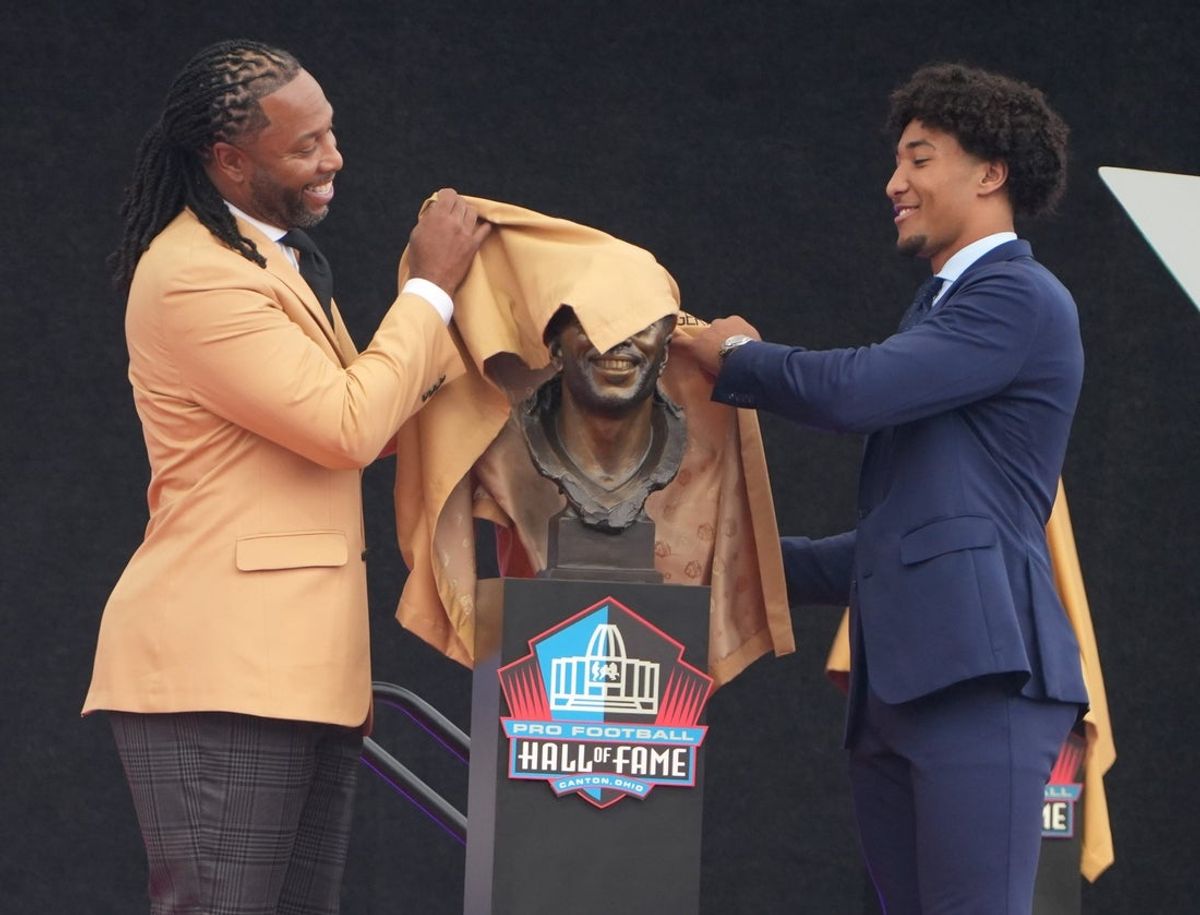
But this weekend of course, that’s exactly where Little Fitzy is headed. He will be enshrined into the Pro Football Hall of Fame in Canton, Ohio, on Saturday as a first-ballot Hall of Famer.

Fitzgerald will be remembered as one of the best and most productive wide receivers in league history after an incredible 17-season career with the Arizona Cardinals.

I have a ton of memories of being around Fitzgerald, but there’s one that stands out among them all.

One day after training camp, a nameless Vikings’ wide receiver camp body was getting extra work on a JUGS machine, catching balls. He was being tutored by Fitzgerald, who was showing this player how to properly approach the incoming ball. This was a child instructing a grown man an NFL team deemed good enough to attend training camp.

Larry Fitzgerald Jr. was special even back then.

In addition to his incredible natural football ability, Larry Fitzgerald Jr. stood out for his politeness and good nature. You could tell he was a good kid from the first time you met him.

There was no I’m-going-to-be-a-star attitude. He was genuine and he worked his tail off with the rest of the ball boys. There was no entitlement. It was as if he was using his time around an NFL camp as an internship for his future. He passed with flying colors.

I’ve always cherished following his career from his days at Pittsburgh in college to his days of dominating the NFL and I’ve enjoyed running into him over the years now and again.

Enjoy Canton, Little Fitzy, you’ve earned it.

#Larry #Fitzgeralds #Hall #Fame #induction #years #making">Larry Fitzgerald’s Hall of Fame induction is 25 years in the making  When I arrived to cover the Minnesota Vikings for the St. Paul Pioneer Press in 2000, it was clear I was dealing with a star-studded roster.The team boasted future Pro Football Hall of Famers; wide receivers Cris Carter and Randy Moss and defensive tackle John Randle. Plus, there were a ton of other stars including quarterback Daunte Culpepper, center Matt Birk and running back Robert Smith. The Vikings were loaded with star power.The talent around the team wasn’t relegated simply to the roster, however.That summer I first laid my eyes on a 16-year-old high school junior named Larry Fitzgerald Jr. The son of a local media member and close friend of Vikings’ head coach Dennis Green, Little Fitzy was a ball boy during training camp and on game days. It turns out, Larry Fitzgerald Jr. is very likely the most famous former NFL ball boy in history.On reporting date, fellow reporter Kevin Seifert pointed out Fitzgerald to me and said “that’s a bad man.” Seifert didn’t say that about any of the actual Vikings that day.Fitzgerald was already known as the best Minnesota high school prospect in years and he was considered one of the best high school players in the country. Seifert told me the buzz was that the kid was, no doubt, headed to the NFL in a half decade or so. Seifert was on the money. I’m not sure the Hall of Fame was mentioned or not.But this weekend of course, that’s exactly where Little Fitzy is headed. He will be enshrined into the Pro Football Hall of Fame in Canton, Ohio, on Saturday as a first-ballot Hall of Famer.Fitzgerald will be remembered as one of the best and most productive wide receivers in league history after an incredible 17-season career with the Arizona Cardinals.I have a ton of memories of being around Fitzgerald, but there’s one that stands out among them all.One day after training camp, a nameless Vikings’ wide receiver camp body was getting extra work on a JUGS machine, catching balls. He was being tutored by Fitzgerald, who was showing this player how to properly approach the incoming ball. This was a child instructing a grown man an NFL team deemed good enough to attend training camp.Larry Fitzgerald Jr. was special even back then.In addition to his incredible natural football ability, Larry Fitzgerald Jr. stood out for his politeness and good nature. You could tell he was a good kid from the first time you met him.There was no I’m-going-to-be-a-star attitude. He was genuine and he worked his tail off with the rest of the ball boys. There was no entitlement. It was as if he was using his time around an NFL camp as an internship for his future. He passed with flying colors.I’ve always cherished following his career from his days at Pittsburgh in college to his days of dominating the NFL and I’ve enjoyed running into him over the years now and again.Enjoy Canton, Little Fitzy, you’ve earned it.  #Larry #Fitzgeralds #Hall #Fame #induction #years #making

Follow Sportstar for extensive coverage of the tenth edition of the TNPL, from live scores and match reports to exclusive analysis and features.

TOSS

Tiruppur Tamizhans won the toss and chose to bowl first.

PLAYING XIs

Nellai Royal Kings: Athish SR(w), D Santhosh Kumar, Ajitesh Guruswamy, U Mukilesh, Rithik Easwaran, Sonu Yadav(c), Muhammed Adnan Khan, Ramalingam Rohit, Emmanuel Cherian, NS Harish, Rocky Bhasker

Tiruppur Tamizhans: Tushar Raheja(w), Amit Sathvik, Pradosh Ranjan Paul, Mohamed Ali, Uthirasamy Sasidev, Ravisrinivasan Sai Kishore(c), M Mathivannan, S Mohan Prasath, R Silambarasan, Esakkimuthu A, T Natarajan

Published on Aug 09, 2026

#TNPL #Live #Allround #batting #display #propels #Nellai #Royal #Kings">TNPL 2026 Live: All-round batting display propels Nellai Royal Kings to 206/8  Follow Sportstar for extensive coverage of the tenth edition of the TNPL, from live scores and match reports to exclusive analysis and features.TOSSTiruppur Tamizhans won the toss and chose to bowl first.PLAYING XIsNellai Royal Kings: Athish SR(w), D Santhosh Kumar, Ajitesh Guruswamy, U Mukilesh, Rithik Easwaran, Sonu Yadav(c), Muhammed Adnan Khan, Ramalingam Rohit, Emmanuel Cherian, NS Harish, Rocky BhaskerTiruppur Tamizhans: Tushar Raheja(w), Amit Sathvik, Pradosh Ranjan Paul, Mohamed Ali, Uthirasamy Sasidev, Ravisrinivasan Sai Kishore(c), M Mathivannan, S Mohan Prasath, R Silambarasan, Esakkimuthu A, T NatarajanPublished on Aug 09, 2026  #TNPL #Live #Allround #batting #display #propels #Nellai #Royal #Kings

Post Comment