×
India loses to Jamaica in Unity Cup 2026 semifinal, sets up third-place match against Zimbabwe  India suffered a 0-2 loss against higher-ranked Jamaica in the second semifinal of the Unity Cup 2026 at The Valley in London on Wednesday.Courtney Clarke and Kaheim Dixon scored for the Reggae Boyz as they set up a final against Nigeria, which beat Zimbabwe 2-0 in the first semifinal on Tuesday.The Blue Tigers, meanwhile, will face Zimbabwe in the third-place match on May 30.The match marked several important individual moments. Noufal PN and Ricky Shabong made their senior national team debuts, while Edmund Lalrindika was handed his first-ever start for India.Before the Blue Tigers, playing their first match on British soil since 2002, could settle into rhythm, Jamaica struck with ruthless efficiency.AS IT HAPPENED | India vs Jamaica HighlightsA quick Jamaican counter sliced through India’s shape in the eighth minute, forcing Gurpreet Singh Sandhu into a sharp save from a tight angle. Yet the danger was far from over. India failed to clear their lines, and Clarke intercepted a loose pass before scoring in emphatic fashion. With composure, he shifted the ball onto his right foot before unleashing a breathtaking strike into the top-right corner beyond Sandhu’s desperate dive.Jamaica, placed 71st in the FIFA Rankings, continued to attack with confidence, stretching the Indian defence through the wings and exploiting spaces with alarming ease. Dixon nearly doubled the advantage in the 17th minute when he burst through on goal, but Sandhu stood tall and made a brave stop to keep India alive.As the half wore on, India slowly managed to steady themselves. There were flashes of neat passing and moments of controlled possession, but the Blue Tigers lacked creativity in the final third. Ryan Williams, Chhangte, and Lalrindika struggled to influence the game, and India reached half-time without seriously testing Jamaica goalkeeper Coniah Boyce-Clarke.Yet India emerged after the break with greater urgency and belief. India’s resistance faded after the second strike as Jamaica comfortably saw out the remainder of the contest to book its place in the final.
                                                            | Photo Credit: 
                                AIFF Media
                            

                            India’s resistance faded after the second strike as Jamaica comfortably saw out the remainder of the contest to book its place in the final.
                                                            | Photo Credit: 
                                AIFF Media
                                                    The Blue Tigers nearly found a lifeline in the 53rd minute after a mistake from the Jamaican defence and goalkeeper. Roshan seized upon a loose ball and played Rahim Ali through on goal after the striker had replaced Lalrindika at half-time. However, Ali had strayed offside, so Chhangte’s follow-up finish into the empty net did not count.The chance, though, transformed the momentum of the match. India suddenly looked alive. Khalid Jamil’s men tried to make a match of it in the second half, pushing higher up the pitch and probing the Jamaican defence with far greater intent. The Blue Tigers finally began asking questions, forcing Jamaica onto the back foot during their best spell of the contest.But just when India seemed capable of finding a way back, Dixon produced a moment of magic that put paid to all their hopes.The Charlton Athletic winger, playing at his home stadium, collected the ball near the edge of the area in the 78th minute and danced past defenders with dazzling footwork. With one quick drop of the shoulder, he created space before drilling a low shot through Akash Mishra’s legs and into the far bottom corner beyond Sandhu.India’s resistance faded after the second strike as Jamaica comfortably saw out the remainder of the contest to book its place in the final.Published on May 28, 2026  #India #loses #Jamaica #Unity #Cup #semifinal #sets #thirdplace #match #Zimbabwe

India loses to Jamaica in Unity Cup 2026 semifinal, sets up third-place match against Zimbabwe

India suffered a 0-2 loss against higher-ranked Jamaica in the second semifinal of the Unity Cup 2026 at The Valley in London on Wednesday.

Courtney Clarke and Kaheim Dixon scored for the Reggae Boyz as they set up a final against Nigeria, which beat Zimbabwe 2-0 in the first semifinal on Tuesday.

The Blue Tigers, meanwhile, will face Zimbabwe in the third-place match on May 30.

The match marked several important individual moments. Noufal PN and Ricky Shabong made their senior national team debuts, while Edmund Lalrindika was handed his first-ever start for India.

Before the Blue Tigers, playing their first match on British soil since 2002, could settle into rhythm, Jamaica struck with ruthless efficiency.

AS IT HAPPENED | India vs Jamaica Highlights

A quick Jamaican counter sliced through India’s shape in the eighth minute, forcing Gurpreet Singh Sandhu into a sharp save from a tight angle. Yet the danger was far from over. India failed to clear their lines, and Clarke intercepted a loose pass before scoring in emphatic fashion. With composure, he shifted the ball onto his right foot before unleashing a breathtaking strike into the top-right corner beyond Sandhu’s desperate dive.

Jamaica, placed 71st in the FIFA Rankings, continued to attack with confidence, stretching the Indian defence through the wings and exploiting spaces with alarming ease. Dixon nearly doubled the advantage in the 17th minute when he burst through on goal, but Sandhu stood tall and made a brave stop to keep India alive.

As the half wore on, India slowly managed to steady themselves. There were flashes of neat passing and moments of controlled possession, but the Blue Tigers lacked creativity in the final third. Ryan Williams, Chhangte, and Lalrindika struggled to influence the game, and India reached half-time without seriously testing Jamaica goalkeeper Coniah Boyce-Clarke.

Yet India emerged after the break with greater urgency and belief.
India loses to Jamaica in Unity Cup 2026 semifinal, sets up third-place match against Zimbabwe  India suffered a 0-2 loss against higher-ranked Jamaica in the second semifinal of the Unity Cup 2026 at The Valley in London on Wednesday.Courtney Clarke and Kaheim Dixon scored for the Reggae Boyz as they set up a final against Nigeria, which beat Zimbabwe 2-0 in the first semifinal on Tuesday.The Blue Tigers, meanwhile, will face Zimbabwe in the third-place match on May 30.The match marked several important individual moments. Noufal PN and Ricky Shabong made their senior national team debuts, while Edmund Lalrindika was handed his first-ever start for India.Before the Blue Tigers, playing their first match on British soil since 2002, could settle into rhythm, Jamaica struck with ruthless efficiency.AS IT HAPPENED | India vs Jamaica HighlightsA quick Jamaican counter sliced through India’s shape in the eighth minute, forcing Gurpreet Singh Sandhu into a sharp save from a tight angle. Yet the danger was far from over. India failed to clear their lines, and Clarke intercepted a loose pass before scoring in emphatic fashion. With composure, he shifted the ball onto his right foot before unleashing a breathtaking strike into the top-right corner beyond Sandhu’s desperate dive.Jamaica, placed 71st in the FIFA Rankings, continued to attack with confidence, stretching the Indian defence through the wings and exploiting spaces with alarming ease. Dixon nearly doubled the advantage in the 17th minute when he burst through on goal, but Sandhu stood tall and made a brave stop to keep India alive.As the half wore on, India slowly managed to steady themselves. There were flashes of neat passing and moments of controlled possession, but the Blue Tigers lacked creativity in the final third. Ryan Williams, Chhangte, and Lalrindika struggled to influence the game, and India reached half-time without seriously testing Jamaica goalkeeper Coniah Boyce-Clarke.Yet India emerged after the break with greater urgency and belief. India’s resistance faded after the second strike as Jamaica comfortably saw out the remainder of the contest to book its place in the final.
                                                            | Photo Credit: 
                                AIFF Media
                            

                            India’s resistance faded after the second strike as Jamaica comfortably saw out the remainder of the contest to book its place in the final.
                                                            | Photo Credit: 
                                AIFF Media
                                                    The Blue Tigers nearly found a lifeline in the 53rd minute after a mistake from the Jamaican defence and goalkeeper. Roshan seized upon a loose ball and played Rahim Ali through on goal after the striker had replaced Lalrindika at half-time. However, Ali had strayed offside, so Chhangte’s follow-up finish into the empty net did not count.The chance, though, transformed the momentum of the match. India suddenly looked alive. Khalid Jamil’s men tried to make a match of it in the second half, pushing higher up the pitch and probing the Jamaican defence with far greater intent. The Blue Tigers finally began asking questions, forcing Jamaica onto the back foot during their best spell of the contest.But just when India seemed capable of finding a way back, Dixon produced a moment of magic that put paid to all their hopes.The Charlton Athletic winger, playing at his home stadium, collected the ball near the edge of the area in the 78th minute and danced past defenders with dazzling footwork. With one quick drop of the shoulder, he created space before drilling a low shot through Akash Mishra’s legs and into the far bottom corner beyond Sandhu.India’s resistance faded after the second strike as Jamaica comfortably saw out the remainder of the contest to book its place in the final.Published on May 28, 2026  #India #loses #Jamaica #Unity #Cup #semifinal #sets #thirdplace #match #Zimbabwe

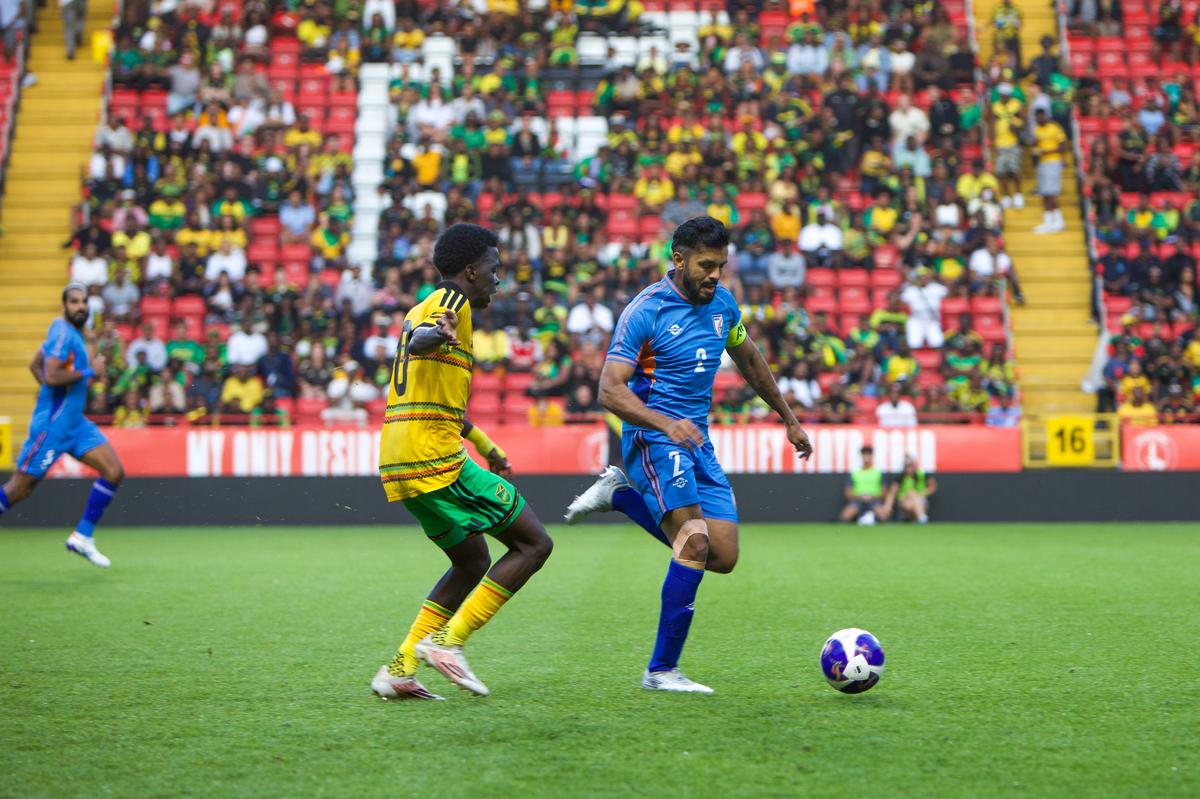
India’s resistance faded after the second strike as Jamaica comfortably saw out the remainder of the contest to book its place in the final. | Photo Credit: AIFF Media

lightbox-info

India’s resistance faded after the second strike as Jamaica comfortably saw out the remainder of the contest to book its place in the final. | Photo Credit: AIFF Media

The Blue Tigers nearly found a lifeline in the 53rd minute after a mistake from the Jamaican defence and goalkeeper. Roshan seized upon a loose ball and played Rahim Ali through on goal after the striker had replaced Lalrindika at half-time. However, Ali had strayed offside, so Chhangte’s follow-up finish into the empty net did not count.

The chance, though, transformed the momentum of the match. India suddenly looked alive. Khalid Jamil’s men tried to make a match of it in the second half, pushing higher up the pitch and probing the Jamaican defence with far greater intent. The Blue Tigers finally began asking questions, forcing Jamaica onto the back foot during their best spell of the contest.

But just when India seemed capable of finding a way back, Dixon produced a moment of magic that put paid to all their hopes.

The Charlton Athletic winger, playing at his home stadium, collected the ball near the edge of the area in the 78th minute and danced past defenders with dazzling footwork. With one quick drop of the shoulder, he created space before drilling a low shot through Akash Mishra’s legs and into the far bottom corner beyond Sandhu.

India’s resistance faded after the second strike as Jamaica comfortably saw out the remainder of the contest to book its place in the final.

Published on May 28, 2026

#India #loses #Jamaica #Unity #Cup #semifinal #sets #thirdplace #match #Zimbabwe

India suffered a 0-2 loss against higher-ranked Jamaica in the second semifinal of the Unity Cup 2026 at The Valley in London on Wednesday.

Courtney Clarke and Kaheim Dixon scored for the Reggae Boyz as they set up a final against Nigeria, which beat Zimbabwe 2-0 in the first semifinal on Tuesday.

The Blue Tigers, meanwhile, will face Zimbabwe in the third-place match on May 30.

The match marked several important individual moments. Noufal PN and Ricky Shabong made their senior national team debuts, while Edmund Lalrindika was handed his first-ever start for India.

Before the Blue Tigers, playing their first match on British soil since 2002, could settle into rhythm, Jamaica struck with ruthless efficiency.

AS IT HAPPENED | India vs Jamaica Highlights

A quick Jamaican counter sliced through India’s shape in the eighth minute, forcing Gurpreet Singh Sandhu into a sharp save from a tight angle. Yet the danger was far from over. India failed to clear their lines, and Clarke intercepted a loose pass before scoring in emphatic fashion. With composure, he shifted the ball onto his right foot before unleashing a breathtaking strike into the top-right corner beyond Sandhu’s desperate dive.

Jamaica, placed 71st in the FIFA Rankings, continued to attack with confidence, stretching the Indian defence through the wings and exploiting spaces with alarming ease. Dixon nearly doubled the advantage in the 17th minute when he burst through on goal, but Sandhu stood tall and made a brave stop to keep India alive.

As the half wore on, India slowly managed to steady themselves. There were flashes of neat passing and moments of controlled possession, but the Blue Tigers lacked creativity in the final third. Ryan Williams, Chhangte, and Lalrindika struggled to influence the game, and India reached half-time without seriously testing Jamaica goalkeeper Coniah Boyce-Clarke.

Yet India emerged after the break with greater urgency and belief.

India’s resistance faded after the second strike as Jamaica comfortably saw out the remainder of the contest to book its place in the final.
| Photo Credit:
AIFF Media

lightbox-info

India’s resistance faded after the second strike as Jamaica comfortably saw out the remainder of the contest to book its place in the final.
| Photo Credit:
AIFF Media

The Blue Tigers nearly found a lifeline in the 53rd minute after a mistake from the Jamaican defence and goalkeeper. Roshan seized upon a loose ball and played Rahim Ali through on goal after the striker had replaced Lalrindika at half-time. However, Ali had strayed offside, so Chhangte’s follow-up finish into the empty net did not count.

The chance, though, transformed the momentum of the match. India suddenly looked alive. Khalid Jamil’s men tried to make a match of it in the second half, pushing higher up the pitch and probing the Jamaican defence with far greater intent. The Blue Tigers finally began asking questions, forcing Jamaica onto the back foot during their best spell of the contest.

But just when India seemed capable of finding a way back, Dixon produced a moment of magic that put paid to all their hopes.

The Charlton Athletic winger, playing at his home stadium, collected the ball near the edge of the area in the 78th minute and danced past defenders with dazzling footwork. With one quick drop of the shoulder, he created space before drilling a low shot through Akash Mishra’s legs and into the far bottom corner beyond Sandhu.

India’s resistance faded after the second strike as Jamaica comfortably saw out the remainder of the contest to book its place in the final.

Published on May 28, 2026

Source link
#India #loses #Jamaica #Unity #Cup #semifinal #sets #thirdplace #match #Zimbabwe

Angel Reese had already established herself as one of the league’s top bigs in her first two seasons in Chicago. The former LSU star was named an All-Star in both her rookie and sophomore campaigns, broke a litany of rebounding records, and showcased her force on both ends of the floor.

But this season, she’s taken her game to a whole other level. While Reese’s individual accolades with the Sky were impressive, the team around her struggled, and the Sky found themselves near the bottom of league standings in back-to-back seasons. In April, Reese was traded to the Atlanta Dream, a team that already found themselves among the league’s best last year, but wanted to further bolster their frontcourt.

For the most part, it’s been a match made in heaven. Reese is averaging 15.6 points, 11.5 rebounds, 2.5 assists, and 1.8 steals per game, and Atlanta is 17-10 and winners of four straight games.

This year, she became the fastest player in league history to record 1,000 rebounds (doing so in 78 games), and the fastest to reach 50 double-doubles (doing so in 65 games).

But, in part due to Reese’s play, they’ve already accrued wins against top teams like the Dallas Wings (who they are 3-0 against) and the Indiana Fever (who are they are 2-1 against), among others. The Dream have outscored opponents by 99 points in Reese’s minutes this season, the 21st-best net rating in the WNBA and the third-best on the Dream, per Hoops Junkie. Atlanta has had a rigorous schedule so far, and they have the third-easiest remaining schedule.

In a Wednesday night victory over the Wings, Reese tallied 22 points, 12 rebounds, 4 assists, 4 steals, and a block.

In a Wednesday night interview with sideline reporter Terrika Foster-Brasby, Reese expressed gratitude for the situation she is in.

“I’m just so happy here in Atlanta; I’m just grateful to be here,” Reese said. “It’s been a sisterhood. They’ve had my back — through the highs, through the lows. It’s just a joy. I feel safe, I feel loved.”

The Dream are eyeing a title, and they have an elite core around Reese that includes Allisha Gray, Rhyne Howard, Jordin Canada, and Brionna Jones, among others.

They’ll have to get through some of the league’s top teams in a potential title run — they’re 0-1 against the Las Vegas Aces, 1-1 against the Minnesota Lynx, and 0-3 against the Golden State Valkyries this season. But if Reese continues to trend upwards, and if the cast around her continues to thrive, a championship could be headed to Atlanta.

#Angel #Reese #perfect #home">Angel Reese has found a perfect home  Angel Reese had already established herself as one of the league’s top bigs in her first two seasons in Chicago. The former LSU star was named an All-Star in both her rookie and sophomore campaigns, broke a litany of rebounding records, and showcased her force on both ends of the floor.But this season, she’s taken her game to a whole other level. While Reese’s individual accolades with the Sky were impressive, the team around her struggled, and the Sky found themselves near the bottom of league standings in back-to-back seasons. In April, Reese was traded to the Atlanta Dream, a team that already found themselves among the league’s best last year, but wanted to further bolster their frontcourt.For the most part, it’s been a match made in heaven. Reese is averaging 15.6 points, 11.5 rebounds, 2.5 assists, and 1.8 steals per game, and Atlanta is 17-10 and winners of four straight games.This year, she became the fastest player in league history to record 1,000 rebounds (doing so in 78 games), and the fastest to reach 50 double-doubles (doing so in 65 games).But, in part due to Reese’s play, they’ve already accrued wins against top teams like the Dallas Wings (who they are 3-0 against) and the Indiana Fever (who are they are 2-1 against), among others. The Dream have outscored opponents by 99 points in Reese’s minutes this season, the 21st-best net rating in the WNBA and the third-best on the Dream, per Hoops Junkie. Atlanta has had a rigorous schedule so far, and they have the third-easiest remaining schedule.In a Wednesday night victory over the Wings, Reese tallied 22 points, 12 rebounds, 4 assists, 4 steals, and a block.In a Wednesday night interview with sideline reporter Terrika Foster-Brasby, Reese expressed gratitude for the situation she is in.“I’m just so happy here in Atlanta; I’m just grateful to be here,” Reese said. “It’s been a sisterhood. They’ve had my back — through the highs, through the lows. It’s just a joy. I feel safe, I feel loved.”The Dream are eyeing a title, and they have an elite core around Reese that includes Allisha Gray, Rhyne Howard, Jordin Canada, and Brionna Jones, among others.They’ll have to get through some of the league’s top teams in a potential title run — they’re 0-1 against the Las Vegas Aces, 1-1 against the Minnesota Lynx, and 0-3 against the Golden State Valkyries this season. But if Reese continues to trend upwards, and if the cast around her continues to thrive, a championship could be headed to Atlanta.  #Angel #Reese #perfect #home

per Hoops Junkie. Atlanta has had a rigorous schedule so far, and they have the third-easiest remaining schedule.

In a Wednesday night victory over the Wings, Reese tallied 22 points, 12 rebounds, 4 assists, 4 steals, and a block.

In a Wednesday night interview with sideline reporter Terrika Foster-Brasby, Reese expressed gratitude for the situation she is in.

“I’m just so happy here in Atlanta; I’m just grateful to be here,” Reese said. “It’s been a sisterhood. They’ve had my back — through the highs, through the lows. It’s just a joy. I feel safe, I feel loved.”

The Dream are eyeing a title, and they have an elite core around Reese that includes Allisha Gray, Rhyne Howard, Jordin Canada, and Brionna Jones, among others.

They’ll have to get through some of the league’s top teams in a potential title run — they’re 0-1 against the Las Vegas Aces, 1-1 against the Minnesota Lynx, and 0-3 against the Golden State Valkyries this season. But if Reese continues to trend upwards, and if the cast around her continues to thrive, a championship could be headed to Atlanta.

#Angel #Reese #perfect #home">Angel Reese has found a perfect home

Angel Reese had already established herself as one of the league’s top bigs in her first two seasons in Chicago. The former LSU star was named an All-Star in both her rookie and sophomore campaigns, broke a litany of rebounding records, and showcased her force on both ends of the floor.

But this season, she’s taken her game to a whole other level. While Reese’s individual accolades with the Sky were impressive, the team around her struggled, and the Sky found themselves near the bottom of league standings in back-to-back seasons. In April, Reese was traded to the Atlanta Dream, a team that already found themselves among the league’s best last year, but wanted to further bolster their frontcourt.

For the most part, it’s been a match made in heaven. Reese is averaging 15.6 points, 11.5 rebounds, 2.5 assists, and 1.8 steals per game, and Atlanta is 17-10 and winners of four straight games.

This year, she became the fastest player in league history to record 1,000 rebounds (doing so in 78 games), and the fastest to reach 50 double-doubles (doing so in 65 games).

But, in part due to Reese’s play, they’ve already accrued wins against top teams like the Dallas Wings (who they are 3-0 against) and the Indiana Fever (who are they are 2-1 against), among others. The Dream have outscored opponents by 99 points in Reese’s minutes this season, the 21st-best net rating in the WNBA and the third-best on the Dream, per Hoops Junkie. Atlanta has had a rigorous schedule so far, and they have the third-easiest remaining schedule.

In a Wednesday night victory over the Wings, Reese tallied 22 points, 12 rebounds, 4 assists, 4 steals, and a block.

In a Wednesday night interview with sideline reporter Terrika Foster-Brasby, Reese expressed gratitude for the situation she is in.

“I’m just so happy here in Atlanta; I’m just grateful to be here,” Reese said. “It’s been a sisterhood. They’ve had my back — through the highs, through the lows. It’s just a joy. I feel safe, I feel loved.”

The Dream are eyeing a title, and they have an elite core around Reese that includes Allisha Gray, Rhyne Howard, Jordin Canada, and Brionna Jones, among others.

They’ll have to get through some of the league’s top teams in a potential title run — they’re 0-1 against the Las Vegas Aces, 1-1 against the Minnesota Lynx, and 0-3 against the Golden State Valkyries this season. But if Reese continues to trend upwards, and if the cast around her continues to thrive, a championship could be headed to Atlanta.

#Angel #Reese #perfect #home

There is a particular silence that falls over a club when it shuts down. Not the managers’ howling instructions or even the players weeping into their kits. It’s the quiet folding of spreadsheets, a refusal to pay a participation fee and a conglomerate deciding that Rs. 55 lakh is too much for the privileged for pretending to care.

And just like that, Jamshedpur FC, the steel city’s improbable footnote to the Indian Super League (ISL), wrapped up its senior team operations before the 2026-27 season, folded like a shirt no longer needed into the cupboard of Tata’s sprawling empire.

That is the reality of corporate football: when the romance wanes, assets become foldable liabilities.

This was a club that was competing for the title until the final matchday last season, which had an actual stadium that it owned, and prided of a genuine, effective pipeline for talent. When the footballing world was busy balancing books during the pandemic, the club actually made profits (Rs. 2 Cr.) in the 2019-20 season, and yet on July 31, 2026, it decided that the league, and its senior first team, was not worth the candle anymore.

“It took a lot of the members of the club aback, and it was informed in a grim breath in the evening. Naturally, most of the contingent was visibly shocked, rather disappointed,” a source told Sportstar.

Silence falls on Red Miners as Jamshedpur FC pulls the plug on its ISL journey  There is a particular silence that falls over a club when it shuts down. Not the managers’ howling instructions or even the players weeping into their kits. It’s the quiet folding of spreadsheets, a refusal to pay a participation fee and a conglomerate deciding that Rs. 55 lakh is too much for the privileged for pretending to care.And just like that, Jamshedpur FC, the steel city’s improbable footnote to the Indian Super League (ISL), wrapped up its senior team operations before the 2026-27 season, folded like a shirt no longer needed into the cupboard of Tata’s sprawling empire.That is the reality of corporate football: when the romance wanes, assets become foldable liabilities.This was a club that was competing for the title until the final matchday last season, which had an actual stadium that it owned, and prided of a genuine, effective pipeline for talent. When the footballing world was busy balancing books during the pandemic, the club actually made profits (Rs. 2 Cr.) in the 2019-20 season, and yet on July 31, 2026, it decided that the league, and its senior first team, was not worth the candle anymore.“It took a lot of the members of the club aback, and it was informed in a grim breath in the evening. Naturally, most of the contingent was visibly shocked, rather disappointed,” a source told        Sportstar. Jamshedpur FC had an actual stadium that it owned, and prided of a genuine, effective pipeline for talent.
                                                            | Photo Credit: 
                                ISL Media
                            

                            Jamshedpur FC had an actual stadium that it owned, and prided of a genuine, effective pipeline for talent.
                                                            | Photo Credit: 
                                ISL Media
                                                    The Tata Group has not provided an explanation for the decision. But it comes against the backdrop of the prolonged decline of Indian football in the last few years, which has had a domino effect on the men’s topflight. The men’s team’s FIFA rankings have plummeted, the league’s commercial value shrank by 97 per cent last season, and four ISL clubs have either shut down or shifted base.
ISL Clubs which have shut down or have been rebranded:

Pune City FC

Atletico de Kolkata

Delhi Dynamos

Hyderabad FC

Jamshedpur FC
Reliance, the initial commercial partner, is gone. The City Football Group abandoned Mumbai City’s ship last season, and now Tata, gently, has shown itself out.In the last two years, the Tata-owned club lost about Rs. 11 Crore, while its Central Rights income collapsed from Rs. 21.24 crore to Rs. 32 Lakhs – a fall of nearly 99 per cent. As a result, its deficit in football operations tripled, from Rs. 1 Crore in the 2024-25 season to Rs. 2.8 Crore in the 2025-26 season.Capital fuels growth, and that in turn drives football, and that goes on in cycles.The most promising trend for Jamshedpur FC, in the last two years, was grassroots development, player transfers and training compensation (providing facilities for player training). And the conglomerate, as they usually do, got its blue-eyed boy here – the kids.“JFSPL (Jamshedpur Football and Sporting Private Limited) remains committed, in other capacities, to the continued growth and development of football in India. We will continue in our endeavour to promote and develop the game of football, including at the grassroots level,” the club said in its statement.The decision also pushed players into choppy waters. Players, some of whom were chiselled at the storied Tata Football Academy (TFA), will now be expected to run from pillar to post late in the summer window for a new team when most teams already have their squads chalked out.But the real victims of the decision will not be the professionals. Footballers are mercenaries by profession: they will find another jersey to don, another bench to warm.The tragedy will lie with the fans – people who built a community organically, named it the Red Miners, and rallied behind the team no matter how it played. The roar at the JRD Stadium when a TFA product scored meant something, everything, and that is what will no longer be heard.The ones who gave free treats when Jamshedpur won, to the ones who quietly bought season tickets, the silence will now haunt them, leaving them wondering if this was just part of an elaborate, expensive dream. The tragedy will lie with the fans – people who built a community organically, named it the Red Miners, and rallied behind the team no matter how it played.
                                                            | Photo Credit: 
                                ISL Media
                            

                            The tragedy will lie with the fans – people who built a community organically, named it the Red Miners, and rallied behind the team no matter how it played.
                                                            | Photo Credit: 
                                ISL Media
                                                    The Tata group showed that Jamshedpur FC, in the ISL, had always been a product rather than a community club, and when a product wears out, it is sold in parts, just like its ball bearings and wires.And dreamers? Well, they get a press release.Published on Aug 01, 2026  #Silence #falls #Red #Miners #Jamshedpur #pulls #plug #ISL #journey

Jamshedpur FC had an actual stadium that it owned, and prided of a genuine, effective pipeline for talent. | Photo Credit: ISL Media

lightbox-info

Jamshedpur FC had an actual stadium that it owned, and prided of a genuine, effective pipeline for talent. | Photo Credit: ISL Media

The Tata Group has not provided an explanation for the decision. But it comes against the backdrop of the prolonged decline of Indian football in the last few years, which has had a domino effect on the men’s topflight. The men’s team’s FIFA rankings have plummeted, the league’s commercial value shrank by 97 per cent last season, and four ISL clubs have either shut down or shifted base.

ISL Clubs which have shut down or have been rebranded:

Pune City FC

Atletico de Kolkata

Delhi Dynamos

Hyderabad FC

Jamshedpur FC

Reliance, the initial commercial partner, is gone. The City Football Group abandoned Mumbai City’s ship last season, and now Tata, gently, has shown itself out.

In the last two years, the Tata-owned club lost about Rs. 11 Crore, while its Central Rights income collapsed from Rs. 21.24 crore to Rs. 32 Lakhs – a fall of nearly 99 per cent. As a result, its deficit in football operations tripled, from Rs. 1 Crore in the 2024-25 season to Rs. 2.8 Crore in the 2025-26 season.

Capital fuels growth, and that in turn drives football, and that goes on in cycles.

The most promising trend for Jamshedpur FC, in the last two years, was grassroots development, player transfers and training compensation (providing facilities for player training). And the conglomerate, as they usually do, got its blue-eyed boy here – the kids.

“JFSPL (Jamshedpur Football and Sporting Private Limited) remains committed, in other capacities, to the continued growth and development of football in India. We will continue in our endeavour to promote and develop the game of football, including at the grassroots level,” the club said in its statement.

The decision also pushed players into choppy waters. Players, some of whom were chiselled at the storied Tata Football Academy (TFA), will now be expected to run from pillar to post late in the summer window for a new team when most teams already have their squads chalked out.

But the real victims of the decision will not be the professionals. Footballers are mercenaries by profession: they will find another jersey to don, another bench to warm.

The tragedy will lie with the fans – people who built a community organically, named it the Red Miners, and rallied behind the team no matter how it played. The roar at the JRD Stadium when a TFA product scored meant something, everything, and that is what will no longer be heard.

The ones who gave free treats when Jamshedpur won, to the ones who quietly bought season tickets, the silence will now haunt them, leaving them wondering if this was just part of an elaborate, expensive dream.

The tragedy will lie with the fans – people who built a community organically, named it the Red Miners, and rallied behind the team no matter how it played.

The tragedy will lie with the fans – people who built a community organically, named it the Red Miners, and rallied behind the team no matter how it played. | Photo Credit: ISL Media

lightbox-info

The tragedy will lie with the fans – people who built a community organically, named it the Red Miners, and rallied behind the team no matter how it played. | Photo Credit: ISL Media

The Tata group showed that Jamshedpur FC, in the ISL, had always been a product rather than a community club, and when a product wears out, it is sold in parts, just like its ball bearings and wires.

And dreamers? Well, they get a press release.

Published on Aug 01, 2026

#Silence #falls #Red #Miners #Jamshedpur #pulls #plug #ISL #journey">Silence falls on Red Miners as Jamshedpur FC pulls the plug on its ISL journey  There is a particular silence that falls over a club when it shuts down. Not the managers’ howling instructions or even the players weeping into their kits. It’s the quiet folding of spreadsheets, a refusal to pay a participation fee and a conglomerate deciding that Rs. 55 lakh is too much for the privileged for pretending to care.And just like that, Jamshedpur FC, the steel city’s improbable footnote to the Indian Super League (ISL), wrapped up its senior team operations before the 2026-27 season, folded like a shirt no longer needed into the cupboard of Tata’s sprawling empire.That is the reality of corporate football: when the romance wanes, assets become foldable liabilities.This was a club that was competing for the title until the final matchday last season, which had an actual stadium that it owned, and prided of a genuine, effective pipeline for talent. When the footballing world was busy balancing books during the pandemic, the club actually made profits (Rs. 2 Cr.) in the 2019-20 season, and yet on July 31, 2026, it decided that the league, and its senior first team, was not worth the candle anymore.“It took a lot of the members of the club aback, and it was informed in a grim breath in the evening. Naturally, most of the contingent was visibly shocked, rather disappointed,” a source told        Sportstar. Jamshedpur FC had an actual stadium that it owned, and prided of a genuine, effective pipeline for talent.
                                                            | Photo Credit: 
                                ISL Media
                            

                            Jamshedpur FC had an actual stadium that it owned, and prided of a genuine, effective pipeline for talent.
                                                            | Photo Credit: 
                                ISL Media
                                                    The Tata Group has not provided an explanation for the decision. But it comes against the backdrop of the prolonged decline of Indian football in the last few years, which has had a domino effect on the men’s topflight. The men’s team’s FIFA rankings have plummeted, the league’s commercial value shrank by 97 per cent last season, and four ISL clubs have either shut down or shifted base.
ISL Clubs which have shut down or have been rebranded:

Pune City FC

Atletico de Kolkata

Delhi Dynamos

Hyderabad FC

Jamshedpur FC
Reliance, the initial commercial partner, is gone. The City Football Group abandoned Mumbai City’s ship last season, and now Tata, gently, has shown itself out.In the last two years, the Tata-owned club lost about Rs. 11 Crore, while its Central Rights income collapsed from Rs. 21.24 crore to Rs. 32 Lakhs – a fall of nearly 99 per cent. As a result, its deficit in football operations tripled, from Rs. 1 Crore in the 2024-25 season to Rs. 2.8 Crore in the 2025-26 season.Capital fuels growth, and that in turn drives football, and that goes on in cycles.The most promising trend for Jamshedpur FC, in the last two years, was grassroots development, player transfers and training compensation (providing facilities for player training). And the conglomerate, as they usually do, got its blue-eyed boy here – the kids.“JFSPL (Jamshedpur Football and Sporting Private Limited) remains committed, in other capacities, to the continued growth and development of football in India. We will continue in our endeavour to promote and develop the game of football, including at the grassroots level,” the club said in its statement.The decision also pushed players into choppy waters. Players, some of whom were chiselled at the storied Tata Football Academy (TFA), will now be expected to run from pillar to post late in the summer window for a new team when most teams already have their squads chalked out.But the real victims of the decision will not be the professionals. Footballers are mercenaries by profession: they will find another jersey to don, another bench to warm.The tragedy will lie with the fans – people who built a community organically, named it the Red Miners, and rallied behind the team no matter how it played. The roar at the JRD Stadium when a TFA product scored meant something, everything, and that is what will no longer be heard.The ones who gave free treats when Jamshedpur won, to the ones who quietly bought season tickets, the silence will now haunt them, leaving them wondering if this was just part of an elaborate, expensive dream. The tragedy will lie with the fans – people who built a community organically, named it the Red Miners, and rallied behind the team no matter how it played.
                                                            | Photo Credit: 
                                ISL Media
                            

                            The tragedy will lie with the fans – people who built a community organically, named it the Red Miners, and rallied behind the team no matter how it played.
                                                            | Photo Credit: 
                                ISL Media
                                                    The Tata group showed that Jamshedpur FC, in the ISL, had always been a product rather than a community club, and when a product wears out, it is sold in parts, just like its ball bearings and wires.And dreamers? Well, they get a press release.Published on Aug 01, 2026  #Silence #falls #Red #Miners #Jamshedpur #pulls #plug #ISL #journey

Post Comment