
What happened to the one ’90s thriller nobody saw in theaters that absolutely nobody who did see it has ever forgotten? It’s 1993. A scrappy little urban chase movie opens at number five at the box office and disappears inside of two weeks. And somehow, thirty-plus years later, people are still pressing it on friends and watching their faces to see the exact moment Denis Leary walks into frame.
How does a film bomb that hard and still carve out a legitimate cult? And how did the behind-the-scenes story end up being almost as wild as anything in the movie? That movie is Judgment Night. And if you haven’t seen it, what are you doing with your life?
Seriously though. This film has one of the most absurd, on-paper-makes-no-sense casts of the entire decade. Emilio Estevez, Cuba Gooding Jr., Stephen Dorff, Jeremy Piven, and Denis Leary, who plays a psychotic crime lord. All crammed into a grimy Chicago thriller where four buds on their way to a boxing match accidentally witness a murder and spend the rest of the night running for their lives through rooftops, housing projects, and a flea market. Yes, a flea market. The ’90s were wild. So today on WTF Happened To This Movie, we’ll dive into how this got made, bombed, was forgotten, came back, and carved itself a proper cult following. This is Judgment Night – a fave of ours here on JoBlo.
The Chaos of Development: From Spec Script to Twelve Writers
This movie started as a spec script called Escape, written by Kevin Jarre, who later wrote Tombstone. The idea got picked up somewhere around 1989–1990 by producer Lawrence Gordon, whose resume at that point included Predator and Die Hard. Gordon’s production company, Largo Entertainment, bought it and… kind of sat on it for a while trying to figure out what exactly to do with it.
What followed was one of the most exhausting development processes of the era. Director Stephen Hopkins, who had just come off Predator 2, was brought aboard and handed what can only be described as a pile of scripts. At the 25th anniversary screening of the film during Chicago’s Cinepocalypse festival in 2018, Hopkins said the studio commissioned multiple writers to take a crack at the material. We’re talking about John Carpenter, William Wisher (who co-wrote Terminator 2), Randall Wallace, and Christopher Crowe—each took a swing. Some versions had bikers in the desert outside L.A. One apparently involved rooftop motorcycle chases. Hopkins himself said at Cinepocalypse: “I was given a lot of scripts, and it was quite a long process, we wanted to work hard to get it right.”
It’s worth pausing on the John Carpenter detail for a second, because it’s genuinely fascinating. The producers, who had a history with Walter Hill going back to The Warriors, wanted something in that spirit: a heightened, almost mythological urban chase. And they went to Carpenter to try and get it. Nobody knows exactly what his version looked like. Hopkins only mentioned him briefly. But the idea of a Carpenter-written Judgment Night bouncing around Hollywood in the early ’90s is the kind of what-if that keeps film obsessives up at night.
The final script that actually got made was written by Lewis Colick from a story he co-developed with novelist Jere Cunningham. Screenwriter Larry Ferguson was brought in for rewrites. So what you’re watching when you watch this movie is the combined creative suffering of somewhere between six and twelve human beings. And honestly… it works.
Casting the Chaos: The Men Behind the Chase
Okay, here’s where things get genuinely wild. According to Hopkins, his original vision for Judgment Night had John Travolta in the lead role and Kevin Spacey as the villain. Tom Cruise was reportedly approached. Ray Liotta was considered. Samuel L. Jackson and Christian Slater were either offered roles or passed. This thing was bouncing around Hollywood like a hot potato. And then somehow, we ended up with Emilio Estevez as Frank Wyatt, family man and accidental hero.
Now, to be fair, Estevez was a perfectly reasonable choice by 1993 standards. He’d done Repo Man, The Mighty Ducks, Young Guns, and Stakeout. Basically, the guy could carry a movie. But the lead role was never written with him in mind, and there’s something a little off about the fit that actually serves the character. Frank’s supposed to be a guy who’s slightly out of his league from the jump. He’s not an action hero. He’s a new dad who just wanted to watch a boxing match and is now getting shot at on a rooftop.
Then you’ve got Cuba Gooding Jr. as Mike, Frank’s best friend. He’s a charismatic actor with obvious star power that the film absolutely benefits from. Hopkins has talked openly about his experience watching Gooding in Boyz n the Hood and being struck by how still and quiet he was in that role. He assumed Gooding would bring that same restrained energy to Judgment Night. What he got instead was the actual Cuba Gooding Jr., which is to say, an outrageous, high-energy performer who had grown up with a genuinely tough life and brought something raw to the role that Hopkins hadn’t entirely anticipated. Some people felt he went over the top. Hopkins disagreed then and still disagrees now.
Stephen Dorff as the younger brother John brings genuine vulnerability to a role that could have easily been nothing. Hopkins had known Dorff since he was a kid and describes him as a great pianist and a genuinely heartfelt person who translates that quality onto screen. He and Estevez had a real big brother-little brother dynamic on set. That makes sense, because Estevez was famously professional and by-the-book on set, very much the product of growing up in a movie family, while Dorff was younger and looser and just wired differently.
And Jeremy Piven as Ray, the rich friend with the rented RV who makes increasingly bad decisions. He’s doing what Jeremy Piven does best: being the guy in the room you kind of want to slap but also kind of feel sorry for when things go sideways. Hopkins has a line about it that’s perfect. He says when Piven’s character dies, everyone in the theater cheers—but then immediately feels a little bad about it. And spoiler alert, things go very sideways for Ray.
Denis Leary: The Perfect ’90s Villain
But let’s talk about the real MVP, Denis Leary. In 1993, Denis Leary was in a very specific moment in his career. His debut comedy album No Cure for Cancer had dropped in 1992 and he’d done the accompanying HBO special, making him the guy everyone quoted at parties. The fast-talking, cigarette-smoking, aggressively opinionated stand-up comic who seemed perpetually furious at the concept of politeness. He was not yet known for playing noble firefighters on Rescue Meor voicing Diego the saber-toothed tiger in the Ice Age films. He was just a comedian who liked to be known as an asshole.
So casting him as Fallon, a murderous Chicago crime lord with a hair-trigger temper and a deep philosophical contempt for the wealthy, is either genius or the most obvious decision anyone has ever made. When Jeremy Piven’s character tries to bribe his way out of certain death, Fallon is practically offended. Not because he doesn’t want the money, but because he finds the whole concept of a rich kid thinking cash can solve everything to be uniquely revolting. There’s a worldview in there, buried under the murder and the menace, and Leary sells every word of it.
He is absolutely terrifying in this movie. You believe every second that Fallon will kill someone over a comment he didn’t like. He drowns one of his own guys in a sewer because the dude said something that annoyed him. It’s a legitimately great villain performance from a guy who had no business being this good in his first major dramatic role. Or maybe he did. Maybe years of screaming into a microphone about things that irritate him was the perfect training ground.
A Hostile Chicago: Real Guns and Sodium Lights
Production on Judgment Night began in Long Beach before relocating to Los Angeles, but the film is set in Chicago, which was achieved through a combination of locations and sheer atmosphere. Stephen Hopkins wanted the city to feel like a character itself, something hostile and unknowable, and the cinematography leans hard into darkness, shadow, and urban decay.
Hopkins has talked at length about the specific visual language he was chasing. He screened Touch of Evil for his crew and told them to pay attention to the vast expanses of black on screen. The goal was to make something that could almost pass for black and white with deep shadows and proper horror-movie darkness. They also discovered that Chicago at night had a very specific kind of sodium-yellow streetlighting that looked distinctive but reacted poorly on film, throwing everything slightly out of focus. They had to continuously adjust as they shot. All of this while the actors were soaked in water and covered in dirt in the middle of a Chicago October.
The dailies apparently freaked out the studio so badly that executives thought the crew was using matte paintings. Hopkins was sending footage back to Universal showing what they were shooting in some of the rougher neighborhoods on the west and south sides of the city—these were areas that had been devastated since the 1968 riots and never fully recovered. The studio literally couldn’t believe it was real. Hopkins had to essentially prove they were shooting a movie in actual locations before anyone calmed down.
And then there was the shooting. As in, an actual gunfight. It broke out near the set during the scene where Jeremy Piven’s Ray confronts Fallon. Hopkins described it in stark terms: they were filming, a shot rang out, and it turned out a schoolkid had just been killed by someone in a nearby building—a sixteen-year-old who had to shoot someone to get into a gang. The crew ran toward the sound. The Army showed up the next day and temporarily shut production down. Hopkins reflected on it as a real awakening for a crew of filmmakers who thought they were making a tough movie: you’d be driving through these neighborhoods and there’d be people sitting on porches with their rifles out. The film’s whole premise—suburban guys stumbling into a world they’ve been insulated from their entire lives—was playing out in real time around the production.
Adam Carolla was also on this production. He was a stand-in for one of the bad guys, a small role player named Michael Wiseman. A friend of his was the assistant director, and Carolla parlayed that connection into what he’s described as his first real foray into film.
The film also featured Everlast, then known as Erik Schrody, as one of Fallon’s henchmen, Rhodes. This was before his massive solo hit a few years later, back when he was still primarily known as the rapper from House of Pain. Hopkins specifically mentioned that Everlast’s involvement in the film, both on screen and on the soundtrack, was a useful connective tissue between the movie and the album.
The Legendary Rap-Rock Soundtrack
Speaking of music, the Judgment Night soundtrack is one of the genuinely great artifacts of the early ’90s! Music supervisor Happy Walters was the architect of it. Hopkins is quick to deflect credit there, and the concept was simple and brilliant: pair rock bands with hip-hop artists for collaborative tracks. Not just mash-ups, actual collaborations. Slayer and Ice-T. Biohazard and Onyx. Mudhoney and Sir Mix-a-Lot. Helmet and House of Pain. Pearl Jam and Cypress Hill. Living Colour and Run-DMC.
Hopkins admits he didn’t completely understand it when Walters first pitched it, and went to some of the recording sessions not entirely sure what he was walking into. What he heard when the tracks started coming together was something that felt genuinely fresh. He said he didn’t think there had ever been anything quite like it before, and he’s probably right. It essentially predicted the rap-rock fusion that would take over the late ’90s.
The album was praised across the board, including an A from Entertainment Weekly and an A-minus from noted critic Robert Christgau. Hopkins’s daughter, he said with obvious delight, considers it the greatest album ever made and credits it as the only real reason she’s proud of him for making the film.
The film also had a fully orchestral score by Alan Silvestri, who’d previously worked with Hopkins on Predator 2. In 2005, Intrada Records released the complete score with two previously rejected tracks. That’s some real cult status right there.
The Disastrous Release and the Path to Cult Classic
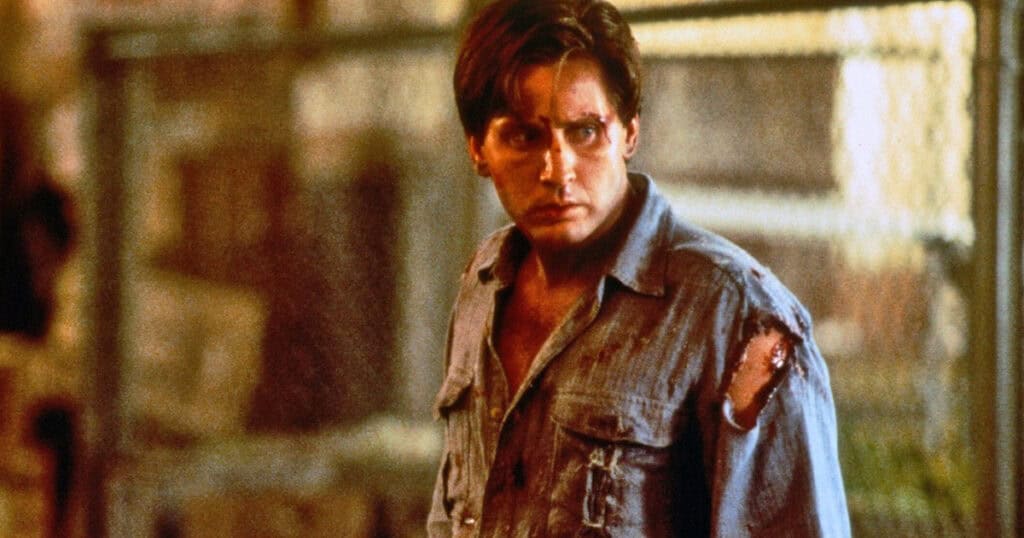
Judgment Night opened on October 15, 1993. It ended its theatrical run with a total domestic gross of just over $12 million against a reported budget of $21 million. So by any conventional measure, a flop.
Critics were mixed at best. The film currently sits at 38% on Rotten Tomatoes. The Michigan Daily‘s John Rybock, writing that same opening week, was pretty brutal about it; he said he had to struggle to find good things to say about it, though he acknowledged the cinematography and called Leary “fairly good.” That’s a rough review. On the more positive end, Variety called it “an exceedingly well directed, cleverly filmed and edited, tension-filled affair” while also calling the plot “wholly preposterous.” Which honestly sounds about right and also makes it sound kind of great. The Sydney Morning Herald‘s Michael Hutak, looking back at the film decades later, praised it more warmly, capturing the sense that it rewards revisitation in a way that pure genre exercises often don’t. Audiences in 1993 gave it a B on CinemaScore, which is at least a signal that the people who actually showed up generally liked what they saw.
There was also one more ugly wrinkle in the theatrical run that Hopkins talked about openly. On the opening weekend in the Bronx, a shootout broke out in a movie theater during a screening of Judgment Night. The film was briefly listed among the things being blamed for it. It was pulled from those screens almost immediately. Hopkins reflected on the unfairness of that; the film itself is about the horror of urban violence, not a glorification of it. Unfortunately, the damage was done. In those days, if a film got pulled, it went in a vault somewhere, like your favorite Disney VHSs, and that was that.
Judgment Night did, however, find its real audience on VHS. The film would build a real following over the years through cable and home video. People who saw it remembered it. People who stumbled across it at a friend’s house or caught it on late-night cable became genuine advocates for it.
Fast forward to January 2019, when Warner Archive Collection finally dropped a somewhat proper Blu-ray in the United States. And here’s where I have to be honest with you: the disc is technically solid. The video transfer, sourced from a new 2K scan, is genuinely impressive. The audio sounds great. But the extras? There are none. For a movie with this much of a story behind it, it’s genuinely baffling that nobody put together even a basic making-of. There’s an international Blu-ray release that’s been around since 2016, but it was sourced from an older Universal master that apparently doesn’t hold up as well. Come to think of it, Arrow Video has released films with similar cult pedigrees, including 4K restorations, booklets with essays, excellent sound, and tons of bonus content. Someone get them on the phone so we can have a proper release, please.
25 Years Later: Why It Still Matters
One of the better things to happen to Judgment Night‘s legacy in recent years was the 25th anniversary screening at Cinepocalypse in Chicago in 2018. Hopkins showed up to talk about the film, and what came out of both the Q&A and the Consequence of Sound interview conducted around that same weekend is as good a document of this film’s backstory as you’re going to find.
A lot of what Hopkins talked about was the city itself. He described Chicago as uniquely primed for the story Judgment Night was trying to tell. The freeway system in American cities, he explained, is basically designed to let people drive over the top of poor neighborhoods without ever having to engage with them. The whole premise of the film—Frank and his friends accidentally exiting the highway into a world they’ve never had to confront—isn’t just a thriller conceit; it’s a literal description of how American urban geography works. Hopkins said he wanted that subtext baked into the film, and whether critics noticed it or not in 1993, it’s there.
He also talked about the specific look of the movie, and how it almost broke apart before they found it. Chicago at night in 1993 was lit primarily by sodium-yellow street lamps, and when they tested that look on film, it went slightly out of focus. The aesthetic they eventually landed on came out of weeks of problem-solving around a technical limitation. They were making it work by necessity, and it ended up being the defining visual of the movie. Hopkins credits Touch of Evilexplicitly. He made the crew watch it and told them to pay attention to how much Welles left in darkness.
Hopkins also reflected on the class dynamics of the film, and this is maybe the most interesting part of what he had to say. He talked about a type of American man—he invoked Sam Peckinpah—who peaked in college and spends the rest of his adult life quietly aware of that. He sees that in Cuba Gooding’s character, Mike: someone who always felt like the biggest personality in the room back in the day, and who embraces this terrible night because part of him has always wanted to be tested that way. And then there’s Frank, the “family man who finds his private animal,” as Hopkins put it. The film is partly about what happens when men who’ve been comfortable for too long are suddenly forced to operate on pure instinct. Fallon, the villain, doesn’t exist in that world of comfort. He’s always been operating on instinct. And that’s why the suburbanites are so outmatched for most of the runtime.
Hopkins also made an interesting observation about what the film gets right by accident. He noted that the production needed to make arrangements with actual gangs when they were shooting certain locations. This wasn’t metaphorical. On Predator 2, they’d hired members of the Crips to essentially protect the set in downtown LA, and he described the moment one of them pulled out a loaded gun mid-conversation. He brought that experience to Judgment Night. The danger in the film isn’t invented. The hostility of those environments wasn’t a production design choice. Hopkins and his crew were experiencing a version of it every day.
Hopkins would later go on to direct The Ghost and the Darkness, Lost in Space, and a bunch of prestigious TV including 24, Boardwalk Empire, and Game of Thrones. Still, Judgment Night seems to hold a specific place for him. He came to Cinepocalypse with affection for the film and something genuine to say about it, which is rarer than you’d think from directors reflecting on work that underperformed.
The Verdict on Judgment Night
On paper, Judgment Night has no right to be as good as it is. The story is essentially The Warriors if The Warriors got off the freeway by accident and the antagonist did stand-up comedy on weekends. But somehow it really works.
The pacing is relentless in a way that a lot of action movies from the era aspired to and missed. The villain is terrifying without being cartoonish. The four leads have genuine chemistry that sells the friendship instantly, which matters enormously in a movie where the whole emotional core is “these are people worth saving.” And there’s class anxiety running through the whole thing. The sense that Fallon’s gang represents something that Frank and his friends have been insulated from their entire lives, and that their suburban comfort is being stripped away layer by layer as the night goes on, gives the film some weight.
This is an actual, honest-to-goodness mid-budget genre gem that got swallowed by a busy fall season, roughed up by critics, briefly scapegoated for real-world violence it had nothing to do with, and left theaters without much ceremony. Then home media kept it alive, sent it around, and let it find the people who were going to love it. And over thirty years, it slowly carved out exactly the reputation it deserved.
It’s not a perfect movie. But it’s a great watch. It’s tense and mean and funny in all the right dark ways, with a cast that had no business being assembled in one film and a director who squeezed every dollar out of that $21 million budget even if the box office numbers suggest otherwise. It’s the kind of movie you throw on for someone who’s never seen it and spend the whole runtime watching their face to see when they get hooked. Usually, it’s the first time Denis Leary comes on screen.

Subscribe to our weekly newsletter
Source link
#Judgment #Night #Forgotten #90s #Action #Thriller #Decades #Soundtrack


Post Comment