×
Who are the Druze and why is Israel attacking Syria?

Who are the Druze and why is Israel attacking Syria?

Tess Mallinder Heron

BBC Monitoring
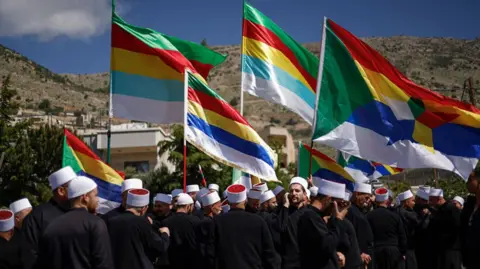
Getty Images Druze men lifting their flags in the air, wearing white hats and black robesGetty Images

A fresh wave of deadly sectarian violence has rocked Syria, putting into focus the country’s fragile security landscape as the new government attempts to impose its authority over the fractured territory.

On Sunday 13 July, the reported abduction of a merchant from the Druze minority sparked days of deadly clashes between Druze militias and Sunni Bedouin fighters in southern Syria.

Later on Tuesday 15 July, Israel intervened militarily, saying its forces were seeking to protect the Druze and to eliminate pro-government forces accused of attacking them in Suweida. At least 300 people are reported to have been killed in Suweida since Sunday, according to the Syrian Observatory for Human Rights.

The violence is the first in the Druze-majority province of Suweida since fighting in April and May between Druze fighters and Syria’s new security forces killed dozens of people. Prior to this, clashes in Syria’s coastal provinces in March were said to have killed hundreds of members of the Alawite minority, to which former ruler Bashar al-Assad belongs.

The deadly unrest, along with the violent Israeli strikes, have re-ignited fears of a security breakdown in Syria, as the country grapples with the fallout from over a decade of civil war, and the recent Islamist-led rebel takeover of Damascus in December 2024. Syria’s current leader, former jihadist Ahmed al-Sharaa, has vowed to protect Syria’s minorities.

Who are the Druze?

The Druze are an Arabic-speaking ethno-religious minority in Syria, Lebanon, Israel and the occupied Golan Heights. The Druze faith is an offshoot of Shia Islam with its own unique identity and beliefs.

Half of its roughly one million followers live in Syria, where they make up about 3% of the population. The Druze community in Israel is largely considered to be loyal to the Israeli state, owing to its members’ participation in military service. There are some 152,000 Druze people living in Israel and the Israeli-occupied Golan Heights, according to the Israeli Central Bureau of Statistics.

They have historically occupied a precarious position in Syria’s political order. During Syria’s almost 14-year civil war, the Druze operated their own militias in southern Syria.

Since the fall of Assad in December, the Druze have resisted state attempts to impose authority over southern Syria. While the Druze factions in Syria are divided in their approach to the new authorities, ranging from caution to outright rejection, many object to official Syrian security presence in Suweida and have resisted integration into the Syrian army – relying instead on local militias.

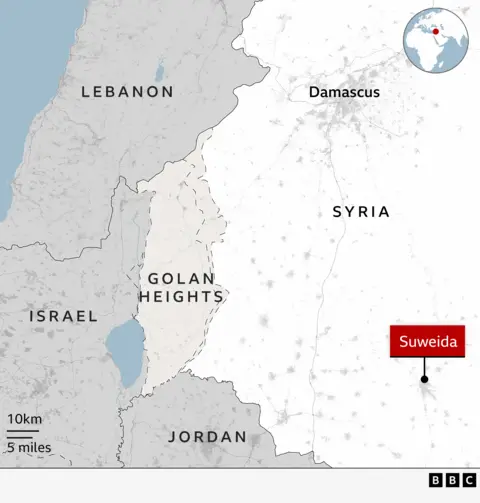
A BBC map showing Syria, Israel, the occupied Golan Heights and Suweida city

Despite the Syrian government condemning the recent attacks on Druze people and vowing to restore order in southern Syria, its forces have also been accused of attacking the minority – with the UK-based Syrian Observatory for Human Rights (SOHR) war monitor documenting “summary executions” of Druze people by government forces. Such reports have fuelled mistrust among some members of the Druze community towards the authorities in Damascus.

After Assad’s sudden fall, Israel has been reaching out to the Druze community near its northern border in a bid to forge alliances with Syria’s minorities. It has increasingly positioned itself as a regional protector of minorities, including the Kurds, Druze and Alawites in Syria, while attacking military sites in Syria and government forces.

During the sectarian clashes in May, Israel carried out strikes near the presidential palace in Damascus, saying it was a warning against attacks on the Druze. However, some Druze figures in Syria and Lebanon have accused Israel of stoking sectarian divisions to advance its own expansionist aspirations in the region.

Why is Israel attacking Syria now?

The most recent strikes have primarily acted as a warning and a deterrent against the Syrian army deploying to southern Syria, with Israel seeking to create a demilitarised zone in the area. In particular, Israel fears the presence of Islamist fighters near its northern border, along the Israeli-occupied Golan Heights.

While the Israeli air strikes on 15 July were limited to targeting security forces and vehicles in Suweida, the Israeli military expanded the scope of its attacks on 16 July, striking the Ministry of Defence and the Syrian army headquarters in Damascus. Syria has condemned the attacks.

The strikes represented the most serious Israeli escalation in Syria since December 2024, when it obliterated hundreds of military sites across the country and seized a UN-patrolled buffer zone in the Syrian Golan Heights. Israel has struck Syria multiple times, with the intention of preventing the new authorities from building its military capacities – viewed as a potential threat to Israeli security.

“The warnings in Damascus have ended – now painful blows will come,” Israeli Foreign Minister Israel Katz wrote on social media on 16 July, shortly after Israeli strikes on Damascus began.

The targeting of the Syrian military headquarters was broadcast live by the leading Syria TV channel, from its studios located across from the building – with the presenter captured on air fleeing the studio.

Watch: How a day of bombing unfolded in Damascus

How has the rest of the world reacted?

The US Secretary of State Marco Rubio has said the US was “very concerned” about the violence and announced on 16 July: “We have agreed on specific steps that will bring this troubling and horrifying situation to an end tonight.”

Several Arab states, including Lebanon, Iraq, Qatar, Jordan, Egypt, and Kuwait, have condemned the Israeli strikes targeting Syrian government and security forces. Saudi Arabia’s foreign ministry denounced what it described as “Israel’s blatant attacks” on Syria, while Iran described the attacks as “all too predictable”.

Turkey, a key stakeholder in post-Assad Syria, described the strikes as “an act of sabotage against Syria’s efforts to secure peace, stability and security”.

UN Secretary-General Antonio Guterres also condemned Israel’s “escalatory” strikes in Suweida and Damascus.

What could happen next?

The violence has underlined the fragility of Syria’s post-war security and political landscape, with the most recent spate of violence fuelling fears of renewed sectarian attacks across Syria.

As Sharaa attempts to establish control over Syria and to unite its various groups, it remains to be seen whether his Islamist-dominated government will be able to reconcile Syria’s deep-rooted sectarian divisions, stoked by years of civil war. The sectarian clashes, along with the Israeli strikes, threaten to derail attempts at state-building and post-war recovery.

Israel, for its part, is likely to continue to perceive the new authorities, and its affiliated Islamist fighters in the south, as a significant security threat – pushing it to pursue alliances with groups that may feel alienated by the new authorities.

Source link
#Druze #Israel #attacking #Syria

岩手 大槌町 山林火災は住宅近く迫る 1000人規模で消火 | NHKニュース岩手県大槌町の山林火災は25日で発生から4日目となりますが、延焼が続いています。町によりますと複数の地区にある住宅の近くまで火が迫っているということで、1000人以上の規模での懸命な消火活動が行われています。#岩手 #大槌町 #山林火災は住宅近く迫る #1000人規模で消火 #NHKニュースNHK,ニュース,NHK ONE,火災,岩手県,一覧

OpenAI CEO Sam Altman has apologized to the Canadian town of Tumbler Ridge following a February mass shooting that left eight dead. 

Altman said he was “deeply sorry” the company didn’t alert the police about the shooter’s troubling ChatGPT accounts.

Britich Colombia Primier David Eby called the apology “necessary, and yet grossly insufficient.”

How did OpenAI fail to act?

An 18-year-old transgender woman killed her mother and stepbrother at home on February 10, before going to a local secondary school and opening fire. She killed five children and a teacher, then took her own life.

After the attack, OpenAI said it had identified the suspect’s account through its abuse detection systems and banned it in June, eight months before the shooting.

The ChatGPT developer said it did not report the account to Canadian police at the time, as the activity did not meet its threshold for referral to law enforcement.

“I am deeply sorry that we did not alert law enforcement to the account that was banned in June,” Altman said. “While I know words can never be enough, I believe an apology is necessary to recognize the harm and irreversible loss your community has suffered.” 

How does ChatGPT report suspected violance?

OpenAI says it uses automated moderation systems that scan content in real time. Accounts can be restricted or banned for violating the rules. Violations include sexual exploitation, support of self-harm and suicide, and promotion of violence and harm.

In serious cases, systems are designed to flag high-risk behavior for human review. If a credible threat is identified, the company may share relevant account data with law enforcement.

Following the attack, Canadian officials summoned OpenAI’s safety team and warned of regulation actions if changes were not made. The company said it would tighten its safety measures and had created a direct contact channel with police.

In the letter, Altman said the company is committed to find ways to prevent similar tragedies. “Going forward, our focus will continue to be on working with all levels of government to help ensure something like this never happens again,” he said. 

The family of a girl who was seriously injured in the shooting has filed a negligence lawsuit against the US tech giant.

Is your AI private? OpenAI and the Canadian school shooting

Edited by: Wesley Dockery 

#OpenAI #apologizes #reporting #Canada #mass #shooter">OpenAI apologizes for not reporting Canada mass shooterOpenAI CEO Sam Altman has apologized to the Canadian town of Tumbler Ridge following a February mass shooting that left eight dead. 

Altman said he was “deeply sorry” the company didn’t alert the police about the shooter’s troubling ChatGPT accounts.

Britich Colombia Primier David Eby called the apology “necessary, and yet grossly insufficient.”

How did OpenAI fail to act?

An 18-year-old transgender woman killed her mother and stepbrother at home on February 10, before going to a local secondary school and opening fire. She killed five children and a teacher, then took her own life.

After the attack, OpenAI said it had identified the suspect’s account through its abuse detection systems and banned it in June, eight months before the shooting.

The ChatGPT developer said it did not report the account to Canadian police at the time, as the activity did not meet its threshold for referral to law enforcement.

“I am deeply sorry that we did not alert law enforcement to the account that was banned in June,” Altman said. “While I know words can never be enough, I believe an apology is necessary to recognize the harm and irreversible loss your community has suffered.” 

How does ChatGPT report suspected violance?

OpenAI says it uses automated moderation systems that scan content in real time. Accounts can be restricted or banned for violating the rules. Violations include sexual exploitation, support of self-harm and suicide, and promotion of violence and harm.

In serious cases, systems are designed to flag high-risk behavior for human review. If a credible threat is identified, the company may share relevant account data with law enforcement.

Following the attack, Canadian officials summoned OpenAI’s safety team and warned of regulation actions if changes were not made. The company said it would tighten its safety measures and had created a direct contact channel with police.

In the letter, Altman said the company is committed to find ways to prevent similar tragedies. “Going forward, our focus will continue to be on working with all levels of government to help ensure something like this never happens again,” he said. 

The family of a girl who was seriously injured in the shooting has filed a negligence lawsuit against the US tech giant.

Is your AI private? OpenAI and the Canadian school shootingTo view this video please enable JavaScript, and consider upgrading to a web browser that supports HTML5 video

Edited by: Wesley Dockery 
#OpenAI #apologizes #reporting #Canada #mass #shooter

February mass shooting that left eight dead. 

Altman said he was “deeply sorry” the company didn’t alert the police about the shooter’s troubling ChatGPT accounts.

Britich Colombia Primier David Eby called the apology “necessary, and yet grossly insufficient.”

How did OpenAI fail to act?

An 18-year-old transgender woman killed her mother and stepbrother at home on February 10, before going to a local secondary school and opening fire. She killed five children and a teacher, then took her own life.

After the attack, OpenAI said it had identified the suspect’s account through its abuse detection systems and banned it in June, eight months before the shooting.

The ChatGPT developer said it did not report the account to Canadian police at the time, as the activity did not meet its threshold for referral to law enforcement.

“I am deeply sorry that we did not alert law enforcement to the account that was banned in June,” Altman said. “While I know words can never be enough, I believe an apology is necessary to recognize the harm and irreversible loss your community has suffered.” 

How does ChatGPT report suspected violance?

OpenAI says it uses automated moderation systems that scan content in real time. Accounts can be restricted or banned for violating the rules. Violations include sexual exploitation, support of self-harm and suicide, and promotion of violence and harm.

In serious cases, systems are designed to flag high-risk behavior for human review. If a credible threat is identified, the company may share relevant account data with law enforcement.

Following the attack, Canadian officials summoned OpenAI’s safety team and warned of regulation actions if changes were not made. The company said it would tighten its safety measures and had created a direct contact channel with police.

In the letter, Altman said the company is committed to find ways to prevent similar tragedies. “Going forward, our focus will continue to be on working with all levels of government to help ensure something like this never happens again,” he said. 

The family of a girl who was seriously injured in the shooting has filed a negligence lawsuit against the US tech giant.

Is your AI private? OpenAI and the Canadian school shooting

Edited by: Wesley Dockery 

#OpenAI #apologizes #reporting #Canada #mass #shooter">OpenAI apologizes for not reporting Canada mass shooter

OpenAI CEO Sam Altman has apologized to the Canadian town of Tumbler Ridge following a February mass shooting that left eight dead. 

Altman said he was “deeply sorry” the company didn’t alert the police about the shooter’s troubling ChatGPT accounts.

Britich Colombia Primier David Eby called the apology “necessary, and yet grossly insufficient.”

How did OpenAI fail to act?

An 18-year-old transgender woman killed her mother and stepbrother at home on February 10, before going to a local secondary school and opening fire. She killed five children and a teacher, then took her own life.

After the attack, OpenAI said it had identified the suspect’s account through its abuse detection systems and banned it in June, eight months before the shooting.

The ChatGPT developer said it did not report the account to Canadian police at the time, as the activity did not meet its threshold for referral to law enforcement.

“I am deeply sorry that we did not alert law enforcement to the account that was banned in June,” Altman said. “While I know words can never be enough, I believe an apology is necessary to recognize the harm and irreversible loss your community has suffered.” 

How does ChatGPT report suspected violance?

OpenAI says it uses automated moderation systems that scan content in real time. Accounts can be restricted or banned for violating the rules. Violations include sexual exploitation, support of self-harm and suicide, and promotion of violence and harm.

In serious cases, systems are designed to flag high-risk behavior for human review. If a credible threat is identified, the company may share relevant account data with law enforcement.

Following the attack, Canadian officials summoned OpenAI’s safety team and warned of regulation actions if changes were not made. The company said it would tighten its safety measures and had created a direct contact channel with police.

In the letter, Altman said the company is committed to find ways to prevent similar tragedies. “Going forward, our focus will continue to be on working with all levels of government to help ensure something like this never happens again,” he said. 

The family of a girl who was seriously injured in the shooting has filed a negligence lawsuit against the US tech giant.

Is your AI private? OpenAI and the Canadian school shooting

Edited by: Wesley Dockery 

#OpenAI #apologizes #reporting #Canada #mass #shooter

Post Comment