×
What could have caused Air India plane to crash in 30 seconds?

What could have caused Air India plane to crash in 30 seconds?

Matt Murphy & Joshua Cheetham

BBC Verify

BBC A graphic showing the Boeing 737-8 Dreamliner that crashed on Thursday. It is shown in flight and imposed over the BBC Verify colours. BBC

What exactly happened to Flight AI171 between Ahmedabad and London Gatwick on Thursday afternoon will only be revealed by a detailed investigation, but the moments after take-off can be the most challenging in aviation.

Indian investigators will be joined by experts from the US and UK in the coming days, as authorities attempt to establish what caused the Boeing 787-8 Dreamliner to crash shortly after take-off just 1.5km (0.9 miles) from the runway at Sardar Vallabhbhai Patel International Airport.

It marks the first time a 787-8 Dreamliner has suffered a fatal crash since it entered commercial service in 2011. Thursday’s disaster killed 241 people onboard and more on the ground.

The BBC has spoken to aviation experts as well as pilots based in India – some of whom spoke on the condition of anonymity – who regularly fly 787-8s out of India’s international airports to find out what factors might have caused the plane to slam into residential buildings in the heart of Ahmedabad just moments into its flight.

Struggled to gain altitude

The 787-8 Dreamliner was flown by Captain Sumeet Sabharwal and his co-pilot Clive Kundar. The two were highly experienced, with more than 9,000 combined flying hours. Mr Sabharwal having earned over 22-years expertise as a commercial airline pilot.

The plane was carrying 242 people as it taxied along the runway at Ahmedabad International Airport on Thursday afternoon. The jet took off at 13:39 local time (08:09 GMT), operator Air India said.

India’s Home Affairs Minister Amit Shah said the plane was carrying 100 tonnes of fuel – practically a full load – as it climbed out of Ahmedabad.

Almost immediately after take-off the cockpit gave a mayday call, India’s aviation regulator said. No response was given by the aircraft after that. It’s unclear what prompted the mayday call, but the flight’s sole survivor has told Indian media that he heard a loud bang as the plane struggled to gain altitude.

Footage authenticated by BBC Verify then showed the plane flying low over what appears to be a residential neighbourhood. The final transmitted data showed the plane reached at a height of 625ft (109m). It proceeds to descend and becomes obscured by trees and buildings, before a large explosion appears on the horizon.

Verified video shows Air India plane descending moments before crash

“There would have been no time for him to react if he lost both engines,” one pilot said. CCTV footage viewed by BBC Verify showed that the plane was airborne for 30 seconds.

The plane crashed in a residential area, with images showing housing blocks heavily damaged in a densely built area which included hospitals and official buildings.

Speculation of ‘very rare’ double engine failure

It is almost impossible to definitively establish what caused the disaster based on videos of the plane’s brief flight.

In the coming days a complex investigation involving the plane’s black box – which records flight data – and an examination of debris will commence. But videos that have emerged show the plane struggling to lift off the ground, seemingly amid a lack of thrust or power.

One cause that has been speculated on by some experts is the possibility of an extremely rare double engine failure. Questions have been raised as to whether the plane had its Ram Air Turbine (RAT) deployed, an emergency back-up turbine which kicks in when main engines fail to generate power for essential systems.

Double engine failures are almost unheard of, with the most notable example being the 2009 “Miracle on the Hudson”, when a US Airways Airbus A320 lost both engines to a bird strike moments after take-off from New York’s LaGuardia Airport, but glided to safety.

One senior pilot told the BBC that dual engine failure could also result from fuel contamination or clogging. Aircraft engines rely on a precise fuel metering system – if that system gets blocked, it can lead to fuel starvation and engine shutdown.

Marco Chan, an ex-pilot, told BBC Verify that there isn’t any evidence to suggest a double engine failure based on the available footage.

Mohan Ranganathan, an aviation expert, told the BBC that a double engine failure would be “a very, very rare incident”.

Engine manufacturer GE Aerospace said it was sending a team to India to help with the investigation, while Boeing said it was offering its full support to the airline.

Bird strikes

Another possibility raised by some experts in India is a bird strike.

They occur when a plane collides with a bird and can be extremely dangerous for aircraft. In serious cases, engines can lose power if they suck in a bird, as happened in South Korea’s Jeju Air disaster which killed 179 people last year.

Experts and pilots familiar with Ahmedabad airport have told the BBC that it is “notorious for birds”.

“They are always around,” says Mr Ranganathan, echoing what at least three Indian pilots who have flown in and out of the airport told the BBC .

Gujarat state, where Ahmedabad is located, reported 462 bird strike incidents over five years, with most occurring at Ahmedabad airport, according to Civil Aviation Ministry data tabled in Parliament in December 2023.

A Times of India report in September 2023 cited Airport Authority data noting 38 bird strikes in 2022–23 in Ahmedabad, a 35% rise over previous 12 months.

In the 2009 case, a flock of seagulls was ingested at 2,700ft – more than four times higher than the Air India flight. In this case the Indian pilots had neither the altitude nor the time to manoeuvre.

However, a senior pilot said that a bird hit is rarely catastrophic “unless it affects both engines”.

Could the plane’s flaps have contributed?

Three experts who spoke to BBC Verify suggested that the disaster may have occurred as the aircraft’s flaps were not extended during take-off – though other pilots and analysts have challenged this.

Flaps play a vital role during take-off, helping an aircraft generate maximum lift at lower speeds.

If they’re not properly extended, a fully loaded jet – carrying passengers, heavy fuel for a long-haul flight, and battling hot conditions – will struggle to lift off.

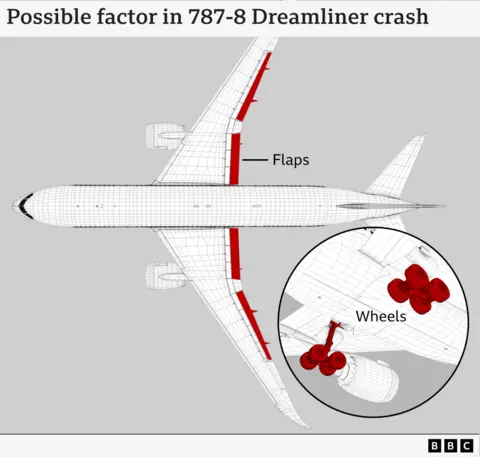
A graphic showing the 737-8 Dreamliner

In Ahmedabad, where temperatures neared 40°C (104F) on Thursday, the thinner air would have demanded higher flap settings and greater engine thrust, one pilot told the BBC. In such conditions, even a small configuration error can have catastrophic consequences.

CCTV footage which emerged late on Thursday afternoon showed the plane taking off from Ahmedabad, struggling to achieve altitude, and then slowly descending before crashing.

But a take-off roll with retracted flaps would trigger warnings from the 787’s take-off Configuration Warning System, alerting the flight crew to an unsafe configuration, according to one pilot the BBC spoke to.

Ex-pilot Mr Chan told BBC Verify that the footage that has emerged so far is too distorted to establish for sure whether the flaps were extended, but said that such an error would be “highly unusual”.

“The flaps are set by pilots themselves, before take off, and there are several checklists and procedures to verify the setting,” Mr Chan said. “That would point to potential human error if flaps aren’t set correctly.”

Additional reporting by Jake Horton

The BBC Verify logo

Source link
#caused #Air #India #plane #crash #seconds

Australia and Japan have signed contracts for the first three of 11 warships set to be delivered to the Australian navy under a landmark $7bn defence deal, as the two close US allies in the Asia Pacific region deepen defence cooperation.

Australia’s Defence Minister Richard Marles and Japanese Defence Minister Koizumi Shinjiro made the announcement in Melbourne on Saturday at the signing ceremony for the Mogami-class warships.

Recommended Stories

list of 4 itemsend of list

The “Mogami Memorandum” pledges to deepen military ties, including through “closer industrial cooperation” in defence.

Japan’s Mitsubishi Heavy Industries will build three of the stealth frigates in southern Nagasaki Prefecture, while Australia’s Austal will build eight in Western Australia.

The first of the Japanese-built warships is scheduled to be delivered in 2029 and enter service in 2030.

“Our surface fleet is more important than at any time in decades,” Marles said in a statement.

“These general-purpose frigates will help secure our maritime trade routes and northern approaches as part of a larger and more lethal surface combatant fleet.”

Shinjiro said closer defence coordination was becoming more important as Australia and Japan faced an “increasingly severe security environment”.

Australia’s government last year announced that it had chosen Mitsubishi Heavy Industries to build its fleet of next-generation warships, following a bidding war between the Tokyo-based firm and Germany’s Thyssenkrupp.

Australia has committed to a record $305bn in military spending over the next decade, as part of a widespread defence overhaul aimed at boosting the country’s naval power to levels not seen since World War II.

Under the plans, Canberra’s defence spending is set to rise to 3 percent of gross domestic product (GDP) by 3033, from about 2 percent now.

Australia and Japan, two of the United States’ closest allies, have ramped up military cooperation in recent years amid shared concerns about shifts in the regional security environment, particularly China’s rising influence. Tokyo and Canberra are also members of the Quad security bloc led by the US.

#Australia #Japan #sign #contracts #7bn #warships #dealEconomy, News, Business and Economy, Military, Asia Pacific, Australia">Australia and Japan sign contracts for bn warships dealDefence deal is latest example of deepening ties between Canberra and Tokyo amid shared concerns over China’s rise.Published On 19 Apr 202619 Apr 2026Australia and Japan have signed contracts for the first three of 11 warships set to be delivered to the Australian navy under a landmark bn defence deal, as the two close US allies in the Asia Pacific region deepen defence cooperation.Australia’s Defence Minister Richard Marles and Japanese Defence Minister Koizumi Shinjiro made the announcement in Melbourne on Saturday at the signing ceremony for the Mogami-class warships.Recommended Stories list of 4 itemsend of listThe “Mogami Memorandum” pledges to deepen military ties, including through “closer industrial cooperation” in defence.Japan’s Mitsubishi Heavy Industries will build three of the stealth frigates in southern Nagasaki Prefecture, while Australia’s Austal will build eight in Western Australia.The first of the Japanese-built warships is scheduled to be delivered in 2029 and enter service in 2030.“Our surface fleet is more important than at any time in decades,” Marles said in a statement.“These general-purpose frigates will help secure our maritime trade routes and northern approaches as part of a larger and more lethal surface combatant fleet.”Shinjiro said closer defence coordination was becoming more important as Australia and Japan faced an “increasingly severe security environment”.Australia’s government last year announced that it had chosen Mitsubishi Heavy Industries to build its fleet of next-generation warships, following a bidding war between the Tokyo-based firm and Germany’s Thyssenkrupp.Australia has committed to a record 5bn in military spending over the next decade, as part of a widespread defence overhaul aimed at boosting the country’s naval power to levels not seen since World War II.Under the plans, Canberra’s defence spending is set to rise to 3 percent of gross domestic product (GDP) by 3033, from about 2 percent now.Australia and Japan, two of the United States’ closest allies, have ramped up military cooperation in recent years amid shared concerns about shifts in the regional security environment, particularly China’s rising influence. Tokyo and Canberra are also members of the Quad security bloc led by the US.#Australia #Japan #sign #contracts #7bn #warships #dealEconomy, News, Business and Economy, Military, Asia Pacific, Australia

Australia and Japan have signed contracts for the first three of 11 warships set to be delivered to the Australian navy under a landmark $7bn defence deal, as the two close US allies in the Asia Pacific region deepen defence cooperation.

Australia’s Defence Minister Richard Marles and Japanese Defence Minister Koizumi Shinjiro made the announcement in Melbourne on Saturday at the signing ceremony for the Mogami-class warships.

Recommended Stories

list of 4 itemsend of list

The “Mogami Memorandum” pledges to deepen military ties, including through “closer industrial cooperation” in defence.

Japan’s Mitsubishi Heavy Industries will build three of the stealth frigates in southern Nagasaki Prefecture, while Australia’s Austal will build eight in Western Australia.

The first of the Japanese-built warships is scheduled to be delivered in 2029 and enter service in 2030.

“Our surface fleet is more important than at any time in decades,” Marles said in a statement.

“These general-purpose frigates will help secure our maritime trade routes and northern approaches as part of a larger and more lethal surface combatant fleet.”

Shinjiro said closer defence coordination was becoming more important as Australia and Japan faced an “increasingly severe security environment”.

Australia’s government last year announced that it had chosen Mitsubishi Heavy Industries to build its fleet of next-generation warships, following a bidding war between the Tokyo-based firm and Germany’s Thyssenkrupp.

Australia has committed to a record $305bn in military spending over the next decade, as part of a widespread defence overhaul aimed at boosting the country’s naval power to levels not seen since World War II.

Under the plans, Canberra’s defence spending is set to rise to 3 percent of gross domestic product (GDP) by 3033, from about 2 percent now.

Australia and Japan, two of the United States’ closest allies, have ramped up military cooperation in recent years amid shared concerns about shifts in the regional security environment, particularly China’s rising influence. Tokyo and Canberra are also members of the Quad security bloc led by the US.

#Australia #Japan #sign #contracts #7bn #warships #dealEconomy, News, Business and Economy, Military, Asia Pacific, Australia">Australia and Japan sign contracts for $7bn warships deal

Defence deal is latest example of deepening ties between Canberra and Tokyo amid shared concerns over China’s rise.

Australia and Japan have signed contracts for the first three of 11 warships set to be delivered to the Australian navy under a landmark $7bn defence deal, as the two close US allies in the Asia Pacific region deepen defence cooperation.

Australia’s Defence Minister Richard Marles and Japanese Defence Minister Koizumi Shinjiro made the announcement in Melbourne on Saturday at the signing ceremony for the Mogami-class warships.

Recommended Stories

list of 4 itemsend of list

The “Mogami Memorandum” pledges to deepen military ties, including through “closer industrial cooperation” in defence.

Japan’s Mitsubishi Heavy Industries will build three of the stealth frigates in southern Nagasaki Prefecture, while Australia’s Austal will build eight in Western Australia.

The first of the Japanese-built warships is scheduled to be delivered in 2029 and enter service in 2030.

“Our surface fleet is more important than at any time in decades,” Marles said in a statement.

“These general-purpose frigates will help secure our maritime trade routes and northern approaches as part of a larger and more lethal surface combatant fleet.”

Shinjiro said closer defence coordination was becoming more important as Australia and Japan faced an “increasingly severe security environment”.

Australia’s government last year announced that it had chosen Mitsubishi Heavy Industries to build its fleet of next-generation warships, following a bidding war between the Tokyo-based firm and Germany’s Thyssenkrupp.

Australia has committed to a record $305bn in military spending over the next decade, as part of a widespread defence overhaul aimed at boosting the country’s naval power to levels not seen since World War II.

Under the plans, Canberra’s defence spending is set to rise to 3 percent of gross domestic product (GDP) by 3033, from about 2 percent now.

Australia and Japan, two of the United States’ closest allies, have ramped up military cooperation in recent years amid shared concerns about shifts in the regional security environment, particularly China’s rising influence. Tokyo and Canberra are also members of the Quad security bloc led by the US.

#Australia #Japan #sign #contracts #7bn #warships #dealEconomy, News, Business and Economy, Military, Asia Pacific, Australia

Post Comment