
It took until the early ’90s for Batman to get his first Old West adventure. When it did finally arrive in the form of 1993’s “Batman: The Blue, the Grey, and the Bat,” it saw Abraham Lincoln himself entrusting Batman to neutralize a threat to the Union. On his mission, the Dark Knight encountered Old West legends like Samuel Clemens and Wild Bill Hickok, and in a controversial move, appeared as a full-fledged gunslinger. It was a silly and strange outing that, in retrospect, is a fascinating moment in the history of the Caped Crusader.
Batman has been around for almost 80 years, and in that time, he’s had pretty much every adventure imaginable. There was the time writer Jack C. Harris and illustrator Bo Hampton reimagined the “Frankenstein” story as a Batman comic, or the many times Batman faced off against the bizarre, sci-fi inspired villains of the Silver Age comics. Of course, when Bats first arrived on the scene in 1939, sci-fi wasn’t yet the cultural force it would later become. Instead, this was the year that John Wayne shot to surprise stardom after being cast in John Ford’s “Stagecoach.”
In that sense, Batman and the Western genre ascended to pop culture dominance together. After a decade of “Poverty Row” pictures had confined the Western to B-movie status, it suddenly became Hollywood’s biggest genre. Meanwhile, by the 1940s, Batman and his fellow comic book heroes were capturing the national imagination. With that history in mind, it was only right to give the Dark Knight a Western adventure at some point. But it took more than 50 years for it to actually happen.
Batman’s first major Old West adventure sees Bruce Wayne working for Abe Lincoln
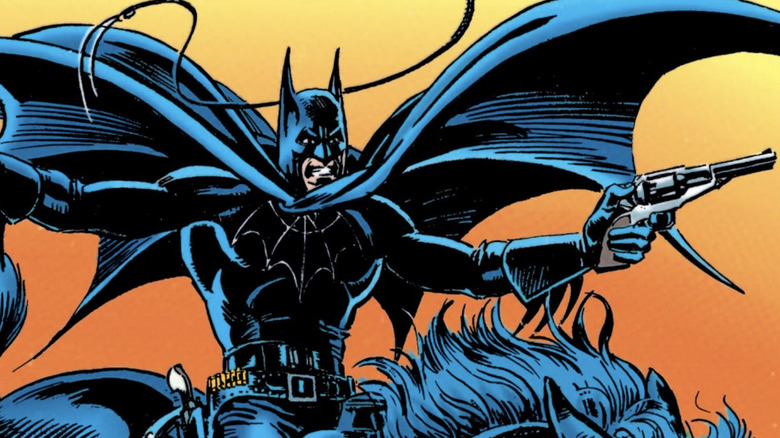
Batman and Robin did travel back to 1854 in 1940’s “Batman” #89, but the first time we got a true cowboy version of the Dark Knight in the comics was in 1993. “Batman: The Blue, the Grey, and the Bat” was an Elseworlds story set in the Old West and written by Elliot S. Maggin, with illustrations by Alan Weiss and José Luis García-López. The story starts in 1863, following the discovery of gold in the Nevada territory. Abraham Lincoln is eager to secure the gold for the Union and prevent it from falling into the hands of the Confederates, Native American tribes, or aggrieved Mexicans. With his armies engaged in battle, his best hope is Lieutenant-Colonel Bruce Wayne of the 13th Massachusetts Cavalry.
In this story, Bruce seems to have taken on the Batman persona merely due to the undercover nature of Lincoln’s mission and the fact a bat flew in his window the same night the President sent for him. This is far from the most egregious deviation from established Bat-lore, however, as we later find out this version of Bruce is a full-on gunslinger.
At this point, if the title’s awkward attempt to evoke the spirit of “The Good, The Bad, and The Ugly,” hadn’t tipped you off, you might be getting the sense that “Batman: The Blue, the Grey, and the Bat,” isn’t one of the best Batman comics. Indeed, this one-shot isn’t anywhere near as powerful and profound as, say, Batman’s best and darkest story, “Night Cries.” But it is a thoroughly interesting read, partly because so many parts of it appear so misguided, and partly because it was the first time Batman was given a proper Western adventure.
Batman: The Blue, the Grey, and the Bat was a missed opportunity that’s still worth reading
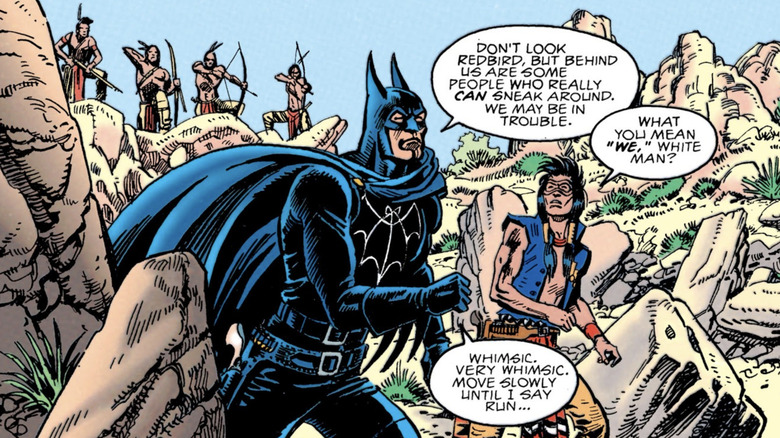
Rather than trying to use the Western setting to explore a new aspect of the Batman persona, “Batman: The Blue, the Grey, and the Bat” was just a silly Western adventure. It featured a hero who rode a black, Bat symbol-adorned horse named Apocalypse and apparently thought nothing of donning his full costume in the heat of the desert. It also didn’t do much to tie itself into the Batman mythos. We do get a brief Alfred appearance when he helps Bruce board his Nevada-bound carriage, but he disappears entirely after that.
One character that should have arguably disappeared altogether was the issue’s Robin analogue, Redbird. This Native American boy trails Bruce’s carriage before it’s revealed that the pair are working together. The stereotypical Native American dialogue is one of the most regrettable parts of the story, as is Bruce Wayne’s fondness for guns. When Batman first appears to take down a gang of outlaws, he does so while dual-wielding six-shooters in a move that Elliot S. Maggin surely knew would rile up readers.
In one sense, “Batman: The Blue, the Grey, and the Bat” seemed like a missed opportunity to finally acknowledge the relationship between the Dark Knight and Western heroes of the past. But this Elseworlds story is best enjoyed as a bit of fun and nothing more. It’s worth reading for being an odd little moment in Batman history, and a very strange way to finally bring Batman to the Old West. If you want a more serious alternative, “Batman: The Animated Series” transformed the show into a Western for one of its most memorable episodes two years after this comic came out.
Source link
#Batman #Agent #Abraham #Lincoln #Western #Shot #Read #SlashFilm


Post Comment