
Superheroes are ubiquitous in American comic books, especially ones with Marvel or DC branding. Both companies pioneered the shared universe storytelling model, which is an ingenious business move: readers become not fans of one or two books, but fans of your entire publishing line. I’m a lifelong Marvel and DC fan, and so living proof of that model’s success.
While my love for Marvel or DC has never totally faded, age has made me more conscious of their limitations. Characters and stories in Marvel or DC aren’t on an arc, but a cycle, and that makes diminishing returns inevitable. But as I’ve grown, I’ve also realized comic books are much more than Marvel or DC. The most satisfying experience I’ve ever had with an American comic series? Reading Mike Mignola’s “Hellboy” series front-to-back, from opening miniseries “Seed of Destruction” to the solemn “Hellboy in Hell.”
Summoned from, well, Hell in 1944, Hellboy is a paranormal investigator with the Bureau for Paranormal Research and Defense (B.P.R.D.). A soft-hearted demon, Hellboy hunts truly malicious monsters alongside other eccentric coworkers, like the fishman Abe Sapien, or the firestarter Liz Sherman. Since “Seed of Destruction” was published by Dark Horse Comics in 1994, Hellboy felt like it was giving audiences a peek of a world with a dark and grand history. In three decades since, Mignola has left few stones unturned.
Though Dark Horse started decades behind Marvel and DC, “Hellboy” has given them a universe that rivals the big two’s scope. A spin-off “B.P.R.D.” comic is a secondary spine of this “Mignolaverse,” which is also home to 1930s pulp vigilante Lobster Johnson, Victorian supernatural detective Edward Grey aka Witchfinder, cursed Russian warrior Koshchei the Deathless, villains from Nimue the Blood Queen to the undead Black Flame, and even a version of Frankenstein’s Monster.
Unlike Marvel or DC, Hellboy has a singular creative vision
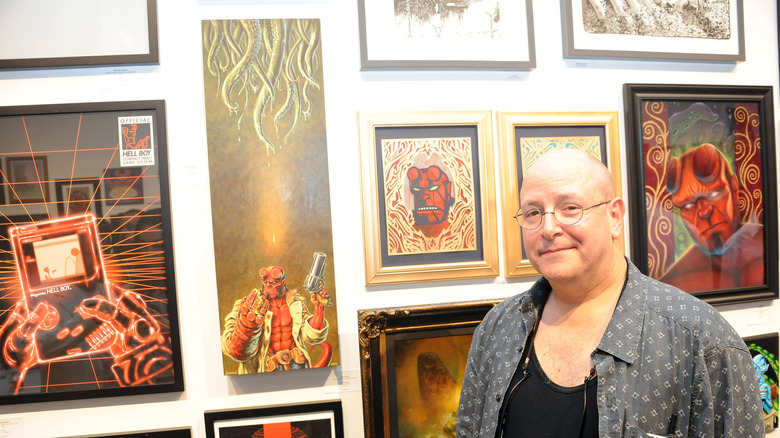
DC’s major characters were created by different artists, and them being folded into a shared setting came about due to corporate consolidation. The Marvel Universe was conceived as a shared setting, but it’s grown beyond architects like Stan Lee, Jack Kirby, and Steve Ditko,
“Hellboy,” though, lives and dies with Mike Mignola. Note the “Mignolaverse” label — the setting is synonymous with its original creator. A big reason that “Hellboy” first stood out is Mignola’s singular art style. He uses minimalist compositions, thick black colors to create the illusion of true darkness, decompressed panel-to-panel storytelling, and backgrounds filled with skeletons, monsters, and/or ominous statues.
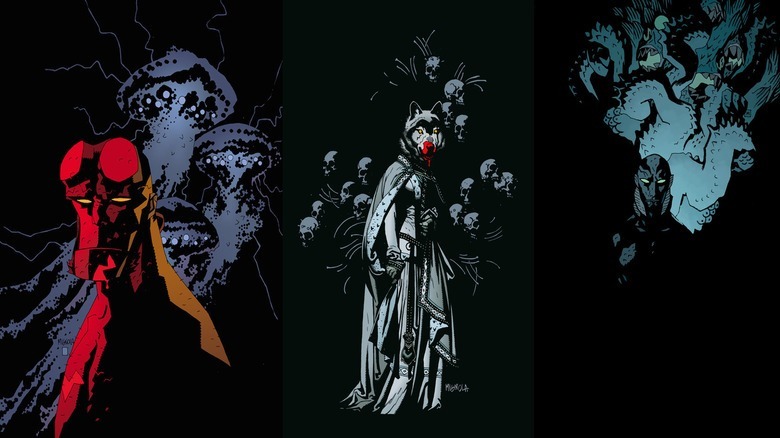 Dark Horse Comics
Mignola cut his teeth drawing Marvel and DC superheroes like Batman, and his influences range from Henry James’ ghost stories to “Conan the Barbarian” creator Robert E. Howard to filmmaker James Whale (“Frankenstein” and “Bride of Frankenstein”) to the aforementioned Jack Kirby. Different niches of the “Hellboy” universe let him prioritize different influences.
Marvel and DC are held together by rotating work-for-hire teams, but Mignola has his hands in every “Hellboy” universe project — with help from collaborators. “B.P.R.D.” is as much the work of writer John Arcudi and artist Guy Davis. Other artists in the Mignolaverse roster include Duncan Fegredo, Ben Stenbeck, and Max Fiumara. Yet each artist also brings their own style; there is aesthetic consistency but not uniformity.
Rather than ongoing series with hundreds of issues, the Mignolaverse is mostly made up of self-contained one-shots and short miniseries. This makes the barrier for entry lower than Marvel or DC; you can read one of Hellboy’s short adventures, like “The Corpse” or “The Wolves of Saint August,” and walk away satisfied. If you want more afterwards, a whole world awaits.
Mike Mignola understood that Hellboy’s epic needed an ending
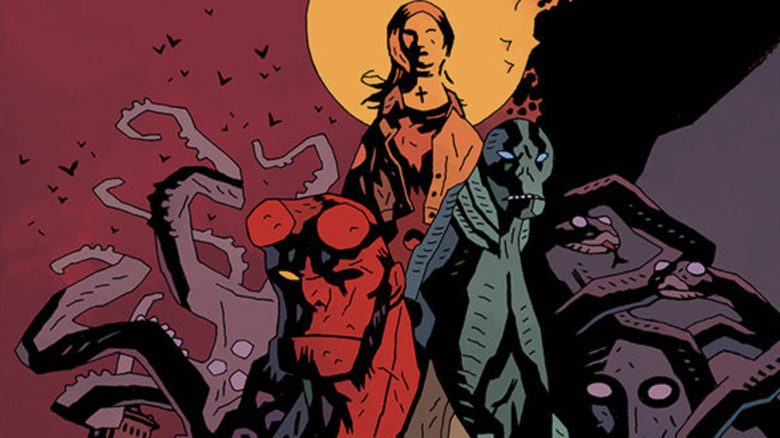
While the Mignolaverse has a strict chronology, new comics bounce around that timeline. Take how Lobster Johnson debuted as a ghost in 2001 miniseries “Hellboy: Conqueror Worm,” leaving the door open for later published comics to explore the Lobster’s crime-fighting in the 1930s.
Despite those non-chronological detours, Hellboy’s story has a linear progression. The first batch of stories feature him learning more and more about his apocalyptic destiny to end the world, culminating in “Conqueror Worm” when he leaves the B.P.R.D. to become a wanderer. That next chapter of Hellboy’s life concludes with him dying at the hands of Nimue, in turn leading into the epilogue “Hellboy in Hell.”
Hellboy departing the Bureau opened the door for the “B.P.R.D.” comic, showing how his old partners handle monster-hunting in his absence. The series is divided into three sections: “Plague of Frogs,” “Hell on Earth,” and “The Devil You Know,” as an apocalypse ramps up and the B.P.R.D. can barely hold it back.
Unlike Marvel or DC, when a hero dies in “B.P.R.D.” they almost always stay dead. The one exception? Hellboy, who returns from Hell for one last hurrah in “The Devil You Know.” Mignola delivered a melancholic ending to Hellboy in “Hellboy in Hell,” while “The Devil You Know” is a more action-packed one (that also paid off witch goddess Hecate’s long-seeded prophecy that Hellboy would die with her).
A story can’t be an epic without an ending. While Marvel and DC’s heroes and villains wrestle in limbo, “The Devil You Know” concludes the Mignolaverse as definitely as possible. New Mignolaverse comics instead look backwards. Hellboy’s 70-ish years on Earth has gaps aplenty to explore, and knowing how it all ends doesn’t dampen the spooky fun.
Source link
#Ive #Reading #Comics #Entire #Life #Marvel #Arent #Shared #Universes #Close #SlashFilm


Post Comment