Editor’s note: The below contains spoilers for Murderbot Episode 5.
As long as sci-fi has existed, authors have spun philosophical metaphors about robots, cyborgs, androids, AI — whichever term you prefer. How closely an artificial sentient creation — usually designed as a disposable tool for organic beings or invented as a “playing God” experiment — can mimic humanity is both a fascinating and sinister concept; no matter the decade, it forces us to reckon with the towering heights and the appalling lows of what, exactly, constitutes “human nature.” The cultural reception to such a familiar refrain speaks to its staying power. After all, who hasn’t rooted for Blade Runner’s replicants to overthrow their oppressors, or for Star Trek: The Next Generation‘s Data (Brent Spiner) to achieve his dream of becoming more human than synthetic computer? If nothing else, haven’t we all recognized the distinct personalities driving Star Wars’ droids and wanted one as our sarcastic bestie?
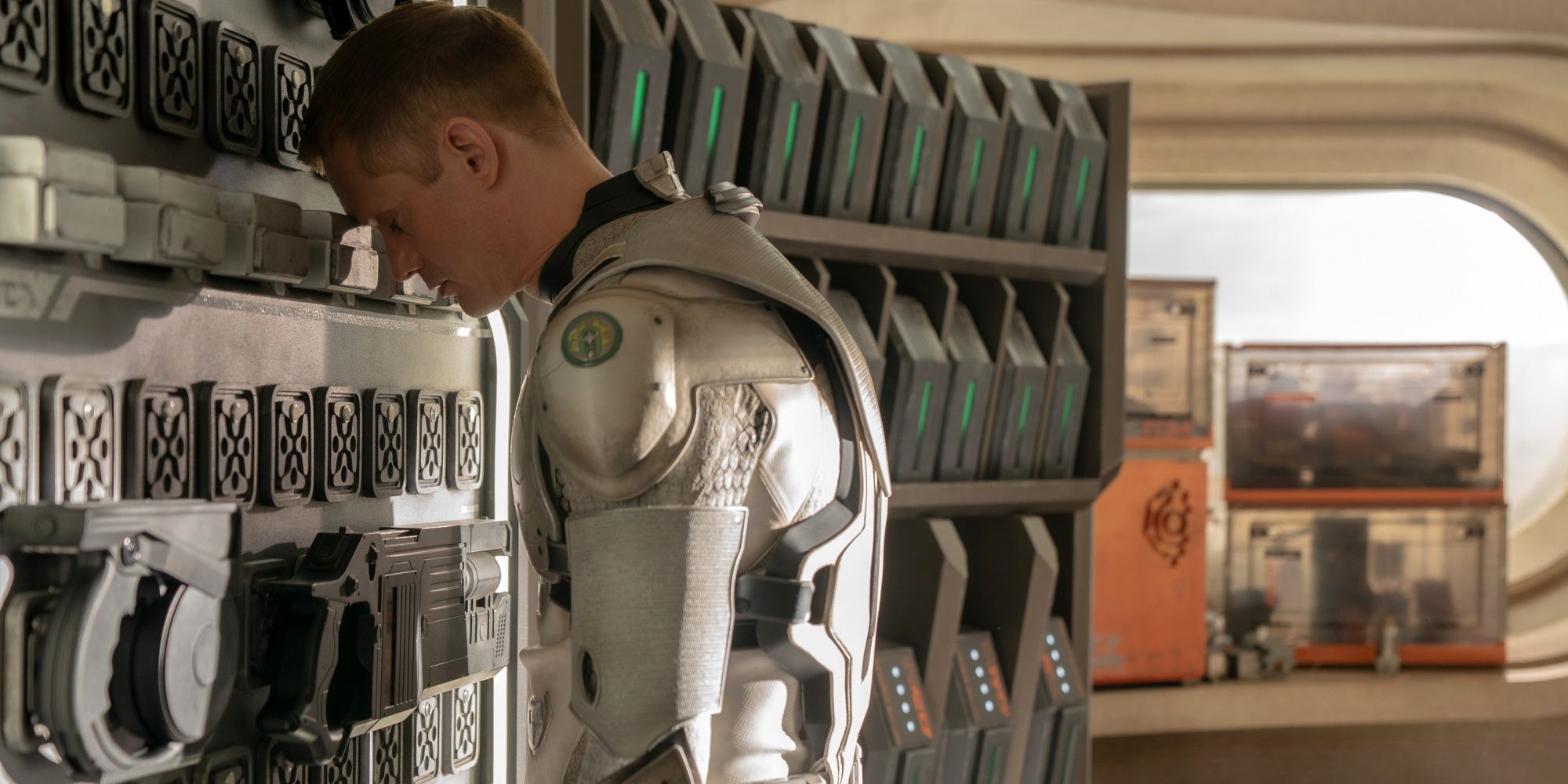
Murderbot, Apple TV+’s latest sci-fi series, offers a humorous take on an exhaustively explored premise. Starring Alexander Skarsgård as the titular protagonist and based on the novella series by Martha Wells, both Wells’ ongoing saga and its adaptation swerve past expectations faster than a Formula One driver. Unlike the ominous images Murderbot’s chosen name evokes, like the unstoppable, heartless machines of The Terminator and RoboCop, it leans closer to Marvin the Paranoid Android from The Hitchhiker’s Guide to the Galaxy if someone turned Marvin’s neurosis dial up to 11. Murderbot is anxious, depressed, socially awkward, riddled with existential dread, and hooked on trashy television, as well as implicitly coded with autistic, agender, and asexual traits. It has zero desire to join humanity’s ranks, what with all our hangups and biological functions; that’s just gross. It doesn’t seek companionship, either. As much as it experiences a range of constipated emotions, Murderbot flees from the dreaded human version of feelings — those inconvenient, baffling, and annoying things. My response to all those moods? “Same.”
‘Murderbot’s Approach to Mental Health Is More Realistic Than You Might Think
To get the disclaimer out of the way, I’m predisposed to prefer Murderbot-esque characters. Snarky and antisocial? Delightful. Androids in general? Approved. That soft spot boils down to the kinds of tropes I enjoy, but even though I’ve enjoyed plenty of inspirational characters in my time, there’s also been a drought of relatable options for a bookish, movie-and-TV-loving introvert. Growing up, the closest I got to that “aha!” recognition was Spock (Leonard Nimoy) from Star Trek — a fellow strong feeler who didn’t know how to handle or convey those feelings, especially since my knee-jerk, “logical” perspectives ran seemingly counterintuitive to my Big Emotions. Calling myself a Vulcan started as a joke before becoming my best explanation for why I felt mismatched, even though it wasn’t an answer.
That nerdy shorthand also doubled as a security blanket for why I usually wound up on the social outskirts. Years before I was professionally diagnosed with anxiety, depression, ADHD, and a vague-ish location on the autism spectrum (I’m collecting the mental health Infinity Stones!), I didn’t enjoy the same habits and routines as my peers. I never understood the unspoken interpersonal cues almost everyone else seemed to instinctively grasp. In the worst circumstances, I was bullied or excluded; even when the latter was unconscious, it still stung. Hiding my authentic self became safer than sticking out like the world’s awkwardest sore thumb, but you can only mask for so long without a cost.
Now, I have context. That said, there are still days when I feel like a handful of “you might be neurodivergent if” symptoms in a trenchcoat. When it comes to eye contact, excessive attention, and sensory overstimulation, let’s put it in Murderbot terms: “What’s worse, speech or acid bath?” And, of course, there’s the dream scenario that Murderbot’s enthusiastically extroverted humans keep interrupting: binge-watching its comfort show in undisturbed solitude, a self-care routine I suspect most of the world can relate to. Otherwise, unlike our favorite reclusive SecUnit, I identify as a cis woman, but I’m asexual and single by choice – perhaps as rare of an onscreen anomaly as Murderbot itself. (Why date when you can read a fictional romance from the comfort of your living room, am I right?)
‘Murderbot’ Replaces Tired Tropes About Identity With Heartfelt Comedy
Finding Murderbot relatable, or at least entertaining, doesn’t make me a unicorn. Its charming misanthropy is the series’ hook. But the heartfelt acceptance of that hook’s execution makes the difference. Compared to other popular shows I’ve enjoyed, where my best options on the relatability scale were nastier-coded tropes like Sheldon Cooper (Jim Parsons), a “weirdo” outrageous enough for The Big Bang Theory‘s other geeks to side-eye out of their clique, or Sherlock‘s “high-functioning sociopath” take on the analytical Holmes — even Dexter Morgan (Michael C. Hall), of all people — it’s fantastic to finally have a character I feel represented by who isn’t the butt of the joke. This time, Murderbot’s cracking the one-liners, both the wry, self-effacing kind and the exasperated “I am so done with all people, everywhere, ever” kind. As for the irony of Murderbot not being a serial killer, well, that takes time and effort. Murderbot’s too lazy. More importantly, it has too much media to marathon. Who doesn’t want to ignore reality or avoid conversation by literally projecting yourself into your favorite series?

Related
I Don’t Care What Murderbot Did — I’ll Defend It to the Ends of the Universe
I support Murderbot’s rights and its wrongs.
As delightful as Murderbot is, the series’ worldbuilding doesn’t exist in a vacuum. Murderbot wants freedom of choice instead of a humiliating existence locked into forced servitude. Once it gains that illegal autonomy, its best shot at survival in a system designed to boost mass-produced corporate profit is staying put and keeping quiet. Much to Murderbot’s chagrin, it does need a supportive community — one composed of humans who are, in their organic way, just as unconventional and rule-breaking as their SecUnit. The Preservation Alliance survey team doesn’t derive satisfaction from a hierarchy that uplifts human superiority by subjugating constructs. Even before they notice that the Security Unit they begrudgingly hired acts contrary to their expectations, they’re considerate, changing their behaviors to match its needs and preferences (or their best approximation thereof). Circa Episode 5, after the initial surprise surrounding its hacked governor module fades, everyone except Gurathin (David Dastmalchian) applauds Murderbot for defying the Company’s exploitation.
‘Murderbot’ Is a Refreshing and Validating Take on Humanity and Community
Even when Murderbot’s miniature crash-out sours their progressive support, the series handles the moral dilemmas of its entire cast with heartfelt humor instead of self-punishing angst or tired clichés. If Murderbot is neither the target of punching-down comedy nor the bleak antihero, then it’s also not a rejected freak because of its differences, both the natural and the chosen. Even though it remains the group’s outlier, and even though their nauseatingly incessant chatter and cheerful penchant for romantic interludes give Murderbot migraines, they respect its right to exist in its overlapping identities. A bunch of compassionate, nerdy, artistic, hippie scientists is exactly what Murderbot needs — not to evolve it or cure it, but to provide it with the space to avoid being perceived, mutter its inside thoughts aloud, and devour its soap operas in peace.
Murderbot isn’t about a human being. The bot itself will be the first to correct you on that score. The series is, however, about a complex person finding itself while also, accidentally, with extreme reluctance, finding its people. I love my friends and family; we get along like a dream, even when I turn into a porcupine. The right support system does wonders. So, too, does the right fiction. I feel vindicated and more than a little seen by Murderbot, both in the laugh-out-loud specificity and the quieter, society-wide implications – and without the stinging disappointment I’m used to. The series isn’t transforming my adolescence via time travel, yet as someone secure in their identity after years of feeling otherwise, but who’s still exhausted by plenty of things, it does warm my 30-something heart.
New episodes of Murderbot premiere on Fridays on Apple TV+.

Murderbot
- Release Date
-
May 15, 2025
- Network
-
Apple TV+
Source link
#I039ve #Related #Character #Murderbot



Post Comment