Earn Free 1% Crypto Bonus on Deposit & Withdrawal fees Payback
BuyUcoin giving 1% deposit bonus on crypto and reimbursement of crypto withdrawal fees for Indian…
BuyUcoin giving 1% deposit bonus on crypto and reimbursement of crypto withdrawal fees for Indian…
In the ever-evolving world of cryptocurrency trading, finding reliable signals can be a daunting task.…
As the popularity of cryptocurrencies continues to rise, ensuring the security of your digital assets…
The transition to Coinwink V2 has been successfully completed. Over the past year, we have…
Thunderbirds, a cult classic notable for their 1966 British science-fiction puppet film ThunderBirds Are Go,…
In the midst of crypto winter, BITMAIN is launching a reward coupon program to share…
Have you had the itch to watch some movies about crypto? Maybe you like to…
The round was led by 6th Man Ventures, the investment firm of The Block's founder.http://dlvr.it/SRvcXN…
Macau concessionaire MGM China saw net revenues rise 3% year-on-year and 9% sequentially to HK$2.45…
The central bank of Mexico will launch its own digital currency by 2024, announced the…
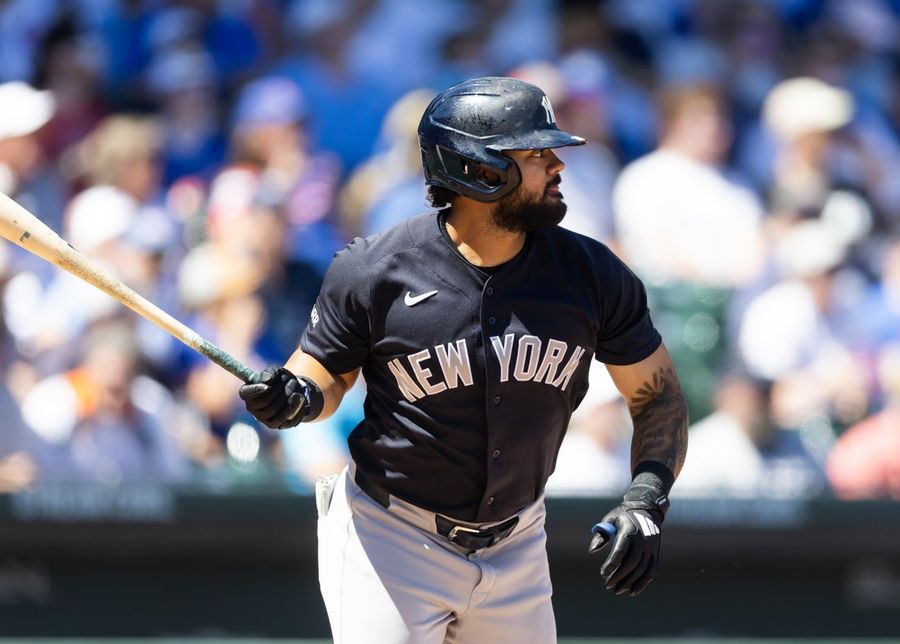 Mar 24, 2026; Mesa, Arizona, USA; New York Yankees outfielder Jasson Dominguez against the Chicago Cubs during spring training at Sloan Park. Mandatory Credit: Mark J. Rebilas-Imagn Images
 The New York Yankees promoted outfielder Jasson Dominguez from Triple-A Scranton/Wilkes-Barre ahead of Monday’s game against the Texas Rangers.
He’s the replacement on the roster for right-hander Luis Gil, who was optioned to Triple-A after taking the loss in Sunday’s 7-4 loss at Houston. He’s a potential lineup replacement for Giancarlo Stanton, who missed his second straight game Sunday with a calf injury but has not been placed on the injured list.
A product of the Dominican Republic, Dominguez saw extended action for the Yankees in 2025 and produced during Spring Training before New York optioned him to the minors on March 20.
The 23-year-old’s 2025 line included a batting average of .257 with a .331 on-base percentage and a .388 slugging percentage over 429 plate appearances. He totaled 47 RBIs, 10 home runs and 23 stolen bases.
Over 22 games with Triple-A Scranton/Wilkes-Barre this spring, Dominguez notched 13 RBIs and three home runs with a .306 batting average.
–Field Level Media


New marathon world record holder Sabastian Sawe brushed aside suggestions his Adidas “super shoes” amounted to “mechanical doping” on Monday as he basked in the glow of becoming the first man to break the two-hour barrier in an official race.
The 31-year-old Kenyan shattered one of athletics’ most elusive barriers in storming to victory at the London Marathon in one hour, 59 minutes, and 30 seconds.
Running in Adidas’ 97 gramme Adizero Adios Pro Evo 3, he also obliterated the world record of 2:00.35, set by the late Kelvin Kiptum in 2023.
“The shoe is very nice, very light, comfortable, and so supportive, and it’s pushing forward,” he said. “And the big difference is it’s so light and very comfortable.”
Sawe’s run was the most dramatic marker yet of a technological arms race that has transformed distance running over the past decade but he was unmoved when asked if criticism around the shoes annoyed him.
“Absolutely no, because the shoe was approved,” he said. “And I think there were no doubt about it. So, I have no doubt about it.”
The women’s race offered its own striking parallel as Tigst Assefa broke her own women’s-only world record (without male pacemakers) to retain her London title—doing so in the same Adidas model worn by Sawe.
“For the future, I would love to get the all-time world record for women’s marathon,” Assefa said.
“And in terms of the shoes, I’ll speak to my coach and I’ll speak to my shoe company and hope that they can continue to give me the shoes that are going to allow me to run fast.”
Assefa clocked 2:15.41 on Sunday.
Fellow Kenyan Ruth Chepng’etich set the world record in a mixed race when she became the first woman to break both the 2:11:00 and 2:10:00 barriers, clocking 2:09.56 in Chicago in 2024.
Although she was banned three years for doping in October 2025, her achievements pre-dating her March 2025 sample stand, leaving fans confused about what they should be believing in.
The two-hour men’s marathon was once treated as a natural physiological ceiling, with athletes moving towards it in small increments. This century, records had fallen by seconds until the past nine years when they have plummeted by minutes.
The turning-point came with the arrival of Nike’s high-stack shoes built around ultra-responsive foams and stiff carbon elements designed to improve running economy.
Independent studies showed gains in running economy of 2 to 4 per cent—trivial on paper, but monumental over 42.195 kilometres, where seconds usually decide medals and minutes are the difference between eras, and the latest generation of shoes have made those 2016 models obsolete.
World Athletics tried to regulate the revolution in 2020, capping sole thickness and limiting plates rather than banning the technology outright. The aim was compromise: allow innovation, but stop shoes becoming mechanical aids, and rival shoe companies immediately hurried to get their own versions to the market.
Sunday’s race suggested that compromise has still left the sport in a very different place.
Almost lost amid Sawe’s historic win was the fact that Ethiopia’s Yomif Kejelcha became distance running’s “second man on the moon” as he finished second in 1:59:41 on his marathon debut.
A barrier that only a few years ago many believed would never fall was beaten twice in the space of 11 seconds.
Defenders of the super-shoe era point out that innovation has always shaped athletics as cinder tracks were replaced by synthetic surfaces and lighter, responsive racing spikes helped modern athletes rip past some long-standing records.
Critics counter that shoes now operate too close to the body’s mechanics, storing and returning energy in ways previous generations never had access to and say historical context has gone and the ability to compare performances across generations has been wiped out.
On a spring morning in London, the goalposts moved further than almost anybody thought possible, undoubtedly carried forward by legs, lungs, talent, training and belief, but also by foam, carbon and design.
Published on Apr 27, 2026
New marathon world record holder Sabastian Sawe brushed aside suggestions his Adidas “super shoes” amounted to “mechanical doping” on Monday as he basked in the glow of becoming the first man to break the two-hour barrier in an official race.
The 31-year-old Kenyan shattered one of athletics’ most elusive barriers in storming to victory at the London Marathon in one hour, 59 minutes, and 30 seconds.
Running in Adidas’ 97 gramme Adizero Adios Pro Evo 3, he also obliterated the world record of 2:00.35, set by the late Kelvin Kiptum in 2023.
“The shoe is very nice, very light, comfortable, and so supportive, and it’s pushing forward,” he said. “And the big difference is it’s so light and very comfortable.”
Sawe’s run was the most dramatic marker yet of a technological arms race that has transformed distance running over the past decade but he was unmoved when asked if criticism around the shoes annoyed him.
“Absolutely no, because the shoe was approved,” he said. “And I think there were no doubt about it. So, I have no doubt about it.”
The women’s race offered its own striking parallel as Tigst Assefa broke her own women’s-only world record (without male pacemakers) to retain her London title—doing so in the same Adidas model worn by Sawe.
“For the future, I would love to get the all-time world record for women’s marathon,” Assefa said.
“And in terms of the shoes, I’ll speak to my coach and I’ll speak to my shoe company and hope that they can continue to give me the shoes that are going to allow me to run fast.”
Assefa clocked 2:15.41 on Sunday.
Fellow Kenyan Ruth Chepng’etich set the world record in a mixed race when she became the first woman to break both the 2:11:00 and 2:10:00 barriers, clocking 2:09.56 in Chicago in 2024.
Although she was banned three years for doping in October 2025, her achievements pre-dating her March 2025 sample stand, leaving fans confused about what they should be believing in.
The two-hour men’s marathon was once treated as a natural physiological ceiling, with athletes moving towards it in small increments. This century, records had fallen by seconds until the past nine years when they have plummeted by minutes.
The turning-point came with the arrival of Nike’s high-stack shoes built around ultra-responsive foams and stiff carbon elements designed to improve running economy.
Independent studies showed gains in running economy of 2 to 4 per cent—trivial on paper, but monumental over 42.195 kilometres, where seconds usually decide medals and minutes are the difference between eras, and the latest generation of shoes have made those 2016 models obsolete.
World Athletics tried to regulate the revolution in 2020, capping sole thickness and limiting plates rather than banning the technology outright. The aim was compromise: allow innovation, but stop shoes becoming mechanical aids, and rival shoe companies immediately hurried to get their own versions to the market.
Sunday’s race suggested that compromise has still left the sport in a very different place.
Almost lost amid Sawe’s historic win was the fact that Ethiopia’s Yomif Kejelcha became distance running’s “second man on the moon” as he finished second in 1:59:41 on his marathon debut.
A barrier that only a few years ago many believed would never fall was beaten twice in the space of 11 seconds.
Defenders of the super-shoe era point out that innovation has always shaped athletics as cinder tracks were replaced by synthetic surfaces and lighter, responsive racing spikes helped modern athletes rip past some long-standing records.
Critics counter that shoes now operate too close to the body’s mechanics, storing and returning energy in ways previous generations never had access to and say historical context has gone and the ability to compare performances across generations has been wiped out.
On a spring morning in London, the goalposts moved further than almost anybody thought possible, undoubtedly carried forward by legs, lungs, talent, training and belief, but also by foam, carbon and design.
Published on Apr 27, 2026







I’ve seen the future of the NBA. It’s part Caitlin Clark, part Waymo and, of course, a heaping helping of IT.
There have been 30 NBA playoff games to date. And there have been – according to no better source than players on the losing team – 30 poorly officiated boat races.
Coincidence? Hardly.
For years, perimeter play in the NBA postseason has resembled that of the NFL, complete with the chucking, hand-fighting and illegal picking.
If you’re wondering why Stephen Curry shoots more 30-footers now than ever before, it’s because apparently bear-hugging is legal inside 25 feet. So what’s a little guy to do?
Clark has received this kind of hands-on treatment since Day 1 of her miserable WNBA life. She’s bumped endlessly attempting to dribble around screens and held constantly while simply trying to use picks to free herself without the ball.
To its credit, the WNBA has created (they don’t call it this, but let’s be honest) the “Clark Compromise” this season. If you watched the preseason games over the weekend, you undoubtedly heard the broadcasters complaining about it.
I applaud Cathy Engelbert, and that’s hard to do. The league has instructed its refs to clean up the perimeter mess – from the clutching and bumping of defenders preventing offensive players from legally utilizing screens, to the hip-checking and general bullying screen-setters routinely employ on undersized defenders.
The constant whistles made Saturday’s games hard to watch, as the broadcasters noted. But that’s missing the point.
The goal is to use otherwise meaningless exhibitions to make the fast-approaching regular-season openers more enjoyable to watch. You know, by actually calling fouls now so that players are hard-taught to play by the book by the time the finicky viewers start tuning in.
Imagine that, NBA.
The premier men’s league has half-heartedly attempted to take this type of approach in the past couple of seasons, and clearly it’s not working. Ask Curry. Ask Devin Booker. Ask anybody trying to guard Shai Gilgeous-Alexander, James Harden or Jaylen Brown.
Let ‘em play has become the unofficial motto of the NBA postseason. And what has it given us?
In general: Less entertainment, poorer shooting opportunities, frustration, more extra-curriculars among players and an inordinate number of key injuries.
Specifically: There have been 30 playoff games so far. In those games, three of the 60 teams have been held under 90 points. That’s 5%. In the regular season, it was 1.7%.
Same with scores under 100. There have been 16 of them so far in the postseason (26.7%). In the regular season: 10.6%.
Sunday was the worst: More teams failed to reach triple figures than did. Number of watchable games: Zero.
That’s letting ‘em play. But play exactly what, I’m not sure.
In fact, with all the fouling that’s going uncalled, they’re not playing at all. They’re moshing.
It’s time to get with the times and take corrective steps. My solution is extreme – gee, imagine that – but when you’ve got people switching off a Thunder-Suns playoff game to watch Day 3 of the NFL draft, you’ve got problems.
The NBA needs to take a Waymo approach. You know, an implanted chip that tells the brain: All contact is bad. Avoid at all costs.
No, I’m not suggesting tattooing a sensor into every player’s forehead. Rather, a simple memory scan of each player’s arms – the major culprits in most of these so-called victimless crimes – so that when someone’s shoulder or elbow or forearm or hand simply touches an opponent, the referee gets buzzed and the actionless action is stopped.
Why? Because touching an opponent should be illegal. Think baseball. Not football.
As Waymo has taught us: All contact is bad.
And if cars can learn it, why can’t humans?
Then it’s IT’s turn.
Within one second, IT has the ability to study every available angle of a “collision” and make the determination: Which player caused this to happen?
Was it Brown pushing off Paul George in order to create space to get off a clean shot? Or was it George sticking a forearm into Brown’s back, stalling his initial move toward the hoop?
In today’s game, it doesn’t matter. More possessions than not resemble DK Metcalf and Carlton Davis wrestling inside the 5-yard, anything-goes NFL passing zone.
Only the NBA has no such thing.
Really. One second. That’s all it would take IT to point its virtual punitive finger.
And then guess what? Brown wouldn’t do it again. Or Harden. Or SGA.
That’s how you clean up and speed up the NBA game. Or at least start to do so.
Imagine an NBA rule in which you’re not allowed to touch your opponent. Yes, it’s hard to envision. But think about it for a minute.
Fifty years ago, when Lester Hayes was literally using stickum to latch onto wide receivers, who would have thought a hands-off rule would revolutionize football?
And that was back when the only IT was Isiah Thomas.
The NBA had hand-checking back then. Remember that thrill-killer?
That was banished and the game became great. But the problem has resurfaced, more so in the postseason than in the regular year, when it was a lesser issue because star players weren’t complaining. They were resting.
It’s time to get with the times, Commissioner Silver. Take the leap.
Thank you Caitlin Clark for saving the NBA.
I’ve seen the future of the NBA. It’s part Caitlin Clark, part Waymo and, of course, a heaping helping of IT.
There have been 30 NBA playoff games to date. And there have been – according to no better source than players on the losing team – 30 poorly officiated boat races.
Coincidence? Hardly.
For years, perimeter play in the NBA postseason has resembled that of the NFL, complete with the chucking, hand-fighting and illegal picking.
If you’re wondering why Stephen Curry shoots more 30-footers now than ever before, it’s because apparently bear-hugging is legal inside 25 feet. So what’s a little guy to do?
Clark has received this kind of hands-on treatment since Day 1 of her miserable WNBA life. She’s bumped endlessly attempting to dribble around screens and held constantly while simply trying to use picks to free herself without the ball.
To its credit, the WNBA has created (they don’t call it this, but let’s be honest) the “Clark Compromise” this season. If you watched the preseason games over the weekend, you undoubtedly heard the broadcasters complaining about it.
I applaud Cathy Engelbert, and that’s hard to do. The league has instructed its refs to clean up the perimeter mess – from the clutching and bumping of defenders preventing offensive players from legally utilizing screens, to the hip-checking and general bullying screen-setters routinely employ on undersized defenders.
The constant whistles made Saturday’s games hard to watch, as the broadcasters noted. But that’s missing the point.
The goal is to use otherwise meaningless exhibitions to make the fast-approaching regular-season openers more enjoyable to watch. You know, by actually calling fouls now so that players are hard-taught to play by the book by the time the finicky viewers start tuning in.
Imagine that, NBA.
The premier men’s league has half-heartedly attempted to take this type of approach in the past couple of seasons, and clearly it’s not working. Ask Curry. Ask Devin Booker. Ask anybody trying to guard Shai Gilgeous-Alexander, James Harden or Jaylen Brown.
Let ‘em play has become the unofficial motto of the NBA postseason. And what has it given us?
In general: Less entertainment, poorer shooting opportunities, frustration, more extra-curriculars among players and an inordinate number of key injuries.
Specifically: There have been 30 playoff games so far. In those games, three of the 60 teams have been held under 90 points. That’s 5%. In the regular season, it was 1.7%.
Same with scores under 100. There have been 16 of them so far in the postseason (26.7%). In the regular season: 10.6%.
Sunday was the worst: More teams failed to reach triple figures than did. Number of watchable games: Zero.
That’s letting ‘em play. But play exactly what, I’m not sure.
In fact, with all the fouling that’s going uncalled, they’re not playing at all. They’re moshing.
It’s time to get with the times and take corrective steps. My solution is extreme – gee, imagine that – but when you’ve got people switching off a Thunder-Suns playoff game to watch Day 3 of the NFL draft, you’ve got problems.
The NBA needs to take a Waymo approach. You know, an implanted chip that tells the brain: All contact is bad. Avoid at all costs.
No, I’m not suggesting tattooing a sensor into every player’s forehead. Rather, a simple memory scan of each player’s arms – the major culprits in most of these so-called victimless crimes – so that when someone’s shoulder or elbow or forearm or hand simply touches an opponent, the referee gets buzzed and the actionless action is stopped.
Why? Because touching an opponent should be illegal. Think baseball. Not football.
As Waymo has taught us: All contact is bad.
And if cars can learn it, why can’t humans?
Then it’s IT’s turn.
Within one second, IT has the ability to study every available angle of a “collision” and make the determination: Which player caused this to happen?
Was it Brown pushing off Paul George in order to create space to get off a clean shot? Or was it George sticking a forearm into Brown’s back, stalling his initial move toward the hoop?
In today’s game, it doesn’t matter. More possessions than not resemble DK Metcalf and Carlton Davis wrestling inside the 5-yard, anything-goes NFL passing zone.
Only the NBA has no such thing.
Really. One second. That’s all it would take IT to point its virtual punitive finger.
And then guess what? Brown wouldn’t do it again. Or Harden. Or SGA.
That’s how you clean up and speed up the NBA game. Or at least start to do so.
Imagine an NBA rule in which you’re not allowed to touch your opponent. Yes, it’s hard to envision. But think about it for a minute.
Fifty years ago, when Lester Hayes was literally using stickum to latch onto wide receivers, who would have thought a hands-off rule would revolutionize football?
And that was back when the only IT was Isiah Thomas.
The NBA had hand-checking back then. Remember that thrill-killer?
That was banished and the game became great. But the problem has resurfaced, more so in the postseason than in the regular year, when it was a lesser issue because star players weren’t complaining. They were resting.
It’s time to get with the times, Commissioner Silver. Take the leap.
Thank you Caitlin Clark for saving the NBA.