Sports news
#Teenage #sprint #star #Gout #Gout #powers #200m #win #blistering #19.67s #Australian #Athletics #Championships">Teenage sprint star Gout Gout powers to 200m win in blistering 19.67s at Australian Athletics Championships Teenage sprint sensation Gout Gout ran a blistering 19.67 seconds to win the 200m at the Australian championships on Sunday, reinforcing his status as a rapidly rising star.
Fellow Australian Aidan Murphy also cracked the 20-second mark, coming second in 19.88—the two quickest times of the year and with a legal tailwind.
“This is what I’ve been waiting for,” said Gout at the Sydney Olympic Park Athletic Centre.
“We have such incredible athletes in Australia and me being able to race these athletes, we push each other to the limits. Two Australians sub-20. I mean, this is amazing.”
The 18-year-old burst on the scene in 2024 when he clocked 20.04 seconds at the Australian All Schools Athletics Championships.
It shattered Peter Norman’s national record of 20.06 from the 1968 Olympics and was the quickest ever by a 16-year-old, earning him comparisons to Usain Bolt.
He had improved to 20.02 but never gone under 20 seconds legally before.
The race was billed as a showdown with his closest Australian rival Lachlan Kennedy.
But 22-year-old Kennedy, who is also on a rapid rise, withdrew after executing flawlessly to win the 100m in 9.96 on Saturday—the fastest time run by an Australian on home soil.
He also clocked 9.96 in his heat.
“It’s the standard I’ve set now, so hopefully I can go a bit quicker next time and see where it takes me,” Kennedy said. “I think the sky is the limit.”
World under-20 mile record holder Cameron Myers reinforced his potential by running 3:29.85 in the 1500m, edging out reigning Commonwealth Games champion Oliver Hoare.
It was the best time globally this year and the quickest ever in Australia.
The 19-year-old Myers backed up by taking out the 5000m in a personal best 13:11.66.
But Paris Olympic 1500m silver medallist Jessica Hull’s bid for a rare 800m-1500m-5000m treble fell apart.
Hull was leading the 1500m with 100m to go, but was clipped from behind and dramatically fell with fellow Olympian Claudia Hollingsworth crossing first.
Hollingsworth was initially disqualified over the incident, but reinstated on appeal.
Hull pulled out of the 800m, won by Abbey Caldwell in 1:58.57, but returned to win the 5000m in 15:13.21.
The four-day meet also saw Olympic pole vault champion Nina Kennedy clear 4.65m to stand on top of the national podium for the fifth time in her career.
Kennedy continues to jump off a restricted run-up as she returns from a long injury layoff ahead of defending her title at the Glasgow Commonwealth Games in July.
“I’m happy with how I jumped. I got the win pretty comfortably out there, so there is no need to push the body,” she said.
High jump world champion and Olympic silver medallist Nicola Olyslagers cleared 1.99m to outleap Olympic bronze medallist Eleanor Patterson (1.93m).
Published on Apr 12, 2026
Teenage sprint sensation Gout Gout ran a blistering 19.67 seconds to win the 200m at…
Sports news
#Athletes #mandatory #federation #approval #signing #sponsors #AFI">Athletes now need mandatory federation approval before signing with sponsors, says AFI
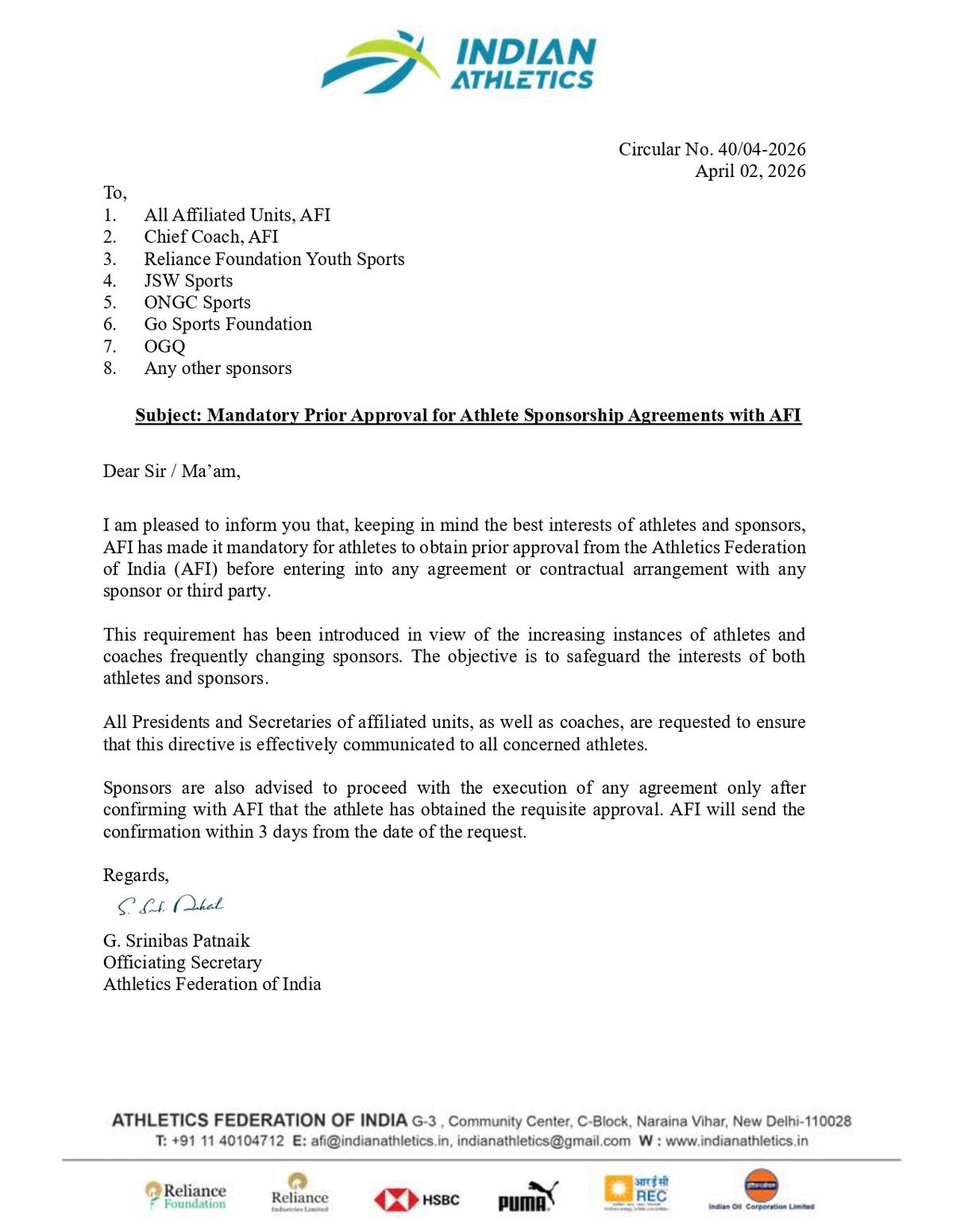
All Indian track-and-field athletes will now have to take prior approval from the Athletics Federation of India (AFI) before signing any sponsorship agreements, the national governing body has announced.
In a circular issued on Thursday, AFI said, “Keeping in mind the best interests of athletes and sponsors, AFI has made it mandatory for athletes to obtain prior approval from the Athletics Federation of India before entering into any agreement or contractual arrangement with any sponsor or third party.”
“Sponsors are also advised to proceed with the execution of any agreement only after confirming with AFI that the athlete has obtained the requisite approval. AFI will send the confirmation within 3 days from the date of the request.”

The circular was addressed to all state units, chief coach Radhakrishnan Nair, Reliance Foundation Youth Sports, JSW Sports, ONGC Sports, Go Sports Foundation, OGQ and any other potential sponsors.
AFI ex officio member and World Athletics Vice President Adille Sumariwalla said that this step had to be taken to protect the athletes: “There are agents who keep bringing top athletes to these private organisations. So, for two months, they’re at one top company and after two months, suddenly they have been brought to another top company. We want to ensure that these private organisations are not being influenced by some mafia agents.
“These crook agents, some of them are even coaches, are making money on the side and using athletes as a commodity. We have to respect the athletes. There are people who are giving athletes nothing and signing them on. So, we want to ensure that the athletes are not taken for a ride (sic).”
Sumariwalla mentioned that the situation had reached a tipping point where the national cause was taking a hit, forcing AFI to intervene. He said, “For them (private sponsors), they are more important than India. It is their organisation first and India comes later. And that, we cannot allow.”
ALSO READ | Outside lane, inside history: M. D. Valsamma and the race that changed Indian athletics
Without revealing names, the former AFI President gave an example of how, in the past, athletes have lost out on getting the appropriate financial assistance. “I don’t want to get into details but a junior world champion (Neeraj Chopra – men’s javelin throw – and Hima Das – women’s 400m – are the only two Indians who have been junior world champions) was paid a stipend of 15,000 a month, which we did not know. We would have never let them sign it. They would have paid 1.5 lakhs a month but the poor athlete did not know,” said the 68-year-old.
The circular mentions that the approval process will take three days but Sumariwalla pointed out that a long contract will require time with the decision-making process involving all stakeholders. “We will try to approve it as fast as possible but if you send me a 30-page contract and I find that things are not okay, then it’s very simple for me to say no but that’s not what we want. Then, we’ll have to call them in for a conversation,” he said.
He also debunked the myth that the time taken by the approval process could cost the athlete a potential deal as the sponsors may back out. “No athlete is going to be sponsored by a private party who does not have employment with railways or police or services or somewhere. That’s the first point of entry,” he opined.
Welcoming the move, Rahul Trehan, Chief Operating Officer at IOS Sports & Entertainment, said, “In certain cases, the agreements are not balanced. Athletes don’t have the termination clause but the agencies do. So, if the governing body of that particular sport is doing this to maintain a balance between the athlete and (the sponsors) and to oversee the things, it is fine.”
However, Manisha Malhotra, the president of Inspire Institute of Sport (a high performance training centre run by JSW Sports), argued that athletes should have the right to make the decision about what’s right for them. She said, “I don’t agree with federations trying to control athletes. Those days are far gone. Athletes should be allowed to make choices out of their own free will.
“A federation can definitely advise an athlete of what they think is better for them or not but to dictate terms, I don’t fully agree with that whole thing but it is what it is. The flip side of that is that athletes are taking the system for a ride and maybe they’re trying to govern it in that way. So, there’s merit on both accounts. We’ll see whether eventually it’s beneficial to sport or not.”
On AFI’s decision to be involved in such a capacity in a sponsorship agreement between a private entity and an athlete, Malhotra pointed out that federations in nations with good sporting ecosystems provide a pathway for assistance but not the final approval. “In most other countries where the governance is good, most sponsorship comes through the sports federation. So, while it’s not a direct approval, the sports federations or the Olympic committees are the ones vetting out different sorts of grants.
“I don’t think it’s happening in the western countries for sure where you need to ask the permission of a federation if someone can support you.”
Published on Apr 04, 2026

All Indian track-and-field athletes will now have to take prior approval from the Athletics Federation of India (AFI) before signing any sponsorship agreements, the national governing body has announced.
In a circular issued on Thursday, AFI said, “Keeping in mind the best interests of athletes and sponsors, AFI has made it mandatory for athletes to obtain prior approval from the Athletics Federation of India before entering into any agreement or contractual arrangement with any sponsor or third party.”
“Sponsors are also advised to proceed with the execution of any agreement only after confirming with AFI that the athlete has obtained the requisite approval. AFI will send the confirmation within 3 days from the date of the request.”

The circular was addressed to all state units, chief coach Radhakrishnan Nair, Reliance Foundation Youth Sports, JSW Sports, ONGC Sports, Go Sports Foundation, OGQ and any other potential sponsors.
AFI ex officio member and World Athletics Vice President Adille Sumariwalla said that this step had to be taken to protect the athletes: “There are agents who keep bringing top athletes to these private organisations. So, for two months, they’re at one top company and after two months, suddenly they have been brought to another top company. We want to ensure that these private organisations are not being influenced by some mafia agents.
“These crook agents, some of them are even coaches, are making money on the side and using athletes as a commodity. We have to respect the athletes. There are people who are giving athletes nothing and signing them on. So, we want to ensure that the athletes are not taken for a ride (sic).”
Sumariwalla mentioned that the situation had reached a tipping point where the national cause was taking a hit, forcing AFI to intervene. He said, “For them (private sponsors), they are more important than India. It is their organisation first and India comes later. And that, we cannot allow.”
ALSO READ | Outside lane, inside history: M. D. Valsamma and the race that changed Indian athletics
Without revealing names, the former AFI President gave an example of how, in the past, athletes have lost out on getting the appropriate financial assistance. “I don’t want to get into details but a junior world champion (Neeraj Chopra – men’s javelin throw – and Hima Das – women’s 400m – are the only two Indians who have been junior world champions) was paid a stipend of 15,000 a month, which we did not know. We would have never let them sign it. They would have paid 1.5 lakhs a month but the poor athlete did not know,” said the 68-year-old.
The circular mentions that the approval process will take three days but Sumariwalla pointed out that a long contract will require time with the decision-making process involving all stakeholders. “We will try to approve it as fast as possible but if you send me a 30-page contract and I find that things are not okay, then it’s very simple for me to say no but that’s not what we want. Then, we’ll have to call them in for a conversation,” he said.
He also debunked the myth that the time taken by the approval process could cost the athlete a potential deal as the sponsors may back out. “No athlete is going to be sponsored by a private party who does not have employment with railways or police or services or somewhere. That’s the first point of entry,” he opined.
Welcoming the move, Rahul Trehan, Chief Operating Officer at IOS Sports & Entertainment, said, “In certain cases, the agreements are not balanced. Athletes don’t have the termination clause but the agencies do. So, if the governing body of that particular sport is doing this to maintain a balance between the athlete and (the sponsors) and to oversee the things, it is fine.”
However, Manisha Malhotra, the president of Inspire Institute of Sport (a high performance training centre run by JSW Sports), argued that athletes should have the right to make the decision about what’s right for them. She said, “I don’t agree with federations trying to control athletes. Those days are far gone. Athletes should be allowed to make choices out of their own free will.
“A federation can definitely advise an athlete of what they think is better for them or not but to dictate terms, I don’t fully agree with that whole thing but it is what it is. The flip side of that is that athletes are taking the system for a ride and maybe they’re trying to govern it in that way. So, there’s merit on both accounts. We’ll see whether eventually it’s beneficial to sport or not.”
On AFI’s decision to be involved in such a capacity in a sponsorship agreement between a private entity and an athlete, Malhotra pointed out that federations in nations with good sporting ecosystems provide a pathway for assistance but not the final approval. “In most other countries where the governance is good, most sponsorship comes through the sports federation. So, while it’s not a direct approval, the sports federations or the Olympic committees are the ones vetting out different sorts of grants.
“I don’t think it’s happening in the western countries for sure where you need to ask the permission of a federation if someone can support you.”
Published on Apr 04, 2026
All Indian track-and-field athletes will now have to take prior approval from the Athletics Federation…