Coristine told the engineer that the role was geared toward supporting what would become Rampart, a tool released in late June to prevent personally identifiable information (PII) from leaving a user’s browser, particularly if they’re using something like a chatbot. In an interview with the Technology Business Programming Network (TBPN) podcast, Coristine described the project as a “side quest ” and told the engineer that the NDS team of about 30 people did not include a machine-learning engineer.
The tool is similar to OpenAI’s browser-based “privacy filter,” which can detect things like a personal email, address, or account number, and mask them automatically. But exactly how this tool is meant to be used in the context of government services is unclear. In the interview with TBPN, Coristine did not offer any particular examples, though he noted the tool is significantly smaller than OpenAI’s, making it potentially more accessible in lower-bandwidth environments.
“It feels very counterintuitive because in most instances, when you are asking for PII, you want PII,” says the engineer, noting that in government work, a user might need to provide PII like their social security number or address in order to access government benefits. “You don’t want that information redacted.”
In many cases, developers can choose to encrypt certain fields that an API sends to the backend of a website, and websites that use HTTPS connections to communicate with their backends also encrypt their requests.
This is not the first time the Trump administration has tried to reinvent the wheel of government technology. Last year, as DOGE promised government efficiency through technology, its members fired technologists who were already working on exactly the kinds of projects it purported to want, even killing a flagship product in the Internal Revenue Service’s free tax filing tool. An OPM memo published last week instructed agencies to prioritize hiring technical talent.
“This does feel superfluous. My most optimistic speculation is that this is indicative of an organization that has no goals,” the engineer says, noting that the National Institute of Standards and Technology (NIST) regularly supports the creation of tools to solve complex technical problems around issues like privacy. “Why are these guys who are so closely associated with the White House wasting tax money on this little hacker project?”
Coristine told the engineer that the role was geared toward supporting what would become Rampart, a tool released in late June to prevent personally identifiable information (PII) from leaving a user’s browser, particularly if they’re using something like a chatbot. In an interview with the Technology Business Programming Network (TBPN) podcast, Coristine described the project as a “side quest ” and told the engineer that the NDS team of about 30 people did not include a machine-learning engineer.
The tool is similar to OpenAI’s browser-based “privacy filter,” which can detect things like a personal email, address, or account number, and mask them automatically. But exactly how this tool is meant to be used in the context of government services is unclear. In the interview with TBPN, Coristine did not offer any particular examples, though he noted the tool is significantly smaller than OpenAI’s, making it potentially more accessible in lower-bandwidth environments.
“It feels very counterintuitive because in most instances, when you are asking for PII, you want PII,” says the engineer, noting that in government work, a user might need to provide PII like their social security number or address in order to access government benefits. “You don’t want that information redacted.”
In many cases, developers can choose to encrypt certain fields that an API sends to the backend of a website, and websites that use HTTPS connections to communicate with their backends also encrypt their requests.
This is not the first time the Trump administration has tried to reinvent the wheel of government technology. Last year, as DOGE promised government efficiency through technology, its members fired technologists who were already working on exactly the kinds of projects it purported to want, even killing a flagship product in the Internal Revenue Service’s free tax filing tool. An OPM memo published last week instructed agencies to prioritize hiring technical talent.
“This does feel superfluous. My most optimistic speculation is that this is indicative of an organization that has no goals,” the engineer says, noting that the National Institute of Standards and Technology (NIST) regularly supports the creation of tools to solve complex technical problems around issues like privacy. “Why are these guys who are so closely associated with the White House wasting tax money on this little hacker project?”
#National #Design #Studio #DOGE #Landing #Pad #Big #Balls #Recruitinginner loop,politics,government,doge,elon musk">The National Design Studio Became a DOGE Landing Pad. Now ‘Big Balls’ Is Recruiting
“I have no idea how they got my contact information,” says the engineer. Unlike other interviews for government jobs, the engineer says, there was no recruiter present—only Coristine was on the interview call. “Normally initial screenings are done over the phone, rather than video, to reduce bias in the process,” they say.
During the engineer’s NDS interview, they say, Coristine didn’t seem to know the skill set he was looking for. “I generally don’t know if this person is capable of evaluating a full-stack engineer,” they say, “because they themselves aren’t aware of the skill sets, tools, and things needed in this profession.” Coristine did not reply to a request for comment. (In January 2025, Coristine was one of several DOGE members who interviewed workers at the General Services Administration’s Technology Transformation Services, who were required to defend their jobs and justify their projects. At the time, employees who spoke to WIRED described meetings in which the DOGE members were not familiar with their work.)
Coristine told the engineer that the role was geared toward supporting what would become Rampart, a tool released in late June to prevent personally identifiable information (PII) from leaving a user’s browser, particularly if they’re using something like a chatbot. In an interview with the Technology Business Programming Network (TBPN) podcast, Coristine described the project as a “side quest ” and told the engineer that the NDS team of about 30 people did not include a machine-learning engineer.
The tool is similar to OpenAI’s browser-based “privacy filter,” which can detect things like a personal email, address, or account number, and mask them automatically. But exactly how this tool is meant to be used in the context of government services is unclear. In the interview with TBPN, Coristine did not offer any particular examples, though he noted the tool is significantly smaller than OpenAI’s, making it potentially more accessible in lower-bandwidth environments.
“It feels very counterintuitive because in most instances, when you are asking for PII, you want PII,” says the engineer, noting that in government work, a user might need to provide PII like their social security number or address in order to access government benefits. “You don’t want that information redacted.”
In many cases, developers can choose to encrypt certain fields that an API sends to the backend of a website, and websites that use HTTPS connections to communicate with their backends also encrypt their requests.
This is not the first time the Trump administration has tried to reinvent the wheel of government technology. Last year, as DOGE promised government efficiency through technology, its members fired technologists who were already working on exactly the kinds of projects it purported to want, even killing a flagship product in the Internal Revenue Service’s free tax filing tool. An OPM memo published last week instructed agencies to prioritize hiring technical talent.
“This does feel superfluous. My most optimistic speculation is that this is indicative of an organization that has no goals,” the engineer says, noting that the National Institute of Standards and Technology (NIST) regularly supports the creation of tools to solve complex technical problems around issues like privacy. “Why are these guys who are so closely associated with the White House wasting tax money on this little hacker project?”
The stock was down more than 13 percent as investors were spooked by the company’s…
Elon Musk’s SpaceX spent an eye-watering $18.4 billion in its first quarter as a publicly traded company and warned investors to expect similarly high spending in the next two financial quarters, sending the stock price down more than 8% in late trading on Tuesday evening. A whopping $15.8 billion of that spending was to power its artificial intelligence efforts, a division that ended the quarter with a $1.3 billion net operating loss.
The figure comes from the company’s first earnings report since the record-setting initial public offering hit the market in mid-June. Although the IPO was surely an amazing day for Musk, who briefly became the world’s first trillionaire, things have not been all peachy since then, with the stock price currently well below its IPO price. As of last week, the company’s stock was so far down from its IPO highs that the value it shed was roughly equal to Musk’s other company, Tesla’s, market capitalization. Tuesday’s stock sales are unlikely to help that scenario, and neither is the fact that the company’s first lockup period ends on Thursday, meaning some company insiders will be able to sell more than $100 billion worth of stock for the first time since SpaceX went public.
To ease some of those worries, Musk promised dramatic AI advancements.
“Our rate of growth certainly is faster than anyone else, and our efficiency of compute deployment I think is also the highest,” Musk claimed. “So we expect to end this year with over two gigawatts of compute, and probably our cumulative compute online by the end of next year will be several times higher.”
Those compute plans are ambitious, but Musk struck a defiant tone against any doubters in the earnings call on Tuesday.
“The terrestrial data centers are a trivial problem compared to making gigantic reusable rockets which are launched frequently,” Musk said.
Musk said SpaceX’s data centers will be exclusively built on Nvidia chips. The two companies are also partnering to build Starmind AI satellites, a part of SpaceX’s even more ambitious plan to put a giant colony of up to a million AI data centers in Earth’s orbit. Some experts are hesitant that Musk and his company will be able to pull off the space-based data center colony plan, while many have also raised concerns about the environmental, economic, and social impact of such a huge launch program if it does pan out as promised.
On the call, Musk said that SpaceX would begin launching the Starmind AI satellites in 2027.
The company will also be unveiling Grok 5 before the end of the year, which Musk said would be trained on “all the data that SpaceX has ever produced,” making the chatbot “by far the best engineer.” Musk has previously claimed the yet-to-be-unveiled LLM will be AGI-level, aka a contested hypothetical AI that would theoretically equal or beat all human capabilities.
“We expect the cadence of AI development to improve dramatically,” Musk said. “I think, by the end of next year, it’s not clear to me that there’s anything digital at least that AI won’t be able to do based on the current rate of improvement.”
All of this comes with a huge, obvious caveat: Musk has long had a penchant for overpromising. His hefty promises extended beyond the AI sphere on Tuesday as well, with the CEO claiming that the company’s space business would be launching a rocket a day by next year and that there will be robots working in manufacturing operations on the literal Moon.
“I know this sounds totally nuts, but you can probably scale to a thousand times the economy of Earth in terms of intelligence launched to space, but probably maybe even a million times,” Musk claimed. “We’re going to build the factories on the Moon; the robots will be helpful with that.
Elon Musk’s SpaceX spent an eye-watering $18.4 billion in its first quarter as a publicly traded company and warned investors to expect similarly high spending in the next two financial quarters, sending the stock price down more than 8% in late trading on Tuesday evening. A whopping $15.8 billion of that spending was to power its artificial intelligence efforts, a division that ended the quarter with a $1.3 billion net operating loss.
The figure comes from the company’s first earnings report since the record-setting initial public offering hit the market in mid-June. Although the IPO was surely an amazing day for Musk, who briefly became the world’s first trillionaire, things have not been all peachy since then, with the stock price currently well below its IPO price. As of last week, the company’s stock was so far down from its IPO highs that the value it shed was roughly equal to Musk’s other company, Tesla’s, market capitalization. Tuesday’s stock sales are unlikely to help that scenario, and neither is the fact that the company’s first lockup period ends on Thursday, meaning some company insiders will be able to sell more than $100 billion worth of stock for the first time since SpaceX went public.
To ease some of those worries, Musk promised dramatic AI advancements.
“Our rate of growth certainly is faster than anyone else, and our efficiency of compute deployment I think is also the highest,” Musk claimed. “So we expect to end this year with over two gigawatts of compute, and probably our cumulative compute online by the end of next year will be several times higher.”
Those compute plans are ambitious, but Musk struck a defiant tone against any doubters in the earnings call on Tuesday.
“The terrestrial data centers are a trivial problem compared to making gigantic reusable rockets which are launched frequently,” Musk said.
Musk said SpaceX’s data centers will be exclusively built on Nvidia chips. The two companies are also partnering to build Starmind AI satellites, a part of SpaceX’s even more ambitious plan to put a giant colony of up to a million AI data centers in Earth’s orbit. Some experts are hesitant that Musk and his company will be able to pull off the space-based data center colony plan, while many have also raised concerns about the environmental, economic, and social impact of such a huge launch program if it does pan out as promised.
On the call, Musk said that SpaceX would begin launching the Starmind AI satellites in 2027.
The company will also be unveiling Grok 5 before the end of the year, which Musk said would be trained on “all the data that SpaceX has ever produced,” making the chatbot “by far the best engineer.” Musk has previously claimed the yet-to-be-unveiled LLM will be AGI-level, aka a contested hypothetical AI that would theoretically equal or beat all human capabilities.
“We expect the cadence of AI development to improve dramatically,” Musk said. “I think, by the end of next year, it’s not clear to me that there’s anything digital at least that AI won’t be able to do based on the current rate of improvement.”
All of this comes with a huge, obvious caveat: Musk has long had a penchant for overpromising. His hefty promises extended beyond the AI sphere on Tuesday as well, with the CEO claiming that the company’s space business would be launching a rocket a day by next year and that there will be robots working in manufacturing operations on the literal Moon.
“I know this sounds totally nuts, but you can probably scale to a thousand times the economy of Earth in terms of intelligence launched to space, but probably maybe even a million times,” Musk claimed. “We’re going to build the factories on the Moon; the robots will be helpful with that.
#SpaceX #Stock #Drops #Earnings #Call #Musk #Fails #Woo #Investors #Goalscapex,Elon Musk,SPACEX">SpaceX Stock Drops After First Earnings Call as Musk Fails to Woo Investors With AI Goals
Elon Musk’s SpaceX spent an eye-watering $18.4 billion in its first quarter as a publicly traded company and warned investors to expect similarly high spending in the next two financial quarters, sending the stock price down more than 8% in late trading on Tuesday evening. A whopping $15.8 billion of that spending was to power its artificial intelligence efforts, a division that ended the quarter with a $1.3 billion net operating loss.
The figure comes from the company’s first earnings report since the record-setting initial public offering hit the market in mid-June. Although the IPO was surely an amazing day for Musk, who briefly became the world’s first trillionaire, things have not been all peachy since then, with the stock price currently well below its IPO price. As of last week, the company’s stock was so far down from its IPO highs that the value it shed was roughly equal to Musk’s other company, Tesla’s, market capitalization. Tuesday’s stock sales are unlikely to help that scenario, and neither is the fact that the company’s first lockup period ends on Thursday, meaning some company insiders will be able to sell more than $100 billion worth of stock for the first time since SpaceX went public.
To ease some of those worries, Musk promised dramatic AI advancements.
“Our rate of growth certainly is faster than anyone else, and our efficiency of compute deployment I think is also the highest,” Musk claimed. “So we expect to end this year with over two gigawatts of compute, and probably our cumulative compute online by the end of next year will be several times higher.”
Those compute plans are ambitious, but Musk struck a defiant tone against any doubters in the earnings call on Tuesday.
“The terrestrial data centers are a trivial problem compared to making gigantic reusable rockets which are launched frequently,” Musk said.
Musk said SpaceX’s data centers will be exclusively built on Nvidia chips. The two companies are also partnering to build Starmind AI satellites, a part of SpaceX’s even more ambitious plan to put a giant colony of up to a million AI data centers in Earth’s orbit. Some experts are hesitant that Musk and his company will be able to pull off the space-based data center colony plan, while many have also raised concerns about the environmental, economic, and social impact of such a huge launch program if it does pan out as promised.
On the call, Musk said that SpaceX would begin launching the Starmind AI satellites in 2027.
The company will also be unveiling Grok 5 before the end of the year, which Musk said would be trained on “all the data that SpaceX has ever produced,” making the chatbot “by far the best engineer.” Musk has previously claimed the yet-to-be-unveiled LLM will be AGI-level, aka a contested hypothetical AI that would theoretically equal or beat all human capabilities.
“We expect the cadence of AI development to improve dramatically,” Musk said. “I think, by the end of next year, it’s not clear to me that there’s anything digital at least that AI won’t be able to do based on the current rate of improvement.”
All of this comes with a huge, obvious caveat: Musk has long had a penchant for overpromising. His hefty promises extended beyond the AI sphere on Tuesday as well, with the CEO claiming that the company’s space business would be launching a rocket a day by next year and that there will be robots working in manufacturing operations on the literal Moon.
“I know this sounds totally nuts, but you can probably scale to a thousand times the economy of Earth in terms of intelligence launched to space, but probably maybe even a million times,” Musk claimed. “We’re going to build the factories on the Moon; the robots will be helpful with that.
Elon Musk’s SpaceX spent an eye-watering $18.4 billion in its first quarter as a publicly…
Most people don’t like billionaire Elon Musk. According to the latest polling, 53% of Americans have an unfavorable opinion of the billionaire, while just 39% hold a favorable view. The Economist pointed out this fact in an absolutely wild sit-down interview last week that went viral. Musk appeared defensive and desperate to prove people actually love him, pointing to his large follower count on X, the social media site he controls.
The hate for Musk probably has something to do with his destruction of USAID, his steady stream of racist tweets, and his refusal to accept responsibility for the people who died as a result of his actions in government. And who can forget those two Nazi-style salutes he gave in public? The hate is also likely related to his attitude about charity. Musk has argued that his private businesses are a form of charitable giving and that billionaires like himself shouldn’t bother giving money away.
Why does Musk not believe in charity? Recently, he’s started to insist that it’s because people won’t actually need money in the future.
“Money won’t matter in 2036,” Musk insisted in an interview with the editor-in-chief of the Economist, Zanny Minton Beddoes.
Beddoes laughed off Musk’s assertion, pointing out that SpaceX investors probably believe that money will still matter in ten years. But Musk claims that AI will exceed human intelligence in five years and humans will no longer be in charge of the world by 2036. And at that point, he claims a techno-utopian society will emerge where no one will need money because robots will do all the labor and produce a world of abundance.
It’s absurd, of course. Labor-saving technologies are great, but they don’t change how a political or economic system is set up. If you want to pay people to stay at home, you could do that today in some fashion through government actions. There would be massive trade-offs, especially if the promise was a leisure society of little or no work. But it’s a political problem, not a technological one. And Musk proved through his actions with DOGE that he loathes people who he believes don’t work for the money they’re given. He was constantly complaining about people who he believed were getting government money without contributing through labor. The only thing that’s changed is that he’s selling you on the idea that his robots will do everything.
Musk has been crashing out for days over criticism about what he said in that interview last week. He promoted blog posts from his fanboys, he referred to chef José Andrés as an asshole; he said liberal commentator Joy Reid is a man and suggested she must be getting talking points from some unseen entity; and he called the Economist editor a “traitor to the west” and implied with an image that she should be shot.
All of which brings us to his tweet on Monday where he was asked to put his money where his mouth is. Daron Acemoğlu, a professor at MIT and 2024 recipient of the Nobel Memorial Prize in economics, suggested that Musk pledge to donate about all of his current wealth, about $1 trillion, to charity no later than 2036.
“This would establish with great credibility your belief in the powers of AI and technology,” wrote Acemoğlu. “It would also assuage many people around the world who are worried about the political and social influence of billionaires and trillionaires.”
Acemoğlu added that the charities should be “approved as effective and non-ideological by an impartial body.”
A proposed pledge for Elon Musk. An opportunity to put your money where your mouth is. If money won’t matter in 2036, why don’t you pledge to donate your current wealth of approximately $1 trillion to charity no later than 2036. This would establish with great credibility your…
Musk responded to the tweet by claiming, “I am actually going to do something along these lines!” It’s unclear what that means exactly. But if Musk actually plans to give away all his wealth, that would indeed be noteworthy. Consider us skeptical.
Musk has given money to his own foundation over the years, but the Musk Foundation is little more than a joke. Filings show the Musk Foundation gave out $474 million in 2024 but the vast majority of that went to a nonprofit that operates a school for his employees in Texas, according to the New York Times. If your charitable giving is just something that benefits your business, it’s not really charity.
The most interesting question might be how much money Musk could donate in order to see his approval ratings improve. Would society look at him differently if he actually donated substantial sums to charity? It’s entirely possible that his reputation is so incurably radioactive that his polling numbers wouldn’t budge. But you have to believe that giving away every penny he holds would do something for his likability.
Unfortunately, it seems like we’ll never get to see this experiment play out in real life. Musk could give away hundreds of billions of dollars and he would still have more money than entire countries. And we’ve already seen what he spends his money on.
Musk is currently worth about $715 billion, according to Forbes, well off the $1.4 trillion peak he saw shortly after the SpaceX IPO. And if he’s serious about giving away billions of dollars, that’s not necessarily a bad thing. But it all depends on where the money goes. He spent almost $300 million to help elected Republicans and Donald Trump in 2024. And if we had to bet, this guy isn’t going to give away money to orphans, widows, and starving people.
The head of the UN world food program asked Musk to donate $6.6 billion to feed hungry people in 2021. Musk declined and instead gave money to his own foundation. Whatever he’s cooking up, it’s not going to benefit the poor and the vulnerable.
Most people don’t like billionaire Elon Musk. According to the latest polling, 53% of Americans have an unfavorable opinion of the billionaire, while just 39% hold a favorable view. The Economist pointed out this fact in an absolutely wild sit-down interview last week that went viral. Musk appeared defensive and desperate to prove people actually love him, pointing to his large follower count on X, the social media site he controls.
The hate for Musk probably has something to do with his destruction of USAID, his steady stream of racist tweets, and his refusal to accept responsibility for the people who died as a result of his actions in government. And who can forget those two Nazi-style salutes he gave in public? The hate is also likely related to his attitude about charity. Musk has argued that his private businesses are a form of charitable giving and that billionaires like himself shouldn’t bother giving money away.
Why does Musk not believe in charity? Recently, he’s started to insist that it’s because people won’t actually need money in the future.
“Money won’t matter in 2036,” Musk insisted in an interview with the editor-in-chief of the Economist, Zanny Minton Beddoes.
Beddoes laughed off Musk’s assertion, pointing out that SpaceX investors probably believe that money will still matter in ten years. But Musk claims that AI will exceed human intelligence in five years and humans will no longer be in charge of the world by 2036. And at that point, he claims a techno-utopian society will emerge where no one will need money because robots will do all the labor and produce a world of abundance.
It’s absurd, of course. Labor-saving technologies are great, but they don’t change how a political or economic system is set up. If you want to pay people to stay at home, you could do that today in some fashion through government actions. There would be massive trade-offs, especially if the promise was a leisure society of little or no work. But it’s a political problem, not a technological one. And Musk proved through his actions with DOGE that he loathes people who he believes don’t work for the money they’re given. He was constantly complaining about people who he believed were getting government money without contributing through labor. The only thing that’s changed is that he’s selling you on the idea that his robots will do everything.
Musk has been crashing out for days over criticism about what he said in that interview last week. He promoted blog posts from his fanboys, he referred to chef José Andrés as an asshole; he said liberal commentator Joy Reid is a man and suggested she must be getting talking points from some unseen entity; and he called the Economist editor a “traitor to the west” and implied with an image that she should be shot.
All of which brings us to his tweet on Monday where he was asked to put his money where his mouth is. Daron Acemoğlu, a professor at MIT and 2024 recipient of the Nobel Memorial Prize in economics, suggested that Musk pledge to donate about all of his current wealth, about $1 trillion, to charity no later than 2036.
“This would establish with great credibility your belief in the powers of AI and technology,” wrote Acemoğlu. “It would also assuage many people around the world who are worried about the political and social influence of billionaires and trillionaires.”
Acemoğlu added that the charities should be “approved as effective and non-ideological by an impartial body.”
A proposed pledge for Elon Musk. An opportunity to put your money where your mouth is. If money won’t matter in 2036, why don’t you pledge to donate your current wealth of approximately $1 trillion to charity no later than 2036. This would establish with great credibility your…
Musk responded to the tweet by claiming, “I am actually going to do something along these lines!” It’s unclear what that means exactly. But if Musk actually plans to give away all his wealth, that would indeed be noteworthy. Consider us skeptical.
Musk has given money to his own foundation over the years, but the Musk Foundation is little more than a joke. Filings show the Musk Foundation gave out $474 million in 2024 but the vast majority of that went to a nonprofit that operates a school for his employees in Texas, according to the New York Times. If your charitable giving is just something that benefits your business, it’s not really charity.
The most interesting question might be how much money Musk could donate in order to see his approval ratings improve. Would society look at him differently if he actually donated substantial sums to charity? It’s entirely possible that his reputation is so incurably radioactive that his polling numbers wouldn’t budge. But you have to believe that giving away every penny he holds would do something for his likability.
Unfortunately, it seems like we’ll never get to see this experiment play out in real life. Musk could give away hundreds of billions of dollars and he would still have more money than entire countries. And we’ve already seen what he spends his money on.
Musk is currently worth about $715 billion, according to Forbes, well off the $1.4 trillion peak he saw shortly after the SpaceX IPO. And if he’s serious about giving away billions of dollars, that’s not necessarily a bad thing. But it all depends on where the money goes. He spent almost $300 million to help elected Republicans and Donald Trump in 2024. And if we had to bet, this guy isn’t going to give away money to orphans, widows, and starving people.
The head of the UN world food program asked Musk to donate $6.6 billion to feed hungry people in 2021. Musk declined and instead gave money to his own foundation. Whatever he’s cooking up, it’s not going to benefit the poor and the vulnerable.
#Charity #People #Elon #Muskcharity,Elon Musk">How Much Charity Would It Take for People to Like Elon Musk?
Most people don’t like billionaire Elon Musk. According to the latest polling, 53% of Americans have an unfavorable opinion of the billionaire, while just 39% hold a favorable view. The Economist pointed out this fact in an absolutely wild sit-down interview last week that went viral. Musk appeared defensive and desperate to prove people actually love him, pointing to his large follower count on X, the social media site he controls.
The hate for Musk probably has something to do with his destruction of USAID, his steady stream of racist tweets, and his refusal to accept responsibility for the people who died as a result of his actions in government. And who can forget those two Nazi-style salutes he gave in public? The hate is also likely related to his attitude about charity. Musk has argued that his private businesses are a form of charitable giving and that billionaires like himself shouldn’t bother giving money away.
Why does Musk not believe in charity? Recently, he’s started to insist that it’s because people won’t actually need money in the future.
“Money won’t matter in 2036,” Musk insisted in an interview with the editor-in-chief of the Economist, Zanny Minton Beddoes.
Beddoes laughed off Musk’s assertion, pointing out that SpaceX investors probably believe that money will still matter in ten years. But Musk claims that AI will exceed human intelligence in five years and humans will no longer be in charge of the world by 2036. And at that point, he claims a techno-utopian society will emerge where no one will need money because robots will do all the labor and produce a world of abundance.
It’s absurd, of course. Labor-saving technologies are great, but they don’t change how a political or economic system is set up. If you want to pay people to stay at home, you could do that today in some fashion through government actions. There would be massive trade-offs, especially if the promise was a leisure society of little or no work. But it’s a political problem, not a technological one. And Musk proved through his actions with DOGE that he loathes people who he believes don’t work for the money they’re given. He was constantly complaining about people who he believed were getting government money without contributing through labor. The only thing that’s changed is that he’s selling you on the idea that his robots will do everything.
Musk has been crashing out for days over criticism about what he said in that interview last week. He promoted blog posts from his fanboys, he referred to chef José Andrés as an asshole; he said liberal commentator Joy Reid is a man and suggested she must be getting talking points from some unseen entity; and he called the Economist editor a “traitor to the west” and implied with an image that she should be shot.
All of which brings us to his tweet on Monday where he was asked to put his money where his mouth is. Daron Acemoğlu, a professor at MIT and 2024 recipient of the Nobel Memorial Prize in economics, suggested that Musk pledge to donate about all of his current wealth, about $1 trillion, to charity no later than 2036.
“This would establish with great credibility your belief in the powers of AI and technology,” wrote Acemoğlu. “It would also assuage many people around the world who are worried about the political and social influence of billionaires and trillionaires.”
Acemoğlu added that the charities should be “approved as effective and non-ideological by an impartial body.”
A proposed pledge for Elon Musk. An opportunity to put your money where your mouth is. If money won’t matter in 2036, why don’t you pledge to donate your current wealth of approximately $1 trillion to charity no later than 2036. This would establish with great credibility your…
Musk responded to the tweet by claiming, “I am actually going to do something along these lines!” It’s unclear what that means exactly. But if Musk actually plans to give away all his wealth, that would indeed be noteworthy. Consider us skeptical.
Musk has given money to his own foundation over the years, but the Musk Foundation is little more than a joke. Filings show the Musk Foundation gave out $474 million in 2024 but the vast majority of that went to a nonprofit that operates a school for his employees in Texas, according to the New York Times. If your charitable giving is just something that benefits your business, it’s not really charity.
The most interesting question might be how much money Musk could donate in order to see his approval ratings improve. Would society look at him differently if he actually donated substantial sums to charity? It’s entirely possible that his reputation is so incurably radioactive that his polling numbers wouldn’t budge. But you have to believe that giving away every penny he holds would do something for his likability.
Unfortunately, it seems like we’ll never get to see this experiment play out in real life. Musk could give away hundreds of billions of dollars and he would still have more money than entire countries. And we’ve already seen what he spends his money on.
Musk is currently worth about $715 billion, according to Forbes, well off the $1.4 trillion peak he saw shortly after the SpaceX IPO. And if he’s serious about giving away billions of dollars, that’s not necessarily a bad thing. But it all depends on where the money goes. He spent almost $300 million to help elected Republicans and Donald Trump in 2024. And if we had to bet, this guy isn’t going to give away money to orphans, widows, and starving people.
The head of the UN world food program asked Musk to donate $6.6 billion to feed hungry people in 2021. Musk declined and instead gave money to his own foundation. Whatever he’s cooking up, it’s not going to benefit the poor and the vulnerable.
#Charity #People #Elon #Muskcharity,Elon Musk
Most people don’t like billionaire Elon Musk. According to the latest polling, 53% of Americans…
“We are in development for a purpose-built, wheelchair-accessible autonomous vehicle,” Tesla senior policy advisor India Herdman told members of the DC City Council on Monday, during a hearing focused on a controversial bill that could allow robotaxi services to operate in the District. “We know that paratransit can be very difficult, and people who are confined to wheelchairs permanently should still be able to move around freely, so that is an active product being built by Tesla in Texas,” she said.
Tesla didn’t respond to a request for comment. Herdman provided no further details about when a wheelchair-accessible product might be available. The electric automaker often takes several years to manufacture its announced products.
Tesla operates a small fleet of autonomous vehicles in the Texas cities of Austin, Dallas, and Houston and, as of this month, in Miami, Florida. (It also operates a service that uses human drivers in the San Francisco Bay Area.) The limited fleet uses Tesla Model Y, a compact SUV that is not wheelchair accessible.
The company has started to manufacture and test a purpose-built Cybercab, meant exclusively for autonomous driving and without steering wheels or pedals. These Cybercabs are not wheelchair accessible, though Tesla highlighted in an X post this month its accessibility features, including braille lettering on controls and wheelchair-height seating to allow for easier transfers.
Tesla and its CEO, Elon Musk, have hinted previously at a wheelchair-accessible autonomous vehicle. The company introduced an accessibility tab in its Robotaxi app last fall, though it directs users to other wheelchair-accessible ride providers in the area, rather than to Tesla’s own service. “We are working on accessible rides,” the app says. In response to an X user’s post last fall about Tesla working on accessible rides, Musk responded, “Absolutely.”
No US robotaxi company currently offers fleetwide driverless, wheelchair-accessible rides, including market leader Waymo. At the DC hearing on Monday, Waymo regional head of state and local policy Matt Walsh said, “To date, it’s my understanding that we haven’t been able to identify a platform that is fully wheelchair-accessible while also meeting the unique specifications to retrofit that vehicle with our technology.” He continued: “Now, I don’t want that to sound like a cop-out. We are trying to find that vehicle.”
Waymo has touted the accessibility features of its newest vehicle, the Zeekr-built Ojai, including its flat floor, low step-in height, and grab bars. But it is not wheelchair accessible. Michigan-based Ann Arbor autonomous-vehicle developer May Mobility offers rides in wheelchair-accessible vehicles in some of its markets, with a human operator on board to help deploy necessary ramps.
The Americans With Disabilities Act prohibits discrimination against people with disabilities in transportation services and requires reasonable modifications to provide equal access. Some but not all US cities require ride-hailing companies to provide wheelchair-accessible services. Many of those companies provide those rides through partnerships with specialized fleets made up of wheelchair-accessible vehicles.
In September 2025, the US Department of Justice sued Uber for “refusing to reasonably modify its policies, practices, or procedures where necessary to avoid discriminating against riders with disabilities.” The case is being litigated.
“We are in development for a purpose-built, wheelchair-accessible autonomous vehicle,” Tesla senior policy advisor India Herdman told members of the DC City Council on Monday, during a hearing focused on a controversial bill that could allow robotaxi services to operate in the District. “We know that paratransit can be very difficult, and people who are confined to wheelchairs permanently should still be able to move around freely, so that is an active product being built by Tesla in Texas,” she said.
Tesla didn’t respond to a request for comment. Herdman provided no further details about when a wheelchair-accessible product might be available. The electric automaker often takes several years to manufacture its announced products.
Tesla operates a small fleet of autonomous vehicles in the Texas cities of Austin, Dallas, and Houston and, as of this month, in Miami, Florida. (It also operates a service that uses human drivers in the San Francisco Bay Area.) The limited fleet uses Tesla Model Y, a compact SUV that is not wheelchair accessible.
The company has started to manufacture and test a purpose-built Cybercab, meant exclusively for autonomous driving and without steering wheels or pedals. These Cybercabs are not wheelchair accessible, though Tesla highlighted in an X post this month its accessibility features, including braille lettering on controls and wheelchair-height seating to allow for easier transfers.
Tesla and its CEO, Elon Musk, have hinted previously at a wheelchair-accessible autonomous vehicle. The company introduced an accessibility tab in its Robotaxi app last fall, though it directs users to other wheelchair-accessible ride providers in the area, rather than to Tesla’s own service. “We are working on accessible rides,” the app says. In response to an X user’s post last fall about Tesla working on accessible rides, Musk responded, “Absolutely.”
No US robotaxi company currently offers fleetwide driverless, wheelchair-accessible rides, including market leader Waymo. At the DC hearing on Monday, Waymo regional head of state and local policy Matt Walsh said, “To date, it’s my understanding that we haven’t been able to identify a platform that is fully wheelchair-accessible while also meeting the unique specifications to retrofit that vehicle with our technology.” He continued: “Now, I don’t want that to sound like a cop-out. We are trying to find that vehicle.”
Waymo has touted the accessibility features of its newest vehicle, the Zeekr-built Ojai, including its flat floor, low step-in height, and grab bars. But it is not wheelchair accessible. Michigan-based Ann Arbor autonomous-vehicle developer May Mobility offers rides in wheelchair-accessible vehicles in some of its markets, with a human operator on board to help deploy necessary ramps.
The Americans With Disabilities Act prohibits discrimination against people with disabilities in transportation services and requires reasonable modifications to provide equal access. Some but not all US cities require ride-hailing companies to provide wheelchair-accessible services. Many of those companies provide those rides through partnerships with specialized fleets made up of wheelchair-accessible vehicles.
In September 2025, the US Department of Justice sued Uber for “refusing to reasonably modify its policies, practices, or procedures where necessary to avoid discriminating against riders with disabilities.” The case is being litigated.
#Tesla #Building #WheelchairAccessible #Robotaxitesla,disability,accessibility,cars,self-driving cars,autonomous vehicles,elon musk,electric vehicles">Tesla Says It’s Building a Wheelchair-Accessible Robotaxi
Tesla is building a wheelchair-accessible autonomous vehicle, a Tesla representative told lawmakers in Washington, DC, on Monday.
“We are in development for a purpose-built, wheelchair-accessible autonomous vehicle,” Tesla senior policy advisor India Herdman told members of the DC City Council on Monday, during a hearing focused on a controversial bill that could allow robotaxi services to operate in the District. “We know that paratransit can be very difficult, and people who are confined to wheelchairs permanently should still be able to move around freely, so that is an active product being built by Tesla in Texas,” she said.
Tesla didn’t respond to a request for comment. Herdman provided no further details about when a wheelchair-accessible product might be available. The electric automaker often takes several years to manufacture its announced products.
Tesla operates a small fleet of autonomous vehicles in the Texas cities of Austin, Dallas, and Houston and, as of this month, in Miami, Florida. (It also operates a service that uses human drivers in the San Francisco Bay Area.) The limited fleet uses Tesla Model Y, a compact SUV that is not wheelchair accessible.
The company has started to manufacture and test a purpose-built Cybercab, meant exclusively for autonomous driving and without steering wheels or pedals. These Cybercabs are not wheelchair accessible, though Tesla highlighted in an X post this month its accessibility features, including braille lettering on controls and wheelchair-height seating to allow for easier transfers.
Tesla and its CEO, Elon Musk, have hinted previously at a wheelchair-accessible autonomous vehicle. The company introduced an accessibility tab in its Robotaxi app last fall, though it directs users to other wheelchair-accessible ride providers in the area, rather than to Tesla’s own service. “We are working on accessible rides,” the app says. In response to an X user’s post last fall about Tesla working on accessible rides, Musk responded, “Absolutely.”
No US robotaxi company currently offers fleetwide driverless, wheelchair-accessible rides, including market leader Waymo. At the DC hearing on Monday, Waymo regional head of state and local policy Matt Walsh said, “To date, it’s my understanding that we haven’t been able to identify a platform that is fully wheelchair-accessible while also meeting the unique specifications to retrofit that vehicle with our technology.” He continued: “Now, I don’t want that to sound like a cop-out. We are trying to find that vehicle.”
Waymo has touted the accessibility features of its newest vehicle, the Zeekr-built Ojai, including its flat floor, low step-in height, and grab bars. But it is not wheelchair accessible. Michigan-based Ann Arbor autonomous-vehicle developer May Mobility offers rides in wheelchair-accessible vehicles in some of its markets, with a human operator on board to help deploy necessary ramps.
The Americans With Disabilities Act prohibits discrimination against people with disabilities in transportation services and requires reasonable modifications to provide equal access. Some but not all US cities require ride-hailing companies to provide wheelchair-accessible services. Many of those companies provide those rides through partnerships with specialized fleets made up of wheelchair-accessible vehicles.
In September 2025, the US Department of Justice sued Uber for “refusing to reasonably modify its policies, practices, or procedures where necessary to avoid discriminating against riders with disabilities.” The case is being litigated.
I am back from vacation. What did I miss? Turns out, quite a lot — including the end of the Uber-Waymopartnership in Phoenix. Uber and Waymo still have robotaxi service partnerships in Atlanta and Austin. The question is not if, but when will these agreements end? But that isn’t the most intriguing question, in my opinion. I am far more intrigued by how these two companies will behave once the remaining partnerships end.
There is already tension with Uber executives taking not-so-subtle shots at Waymo. I expect that once the partnerships end, these thinly veiled barbs will be replaced with more direct action. One battleground will be policy, specifically markets where robotaxi companies are angling to get access.
This week, we saw another interesting development in the autonomous vehicle industry on the federal stage. National Highway Traffic Safety Administration administrator Jonathan Morrison issued a directive to autonomous vehicle developers, stating that it is unacceptable for their vehicles to interfere with first responders or law enforcement.
The money quote: “Let me be clear: the inability to detect and appropriately respond to such situations represents a functional insufficiency. Emergency scenes are not rare or extreme ‘edge cases.’ As such, NHTSA is today issuing a call to action for AV developers and operators to immediately focus their resources on fixing this issue.”
Morrison’s letter never calls out any one robotaxi company and it was sent to every AV developer listed in the Department of Transportation’s Standing General Order. But it sure seems like Morrison is directing the agency’s ire at Waymo.
A previous TechCrunch investigation found that Waymo — which operates the largest robotaxi fleet in the United States, with vehicles in cities such as Los Angeles, Phoenix, and San Francisco — has had repeated run-ins with first responders. And just this week, San Francisco supervisor Bilal Mahmood said he plans to submit a letter of inquiry to examine how autonomous vehicles affected public transit services and emergency responders following a July 4 fireworks show that resulted in massive gridlock. Local news outlets reported that numerous Waymo robotaxis had to be towed after running out of power during the lengthy traffic jam.
Morrison’s letter has gravitas. But will there be substantive consequences for AV developers? It’s hard to tell at this point. For now, the NHTSA has demanded companies present the agency with “solutions” by the end of the month.
One more news item from the feds. Take a look at the new 2026 Regulatory Plan and Unified Agenda, which was updated last week. It contains a long list of proposed changes to Federal Motor Vehicle Safety Standards (FMVSS) requirements, which govern vehicle design and equipment requirements. These proposed changes could help autonomous vehicle companies like Tesla and Zoox, which are developing vehicles without steering wheels, pedals, or other features required on human-driven cars.
We usually focus on venture deals, but this week I wanted to highlight Rivian and the sale of 86.25 million Class A common shares priced at $15.50 each (that includes an added 11.25 million in additional shares that underwriters opted to buy).
In all, Rivian said it expects to raise $1.32 billion in new capital. The raise comes at a notable time for the EV maker. The company started delivering its new R2 SUV last month and recently raised its sales forecast for 2026. The company said it now expects to deliver between 65,000 and 70,000 vehicles after outperforming its own expectations in the second quarter due to robust growth quarter-over-quarter in EDV and R1, coupled with the introduction of R2 deliveries.
The company didn’t explain the reason for the raise. But as a reminder, Rivian is not yet profitable and scaling up production of the R2 — or any vehicle for that matter — isn’t cheap!
Other deals that got my attention …
Bidbus, a Los Angeles-based startup that built a digital marketplace where multiple dealers can bid on a car, raised $15 million in a Series A funding round led by Ibex Investors. Mucker Capital, FJ Labs, Motley Fool Ventures, Data Point Capital, Walter Ventures, and the Car Dealership Guy’s Yossi Levi also participated.
Lyft said it plans to acquire Serveo’s bike-share business in Spain. Terms weren’t disclosed, but the ride-hailing company said it is expected to close this year.
TaiSan, a U.K. battery startup, raised £4.65 million in a seed funding round co-led by Eos Advisory and the Midlands Engine Investment Fund II. InnoEnergy, AFI Ventures, EverQuest Capital Partners, Exergon, Heartfelt Ventures, Adeline Arts & Science, Techmind, angel investor François Badelon, and matched funding from Innovate UK also participated.
Notable reads and other tidbits
Image Credits:Bryce Durbin
AssuranceAmerica, a U.S. insurance provider, confirmed a data breach that affected the personal information and driver’s license numbers of 6.9 million people, making it the largest known spill of Americans’ driver’s license information this year.
Beta Technologies, the electric vehicle takeoff and landing developer, completed operational flights conducted under the U.S. Department of Transportation and Federal Aviation Administration’s new eVTOL Integration Pilot Program. The flights covered about 275 nautical miles covering Virginia and Maryland.
Longtime followers of Tesla will remember the heady days when Elon Musk battled various short sellers of the company’s stock. Musk is more polarizing than ever, and one exchange-traded fund creator has found a way to tap into that negative sentiment with two new anti-Elon exchange-traded funds.
GM brand Chevrolet built an all-American EV truck. Senior reporter Tim De Chant asks, Why is nobody buying it?
Manna Aero, the Ireland-based autonomous drone delivery startup, is scaling up in the United States with a factory and operations center in Tulsa, Oklahoma, that it says will employ 1,000 in the next few years.
Slate Auto teamed up with Crayola to offer its EV truck and SUV customers vehicle wraps in five crayon colors. (Reminder: The basic Slate EV vehicle isn’t painted. Instead, it comes in a gray composite material that can be customized with a vehicle wrap. The company has hundreds of options to choose from.)
One more thing …
TechCrunch podcast Build Mode just launched its third season, and it’s a banger. Build Mode is hosted by Isabelle Johannessen, who heads TechCrunch’s Startup Battlefield program. Unlike Equity — the TC podcast I co-host along with Anthony Ha and Sean O’Kane — Build Mode is designed to help early-stage founders.
The new season kicks off with Precursor Ventures founder and managing partner Charles Hudson, who talks about what early-stage founders need to know before raising their first institutional round.
I am back from vacation. What did I miss? Turns out, quite a lot — including the end of the Uber-Waymopartnership in Phoenix. Uber and Waymo still have robotaxi service partnerships in Atlanta and Austin. The question is not if, but when will these agreements end? But that isn’t the most intriguing question, in my opinion. I am far more intrigued by how these two companies will behave once the remaining partnerships end.
There is already tension with Uber executives taking not-so-subtle shots at Waymo. I expect that once the partnerships end, these thinly veiled barbs will be replaced with more direct action. One battleground will be policy, specifically markets where robotaxi companies are angling to get access.
This week, we saw another interesting development in the autonomous vehicle industry on the federal stage. National Highway Traffic Safety Administration administrator Jonathan Morrison issued a directive to autonomous vehicle developers, stating that it is unacceptable for their vehicles to interfere with first responders or law enforcement.
The money quote: “Let me be clear: the inability to detect and appropriately respond to such situations represents a functional insufficiency. Emergency scenes are not rare or extreme ‘edge cases.’ As such, NHTSA is today issuing a call to action for AV developers and operators to immediately focus their resources on fixing this issue.”
Morrison’s letter never calls out any one robotaxi company and it was sent to every AV developer listed in the Department of Transportation’s Standing General Order. But it sure seems like Morrison is directing the agency’s ire at Waymo.
A previous TechCrunch investigation found that Waymo — which operates the largest robotaxi fleet in the United States, with vehicles in cities such as Los Angeles, Phoenix, and San Francisco — has had repeated run-ins with first responders. And just this week, San Francisco supervisor Bilal Mahmood said he plans to submit a letter of inquiry to examine how autonomous vehicles affected public transit services and emergency responders following a July 4 fireworks show that resulted in massive gridlock. Local news outlets reported that numerous Waymo robotaxis had to be towed after running out of power during the lengthy traffic jam.
Morrison’s letter has gravitas. But will there be substantive consequences for AV developers? It’s hard to tell at this point. For now, the NHTSA has demanded companies present the agency with “solutions” by the end of the month.
One more news item from the feds. Take a look at the new 2026 Regulatory Plan and Unified Agenda, which was updated last week. It contains a long list of proposed changes to Federal Motor Vehicle Safety Standards (FMVSS) requirements, which govern vehicle design and equipment requirements. These proposed changes could help autonomous vehicle companies like Tesla and Zoox, which are developing vehicles without steering wheels, pedals, or other features required on human-driven cars.
We usually focus on venture deals, but this week I wanted to highlight Rivian and the sale of 86.25 million Class A common shares priced at $15.50 each (that includes an added 11.25 million in additional shares that underwriters opted to buy).
In all, Rivian said it expects to raise $1.32 billion in new capital. The raise comes at a notable time for the EV maker. The company started delivering its new R2 SUV last month and recently raised its sales forecast for 2026. The company said it now expects to deliver between 65,000 and 70,000 vehicles after outperforming its own expectations in the second quarter due to robust growth quarter-over-quarter in EDV and R1, coupled with the introduction of R2 deliveries.
The company didn’t explain the reason for the raise. But as a reminder, Rivian is not yet profitable and scaling up production of the R2 — or any vehicle for that matter — isn’t cheap!
Other deals that got my attention …
Bidbus, a Los Angeles-based startup that built a digital marketplace where multiple dealers can bid on a car, raised $15 million in a Series A funding round led by Ibex Investors. Mucker Capital, FJ Labs, Motley Fool Ventures, Data Point Capital, Walter Ventures, and the Car Dealership Guy’s Yossi Levi also participated.
Lyft said it plans to acquire Serveo’s bike-share business in Spain. Terms weren’t disclosed, but the ride-hailing company said it is expected to close this year.
TaiSan, a U.K. battery startup, raised £4.65 million in a seed funding round co-led by Eos Advisory and the Midlands Engine Investment Fund II. InnoEnergy, AFI Ventures, EverQuest Capital Partners, Exergon, Heartfelt Ventures, Adeline Arts & Science, Techmind, angel investor François Badelon, and matched funding from Innovate UK also participated.
Notable reads and other tidbits
Image Credits:Bryce Durbin
AssuranceAmerica, a U.S. insurance provider, confirmed a data breach that affected the personal information and driver’s license numbers of 6.9 million people, making it the largest known spill of Americans’ driver’s license information this year.
Beta Technologies, the electric vehicle takeoff and landing developer, completed operational flights conducted under the U.S. Department of Transportation and Federal Aviation Administration’s new eVTOL Integration Pilot Program. The flights covered about 275 nautical miles covering Virginia and Maryland.
Longtime followers of Tesla will remember the heady days when Elon Musk battled various short sellers of the company’s stock. Musk is more polarizing than ever, and one exchange-traded fund creator has found a way to tap into that negative sentiment with two new anti-Elon exchange-traded funds.
GM brand Chevrolet built an all-American EV truck. Senior reporter Tim De Chant asks, Why is nobody buying it?
Manna Aero, the Ireland-based autonomous drone delivery startup, is scaling up in the United States with a factory and operations center in Tulsa, Oklahoma, that it says will employ 1,000 in the next few years.
Slate Auto teamed up with Crayola to offer its EV truck and SUV customers vehicle wraps in five crayon colors. (Reminder: The basic Slate EV vehicle isn’t painted. Instead, it comes in a gray composite material that can be customized with a vehicle wrap. The company has hundreds of options to choose from.)
One more thing …
TechCrunch podcast Build Mode just launched its third season, and it’s a banger. Build Mode is hosted by Isabelle Johannessen, who heads TechCrunch’s Startup Battlefield program. Unlike Equity — the TC podcast I co-host along with Anthony Ha and Sean O’Kane — Build Mode is designed to help early-stage founders.
The new season kicks off with Precursor Ventures founder and managing partner Charles Hudson, who talks about what early-stage founders need to know before raising their first institutional round.
Welcome back to TechCrunch Mobility, your hub for the future of transportation and now, more than ever, how AI is playing a part. To get this in your inbox, sign up here for free — just click TechCrunch Mobility!
I am back from vacation. What did I miss? Turns out, quite a lot — including the end of the Uber-Waymopartnership in Phoenix. Uber and Waymo still have robotaxi service partnerships in Atlanta and Austin. The question is not if, but when will these agreements end? But that isn’t the most intriguing question, in my opinion. I am far more intrigued by how these two companies will behave once the remaining partnerships end.
There is already tension with Uber executives taking not-so-subtle shots at Waymo. I expect that once the partnerships end, these thinly veiled barbs will be replaced with more direct action. One battleground will be policy, specifically markets where robotaxi companies are angling to get access.
This week, we saw another interesting development in the autonomous vehicle industry on the federal stage. National Highway Traffic Safety Administration administrator Jonathan Morrison issued a directive to autonomous vehicle developers, stating that it is unacceptable for their vehicles to interfere with first responders or law enforcement.
The money quote: “Let me be clear: the inability to detect and appropriately respond to such situations represents a functional insufficiency. Emergency scenes are not rare or extreme ‘edge cases.’ As such, NHTSA is today issuing a call to action for AV developers and operators to immediately focus their resources on fixing this issue.”
Morrison’s letter never calls out any one robotaxi company and it was sent to every AV developer listed in the Department of Transportation’s Standing General Order. But it sure seems like Morrison is directing the agency’s ire at Waymo.
A previous TechCrunch investigation found that Waymo — which operates the largest robotaxi fleet in the United States, with vehicles in cities such as Los Angeles, Phoenix, and San Francisco — has had repeated run-ins with first responders. And just this week, San Francisco supervisor Bilal Mahmood said he plans to submit a letter of inquiry to examine how autonomous vehicles affected public transit services and emergency responders following a July 4 fireworks show that resulted in massive gridlock. Local news outlets reported that numerous Waymo robotaxis had to be towed after running out of power during the lengthy traffic jam.
Morrison’s letter has gravitas. But will there be substantive consequences for AV developers? It’s hard to tell at this point. For now, the NHTSA has demanded companies present the agency with “solutions” by the end of the month.
One more news item from the feds. Take a look at the new 2026 Regulatory Plan and Unified Agenda, which was updated last week. It contains a long list of proposed changes to Federal Motor Vehicle Safety Standards (FMVSS) requirements, which govern vehicle design and equipment requirements. These proposed changes could help autonomous vehicle companies like Tesla and Zoox, which are developing vehicles without steering wheels, pedals, or other features required on human-driven cars.
We usually focus on venture deals, but this week I wanted to highlight Rivian and the sale of 86.25 million Class A common shares priced at $15.50 each (that includes an added 11.25 million in additional shares that underwriters opted to buy).
In all, Rivian said it expects to raise $1.32 billion in new capital. The raise comes at a notable time for the EV maker. The company started delivering its new R2 SUV last month and recently raised its sales forecast for 2026. The company said it now expects to deliver between 65,000 and 70,000 vehicles after outperforming its own expectations in the second quarter due to robust growth quarter-over-quarter in EDV and R1, coupled with the introduction of R2 deliveries.
The company didn’t explain the reason for the raise. But as a reminder, Rivian is not yet profitable and scaling up production of the R2 — or any vehicle for that matter — isn’t cheap!
Other deals that got my attention …
Bidbus, a Los Angeles-based startup that built a digital marketplace where multiple dealers can bid on a car, raised $15 million in a Series A funding round led by Ibex Investors. Mucker Capital, FJ Labs, Motley Fool Ventures, Data Point Capital, Walter Ventures, and the Car Dealership Guy’s Yossi Levi also participated.
Lyft said it plans to acquire Serveo’s bike-share business in Spain. Terms weren’t disclosed, but the ride-hailing company said it is expected to close this year.
TaiSan, a U.K. battery startup, raised £4.65 million in a seed funding round co-led by Eos Advisory and the Midlands Engine Investment Fund II. InnoEnergy, AFI Ventures, EverQuest Capital Partners, Exergon, Heartfelt Ventures, Adeline Arts & Science, Techmind, angel investor François Badelon, and matched funding from Innovate UK also participated.
Notable reads and other tidbits
Image Credits:Bryce Durbin
AssuranceAmerica, a U.S. insurance provider, confirmed a data breach that affected the personal information and driver’s license numbers of 6.9 million people, making it the largest known spill of Americans’ driver’s license information this year.
Beta Technologies, the electric vehicle takeoff and landing developer, completed operational flights conducted under the U.S. Department of Transportation and Federal Aviation Administration’s new eVTOL Integration Pilot Program. The flights covered about 275 nautical miles covering Virginia and Maryland.
Longtime followers of Tesla will remember the heady days when Elon Musk battled various short sellers of the company’s stock. Musk is more polarizing than ever, and one exchange-traded fund creator has found a way to tap into that negative sentiment with two new anti-Elon exchange-traded funds.
GM brand Chevrolet built an all-American EV truck. Senior reporter Tim De Chant asks, Why is nobody buying it?
Manna Aero, the Ireland-based autonomous drone delivery startup, is scaling up in the United States with a factory and operations center in Tulsa, Oklahoma, that it says will employ 1,000 in the next few years.
Slate Auto teamed up with Crayola to offer its EV truck and SUV customers vehicle wraps in five crayon colors. (Reminder: The basic Slate EV vehicle isn’t painted. Instead, it comes in a gray composite material that can be customized with a vehicle wrap. The company has hundreds of options to choose from.)
One more thing …
TechCrunch podcast Build Mode just launched its third season, and it’s a banger. Build Mode is hosted by Isabelle Johannessen, who heads TechCrunch’s Startup Battlefield program. Unlike Equity — the TC podcast I co-host along with Anthony Ha and Sean O’Kane — Build Mode is designed to help early-stage founders.
The new season kicks off with Precursor Ventures founder and managing partner Charles Hudson, who talks about what early-stage founders need to know before raising their first institutional round.
{"_id":"6a394564740db5446c041605","slug":"x-suffers-major-global-outage-thousands-of-users-reported-issues-2026-06-22","type":"feature-story","status":"publish","title_hn":"X हुआ ठप: भारत समेत कई देशों में हजारों यूजर्स परेशान, नहीं लोड हो रहा…
There has been heavy trading volume, as expected. Robinhood said it has seen “record-breaking traffic on its trading platform in the hours after SpaceX’s historic public markets debut.
SpaceX COO Gwynne Shotwell was interviewed by CNBC on Friday and among the many interesting comments she made, here is one that might get the attention of Tesla shareholders. At one point in the interview, Shotwell said a “merger between SpaceX and Tesla might make Elon’s life a little easier.”
Among the winners are the banks, which have brought in about $500 million in total fees. The big winners are Goldman Sachs and Morgan Stanley, per the WSJ.
Musk took to X, the social media company he owns, to share his appreciation of SpaceX employees as the stock rose. “I love the incredible people of SpaceX beyond words,” he wrote Friday afternoon. He also reposted a number of SpaceX IPO related posts, including a photo of insiders all wearing green shoes in what appears to be a nod to “the green shoe option.” This is a provision in an IPO underwriting agreement that lets underwriters to sell up to 15% more shares than originally planned if demand is strong.
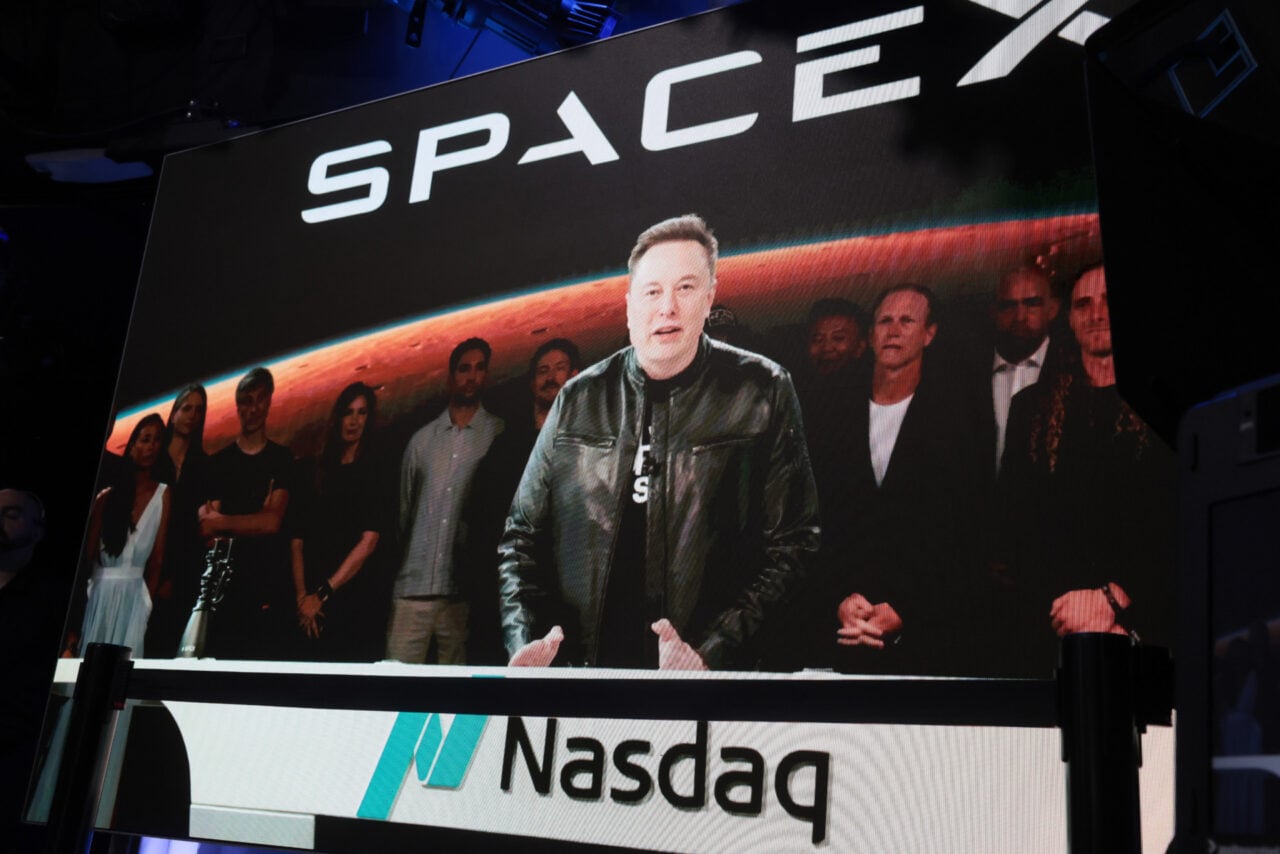
With an offering this large, there is a lot of financial machinery operating behind the scenes — so the first question is just when the stock makes it to the market to start trading. SpaceX is debuting on Nasdaq and you can see the official Nasdaq listing here, which will have the price of record as soon as there is one. Nasdaq also has video of the SpaceX crew ringing the bell, if that’s your thing.
But the price is just part of the picture. For the most up-to-the-minute information, your best bet is still financial press outlets like Bloomberg and CNBC, both of which have liveblogs running and will have close coverage of any hiccups that happen in getting the stock to market.
The SpaceX IPO, by the numbers
Here we look at some of the bigger numbers, the consequential figures, and the eyewatering amounts that make up the company’s S-1 form.
For instance, SpaceX lost $4.9 billion on revenues of over $18 billion in 2025. That’s only a fraction of the more than $37 billion lost since SpaceX’s inception.
As CEO, Elon Musk holds about 85.1% of the company’s voting power. You can read more about that in the next section “Who wins and who doesn’t” — and we’ll continue to drop interesting numbers in here.
Here is another figure that caught our attention… 4,400. That’s the number of SpaceX employees who could become millionaires, according to the NYT.
How Elon Musk will increase his power through the SpaceX IPO: Musk, who will have more than 50% of the voting power, will have a monarchical grip over the publicly traded version of SpaceX — control that goes far beyond what other tech founders enjoy.
The S-1 registration document gave the world an unprecedented look inside SpaceX, including its financials and its various businesses. The S-1 continued to be amended as the IPO date approached, and we were on it. Here is what we found.
Starship’s path to reusability looks murky after SpaceX’s S-1: SpaceX’s IPO and Starship rocket test flight delivered two big data points that offer a realistic vision for the coming years — and one that may disappoint both the company’s boosters and its critics.
This article originally published at 10 am ET, June 12, 2026. It has been updated with new coverage of the SpaceX IPO, share price, and other related events.
When you purchase through links in our articles, we may earn a small commission. This doesn’t affect our editorial independence.
There has been heavy trading volume, as expected. Robinhood said it has seen “record-breaking traffic on its trading platform in the hours after SpaceX’s historic public markets debut.
SpaceX COO Gwynne Shotwell was interviewed by CNBC on Friday and among the many interesting comments she made, here is one that might get the attention of Tesla shareholders. At one point in the interview, Shotwell said a “merger between SpaceX and Tesla might make Elon’s life a little easier.”
Among the winners are the banks, which have brought in about $500 million in total fees. The big winners are Goldman Sachs and Morgan Stanley, per the WSJ.
Musk took to X, the social media company he owns, to share his appreciation of SpaceX employees as the stock rose. “I love the incredible people of SpaceX beyond words,” he wrote Friday afternoon. He also reposted a number of SpaceX IPO related posts, including a photo of insiders all wearing green shoes in what appears to be a nod to “the green shoe option.” This is a provision in an IPO underwriting agreement that lets underwriters to sell up to 15% more shares than originally planned if demand is strong.
With an offering this large, there is a lot of financial machinery operating behind the scenes — so the first question is just when the stock makes it to the market to start trading. SpaceX is debuting on Nasdaq and you can see the official Nasdaq listing here, which will have the price of record as soon as there is one. Nasdaq also has video of the SpaceX crew ringing the bell, if that’s your thing.
But the price is just part of the picture. For the most up-to-the-minute information, your best bet is still financial press outlets like Bloomberg and CNBC, both of which have liveblogs running and will have close coverage of any hiccups that happen in getting the stock to market.
The SpaceX IPO, by the numbers
Here we look at some of the bigger numbers, the consequential figures, and the eyewatering amounts that make up the company’s S-1 form.
For instance, SpaceX lost $4.9 billion on revenues of over $18 billion in 2025. That’s only a fraction of the more than $37 billion lost since SpaceX’s inception.
As CEO, Elon Musk holds about 85.1% of the company’s voting power. You can read more about that in the next section “Who wins and who doesn’t” — and we’ll continue to drop interesting numbers in here.
Here is another figure that caught our attention… 4,400. That’s the number of SpaceX employees who could become millionaires, according to the NYT.
How Elon Musk will increase his power through the SpaceX IPO: Musk, who will have more than 50% of the voting power, will have a monarchical grip over the publicly traded version of SpaceX — control that goes far beyond what other tech founders enjoy.
The S-1 registration document gave the world an unprecedented look inside SpaceX, including its financials and its various businesses. The S-1 continued to be amended as the IPO date approached, and we were on it. Here is what we found.
Starship’s path to reusability looks murky after SpaceX’s S-1: SpaceX’s IPO and Starship rocket test flight delivered two big data points that offer a realistic vision for the coming years — and one that may disappoint both the company’s boosters and its critics.
This article originally published at 10 am ET, June 12, 2026. It has been updated with new coverage of the SpaceX IPO, share price, and other related events.
When you purchase through links in our articles, we may earn a small commission. This doesn’t affect our editorial independence.
#SpaceX #IPO #Live #updates #TechCrunchElon Musk,IPO,SpaceX,spacex ipo">SpaceX IPO: Live updates on everything you need to know | TechCrunch
SpaceX has captured the attention of media, investors, and the public for years now — interest propelled by the company’s reusable rocket launches, the rise of its Starlink satellite network, and of course, for its founder and CEO Elon Musk.
But in its 24-year history, nothing quite compares to this initial public offering. Everyone seems to be interested, and perhaps it’s because of the sheer size of this IPO. The company priced its 555.6 million shares at $135 each to raise $75 billion, making it the largest IPO in history. At this price, the deal also looks set to make Musk the world’s first trillionaire.
TechCrunch has followed SpaceX’s start, struggles, and successes from the early days. And we’re here for what happens next too. This article will be continually updated with all of the latest SpaceX IPO news.
The latest on the SpaceX IPO
SpaceX shares opened at $150 on the Nasdaq public exchange, an 11% pop for the most anticipated debut in history. And it has continued to rise. The shares keep rising too (which we will update here). In midday trading, SpaceX shares soared 30%. SpaceX shares closed at $160.95, up 19%.
There has been heavy trading volume, as expected. Robinhood said it has seen “record-breaking traffic on its trading platform in the hours after SpaceX’s historic public markets debut.
SpaceX COO Gwynne Shotwell was interviewed by CNBC on Friday and among the many interesting comments she made, here is one that might get the attention of Tesla shareholders. At one point in the interview, Shotwell said a “merger between SpaceX and Tesla might make Elon’s life a little easier.”
Among the winners are the banks, which have brought in about $500 million in total fees. The big winners are Goldman Sachs and Morgan Stanley, per the WSJ.
Musk took to X, the social media company he owns, to share his appreciation of SpaceX employees as the stock rose. “I love the incredible people of SpaceX beyond words,” he wrote Friday afternoon. He also reposted a number of SpaceX IPO related posts, including a photo of insiders all wearing green shoes in what appears to be a nod to “the green shoe option.” This is a provision in an IPO underwriting agreement that lets underwriters to sell up to 15% more shares than originally planned if demand is strong.
With an offering this large, there is a lot of financial machinery operating behind the scenes — so the first question is just when the stock makes it to the market to start trading. SpaceX is debuting on Nasdaq and you can see the official Nasdaq listing here, which will have the price of record as soon as there is one. Nasdaq also has video of the SpaceX crew ringing the bell, if that’s your thing.
But the price is just part of the picture. For the most up-to-the-minute information, your best bet is still financial press outlets like Bloomberg and CNBC, both of which have liveblogs running and will have close coverage of any hiccups that happen in getting the stock to market.
The SpaceX IPO, by the numbers
Here we look at some of the bigger numbers, the consequential figures, and the eyewatering amounts that make up the company’s S-1 form.
For instance, SpaceX lost $4.9 billion on revenues of over $18 billion in 2025. That’s only a fraction of the more than $37 billion lost since SpaceX’s inception.
As CEO, Elon Musk holds about 85.1% of the company’s voting power. You can read more about that in the next section “Who wins and who doesn’t” — and we’ll continue to drop interesting numbers in here.
Here is another figure that caught our attention… 4,400. That’s the number of SpaceX employees who could become millionaires, according to the NYT.
How Elon Musk will increase his power through the SpaceX IPO: Musk, who will have more than 50% of the voting power, will have a monarchical grip over the publicly traded version of SpaceX — control that goes far beyond what other tech founders enjoy.
The S-1 registration document gave the world an unprecedented look inside SpaceX, including its financials and its various businesses. The S-1 continued to be amended as the IPO date approached, and we were on it. Here is what we found.
Starship’s path to reusability looks murky after SpaceX’s S-1: SpaceX’s IPO and Starship rocket test flight delivered two big data points that offer a realistic vision for the coming years — and one that may disappoint both the company’s boosters and its critics.
This article originally published at 10 am ET, June 12, 2026. It has been updated with new coverage of the SpaceX IPO, share price, and other related events.
When you purchase through links in our articles, we may earn a small commission. This doesn’t affect our editorial independence.