
Sports news
#Offside #Indian #sport #institutions #teams">Off-side: Indian sport needs institutions, not just teams In my last column, I wrote that the soaring valuations of Royal Challengers Bengaluru and Rajasthan Royals were less a triumph of Indian sport and more a triumph of one sport. But perhaps, the larger question lies beyond valuation: what comes after the franchise boom?
Because while India has spent the last decade trying to replicate the IPL, many of the world’s mature sporting cultures have spent the last century building something more durable.
A franchise can win titles, sell sponsorships and command television ratings. But sporting institutions shape a city, develop generations of athletes and survive cycles of victory and defeat. India has many of the former, but it needs more of the latter.
If you are ever in Barcelona, you will quickly understand that FC Barcelona is not merely a football club. It is a cultural identity. The same crest lives across basketball, women’s football, handball, futsal and youth sport. Real Madrid, for all its global glamour, follows a similar pattern. Olympiacos in Greece, Fenerbahce in Turkey and Sporting CP in Portugal are not simply clubs but social organisms of their cities.
They live by a simple maxim: one badge, many sports; one fan base, many emotional entry points.
The model compounds powerfully. A child may enter through basketball and stay for football. A sponsor may buy one property and inherit five. A city remains engaged across the calendar, not merely during a single league window.
Despite the astronomical success of the IPL, and the more modest gains made by the Pro Kabaddi League, Women’s Premier League, Hockey India League and the Indian Super League, much of Indian sport remains event-led rather than institution-driven.
Every year, IPL teams appear, compete, market themselves for a few months and then recede from public consciousness. Fan engagement is intense but episodic. Sponsorship is sold season by season. Youth pathways remain peripheral, and cities host teams without fully owning them.
If the first wave of sports investment in India was about buying a franchise and entering a league, the next wave should focus on building permanent sporting institutions that are deeply integrated into cities.
Imagine a Bengaluru sporting institution operating cricket, football, women’s cricket, volleyball and academies under one umbrella. Imagine Kolkata reviving its historic club culture into a modern multi-sport platform. Imagine Chennai, Ahmedabad or Lucknow building year-round city brands rather than seasonal, cricket-centric assets.
Sponsors would buy into annual ecosystems. Fans would engage for 12 months. Academies would become both a pipeline and a business, while merchandise, memberships and content would generate recurring revenue.
This future is not theoretical. JSW already owns teams across cricket, football and kabaddi while investing in Olympic sports. Reliance has built beyond teams into pathways and infrastructure. RPSG spans cricket and football. But many such investments remain scattered rather than rooted in one geography.
Seven IPL franchise owners have already expanded overseas, buying teams in South Africa, the UAE, the Caribbean and elsewhere. Profits generated in India are being exported to acquire cricketing assets abroad. But when one sport already commands more than 80 per cent of the domestic sports economy, there is a legitimate question: should some of that capital instead be reinvested into the underfunded Indian sports ecosystem? Should governments remain passive, or design smart incentives through tax rebates, infrastructure credits, co-investment schemes and grassroots grants as cross-sport ownership benefits for franchise groups that invest meaningfully in city-based multi-sport development?
The opportunity now is to build across sports within India: an RCB football team in Bengaluru, a CSK women’s cricket team in Chennai, an LSG hockey team in Lucknow, a Gujarat Titans volleyball team in Ahmedabad, all tied to a city crest.
To make these teams not just tenants of the city, but part of its psyche and consciousness.
The next phase of Indian sport should not be global acquisition but local permanence. Franchises must become sporting institutions embedded in the heartbeat of their cities.
Published on Apr 23, 2026
In my last column, I wrote that the soaring valuations of Royal Challengers Bengaluru and…

Sports news
#Lalit #Modi #man #refuses #wrong #EXCLUSIVE #interview">Lalit Modi, the man who refuses to be wrong — EXCLUSIVE interview
Lalit Modi is perhaps one of modern India’s most conspicuous exiles. A figure who once sat at the centre of cricket’s power now watches it from afar. Often seen in the United Kingdom in the company of fallen titans of Indian business, he remains as visible in absence as he once was in authority.
Exile in Modi’s case has not resembled exile as history often remembers it. Unlike the near-solitary existence of those cast out before him, his life in London has remained public, even opulent. Images of that life surface often on Indian social media. His conversation with Sportstar took place from his home in London — seated in a plush meeting room, relaxed, punctuating his answers with regular puffs from a vape, glasses refilled with regularity.
Modi, the founding chairman of the Indian Premier League (IPL) and a key architect of its commercial rise, saw his tenure end in acrimony with his expulsion from the Board of Control for Cricket in India (BCCI). But the distance since has done little to temper either his claims or his convictions. He now believes the league and its franchises have left significant value unrealised because the BCCI has not adhered to what he describes as a key contractual commitment: a full home-and-away schedule.
His comments come at a time when franchise valuations continue to surge, reinforcing the IPL’s position as one of the most lucrative sporting leagues in the world. Recently, two franchises, Royal Challengers Bengaluru (RCB) and Rajasthan Royals (RR), changed hands, underlining the growing appetite among investors for a stake in the league’s expanding ecosystem. A consortium led by the Aditya Birla Group emerged as the lead bidder to acquire RCB for a reported USD 1.78 billion (approximately ₹16,700 crore), while RR was acquired by a US-based consortium led by Kal Somani for USD 1.63 billion (approximately ₹15,290 crore).
Despite these soaring valuations, Modi believes the league’s true commercial potential is still far from fully realised. He reiterated that the IPL was originally conceived as an independent entity rather than a subsidiary of the BCCI, with a governance structure that would have placed franchise owners at the centre of decision-making, similar to the model followed in major American sports leagues.
“That was how it was proposed on September 13, 2007, and the BCCI Governing Council approved that the IPL was not a subsidiary of the BCCI. It was an independent company,” Modi said.
“I got a lot of backlash… ‘if you want to launch it, it’s going to be this way.’ It was set up with the owner sitting on the board and controlling it like the National Football League (NFL). I will reveal that Constitution one day, but that is actually the fact of what was approved in the Special General Meeting prior to the press conference that I held. Thereafter, it was changed in November or December 2007, in Jaipur, where others got involved and said that this can’t be done.”
Modi recalled that resistance to an independent league structure meant compromises had to be made to ensure the tournament’s launch remained on track. While he acknowledges that the IPL has achieved unprecedented success over the past 18 years, he believes the league might have grown even more rapidly had the original governance framework been retained. With the majority not in favour of creating an independent league, Modi admitted he had “many fires to douse” and chose his battles.
“Had the original structure remained, with owners represented on the board and the league controlling its own operations, the IPL would by now have been an ecosystem unto itself. It would have been untouchable by any company of any kind on the planet,” he said. “We would be controlling everything and marketing our own product through our own streaming system globally by now.”
That tension between vision and control would, in time, lead to a far more consequential rupture.
Back in 2013, Modi was found guilty on eight counts of “various acts of indiscipline and misconduct” by the BCCI’s disciplinary committee, a decision that culminated in his expulsion from Indian cricket’s administrative structure.
Since leaving India in 2010, Modi has faced over two dozen cases, including multiple investigations by the Enforcement Directorate (ED) for alleged financial irregularities, money laundering, and violations under FEMA. Investigations have also involved the Income Tax Department, the Directorate of Revenue Intelligence, and passport authorities, with non-bailable warrants issued in certain cases. Modi is yet to physically appear before an Indian court in these matters.
More than a decade on, Modi continues to contest both the process and the substance of those findings. He maintains that the allegations against him were never tested in a court of law and that no formal charges were framed in a judicial setting.
He also questions the procedural fairness of the BCCI’s internal disciplinary proceedings, claiming he was denied a meaningful opportunity to present his case before the committee.
“I wasn’t even given a fair hearing. The day I was to appear before the committee and answer questions, I was effectively banned before I could present my case,” Modi said.
The Kochi IPL franchise controversy in 2010 was the one that truly opened the floodgates of the accusations against him. Modi was accused of rigging the bidding in favour of a few corporate players and arm-twisting stakeholders thereafter. He suggested that he had faced sustained pressure to step down but chose not to do so voluntarily. He alleged that attempts were made to prevent him from addressing the public at the time, although the speech was eventually broadcast.
“I was asked to resign and told I could return in six months. I said, ‘If you have the guts, fire me.’…” he said.
In his telling, the rupture was not of his making. It is a story of power and politics, of people of influence who, he believes, chose to turn on him. To him, it is less about wrongdoing and more about being pushed out of a system he helped build.
Positioning his defence within his business background, Modi emphasised that he had no financial incentive to engage in wrongdoing.
It is an argument of inheritance. Modi was born into wealth — heir to the KK Modi enterprise, with interests spanning tobacco, hospitality, and chemicals — a life that began with a ‘diamond spoon’.
“I come from an established business family; I did not need to take money from the league. The KK Modi Group is valued in the hundreds of thousands of crores. The suggestion that I would risk everything for relatively small sums makes no sense,” Modi claimed.
He added that he had retained documentation relating to key decisions taken during his tenure and reiterated his belief that a full legal process would bring greater clarity.
“I have always said that if the matter is tested in court, the full record will emerge through discovery. Despite the controversies, the IPL has only grown stronger. If I had to do it again, I would still take the same decisions because they ultimately strengthened the league.”
When he speaks, there is an unyielding certainty – something close to the belief that he could not have been wrong, a trait not unfamiliar among those cast out yet unconvinced.
That certainty extends beyond his defence of the past to his reading of the present and, in particular, what he believes the IPL is still getting wrong.
Home and away is where the value is
While Modi believes the IPL’s long-term dominance is secure, he remains critical of certain structural decisions taken in recent years. His sharpest criticism was directed at the league’s scheduling format, which he argues has diluted the commercial value promised to franchises at the time of purchase.
According to Modi, franchise agreements were based on a format in which every team would face each other twice, once at home and once away. When the IPL expanded to 10 teams in 2022, such a structure would have resulted in a 90-match league phase followed by four playoff fixtures. Instead, the tournament continues to operate with a 74-match format, meaning several teams do not play all opponents twice in a season.
“(For) every game, the BCCI gets 50 per cent, and the remaining 50 per cent is distributed to teams. So teams are now losing out on 20 games.
It is by contractual obligation for the fees that they’re paying to provide them home and away,” he said.
“The home and away is where the value is. If you don’t have time in your calendar, don’t increase the number of teams. Simple as that. That’s not what we sold. Has everybody signed off on it? I guarantee not.”
Modi argued that the absence of a full home-and-away structure has a direct financial impact on both franchises and the board, particularly in terms of media rights revenue, which remains the primary driver of IPL income.
“If there were 94 matches today on a home-and-away basis, Rs 118 crore a game, it’s Rs 2,400 crore just from media rights. That’s Rs 2,400 crore extra coming to the BCCI,” he said.
“Out of this, Rs 1,200 crore would have gone to the 10 teams. Each team would have got Rs 120 crore, and the team value should automatically have been higher.”
From a commercial standpoint, Modi believes increasing the number of matches would not dilute interest but rather enhance engagement by strengthening local rivalries and increasing inventory for broadcasters and advertisers.
Media rights still the primary growth engine
Since the IPL’s inception in 2008, debates have continued over what truly fuels its commercial success. While fan engagement, merchandising and match-day experience are often highlighted as growth pillars, Modi believes media rights remain the single biggest contributor to the league’s rapid financial expansion.
“Fans, too, haven’t played a role yet. It’s primarily the media rights right now,” he said.
“Ticketing hasn’t played a role yet, nor has merchandising, because we are still a relatively young league. For now, we are seeing limited fan bases in pockets, in Bengaluru to a certain extent, in Mumbai and Chennai. That’s it currently… Nobody has asked why it is limited to only three franchises.”
According to Modi, only a few early franchise owners invested significantly in developing team identities beyond on-field performances, focussing on brand-building initiatives that helped create loyal fan communities.
“Vijay Mallya was a showman. His brand was associated with the spirits business, and he spent out-of-proportion money building the base with a liquor brand. With the Mumbai Indians, the Mukesh Ambani family went out of their way. N. Srinivasan did a very smart thing with India Cements buying Chennai Super Kings. A lot of investment was done in building fan bases,” he said.
“None of the other teams did significant brand extension or marketing. They built the team based on personalities and media rights and did no brand building at all.”
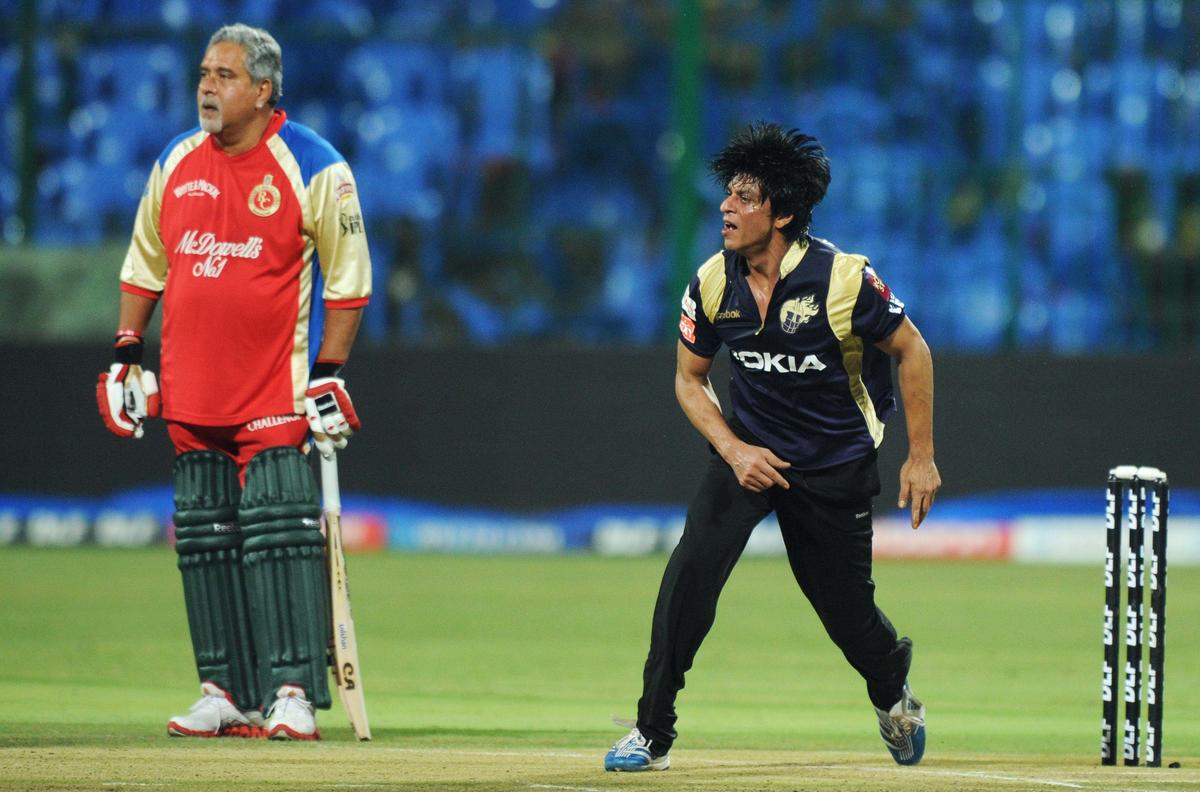
Star power: Before rivalries were built on runs and wickets, Lalit Modi sold the IPL’s first night as a clash of personas: Shah Rukh Khan vs Vijay Mallya, not KKR vs RCB.
| Photo Credit:
AFP

Star power: Before rivalries were built on runs and wickets, Lalit Modi sold the IPL’s first night as a clash of personas: Shah Rukh Khan vs Vijay Mallya, not KKR vs RCB.
| Photo Credit:
AFP
Modi also recalled the strategic importance of bringing Bollywood superstar Shah Rukh Khan on board as co-owner of Kolkata Knight Riders, a move he considers central to the league’s early mass appeal beyond traditional cricket audiences.
“I needed women and children to watch the league, and for that, I needed Shah Rukh. He was a very big part of the IPL and it was do-or-die for me,” Modi said.
“That’s why the first match was purposely scheduled as a clash between the teams owned by Shah Rukh Khan and Vijay Mallya in Bengaluru. It was not KKR versus RCB. Nobody knew KKR and RCB in those days. The headline was Shah Rukh Khan versus Vijay Mallya.”
IPL is ‘recession-proof’
Soon after the inaugural season in 2008, the global financial crisis cast doubts over the sustainability of major sporting investments worldwide. However, at the 2009 players’ auction in Goa, Modi declared that the IPL was recession-proof, a claim he continues to stand by nearly two decades later.
“The IPL is on the cusp of dominating the world. Earlier, we were dependent on broadcasters through television networks and cable. Data was expensive and the world was still small. Today, viewing has shifted to multiple devices,” he said.
“90 per cent of the business lies here. You don’t need a cable operator, you don’t need fibre, you don’t need a broadcaster. Now it can be streamed directly.”
Modi emphasised that advertising continues to form the backbone of the league’s commercial structure, with innovations such as the strategic timeout designed specifically to expand advertising inventory.
“Our market is still advertisement driven. We are sustaining this growth only on advertising, and we are still a fraction of the revenue advertisers are willing to pay for an IPL spot.
“I never sold media rights; I sold 2,600 seconds in my media product. I created a paradigm of selling slots between overs and across digital platforms. I moved it from 2,000 seconds to 2,600 seconds with the strategic timeout because I didn’t have enough advertising inventory. It was done purely for commercial purposes.”
Improving infrastructure and enhancing fan experience
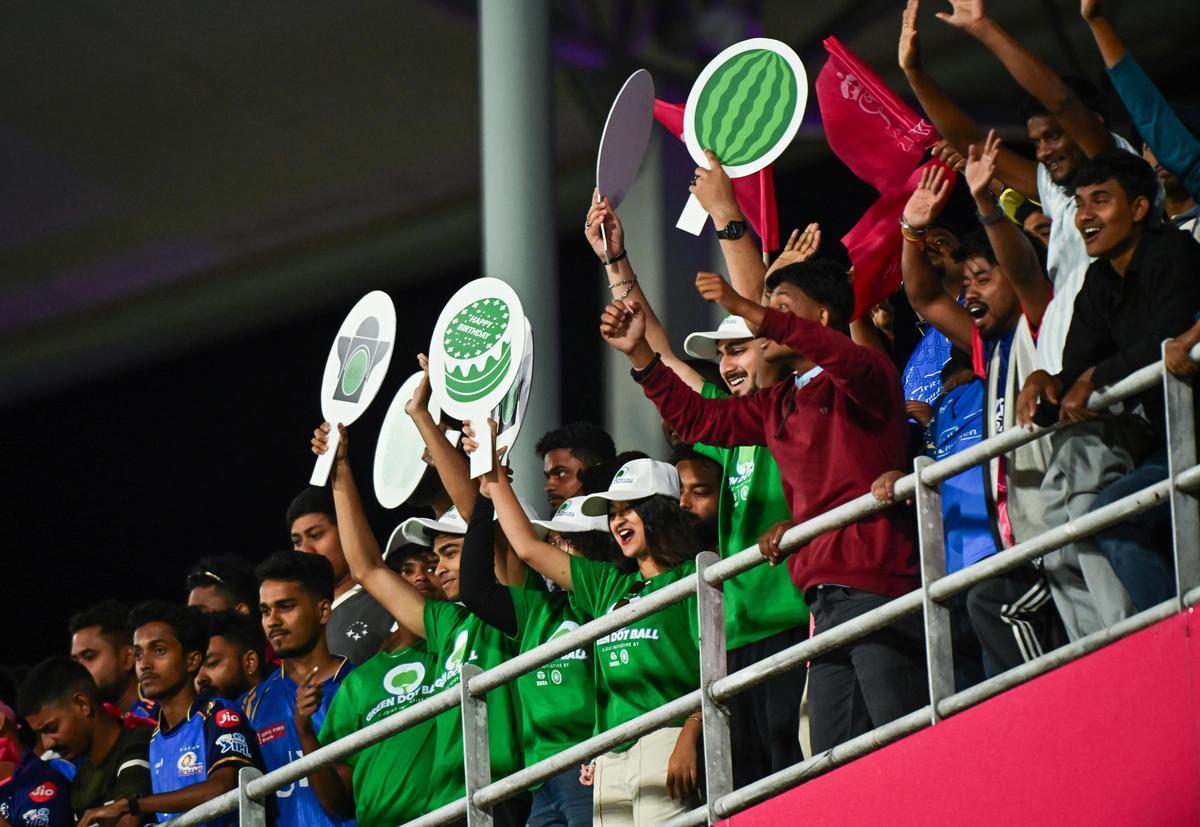
Immersive cricket: For Lalit Modi, the next IPL leap lies not on the pitch, but in turning match-day into an experience.
| Photo Credit:
ANI
Immersive cricket: For Lalit Modi, the next IPL leap lies not on the pitch, but in turning match-day into an experience.
| Photo Credit:
ANI
While franchise owners have increasingly expanded into overseas T20 leagues in recent years, Modi believes these investments will not dilute the IPL’s dominance, primarily because Indian players remain restricted from participating in most foreign leagues.
“The Indian players can never play outside of India, period,” Modi said. “It’s enshrined in my IPL contract, it’s enshrined in everything that we do. So, even if the owners go anywhere, it won’t have an impact.”
However, he stressed that improving stadium infrastructure and overall fan experience should be a key priority for Indian cricket administrators, given the scale of revenues generated by the IPL.
“If I was sitting in the BCCI today, with the money that we earn, I would scrap all our stadiums and build luxurious modern facilities, with amazing bathrooms, air-conditioning, escalators, glass buildings to give an unparalleled experience to the spectators,” Modi said.
During his tenure, American architectural firm HKS Inc., which designed several major global sporting venues including the NFL’s Lucas Oil Stadium, conducted a study of stadium infrastructure in India.
“All the stadiums were unfit to hold matches. I presented the studies to the BCCI, but nothing was done,” he said.
“We talk about building a stadium for Rs 400 crore, Rs 300 crore, Rs 200 crore, but the standards are still below par compared to premium global sporting arenas,” Modi said, adding: “If it was in my system, I would spend the next one year investigating where the money goes, and follow the money. It’s not going to the players for sure, it’s not being spent on infrastructure for sure…”
Modi believes the spectator experience remains one of the least developed aspects of the IPL ecosystem.
“Nobody cares about the fans,” he said. “I was the biggest proponent of fans. Sadly, there is no proactive work at the BCCI level, or the State Association level, in looking after the fans.”
Referring to last year’s stampede outside the M. Chinnaswamy Stadium in Bengaluru following Royal Challengers Bengaluru’s maiden title win, Modi stressed the need for better crowd management and safety infrastructure.
“We need total fan protection, total fan experience, everything else is out of the window…”
According to him, replicating the match-day experience offered by top European football clubs could transform the relationship between fans and franchises.
“If you give him or her the experience that he or she gets in an international venue for a Barcelona game, or a Real Madrid game, or an Arsenal game, or a Chelsea game, there will be a complete paradigm shift,” he said.
Player treatment and franchise culture
In the ongoing edition of the IPL, Lucknow Super Giants owner Sanjiv Goenka attracted criticism after his alleged on-field exchange with captain Rishabh Pant went viral on social media. While such incidents have surfaced previously, Modi believes they set an unhealthy precedent for player-owner relationships.
“Sanjiv is my brother-in-law. He is married to my first cousin, my mother got him married to my first cousin, so I’ve grown up with that kid. I don’t have any animosity with him. You don’t treat players as if they’re your servants or your slaves. You don’t treat your employees like that. So, when I see these kinds of things happening, somebody has to have the guts to talk about it. That’s why I bash him, not because of anything,” Modi said.
“While football league owners treat players with respect, long-term vision, and professionalism, IPL owners are often busy chasing hype and headlines, publicly berating captains right on the boundary after tough losses,” Modi added.
A creator and a disruptor
Back in 2007, when Modi first proposed a franchise-based T20 league that would blend sport and entertainment, scepticism was widespread. Nearly two decades later, the IPL has reshaped the global cricket economy and become one of the most valuable sports properties in the world. Looking back on that journey, Modi says he wants to be remembered as someone who changed the way cricket was consumed, packaged and commercialised.
“I was a disruptor, I was a creator, I was a game changer,” he said with a smile.
“Now, commentators aren’t allowed to take my name, nobody’s allowed to, but it doesn’t matter, they’re immaterial to me. The fans understand it, and that’s what matters to me. Nothing else does…”
Published on Apr 09, 2026
Star power: Before rivalries were built on runs and wickets, Lalit Modi sold the IPL’s first night as a clash of personas: Shah Rukh Khan vs Vijay Mallya, not KKR vs RCB. | Photo Credit: AFP
Star power: Before rivalries were built on runs and wickets, Lalit Modi sold the IPL’s first night as a clash of personas: Shah Rukh Khan vs Vijay Mallya, not KKR vs RCB. | Photo Credit: AFP
Immersive cricket: For Lalit Modi, the next IPL leap lies not on the pitch, but in turning match-day into an experience. | Photo Credit: ANI
Immersive cricket: For Lalit Modi, the next IPL leap lies not on the pitch, but in turning match-day into an experience. | Photo Credit: ANI
Lalit Modi is perhaps one of modern India’s most conspicuous exiles. A figure who once sat at the centre of cricket’s power now watches it from afar. Often seen in the United Kingdom in the company of fallen titans of Indian business, he remains as visible in absence as he once was in authority.
Exile in Modi’s case has not resembled exile as history often remembers it. Unlike the near-solitary existence of those cast out before him, his life in London has remained public, even opulent. Images of that life surface often on Indian social media. His conversation with Sportstar took place from his home in London — seated in a plush meeting room, relaxed, punctuating his answers with regular puffs from a vape, glasses refilled with regularity.
Modi, the founding chairman of the Indian Premier League (IPL) and a key architect of its commercial rise, saw his tenure end in acrimony with his expulsion from the Board of Control for Cricket in India (BCCI). But the distance since has done little to temper either his claims or his convictions. He now believes the league and its franchises have left significant value unrealised because the BCCI has not adhered to what he describes as a key contractual commitment: a full home-and-away schedule.
His comments come at a time when franchise valuations continue to surge, reinforcing the IPL’s position as one of the most lucrative sporting leagues in the world. Recently, two franchises, Royal Challengers Bengaluru (RCB) and Rajasthan Royals (RR), changed hands, underlining the growing appetite among investors for a stake in the league’s expanding ecosystem. A consortium led by the Aditya Birla Group emerged as the lead bidder to acquire RCB for a reported USD 1.78 billion (approximately ₹16,700 crore), while RR was acquired by a US-based consortium led by Kal Somani for USD 1.63 billion (approximately ₹15,290 crore).
Despite these soaring valuations, Modi believes the league’s true commercial potential is still far from fully realised. He reiterated that the IPL was originally conceived as an independent entity rather than a subsidiary of the BCCI, with a governance structure that would have placed franchise owners at the centre of decision-making, similar to the model followed in major American sports leagues.
“That was how it was proposed on September 13, 2007, and the BCCI Governing Council approved that the IPL was not a subsidiary of the BCCI. It was an independent company,” Modi said.
“I got a lot of backlash… ‘if you want to launch it, it’s going to be this way.’ It was set up with the owner sitting on the board and controlling it like the National Football League (NFL). I will reveal that Constitution one day, but that is actually the fact of what was approved in the Special General Meeting prior to the press conference that I held. Thereafter, it was changed in November or December 2007, in Jaipur, where others got involved and said that this can’t be done.”
Modi recalled that resistance to an independent league structure meant compromises had to be made to ensure the tournament’s launch remained on track. While he acknowledges that the IPL has achieved unprecedented success over the past 18 years, he believes the league might have grown even more rapidly had the original governance framework been retained. With the majority not in favour of creating an independent league, Modi admitted he had “many fires to douse” and chose his battles.
“Had the original structure remained, with owners represented on the board and the league controlling its own operations, the IPL would by now have been an ecosystem unto itself. It would have been untouchable by any company of any kind on the planet,” he said. “We would be controlling everything and marketing our own product through our own streaming system globally by now.”
That tension between vision and control would, in time, lead to a far more consequential rupture.
Back in 2013, Modi was found guilty on eight counts of “various acts of indiscipline and misconduct” by the BCCI’s disciplinary committee, a decision that culminated in his expulsion from Indian cricket’s administrative structure.
Since leaving India in 2010, Modi has faced over two dozen cases, including multiple investigations by the Enforcement Directorate (ED) for alleged financial irregularities, money laundering, and violations under FEMA. Investigations have also involved the Income Tax Department, the Directorate of Revenue Intelligence, and passport authorities, with non-bailable warrants issued in certain cases. Modi is yet to physically appear before an Indian court in these matters.
More than a decade on, Modi continues to contest both the process and the substance of those findings. He maintains that the allegations against him were never tested in a court of law and that no formal charges were framed in a judicial setting.
He also questions the procedural fairness of the BCCI’s internal disciplinary proceedings, claiming he was denied a meaningful opportunity to present his case before the committee.
“I wasn’t even given a fair hearing. The day I was to appear before the committee and answer questions, I was effectively banned before I could present my case,” Modi said.
The Kochi IPL franchise controversy in 2010 was the one that truly opened the floodgates of the accusations against him. Modi was accused of rigging the bidding in favour of a few corporate players and arm-twisting stakeholders thereafter. He suggested that he had faced sustained pressure to step down but chose not to do so voluntarily. He alleged that attempts were made to prevent him from addressing the public at the time, although the speech was eventually broadcast.
“I was asked to resign and told I could return in six months. I said, ‘If you have the guts, fire me.’…” he said.
In his telling, the rupture was not of his making. It is a story of power and politics, of people of influence who, he believes, chose to turn on him. To him, it is less about wrongdoing and more about being pushed out of a system he helped build.
Positioning his defence within his business background, Modi emphasised that he had no financial incentive to engage in wrongdoing.
It is an argument of inheritance. Modi was born into wealth — heir to the KK Modi enterprise, with interests spanning tobacco, hospitality, and chemicals — a life that began with a ‘diamond spoon’.
“I come from an established business family; I did not need to take money from the league. The KK Modi Group is valued in the hundreds of thousands of crores. The suggestion that I would risk everything for relatively small sums makes no sense,” Modi claimed.
He added that he had retained documentation relating to key decisions taken during his tenure and reiterated his belief that a full legal process would bring greater clarity.
“I have always said that if the matter is tested in court, the full record will emerge through discovery. Despite the controversies, the IPL has only grown stronger. If I had to do it again, I would still take the same decisions because they ultimately strengthened the league.”
When he speaks, there is an unyielding certainty – something close to the belief that he could not have been wrong, a trait not unfamiliar among those cast out yet unconvinced.
That certainty extends beyond his defence of the past to his reading of the present and, in particular, what he believes the IPL is still getting wrong.
Home and away is where the value is
While Modi believes the IPL’s long-term dominance is secure, he remains critical of certain structural decisions taken in recent years. His sharpest criticism was directed at the league’s scheduling format, which he argues has diluted the commercial value promised to franchises at the time of purchase.
According to Modi, franchise agreements were based on a format in which every team would face each other twice, once at home and once away. When the IPL expanded to 10 teams in 2022, such a structure would have resulted in a 90-match league phase followed by four playoff fixtures. Instead, the tournament continues to operate with a 74-match format, meaning several teams do not play all opponents twice in a season.
“(For) every game, the BCCI gets 50 per cent, and the remaining 50 per cent is distributed to teams. So teams are now losing out on 20 games.
It is by contractual obligation for the fees that they’re paying to provide them home and away,” he said.
“The home and away is where the value is. If you don’t have time in your calendar, don’t increase the number of teams. Simple as that. That’s not what we sold. Has everybody signed off on it? I guarantee not.”
Modi argued that the absence of a full home-and-away structure has a direct financial impact on both franchises and the board, particularly in terms of media rights revenue, which remains the primary driver of IPL income.
“If there were 94 matches today on a home-and-away basis, Rs 118 crore a game, it’s Rs 2,400 crore just from media rights. That’s Rs 2,400 crore extra coming to the BCCI,” he said.
“Out of this, Rs 1,200 crore would have gone to the 10 teams. Each team would have got Rs 120 crore, and the team value should automatically have been higher.”
From a commercial standpoint, Modi believes increasing the number of matches would not dilute interest but rather enhance engagement by strengthening local rivalries and increasing inventory for broadcasters and advertisers.
Media rights still the primary growth engine
Since the IPL’s inception in 2008, debates have continued over what truly fuels its commercial success. While fan engagement, merchandising and match-day experience are often highlighted as growth pillars, Modi believes media rights remain the single biggest contributor to the league’s rapid financial expansion.
“Fans, too, haven’t played a role yet. It’s primarily the media rights right now,” he said.
“Ticketing hasn’t played a role yet, nor has merchandising, because we are still a relatively young league. For now, we are seeing limited fan bases in pockets, in Bengaluru to a certain extent, in Mumbai and Chennai. That’s it currently… Nobody has asked why it is limited to only three franchises.”
According to Modi, only a few early franchise owners invested significantly in developing team identities beyond on-field performances, focussing on brand-building initiatives that helped create loyal fan communities.
“Vijay Mallya was a showman. His brand was associated with the spirits business, and he spent out-of-proportion money building the base with a liquor brand. With the Mumbai Indians, the Mukesh Ambani family went out of their way. N. Srinivasan did a very smart thing with India Cements buying Chennai Super Kings. A lot of investment was done in building fan bases,” he said.
“None of the other teams did significant brand extension or marketing. They built the team based on personalities and media rights and did no brand building at all.”
Star power: Before rivalries were built on runs and wickets, Lalit Modi sold the IPL’s first night as a clash of personas: Shah Rukh Khan vs Vijay Mallya, not KKR vs RCB. | Photo Credit: AFP
Star power: Before rivalries were built on runs and wickets, Lalit Modi sold the IPL’s first night as a clash of personas: Shah Rukh Khan vs Vijay Mallya, not KKR vs RCB. | Photo Credit: AFP
Modi also recalled the strategic importance of bringing Bollywood superstar Shah Rukh Khan on board as co-owner of Kolkata Knight Riders, a move he considers central to the league’s early mass appeal beyond traditional cricket audiences.
“I needed women and children to watch the league, and for that, I needed Shah Rukh. He was a very big part of the IPL and it was do-or-die for me,” Modi said.
“That’s why the first match was purposely scheduled as a clash between the teams owned by Shah Rukh Khan and Vijay Mallya in Bengaluru. It was not KKR versus RCB. Nobody knew KKR and RCB in those days. The headline was Shah Rukh Khan versus Vijay Mallya.”
IPL is ‘recession-proof’
Soon after the inaugural season in 2008, the global financial crisis cast doubts over the sustainability of major sporting investments worldwide. However, at the 2009 players’ auction in Goa, Modi declared that the IPL was recession-proof, a claim he continues to stand by nearly two decades later.
“The IPL is on the cusp of dominating the world. Earlier, we were dependent on broadcasters through television networks and cable. Data was expensive and the world was still small. Today, viewing has shifted to multiple devices,” he said.
“90 per cent of the business lies here. You don’t need a cable operator, you don’t need fibre, you don’t need a broadcaster. Now it can be streamed directly.”
Modi emphasised that advertising continues to form the backbone of the league’s commercial structure, with innovations such as the strategic timeout designed specifically to expand advertising inventory.
“Our market is still advertisement driven. We are sustaining this growth only on advertising, and we are still a fraction of the revenue advertisers are willing to pay for an IPL spot.
“I never sold media rights; I sold 2,600 seconds in my media product. I created a paradigm of selling slots between overs and across digital platforms. I moved it from 2,000 seconds to 2,600 seconds with the strategic timeout because I didn’t have enough advertising inventory. It was done purely for commercial purposes.”
Improving infrastructure and enhancing fan experience
Immersive cricket: For Lalit Modi, the next IPL leap lies not on the pitch, but in turning match-day into an experience. | Photo Credit: ANI
Immersive cricket: For Lalit Modi, the next IPL leap lies not on the pitch, but in turning match-day into an experience. | Photo Credit: ANI
While franchise owners have increasingly expanded into overseas T20 leagues in recent years, Modi believes these investments will not dilute the IPL’s dominance, primarily because Indian players remain restricted from participating in most foreign leagues.
“The Indian players can never play outside of India, period,” Modi said. “It’s enshrined in my IPL contract, it’s enshrined in everything that we do. So, even if the owners go anywhere, it won’t have an impact.”
However, he stressed that improving stadium infrastructure and overall fan experience should be a key priority for Indian cricket administrators, given the scale of revenues generated by the IPL.
“If I was sitting in the BCCI today, with the money that we earn, I would scrap all our stadiums and build luxurious modern facilities, with amazing bathrooms, air-conditioning, escalators, glass buildings to give an unparalleled experience to the spectators,” Modi said.
During his tenure, American architectural firm HKS Inc., which designed several major global sporting venues including the NFL’s Lucas Oil Stadium, conducted a study of stadium infrastructure in India.
“All the stadiums were unfit to hold matches. I presented the studies to the BCCI, but nothing was done,” he said.
“We talk about building a stadium for Rs 400 crore, Rs 300 crore, Rs 200 crore, but the standards are still below par compared to premium global sporting arenas,” Modi said, adding: “If it was in my system, I would spend the next one year investigating where the money goes, and follow the money. It’s not going to the players for sure, it’s not being spent on infrastructure for sure…”
Modi believes the spectator experience remains one of the least developed aspects of the IPL ecosystem.
“Nobody cares about the fans,” he said. “I was the biggest proponent of fans. Sadly, there is no proactive work at the BCCI level, or the State Association level, in looking after the fans.”
Referring to last year’s stampede outside the M. Chinnaswamy Stadium in Bengaluru following Royal Challengers Bengaluru’s maiden title win, Modi stressed the need for better crowd management and safety infrastructure.
“We need total fan protection, total fan experience, everything else is out of the window…”
According to him, replicating the match-day experience offered by top European football clubs could transform the relationship between fans and franchises.
“If you give him or her the experience that he or she gets in an international venue for a Barcelona game, or a Real Madrid game, or an Arsenal game, or a Chelsea game, there will be a complete paradigm shift,” he said.
Player treatment and franchise culture
In the ongoing edition of the IPL, Lucknow Super Giants owner Sanjiv Goenka attracted criticism after his alleged on-field exchange with captain Rishabh Pant went viral on social media. While such incidents have surfaced previously, Modi believes they set an unhealthy precedent for player-owner relationships.
“Sanjiv is my brother-in-law. He is married to my first cousin, my mother got him married to my first cousin, so I’ve grown up with that kid. I don’t have any animosity with him. You don’t treat players as if they’re your servants or your slaves. You don’t treat your employees like that. So, when I see these kinds of things happening, somebody has to have the guts to talk about it. That’s why I bash him, not because of anything,” Modi said.
“While football league owners treat players with respect, long-term vision, and professionalism, IPL owners are often busy chasing hype and headlines, publicly berating captains right on the boundary after tough losses,” Modi added.
A creator and a disruptor
Back in 2007, when Modi first proposed a franchise-based T20 league that would blend sport and entertainment, scepticism was widespread. Nearly two decades later, the IPL has reshaped the global cricket economy and become one of the most valuable sports properties in the world. Looking back on that journey, Modi says he wants to be remembered as someone who changed the way cricket was consumed, packaged and commercialised.
“I was a disruptor, I was a creator, I was a game changer,” he said with a smile.
“Now, commentators aren’t allowed to take my name, nobody’s allowed to, but it doesn’t matter, they’re immaterial to me. The fans understand it, and that’s what matters to me. Nothing else does…”
Published on Apr 09, 2026
Lalit Modi is perhaps one of modern India’s most conspicuous exiles. A figure who once…

Sports news
#Exclusive #Lalit #Modi #IPL #pitch #failed #times">Exclusive – “Nobody came in. Everybody came back with a no”: Lalit Modi on the IPL pitch that failed 999 times
There is a tendency now to treat the Indian Premier League (IPL) as if it arrived fully formed, with billion-dollar valuations trailing in its wake.
In Lalit Modi’s telling, it was anything but. It was imagined early, abandoned once, challenged by rivals, dismissed by the market and then, almost improbably, forced into existence.
“The idea to me was always to be the biggest league in the world,” Modi, the first chairman of the IPL, says. But the idea predates the IPL. “When I conceived it in the early ‘90s, it was called the Indian Cricket League. If you check who owns the domain name, it is not Subhash Chandra. It’s Lalit Modi.”
According to Modi, that first version, an eight-team, city-based competition, came close to life in 1995. “It was all set up, approved by the Board of Control for Cricket in India (BCCI). We spent $17 million to $20 million. All the top players were hired. It was an eight-team format: Delhi Panthers, Mohali Stallions, Gwalior Cobras, Calcutta Tigers, Bangalore Bulls, Chennai Tuskers.”
It collapsed just as quickly. “There was a requirement of too many underhand payments, and I decided this is not the way it’s going to work. And we shelved it,” Modi says.
The idea waited. When it returned a decade later, it entered a changed ecosystem and a rivalry.
“When I was launching the IPL, the first person I went to was Subhash Chandra. I said, ‘Would you like to buy the IPL rights?’” Modi says. Chandra declined and built his own league. “He picked up two of my people to develop the Indian Cricket League.”
Modi calls him “a great adversary”, but is clear about the flaw in Chandra’s system of “owning all the teams, all the broadcasting and all the players”. His own model would move the other way.
Yet the larger obstacle was indifference.
“We went to all the broadcasters. Nobody came in. Everybody came back with a no.” Investors were no better. “I’m making presentations to over 1,000 businessmen. Ninety-nine per cent didn’t understand what we were talking about.” Even within the BCCI, “not a single person could understand except for two.”
The problem, he realised, was cultural.
“I needed to attract the audience of the Saas Bahu shows on TV. That’s where the money was. The bulk of the Indian advertising money sat on the eight o’clock time slot,” he says. “I decided to do a paradigm shift. Night cricket. Eight o’clock start. Music, dancing, fun.”
The logic is blunt. “I needed to attract women and children… that is where the money was.”
The product still needed a trigger. And it arrived, unscripted, in 2007.
“You know the story of Yuvraj Singh’s six sixes already,” Modi says. “India winning over Pakistan, huge, huge. We bring them back as heroes. Millions of people come. That helped it.”
The IPL had its first advertisement.
But emotion could not substitute structure. “I explained, the first pillar is the broadcaster. Without broadcasting, we don’t have a pillar,” he says.
Sony’s interest came with a condition: “We will buy it, provided you have the top 100 players.”
“The task became to find the top 100 players,” Modi says. “You need Team India, without doubt. If you don’t have Team India, you have a problem.”
Even as he scrambled for players, the media rights auction brought the league to the brink.
“So, Sony signed the contract as a sub-licensee of World Sports Group. There were only three bidders, ESPN, World Sports Group, and Sony,” he says.
“ESPN’s bid was revenue sharing. ‘If we do well, we’ll give you 50 per cent.’ I threw them out.
“Before I opened the Sony bid, minutes before, they withdrew. It was hand in glove. I’m in front of live media. I don’t know what’s going to come.
“I opened the World Sports Group bid. It’s a billion dollars. It was a mindset number… I needed the headline to be, ‘IPL has the audacity to ask for a billion dollars’. So, we have a billion-dollar cheque guaranteed. We don’t have a broadcaster at that point in time.”
From there, he says he turned to franchise owners.
“4th of January was the opening of the franchisee tenders. The minimum bid price was 50 million paid over 10 years,” Modi says. “If you bid a minimum of 50, I’m going to give you back five. You’re only giving me five; the rest is your ego money.
“You’re going to get ticketing revenue, team sponsorship, food and beverage, and 60 per cent from the central pool.”
He tried to sell belief. “If you believe in me, it’ll be so big, you don’t have to ever look back.”
But few did.
“None of them believed it, Airtel, Tata group, Birla group, ICICI, HDFC. None of them believed it,” Modi says.
So, he made the risk explicit. “If the IPL doesn’t work in year one, I will tear up all these agreements and cancel IPL year two.”
It was not just a league being launched. It was a wager.
“I put my entire career on the line. I put all my goodwill on the line,” he says. “We formed our own team, paid from our own pocket… and with Sharad Pawar, we got it up and running.”
“And fortunately for us, it worked.”
Published on Apr 08, 2026
There is a tendency now to treat the Indian Premier League (IPL) as if it arrived fully formed, with billion-dollar valuations trailing in its wake.
In Lalit Modi’s telling, it was anything but. It was imagined early, abandoned once, challenged by rivals, dismissed by the market and then, almost improbably, forced into existence.
“The idea to me was always to be the biggest league in the world,” Modi, the first chairman of the IPL, says. But the idea predates the IPL. “When I conceived it in the early ‘90s, it was called the Indian Cricket League. If you check who owns the domain name, it is not Subhash Chandra. It’s Lalit Modi.”
According to Modi, that first version, an eight-team, city-based competition, came close to life in 1995. “It was all set up, approved by the Board of Control for Cricket in India (BCCI). We spent $17 million to $20 million. All the top players were hired. It was an eight-team format: Delhi Panthers, Mohali Stallions, Gwalior Cobras, Calcutta Tigers, Bangalore Bulls, Chennai Tuskers.”
It collapsed just as quickly. “There was a requirement of too many underhand payments, and I decided this is not the way it’s going to work. And we shelved it,” Modi says.
The idea waited. When it returned a decade later, it entered a changed ecosystem and a rivalry.
“When I was launching the IPL, the first person I went to was Subhash Chandra. I said, ‘Would you like to buy the IPL rights?’” Modi says. Chandra declined and built his own league. “He picked up two of my people to develop the Indian Cricket League.”
Modi calls him “a great adversary”, but is clear about the flaw in Chandra’s system of “owning all the teams, all the broadcasting and all the players”. His own model would move the other way.
Yet the larger obstacle was indifference.
“We went to all the broadcasters. Nobody came in. Everybody came back with a no.” Investors were no better. “I’m making presentations to over 1,000 businessmen. Ninety-nine per cent didn’t understand what we were talking about.” Even within the BCCI, “not a single person could understand except for two.”
The problem, he realised, was cultural.
“I needed to attract the audience of the Saas Bahu shows on TV. That’s where the money was. The bulk of the Indian advertising money sat on the eight o’clock time slot,” he says. “I decided to do a paradigm shift. Night cricket. Eight o’clock start. Music, dancing, fun.”
The logic is blunt. “I needed to attract women and children… that is where the money was.”
The product still needed a trigger. And it arrived, unscripted, in 2007.
“You know the story of Yuvraj Singh’s six sixes already,” Modi says. “India winning over Pakistan, huge, huge. We bring them back as heroes. Millions of people come. That helped it.”
The IPL had its first advertisement.
But emotion could not substitute structure. “I explained, the first pillar is the broadcaster. Without broadcasting, we don’t have a pillar,” he says.
Sony’s interest came with a condition: “We will buy it, provided you have the top 100 players.”
“The task became to find the top 100 players,” Modi says. “You need Team India, without doubt. If you don’t have Team India, you have a problem.”
Even as he scrambled for players, the media rights auction brought the league to the brink.
“So, Sony signed the contract as a sub-licensee of World Sports Group. There were only three bidders, ESPN, World Sports Group, and Sony,” he says.
“ESPN’s bid was revenue sharing. ‘If we do well, we’ll give you 50 per cent.’ I threw them out.
“Before I opened the Sony bid, minutes before, they withdrew. It was hand in glove. I’m in front of live media. I don’t know what’s going to come.
“I opened the World Sports Group bid. It’s a billion dollars. It was a mindset number… I needed the headline to be, ‘IPL has the audacity to ask for a billion dollars’. So, we have a billion-dollar cheque guaranteed. We don’t have a broadcaster at that point in time.”
From there, he says he turned to franchise owners.
“4th of January was the opening of the franchisee tenders. The minimum bid price was 50 million paid over 10 years,” Modi says. “If you bid a minimum of 50, I’m going to give you back five. You’re only giving me five; the rest is your ego money.
“You’re going to get ticketing revenue, team sponsorship, food and beverage, and 60 per cent from the central pool.”
He tried to sell belief. “If you believe in me, it’ll be so big, you don’t have to ever look back.”
But few did.
“None of them believed it, Airtel, Tata group, Birla group, ICICI, HDFC. None of them believed it,” Modi says.
So, he made the risk explicit. “If the IPL doesn’t work in year one, I will tear up all these agreements and cancel IPL year two.”
It was not just a league being launched. It was a wager.
“I put my entire career on the line. I put all my goodwill on the line,” he says. “We formed our own team, paid from our own pocket… and with Sharad Pawar, we got it up and running.”
“And fortunately for us, it worked.”
Published on Apr 08, 2026
There is a tendency now to treat the Indian Premier League (IPL) as if it…
