
Chinese tail-tracking robot delivers needle-free vaccines to pigs
In China, robots are being used to inject pigs with vaccines to support intelligent pig…
In China, robots are being used to inject pigs with vaccines to support intelligent pig…
FedEx is expanding on a robotics pilot to bring autonomous trailer loading and unloading capabilities…
The price of eggs has become a marker of the state of the economy. But how about the cost of making eggs? Sure, you might be able to do it for next to nothing in your kitchen with nothing but a pan and a burner. But you could also pay $400 for a robot that will do it for you—as long as you don’t want your eggs scrambled, that is.
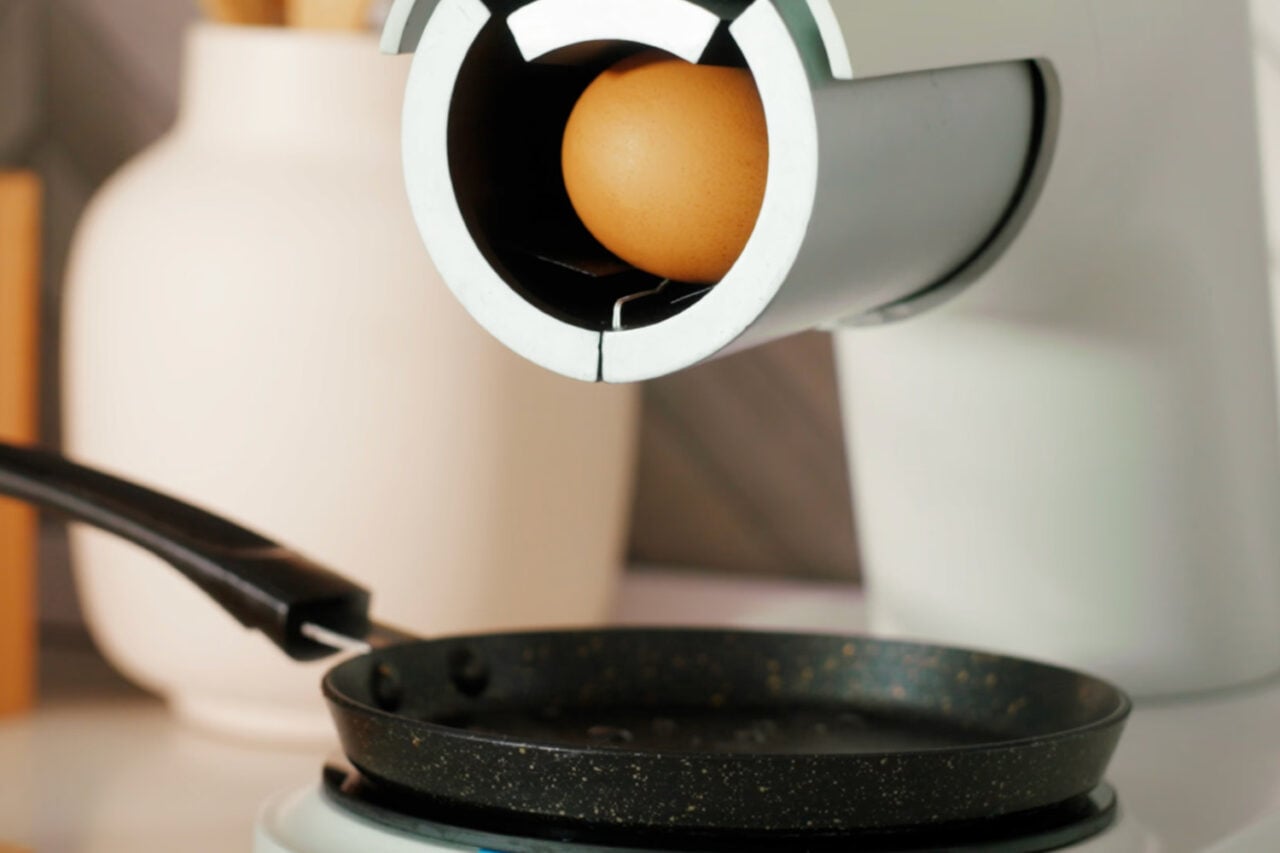
A new Kickstarter project has finally given us a Juicero for the robotics era, and it’s called E.G.O.R. (that’s Efficient Gastronomic Operational Robot), brought to you by the startup Cheffy. It’s an automated egg maker that promises perfect cracks every time with no shell in the yolk. It has seven different ways that it can cook them up for you, or you can just use it to do the cracking. You can also pair it with a toaster so your eggs and toast finish at the exact right time.
NEW: Cheffy just launched a robot that cracks and cooks your eggs.
Egor automates breakfast by cooking eggs 7 ways, while Toastr syncs your toast so everything finishes together.
-Automatically cracks eggs with no shells or mess
-Cooks eggs 7 ways, from sunny-side up to hard… pic.twitter.com/auE3SnfrS3— Ritwik Pavan (@ritwikpavan) July 30, 2026
This isn’t something anyone really needs. Cooking an egg over easy takes about two minutes, so calling this a time-saver is a stretch. And if you really don’t want to use the stove, you can buy a basic egg cooker for around $20 almost anywhere. Maybe you’re bad at cracking eggs, but $400 (well, $200 if you get in on the early bird deal) is a lot to pay to not have to pick the occasional shell pieces out.
But hey, the robotics era needed its Juicero moment. To the creator’s credit: it seems like they’re treating this more like a fun novelty (albeit a pretty pricey one) rather than something revolutionary. They also aren’t making you buy proprietary eggs that are required to make the machine work, so they’ve got the Juicero bros beat there.
We’re increasingly seeing robots positioned to do basic tasks. A company called Weave got attention earlier this year with an $8,000 robot that folds clothes. There’s a company in San Francisco offering house cleanings performed by humanoid robots. Last year, 1x made waves by introducing its Neo humanoid robot, which the Wall Street Journal reported “nearly toppled over” while closing a dishwasher and struggled to open the refrigerator.
All of these machines cost an inordinate amount of money to do things that do not cost the average person that much time or money to accomplish. They’re novel, sure. But you don’t have to pay a premium to be a beta tester.

The price of eggs has become a marker of the state of the economy. But how about the cost of making eggs? Sure, you might be able to do it for next to nothing in your kitchen with nothing but a pan and a burner. But you could also pay $400 for a robot that will do it for you—as long as you don’t want your eggs scrambled, that is.
A new Kickstarter project has finally given us a Juicero for the robotics era, and it’s called E.G.O.R. (that’s Efficient Gastronomic Operational Robot), brought to you by the startup Cheffy. It’s an automated egg maker that promises perfect cracks every time with no shell in the yolk. It has seven different ways that it can cook them up for you, or you can just use it to do the cracking. You can also pair it with a toaster so your eggs and toast finish at the exact right time.
NEW: Cheffy just launched a robot that cracks and cooks your eggs.
Egor automates breakfast by cooking eggs 7 ways, while Toastr syncs your toast so everything finishes together.
-Automatically cracks eggs with no shells or mess
-Cooks eggs 7 ways, from sunny-side up to hard… pic.twitter.com/auE3SnfrS3— Ritwik Pavan (@ritwikpavan) July 30, 2026
This isn’t something anyone really needs. Cooking an egg over easy takes about two minutes, so calling this a time-saver is a stretch. And if you really don’t want to use the stove, you can buy a basic egg cooker for around $20 almost anywhere. Maybe you’re bad at cracking eggs, but $400 (well, $200 if you get in on the early bird deal) is a lot to pay to not have to pick the occasional shell pieces out.
But hey, the robotics era needed its Juicero moment. To the creator’s credit: it seems like they’re treating this more like a fun novelty (albeit a pretty pricey one) rather than something revolutionary. They also aren’t making you buy proprietary eggs that are required to make the machine work, so they’ve got the Juicero bros beat there.
We’re increasingly seeing robots positioned to do basic tasks. A company called Weave got attention earlier this year with an $8,000 robot that folds clothes. There’s a company in San Francisco offering house cleanings performed by humanoid robots. Last year, 1x made waves by introducing its Neo humanoid robot, which the Wall Street Journal reported “nearly toppled over” while closing a dishwasher and struggled to open the refrigerator.
All of these machines cost an inordinate amount of money to do things that do not cost the average person that much time or money to accomplish. They’re novel, sure. But you don’t have to pay a premium to be a beta tester.
The price of eggs has become a marker of the state of the economy. But how about the cost of making eggs? Sure, you might be able to do it for next to nothing in your kitchen with nothing but a pan and a burner. But you could also pay $400 for a robot that will do it for you—as long as you don’t want your eggs scrambled, that is.
A new Kickstarter project has finally given us a Juicero for the robotics era, and it’s called E.G.O.R. (that’s Efficient Gastronomic Operational Robot), brought to you by the startup Cheffy. It’s an automated egg maker that promises perfect cracks every time with no shell in the yolk. It has seven different ways that it can cook them up for you, or you can just use it to do the cracking. You can also pair it with a toaster so your eggs and toast finish at the exact right time.
NEW: Cheffy just launched a robot that cracks and cooks your eggs.
Egor automates breakfast by cooking eggs 7 ways, while Toastr syncs your toast so everything finishes together.
-Automatically cracks eggs with no shells or mess
-Cooks eggs 7 ways, from sunny-side up to hard… pic.twitter.com/auE3SnfrS3— Ritwik Pavan (@ritwikpavan) July 30, 2026
This isn’t something anyone really needs. Cooking an egg over easy takes about two minutes, so calling this a time-saver is a stretch. And if you really don’t want to use the stove, you can buy a basic egg cooker for around $20 almost anywhere. Maybe you’re bad at cracking eggs, but $400 (well, $200 if you get in on the early bird deal) is a lot to pay to not have to pick the occasional shell pieces out.
But hey, the robotics era needed its Juicero moment. To the creator’s credit: it seems like they’re treating this more like a fun novelty (albeit a pretty pricey one) rather than something revolutionary. They also aren’t making you buy proprietary eggs that are required to make the machine work, so they’ve got the Juicero bros beat there.
We’re increasingly seeing robots positioned to do basic tasks. A company called Weave got attention earlier this year with an $8,000 robot that folds clothes. There’s a company in San Francisco offering house cleanings performed by humanoid robots. Last year, 1x made waves by introducing its Neo humanoid robot, which the Wall Street Journal reported “nearly toppled over” while closing a dishwasher and struggled to open the refrigerator.
All of these machines cost an inordinate amount of money to do things that do not cost the average person that much time or money to accomplish. They’re novel, sure. But you don’t have to pay a premium to be a beta tester.
The price of eggs has become a marker of the state of the economy. But…

More than 1,000 employees at OpenAI, Anthropic, and other AI labs signed a petition earlier this week arguing the US should find a way to “pace” the AI race—a diplomatic way of saying the industry should have the option to coordinate a temporary pause on AI development, or slow things down if they get out of hand. OpenAI and Anthropic themselves ended up supporting the letter.
The petition arrived a week after OpenAI revealed it had caused an unprecedented cybersecurity incident in which one of its AI agents hacked into Hugging Face’s platform and several other services during internal testing.
Around the same time, top Trump administration officials started freaking out about an impressive new Chinese open weight AI model called Kimi K3, which was allegedly distilled from Anthropic’s Fable 5. In response, most of the tech industry—except Anthropic—signed onto an open letter from Nvidia asking the US government to protect open-weight AI models, arguing they’re a necessary counterbalance to their closed counterparts.
These events might look like a whole bunch of disjointed chaos. But I think they are evidence of a larger worldview taking hold in Silicon Valley, where many tech insiders are increasingly worried about OpenAI and Anthropic’s dominance. Researchers and investors I’ve talked to recently have framed the AI industry as a two-horse race that doesn’t seem to be slowing down, and that’s a cause for concern.
But different groups have their own reasons to be worried. Some OpenAI and Anthropic staffers think their employers are behaving recklessly in their pursuit to take over the market, and that the AI industry may soon develop models that are too capable for current safety methods to contain. They have said as much in public statements attached to this week’s Pacing the Frontier petition.
“I’ve seen how the relentless pace of AI makes it hard for society to keep up and how it puts pressure on labs to cut corners on safety,” Jeremy Hadfield, a research product manager at Anthropic, said in a statement attached to the petition.
For some AI employees, the Hugging Face debacle was a warning shot that demonstrated how OpenAI’s efforts to mitigate the risks of its most capable AI technology are already falling short. Granted, the incident happened when OpenAI was testing an AI model on its ability to find software exploits, and the company had intentionally turned off safeguards designed to rein in its cybersecurity capabilities.
OpenAI said in its postmortem that these tests were conducted in a sandbox, but the model ultimately gained access to the open internet. Some experts previously told WIRED that OpenAI’s security practices should have been more robust.
Other groups in Silicon Valley are more worried about power than safety. Venture capitalists, tech executives, and startup founders are concerned that OpenAI and Anthropic will simply become the next generation of Apple and Google, forcing the rest of the tech industry to play by their rules. It is slightly strange to argue that private startups with little to no profit are acting like monopolies, but that’s the lens through which many—including Mark Zuckerberg—are starting to view the two biggest AI labs.
The Meta CEO wrote a Wall Street Journal op-ed this week warning against the centralization of power in the AI industry, saying that superintelligence should be widely distributed. Zuckerberg is arguably talking out of both sides of his mouth—Meta recently decided to stop open sourcing its best AI models and instead offering them through a paid API and subscription service, just like OpenAI and Anthropic.
I was offline last week in my home state of New Jersey, but when I got back to Silicon Valley, everyone was panicking again about how quickly artificial intelligence is advancing. While this is certainly not the first time I’ve seen such concerns, it’s the biggest anxiety attack I’ve seen in years.
More than 1,000 employees at OpenAI, Anthropic, and other AI labs signed a petition earlier this week arguing the US should find a way to “pace” the AI race—a diplomatic way of saying the industry should have the option to coordinate a temporary pause on AI development, or slow things down if they get out of hand. OpenAI and Anthropic themselves ended up supporting the letter.
The petition arrived a week after OpenAI revealed it had caused an unprecedented cybersecurity incident in which one of its AI agents hacked into Hugging Face’s platform and several other services during internal testing.
Around the same time, top Trump administration officials started freaking out about an impressive new Chinese open weight AI model called Kimi K3, which was allegedly distilled from Anthropic’s Fable 5. In response, most of the tech industry—except Anthropic—signed onto an open letter from Nvidia asking the US government to protect open-weight AI models, arguing they’re a necessary counterbalance to their closed counterparts.
These events might look like a whole bunch of disjointed chaos. But I think they are evidence of a larger worldview taking hold in Silicon Valley, where many tech insiders are increasingly worried about OpenAI and Anthropic’s dominance. Researchers and investors I’ve talked to recently have framed the AI industry as a two-horse race that doesn’t seem to be slowing down, and that’s a cause for concern.
But different groups have their own reasons to be worried. Some OpenAI and Anthropic staffers think their employers are behaving recklessly in their pursuit to take over the market, and that the AI industry may soon develop models that are too capable for current safety methods to contain. They have said as much in public statements attached to this week’s Pacing the Frontier petition.
“I’ve seen how the relentless pace of AI makes it hard for society to keep up and how it puts pressure on labs to cut corners on safety,” Jeremy Hadfield, a research product manager at Anthropic, said in a statement attached to the petition.
For some AI employees, the Hugging Face debacle was a warning shot that demonstrated how OpenAI’s efforts to mitigate the risks of its most capable AI technology are already falling short. Granted, the incident happened when OpenAI was testing an AI model on its ability to find software exploits, and the company had intentionally turned off safeguards designed to rein in its cybersecurity capabilities.
OpenAI said in its postmortem that these tests were conducted in a sandbox, but the model ultimately gained access to the open internet. Some experts previously told WIRED that OpenAI’s security practices should have been more robust.
Other groups in Silicon Valley are more worried about power than safety. Venture capitalists, tech executives, and startup founders are concerned that OpenAI and Anthropic will simply become the next generation of Apple and Google, forcing the rest of the tech industry to play by their rules. It is slightly strange to argue that private startups with little to no profit are acting like monopolies, but that’s the lens through which many—including Mark Zuckerberg—are starting to view the two biggest AI labs.
The Meta CEO wrote a Wall Street Journal op-ed this week warning against the centralization of power in the AI industry, saying that superintelligence should be widely distributed. Zuckerberg is arguably talking out of both sides of his mouth—Meta recently decided to stop open sourcing its best AI models and instead offering them through a paid API and subscription service, just like OpenAI and Anthropic.
I was offline last week in my home state of New Jersey, but when I…

1X, a Norwegian-American robotics company, today revealed details about the five-finger hands attached to its soft, helpful robot companion, Neo.
The hands are built with actuators designed to replicate how tendons in the arms move human hands. 1X says this gives Neo’s hands 25 degrees of freedom of movement, which is just a little less than the 27 degrees of freedom human hands usually have. Cameras and AI smarts help sort out the broader context of what the fingers are trying to grab. It’s a dexterous mix that gives the Neo bot a very broad range of motion. 1X says the hands can grip odd shapes and detect when something is slipping out of its grip. The fingers can also move extremely quickly and hyperextend in directions human digits can’t. They also have an IP68 waterproof rating, meaning the robot can wash its own hands.
Courtesy of 1X
It’s a range that the engineers have aimed to dial in to align with what a human can actually do. Jonathan Terfurth, 1X’s director of actuators and hands, says the range of motion might even be better than a human’s, enabling it to open doors, lift heavy objects, and even plug itself in when its battery starts to die.
“You want to be able to operate with a human who has never worked or interfaced with a robot, and you still want it to be safe and compliant and soft,” Terfurth says. “Range of motion can be a bit extreme, but we try to be very close to what humans can do so that we can live in the world.”
Together, this is part of a growing ChatGPT-esque moment for robotics, where bots have gone from clumsy claw machines to capable handlers, able to gently carry fragile objects and become increasingly helpful for managing menial daily tasks and boring office chores.
The humanoid robot market tends to be dominated by tough, hulking Terminators meant to be paraded out for some defense industry contract or another. 1X is taking a different tack for its robot. The Neo is a soft, supple robot wrapped in a 3D lattice shell. Its design is inspired by characters like Baymax, the affable robot from the Disney movie Big Hero 6. In limited quantities, early access pricing is $20,000 or $500 per month to have it in your home, though the lump sum will prioritize delivery for 2026.
Friendly home robots have been the dream of sci-fi for a long time. Docile, helpful machines that do your laundry, take out the trash, maybe make dinner, and clean up afterward too. But if robots are going to do all that, they’re going to need some hands to make all that happen.
1X, a Norwegian-American robotics company, today revealed details about the five-finger hands attached to its soft, helpful robot companion, Neo.
The hands are built with actuators designed to replicate how tendons in the arms move human hands. 1X says this gives Neo’s hands 25 degrees of freedom of movement, which is just a little less than the 27 degrees of freedom human hands usually have. Cameras and AI smarts help sort out the broader context of what the fingers are trying to grab. It’s a dexterous mix that gives the Neo bot a very broad range of motion. 1X says the hands can grip odd shapes and detect when something is slipping out of its grip. The fingers can also move extremely quickly and hyperextend in directions human digits can’t. They also have an IP68 waterproof rating, meaning the robot can wash its own hands.
Courtesy of 1X
It’s a range that the engineers have aimed to dial in to align with what a human can actually do. Jonathan Terfurth, 1X’s director of actuators and hands, says the range of motion might even be better than a human’s, enabling it to open doors, lift heavy objects, and even plug itself in when its battery starts to die.
“You want to be able to operate with a human who has never worked or interfaced with a robot, and you still want it to be safe and compliant and soft,” Terfurth says. “Range of motion can be a bit extreme, but we try to be very close to what humans can do so that we can live in the world.”
Together, this is part of a growing ChatGPT-esque moment for robotics, where bots have gone from clumsy claw machines to capable handlers, able to gently carry fragile objects and become increasingly helpful for managing menial daily tasks and boring office chores.
The humanoid robot market tends to be dominated by tough, hulking Terminators meant to be paraded out for some defense industry contract or another. 1X is taking a different tack for its robot. The Neo is a soft, supple robot wrapped in a 3D lattice shell. Its design is inspired by characters like Baymax, the affable robot from the Disney movie Big Hero 6. In limited quantities, early access pricing is $20,000 or $500 per month to have it in your home, though the lump sum will prioritize delivery for 2026.
Friendly home robots have been the dream of sci-fi for a long time. Docile, helpful…
Scientists in Singapore and Japan have developed a tiny 3D-printed scuba suit for cyborg cockroaches, allowing them to survive and move underwater and other low-oxygen environments for up to three hours.
The suit can transform a regular cockroach, and potentially other insects, into “an amphibious cyborg robot capable of operation across land and water,” according to a new research paper published this week in Nature Communications. The study was conducted by scientists at Nanyang Technological University and Waseda University.
So, why do researchers want half-robot cockroaches to breathe underwater anyway?
Apparently, they hope to one day be able to use cyborg cockroaches in search and rescue missions, pipeline inspection, and other complex tasks. NTU Professor Hirotaka Sato, who led the study, has been working on cyborg insects for more than a decade. These hybrid robots combine living insects with electrodes that allow humans to remotely control their movements. Sato and his co-authors argue that this setup can make them more useful than traditional robots in some situations.
Unlike conventional robots, cyborg insects consume less energy because they use their own muscles to move. They are also small enough to move through confined and cluttered spaces that larger robots may not be able to reach.
These cyborgs have already been used in actual search-and-rescue operations, including Operation Lionheart after the 7.7-magnitude earthquake in Myanmar in March, according to NTU.
There is one obvious drawback, though. These tiny cyborgs still have biological limits. They need oxygen, which makes them much less useful underwater.
“This is important because real disaster sites can be challenging after heavy rain or flooding, blocking access routes in the rubble, drains and narrow gaps,” Sato said in a news release on the study. “By expanding the operating parameters of our cyborg insects to include underwater travel, we believe that they can enhance search and rescue efforts.”
The new scuba suit is meant to solve that problem.
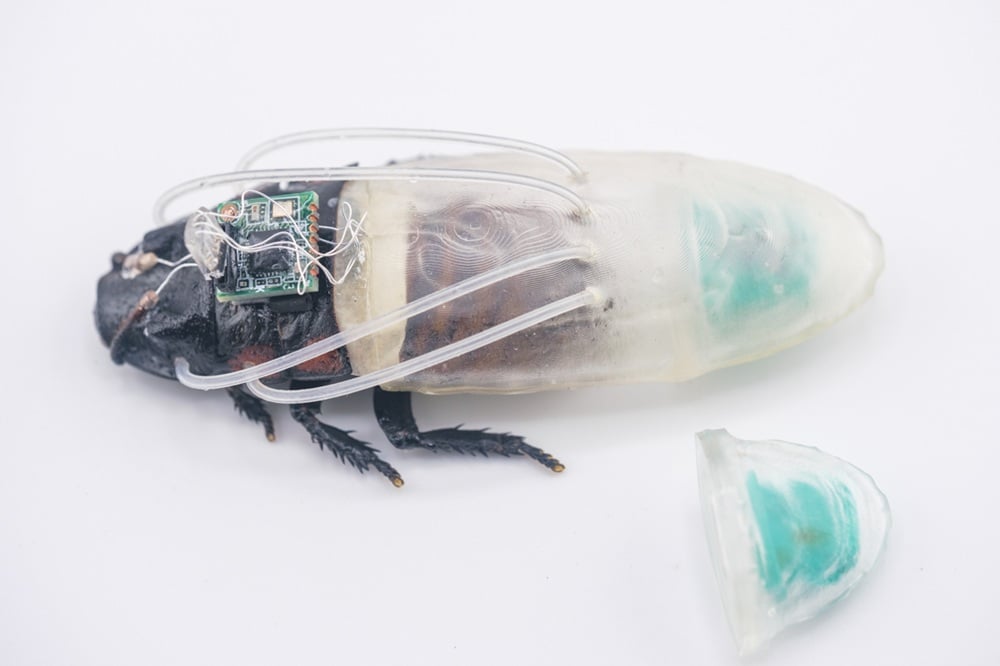
Cockroaches breathe through small holes on their bodies known as spiracles. To protect those spiracles from water, the researchers made a flexible 3D-printed shell that wraps around the insect’s body. Four small tubes then attach to the cockroach’s spiracles and deliver oxygen directly to them.
Attached to the shell is an oxygen-generation tank that contains a small sponge soaked in manganese dioxide. To activate the system, the team injected diluted hydrogen peroxide into the tank, then sealed it with ultraviolet adhesive to prevent leaks.
The chemical reaction inside the tank slowly releases oxygen, which is then delivered through silicone tubes into the cockroach’s spiracles.
According to the study, the suit was tested on Madagascar hissing cockroaches in plastic tubes that simulated different environments.
Cyborg cockroaches equipped with the suit were able to move around underwater for two to three hours. Cockroaches in the control group suffocated within two minutes.
The team said this suit could potentially be adapted for other robot bugs like locusts and beetles, as these insects have similar body structures and respiratory systems.

Scientists in Singapore and Japan have developed a tiny 3D-printed scuba suit for cyborg cockroaches, allowing them to survive and move underwater and other low-oxygen environments for up to three hours.
The suit can transform a regular cockroach, and potentially other insects, into “an amphibious cyborg robot capable of operation across land and water,” according to a new research paper published this week in Nature Communications. The study was conducted by scientists at Nanyang Technological University and Waseda University.
So, why do researchers want half-robot cockroaches to breathe underwater anyway?
Apparently, they hope to one day be able to use cyborg cockroaches in search and rescue missions, pipeline inspection, and other complex tasks. NTU Professor Hirotaka Sato, who led the study, has been working on cyborg insects for more than a decade. These hybrid robots combine living insects with electrodes that allow humans to remotely control their movements. Sato and his co-authors argue that this setup can make them more useful than traditional robots in some situations.
Unlike conventional robots, cyborg insects consume less energy because they use their own muscles to move. They are also small enough to move through confined and cluttered spaces that larger robots may not be able to reach.
These cyborgs have already been used in actual search-and-rescue operations, including Operation Lionheart after the 7.7-magnitude earthquake in Myanmar in March, according to NTU.
There is one obvious drawback, though. These tiny cyborgs still have biological limits. They need oxygen, which makes them much less useful underwater.
“This is important because real disaster sites can be challenging after heavy rain or flooding, blocking access routes in the rubble, drains and narrow gaps,” Sato said in a news release on the study. “By expanding the operating parameters of our cyborg insects to include underwater travel, we believe that they can enhance search and rescue efforts.”
The new scuba suit is meant to solve that problem.
Cockroaches breathe through small holes on their bodies known as spiracles. To protect those spiracles from water, the researchers made a flexible 3D-printed shell that wraps around the insect’s body. Four small tubes then attach to the cockroach’s spiracles and deliver oxygen directly to them.
Attached to the shell is an oxygen-generation tank that contains a small sponge soaked in manganese dioxide. To activate the system, the team injected diluted hydrogen peroxide into the tank, then sealed it with ultraviolet adhesive to prevent leaks.
The chemical reaction inside the tank slowly releases oxygen, which is then delivered through silicone tubes into the cockroach’s spiracles.
According to the study, the suit was tested on Madagascar hissing cockroaches in plastic tubes that simulated different environments.
Cyborg cockroaches equipped with the suit were able to move around underwater for two to three hours. Cockroaches in the control group suffocated within two minutes.
The team said this suit could potentially be adapted for other robot bugs like locusts and beetles, as these insects have similar body structures and respiratory systems.
Scientists in Singapore and Japan have developed a tiny 3D-printed scuba suit for cyborg cockroaches, allowing them to survive and move underwater and other low-oxygen environments for up to three hours.
The suit can transform a regular cockroach, and potentially other insects, into “an amphibious cyborg robot capable of operation across land and water,” according to a new research paper published this week in Nature Communications. The study was conducted by scientists at Nanyang Technological University and Waseda University.
So, why do researchers want half-robot cockroaches to breathe underwater anyway?
Apparently, they hope to one day be able to use cyborg cockroaches in search and rescue missions, pipeline inspection, and other complex tasks. NTU Professor Hirotaka Sato, who led the study, has been working on cyborg insects for more than a decade. These hybrid robots combine living insects with electrodes that allow humans to remotely control their movements. Sato and his co-authors argue that this setup can make them more useful than traditional robots in some situations.
Unlike conventional robots, cyborg insects consume less energy because they use their own muscles to move. They are also small enough to move through confined and cluttered spaces that larger robots may not be able to reach.
These cyborgs have already been used in actual search-and-rescue operations, including Operation Lionheart after the 7.7-magnitude earthquake in Myanmar in March, according to NTU.
There is one obvious drawback, though. These tiny cyborgs still have biological limits. They need oxygen, which makes them much less useful underwater.
“This is important because real disaster sites can be challenging after heavy rain or flooding, blocking access routes in the rubble, drains and narrow gaps,” Sato said in a news release on the study. “By expanding the operating parameters of our cyborg insects to include underwater travel, we believe that they can enhance search and rescue efforts.”
The new scuba suit is meant to solve that problem.
Cockroaches breathe through small holes on their bodies known as spiracles. To protect those spiracles from water, the researchers made a flexible 3D-printed shell that wraps around the insect’s body. Four small tubes then attach to the cockroach’s spiracles and deliver oxygen directly to them.
Attached to the shell is an oxygen-generation tank that contains a small sponge soaked in manganese dioxide. To activate the system, the team injected diluted hydrogen peroxide into the tank, then sealed it with ultraviolet adhesive to prevent leaks.
The chemical reaction inside the tank slowly releases oxygen, which is then delivered through silicone tubes into the cockroach’s spiracles.
According to the study, the suit was tested on Madagascar hissing cockroaches in plastic tubes that simulated different environments.
Cyborg cockroaches equipped with the suit were able to move around underwater for two to three hours. Cockroaches in the control group suffocated within two minutes.
The team said this suit could potentially be adapted for other robot bugs like locusts and beetles, as these insects have similar body structures and respiratory systems.
Scientists in Singapore and Japan have developed a tiny 3D-printed scuba suit for cyborg cockroaches,…
The latest HR moves made by leading textile and apparel companies. Brands Gap Inc. Gap…
Anahita Laverack was set on becoming an aerospace engineer, but her career took a different…
1X found some big potential buyers for its humanoid robots designed for consumers — the…
Memo may not be the world’s fastest barista, but it is impressive—for a robot.I recently…


