
For more than 25 years, one suit has quietly rewritten the rules of modern tailoring. The Thom Browne suit isn’t simply another option for a black-tie affair. Introduced in the early 2000s, its shrunken gray silhouette challenged the conventions of professional menswear, and, in doing so, reshaped what it means to “dress well” in the modern era. Today, as dress codes dissolve and personal style eclipses rigid prescriptions, Browne’s vision feels not nostalgic, but urgent.
Unlike traditional luxury tailoring, the Thom Browne suit prioritizes individuality over conformity. It asks men to consider not just what they wear, but how the garment frames the body. Cropped trousers, narrow shoulders, and high armholes create a silhouette that is unmistakable, yet adaptable enough to evolve alongside contemporary tastes.
The Suit That Disrupted American Masculinity
Shop here
Few garments leave a permanent imprint on fashion history. The Thom Browne suit is one of them. Its signature 3-roll-2 jacket barely reaches the hip, while slim, cropped trousers reveal a precise flash of ankle above classic brogues. On paper, the design references mid-century corporate attire. In practice, it subverts it through exacting proportions.
When Thom Browne first introduced the shrunken gray suit, critics were divided. Was it satire? A playful jab at Wall Street uniformity? Or was it a serious attempt to redefine masculinity through tailoring? The answer, of course, was both. The silhouette reframed masculinity on Browne’s own terms, structured yet vulnerable, disciplined yet expressive. Even decades later, that disruption still resonates.
Why Precision Tailoring Feels Radical Again
Fast forward to 2026, and style has grown increasingly informal. Hoodies, sneakers, and oversized silhouettes dominate both streetwear and corporate wardrobes. Against this relaxed backdrop, the Thom Browne suit stands apart, not because it is loud, but because it demands intention. The narrow shoulders, slim lapels, and cropped trousers subtly elongate the body and sharpen posture. The message is quiet but unmistakable: structure still matters.
Browne’s Classic Fit iterations soften the original proportions for everyday wear, yet retain the brand’s signature details, tricolor grosgrain trim, double vents, cuffed trousers, and clean, architectural lines that define the shoulders and waist. In an era where comfort often supersedes form, the Thom Browne suit reminds us that deliberate tailoring communicates power, precision, and confidence without excess.
From Locker Room to Front Row: The Athlete Effect

The cultural reach of a Thom Browne suit extends well beyond traditional fashion circles. Athletes, including LeBron James and Lionel Messi, have famously embraced Browne’s tailoring for team arrivals and public appearances. The Cleveland Cavaliers wore Thom Browne suits en masse during the 2016 NBA playoffs, while FC Barcelona adopted the tailoring as part of their off-field uniform. More recently, Stefon Diggs and DeAndre Hopkins have also stepped out in Browne’s sharply defined silhouettes.
This crossover reframed the suit as more than formal attire. It became a uniform of identity, performance, and branding. By bridging athleticism and elegance, Browne blurred cultural boundaries. The suit evolved from corporate necessity to aspirational armor.
Built Like Armor: Craftsmanship as Power
Long before the brand’s acquisition by the Zegna Group in 2018, Browne sourced fabrics from Italy’s most revered mills. That commitment to material integrity remains central to the suit’s appeal. Notch lapels, chest and flap pockets, double vents, and buttoned cuffs with signature tricolor detailing converge with sharply creased, cuffed trousers to create something close to wearable architecture. Many trousers arrive with unfinished hems, encouraging personal tailoring, a reminder that the final silhouette belongs to the wearer.
In this sense, the Thom Browne suit exists in duality. It is conceptual art, yet entirely functional. It is disciplined, yet expressive. And in a market saturated with mass-produced suiting, that level of craftsmanship feels quietly rebellious.
Still Provocative. Still Necessary.
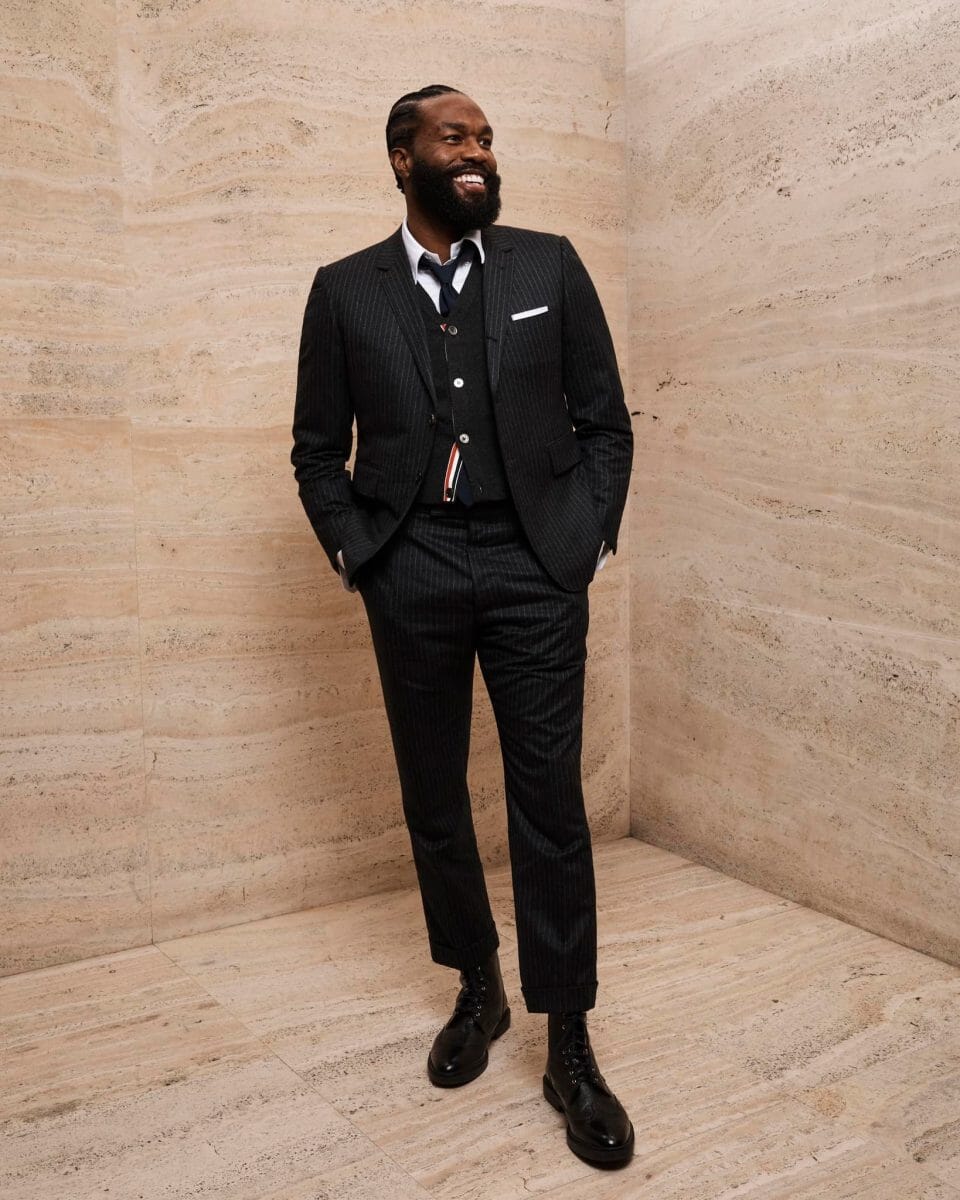
After a quarter-century, the Thom Browne suit remains radical, not through exaggeration, but through restraint. Its shrunken silhouette and disciplined proportions continue to contrast sharply with oversized trends. In a digital-first, fast-fashion era, a precisely tailored suit communicates intentionality instantly. That is precisely why it endures.
Browne’s tailoring is ultimately about presence. It challenges men to consider how clothing shapes posture, identity, and perception. Whether worn in boardrooms, on red carpets, or at off-duty events, the suit makes a clear declaration: elegance is personal, not generic.
The End of the Generic Suit
Ultimately, the Thom Browne suit transcends seasonal trends. It merges history with modernity, sports influence with sartorial rigor, and conceptual design with everyday wearability. More importantly, it reminds men that a suit need not function as a uniform. It can serve as an expression of identity, authority, and creativity.
In 2026, that philosophy feels more relevant than ever. As clothing increasingly becomes a tool of self-definition, the Thom Browne suit proves that structure, proportion, and deliberate design remain timeless forces in the modern wardrobe.
Not outdated. Not nostalgic. Enduring.
Featured image: Tyrell Hampton for Thom Browne
—Read Also
Source link
#Thom #Browne #Suit #Years #Tailoring #Disruption


Post Comment