
 Getty Images
The US justice department has asked a judge to unseal material related to sex offender Jeffrey Epstein, following intense criticism of the Trump administration’s handling of the case.
The request concerns transcripts from the grand jury involved in the government’s 2019 sex trafficking case against Epstein, materials that are typically kept secret and protected by law.
The court filing came as Trump filed a lawsuit against the Wall Street Journal’s parent company, its owner Rupert Murdoch and two reporters, over a story claiming he wrote a “bawdy” personal note to Epstein in 2003.
Trump said the note, which the paper reported he’d sent for Epstein’s 50th birthday, is “fake”.
On Thursday, he ordered Attorney General Pam Bondi to seek the release of documents related to Epstein’s secretive grand jury testimony.
The justice department formally made the request to a judge in New York, arguing the materials related to the case – where he was charged with trafficking dozens of girls as young as 14 – “qualify as a matter of public interest”.
The department is also asking for disclosures in the case of his associate Ghislaine Maxwell, who was convicted in the child sex trafficking conspiracy.
A grand jury – a panel of people who vet whether there is enough evidence to charge a person with a crime – can hear from confidential informants and those whose identities are protected for their safety. Materials in a grand jury are typically kept secret under the law, but a judge can unseal documents if they decide public interest outweighs the need for such legal protections in a case.
Either way, it’s unclear when or if documents will be released, or if they contain many of the details Trump’s supporters have been demanding.
Also on Friday, Trump filed a $10bn (£7.5bn) lawsuit in Miami against Dow Jones, News Corp and conservative media tycoon Rupert Murdoch.
He claims the Wall Street Journal slandered him and violated libel laws in an article alleging that a “bawdy” birthday greeting bearing Trump’s name was sent to Epstein in 2003, before the late financier was charged with sex crimes.
“We have just filed a powerhouse Lawsuit against everyone involved in publishing the false, malicious, defamatory, fake news ‘article’ in the useless ‘rag’ that is, The Wall Street Journal,” Trump said on social media.
“I hope Rupert and his ‘friends’ are looking forward to the many hours of depositions and testimonies they will have to provide in this case,” he added.
He said the newspaper and Murdoch – with whom Trump has had an up-and-down relationship for decades – were warned they would be sued if they printed the article.
Murdoch, who was seen on Sunday attending the Fifa World Cup with Trump, founded a media empire which is credited by some with helping propel the president to the White House.

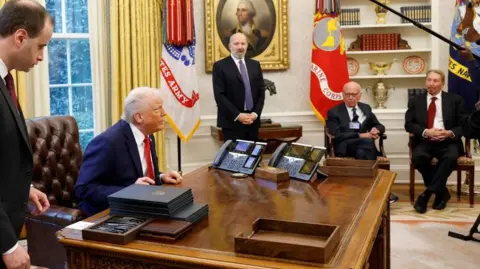 Getty Images
According to the Journal, a letter bearing Trump’s name “contained several lines of typewritten text framed by the outline of a naked woman, which appears to be hand-drawn with a heavy marker”.
“Inside the outline of the naked woman was a typewritten note styled as an imaginary conversation between Trump and Epstein, written in the third person,” the paper reported.
It reportedly contains a joking reference that “Enigmas never age” and allegedly ends with the words: “A pal is a wonderful thing. Happy Birthday – and may every day be another wonderful secret.”
Trump denied writing the note after the article was published on Thursday, posting: “These are not my words, not the way I talk. Also, I don’t draw pictures.”
The developments on Friday came amid a turbulent week for the president as some of his most loyal supporters demanded more transparency and public disclosure in the Epstein case.
Some Trump loyalists have even called for Attorney General Bondi to resign after she reversed course on releasing certain documents related to Epstein.
Chad Bianco, a Republican sheriff running for California governor, told BBC News that Trump’s handling of the Epstein files was “not what I was expecting” and that “millions” of his followers are disappointed.
“We feel like we’re being talked down to like stupid children.”
Meanwhile, members of Congress are pushing to pass a “discharge petition” that would force Bondi to release a broad range of materials that the justice department has related to Epstein.
The effort has brought together some of Congress’s fiercest opponents, including Republican Marjorie Taylor Greene and Democrat Alexandria Ocasio-Cortez who are both signed on as supporters.
Source link
#Trump #admin #asks #court #release #Jeffrey #Epstein #grand #jury #docs


![Displaced in Lebanon: ‘Lives turned upside down’Fatme A. is trying to maintain some semblance of a normal life in between the improvised tent shelters, stacked mattresses and all the other families sheltered close by.
She is staying in the Azarieh buildings, in the middle of Beirut’s commercial center — the buildings have become a shelter for hundreds of displaced Lebanese. Around 250 families are living here in makeshift tents. There’s water, a communal kitchen and goods distributed by aid organizations. But there’s not much space, let alone peace or privacy.
In early March, Fatme (right) and her family left their home in the Beirut suburbs under attack by IsraelImage: privat
Fatme spends most of her time inside her tent. She isn’t even that keen to go to the bathroom here. “You have to queue and everybody looks at you,” she confides. “I get embarrassed.”
That’s why she sits inside her cloth shelter, amid bags, blankets and the small number of personal belongings she was able to carry with her when she was forced to flee home.
She lives here together with her husband, their 7-year-old daughter and her mother, sharing what little space they have. Her husband, a carpenter, has been helping others in the building. He repairs, builds and organizes. “Because he is able to help, we managed to get two tents,” Fatme explains.
During the day she tries to carry on as usual. But the nights are more difficult. “The explosions are so loud,” she tells DW. “A lot of people here are afraid and sleep fully dressed.”
Conflict expanding in Lebanon
The Iran war arrived in Beirut some time ago, and lately it has moved from beyond what are recognized as conflict zones to other parts of the Lebanese capital.
Israel has expanded its targeting and has also started hitting areas that are beyond what are known as neighborhoods that support the Lebanese group, Hezbollah — that includes central city areas. Sometimes the Israeli attacks come without any warning.
Hezbollah has both a military and political wing, plays a major role in Lebanese society and politics and is opposed to Israel. The group, which is allied with Iran, is categorized as a terrorist organization by the US, Germany and a number of Sunni Muslim countries. Europe considers Hezbollah’s armed wing a terrorist organization.
At the same time that Israel is attacking from the air, Israeli Defense Minister Israel Katz has also said a buffer zone will be set up inside southern Lebanon and that Israel will keep security control over it even when the Iran war ends.
Katz has said the area to be occupied by Israeli forces would go right up to the Litani River, about 30 kilometers (around 18 miles) from the Lebanese border with Israel. Katz also said all houses in Lebanese villages near the Israeli border would be destroyed.
In response, Lebanese Defense Minister Michel Menassa said Katz’s remarks showed Israel’s “clear intention to impose a new occupation of Lebanese territory, forcibly displace hundreds of thousands of citizens, and systematically destroy villages and towns in the south.”
A joint statement signed by the foreign ministers of 10 European countries, alongside the European Union’s top diplomat Kaja Kallas, urged Israel to respect Lebanon’s territorial integrity.
‘Nowhere is safe’
But for Lebanese locals impacted by the Israeli invasion, those words bring no comfort. They feel there is nowhere safe for them at the moment.
“We fled [our homes] but we know that there’s nowhere that’s really safe. But there’s nothing more we can do,” Fatme explains.
Only a few weeks ago, Fatme and her family were living at home in Ouzai in the south of the city. It’s a dense, mixed-use neighborhood that belongs to the part of Beirut known as Dahiyeh.
‘Nowhere feels safe’: Beirut hit by ongoing Israeli strikesTo view this video please enable JavaScript, and consider upgrading to a web browser that supports HTML5 video
Dahiyeh — in Arabic, the word simply means “suburb” — is an area that is almost as big as central Beirut itself. Over the past few decades, Dahiyeh has grown thanks to migration and displacement. A lot of people have moved here simply because they couldn’t afford to live in other parts of the increasingly expensive city. Others arrived thanks to war, political crises or a lack of state support elsewhere.
For some outsiders and for Western observers, Dahiyeh is often only seen as a Hezbollah stronghold, a political and military space. But for the people who actually live there it is also a totally normal, often bustling area, filled with shops, restaurants and supermarkets. And above all, it is their home.
“We had a normal family life there,” Fatme recounts. “My daughter went to school, my husband worked as a carpenter and I ran the house. Our life was good there.” The family felt secure and stable, she adds.
No real ceasefire
But in late February the US and Israel began attacking Iran and killed Iran’s supreme leader, Ayatollah Ali Khamenei.
Hezbollah is supported by Iran and had pledged allegiance to Khamenei. At the beginning of March, the group joined the war, explicitly linking their participation to Khamenei’s assassination. They began firing rockets and drones into neighboring Israel and Israel has responded with aerial sorties. Since then, violence and fighting in Lebanon has only escalated.
Fatme’s family managed to get two tents inside buddings in central BeirutImage: privat
After fighting started, Fatme’s family got in their car and left. They managed to return to their home twice and stayed there for two nights. But it was clear things were getting more dangerous.
“We were just afraid,” Fatme says, explaining that they decided to leave again, mostly for their daughter’s sake.
“It took me five years to get pregnant,” Fatme continues, saying she was worried about losing her only child. “And my daughter is still suffering from the war in 2024. She is often afraid and scared to go anywhere alone. Whenever there’s any loud noise, she covers her ears.”
Even after the official ceasefire between Israel and Hezbollah was arranged in November 2024, there was still violence with continuous Israeli attacks, explosions and ever more insecurity.
According to the United Nations Interim Force in Lebanon, or UNIFIL, and the Lebanese government itself, there were more than 15,400 ceasefire violations by Israeli forces, and more than 370 people killed by Israeli fire in Lebanon by February 2026 — that was despite the November ceasefire.
“The continuing Israeli attacks don’t just destroy houses and infrastructure; they erode the pillars of daily life and recovery,” Jeremy Ristord, head of programs in Lebanon for the group Doctors Without Borders, said in a statement in late February.
That was why Fatme’s daughter was still so scared. The explosions and frightening loud noises never stopped, nor did her fear. For Fatme’s family it was clear they had to leave. They packed only necessities. As they drove away, they still didn’t know where they were heading. They just left.
They ran into heavy traffic jams because other people in the area had had the same idea. At first the family slept in their car but then they managed to find some accommodation in the Azarieh buildings, which have been turned into accommodation for displaced locals.
“I really miss my own home,” Fatme says. “My life, my things, my routine. Just a month ago, everything looked so different. Our lives have been turned upside down.”
Even inside the buildings, Fatme’s daughter still gets scared at loud noises and cries a lot. When that happens, Fatme pulls her closer. “That’s when I forget my own fear and try to comfort her,” she says.
Uncertain future
It’s unlikely that things are going to get better any time soon. At a March 31 meeting of the United Nations Security Council, Tom Fletcher, the UN’s emergency relief coordinator, said 1,240 people had been killed and a further 3,500 injured in Lebanon. That number included women, children and first responders.
At the same time, over 1.1 million people have been displaced, including hundreds of thousands of children.
“A cycle of coercive displacement is unfolding,” Fletcher warned. “Displacement is not a solution, but a painful last resort […] a temporary way to preserve dignity.”
During these difficult days there are still moments when Fatme can see some hope for the future, for instance, as she watches the children here playing. When her daughter is among them, relaxed, laughing and without a care even for a few minutes, Fatme feels positive. “When I see her playing, that’s when I think everything will be OK.”
But that feeling often doesn’t last long. The sound of Israeli drones over Beirut, the explosions in the distance — they all bring her back to the present and a view of what is left of their once happy lives: a family, two tents, a makeshift life.
“We are not the first, and we won’t be the last family that has had to flee,” Fatme says. “We’ve just got to hold on. And I just want the people out there to know this: That we had it good here, and that we lived with dignity.”
This article was originally written in German.
Israel strikes Hezbollah sites in BeirutTo view this video please enable JavaScript, and consider upgrading to a web browser that supports HTML5 video
#Displaced #Lebanon #Lives #turned #upside](https://i2.wp.com/static.dw.com/image/76533511_6.jpg?ssl=1 "Displaced in Lebanon: ‘Lives turned upside down’Fatme A. is trying to maintain some semblance of a normal life in between the improvised tent shelters, stacked mattresses and all the other families sheltered close by.
She is staying in the Azarieh buildings, in the middle of Beirut’s commercial center — the buildings have become a shelter for hundreds of displaced Lebanese. Around 250 families are living here in makeshift tents. There’s water, a communal kitchen and goods distributed by aid organizations. But there’s not much space, let alone peace or privacy.
In early March, Fatme (right) and her family left their home in the Beirut suburbs under attack by IsraelImage: privat
Fatme spends most of her time inside her tent. She isn’t even that keen to go to the bathroom here. “You have to queue and everybody looks at you,” she confides. “I get embarrassed.”
That’s why she sits inside her cloth shelter, amid bags, blankets and the small number of personal belongings she was able to carry with her when she was forced to flee home.
She lives here together with her husband, their 7-year-old daughter and her mother, sharing what little space they have. Her husband, a carpenter, has been helping others in the building. He repairs, builds and organizes. “Because he is able to help, we managed to get two tents,” Fatme explains.
During the day she tries to carry on as usual. But the nights are more difficult. “The explosions are so loud,” she tells DW. “A lot of people here are afraid and sleep fully dressed.”
Conflict expanding in Lebanon
The Iran war arrived in Beirut some time ago, and lately it has moved from beyond what are recognized as conflict zones to other parts of the Lebanese capital.
Israel has expanded its targeting and has also started hitting areas that are beyond what are known as neighborhoods that support the Lebanese group, Hezbollah — that includes central city areas. Sometimes the Israeli attacks come without any warning.
Hezbollah has both a military and political wing, plays a major role in Lebanese society and politics and is opposed to Israel. The group, which is allied with Iran, is categorized as a terrorist organization by the US, Germany and a number of Sunni Muslim countries. Europe considers Hezbollah’s armed wing a terrorist organization.
At the same time that Israel is attacking from the air, Israeli Defense Minister Israel Katz has also said a buffer zone will be set up inside southern Lebanon and that Israel will keep security control over it even when the Iran war ends.
Katz has said the area to be occupied by Israeli forces would go right up to the Litani River, about 30 kilometers (around 18 miles) from the Lebanese border with Israel. Katz also said all houses in Lebanese villages near the Israeli border would be destroyed.
In response, Lebanese Defense Minister Michel Menassa said Katz’s remarks showed Israel’s “clear intention to impose a new occupation of Lebanese territory, forcibly displace hundreds of thousands of citizens, and systematically destroy villages and towns in the south.”
A joint statement signed by the foreign ministers of 10 European countries, alongside the European Union’s top diplomat Kaja Kallas, urged Israel to respect Lebanon’s territorial integrity.
‘Nowhere is safe’
But for Lebanese locals impacted by the Israeli invasion, those words bring no comfort. They feel there is nowhere safe for them at the moment.
“We fled [our homes] but we know that there’s nowhere that’s really safe. But there’s nothing more we can do,” Fatme explains.
Only a few weeks ago, Fatme and her family were living at home in Ouzai in the south of the city. It’s a dense, mixed-use neighborhood that belongs to the part of Beirut known as Dahiyeh.
‘Nowhere feels safe’: Beirut hit by ongoing Israeli strikesTo view this video please enable JavaScript, and consider upgrading to a web browser that supports HTML5 video
Dahiyeh — in Arabic, the word simply means “suburb” — is an area that is almost as big as central Beirut itself. Over the past few decades, Dahiyeh has grown thanks to migration and displacement. A lot of people have moved here simply because they couldn’t afford to live in other parts of the increasingly expensive city. Others arrived thanks to war, political crises or a lack of state support elsewhere.
For some outsiders and for Western observers, Dahiyeh is often only seen as a Hezbollah stronghold, a political and military space. But for the people who actually live there it is also a totally normal, often bustling area, filled with shops, restaurants and supermarkets. And above all, it is their home.
“We had a normal family life there,” Fatme recounts. “My daughter went to school, my husband worked as a carpenter and I ran the house. Our life was good there.” The family felt secure and stable, she adds.
No real ceasefire
But in late February the US and Israel began attacking Iran and killed Iran’s supreme leader, Ayatollah Ali Khamenei.
Hezbollah is supported by Iran and had pledged allegiance to Khamenei. At the beginning of March, the group joined the war, explicitly linking their participation to Khamenei’s assassination. They began firing rockets and drones into neighboring Israel and Israel has responded with aerial sorties. Since then, violence and fighting in Lebanon has only escalated.
Fatme’s family managed to get two tents inside buddings in central BeirutImage: privat
After fighting started, Fatme’s family got in their car and left. They managed to return to their home twice and stayed there for two nights. But it was clear things were getting more dangerous.
“We were just afraid,” Fatme says, explaining that they decided to leave again, mostly for their daughter’s sake.
“It took me five years to get pregnant,” Fatme continues, saying she was worried about losing her only child. “And my daughter is still suffering from the war in 2024. She is often afraid and scared to go anywhere alone. Whenever there’s any loud noise, she covers her ears.”
Even after the official ceasefire between Israel and Hezbollah was arranged in November 2024, there was still violence with continuous Israeli attacks, explosions and ever more insecurity.
According to the United Nations Interim Force in Lebanon, or UNIFIL, and the Lebanese government itself, there were more than 15,400 ceasefire violations by Israeli forces, and more than 370 people killed by Israeli fire in Lebanon by February 2026 — that was despite the November ceasefire.
“The continuing Israeli attacks don’t just destroy houses and infrastructure; they erode the pillars of daily life and recovery,” Jeremy Ristord, head of programs in Lebanon for the group Doctors Without Borders, said in a statement in late February.
That was why Fatme’s daughter was still so scared. The explosions and frightening loud noises never stopped, nor did her fear. For Fatme’s family it was clear they had to leave. They packed only necessities. As they drove away, they still didn’t know where they were heading. They just left.
They ran into heavy traffic jams because other people in the area had had the same idea. At first the family slept in their car but then they managed to find some accommodation in the Azarieh buildings, which have been turned into accommodation for displaced locals.
“I really miss my own home,” Fatme says. “My life, my things, my routine. Just a month ago, everything looked so different. Our lives have been turned upside down.”
Even inside the buildings, Fatme’s daughter still gets scared at loud noises and cries a lot. When that happens, Fatme pulls her closer. “That’s when I forget my own fear and try to comfort her,” she says.
Uncertain future
It’s unlikely that things are going to get better any time soon. At a March 31 meeting of the United Nations Security Council, Tom Fletcher, the UN’s emergency relief coordinator, said 1,240 people had been killed and a further 3,500 injured in Lebanon. That number included women, children and first responders.
At the same time, over 1.1 million people have been displaced, including hundreds of thousands of children.
“A cycle of coercive displacement is unfolding,” Fletcher warned. “Displacement is not a solution, but a painful last resort […] a temporary way to preserve dignity.”
During these difficult days there are still moments when Fatme can see some hope for the future, for instance, as she watches the children here playing. When her daughter is among them, relaxed, laughing and without a care even for a few minutes, Fatme feels positive. “When I see her playing, that’s when I think everything will be OK.”
But that feeling often doesn’t last long. The sound of Israeli drones over Beirut, the explosions in the distance — they all bring her back to the present and a view of what is left of their once happy lives: a family, two tents, a makeshift life.
“We are not the first, and we won’t be the last family that has had to flee,” Fatme says. “We’ve just got to hold on. And I just want the people out there to know this: That we had it good here, and that we lived with dignity.”
This article was originally written in German.
Israel strikes Hezbollah sites in BeirutTo view this video please enable JavaScript, and consider upgrading to a web browser that supports HTML5 video
#Displaced #Lebanon #Lives #turned #upside")
Post Comment