
The obsession with lashes is nothing new. From Cleopatra’s kohl-lined drama to Twiggy’s sixties spikes, eyes have long been a canvas for beauty innovation. But in today’s beauty cycle, lashes aren’t just accessories to mascara; they’re the main character. The explosion of extensions, lifts, tints, and clusters proves one thing: we’ve collectively agreed that framing the eyes is non-negotiable. Lashes have become an integral part of what can only be called aura farming (if you know, you know). And that’s where lash mapping comes in—the backstage secret that explains why some lash sets look sculpted and intentional while others simply look… long.
At first glance, a lash map feels hyper-technical, maybe even overly meticulous. Artists literally sketch on under-eye pads with tiny numbers and grids, like they’re charting constellations. Yet that’s exactly the point. The most “effortless” lashes filling our feeds are often the product of the most precise design plans. In an era where personalization is beauty’s ultimate currency—with custom foundation matches, cocktail skincare routines, and nail art as mini-storytelling—lash mapping has carved out its spotlight. Think of it as beauty’s version of precision engineering, and right now, it’s the quiet revolution everyone’s raving about.
What is lash mapping?
Think of lash mapping as creating a GPS route for your lash line. Instead of placing extensions at random until the eye looks “full enough,” lash artists design a map that divides the eyelid into zones. Each zone is assigned a specific lash length and curl type, like coordinates on a blueprint. The artistry lies in arranging those zones to enhance natural eye shapes while achieving defined styles—from cat-eye elongation to round, doll-like openness, or even staggered lengths for that “messy-but-perfect” effect. In short, a good lash map doesn’t just add length; it adds logic. It’s the difference between a set that flatters and one that overwhelms.
The process begins with careful evaluation. Artists study natural lashes, eye symmetry, and overall facial proportions before sketching guides on under-eye pads or directly on the skin with markers or adhesive strips. Each mark corresponds to a length, curl, or thickness, ensuring lashes build like puzzle pieces rather than a haphazard collage. This design-first approach guarantees that no two clients ever leave with the same set, even if they both request a “cat eye.” Your map is yours alone: an architectural plan that balances your features while amplifying your desired look.
What’s the hype about this beauty procedure?
Part of the lash map fascination is visual. Watching an artist sketch neat little lines across an eyelid has a strangely satisfying effect, almost ASMR in its precision, which explains why lash-mapping tutorials rack up millions of TikTok views. But beyond the content factor, lash mapping taps into something bigger: the modern appetite for customization. Just as lip liners are tailored to undertones and foundations come in 40+ shades, lashes now exist in seemingly infinite configurations. Clients don’t just want “extensions” anymore. They want an eye look that reflects mood boards, aesthetics, and micro-trends like “clean girl,” “coquette,” or “hyper-glam.” Lash mapping is what makes that level of precision possible.
Of course, not everyone is convinced. Critics argue that lash mapping is simply a rebranded version of what skilled artists have always done—a marketing-friendly label slapped onto standard customization. Others worry that strict mapping might stifle artistry, reducing creativity to a formula. Yet for most in the beauty community, mapping isn’t a cage but a canvas. A guide doesn’t kill creativity; it amplifies it. Just as painters begin with an outline before layering colors, lash artists use mapping to frame their vision.
And the results speak for themselves. Clients often report more balanced, eye-enhancing outcomes that last longer, thanks to mapping’s attention to lash health and weight distribution. By spacing lengths and curls strategically, artists reduce strain on natural lashes, minimizing premature fallouts. The payoff is instantly recognizable in photos, too. Lashes appear lifted, defined, and intentional rather than heavy or clumped. In other words, mapping doesn’t just elevate aesthetics—it elevates longevity.
Lash mapping and the culture
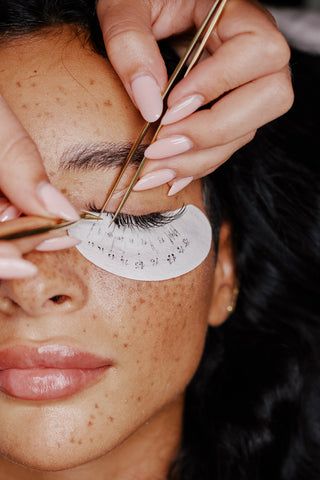
Beyond the technical, lash mapping captures the cultural moment we’re living in. Beauty today is all about detail—the micro-decisions that create macro impact. From underpainting techniques in makeup to “nail cocktails” on manicures, the scene thrives on precision layered with personality. Lash mapping fits neatly into this landscape, serving both as a technique and a content-ready spectacle. It also mirrors how beauty has become performative in the best way: the process is just as captivating as the final reveal. Watching an artist draw a lash map feels like witnessing an architect’s sketch before the skyscraper—the blueprint that makes the magic possible.
Shop editor’s finds
Conclusion
Lash mapping is more than a passing buzzword. It’s the invisible strategy behind the lashes you scroll past, save, and screenshot. Whether you see it as art, geometry, or savvy branding, one truth defines 2025: the most striking lashes aren’t improvised. They’re mapped with precision, designed with intent, and worn like architecture for the eyes.
Featured image: @kimmie_hoo/Instagram
For the latest in fashion, lifestyle, and culture, follow us on Instagram @StyleRave
—Read also

Source link
#Lash #Mapping #Beautys #Precision #Art


Post Comment