
Scroll long enough through George Lucas’ filmography, and you’ll discover “Radioland Murders,” a 1994 picture that he received executive producer, story, and second unit director credit on … at which point you may ask, “What the heck is ‘Radioland Murders’?” Well, believe it or not, this mostly forgotten ’90s crime comedy is an essential piece to the puzzle that is the “Star Wars” and “Indiana Jones” creator’s fascinating (and sometimes just confounding) pop art.
To understand where “Radioland Murders” came from, you have to rewind the clock back to the 1970s. As explained in a 30-year retrospective published on Lucasfilm’s website, the film was one of several that Lucas began developing following his 1973 breakout hit “American Graffiti” (a genuinely innovative movie that, never forget, Hollywood at large was convinced would bomb at the box office). And just as “Star Wars” and “Indiana Jones” were pastiches born from Lucas’ enduring affection for the cinematic sci-fi and adventure serials he grew up watching (with “American Graffiti” likewise being a wistful tribute to his days as a rambunctious teenager), “Radioland Murders” was inspired by his fondness for another aspect of his youth: radio shows.
Being the busy bee that he was, however, the younger Lucas could never find the time to make it. Instead, “Radioland Murders” gathered dust for decades until he handed the reins to English filmmaker and comedian Mel Smith, then hot off his well-liked 1989 rom-com “The Tall Guy.” Unfortunately, even appearances by the likes of Christopher Lloyd, Harvey Korman, Bobcat Goldthwait, and other comedic giants couldn’t get audiences interested in the film (as evidenced by its $1.3 million box office gross). And yet, “Radioland Murders” might be the Charles Guiteau of historically significant flops. (That’s a “Death by Lightning” joke, for those who’re feeling confused right now.)
Radioland Murders was more important to George Lucas’ career than you may realize
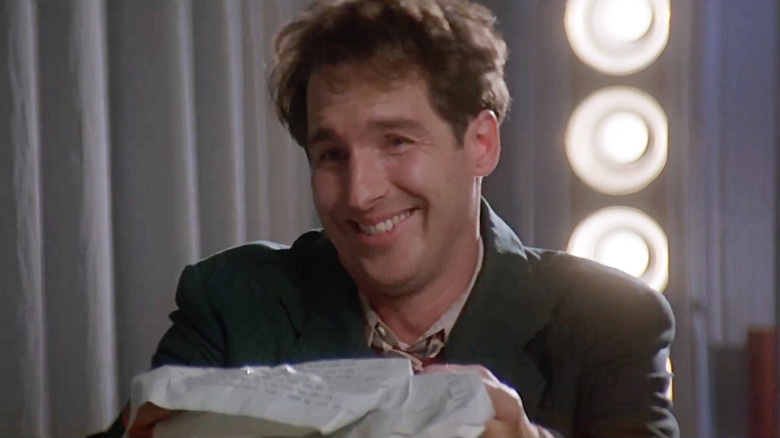
George Lucas cooked up “Radioland Murders” with his “American Graffiti” co-writers Willard Huyck and Gloria Katz, which tracks. Like that movie, the whole thing takes place across one hectic night and is crammed with animated character archetypes. Its leads’ screwball comedy dynamic even recalls the Indy-Willie romance from the Lucas, Huyck, and Katz-scripted “Indiana Jones and the Temple of Doom,” with “Radioland Murders” following estranged couple Penny (Mary Stuart Masterson) and Roger (Brian Benben) as their co-workers are mysteriously bumped off amidst their radio network’s premiere night festivities in 1939.
Quality-wise, however, most critics found “Radioland Murders” off-puttingly frantic and slapstick-heavy, even after a rewrite by Jeff Reno and Ron Osborn (who’d proven adept at combining screwball comedy with mystery hijinks on “Moonlighting”). It also lacks the quirky showmanship that’s earned the Coen Brothers’ own 1994 throwback caper, “The Hudsucker Proxy,” a loyal following and was apparently a snafu off-camera. Indeed, when interviewed for 2022’s “Who Done It: The Clue Documentary,” co-star Michael McKean claimed Lucas and Mel Smith jammed “100 pages of inserts and reshoots” into the last 10 days of filming alone.
Why does “Radioland Murders” matter then? Because Industrial Light & Magic used it to refine techniques they’d subsequently utilize on Lucas’ “Star Wars” prequels, like creating digital mattes to extend practical sets. Just as importantly, they did this while keeping the production budget at $10 million, which was shockingly low in context. Clearly, that gave Lucas the confidence he needed to finally return to a galaxy far, far away, so much so that he started writing his prequels two weeks after the film hit theaters.
So, yeah: You want a truly comprehensive perspective on Lucas? You’d best familiarize yourself with this curio.
Source link
#Youre #George #Lucas #Fan #Havent #90s #Crime #Comedy #SlashFilm


Post Comment