×

Follow the live score and updates from the DC vs RCB match

Here is the list of the lowest scores recorded at the end of the PowerPlay:

  • 13 – DC vs RCB (New Delhi, 2026)
  • 14 – RR vs RCB (Cape Town, 2009)
  • 14 – SRH vs RR (Pune, 2022)
  • 15 – CSK vs KKR (Kolkata, 2011)
  • 16 – CSK vs DC (Raipur, 2015)

Published on Apr 27, 2026

#RCB #Delhi #Capitals #records #lowest #PowerPlay #total #IPL #history"> DC vs RCB: Delhi Capitals records lowest PowerPlay total in IPL history  Delhi Capitals registered the lowest ever score at the end of the Powerplay during its IPL 2026 contest against the Royal Challengers Bengaluru in New Delhi on Monday.DC was restricted to 13 for six at the end of the mandatory six-over phase with Bhuvneshwar Kumar and Josh Hazlewood picking three wickets each.RELATED | Follow the live score and updates from the DC vs RCB matchHere is the list of the lowest scores recorded at the end of the PowerPlay:
                                                        13 – DC vs RCB (New Delhi, 2026)                    
                                                        14 – RR vs RCB (Cape Town, 2009)                    
                                                        14 – SRH vs RR (Pune, 2022)                    
                                                        15 – CSK vs KKR (Kolkata, 2011)                    
                                                        16 – CSK vs DC (Raipur, 2015)                    Published on Apr 27, 2026  #RCB #Delhi #Capitals #records #lowest #PowerPlay #total #IPL #history
Sports news

Follow the live score and updates from the DC vs RCB match

Here is the list of the lowest scores recorded at the end of the PowerPlay:

  • 13 – DC vs RCB (New Delhi, 2026)
  • 14 – RR vs RCB (Cape Town, 2009)
  • 14 – SRH vs RR (Pune, 2022)
  • 15 – CSK vs KKR (Kolkata, 2011)
  • 16 – CSK vs DC (Raipur, 2015)

Published on Apr 27, 2026

#RCB #Delhi #Capitals #records #lowest #PowerPlay #total #IPL #history">DC vs RCB: Delhi Capitals records lowest PowerPlay total in IPL history

Delhi Capitals registered the lowest ever score at the end of the Powerplay during its IPL 2026 contest against the Royal Challengers Bengaluru in New Delhi on Monday.

DC was restricted to 13 for six at the end of the mandatory six-over phase with Bhuvneshwar Kumar and Josh Hazlewood picking three wickets each.

RELATED | Follow the live score and updates from the DC vs RCB match

Here is the list of the lowest scores recorded at the end of the PowerPlay:

  • 13 – DC vs RCB (New Delhi, 2026)
  • 14 – RR vs RCB (Cape Town, 2009)
  • 14 – SRH vs RR (Pune, 2022)
  • 15 – CSK vs KKR (Kolkata, 2011)
  • 16 – CSK vs DC (Raipur, 2015)

Published on Apr 27, 2026

#RCB #Delhi #Capitals #records #lowest #PowerPlay #total #IPL #history

Delhi Capitals registered the lowest ever score at the end of the Powerplay during its…


The 7-foot-2 Krivas averaged less than eight points in less than 16 minutes per game in each of his first two seasons with the Wildcats. This past season, he amassed 10.4 points (fourth-most on the team), 8.2 rebounds (second) and 1.9 blocks per game (fourth nationally), helping Arizona reach the Final Four for the first time since 2001.

With his return for a fourth season in Tucson, he’ll be the first player to start and finish a four-year career at Arizona under Tommy Lloyd.

He’s likely to be a critical piece of the team with freshmen Brayden Burries and Koa Peat declaring for the NBA Draft. The Wildcats have added a pair of guards through the portal: North Carolina transfer Derek Dixon and Washington transfer JJ Mandaquit.

–Field Level Media

#Deadspin #Arizona #Motiejus #Krivas #returning #senior #season"> Deadspin | Arizona C Motiejus Krivas returning for senior season  Apr 4, 2026; Indianapolis, IN, USA;  Arizona Wildcats center Motiejus Krivas (13) shoots against Michigan Wolverines center Aday Mara (15) in the second half during a semifinal of the Final Four of the men’s 2026 NCAA Tournament at Lucas Oil Stadium. Mandatory Credit: Robert Deutsch-Imagn Images   Arizona center Motiejus Krivas is returning for the 2026-27 season after a breakout junior campaign for the Wildcats.  The school announced the news on social media Monday with the caption, “Go ahead and add him to your preseason POY watch list now. Mount Krivas is back!”  Go ahead and add him to your preseason POY watch list now.Mount Krivas is back! pic.twitter.com/lKvkoFPExc— Arizona Basketball (@ArizonaMBB) April 27, 2026    The 7-foot-2 Krivas averaged less than eight points in less than 16 minutes per game in each of his first two seasons with the Wildcats. This past season, he amassed 10.4 points (fourth-most on the team), 8.2 rebounds (second) and 1.9 blocks per game (fourth nationally), helping Arizona reach the Final Four for the first time since 2001.   With his return for a fourth season in Tucson, he’ll be the first player to start and finish a four-year career at Arizona under Tommy Lloyd.  He’s likely to be a critical piece of the team with freshmen Brayden Burries and Koa Peat declaring for the NBA Draft. The Wildcats have added a pair of guards through the portal: North Carolina transfer Derek Dixon and Washington transfer JJ Mandaquit.  –Field Level Media   #Deadspin #Arizona #Motiejus #Krivas #returning #senior #season
Sports news


The 7-foot-2 Krivas averaged less than eight points in less than 16 minutes per game in each of his first two seasons with the Wildcats. This past season, he amassed 10.4 points (fourth-most on the team), 8.2 rebounds (second) and 1.9 blocks per game (fourth nationally), helping Arizona reach the Final Four for the first time since 2001.

With his return for a fourth season in Tucson, he’ll be the first player to start and finish a four-year career at Arizona under Tommy Lloyd.

He’s likely to be a critical piece of the team with freshmen Brayden Burries and Koa Peat declaring for the NBA Draft. The Wildcats have added a pair of guards through the portal: North Carolina transfer Derek Dixon and Washington transfer JJ Mandaquit.

–Field Level Media

#Deadspin #Arizona #Motiejus #Krivas #returning #senior #season">Deadspin | Arizona C Motiejus Krivas returning for senior season
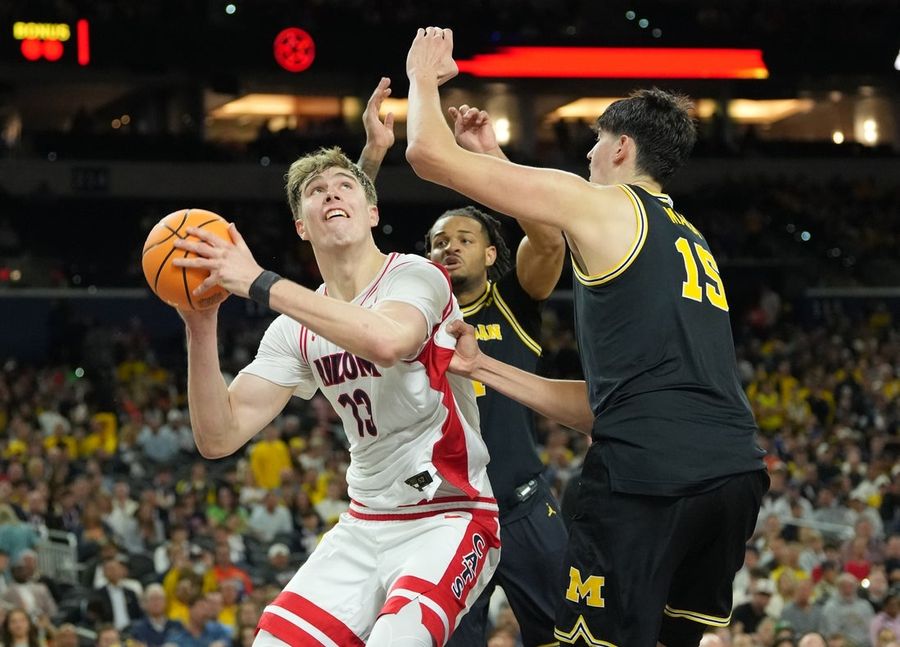
Deadspin | Arizona C Motiejus Krivas returning for senior season  Apr 4, 2026; Indianapolis, IN, USA;  Arizona Wildcats center Motiejus Krivas (13) shoots against Michigan Wolverines center Aday Mara (15) in the second half during a semifinal of the Final Four of the men’s 2026 NCAA Tournament at Lucas Oil Stadium. Mandatory Credit: Robert Deutsch-Imagn Images   Arizona center Motiejus Krivas is returning for the 2026-27 season after a breakout junior campaign for the Wildcats.  The school announced the news on social media Monday with the caption, “Go ahead and add him to your preseason POY watch list now. Mount Krivas is back!”  Go ahead and add him to your preseason POY watch list now.Mount Krivas is back! pic.twitter.com/lKvkoFPExc— Arizona Basketball (@ArizonaMBB) April 27, 2026    The 7-foot-2 Krivas averaged less than eight points in less than 16 minutes per game in each of his first two seasons with the Wildcats. This past season, he amassed 10.4 points (fourth-most on the team), 8.2 rebounds (second) and 1.9 blocks per game (fourth nationally), helping Arizona reach the Final Four for the first time since 2001.   With his return for a fourth season in Tucson, he’ll be the first player to start and finish a four-year career at Arizona under Tommy Lloyd.  He’s likely to be a critical piece of the team with freshmen Brayden Burries and Koa Peat declaring for the NBA Draft. The Wildcats have added a pair of guards through the portal: North Carolina transfer Derek Dixon and Washington transfer JJ Mandaquit.  –Field Level Media   #Deadspin #Arizona #Motiejus #Krivas #returning #senior #seasonApr 4, 2026; Indianapolis, IN, USA; Arizona Wildcats center Motiejus Krivas (13) shoots against Michigan Wolverines center Aday Mara (15) in the second half during a semifinal of the Final Four of the men’s 2026 NCAA Tournament at Lucas Oil Stadium. Mandatory Credit: Robert Deutsch-Imagn Images

Arizona center Motiejus Krivas is returning for the 2026-27 season after a breakout junior campaign for the Wildcats.

The school announced the news on social media Monday with the caption, “Go ahead and add him to your preseason POY watch list now. Mount Krivas is back!”


The 7-foot-2 Krivas averaged less than eight points in less than 16 minutes per game in each of his first two seasons with the Wildcats. This past season, he amassed 10.4 points (fourth-most on the team), 8.2 rebounds (second) and 1.9 blocks per game (fourth nationally), helping Arizona reach the Final Four for the first time since 2001.

With his return for a fourth season in Tucson, he’ll be the first player to start and finish a four-year career at Arizona under Tommy Lloyd.

He’s likely to be a critical piece of the team with freshmen Brayden Burries and Koa Peat declaring for the NBA Draft. The Wildcats have added a pair of guards through the portal: North Carolina transfer Derek Dixon and Washington transfer JJ Mandaquit.

–Field Level Media

#Deadspin #Arizona #Motiejus #Krivas #returning #senior #season

Apr 4, 2026; Indianapolis, IN, USA; Arizona Wildcats center Motiejus Krivas (13) shoots against Michigan…

Sports news

The London Marathon broke the record ​for the highest number ‌of finishers in a marathon,…

India news

परिवहन विभाग द्वारा 136 बस मालिकों को नोटिस जारी कर निर्देशित किया गया था कि…

Sports news

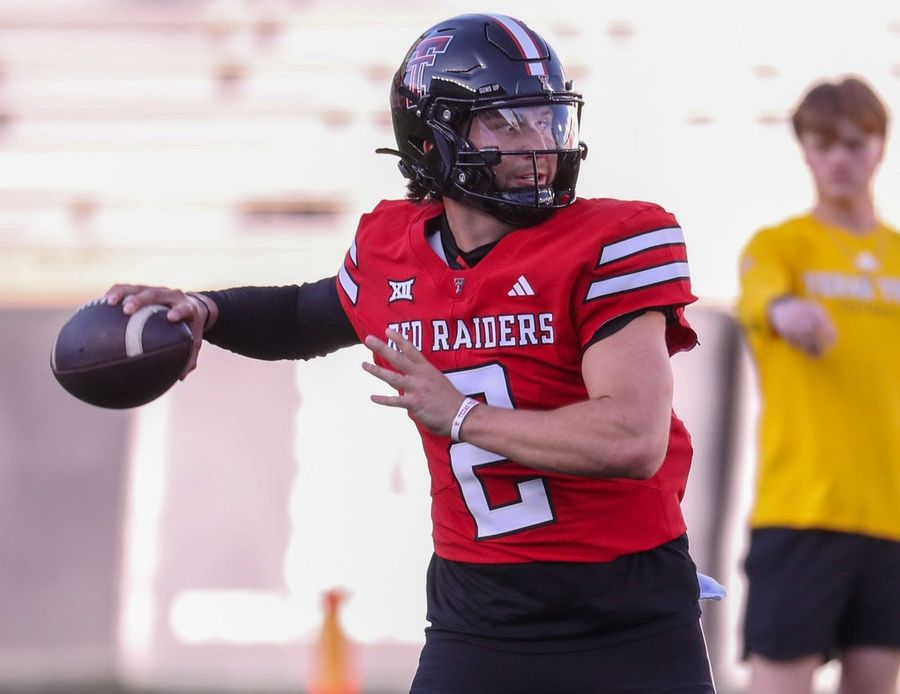
Brendan Sorsby looks to throw during the Texas Tech football team's spring game, Friday, April…

Sports news

KL Rahul’s scintillating unbeaten 152 against Punjab Kings in the ongoing Indian Premier League (IPL)…

Asking questions

If you’ve been on the internet for long enough—or perhaps if there’s a teenager or…

her miserable WNBA life. She’s bumped endlessly attempting to dribble around screens and held constantly while simply trying to use picks to free herself without the ball.

To its credit, the WNBA has created (they don’t call it this, but let’s be honest) the “Clark Compromise” this season. If you watched the preseason games over the weekend, you undoubtedly heard the broadcasters complaining about it.

I applaud Cathy Engelbert, and that’s hard to do. The league has instructed its refs to clean up the perimeter mess – from the clutching and bumping of defenders preventing offensive players from legally utilizing screens, to the hip-checking and general bullying screen-setters routinely employ on undersized defenders.

The constant whistles made Saturday’s games hard to watch, as the broadcasters noted. But that’s missing the point.

The goal is to use otherwise meaningless exhibitions to make the fast-approaching regular-season openers more enjoyable to watch. You know, by actually calling fouls now so that players are hard-taught to play by the book by the time the finicky viewers start tuning in.

Imagine that, NBA.

The premier men’s league has half-heartedly attempted to take this type of approach in the past couple of seasons, and clearly it’s not working. Ask Curry. Ask Devin Booker. Ask anybody trying to guard Shai Gilgeous-Alexander, James Harden or Jaylen Brown.

Let ‘em play has become the unofficial motto of the NBA postseason. And what has it given us?

In general: Less entertainment, poorer shooting opportunities, frustration, more extra-curriculars among players and an inordinate number of key injuries.

Specifically: There have been 30 playoff games so far. In those games, three of the 60 teams have been held under 90 points. That’s 5%. In the regular season, it was 1.7%.

Same with scores under 100. There have been 16 of them so far in the postseason (26.7%). In the regular season: 10.6%.

Sunday was the worst: More teams failed to reach triple figures than did. Number of watchable games: Zero.

That’s letting ‘em play. But play exactly what, I’m not sure.

In fact, with all the fouling that’s going uncalled, they’re not playing at all. They’re moshing.

It’s time to get with the times and take corrective steps. My solution is extreme – gee, imagine that – but when you’ve got people switching off a Thunder-Suns playoff game to watch Day 3 of the NFL draft, you’ve got problems.

The NBA needs to take a Waymo approach. You know, an implanted chip that tells the brain: All contact is bad. Avoid at all costs.

No, I’m not suggesting tattooing a sensor into every player’s forehead. Rather, a simple memory scan of each player’s arms – the major culprits in most of these so-called victimless crimes – so that when someone’s shoulder or elbow or forearm or hand simply touches an opponent, the referee gets buzzed and the actionless action is stopped.

Why? Because touching an opponent should be illegal. Think baseball. Not football.

As Waymo has taught us: All contact is bad.

And if cars can learn it, why can’t humans?

Then it’s IT’s turn.

Within one second, IT has the ability to study every available angle of a “collision” and make the determination: Which player caused this to happen?

Was it Brown pushing off Paul George in order to create space to get off a clean shot? Or was it George sticking a forearm into Brown’s back, stalling his initial move toward the hoop?

In today’s game, it doesn’t matter. More possessions than not resemble DK Metcalf and Carlton Davis wrestling inside the 5-yard, anything-goes NFL passing zone.

Only the NBA has no such thing.

Really. One second. That’s all it would take IT to point its virtual punitive finger.

And then guess what? Brown wouldn’t do it again. Or Harden. Or SGA.

That’s how you clean up and speed up the NBA game. Or at least start to do so.

Imagine an NBA rule in which you’re not allowed to touch your opponent. Yes, it’s hard to envision. But think about it for a minute.

Fifty years ago, when Lester Hayes was literally using stickum to latch onto wide receivers, who would have thought a hands-off rule would revolutionize football?

And that was back when the only IT was Isiah Thomas.

The NBA had hand-checking back then. Remember that thrill-killer?

That was banished and the game became great. But the problem has resurfaced, more so in the postseason than in the regular year, when it was a lesser issue because star players weren’t complaining. They were resting.

It’s time to get with the times, Commissioner Silver. Take the leap.

Thank you Caitlin Clark for saving the NBA.

#Technology #Fix #NBA #Officiating #Bold #Solution #Playoff #Issues #Deadspin.com"> Can Technology Fix NBA Officiating? A Bold Solution to Playoff Issues | Deadspin.com   I’ve seen the future of the NBA. It’s part Caitlin Clark, part Waymo and, of course, a heaping helping of IT.There have been 30 NBA playoff games to date. And there have been – according to no better source than players on the losing team – 30 poorly officiated boat races.Coincidence? Hardly.For years, perimeter play in the NBA postseason has resembled that of the NFL, complete with the chucking, hand-fighting and illegal picking.If you’re wondering why Stephen Curry shoots more 30-footers now than ever before, it’s because apparently bear-hugging is legal inside 25 feet. So what’s a little guy to do?Clark has received this kind of hands-on treatment since Day 1 of her miserable WNBA life. She’s bumped endlessly attempting to dribble around screens and held constantly while simply trying to use picks to free herself without the ball.To its credit, the WNBA has created (they don’t call it this, but let’s be honest) the “Clark Compromise” this season. If you watched the preseason games over the weekend, you undoubtedly heard the broadcasters complaining about it.I applaud Cathy Engelbert, and that’s hard to do. The league has instructed its refs to clean up the perimeter mess – from the clutching and bumping of defenders preventing offensive players from legally utilizing screens, to the hip-checking and general bullying screen-setters routinely employ on undersized defenders.The constant whistles made Saturday’s games hard to watch, as the broadcasters noted. But that’s missing the point.The goal is to use otherwise meaningless exhibitions to make the fast-approaching regular-season openers more enjoyable to watch. You know, by actually calling fouls now so that players are hard-taught to play by the book by the time the finicky viewers start tuning in.Imagine that, NBA.The premier men’s league has half-heartedly attempted to take this type of approach in the past couple of seasons, and clearly it’s not working. Ask Curry. Ask Devin Booker. Ask anybody trying to guard Shai Gilgeous-Alexander, James Harden or Jaylen Brown.Let ‘em play has become the unofficial motto of the NBA postseason. And what has it given us?In general: Less entertainment, poorer shooting opportunities, frustration, more extra-curriculars among players and an inordinate number of key injuries.Specifically: There have been 30 playoff games so far. In those games, three of the 60 teams have been held under 90 points. That’s 5%. In the regular season, it was 1.7%.Same with scores under 100. There have been 16 of them so far in the postseason (26.7%). In the regular season: 10.6%.Sunday was the worst: More teams failed to reach triple figures than did. Number of watchable games: Zero.That’s letting ‘em play. But play exactly what, I’m not sure.In fact, with all the fouling that’s going uncalled, they’re not playing at all. They’re moshing.It’s time to get with the times and take corrective steps. My solution is extreme – gee, imagine that – but when you’ve got people switching off a Thunder-Suns playoff game to watch Day 3 of the NFL draft, you’ve got problems.The NBA needs to take a Waymo approach. You know, an implanted chip that tells the brain: All contact is bad. Avoid at all costs.No, I’m not suggesting tattooing a sensor into every player’s forehead. Rather, a simple memory scan of each player’s arms – the major culprits in most of these so-called victimless crimes – so that when someone’s shoulder or elbow or forearm or hand simply touches an opponent, the referee gets buzzed and the actionless action is stopped.Why? Because touching an opponent should be illegal. Think baseball. Not football.As Waymo has taught us: All contact is bad.And if cars can learn it, why can’t humans?Then it’s IT’s turn.Within one second, IT has the ability to study every available angle of a “collision” and make the determination: Which player caused this to happen?Was it Brown pushing off Paul George in order to create space to get off a clean shot? Or was it George sticking a forearm into Brown’s back, stalling his initial move toward the hoop?In today’s game, it doesn’t matter. More possessions than not resemble DK Metcalf and Carlton Davis wrestling inside the 5-yard, anything-goes NFL passing zone.Only the NBA has no such thing.Really. One second. That’s all it would take IT to point its virtual punitive finger.And then guess what? Brown wouldn’t do it again. Or Harden. Or SGA.That’s how you clean up and speed up the NBA game. Or at least start to do so.Imagine an NBA rule in which you’re not allowed to touch your opponent. Yes, it’s hard to envision. But think about it for a minute.Fifty years ago, when Lester Hayes was literally using stickum to latch onto wide receivers, who would have thought a hands-off rule would revolutionize football?And that was back when the only IT was Isiah Thomas.The NBA had hand-checking back then. Remember that thrill-killer?That was banished and the game became great. But the problem has resurfaced, more so in the postseason than in the regular year, when it was a lesser issue because star players weren’t complaining. They were resting.It’s time to get with the times, Commissioner Silver. Take the leap.Thank you Caitlin Clark for saving the NBA.   #Technology #Fix #NBA #Officiating #Bold #Solution #Playoff #Issues #Deadspin.com
Sports news

her miserable WNBA life. She’s bumped endlessly attempting to dribble around screens and held constantly while simply trying to use picks to free herself without the ball.

To its credit, the WNBA has created (they don’t call it this, but let’s be honest) the “Clark Compromise” this season. If you watched the preseason games over the weekend, you undoubtedly heard the broadcasters complaining about it.

I applaud Cathy Engelbert, and that’s hard to do. The league has instructed its refs to clean up the perimeter mess – from the clutching and bumping of defenders preventing offensive players from legally utilizing screens, to the hip-checking and general bullying screen-setters routinely employ on undersized defenders.

The constant whistles made Saturday’s games hard to watch, as the broadcasters noted. But that’s missing the point.

The goal is to use otherwise meaningless exhibitions to make the fast-approaching regular-season openers more enjoyable to watch. You know, by actually calling fouls now so that players are hard-taught to play by the book by the time the finicky viewers start tuning in.

Imagine that, NBA.

The premier men’s league has half-heartedly attempted to take this type of approach in the past couple of seasons, and clearly it’s not working. Ask Curry. Ask Devin Booker. Ask anybody trying to guard Shai Gilgeous-Alexander, James Harden or Jaylen Brown.

Let ‘em play has become the unofficial motto of the NBA postseason. And what has it given us?

In general: Less entertainment, poorer shooting opportunities, frustration, more extra-curriculars among players and an inordinate number of key injuries.

Specifically: There have been 30 playoff games so far. In those games, three of the 60 teams have been held under 90 points. That’s 5%. In the regular season, it was 1.7%.

Same with scores under 100. There have been 16 of them so far in the postseason (26.7%). In the regular season: 10.6%.

Sunday was the worst: More teams failed to reach triple figures than did. Number of watchable games: Zero.

That’s letting ‘em play. But play exactly what, I’m not sure.

In fact, with all the fouling that’s going uncalled, they’re not playing at all. They’re moshing.

It’s time to get with the times and take corrective steps. My solution is extreme – gee, imagine that – but when you’ve got people switching off a Thunder-Suns playoff game to watch Day 3 of the NFL draft, you’ve got problems.

The NBA needs to take a Waymo approach. You know, an implanted chip that tells the brain: All contact is bad. Avoid at all costs.

No, I’m not suggesting tattooing a sensor into every player’s forehead. Rather, a simple memory scan of each player’s arms – the major culprits in most of these so-called victimless crimes – so that when someone’s shoulder or elbow or forearm or hand simply touches an opponent, the referee gets buzzed and the actionless action is stopped.

Why? Because touching an opponent should be illegal. Think baseball. Not football.

As Waymo has taught us: All contact is bad.

And if cars can learn it, why can’t humans?

Then it’s IT’s turn.

Within one second, IT has the ability to study every available angle of a “collision” and make the determination: Which player caused this to happen?

Was it Brown pushing off Paul George in order to create space to get off a clean shot? Or was it George sticking a forearm into Brown’s back, stalling his initial move toward the hoop?

In today’s game, it doesn’t matter. More possessions than not resemble DK Metcalf and Carlton Davis wrestling inside the 5-yard, anything-goes NFL passing zone.

Only the NBA has no such thing.

Really. One second. That’s all it would take IT to point its virtual punitive finger.

And then guess what? Brown wouldn’t do it again. Or Harden. Or SGA.

That’s how you clean up and speed up the NBA game. Or at least start to do so.

Imagine an NBA rule in which you’re not allowed to touch your opponent. Yes, it’s hard to envision. But think about it for a minute.

Fifty years ago, when Lester Hayes was literally using stickum to latch onto wide receivers, who would have thought a hands-off rule would revolutionize football?

And that was back when the only IT was Isiah Thomas.

The NBA had hand-checking back then. Remember that thrill-killer?

That was banished and the game became great. But the problem has resurfaced, more so in the postseason than in the regular year, when it was a lesser issue because star players weren’t complaining. They were resting.

It’s time to get with the times, Commissioner Silver. Take the leap.

Thank you Caitlin Clark for saving the NBA.

#Technology #Fix #NBA #Officiating #Bold #Solution #Playoff #Issues #Deadspin.com">Can Technology Fix NBA Officiating? A Bold Solution to Playoff Issues | Deadspin.com

I’ve seen the future of the NBA. It’s part Caitlin Clark, part Waymo and, of course, a heaping helping of IT.

There have been 30 NBA playoff games to date. And there have been – according to no better source than players on the losing team – 30 poorly officiated boat races.

Coincidence? Hardly.

For years, perimeter play in the NBA postseason has resembled that of the NFL, complete with the chucking, hand-fighting and illegal picking.

If you’re wondering why Stephen Curry shoots more 30-footers now than ever before, it’s because apparently bear-hugging is legal inside 25 feet. So what’s a little guy to do?

Clark has received this kind of hands-on treatment since Day 1 of her miserable WNBA life. She’s bumped endlessly attempting to dribble around screens and held constantly while simply trying to use picks to free herself without the ball.

To its credit, the WNBA has created (they don’t call it this, but let’s be honest) the “Clark Compromise” this season. If you watched the preseason games over the weekend, you undoubtedly heard the broadcasters complaining about it.

I applaud Cathy Engelbert, and that’s hard to do. The league has instructed its refs to clean up the perimeter mess – from the clutching and bumping of defenders preventing offensive players from legally utilizing screens, to the hip-checking and general bullying screen-setters routinely employ on undersized defenders.

The constant whistles made Saturday’s games hard to watch, as the broadcasters noted. But that’s missing the point.

The goal is to use otherwise meaningless exhibitions to make the fast-approaching regular-season openers more enjoyable to watch. You know, by actually calling fouls now so that players are hard-taught to play by the book by the time the finicky viewers start tuning in.

Imagine that, NBA.

The premier men’s league has half-heartedly attempted to take this type of approach in the past couple of seasons, and clearly it’s not working. Ask Curry. Ask Devin Booker. Ask anybody trying to guard Shai Gilgeous-Alexander, James Harden or Jaylen Brown.

Let ‘em play has become the unofficial motto of the NBA postseason. And what has it given us?

In general: Less entertainment, poorer shooting opportunities, frustration, more extra-curriculars among players and an inordinate number of key injuries.

Specifically: There have been 30 playoff games so far. In those games, three of the 60 teams have been held under 90 points. That’s 5%. In the regular season, it was 1.7%.

Same with scores under 100. There have been 16 of them so far in the postseason (26.7%). In the regular season: 10.6%.

Sunday was the worst: More teams failed to reach triple figures than did. Number of watchable games: Zero.

That’s letting ‘em play. But play exactly what, I’m not sure.

In fact, with all the fouling that’s going uncalled, they’re not playing at all. They’re moshing.

It’s time to get with the times and take corrective steps. My solution is extreme – gee, imagine that – but when you’ve got people switching off a Thunder-Suns playoff game to watch Day 3 of the NFL draft, you’ve got problems.

The NBA needs to take a Waymo approach. You know, an implanted chip that tells the brain: All contact is bad. Avoid at all costs.

No, I’m not suggesting tattooing a sensor into every player’s forehead. Rather, a simple memory scan of each player’s arms – the major culprits in most of these so-called victimless crimes – so that when someone’s shoulder or elbow or forearm or hand simply touches an opponent, the referee gets buzzed and the actionless action is stopped.

Why? Because touching an opponent should be illegal. Think baseball. Not football.

As Waymo has taught us: All contact is bad.

And if cars can learn it, why can’t humans?

Then it’s IT’s turn.

Within one second, IT has the ability to study every available angle of a “collision” and make the determination: Which player caused this to happen?

Was it Brown pushing off Paul George in order to create space to get off a clean shot? Or was it George sticking a forearm into Brown’s back, stalling his initial move toward the hoop?

In today’s game, it doesn’t matter. More possessions than not resemble DK Metcalf and Carlton Davis wrestling inside the 5-yard, anything-goes NFL passing zone.

Only the NBA has no such thing.

Really. One second. That’s all it would take IT to point its virtual punitive finger.

And then guess what? Brown wouldn’t do it again. Or Harden. Or SGA.

That’s how you clean up and speed up the NBA game. Or at least start to do so.

Imagine an NBA rule in which you’re not allowed to touch your opponent. Yes, it’s hard to envision. But think about it for a minute.

Fifty years ago, when Lester Hayes was literally using stickum to latch onto wide receivers, who would have thought a hands-off rule would revolutionize football?

And that was back when the only IT was Isiah Thomas.

The NBA had hand-checking back then. Remember that thrill-killer?

That was banished and the game became great. But the problem has resurfaced, more so in the postseason than in the regular year, when it was a lesser issue because star players weren’t complaining. They were resting.

It’s time to get with the times, Commissioner Silver. Take the leap.

Thank you Caitlin Clark for saving the NBA.

#Technology #Fix #NBA #Officiating #Bold #Solution #Playoff #Issues #Deadspin.com

I’ve seen the future of the NBA. It’s part Caitlin Clark, part Waymo and, of…

Sports news

Mumbai Indians has drafted in Keshav Maharaj as a replacement for the injured Mitchell Santner,…