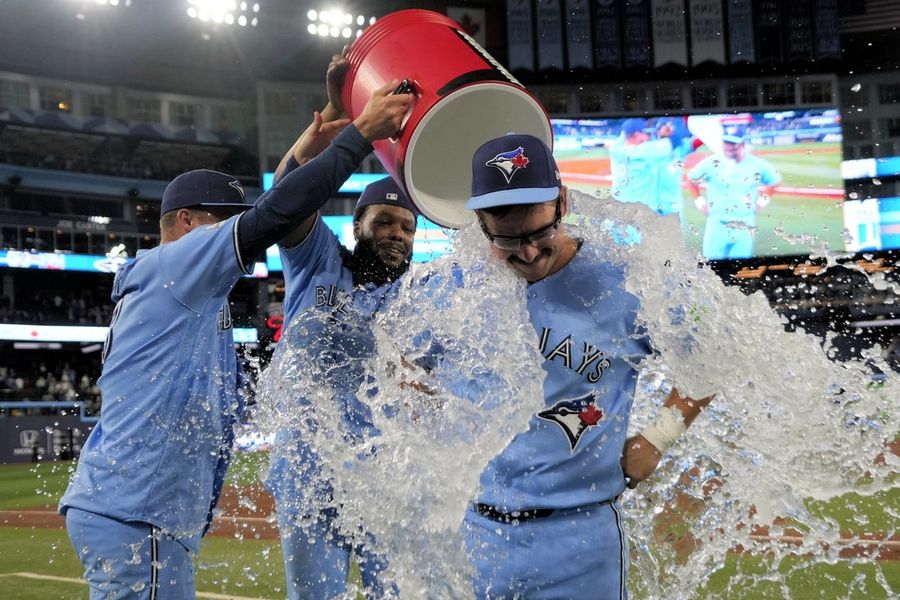
 Apr 8, 2026; Toronto, Ontario, CAN; Toronto Blue Jays left fielder Davis Schneider (center) gets doused with ice water by center fielder Myles Straw (3) and first baseman Vladimir Guerrero Jr. (27) after a win over the Los Angeles Dodgers at Rogers Centre. Mandatory Credit: John E. Sokolowski-Imagn Images
 The Toronto Blue Jays scored the go-ahead run in the eighth inning on an error Wednesday afternoon and went on to defeat the visiting Los Angeles Dodgers 4-3.
The Blue Jays salvaged the finale of the three-game series, a rematch of the 2025 World Series won by Los Angeles, to end a six-game skid and end the Dodgers’ five-game winning streak. Jeff Hoffman pitched around a single and a walk in the ninth to earn his second save. Tyler Rogers (1-0) pitched 1 2/3 innings for the win.
Davis Schneider walked with one out in the eighth against Ben Casparius (0-1) and took third on Andres Gimenez’s single. Schneider scored on catcher Will Smith’s throwing error when Gimenez stole second. George Springer and Jesus Sanchez each hit an RBI double and Daulton Varsho added an RBI single.
Shohei Ohtani’s leadoff walk in the first extended his on-base streak to 43 games dating to August. That ties Ichiro Suzuki (2009) for the longest such streak by a Japanese-born player. Ohtani pitched six innings, allowing one unearned run, four hits and one walk with two strikeouts. Freddie Freeman and Will Smith delivered RBI singles and Teoscar Hernandez lifted a sacrifice fly.
Angel Martinez had four hits, including a grand slam, and Cleveland rolled past visiting Kansas City in the rubber game of their three-game series.
Rhys Hoskins had three doubles, an RBI and run scored, and Jose Ramirez and Juan Brito each had two hits, an RBI and run scored for Cleveland, which has won three of four. Guardians left-hander Joey Cantillo (1-0) allowed two runs (one earned) and three hits over 5 2/3 innings. He struck out nine and walked two.
Bobby Witt Jr. produced two hits and an RBI for Kansas City, which has lost three of four. Royals starter Cole Ragans (0-3) lasted just five batters after he sustained a thumb contusion on his throwing hand when was hit by a comebacker by Ramirez.
Nick Castellanos drove in two runs and Jake Cronenworth hit his first homer of the season to lead San Diego to a victory over host Pittsburgh.
It was more tough luck for Pirates starter Mitch Keller, who tossed six scoreless innings. Through his first three starts, Keller has a 1.00 ERA and has allowed only two runs in 18 innings but has just one win to show for it. Rookie Konnor Griffin and Joey Bart had RBIs for Pittsburgh.
San Diego starter Michael King (1-1) pitched six innings and allowed two runs on four hits and three walks. King struck out four and threw 95 pitches. Mason Miller worked a scoreless ninth, but had a streak of 11 consecutive strikeouts snapped when Mangum grounded out to end the game. Luis Campusano and Fernando Tatis Jr. each had an RBI.
Sonny Gray tossed 6 1/3 scoreless innings and Trevor Story drove in two runs to help Boston defeat visiting Milwaukee.
Gray (2-0) limited Milwaukee to three hits, walked two and struck out two. The victory gave Boston back-to-back wins for the first time this season. The Red Sox beat the Brewers 3-2 in the second game of the series Tuesday. The victory in the finale also handed Boston its first series win.
Milwaukee starting pitcher Shane Drohan (0-1) made his MLB debut, but was pulled with two outs in the third. He gave up three runs on three hits, walked four and struck out two. Three of the four walks he issued came in Boston’s three-run third inning.
A three-run inning was all Texas needed to defeat Seattle in Arlington, Texas, giving the Rangers a three-game series sweep over the slumping Mariners.
A bases-loaded throwing error by Mariners first baseman Connor Joe allowed two runs to score, and Texas added another in the bottom of the fifth against Seattle starter Bryan Woo (0-1). The Rangers got five scoreless innings from starter MacKenzie Gore (2-0), who allowed one hit and struck out nine with two walks. Then, their bullpen finished off the Mariners with four scoreless innings.
The Mariners managed just three runs total in the series despite good pitching. Seattle lost its fifth straight game and seventh in its last eight. Seattle has been shut out three times in that eight-game stretch and has not scored more than three runs in any of those games.
Hunter Goodman homered, Ezequiel Tovar, Troy Johnston and Edouard Julien had two hits apiece, and Colorado beat Houston in Denver.
Michael Lorenzen bounced back from his last start to get his first win with Colorado. Lorenzen (1-1) allowed one run on seven hits in 5 2/3 innings to help the Rockies sweep the three-game series from Houston at home for the first time since 2012. Right-hander Zach Agnos tossed 3 1/3 innings of relief to earn his first save for Colorado, which has won four in a row.
Christian Walker had two hits for the Astros, who lost outfielder Jake Meyers to an injury in the second inning. Houston has dropped its last four games.
Taylor Ward went 4-for-5 with three doubles and two RBIs as Baltimore completed a three-game series sweep of host Chicago.
Baltimore right-hander Kyle Bradish (1-2) earned his first victory of the season. Bradish spaced three runs (two earned) and six hits over five innings. He had three walks against seven strikeouts. Rico Garcia worked around a pair of walks in the bottom half to pick up his first career save.
Down 3-2 with one out in the top of the sixth, the Orioles loaded the bases against reliever Lucas Sims (0-1). Bryan Hudson replaced Sims, but a passed ball by catcher Reese McGuire allowed the tying run to score. Dylan Beavers then hit a sacrifice fly for a 4-3 Orioles lead.
Griffin Conine slugged a two-run homer and Connor Norby hit a solo shot as host Miami ended Cincinnati’s five-game win streak.
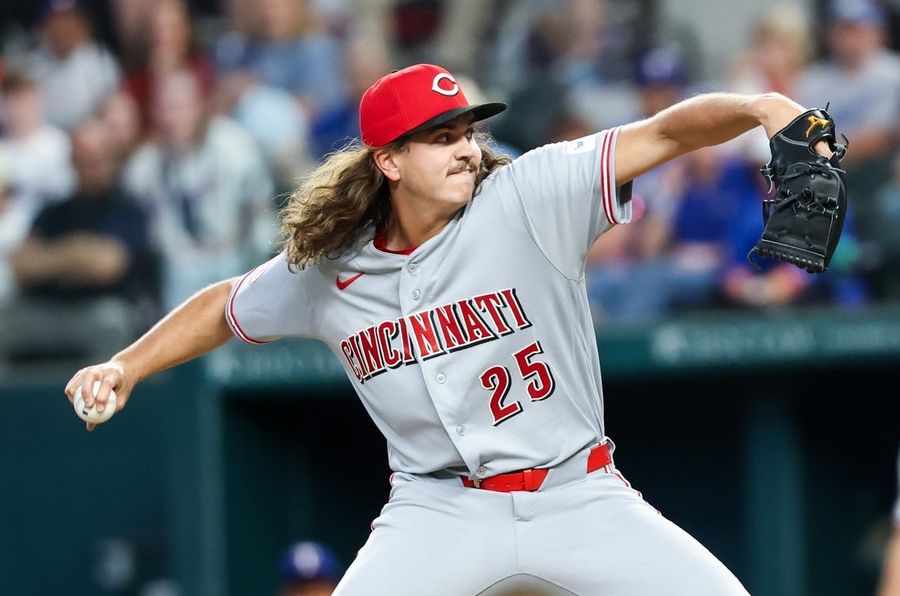
Michael Petersen pitched a scoreless ninth for his first career save as the Marlins halted a two-game skid. Reds rookie first baseman Sal Stewart, a Miami native who had several family members and friends in the stands displaying posters with his likeness, went 2-for-4 with a two-run homer, two runs and a stolen base. Eury Perez (1-1) earned the win, allowing six hits, two walks and four runs (two earned) in five innings.
Native Floridian Brady Singer (0-1) took the loss, allowing 10 hits and six runs (five earned) in 2 2/3 innings. He was also charged with two errors on failed pickoff plays. Cincinnati’s Elly De La Cruz scored a run for the eighth straight game after drawing a walk and stealing second base in the first inning. Julien drove in two with a single, Mickey Moniak hit a sacrifice fly and Julien scored on a wild pitch.
Nico Hoerner homered to highlight his three-hit performance and Michael Conforto drove in a pair, fueling Chicago past host Tampa Bay for the Cubs’ first back-to-back wins and first series victory of the season.
Hoerner led the game off with a homer and added an RBI double during a five-run fifth inning for the Cubs. Colin Rea (1-0) allowed one run on two hits in five innings while taking the spot in the rotation of Cade Horton, who is out for the season with an elbow injury.
Tampa Bay starter Joe Boyle (0-1) was charged with six runs (five earned) on four hits in 4 1/3 innings and took the loss. The Rays committed three errors en route to losing for the fifth time in their last eight games.
Jordan Walker homered again, Alec Burleson drove in three runs and notched three hits and St. Louis won the decisive game of a three-game series at Washington.
Walker hit his fifth home run of the season and three St. Louis relievers completed what became a combined four-hitter. Michael McGreevy (1-1) worked six innings, yielding one run.
Nationals starter Miles Mikolas (0-3) allowed two runs on five hits in three innings. James Wood went 2-for-4.
Brent Rooker lifted a tiebreaking sacrifice fly in the ninth inning, and the Athletics earned a victory at New York.
A’s reliever Elvis Alvarado (2-0) got two outs in the eighth, and Joel Kuhnel retired the side in the ninth for his second career save and first since 2022. Nick Kurtz, Shea Langeliers and Jeff McNeil had multi-hit games for the A’s.
The Yankees managed just four hits, three in the first inning, when Cody Bellinger had an RBI single. David Bednar (0-1) took the loss.
Tyler Mahle combined with four relievers on a four-hitter, Rafael Devers broke a sixth-inning tie with a three-run home run and San Francisco made it two of three from visiting Philadelphia.
Making his third start as a Giant, Mahle matched zeroes with Phillies starter Aaron Nola for five innings before getting pulled with two outs in the sixth. Nola completed six innings, allowing three runs and five hits. He walked one and struck out three.
Willy Adames doubled with one out in the bottom of the sixth, and Luis Arraez followed with a walk. After Nola struck out Matt Chapman, Devers launched the first pitch he saw over the fence in center field for a 3-0 lead. Devers added his fourth RBI on a single. Mahle yielded four hits and struck out six in 5 2/3 innings.
Matt Olson hit a home run and Ronald Acuna Jr. doubled twice and scored a run to lead Atlanta past Los Angeles in the rubber game of their three-game series in Anaheim, Calif.
Austin Riley doubled, stole a base and scored three runs, and Mauricio Dubon had a two-run double for Atlanta, which finished a seven-game western road trip with a 4-3 record. Atlanta starter Grant Holmes (1-1) picked up the win, allowing two runs on five hits in 6 2/3 innings. The right-hander walked three and struck out six.
Jorge Soler, appealing a seven-game suspension for his role in a benches-emptying brawl with Braves pitcher Reynaldo Lopez on Tuesday night, homered for the second straight game, and Jo Adell had three hits for Los Angeles. Reid Detmers (0-1) suffered the loss, allowing six runs (five earned) on five hits in 4 1/3 innings. The left-hander walked two and struck out four.
Ryne Nelson tossed 5 2/3 solid innings and earned the win for visiting Arizona, which cooled off surging New York.
Corbin Carroll and Ildemaro Vargas had three hits apiece for the Diamondbacks, who have won six of nine. Carroll and Jorge Barrosa each had two-run doubles, while Gabriel Moreno, Ketel Marte and Geraldo Perdomo had an RBI apiece. Jose Fernandez added two hits.
Brett Baty had an RBI single, and Mark Vientos lofted a sacrifice fly for the Mets, who won their previous four games by a combined score of 28-8. Baty, Luis Robert Jr. and Bo Bichette had two hits each.
Royce Lewis went 2-for-3 with two RBIs and Minnesota won its third straight with a win over Detroit in Minneapolis.
Byron Buxton went 3-for-4 with a double and scored three runs for Minnesota while Matt Wallner doubled and drove in a run. Twins right-hander Bailey Ober (1-0) allowed two runs on five hits in 5 2/3 innings.
Gleyber Torres went 2-for-5 with a double and two RBIs to lead Detroit, which lost its fourth in a row. Tigers left-hander Framber Valdez (1-1) surrendered eight runs on 10 hits in five-plus innings after permitting only two runs (one earned) in his first two starts combined.
Apr 8, 2026; Toronto, Ontario, CAN; Toronto Blue Jays left fielder Davis Schneider (center) gets…

 Mar 12, 2026; Cincinnati, Ohio, USA; A general view of the official game ball during the first half in the match between Tigres UANL and FC Cincinnati at TQL Stadium. Mandatory Credit: Katie Stratman-Imagn Images