×
Exclusive – “Nobody came in. Everybody came back with a no”: Lalit Modi on the IPL pitch that failed 999 times  There is a tendency now to treat the Indian Premier League (IPL) as if it arrived fully formed, with billion-dollar valuations trailing in its wake.In Lalit Modi’s telling, it was anything but. It was imagined early, abandoned once, challenged by rivals, dismissed by the market and then, almost improbably, forced into existence.“The idea to me was always to be the biggest league in the world,” Modi, the first chairman of the IPL, says. But the idea predates the IPL. “When I conceived it in the early ‘90s, it was called the Indian Cricket League. If you check who owns the domain name, it is not Subhash Chandra. It’s Lalit Modi.”According to Modi, that first version, an eight-team, city-based competition, came close to life in 1995. “It was all set up, approved by the Board of Control for Cricket in India (BCCI). We spent  million to  million. All the top players were hired. It was an eight-team format: Delhi Panthers, Mohali Stallions, Gwalior Cobras, Calcutta Tigers, Bangalore Bulls, Chennai Tuskers.”It collapsed just as quickly. “There was a requirement of too many underhand payments, and I decided this is not the way it’s going to work. And we shelved it,” Modi says.The idea waited. When it returned a decade later, it entered a changed ecosystem and a rivalry.“When I was launching the IPL, the first person I went to was Subhash Chandra. I said, ‘Would you like to buy the IPL rights?’” Modi says. Chandra declined and built his own league. “He picked up two of my people to develop the Indian Cricket League.”Modi calls him “a great adversary”, but is clear about the flaw in Chandra’s system of “owning all the teams, all the broadcasting and all the players”. His own model would move the other way.Yet the larger obstacle was indifference.“We went to all the broadcasters. Nobody came in. Everybody came back with a no.” Investors were no better. “I’m making presentations to over 1,000 businessmen. Ninety-nine per cent didn’t understand what we were talking about.” Even within the BCCI, “not a single person could understand except for two.”The problem, he realised, was cultural.“I needed to attract the audience of the Saas Bahu shows on TV. That’s where the money was. The bulk of the Indian advertising money sat on the eight o’clock time slot,” he says. “I decided to do a paradigm shift. Night cricket. Eight o’clock start. Music, dancing, fun.”The logic is blunt. “I needed to attract women and children… that is where the money was.”The product still needed a trigger. And it arrived, unscripted, in 2007.“You know the story of Yuvraj Singh’s six sixes already,” Modi says. “India winning over Pakistan, huge, huge. We bring them back as heroes. Millions of people come. That helped it.”The IPL had its first advertisement.But emotion could not substitute structure. “I explained, the first pillar is the broadcaster. Without broadcasting, we don’t have a pillar,” he says.Sony’s interest came with a condition: “We will buy it, provided you have the top 100 players.”“The task became to find the top 100 players,” Modi says. “You need Team India, without doubt. If you don’t have Team India, you have a problem.”Even as he scrambled for players, the media rights auction brought the league to the brink.“So, Sony signed the contract as a sub-licensee of World Sports Group. There were only three bidders, ESPN, World Sports Group, and Sony,” he says.“ESPN’s bid was revenue sharing. ‘If we do well, we’ll give you 50 per cent.’ I threw them out.“Before I opened the Sony bid, minutes before, they withdrew. It was hand in glove. I’m in front of live media. I don’t know what’s going to come.“I opened the World Sports Group bid. It’s a billion dollars. It was a mindset number… I needed the headline to be, ‘IPL has the audacity to ask for a billion dollars’. So, we have a billion-dollar cheque guaranteed. We don’t have a broadcaster at that point in time.”From there, he says he turned to franchise owners.“4th of January was the opening of the franchisee tenders. The minimum bid price was 50 million paid over 10 years,” Modi says. “If you bid a minimum of 50, I’m going to give you back five. You’re only giving me five; the rest is your ego money.“You’re going to get ticketing revenue, team sponsorship, food and beverage, and 60 per cent from the central pool.”He tried to sell belief. “If you believe in me, it’ll be so big, you don’t have to ever look back.”But few did.“None of them believed it, Airtel, Tata group, Birla group, ICICI, HDFC. None of them believed it,” Modi says.So, he made the risk explicit. “If the IPL doesn’t work in year one, I will tear up all these agreements and cancel IPL year two.”It was not just a league being launched. It was a wager.“I put my entire career on the line. I put all my goodwill on the line,” he says. “We formed our own team, paid from our own pocket… and with Sharad Pawar, we got it up and running.”“And fortunately for us, it worked.”Published on Apr 08, 2026  #Exclusive #Lalit #Modi #IPL #pitch #failed #times

Exclusive – “Nobody came in. Everybody came back with a no”: Lalit Modi on the IPL pitch that failed 999 times

There is a tendency now to treat the Indian Premier League (IPL) as if it arrived fully formed, with billion-dollar valuations trailing in its wake.

In Lalit Modi’s telling, it was anything but. It was imagined early, abandoned once, challenged by rivals, dismissed by the market and then, almost improbably, forced into existence.

“The idea to me was always to be the biggest league in the world,” Modi, the first chairman of the IPL, says. But the idea predates the IPL. “When I conceived it in the early ‘90s, it was called the Indian Cricket League. If you check who owns the domain name, it is not Subhash Chandra. It’s Lalit Modi.”

According to Modi, that first version, an eight-team, city-based competition, came close to life in 1995. “It was all set up, approved by the Board of Control for Cricket in India (BCCI). We spent $17 million to $20 million. All the top players were hired. It was an eight-team format: Delhi Panthers, Mohali Stallions, Gwalior Cobras, Calcutta Tigers, Bangalore Bulls, Chennai Tuskers.”

It collapsed just as quickly. “There was a requirement of too many underhand payments, and I decided this is not the way it’s going to work. And we shelved it,” Modi says.

The idea waited. When it returned a decade later, it entered a changed ecosystem and a rivalry.

“When I was launching the IPL, the first person I went to was Subhash Chandra. I said, ‘Would you like to buy the IPL rights?’” Modi says. Chandra declined and built his own league. “He picked up two of my people to develop the Indian Cricket League.”

Modi calls him “a great adversary”, but is clear about the flaw in Chandra’s system of “owning all the teams, all the broadcasting and all the players”. His own model would move the other way.

Yet the larger obstacle was indifference.

“We went to all the broadcasters. Nobody came in. Everybody came back with a no.” Investors were no better. “I’m making presentations to over 1,000 businessmen. Ninety-nine per cent didn’t understand what we were talking about.” Even within the BCCI, “not a single person could understand except for two.”

The problem, he realised, was cultural.

“I needed to attract the audience of the Saas Bahu shows on TV. That’s where the money was. The bulk of the Indian advertising money sat on the eight o’clock time slot,” he says. “I decided to do a paradigm shift. Night cricket. Eight o’clock start. Music, dancing, fun.”

The logic is blunt. “I needed to attract women and children… that is where the money was.”

The product still needed a trigger. And it arrived, unscripted, in 2007.

“You know the story of Yuvraj Singh’s six sixes already,” Modi says. “India winning over Pakistan, huge, huge. We bring them back as heroes. Millions of people come. That helped it.”

The IPL had its first advertisement.

But emotion could not substitute structure. “I explained, the first pillar is the broadcaster. Without broadcasting, we don’t have a pillar,” he says.

Sony’s interest came with a condition: “We will buy it, provided you have the top 100 players.”

“The task became to find the top 100 players,” Modi says. “You need Team India, without doubt. If you don’t have Team India, you have a problem.”

Even as he scrambled for players, the media rights auction brought the league to the brink.

“So, Sony signed the contract as a sub-licensee of World Sports Group. There were only three bidders, ESPN, World Sports Group, and Sony,” he says.

“ESPN’s bid was revenue sharing. ‘If we do well, we’ll give you 50 per cent.’ I threw them out.

“Before I opened the Sony bid, minutes before, they withdrew. It was hand in glove. I’m in front of live media. I don’t know what’s going to come.

“I opened the World Sports Group bid. It’s a billion dollars. It was a mindset number… I needed the headline to be, ‘IPL has the audacity to ask for a billion dollars’. So, we have a billion-dollar cheque guaranteed. We don’t have a broadcaster at that point in time.”

From there, he says he turned to franchise owners.

“4th of January was the opening of the franchisee tenders. The minimum bid price was 50 million paid over 10 years,” Modi says. “If you bid a minimum of 50, I’m going to give you back five. You’re only giving me five; the rest is your ego money.

“You’re going to get ticketing revenue, team sponsorship, food and beverage, and 60 per cent from the central pool.”

He tried to sell belief. “If you believe in me, it’ll be so big, you don’t have to ever look back.”

But few did.

“None of them believed it, Airtel, Tata group, Birla group, ICICI, HDFC. None of them believed it,” Modi says.

So, he made the risk explicit. “If the IPL doesn’t work in year one, I will tear up all these agreements and cancel IPL year two.”

It was not just a league being launched. It was a wager.

“I put my entire career on the line. I put all my goodwill on the line,” he says. “We formed our own team, paid from our own pocket… and with Sharad Pawar, we got it up and running.”

“And fortunately for us, it worked.”

Published on Apr 08, 2026
#Exclusive #Lalit #Modi #IPL #pitch #failed #times

There is a tendency now to treat the Indian Premier League (IPL) as if it arrived fully formed, with billion-dollar valuations trailing in its wake.

In Lalit Modi’s telling, it was anything but. It was imagined early, abandoned once, challenged by rivals, dismissed by the market and then, almost improbably, forced into existence.

“The idea to me was always to be the biggest league in the world,” Modi, the first chairman of the IPL, says. But the idea predates the IPL. “When I conceived it in the early ‘90s, it was called the Indian Cricket League. If you check who owns the domain name, it is not Subhash Chandra. It’s Lalit Modi.”

According to Modi, that first version, an eight-team, city-based competition, came close to life in 1995. “It was all set up, approved by the Board of Control for Cricket in India (BCCI). We spent $17 million to $20 million. All the top players were hired. It was an eight-team format: Delhi Panthers, Mohali Stallions, Gwalior Cobras, Calcutta Tigers, Bangalore Bulls, Chennai Tuskers.”

It collapsed just as quickly. “There was a requirement of too many underhand payments, and I decided this is not the way it’s going to work. And we shelved it,” Modi says.

The idea waited. When it returned a decade later, it entered a changed ecosystem and a rivalry.

“When I was launching the IPL, the first person I went to was Subhash Chandra. I said, ‘Would you like to buy the IPL rights?’” Modi says. Chandra declined and built his own league. “He picked up two of my people to develop the Indian Cricket League.”

Modi calls him “a great adversary”, but is clear about the flaw in Chandra’s system of “owning all the teams, all the broadcasting and all the players”. His own model would move the other way.

Yet the larger obstacle was indifference.

“We went to all the broadcasters. Nobody came in. Everybody came back with a no.” Investors were no better. “I’m making presentations to over 1,000 businessmen. Ninety-nine per cent didn’t understand what we were talking about.” Even within the BCCI, “not a single person could understand except for two.”

The problem, he realised, was cultural.

“I needed to attract the audience of the Saas Bahu shows on TV. That’s where the money was. The bulk of the Indian advertising money sat on the eight o’clock time slot,” he says. “I decided to do a paradigm shift. Night cricket. Eight o’clock start. Music, dancing, fun.”

The logic is blunt. “I needed to attract women and children… that is where the money was.”

The product still needed a trigger. And it arrived, unscripted, in 2007.

“You know the story of Yuvraj Singh’s six sixes already,” Modi says. “India winning over Pakistan, huge, huge. We bring them back as heroes. Millions of people come. That helped it.”

The IPL had its first advertisement.

But emotion could not substitute structure. “I explained, the first pillar is the broadcaster. Without broadcasting, we don’t have a pillar,” he says.

Sony’s interest came with a condition: “We will buy it, provided you have the top 100 players.”

“The task became to find the top 100 players,” Modi says. “You need Team India, without doubt. If you don’t have Team India, you have a problem.”

Even as he scrambled for players, the media rights auction brought the league to the brink.

“So, Sony signed the contract as a sub-licensee of World Sports Group. There were only three bidders, ESPN, World Sports Group, and Sony,” he says.

“ESPN’s bid was revenue sharing. ‘If we do well, we’ll give you 50 per cent.’ I threw them out.

“Before I opened the Sony bid, minutes before, they withdrew. It was hand in glove. I’m in front of live media. I don’t know what’s going to come.

“I opened the World Sports Group bid. It’s a billion dollars. It was a mindset number… I needed the headline to be, ‘IPL has the audacity to ask for a billion dollars’. So, we have a billion-dollar cheque guaranteed. We don’t have a broadcaster at that point in time.”

From there, he says he turned to franchise owners.

“4th of January was the opening of the franchisee tenders. The minimum bid price was 50 million paid over 10 years,” Modi says. “If you bid a minimum of 50, I’m going to give you back five. You’re only giving me five; the rest is your ego money.

“You’re going to get ticketing revenue, team sponsorship, food and beverage, and 60 per cent from the central pool.”

He tried to sell belief. “If you believe in me, it’ll be so big, you don’t have to ever look back.”

But few did.

“None of them believed it, Airtel, Tata group, Birla group, ICICI, HDFC. None of them believed it,” Modi says.

So, he made the risk explicit. “If the IPL doesn’t work in year one, I will tear up all these agreements and cancel IPL year two.”

It was not just a league being launched. It was a wager.

“I put my entire career on the line. I put all my goodwill on the line,” he says. “We formed our own team, paid from our own pocket… and with Sharad Pawar, we got it up and running.”

“And fortunately for us, it worked.”

Published on Apr 08, 2026

Source link
#Exclusive #Lalit #Modi #IPL #pitch #failed #times

Previous post

इंदौर के DPS स्कूल को बम से उड़ाने की धमकी, ई-मेल मिलते ही मचा हड़कंप, खाली कराया गया परिसर

Next post

Deadspin | Jeremiah Fears, Pelicans set scoring marks in rout of Jazz <div id=""><section id="0" class=" w-full"><div class="xl:container mx-0 !px-4 py-0 pb-4 !mx-0 !px-0"><img src="https://images.deadspin.com/tr:w-900/28680181.jpg" srcset="https://images.deadspin.com/tr:w-900/28680181.jpg" alt="NBA: Utah Jazz at New Orleans Pelicans" class="w-full" fetchpriority="high" loading="eager"/><span class="text-0.8 leading-tight">Apr 7, 2026; New Orleans, Louisiana, USA; New Orleans Pelicans guard Jordan Hawkins (24) shoots the ball against Utah Jazz forward Cody Williams (5) during the first half at Smoothie King Center. Mandatory Credit: Stephen Lew-Imagn Images<!-- --> <!-- --> </span></div></section><section id="section-1"> <p>Rookie Jeremiah Fears scored a career-high 40 points and Jordan Poole added 22 of his 34 points in a decisive third quarter as the New Orleans Pelicans closed out their home schedule with a 156-137 victory over the Utah Jazz on Tuesday.</p> </section><section id="section-2"> <p>Rookie Micah Peavy scored a career-high 20 points, Jordan Hawkins added a season-high 25 and rookie Derik Queen had 17 points with 12 rebounds as the Pelicans ended an eight-game losing streak. Kevon Looney also had 12 rebounds.</p> </section><section id="section-3"> <p>Fears set a Pelicans franchise record for rookie points in a game as the Pelicans set a team mark for total points in a game.</p> </section><section id="section-4"> <p>New Orleans (26-54), which has been eliminated from playoff consideration, finished with a 17-24 home record.</p> </section><section id="section-5"> <p>New Orleans went 3-0 against Utah this season and won while playing without their four leading scorers, Trey Murphy III (ankle), Zion Williamson, Saddiq Bey and Dejounte Murray (hand). Williamson and Bey dressed but remained on the bench, as did Herbert Jones.</p> </section><br/><section id="section-6"> <p>Kennedy Chandler scored a career-high 31 points and rookie Bez Mbeng added a career-best 26 for the Jazz, who lost their 10th consecutive game with two games remaining. Cody Williams scored 19 points and Brice Sensabaugh added 18 as Utah dropped to 3-22 since Feb. 12.</p> </section> <section id="section-7"> <p>The Jazz (21-59), who are at the bottom of the Western Conference standings, were without Lauri Markkanen (hip), Keyonte George (hamstring) and Jaren Jackson Jr. (knee).</p> </section><section id="section-8"> <p>The Jazz got off to a strong start, leading 34-24 after one quarter by making half of their 26 shots from the floor and their eight shots from 3-point range. Utah continued to hold a 69-61 lead at halftime.</p> </section><section id="section-9"> <p>Poole was the star of the third quarter by scoring his 22 points in the period on 8-of-12 shooting, including 5 of 8 from 3-point range. The Pelicans outscored the Jazz 50-27 in the quarter by shooting 72% while taking a 111-96 lead.</p> </section><section id="section-10"> <p>Fears was 17 of 29 (58.6%) from the floor in the game to better his previous season high of 28 points.</p> </section><section id="section-11"> <p>New Orleans shot 57.5% from the floor, tied for its second best in a game this season, while the Jazz shot 51%.</p> </section><br/><section id="section-12"> <p>–Field Level Media</p> </section> </div> #Deadspin #Jeremiah #Fears #Pelicans #set #scoring #marks #rout #Jazz

When I arrived to cover the Minnesota Vikings for the St. Paul Pioneer Press in 2000, it was clear I was dealing with a star-studded roster.

The team boasted future Pro Football Hall of Famers; wide receivers Cris Carter and Randy Moss and defensive tackle John Randle. Plus, there were a ton of other stars including quarterback Daunte Culpepper, center Matt Birk and running back Robert Smith. The Vikings were loaded with star power.

The talent around the team wasn’t relegated simply to the roster, however.

That summer I first laid my eyes on a 16-year-old high school junior named Larry Fitzgerald Jr. The son of a local media member and close friend of Vikings’ head coach Dennis Green, Little Fitzy was a ball boy during training camp and on game days. It turns out, Larry Fitzgerald Jr. is very likely the most famous former NFL ball boy in history.

On reporting date, fellow reporter Kevin Seifert pointed out Fitzgerald to me and said “that’s a bad man.” Seifert didn’t say that about any of the actual Vikings that day.

Fitzgerald was already known as the best Minnesota high school prospect in years and he was considered one of the best high school players in the country. Seifert told me the buzz was that the kid was, no doubt, headed to the NFL in a half decade or so. Seifert was on the money. I’m not sure the Hall of Fame was mentioned or not.

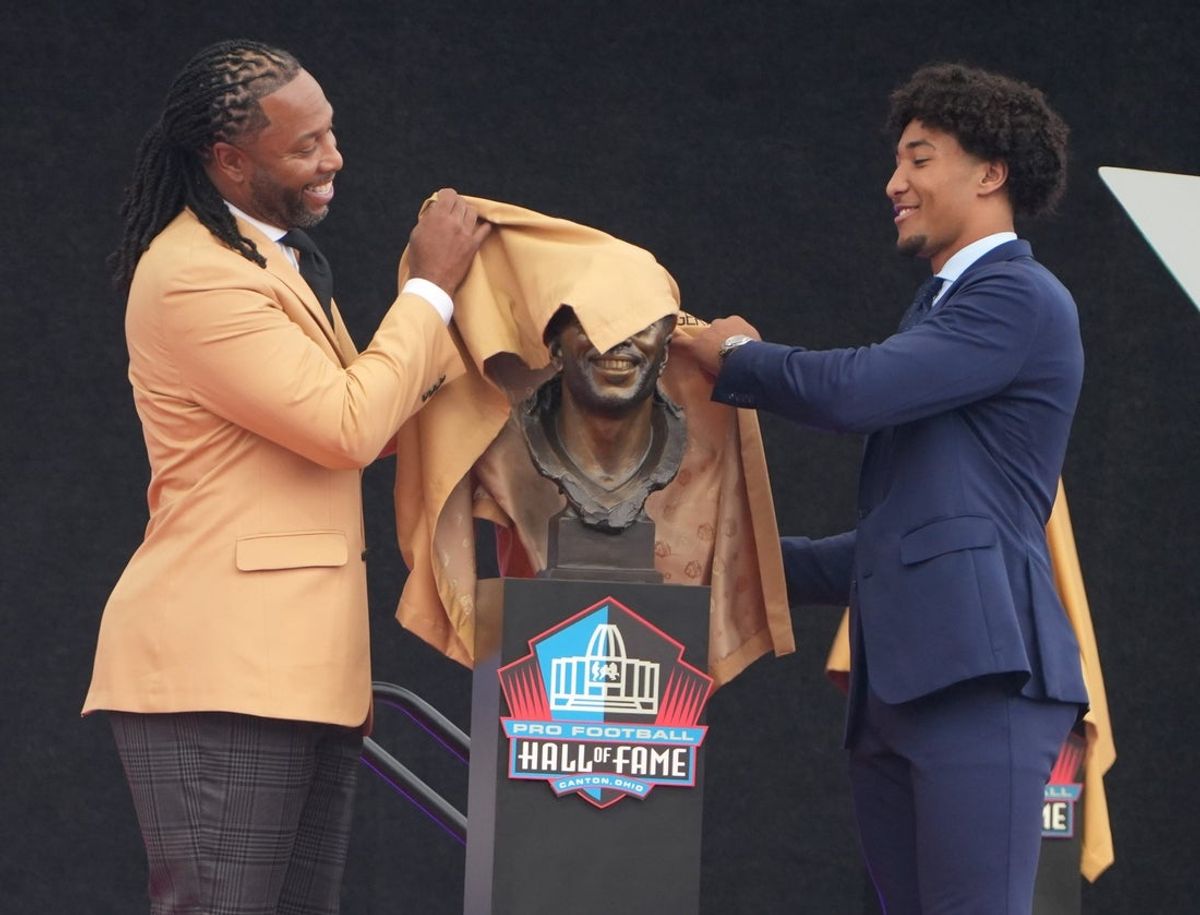
But this weekend of course, that’s exactly where Little Fitzy is headed. He will be enshrined into the Pro Football Hall of Fame in Canton, Ohio, on Saturday as a first-ballot Hall of Famer.

Fitzgerald will be remembered as one of the best and most productive wide receivers in league history after an incredible 17-season career with the Arizona Cardinals.

I have a ton of memories of being around Fitzgerald, but there’s one that stands out among them all.

One day after training camp, a nameless Vikings’ wide receiver camp body was getting extra work on a JUGS machine, catching balls. He was being tutored by Fitzgerald, who was showing this player how to properly approach the incoming ball. This was a child instructing a grown man an NFL team deemed good enough to attend training camp.

Larry Fitzgerald Jr. was special even back then.

In addition to his incredible natural football ability, Larry Fitzgerald Jr. stood out for his politeness and good nature. You could tell he was a good kid from the first time you met him.

There was no I’m-going-to-be-a-star attitude. He was genuine and he worked his tail off with the rest of the ball boys. There was no entitlement. It was as if he was using his time around an NFL camp as an internship for his future. He passed with flying colors.

I’ve always cherished following his career from his days at Pittsburgh in college to his days of dominating the NFL and I’ve enjoyed running into him over the years now and again.

Enjoy Canton, Little Fitzy, you’ve earned it.

#Larry #Fitzgeralds #Hall #Fame #induction #years #making">Larry Fitzgerald’s Hall of Fame induction is 25 years in the making  When I arrived to cover the Minnesota Vikings for the St. Paul Pioneer Press in 2000, it was clear I was dealing with a star-studded roster.The team boasted future Pro Football Hall of Famers; wide receivers Cris Carter and Randy Moss and defensive tackle John Randle. Plus, there were a ton of other stars including quarterback Daunte Culpepper, center Matt Birk and running back Robert Smith. The Vikings were loaded with star power.The talent around the team wasn’t relegated simply to the roster, however.That summer I first laid my eyes on a 16-year-old high school junior named Larry Fitzgerald Jr. The son of a local media member and close friend of Vikings’ head coach Dennis Green, Little Fitzy was a ball boy during training camp and on game days. It turns out, Larry Fitzgerald Jr. is very likely the most famous former NFL ball boy in history.On reporting date, fellow reporter Kevin Seifert pointed out Fitzgerald to me and said “that’s a bad man.” Seifert didn’t say that about any of the actual Vikings that day.Fitzgerald was already known as the best Minnesota high school prospect in years and he was considered one of the best high school players in the country. Seifert told me the buzz was that the kid was, no doubt, headed to the NFL in a half decade or so. Seifert was on the money. I’m not sure the Hall of Fame was mentioned or not.But this weekend of course, that’s exactly where Little Fitzy is headed. He will be enshrined into the Pro Football Hall of Fame in Canton, Ohio, on Saturday as a first-ballot Hall of Famer.Fitzgerald will be remembered as one of the best and most productive wide receivers in league history after an incredible 17-season career with the Arizona Cardinals.I have a ton of memories of being around Fitzgerald, but there’s one that stands out among them all.One day after training camp, a nameless Vikings’ wide receiver camp body was getting extra work on a JUGS machine, catching balls. He was being tutored by Fitzgerald, who was showing this player how to properly approach the incoming ball. This was a child instructing a grown man an NFL team deemed good enough to attend training camp.Larry Fitzgerald Jr. was special even back then.In addition to his incredible natural football ability, Larry Fitzgerald Jr. stood out for his politeness and good nature. You could tell he was a good kid from the first time you met him.There was no I’m-going-to-be-a-star attitude. He was genuine and he worked his tail off with the rest of the ball boys. There was no entitlement. It was as if he was using his time around an NFL camp as an internship for his future. He passed with flying colors.I’ve always cherished following his career from his days at Pittsburgh in college to his days of dominating the NFL and I’ve enjoyed running into him over the years now and again.Enjoy Canton, Little Fitzy, you’ve earned it.  #Larry #Fitzgeralds #Hall #Fame #induction #years #making

Follow Sportstar for extensive coverage of the tenth edition of the TNPL, from live scores and match reports to exclusive analysis and features.

TOSS

Tiruppur Tamizhans won the toss and chose to bowl first.

PLAYING XIs

Nellai Royal Kings: Athish SR(w), D Santhosh Kumar, Ajitesh Guruswamy, U Mukilesh, Rithik Easwaran, Sonu Yadav(c), Muhammed Adnan Khan, Ramalingam Rohit, Emmanuel Cherian, NS Harish, Rocky Bhasker

Tiruppur Tamizhans: Tushar Raheja(w), Amit Sathvik, Pradosh Ranjan Paul, Mohamed Ali, Uthirasamy Sasidev, Ravisrinivasan Sai Kishore(c), M Mathivannan, S Mohan Prasath, R Silambarasan, Esakkimuthu A, T Natarajan

Published on Aug 09, 2026

#TNPL #Live #Allround #batting #display #propels #Nellai #Royal #Kings">TNPL 2026 Live: All-round batting display propels Nellai Royal Kings to 206/8  Follow Sportstar for extensive coverage of the tenth edition of the TNPL, from live scores and match reports to exclusive analysis and features.TOSSTiruppur Tamizhans won the toss and chose to bowl first.PLAYING XIsNellai Royal Kings: Athish SR(w), D Santhosh Kumar, Ajitesh Guruswamy, U Mukilesh, Rithik Easwaran, Sonu Yadav(c), Muhammed Adnan Khan, Ramalingam Rohit, Emmanuel Cherian, NS Harish, Rocky BhaskerTiruppur Tamizhans: Tushar Raheja(w), Amit Sathvik, Pradosh Ranjan Paul, Mohamed Ali, Uthirasamy Sasidev, Ravisrinivasan Sai Kishore(c), M Mathivannan, S Mohan Prasath, R Silambarasan, Esakkimuthu A, T NatarajanPublished on Aug 09, 2026  #TNPL #Live #Allround #batting #display #propels #Nellai #Royal #Kings

Post Comment