×
Kyiv gunman kills 6, takes hostages before being shot dead by Ukraine policeA gunman who killed at least six people in the streets of Kyiv on Saturday before taking hostages and barricading himself in a nearby supermarket has been shot dead by police, Ukrainian officials said.The head of Ukraine’s Interior Ministry, Ihor Klymenko, said in a statement on social media that special tactical police units stormed the store after attempts to contact the gunman with a negotiator failed.The attacker was killed while resisting arrest, he said.Speaking to reporters at the scene, Klymenko said that the government had killed four bystanders while on the street, before entering the supermarket and killing a fifth person.Mayor Vitali Klitschko said that a sixth victim, a young woman, had died from her injuries in the hospital.Special forces officers evacuate a hostage at the site of a shooting incident, in Kyiv, Ukraine, on Saturday. Photo: ReutersKlymenko said that police negotiators spoke with the attacker for roughly 40 minutes before storming the building.#Kyiv #gunman #kills #takes #hostages #shot #dead #Ukraine #policeUkrainian, Kyiv, President Volodymyr Zelensky, supermarket, Holosiivskyi district, Vitali Klitschko, Ukraine, Ihor Klymenko

Kyiv gunman kills 6, takes hostages before being shot dead by Ukraine police

A gunman who killed at least six people in the streets of Kyiv on Saturday before taking hostages and barricading himself in a nearby supermarket has been shot dead by police, Ukrainian officials said.

The head of Ukraine’s Interior Ministry, Ihor Klymenko, said in a statement on social media that special tactical police units stormed the store after attempts to contact the gunman with a negotiator failed.

The attacker was killed while resisting arrest, he said.

Speaking to reporters at the scene, Klymenko said that the government had killed four bystanders while on the street, before entering the supermarket and killing a fifth person.

Mayor Vitali Klitschko said that a sixth victim, a young woman, had died from her injuries in the hospital.

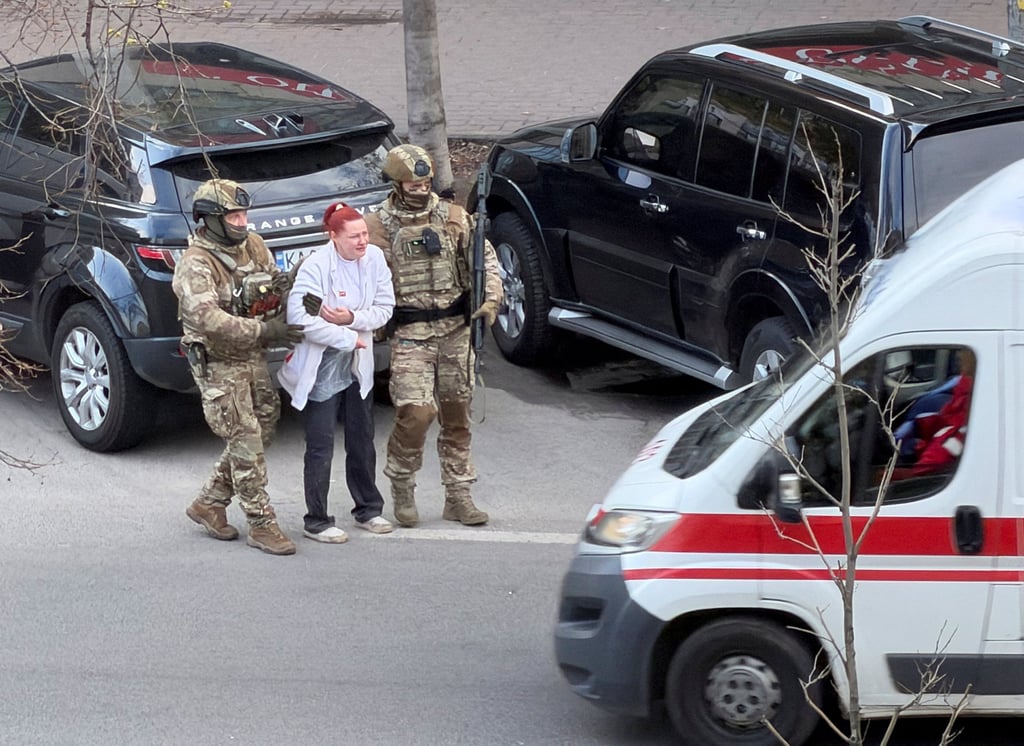
Special forces officers evacuate a hostage at the site of a shooting incident, in Kyiv, Ukraine, on Saturday. Photo: Reuters

Klymenko said that police negotiators spoke with the attacker for roughly 40 minutes before storming the building.

#Kyiv #gunman #kills #takes #hostages #shot #dead #Ukraine #policeUkrainian, Kyiv, President Volodymyr Zelensky, supermarket, Holosiivskyi district, Vitali Klitschko, Ukraine, Ihor Klymenko

A gunman who killed at least six people in the streets of Kyiv on Saturday before taking hostages and barricading himself in a nearby supermarket has been shot dead by police, Ukrainian officials said.

The head of Ukraine’s Interior Ministry, Ihor Klymenko, said in a statement on social media that special tactical police units stormed the store after attempts to contact the gunman with a negotiator failed.

The attacker was killed while resisting arrest, he said.

Speaking to reporters at the scene, Klymenko said that the government had killed four bystanders while on the street, before entering the supermarket and killing a fifth person.

Mayor Vitali Klitschko said that a sixth victim, a young woman, had died from her injuries in the hospital.

Special forces officers evacuate a hostage at the site of a shooting incident, in Kyiv, Ukraine, on Saturday. Photo: Reuters

Klymenko said that police negotiators spoke with the attacker for roughly 40 minutes before storming the building.

Source link
#Kyiv #gunman #kills #takes #hostages #shot #dead #Ukraine #police

Previous post

Spain routs Ukraine to boost Women’s World Cup 2027 qualifying hopes <div id="content-body-70878694" itemprop="articleBody"><p>Edna Imade netted two headers as Spain crushed Ukraine 5-0 to go provisionally level with England at the top of Women’s World Cup 2027 qualifying group A3 on Saturday.</p><p>Only the top team progresses automatically to the tournament in Brazil next year, and European champion England defeated Spain 1-0 at Wembley on Tuesday to claim an early advantage.</p><p>Boasting a perfect record of three wins from three, England faces Iceland in Reykjavik later on Saturday, looking to move back clear of Spain.</p><p>Spain, which lifted the last World Cup in 2023, made light work of Ukraine in sunny Cordoba to boost its goal difference.</p><p>Sonia Bermudez’s side roared into an immediate lead through Bayern Munich striker Imade. She powered home a fine header from Lucia Corrales’s cross before 90 seconds had passed.</p><p><b>ALSO READ | <a href="https://sportstar.thehindu.com/football/fifa-world-cup-2026-new-jersey-transit-fare-fans-travel-charges-ticket-prices/article70877877.ece" target="_blank" rel="nofollow">New Jersey’s $150 transit fare will have ‘chilling effect’ on fans, FIFA warns</a></b></p><p>Spain was without injured three-time Ballon d’Or winner Aitana Bonmati, but her Barcelona team-mate Alexia Putellas ran the show from midfield.</p><p>The visitor almost levelled before the break when Olha Ovdiychuk fired against the post.</p><p>Spain’s second goal was a carbon copy of the first, with Corrales crossing from the left and Imade nodding home just over a minute into the second half.</p><p>Salma Paralluelo hit the post before Maria Mendez headed home the third from Barcelona teenager Vicky Lopez’s cross.</p><p>Eva Navarro notched Spain’s fourth with a deflected effort from the edge of the area, and Lopez showed neat footwork before tapping home the fifth.</p><p>Spain hosts England in Mallorca on June 5, a game it likely has to win if it wants to qualify directly and avoid the play-offs.</p><p class="publish-time" id="end-of-article">Published on Apr 18, 2026</p></div> #Spain #routs #Ukraine #boost #Womens #World #Cup #qualifying #hopes

Next post

Deadspin | Blue Jays’ Max Scherzer aims to hit right notes vs. D-backs <div id=""><section id="0" class=" w-full"><div class="xl:container mx-0 !px-4 py-0 pb-4 !mx-0 !px-0"><img src="https://images.deadspin.com/tr:w-900/28715152.jpg" srcset="https://images.deadspin.com/tr:w-900/28715152.jpg" alt="MLB: Minnesota Twins at Toronto Blue Jays" class="w-full" fetchpriority="high" loading="eager"/><span class="text-0.8 leading-tight">Apr 12, 2026; Toronto, Ontario, CAN; Toronto Blue Jays starting pitcher Max Scherzer (31) pitches to the Minnesota Twins during the second inning at Rogers Centre. Mandatory Credit: John E. Sokolowski-Imagn Images<!-- --> <!-- --> </span></div></section><section id="section-1"> <p>Max Scherzer’s off-day preparation includes time on the piano. Don’t knock it until you try it.</p> </section><section id="section-2"> <p>Scherzer (1-2, 9.58 ERA) will get the ball on Saturday for the Toronto Blue Jays against Zac Gallen (1-1, 3.60) of the Arizona Diamondbacks. The veteran right-handers will meet Saturday in Phoenix in the second game of a three-game set.</p> </section><section id="section-3"> <p>A three-time Cy Young Award winner, Scherzer found a keyboard in a room near the Blue Jays clubhouse on Friday and started tapping out Van Halen’s “Right Now.” He has credited the dexterity required to play the piano with extending his career by helping to relieve the discomfort of a troublesome right thumb injury.</p> </section><section id="section-4"> <p>“When you’re playing different keys and notes and chords, your hands are in very unique positions,” Scherzer told The Athletic’s Ken Rosenthal late in spring training.</p> </section><section id="section-5"> <p>“It makes you really work through your fingertips. By working those muscles in my hand, it got my fingers, ‘quote unquote,’ stronger. All of a sudden, that alleviated the thumb pain.”</p> </section><section id="section-6"> <p>Scherzer will attempt to put the Blue Jays out of their pain on Saturday. The reigning American League champions have lost five of the past six games and are 3-11 in April, occupying last place in the AL East.</p> </section><section id="section-7"> <p>Gallen, 30, also will look to extend an Arizona streak.</p> </section><section id="section-8"> <p>The Diamondbacks have won nine of the past 12 games after beating the Blue Jays 6-3 behind Michael Soroka’s fourth win of the season Friday. </p> </section><section id="section-9"> <p>Gallen pitched five scoreless innings in his most recent start and took a 2-0 lead into the sixth before the Philadelphia Phillies drove him out with five straight hits — including a homer and three doubles — as he took a no-decision in Arizona’s 4-3 victory.</p> </section><br/><section id="section-10"> <p>“I think as a team, we believe in the talent that’s in here,” Gallen said. “I think guys are playing free and not playing scared.”</p> </section> <section id="section-11"> <p>Gallen pitched six scoreless innings in a 1-0 victory over Detroit on April 1, them went five innings in each of his successive two outings.</p> </section><section id="section-12"> <p>He has faced the Blue Jays twice in his career without much success, going 0-1 with a 9.35 ERA in two starts. The last time he pitched against Toronto came in 2024. </p> </section><section id="section-13"> <p>Scherzer allowed one run over six innings in a 5-1 victory over Colorado on March 31 but has given up 10 earned runs in 4 1/3 innings in his two starts since. </p> </section><section id="section-14"> <p>He left his April 6 start against the Los Angeles Dodgers after two innings while dealing with right forearm tightness, but he said that was not a factor in an 8-2 loss to the Minnesota Twins last Sunday. </p> </section><section id="section-15"> <p>The Twins scored eight runs off Scherzer in 2 1/3 innings, with homers from Kody Clemens and Tristan Gray.</p> </section><section id="section-16"> <p>“It actually loosened up on me,” Scherzer said of the forearm after the game. “I felt like it was coming out of my hand better. I was able to throw all of my pitches and as I got out of that outing. I haven’t felt the forearm completely tighten up, so that’s a good sign.”</p> </section><section id="section-17"> <p>Scherzer, 41, is with his seventh team and in his 19th season. He began his career with the Diamondbacks, who selected him with the 11th overall pick in the 2006 MLB Draft out of college at Missouri. In late 2009, he was dealt to the Tigers as part of a three-team, seven-player deal that also involved Curtis Granderson and Edwin Jackson.</p> </section><section id="section-18"> <p>He has started 12 games against Arizona and is 9-0 with a 2.65 ERA. He has struck out 111 and walked 19 in 78 innings.</p> </section><section id="section-19"> <p>–Field Level Media</p> </section></div> #Deadspin #Blue #Jays #Max #Scherzer #aims #hit #notes #Dbacks

Catch up with the most important stories from around Europe and beyond this April 18th, 2026 – latest news, breaking news, World, Business, Entertainment, Politics, Culture, Travel.

#Video #Latest #news #bulletin #April #18th #Midday{id:11940,slug:news,urlSafeValue:news,title:news},{id:12984,slug:world-news,urlSafeValue:world-news,title:World News},{id:25926,slug:top-stories,urlSafeValue:top-stories,title:Latest News},{id:26778,slug:euronews-live,urlSafeValue:euronews-live,title:euronews live}">Video. Latest news bulletin | April 18th, 2026 – Midday
      
                  
              Updated: 18/04/2026 – 12:00 GMT+2
          
              
                    Catch up with the most important stories from around Europe and beyond this April 18th, 2026 – latest news, breaking news, World, Business, Entertainment, Politics, Culture, Travel.
              
                … More


    #Video #Latest #news #bulletin #April #18th #Midday{id:11940,slug:news,urlSafeValue:news,title:news},{id:12984,slug:world-news,urlSafeValue:world-news,title:World News},{id:25926,slug:top-stories,urlSafeValue:top-stories,title:Latest News},{id:26778,slug:euronews-live,urlSafeValue:euronews-live,title:euronews live}

It was the shelling that drove Syrian man Imad Omar Qashit from his home again. Fourteen years ago, he fled from Syria to Lebanon. This time, it was the other way round.

“When Israeli missiles destroyed entire homes in my neighborhood in southern Lebanon’s city of Tyre, we decided it was time to save our lives again,” the 52-year-old told DW.

In early March, Lebanon was drawn into the wider Middle East war after local group Hezbollah, which is backed by Iran, fired rockets into Israel, ostensibly in retaliation for the Israeli killing of Iran’s leader.

On Thursday, a 10-day ceasefire between Israel and Lebanon was brokered by the US but before that, more than 227,549 people had crossed the three official border points from Lebanon into Syria, according to the latest numbers from the United Nation’s International Organization for Migration (IOM). The vast majority, 95%, were Syrians, while 5% were Lebanese nationals.

Lebanon’s health authorities say the death toll from Israel’s attacks on the Hezbollah militia is around 2,196. The ministry does not provide a breakdown by nationality and estimates of how many Syrians are among the killed and injured range widely, from 39 to 315. According to the UN refugee agency UNHCR, more than 1 million Syrian refugees are still registered in Lebanon, with hundreds of thousands more believed to be in the country without registration.

Syrians wait at a border crossing as refugees
More than 270,000 Syrians returned from Lebanon since March even though observers warn the country is not ready to host them Image: Izz Aldien Alqasem/Anadolu Agency/IMAGO

Protracted crisis

Once Qashit and his family arrived back in their home town Maarat al-Numan near Aleppo, they found their house completely destroyed as a result of Syria’s civil war, which only ended in December 2024 after a coalition of rebel groups ousted Syria’s longtime dictator, Bashar Assad.

“There are no houses for rent as the whole city is destroyed,” Qashit told DW. For the time being, they are staying with his sister. 

Another Syrian, Mohammad Jassem al-Brouk, fled Israeli strikes in Lebanon two weeks ago. “It was extremely crowded at the border crossing and it took an entire day to get through,” he told DW.

When he eventually arrived at his family home in the city of Qusair near Homs, he only found remnants of the house. With no other option, he unpacked his tent from the refugee camp in Lebanon, set it up, and is now living in it. Despite his lack of housing, he has no intention of returning to Lebanon. 

Earlier in April, a survey by the UN’s refugee agency, the UNHCR, found that around half of the Syrians they had interviewed also said that they intend to remain permanently in Syria despite economic challenges and limited state services.

“Syrians are returning because Lebanon has become unlivable, rather than Syria being ready to receive them,” Nanar Hawach, senior Syria analyst at the International Crisis Group, confirms. “The government can manage the border but it has no answer for what happens after that,” he said. In his view, the hundreds of thousands of returnees should not be read as a sign that conditions inside Syria have improved.

A boy jumps off the back of the rusted and charred remains of abandoned military vehicles
Areas that were contested during the Syrian civil war are often contaminated with unexploded devices that pose a danger to returning SyriansImage: Arif Hudaverdi Yaman/Anadolu/picture alliance

Legacy of war

Syria continues to struggle with the legacy of more than a decade of conflict. Despite sanctions being lifted and Syria’s return to the international fold, sectarian clashes and political instability still compound the country’s problems.

The World Bank’s damage assessment estimates total reconstruction costs at about $216 billion (€200 billion). Basic services, including education, health care and infrastructure, remain limited and the humanitarian situation for the around 26 million people is  dire.

According to the UN, around 15.6 million Syrians require humanitarian assistance and 13.3 million Syrians are food-insecure. A severe drought in 2025 devastated 95% of rainfed crops, the UN 2025 food security assessment report notes.

“Syria was already in a protracted humanitarian crisis before this new wave of returns,” Hiba Zayadin, senior researcher in the Middle East and North Africa division at Human Rights Watch, told DW. “The infrastructure simply isn’t there to absorb large numbers of people, many of whom left with nothing and are returning to the same.” 

A woman walks next to an ambulance
Before the US-brokered ceasefire, Israel demolished large parts of southern Lebanon and Tyre, prompting Syrian refugees to pack up and leaveImage: Louisa Gouliamaki/REUTERS

Risk of unexploded devices

These are not the only issues. Syria is also one of the most contaminated countries in the world when it comes to explosive remnants. “Years of aerial bombardment, ground fighting and the use of cluster munitions across multiple governorates have left vast areas littered with unexploded ordnance, or UXO, landmines and improvised explosive devices,” Zayadin continued.

“The danger is very real,” Iain Overton confirmed. He’s the executive director of the UK-based organization, Action on Armed Violence (AOAV) which records evidence of armed violence against civilians worldwide.

He also warned that UXO contamination remains particularly acute in areas that have seen sustained fighting and shifting frontlines, including parts of Raqqa, Deir el-Zour, Aleppo, Idlib and rural Homs and Hama. “These are precisely the areas to which many refugees are returning,” he told DW, adding that children and returnees unfamiliar with contaminated environments are especially vulnerable.

“Even in the absence of active hostilities, the legacy of explosive violence continues to kill and injure,” Overton said, adding that the trend is worsening. In 2024, AOAV recorded 238 UXO incidents causing 508 casualties. Of these, 479 were civilians. By 2025, this had risen sharply to 794 incidents and 1,537 casualties, including 1,424 civilians.

For Qashit and his family, recently returned from Lebanon, these is just one more thing to worry about. “My children would not recognize unexploded mines when they are playing outside,” he said, concerned. 

Back to Yarmouk: A Syrian family rebuilds and seeks justice

Edited by: C. Schaer

#Displaced #Iran #war #Lebanon #Syrian #crisis">Displaced by Iran war: out of Lebanon, into Syrian crisisIt was the shelling that drove Syrian man Imad Omar Qashit from his home again. Fourteen years ago, he fled from Syria to Lebanon. This time, it was the other way round.

“When Israeli missiles destroyed entire homes in my neighborhood in southern Lebanon’s city of Tyre, we decided it was time to save our lives again,” the 52-year-old told DW.

In early March, Lebanon was drawn into the wider Middle East war after local group Hezbollah, which is backed by Iran, fired rockets into Israel, ostensibly in retaliation for the Israeli killing of Iran’s leader.

On Thursday, a 10-day ceasefire between Israel and Lebanon was brokered by the US but before that, more than 227,549 people had crossed the three official border points from Lebanon into Syria, according to the latest numbers from the United Nation’s International Organization for Migration (IOM). The vast majority, 95%, were Syrians, while 5% were Lebanese nationals.

Lebanon’s health authorities say the death toll from Israel’s attacks on the Hezbollah militia is around 2,196. The ministry does not provide a breakdown by nationality and estimates of how many Syrians are among the killed and injured range widely, from 39 to 315. According to the UN refugee agency UNHCR, more than 1 million Syrian refugees are still registered in Lebanon, with hundreds of thousands more believed to be in the country without registration.More than 270,000 Syrians returned from Lebanon since March even though observers warn the country is not ready to host them Image: Izz Aldien Alqasem/Anadolu Agency/IMAGO

Protracted crisis

Once Qashit and his family arrived back in their home town Maarat al-Numan near Aleppo, they found their house completely destroyed as a result of Syria’s civil war, which only ended in December 2024 after a coalition of rebel groups ousted Syria’s longtime dictator, Bashar Assad.

“There are no houses for rent as the whole city is destroyed,” Qashit told DW. For the time being, they are staying with his sister. 

Another Syrian, Mohammad Jassem al-Brouk, fled Israeli strikes in Lebanon two weeks ago. “It was extremely crowded at the border crossing and it took an entire day to get through,” he told DW.

When he eventually arrived at his family home in the city of Qusair near Homs, he only found remnants of the house. With no other option, he unpacked his tent from the refugee camp in Lebanon, set it up, and is now living in it. Despite his lack of housing, he has no intention of returning to Lebanon. 

Earlier in April, a survey by the UN’s refugee agency, the UNHCR, found that around half of the Syrians they had interviewed also said that they intend to remain permanently in Syria despite economic challenges and limited state services.

“Syrians are returning because Lebanon has become unlivable, rather than Syria being ready to receive them,” Nanar Hawach, senior Syria analyst at the International Crisis Group, confirms. “The government can manage the border but it has no answer for what happens after that,” he said. In his view, the hundreds of thousands of returnees should not be read as a sign that conditions inside Syria have improved.Areas that were contested during the Syrian civil war are often contaminated with unexploded devices that pose a danger to returning SyriansImage: Arif Hudaverdi Yaman/Anadolu/picture alliance

Legacy of war

Syria continues to struggle with the legacy of more than a decade of conflict. Despite sanctions being lifted and Syria’s return to the international fold, sectarian clashes and political instability still compound the country’s problems.

The World Bank’s damage assessment estimates total reconstruction costs at about 6 billion (€200 billion). Basic services, including education, health care and infrastructure, remain limited and the humanitarian situation for the around 26 million people is  dire.

According to the UN, around 15.6 million Syrians require humanitarian assistance and 13.3 million Syrians are food-insecure. A severe drought in 2025 devastated 95% of rainfed crops, the UN 2025 food security assessment report notes.

“Syria was already in a protracted humanitarian crisis before this new wave of returns,” Hiba Zayadin, senior researcher in the Middle East and North Africa division at Human Rights Watch, told DW. “The infrastructure simply isn’t there to absorb large numbers of people, many of whom left with nothing and are returning to the same.”  Before the US-brokered ceasefire, Israel demolished large parts of southern Lebanon and Tyre, prompting Syrian refugees to pack up and leaveImage: Louisa Gouliamaki/REUTERS

Risk of unexploded devices

These are not the only issues. Syria is also one of the most contaminated countries in the world when it comes to explosive remnants. “Years of aerial bombardment, ground fighting and the use of cluster munitions across multiple governorates have left vast areas littered with unexploded ordnance, or UXO, landmines and improvised explosive devices,” Zayadin continued.

“The danger is very real,” Iain Overton confirmed. He’s the executive director of the UK-based organization, Action on Armed Violence (AOAV) which records evidence of armed violence against civilians worldwide.

He also warned that UXO contamination remains particularly acute in areas that have seen sustained fighting and shifting frontlines, including parts of Raqqa, Deir el-Zour, Aleppo, Idlib and rural Homs and Hama. “These are precisely the areas to which many refugees are returning,” he told DW, adding that children and returnees unfamiliar with contaminated environments are especially vulnerable.

“Even in the absence of active hostilities, the legacy of explosive violence continues to kill and injure,” Overton said, adding that the trend is worsening. In 2024, AOAV recorded 238 UXO incidents causing 508 casualties. Of these, 479 were civilians. By 2025, this had risen sharply to 794 incidents and 1,537 casualties, including 1,424 civilians.

For Qashit and his family, recently returned from Lebanon, these is just one more thing to worry about. “My children would not recognize unexploded mines when they are playing outside,” he said, concerned. 

Back to Yarmouk: A Syrian family rebuilds and seeks justice To view this video please enable JavaScript, and consider upgrading to a web browser that supports HTML5 video

Edited by: C. Schaer
#Displaced #Iran #war #Lebanon #Syrian #crisis

Syria to Lebanon. This time, it was the other way round.

“When Israeli missiles destroyed entire homes in my neighborhood in southern Lebanon’s city of Tyre, we decided it was time to save our lives again,” the 52-year-old told DW.

In early March, Lebanon was drawn into the wider Middle East war after local group Hezbollah, which is backed by Iran, fired rockets into Israel, ostensibly in retaliation for the Israeli killing of Iran’s leader.

On Thursday, a 10-day ceasefire between Israel and Lebanon was brokered by the US but before that, more than 227,549 people had crossed the three official border points from Lebanon into Syria, according to the latest numbers from the United Nation’s International Organization for Migration (IOM). The vast majority, 95%, were Syrians, while 5% were Lebanese nationals.

Lebanon’s health authorities say the death toll from Israel’s attacks on the Hezbollah militia is around 2,196. The ministry does not provide a breakdown by nationality and estimates of how many Syrians are among the killed and injured range widely, from 39 to 315. According to the UN refugee agency UNHCR, more than 1 million Syrian refugees are still registered in Lebanon, with hundreds of thousands more believed to be in the country without registration.

Syrians wait at a border crossing as refugees
More than 270,000 Syrians returned from Lebanon since March even though observers warn the country is not ready to host them Image: Izz Aldien Alqasem/Anadolu Agency/IMAGO

Protracted crisis

Once Qashit and his family arrived back in their home town Maarat al-Numan near Aleppo, they found their house completely destroyed as a result of Syria’s civil war, which only ended in December 2024 after a coalition of rebel groups ousted Syria’s longtime dictator, Bashar Assad.

“There are no houses for rent as the whole city is destroyed,” Qashit told DW. For the time being, they are staying with his sister. 

Another Syrian, Mohammad Jassem al-Brouk, fled Israeli strikes in Lebanon two weeks ago. “It was extremely crowded at the border crossing and it took an entire day to get through,” he told DW.

When he eventually arrived at his family home in the city of Qusair near Homs, he only found remnants of the house. With no other option, he unpacked his tent from the refugee camp in Lebanon, set it up, and is now living in it. Despite his lack of housing, he has no intention of returning to Lebanon. 

Earlier in April, a survey by the UN’s refugee agency, the UNHCR, found that around half of the Syrians they had interviewed also said that they intend to remain permanently in Syria despite economic challenges and limited state services.

“Syrians are returning because Lebanon has become unlivable, rather than Syria being ready to receive them,” Nanar Hawach, senior Syria analyst at the International Crisis Group, confirms. “The government can manage the border but it has no answer for what happens after that,” he said. In his view, the hundreds of thousands of returnees should not be read as a sign that conditions inside Syria have improved.

A boy jumps off the back of the rusted and charred remains of abandoned military vehicles
Areas that were contested during the Syrian civil war are often contaminated with unexploded devices that pose a danger to returning SyriansImage: Arif Hudaverdi Yaman/Anadolu/picture alliance

Legacy of war

Syria continues to struggle with the legacy of more than a decade of conflict. Despite sanctions being lifted and Syria’s return to the international fold, sectarian clashes and political instability still compound the country’s problems.

The World Bank’s damage assessment estimates total reconstruction costs at about $216 billion (€200 billion). Basic services, including education, health care and infrastructure, remain limited and the humanitarian situation for the around 26 million people is  dire.

According to the UN, around 15.6 million Syrians require humanitarian assistance and 13.3 million Syrians are food-insecure. A severe drought in 2025 devastated 95% of rainfed crops, the UN 2025 food security assessment report notes.

“Syria was already in a protracted humanitarian crisis before this new wave of returns,” Hiba Zayadin, senior researcher in the Middle East and North Africa division at Human Rights Watch, told DW. “The infrastructure simply isn’t there to absorb large numbers of people, many of whom left with nothing and are returning to the same.” 

A woman walks next to an ambulance
Before the US-brokered ceasefire, Israel demolished large parts of southern Lebanon and Tyre, prompting Syrian refugees to pack up and leaveImage: Louisa Gouliamaki/REUTERS

Risk of unexploded devices

These are not the only issues. Syria is also one of the most contaminated countries in the world when it comes to explosive remnants. “Years of aerial bombardment, ground fighting and the use of cluster munitions across multiple governorates have left vast areas littered with unexploded ordnance, or UXO, landmines and improvised explosive devices,” Zayadin continued.

“The danger is very real,” Iain Overton confirmed. He’s the executive director of the UK-based organization, Action on Armed Violence (AOAV) which records evidence of armed violence against civilians worldwide.

He also warned that UXO contamination remains particularly acute in areas that have seen sustained fighting and shifting frontlines, including parts of Raqqa, Deir el-Zour, Aleppo, Idlib and rural Homs and Hama. “These are precisely the areas to which many refugees are returning,” he told DW, adding that children and returnees unfamiliar with contaminated environments are especially vulnerable.

“Even in the absence of active hostilities, the legacy of explosive violence continues to kill and injure,” Overton said, adding that the trend is worsening. In 2024, AOAV recorded 238 UXO incidents causing 508 casualties. Of these, 479 were civilians. By 2025, this had risen sharply to 794 incidents and 1,537 casualties, including 1,424 civilians.

For Qashit and his family, recently returned from Lebanon, these is just one more thing to worry about. “My children would not recognize unexploded mines when they are playing outside,” he said, concerned. 

Back to Yarmouk: A Syrian family rebuilds and seeks justice

Edited by: C. Schaer

#Displaced #Iran #war #Lebanon #Syrian #crisis">Displaced by Iran war: out of Lebanon, into Syrian crisis

It was the shelling that drove Syrian man Imad Omar Qashit from his home again. Fourteen years ago, he fled from Syria to Lebanon. This time, it was the other way round.

“When Israeli missiles destroyed entire homes in my neighborhood in southern Lebanon’s city of Tyre, we decided it was time to save our lives again,” the 52-year-old told DW.

In early March, Lebanon was drawn into the wider Middle East war after local group Hezbollah, which is backed by Iran, fired rockets into Israel, ostensibly in retaliation for the Israeli killing of Iran’s leader.

On Thursday, a 10-day ceasefire between Israel and Lebanon was brokered by the US but before that, more than 227,549 people had crossed the three official border points from Lebanon into Syria, according to the latest numbers from the United Nation’s International Organization for Migration (IOM). The vast majority, 95%, were Syrians, while 5% were Lebanese nationals.

Lebanon’s health authorities say the death toll from Israel’s attacks on the Hezbollah militia is around 2,196. The ministry does not provide a breakdown by nationality and estimates of how many Syrians are among the killed and injured range widely, from 39 to 315. According to the UN refugee agency UNHCR, more than 1 million Syrian refugees are still registered in Lebanon, with hundreds of thousands more believed to be in the country without registration.

Syrians wait at a border crossing as refugees
More than 270,000 Syrians returned from Lebanon since March even though observers warn the country is not ready to host them Image: Izz Aldien Alqasem/Anadolu Agency/IMAGO

Protracted crisis

Once Qashit and his family arrived back in their home town Maarat al-Numan near Aleppo, they found their house completely destroyed as a result of Syria’s civil war, which only ended in December 2024 after a coalition of rebel groups ousted Syria’s longtime dictator, Bashar Assad.

“There are no houses for rent as the whole city is destroyed,” Qashit told DW. For the time being, they are staying with his sister. 

Another Syrian, Mohammad Jassem al-Brouk, fled Israeli strikes in Lebanon two weeks ago. “It was extremely crowded at the border crossing and it took an entire day to get through,” he told DW.

When he eventually arrived at his family home in the city of Qusair near Homs, he only found remnants of the house. With no other option, he unpacked his tent from the refugee camp in Lebanon, set it up, and is now living in it. Despite his lack of housing, he has no intention of returning to Lebanon. 

Earlier in April, a survey by the UN’s refugee agency, the UNHCR, found that around half of the Syrians they had interviewed also said that they intend to remain permanently in Syria despite economic challenges and limited state services.

“Syrians are returning because Lebanon has become unlivable, rather than Syria being ready to receive them,” Nanar Hawach, senior Syria analyst at the International Crisis Group, confirms. “The government can manage the border but it has no answer for what happens after that,” he said. In his view, the hundreds of thousands of returnees should not be read as a sign that conditions inside Syria have improved.

A boy jumps off the back of the rusted and charred remains of abandoned military vehicles
Areas that were contested during the Syrian civil war are often contaminated with unexploded devices that pose a danger to returning SyriansImage: Arif Hudaverdi Yaman/Anadolu/picture alliance

Legacy of war

Syria continues to struggle with the legacy of more than a decade of conflict. Despite sanctions being lifted and Syria’s return to the international fold, sectarian clashes and political instability still compound the country’s problems.

The World Bank’s damage assessment estimates total reconstruction costs at about $216 billion (€200 billion). Basic services, including education, health care and infrastructure, remain limited and the humanitarian situation for the around 26 million people is  dire.

According to the UN, around 15.6 million Syrians require humanitarian assistance and 13.3 million Syrians are food-insecure. A severe drought in 2025 devastated 95% of rainfed crops, the UN 2025 food security assessment report notes.

“Syria was already in a protracted humanitarian crisis before this new wave of returns,” Hiba Zayadin, senior researcher in the Middle East and North Africa division at Human Rights Watch, told DW. “The infrastructure simply isn’t there to absorb large numbers of people, many of whom left with nothing and are returning to the same.” 

A woman walks next to an ambulance
Before the US-brokered ceasefire, Israel demolished large parts of southern Lebanon and Tyre, prompting Syrian refugees to pack up and leaveImage: Louisa Gouliamaki/REUTERS

Risk of unexploded devices

These are not the only issues. Syria is also one of the most contaminated countries in the world when it comes to explosive remnants. “Years of aerial bombardment, ground fighting and the use of cluster munitions across multiple governorates have left vast areas littered with unexploded ordnance, or UXO, landmines and improvised explosive devices,” Zayadin continued.

“The danger is very real,” Iain Overton confirmed. He’s the executive director of the UK-based organization, Action on Armed Violence (AOAV) which records evidence of armed violence against civilians worldwide.

He also warned that UXO contamination remains particularly acute in areas that have seen sustained fighting and shifting frontlines, including parts of Raqqa, Deir el-Zour, Aleppo, Idlib and rural Homs and Hama. “These are precisely the areas to which many refugees are returning,” he told DW, adding that children and returnees unfamiliar with contaminated environments are especially vulnerable.

“Even in the absence of active hostilities, the legacy of explosive violence continues to kill and injure,” Overton said, adding that the trend is worsening. In 2024, AOAV recorded 238 UXO incidents causing 508 casualties. Of these, 479 were civilians. By 2025, this had risen sharply to 794 incidents and 1,537 casualties, including 1,424 civilians.

For Qashit and his family, recently returned from Lebanon, these is just one more thing to worry about. “My children would not recognize unexploded mines when they are playing outside,” he said, concerned. 

Back to Yarmouk: A Syrian family rebuilds and seeks justice

Edited by: C. Schaer

#Displaced #Iran #war #Lebanon #Syrian #crisis

Post Comment