
It was in the year of our Lord 1373, when Julian of Norwich was 30 years old, that she suffered a terrifying 3 day illness. In the high summer of that year, the local curate offered her last rites. While the rites were being conducted, Julian recollects in her writings that she began to have visions. Recording the visions she experienced while ill would become her life’s work. That work has been loosely adapted by Caroline Golum and Laurence Bond into Revelations of Divine Love, and it is that film I am reviewing today.
There is little known of the anchoress who was Julian of Norwich. Indeed, that is not even the woman’s actual name. Rather, it’s the name of the cloister wherein she would spend the remaining 40 years of her life. Revelations of Divine Love limits its version of events to Julian’s writings. The woman referred to as Julian was alive for some fascinating bits of history. She was a child when the Black Death hit, and that plague decimated England and continental Europe. In her middle age, the Peasants’ Revolt of 1381 struck. Golum chooses to include a small potential origin for The Peasants’ Revolt, and it fits in nicely with the daily actions of a woman who lives as an anchoress.
For the uninitiated, an Anchoress – as we witness in Revelations of Divine Love – is a woman who has volunteered to isolate herself in a sealed off room in a monastery for nuns. This is referred to as a cloister. There she devotes herself to many hours of writing, contemplation, and praying on behalf of her visitors. In that time, people would visit the cloister and seek out the Anchoress to request that she pray on their behalf. They would seek wisdom, and they would also provide gifts of food and clothing, which would sustain the Anchoress.
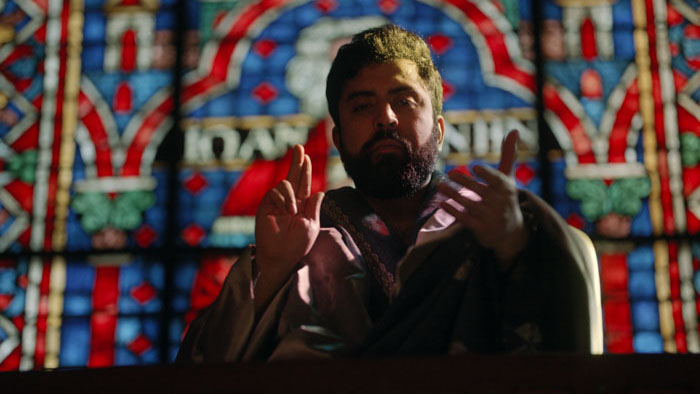
“Recording the visions she experienced while ill would become her life’s work.”
During her time at the cloister, Julian would prepare two manuscripts. The Short Writing and the Long Writing. It is The Long Writing that is the basis for the collection known as Revelations of Divine Love. And what is this revelation I hear you ask? Simply, it is a revelation of the extent of Jesus’ love. What that revelation entails, and why she chose to lead a life of solitude in order to write it all down are details I shall not divulge, dear reader. Instead, you must seek this film out in order to glean those lessons.
This is the second film from Caroline Golum. It is a wonderful piece of theological history. Tessa Strain was cast as Julian, and she embodies the role fully. Whereas some of the other acting is uneven in this film, Strain absolutely commits to the portrayal of Julian as a pious visionary who struggles to understand the lessons Jesus has bestowed upon her when she was deathly ill. Revelations of Divine Love is filmed, staged, and prepared much like a medieval biopic of the 60’s and 70’s. The font type screams Beckett and The Lion in Winter. The costumes look like authentically homespun wool. Cinematographer Gabe Elder captures Revelations of Divine Love in the same almost high definition aesthetic used by the BBC in the 70’s. I loved every minute of Revelations of Divine Love, dear reader.
If you enjoy history, especially English history, or are into theological cinema, check out Revelations of Divine Love when it finds its way to you. This is heady and passionate work. Truly, Revelations of Divine Love is one for the ages.
Source link
#Revelations #Divine #Love #Film #Threat


Post Comment