![The boy who asked for more: Behind the rise of Vaibhav Sooryavanshi “Abhi nahin… abhi toh thoda aur batting karna hai…”A strident voice cut through the hush of a fading afternoon at the Beckenham County Ground, where India’s Under-19 team had just endured a long, draining session ahead of its Youth Test against England U-19.One boy, however, wasn’t ready to leave. Not yet. He wanted more: more balls, more time, more of the crease.The coaches exchanged confused glances before giving in. Thirty more minutes.He batted on, unhurried and unwilling to surrender the moment. It eventually took the ground staff to step in, a gentle reminder that the day was done, for him to finally walk off, bat tucked under his arm, head still somewhere in the middle.But the day was far from over.As he sauntered towards the dressing room, a small group of girls, dressed in the pink and blue of the Rajasthan Royals (RR), called out his name from outside the boundary rope.He paused. Slightly overwhelmed, but smiling.“Samajh nahin aa raha hai bhaiya. Yeh sab meri photo kyun le rahein hain?”There was no pretence in that awkward query. Just the disarming honesty of a 14-year-old.It’s been a year since then. By now, Vaibhav Sooryavanshi must know what the fuss is about.Having made his First-Class debut for Bihar at just 12, Sooryavanshi has spent the last few years dismantling bowling attacks far more experienced than him. His exploits for his State and India U-19 earned him an Indian Premier League (IPL) contract with RR. He wasted little time in justifying the hype, smashing a breathtaking 100 off 35 balls in only his second game.What followed silenced any lingering doubt. In the Vijay Hazare Trophy, representing Bihar against Arunachal Pradesh, he hammered a stunning 190 off 84 balls, breaking AB de Villiers’ record for the fastest 150 in List A cricket.There’s more.Earlier this year, he emerged as India’s leading run-scorer at the U-19 World Cup, amassing 439 runs at an average of 62.71 and a staggering strike rate of 169.49, with fifties against Afghanistan, Zimbabwe and Bangladesh.In the ongoing edition of the IPL, he has raced to 246 runs in his first six matches at 236.54, taking apart some of the best in the business, including Jasprit Bumrah, with a defiance that belies his age.Understandably, the calls for fast-tracking him into India’s senior side have only grown louder.Sooryavanshi turned 15 in March this year, which means that, according to the International Cricket Council’s (ICC) Minimum Age Eligibility criteria, he can represent the senior national side.The rule states: “A player will only be eligible to represent a National Cricket Federation in an International Match (including ICC Events and U-19 Events) if he or she is aged 15 or over on the relevant squad submission date (in the case of ICC Events including U-19 Events) or on the date of the first match of the series/tournament to be played (in the case of all other International Matches).”A large section of the cricketing fraternity is of the opinion that Sooryavanshi should be picked for India’s T20I tour to Ireland in June. That would make the Samastipur-born the youngest player to debut for India, surpassing Sachin Tendulkar, who earned his first cap at 16.However, Pakistan’s Hasan Raza, who debuted at 14 years and 233 days in 1996, would still remain the youngest to have made an international appearance.Whether it is too soon for Sooryavanshi to wear the hallowed Blues can be a debate for another day. What is undeniable is that behind the baby face lies a rare mix of audacity and assurance, perhaps even the outline of India’s next big story.One call awayThe transformation, in many ways, has been as rapid as it has been remarkable. Let’s rewind to January 2024. Zubin Bharucha, director of High Performance at RR, received a call from Samar Qadri, a former Bihar cricketer and a scout associated with the IPL franchise.Qadri spoke enthusiastically about a young player who had begun attracting attention immediately after making his First-Class debut.Although Qadri believed the kid warranted serious consideration, Bharucha approached the matter with measured restraint.“Everyone wanted to know who this 12-year-old making his Ranji debut was, and that’s when Samar told me about his talent. My thinking was clear: let’s see him bat live and put him under pressure at the trials,” Bharucha tells Sportstar.Interest from other franchises soon followed, but RR maintained a particularly close watch, thanks to Qadri’s timely updates. As Sooryavanshi continued to perform for India U-19, internal discussions gathered momentum, eventually culminating in a message from talent identification coordinator Akshay Karanje: “There’s an amazing young player who deserves a look in…”That one text set things in motion.The Boy WonderSooryavanshi was invited to the Royals’ academy in Talegaon for trials, where Bharucha had his first close look.Curiosity prompted a simple question: who is your favourite cricketer? Bharucha expected an answer like Rishabh Pant, given their similarity in approach.But Sooryavanshi’s response surprised him.“Brian Lara,” he said.The reply was unexpected, not just because of the generational gap, but because it hinted at a deeper engagement with the game. Sooryavanshi had gone back, watched Lara’s batting, studied it, and internalised aspects of it.As the trials progressed, those influences began to surface.“There is an almost Laraesque aspect in his game,” Bharucha says. “He has got a lovely backlift that goes over his head and comes through. It’s very rare. The bat actually crosses the vertical, almost goes in front of his hands and wrists. It’s unbelievable.”Even then, Bharucha chose not to rush to a conclusion. He preferred evidence under pressure.When Sooryavanshi faced a left-arm quick during the trials, Bharucha anticipated a difficult start.Instead, he witnessed a moment that shifted his perspective. A delivery expected to beat the outside edge was dispatched over extra cover for six.A glitch in the matrix, Bharucha might have thought, before asking Sooryavanshi to stay back for a more intense test. Side-arm specialists, capable of delivering at speeds touching 157-158 kmph, were instructed to test him with a new ball.Bharucha thought he was in command.“I was clear in my head that this kid won’t have it easy now.”Sooryavanshi began cautiously, leaving the initial deliveries with almost ascetic discipline. Then came the statement.“As the sidearmer continued to hit the deck hard, Sooryavanshi smashed two straight sixes over the sightscreen. Back to back. I asked for the speed, and was surprised to know that they were 155 kph and 157 kmph respectively. That was unbelievable!”Bharucha was seeing flashes of a young Tendulkar. That was when he became “100 per cent sure” that RR had to sign him.As soon as the trials ended for the day, he texted Jake Lush McCrum, then CEO of the franchise: “All plans gone for a toss, boss. Generational talent on display at trials.”A curious McCrum wanted to know more. Bharucha simply asked him to set aside Rs. 10 crore for Sooryavanshi at the auction before adding that the lad was “probably better than [Yashasvi] Jaiswal when he first came in.”“This guy is only 13. Probably the best 13-year-old in the history of our sport after SRT,” Bharucha wrote.Rahul Dravid, then head coach, was the next to be informed.Royals eventually secured Sooryavanshi for just Rs. 1.1 crore. The real challenge, however, was ensuring he was not swayed by money and fame.Dravid believed the focus should not merely be on development, but also on protection, creating an environment where the youngster could grow without being overwhelmed by external pressures.“Rahul was very clear about it. He brought all these guys into the room and basically laid out how we are supposed to let this kid be a kid,” Bharucha says.The philosophy has endured.Under Kumar Sangakkara, the emphasis remains on preserving Sooryavanshi’s natural approach while ensuring he is not burdened by expectations. During pre-season, he spends most of his time at the Talegaon facility under the watchful eye of manager Romi Bhinder, whom he considers a guardian.Over the years, the Royals have transformed several young cricketers into stars, from Ravindra Jadeja to Sanju Samson and now Jaiswal. Bharucha believes the environment has been key.“When Dhruv Jurel came in, he saw Jaiswal spending hours at the nets and making it to the national team. So Dhruv followed. Then Riyan Parag. And now Vaibhav sees them doing the same,” Bharucha says, adding: “This is a very contagious habit, perhaps the best thing to happen in Indian cricket!”Perhaps it is. But it is imperative that Sooryavanshi, given his age, is handled carefully, especially considering how talents like Prithvi Shaw have faded despite promising starts.Sangakkara, however, wants him to stay in the present.“For Vaibhav, the most important thing is to enjoy playing cricket. And he must never lose that freedom,” he says.“Failure is a very strong word. My message to Vaibhav is that he’s got to enjoy everything. Whether it’s 100 off 35 balls, 50 off 15, or a first-ball duck, you’re allowed to score runs, and you’re allowed to fail.”It helps that Sooryavanshi remains a kid at heart. Jitesh Sharma, who captained him in India A, had said, “He is very professional on the field, but off the field, he is (still a kid)… I’m trying my best, asking him not to eat ice cream at night. But he still has those cravings.” Young Turk: Rajasthan Royals opener Vaibhav Sooryavanshi, 14 at the time, made history as the youngest player to hit a century in men’s T20s when he smacked 101 from 38 balls in 2025 against Gujarat Titans.
| Photo Credit:
R.V. MOORTHY
Young Turk: Rajasthan Royals opener Vaibhav Sooryavanshi, 14 at the time, made history as the youngest player to hit a century in men’s T20s when he smacked 101 from 38 balls in 2025 against Gujarat Titans.
| Photo Credit:
R.V. MOORTHY
The A-B-C-D of CricketBack in Patna, Manish Ojha reflects on a journey that began in far more modest surroundings.He still remembers the day in 2018, when Sooryavanshi came to Ojha’s GenNex Academy in the city, holding his father Sanjeev’s hand. The boy had just been gifted a Kashmiri willow on his birthday, and Sanjeev, a failed cricketer himself, wanted Ojha to work with his son.That’s how the narrative began to take shape.“When Vaibhav came to me, he started from the A-B-C-D of cricket. So, the technical inputs or processes that he was taught, he never doubted,” Ojha says. “He was a small kid and, for him, the belief system in his coach was immense. He must have been between 8-9 years old. So, the technical aspects that I gave him, he used to adopt very quickly,” Ojha reminisces. Initially, Ojha would make Sooryavanshi repeat the same exercise all day. Strong bond: From early drills in Patna to bigger stages, Manish Ojha with Vaibhav Sooryavanshi — a journey still in motion.
| Photo Credit:
Special Arrangement
Strong bond: From early drills in Patna to bigger stages, Manish Ojha with Vaibhav Sooryavanshi — a journey still in motion.
| Photo Credit:
Special Arrangement
“(When teaching Sooryavanshi how to play the front-foot drive) Around 70 per cent of the balls that day would be for him to go for the front-foot drive. I tried to maintain continuity. He used to try and execute it in the best way possible,” he says. Later, the focus shifted entirely to strategy and planning.“He was put in open-air match simulations. There used to be targets, like trying to find out how many runs he could make in 20 overs. Or how to protect his wicket in a 40-over game? How does one rotate strike then? How does one contribute to the team’s overall total? According to such situations, we started giving him plans. And he used to play accordingly.”While Ojha takes pride in watching his ward scale new heights, he acknowledges there were certain “invisible flaws” in Sooryavanshi’s game, ones the youngster worked through and refined.“You will see that he bats very aggressively. And most aggressive batters use the bottom hand a lot,” he says. “When you initiate any shot with the bottom hand, the downswing of the bat is a little dodgy. The flow of the bat deviates from the line slightly during shot-making. So, that is one thing that Vaibhav has improved. We have been marking him for a long time.”If Sooryavanshi eventually makes the Indian team, he will be the first cricketer from Bihar to don the national colours since the State was reinstated as a BCCI affiliate in 2018.In the past, several cricketers from the undivided State, including Subroto Banerjee and Syed Saba Karim, have featured for India. However, after the formation of Jharkhand, Mahendra Singh Dhoni, Ishan Kishan, Shahbaz Nadeem and several others have represented the new State, even as Bihar remained suspended from the BCCI due to political infighting. In recent years, a couple of Bihar-born players like Mukesh Kumar and Akash Deep have represented India, but both played domestic cricket for Bengal. Stamping authority: Led by the then 14-year-old Vaibhav Sooryavanshi’s century, India secured a sixth Under-19 World Cup title in Harare earlier this year.
| Photo Credit:
Getty Images
Stamping authority: Led by the then 14-year-old Vaibhav Sooryavanshi’s century, India secured a sixth Under-19 World Cup title in Harare earlier this year.
| Photo Credit:
Getty Images
Playing the ball, not the bowlerAt the local level, the lack of serious competition made things relatively easy. But at the highest tier, the demands are far greater.“The heavy bottom-hand domination is still there. There is a quick bat flow, but he manages it somehow,” Ojha says, referring to the recent game against Royal Challengers Bengaluru, where his ward handled the seasoned Bhuvneshwar Kumar tactfully.“When Vaibhav faced Bhuvneshwar’s ball (second ball of Bhuvneshwar’s second over), if he had shifted his whole body towards mid-on instead of opening up his back shoulder and keeping the bat’s downswing right, he would have been out. But he controlled himself so well on the batswing that it became a six,” Ojha explains.“Even in the first over (of Bhuvneshwar), his backlift was so high, but he managed to connect the ball right next to his toe and it raced away for four,” he adds.Ojha admits he is often struck by how Sooryavanshi continues to thrive, finding answers even while carrying a clear technical flaw.“We were expecting bowlers to target the gap that opens up between the bat and pad when you use a lot of bottom hand. You tend to go against your line and there is a possibility of getting out… In the IPL, there are so many big coaches and players, and we thought they would detect the loophole easily. But Vaibhav has managed it well. He has been able to work on it.”Sooryavanshi was the raging trend on social media after he fearlessly smashed Mumbai Indians’ Bumrah for two sixes in an over. And, of course, there was no one happier than Ojha.“It was a very proud moment,” he says. “But a few things have to be taken into consideration here. Firstly, Vaibhav is a player who initiates. He is willing to take risks. Secondly, when he is making so many runs, his confidence is very high. And the third factor is that he sticks to his strategy and planning. Whatever target the team has, he is ready to strike from the very first ball,” Ojha continues.“If you let the bowler dominate your mind, then he will not let you bat. Especially at this level, if you start thinking about the bowler’s face value, his records, his reputation, then you will not be able to play. You need to play by watching the ball and making your judgement according to its merit.”Despite being among the world’s finest, Bumrah was left looking helpless against Sooryavanshi.“Bumrah is a player with so many years of experience. But when Vaibhav hit that six, he was not playing Bumrah. He was playing Bumrah’s ball. This mindset is instilled within him. It doesn’t matter who is bowling,” Ojha says.It is a simple idea, but one that requires immense clarity to execute at the highest level. Perhaps that is what sets Sooryavanshi apart. The ability to remain anchored in the moment, to see the ball rather than the reputation attached to it, to trust instinct without losing structure.The journey ahead will bring its own set of challenges, as every promising career inevitably does. That’s why, for now, the essence remains unchanged.The boy at Beckenham, asking for a few more minutes. The teenager unsure why people wanted his photograph. And the cricketer who, despite everything, still seems driven by that one simple desire.“Abhi nahin… abhi toh thoda aur batting karna hai…”Published on Apr 22, 2026 #boy #asked #rise #Vaibhav #Sooryavanshi](https://i0.wp.com/ss-i.thgim.com/public/incoming/e9rzon/article70891376.ece/alternates/FREE_1200/31_RVM_6721.jpg?ssl=1 "The boy who asked for more: Behind the rise of Vaibhav Sooryavanshi “Abhi nahin… abhi toh thoda aur batting karna hai…”A strident voice cut through the hush of a fading afternoon at the Beckenham County Ground, where India’s Under-19 team had just endured a long, draining session ahead of its Youth Test against England U-19.One boy, however, wasn’t ready to leave. Not yet. He wanted more: more balls, more time, more of the crease.The coaches exchanged confused glances before giving in. Thirty more minutes.He batted on, unhurried and unwilling to surrender the moment. It eventually took the ground staff to step in, a gentle reminder that the day was done, for him to finally walk off, bat tucked under his arm, head still somewhere in the middle.But the day was far from over.As he sauntered towards the dressing room, a small group of girls, dressed in the pink and blue of the Rajasthan Royals (RR), called out his name from outside the boundary rope.He paused. Slightly overwhelmed, but smiling.“Samajh nahin aa raha hai bhaiya. Yeh sab meri photo kyun le rahein hain?”There was no pretence in that awkward query. Just the disarming honesty of a 14-year-old.It’s been a year since then. By now, Vaibhav Sooryavanshi must know what the fuss is about.Having made his First-Class debut for Bihar at just 12, Sooryavanshi has spent the last few years dismantling bowling attacks far more experienced than him. His exploits for his State and India U-19 earned him an Indian Premier League (IPL) contract with RR. He wasted little time in justifying the hype, smashing a breathtaking 100 off 35 balls in only his second game.What followed silenced any lingering doubt. In the Vijay Hazare Trophy, representing Bihar against Arunachal Pradesh, he hammered a stunning 190 off 84 balls, breaking AB de Villiers’ record for the fastest 150 in List A cricket.There’s more.Earlier this year, he emerged as India’s leading run-scorer at the U-19 World Cup, amassing 439 runs at an average of 62.71 and a staggering strike rate of 169.49, with fifties against Afghanistan, Zimbabwe and Bangladesh.In the ongoing edition of the IPL, he has raced to 246 runs in his first six matches at 236.54, taking apart some of the best in the business, including Jasprit Bumrah, with a defiance that belies his age.Understandably, the calls for fast-tracking him into India’s senior side have only grown louder.Sooryavanshi turned 15 in March this year, which means that, according to the International Cricket Council’s (ICC) Minimum Age Eligibility criteria, he can represent the senior national side.The rule states: “A player will only be eligible to represent a National Cricket Federation in an International Match (including ICC Events and U-19 Events) if he or she is aged 15 or over on the relevant squad submission date (in the case of ICC Events including U-19 Events) or on the date of the first match of the series/tournament to be played (in the case of all other International Matches).”A large section of the cricketing fraternity is of the opinion that Sooryavanshi should be picked for India’s T20I tour to Ireland in June. That would make the Samastipur-born the youngest player to debut for India, surpassing Sachin Tendulkar, who earned his first cap at 16.However, Pakistan’s Hasan Raza, who debuted at 14 years and 233 days in 1996, would still remain the youngest to have made an international appearance.Whether it is too soon for Sooryavanshi to wear the hallowed Blues can be a debate for another day. What is undeniable is that behind the baby face lies a rare mix of audacity and assurance, perhaps even the outline of India’s next big story.One call awayThe transformation, in many ways, has been as rapid as it has been remarkable. Let’s rewind to January 2024. Zubin Bharucha, director of High Performance at RR, received a call from Samar Qadri, a former Bihar cricketer and a scout associated with the IPL franchise.Qadri spoke enthusiastically about a young player who had begun attracting attention immediately after making his First-Class debut.Although Qadri believed the kid warranted serious consideration, Bharucha approached the matter with measured restraint.“Everyone wanted to know who this 12-year-old making his Ranji debut was, and that’s when Samar told me about his talent. My thinking was clear: let’s see him bat live and put him under pressure at the trials,” Bharucha tells Sportstar.Interest from other franchises soon followed, but RR maintained a particularly close watch, thanks to Qadri’s timely updates. As Sooryavanshi continued to perform for India U-19, internal discussions gathered momentum, eventually culminating in a message from talent identification coordinator Akshay Karanje: “There’s an amazing young player who deserves a look in…”That one text set things in motion.The Boy WonderSooryavanshi was invited to the Royals’ academy in Talegaon for trials, where Bharucha had his first close look.Curiosity prompted a simple question: who is your favourite cricketer? Bharucha expected an answer like Rishabh Pant, given their similarity in approach.But Sooryavanshi’s response surprised him.“Brian Lara,” he said.The reply was unexpected, not just because of the generational gap, but because it hinted at a deeper engagement with the game. Sooryavanshi had gone back, watched Lara’s batting, studied it, and internalised aspects of it.As the trials progressed, those influences began to surface.“There is an almost Laraesque aspect in his game,” Bharucha says. “He has got a lovely backlift that goes over his head and comes through. It’s very rare. The bat actually crosses the vertical, almost goes in front of his hands and wrists. It’s unbelievable.”Even then, Bharucha chose not to rush to a conclusion. He preferred evidence under pressure.When Sooryavanshi faced a left-arm quick during the trials, Bharucha anticipated a difficult start.Instead, he witnessed a moment that shifted his perspective. A delivery expected to beat the outside edge was dispatched over extra cover for six.A glitch in the matrix, Bharucha might have thought, before asking Sooryavanshi to stay back for a more intense test. Side-arm specialists, capable of delivering at speeds touching 157-158 kmph, were instructed to test him with a new ball.Bharucha thought he was in command.“I was clear in my head that this kid won’t have it easy now.”Sooryavanshi began cautiously, leaving the initial deliveries with almost ascetic discipline. Then came the statement.“As the sidearmer continued to hit the deck hard, Sooryavanshi smashed two straight sixes over the sightscreen. Back to back. I asked for the speed, and was surprised to know that they were 155 kph and 157 kmph respectively. That was unbelievable!”Bharucha was seeing flashes of a young Tendulkar. That was when he became “100 per cent sure” that RR had to sign him.As soon as the trials ended for the day, he texted Jake Lush McCrum, then CEO of the franchise: “All plans gone for a toss, boss. Generational talent on display at trials.”A curious McCrum wanted to know more. Bharucha simply asked him to set aside Rs. 10 crore for Sooryavanshi at the auction before adding that the lad was “probably better than [Yashasvi] Jaiswal when he first came in.”“This guy is only 13. Probably the best 13-year-old in the history of our sport after SRT,” Bharucha wrote.Rahul Dravid, then head coach, was the next to be informed.Royals eventually secured Sooryavanshi for just Rs. 1.1 crore. The real challenge, however, was ensuring he was not swayed by money and fame.Dravid believed the focus should not merely be on development, but also on protection, creating an environment where the youngster could grow without being overwhelmed by external pressures.“Rahul was very clear about it. He brought all these guys into the room and basically laid out how we are supposed to let this kid be a kid,” Bharucha says.The philosophy has endured.Under Kumar Sangakkara, the emphasis remains on preserving Sooryavanshi’s natural approach while ensuring he is not burdened by expectations. During pre-season, he spends most of his time at the Talegaon facility under the watchful eye of manager Romi Bhinder, whom he considers a guardian.Over the years, the Royals have transformed several young cricketers into stars, from Ravindra Jadeja to Sanju Samson and now Jaiswal. Bharucha believes the environment has been key.“When Dhruv Jurel came in, he saw Jaiswal spending hours at the nets and making it to the national team. So Dhruv followed. Then Riyan Parag. And now Vaibhav sees them doing the same,” Bharucha says, adding: “This is a very contagious habit, perhaps the best thing to happen in Indian cricket!”Perhaps it is. But it is imperative that Sooryavanshi, given his age, is handled carefully, especially considering how talents like Prithvi Shaw have faded despite promising starts.Sangakkara, however, wants him to stay in the present.“For Vaibhav, the most important thing is to enjoy playing cricket. And he must never lose that freedom,” he says.“Failure is a very strong word. My message to Vaibhav is that he’s got to enjoy everything. Whether it’s 100 off 35 balls, 50 off 15, or a first-ball duck, you’re allowed to score runs, and you’re allowed to fail.”It helps that Sooryavanshi remains a kid at heart. Jitesh Sharma, who captained him in India A, had said, “He is very professional on the field, but off the field, he is (still a kid)… I’m trying my best, asking him not to eat ice cream at night. But he still has those cravings.” Young Turk: Rajasthan Royals opener Vaibhav Sooryavanshi, 14 at the time, made history as the youngest player to hit a century in men’s T20s when he smacked 101 from 38 balls in 2025 against Gujarat Titans.
| Photo Credit:
R.V. MOORTHY
Young Turk: Rajasthan Royals opener Vaibhav Sooryavanshi, 14 at the time, made history as the youngest player to hit a century in men’s T20s when he smacked 101 from 38 balls in 2025 against Gujarat Titans.
| Photo Credit:
R.V. MOORTHY
The A-B-C-D of CricketBack in Patna, Manish Ojha reflects on a journey that began in far more modest surroundings.He still remembers the day in 2018, when Sooryavanshi came to Ojha’s GenNex Academy in the city, holding his father Sanjeev’s hand. The boy had just been gifted a Kashmiri willow on his birthday, and Sanjeev, a failed cricketer himself, wanted Ojha to work with his son.That’s how the narrative began to take shape.“When Vaibhav came to me, he started from the A-B-C-D of cricket. So, the technical inputs or processes that he was taught, he never doubted,” Ojha says. “He was a small kid and, for him, the belief system in his coach was immense. He must have been between 8-9 years old. So, the technical aspects that I gave him, he used to adopt very quickly,” Ojha reminisces. Initially, Ojha would make Sooryavanshi repeat the same exercise all day. Strong bond: From early drills in Patna to bigger stages, Manish Ojha with Vaibhav Sooryavanshi — a journey still in motion.
| Photo Credit:
Special Arrangement
Strong bond: From early drills in Patna to bigger stages, Manish Ojha with Vaibhav Sooryavanshi — a journey still in motion.
| Photo Credit:
Special Arrangement
“(When teaching Sooryavanshi how to play the front-foot drive) Around 70 per cent of the balls that day would be for him to go for the front-foot drive. I tried to maintain continuity. He used to try and execute it in the best way possible,” he says. Later, the focus shifted entirely to strategy and planning.“He was put in open-air match simulations. There used to be targets, like trying to find out how many runs he could make in 20 overs. Or how to protect his wicket in a 40-over game? How does one rotate strike then? How does one contribute to the team’s overall total? According to such situations, we started giving him plans. And he used to play accordingly.”While Ojha takes pride in watching his ward scale new heights, he acknowledges there were certain “invisible flaws” in Sooryavanshi’s game, ones the youngster worked through and refined.“You will see that he bats very aggressively. And most aggressive batters use the bottom hand a lot,” he says. “When you initiate any shot with the bottom hand, the downswing of the bat is a little dodgy. The flow of the bat deviates from the line slightly during shot-making. So, that is one thing that Vaibhav has improved. We have been marking him for a long time.”If Sooryavanshi eventually makes the Indian team, he will be the first cricketer from Bihar to don the national colours since the State was reinstated as a BCCI affiliate in 2018.In the past, several cricketers from the undivided State, including Subroto Banerjee and Syed Saba Karim, have featured for India. However, after the formation of Jharkhand, Mahendra Singh Dhoni, Ishan Kishan, Shahbaz Nadeem and several others have represented the new State, even as Bihar remained suspended from the BCCI due to political infighting. In recent years, a couple of Bihar-born players like Mukesh Kumar and Akash Deep have represented India, but both played domestic cricket for Bengal. Stamping authority: Led by the then 14-year-old Vaibhav Sooryavanshi’s century, India secured a sixth Under-19 World Cup title in Harare earlier this year.
| Photo Credit:
Getty Images
Stamping authority: Led by the then 14-year-old Vaibhav Sooryavanshi’s century, India secured a sixth Under-19 World Cup title in Harare earlier this year.
| Photo Credit:
Getty Images
Playing the ball, not the bowlerAt the local level, the lack of serious competition made things relatively easy. But at the highest tier, the demands are far greater.“The heavy bottom-hand domination is still there. There is a quick bat flow, but he manages it somehow,” Ojha says, referring to the recent game against Royal Challengers Bengaluru, where his ward handled the seasoned Bhuvneshwar Kumar tactfully.“When Vaibhav faced Bhuvneshwar’s ball (second ball of Bhuvneshwar’s second over), if he had shifted his whole body towards mid-on instead of opening up his back shoulder and keeping the bat’s downswing right, he would have been out. But he controlled himself so well on the batswing that it became a six,” Ojha explains.“Even in the first over (of Bhuvneshwar), his backlift was so high, but he managed to connect the ball right next to his toe and it raced away for four,” he adds.Ojha admits he is often struck by how Sooryavanshi continues to thrive, finding answers even while carrying a clear technical flaw.“We were expecting bowlers to target the gap that opens up between the bat and pad when you use a lot of bottom hand. You tend to go against your line and there is a possibility of getting out… In the IPL, there are so many big coaches and players, and we thought they would detect the loophole easily. But Vaibhav has managed it well. He has been able to work on it.”Sooryavanshi was the raging trend on social media after he fearlessly smashed Mumbai Indians’ Bumrah for two sixes in an over. And, of course, there was no one happier than Ojha.“It was a very proud moment,” he says. “But a few things have to be taken into consideration here. Firstly, Vaibhav is a player who initiates. He is willing to take risks. Secondly, when he is making so many runs, his confidence is very high. And the third factor is that he sticks to his strategy and planning. Whatever target the team has, he is ready to strike from the very first ball,” Ojha continues.“If you let the bowler dominate your mind, then he will not let you bat. Especially at this level, if you start thinking about the bowler’s face value, his records, his reputation, then you will not be able to play. You need to play by watching the ball and making your judgement according to its merit.”Despite being among the world’s finest, Bumrah was left looking helpless against Sooryavanshi.“Bumrah is a player with so many years of experience. But when Vaibhav hit that six, he was not playing Bumrah. He was playing Bumrah’s ball. This mindset is instilled within him. It doesn’t matter who is bowling,” Ojha says.It is a simple idea, but one that requires immense clarity to execute at the highest level. Perhaps that is what sets Sooryavanshi apart. The ability to remain anchored in the moment, to see the ball rather than the reputation attached to it, to trust instinct without losing structure.The journey ahead will bring its own set of challenges, as every promising career inevitably does. That’s why, for now, the essence remains unchanged.The boy at Beckenham, asking for a few more minutes. The teenager unsure why people wanted his photograph. And the cricketer who, despite everything, still seems driven by that one simple desire.“Abhi nahin… abhi toh thoda aur batting karna hai…”Published on Apr 22, 2026 #boy #asked #rise #Vaibhav #Sooryavanshi")
The boy who asked for more: Behind the rise of Vaibhav Sooryavanshi “Abhi nahin… abhi toh thoda aur batting karna hai…”
A strident voice cut through the hush of a fading afternoon at the Beckenham County Ground, where India’s Under-19 team had just endured a long, draining session ahead of its Youth Test against England U-19.
One boy, however, wasn’t ready to leave. Not yet. He wanted more: more balls, more time, more of the crease.
The coaches exchanged confused glances before giving in. Thirty more minutes.
He batted on, unhurried and unwilling to surrender the moment. It eventually took the ground staff to step in, a gentle reminder that the day was done, for him to finally walk off, bat tucked under his arm, head still somewhere in the middle.
But the day was far from over.
As he sauntered towards the dressing room, a small group of girls, dressed in the pink and blue of the Rajasthan Royals (RR), called out his name from outside the boundary rope.
He paused. Slightly overwhelmed, but smiling.
“Samajh nahin aa raha hai bhaiya. Yeh sab meri photo kyun le rahein hain?”
There was no pretence in that awkward query. Just the disarming honesty of a 14-year-old.
It’s been a year since then. By now, Vaibhav Sooryavanshi must know what the fuss is about.
Having made his First-Class debut for Bihar at just 12, Sooryavanshi has spent the last few years dismantling bowling attacks far more experienced than him. His exploits for his State and India U-19 earned him an Indian Premier League (IPL) contract with RR. He wasted little time in justifying the hype, smashing a breathtaking 100 off 35 balls in only his second game.
What followed silenced any lingering doubt. In the Vijay Hazare Trophy, representing Bihar against Arunachal Pradesh, he hammered a stunning 190 off 84 balls, breaking AB de Villiers’ record for the fastest 150 in List A cricket.
There’s more.
Earlier this year, he emerged as India’s leading run-scorer at the U-19 World Cup, amassing 439 runs at an average of 62.71 and a staggering strike rate of 169.49, with fifties against Afghanistan, Zimbabwe and Bangladesh.
In the ongoing edition of the IPL, he has raced to 246 runs in his first six matches at 236.54, taking apart some of the best in the business, including Jasprit Bumrah, with a defiance that belies his age.
Understandably, the calls for fast-tracking him into India’s senior side have only grown louder.
Sooryavanshi turned 15 in March this year, which means that, according to the International Cricket Council’s (ICC) Minimum Age Eligibility criteria, he can represent the senior national side.
The rule states: “A player will only be eligible to represent a National Cricket Federation in an International Match (including ICC Events and U-19 Events) if he or she is aged 15 or over on the relevant squad submission date (in the case of ICC Events including U-19 Events) or on the date of the first match of the series/tournament to be played (in the case of all other International Matches).”
A large section of the cricketing fraternity is of the opinion that Sooryavanshi should be picked for India’s T20I tour to Ireland in June. That would make the Samastipur-born the youngest player to debut for India, surpassing Sachin Tendulkar, who earned his first cap at 16.
However, Pakistan’s Hasan Raza, who debuted at 14 years and 233 days in 1996, would still remain the youngest to have made an international appearance.
Whether it is too soon for Sooryavanshi to wear the hallowed Blues can be a debate for another day. What is undeniable is that behind the baby face lies a rare mix of audacity and assurance, perhaps even the outline of India’s next big story.
One call away
The transformation, in many ways, has been as rapid as it has been remarkable. Let’s rewind to January 2024. Zubin Bharucha, director of High Performance at RR, received a call from Samar Qadri, a former Bihar cricketer and a scout associated with the IPL franchise.
Qadri spoke enthusiastically about a young player who had begun attracting attention immediately after making his First-Class debut.
Although Qadri believed the kid warranted serious consideration, Bharucha approached the matter with measured restraint.
“Everyone wanted to know who this 12-year-old making his Ranji debut was, and that’s when Samar told me about his talent. My thinking was clear: let’s see him bat live and put him under pressure at the trials,” Bharucha tells Sportstar.
Interest from other franchises soon followed, but RR maintained a particularly close watch, thanks to Qadri’s timely updates. As Sooryavanshi continued to perform for India U-19, internal discussions gathered momentum, eventually culminating in a message from talent identification coordinator Akshay Karanje: “There’s an amazing young player who deserves a look in…”
That one text set things in motion.
The Boy Wonder
Sooryavanshi was invited to the Royals’ academy in Talegaon for trials, where Bharucha had his first close look.
Curiosity prompted a simple question: who is your favourite cricketer? Bharucha expected an answer like Rishabh Pant, given their similarity in approach.
But Sooryavanshi’s response surprised him.
“Brian Lara,” he said.
The reply was unexpected, not just because of the generational gap, but because it hinted at a deeper engagement with the game. Sooryavanshi had gone back, watched Lara’s batting, studied it, and internalised aspects of it.
As the trials progressed, those influences began to surface.
“There is an almost Laraesque aspect in his game,” Bharucha says. “He has got a lovely backlift that goes over his head and comes through. It’s very rare. The bat actually crosses the vertical, almost goes in front of his hands and wrists. It’s unbelievable.”
Even then, Bharucha chose not to rush to a conclusion. He preferred evidence under pressure.
When Sooryavanshi faced a left-arm quick during the trials, Bharucha anticipated a difficult start.
Instead, he witnessed a moment that shifted his perspective. A delivery expected to beat the outside edge was dispatched over extra cover for six.
A glitch in the matrix, Bharucha might have thought, before asking Sooryavanshi to stay back for a more intense test. Side-arm specialists, capable of delivering at speeds touching 157-158 kmph, were instructed to test him with a new ball.
Bharucha thought he was in command.
“I was clear in my head that this kid won’t have it easy now.”
Sooryavanshi began cautiously, leaving the initial deliveries with almost ascetic discipline. Then came the statement.
“As the sidearmer continued to hit the deck hard, Sooryavanshi smashed two straight sixes over the sightscreen. Back to back. I asked for the speed, and was surprised to know that they were 155 kph and 157 kmph respectively. That was unbelievable!”
Bharucha was seeing flashes of a young Tendulkar. That was when he became “100 per cent sure” that RR had to sign him.
As soon as the trials ended for the day, he texted Jake Lush McCrum, then CEO of the franchise: “All plans gone for a toss, boss. Generational talent on display at trials.”
A curious McCrum wanted to know more. Bharucha simply asked him to set aside Rs. 10 crore for Sooryavanshi at the auction before adding that the lad was “probably better than [Yashasvi] Jaiswal when he first came in.”
“This guy is only 13. Probably the best 13-year-old in the history of our sport after SRT,” Bharucha wrote.
Rahul Dravid, then head coach, was the next to be informed.
Royals eventually secured Sooryavanshi for just Rs. 1.1 crore. The real challenge, however, was ensuring he was not swayed by money and fame.
Dravid believed the focus should not merely be on development, but also on protection, creating an environment where the youngster could grow without being overwhelmed by external pressures.
“Rahul was very clear about it. He brought all these guys into the room and basically laid out how we are supposed to let this kid be a kid,” Bharucha says.
The philosophy has endured.
Under Kumar Sangakkara, the emphasis remains on preserving Sooryavanshi’s natural approach while ensuring he is not burdened by expectations. During pre-season, he spends most of his time at the Talegaon facility under the watchful eye of manager Romi Bhinder, whom he considers a guardian.
Over the years, the Royals have transformed several young cricketers into stars, from Ravindra Jadeja to Sanju Samson and now Jaiswal. Bharucha believes the environment has been key.
“When Dhruv Jurel came in, he saw Jaiswal spending hours at the nets and making it to the national team. So Dhruv followed. Then Riyan Parag. And now Vaibhav sees them doing the same,” Bharucha says, adding: “This is a very contagious habit, perhaps the best thing to happen in Indian cricket!”
Perhaps it is. But it is imperative that Sooryavanshi, given his age, is handled carefully, especially considering how talents like Prithvi Shaw have faded despite promising starts.
Sangakkara, however, wants him to stay in the present.
“For Vaibhav, the most important thing is to enjoy playing cricket. And he must never lose that freedom,” he says.
“Failure is a very strong word. My message to Vaibhav is that he’s got to enjoy everything. Whether it’s 100 off 35 balls, 50 off 15, or a first-ball duck, you’re allowed to score runs, and you’re allowed to fail.”
It helps that Sooryavanshi remains a kid at heart. Jitesh Sharma, who captained him in India A, had said, “He is very professional on the field, but off the field, he is (still a kid)… I’m trying my best, asking him not to eat ice cream at night. But he still has those cravings.”
![The boy who asked for more: Behind the rise of Vaibhav Sooryavanshi “Abhi nahin… abhi toh thoda aur batting karna hai…”A strident voice cut through the hush of a fading afternoon at the Beckenham County Ground, where India’s Under-19 team had just endured a long, draining session ahead of its Youth Test against England U-19.One boy, however, wasn’t ready to leave. Not yet. He wanted more: more balls, more time, more of the crease.The coaches exchanged confused glances before giving in. Thirty more minutes.He batted on, unhurried and unwilling to surrender the moment. It eventually took the ground staff to step in, a gentle reminder that the day was done, for him to finally walk off, bat tucked under his arm, head still somewhere in the middle.But the day was far from over.As he sauntered towards the dressing room, a small group of girls, dressed in the pink and blue of the Rajasthan Royals (RR), called out his name from outside the boundary rope.He paused. Slightly overwhelmed, but smiling.“Samajh nahin aa raha hai bhaiya. Yeh sab meri photo kyun le rahein hain?”There was no pretence in that awkward query. Just the disarming honesty of a 14-year-old.It’s been a year since then. By now, Vaibhav Sooryavanshi must know what the fuss is about.Having made his First-Class debut for Bihar at just 12, Sooryavanshi has spent the last few years dismantling bowling attacks far more experienced than him. His exploits for his State and India U-19 earned him an Indian Premier League (IPL) contract with RR. He wasted little time in justifying the hype, smashing a breathtaking 100 off 35 balls in only his second game.What followed silenced any lingering doubt. In the Vijay Hazare Trophy, representing Bihar against Arunachal Pradesh, he hammered a stunning 190 off 84 balls, breaking AB de Villiers’ record for the fastest 150 in List A cricket.There’s more.Earlier this year, he emerged as India’s leading run-scorer at the U-19 World Cup, amassing 439 runs at an average of 62.71 and a staggering strike rate of 169.49, with fifties against Afghanistan, Zimbabwe and Bangladesh.In the ongoing edition of the IPL, he has raced to 246 runs in his first six matches at 236.54, taking apart some of the best in the business, including Jasprit Bumrah, with a defiance that belies his age.Understandably, the calls for fast-tracking him into India’s senior side have only grown louder.Sooryavanshi turned 15 in March this year, which means that, according to the International Cricket Council’s (ICC) Minimum Age Eligibility criteria, he can represent the senior national side.The rule states: “A player will only be eligible to represent a National Cricket Federation in an International Match (including ICC Events and U-19 Events) if he or she is aged 15 or over on the relevant squad submission date (in the case of ICC Events including U-19 Events) or on the date of the first match of the series/tournament to be played (in the case of all other International Matches).”A large section of the cricketing fraternity is of the opinion that Sooryavanshi should be picked for India’s T20I tour to Ireland in June. That would make the Samastipur-born the youngest player to debut for India, surpassing Sachin Tendulkar, who earned his first cap at 16.However, Pakistan’s Hasan Raza, who debuted at 14 years and 233 days in 1996, would still remain the youngest to have made an international appearance.Whether it is too soon for Sooryavanshi to wear the hallowed Blues can be a debate for another day. What is undeniable is that behind the baby face lies a rare mix of audacity and assurance, perhaps even the outline of India’s next big story.One call awayThe transformation, in many ways, has been as rapid as it has been remarkable. Let’s rewind to January 2024. Zubin Bharucha, director of High Performance at RR, received a call from Samar Qadri, a former Bihar cricketer and a scout associated with the IPL franchise.Qadri spoke enthusiastically about a young player who had begun attracting attention immediately after making his First-Class debut.Although Qadri believed the kid warranted serious consideration, Bharucha approached the matter with measured restraint.“Everyone wanted to know who this 12-year-old making his Ranji debut was, and that’s when Samar told me about his talent. My thinking was clear: let’s see him bat live and put him under pressure at the trials,” Bharucha tells Sportstar.Interest from other franchises soon followed, but RR maintained a particularly close watch, thanks to Qadri’s timely updates. As Sooryavanshi continued to perform for India U-19, internal discussions gathered momentum, eventually culminating in a message from talent identification coordinator Akshay Karanje: “There’s an amazing young player who deserves a look in…”That one text set things in motion.The Boy WonderSooryavanshi was invited to the Royals’ academy in Talegaon for trials, where Bharucha had his first close look.Curiosity prompted a simple question: who is your favourite cricketer? Bharucha expected an answer like Rishabh Pant, given their similarity in approach.But Sooryavanshi’s response surprised him.“Brian Lara,” he said.The reply was unexpected, not just because of the generational gap, but because it hinted at a deeper engagement with the game. Sooryavanshi had gone back, watched Lara’s batting, studied it, and internalised aspects of it.As the trials progressed, those influences began to surface.“There is an almost Laraesque aspect in his game,” Bharucha says. “He has got a lovely backlift that goes over his head and comes through. It’s very rare. The bat actually crosses the vertical, almost goes in front of his hands and wrists. It’s unbelievable.”Even then, Bharucha chose not to rush to a conclusion. He preferred evidence under pressure.When Sooryavanshi faced a left-arm quick during the trials, Bharucha anticipated a difficult start.Instead, he witnessed a moment that shifted his perspective. A delivery expected to beat the outside edge was dispatched over extra cover for six.A glitch in the matrix, Bharucha might have thought, before asking Sooryavanshi to stay back for a more intense test. Side-arm specialists, capable of delivering at speeds touching 157-158 kmph, were instructed to test him with a new ball.Bharucha thought he was in command.“I was clear in my head that this kid won’t have it easy now.”Sooryavanshi began cautiously, leaving the initial deliveries with almost ascetic discipline. Then came the statement.“As the sidearmer continued to hit the deck hard, Sooryavanshi smashed two straight sixes over the sightscreen. Back to back. I asked for the speed, and was surprised to know that they were 155 kph and 157 kmph respectively. That was unbelievable!”Bharucha was seeing flashes of a young Tendulkar. That was when he became “100 per cent sure” that RR had to sign him.As soon as the trials ended for the day, he texted Jake Lush McCrum, then CEO of the franchise: “All plans gone for a toss, boss. Generational talent on display at trials.”A curious McCrum wanted to know more. Bharucha simply asked him to set aside Rs. 10 crore for Sooryavanshi at the auction before adding that the lad was “probably better than [Yashasvi] Jaiswal when he first came in.”“This guy is only 13. Probably the best 13-year-old in the history of our sport after SRT,” Bharucha wrote.Rahul Dravid, then head coach, was the next to be informed.Royals eventually secured Sooryavanshi for just Rs. 1.1 crore. The real challenge, however, was ensuring he was not swayed by money and fame.Dravid believed the focus should not merely be on development, but also on protection, creating an environment where the youngster could grow without being overwhelmed by external pressures.“Rahul was very clear about it. He brought all these guys into the room and basically laid out how we are supposed to let this kid be a kid,” Bharucha says.The philosophy has endured.Under Kumar Sangakkara, the emphasis remains on preserving Sooryavanshi’s natural approach while ensuring he is not burdened by expectations. During pre-season, he spends most of his time at the Talegaon facility under the watchful eye of manager Romi Bhinder, whom he considers a guardian.Over the years, the Royals have transformed several young cricketers into stars, from Ravindra Jadeja to Sanju Samson and now Jaiswal. Bharucha believes the environment has been key.“When Dhruv Jurel came in, he saw Jaiswal spending hours at the nets and making it to the national team. So Dhruv followed. Then Riyan Parag. And now Vaibhav sees them doing the same,” Bharucha says, adding: “This is a very contagious habit, perhaps the best thing to happen in Indian cricket!”Perhaps it is. But it is imperative that Sooryavanshi, given his age, is handled carefully, especially considering how talents like Prithvi Shaw have faded despite promising starts.Sangakkara, however, wants him to stay in the present.“For Vaibhav, the most important thing is to enjoy playing cricket. And he must never lose that freedom,” he says.“Failure is a very strong word. My message to Vaibhav is that he’s got to enjoy everything. Whether it’s 100 off 35 balls, 50 off 15, or a first-ball duck, you’re allowed to score runs, and you’re allowed to fail.”It helps that Sooryavanshi remains a kid at heart. Jitesh Sharma, who captained him in India A, had said, “He is very professional on the field, but off the field, he is (still a kid)… I’m trying my best, asking him not to eat ice cream at night. But he still has those cravings.” Young Turk: Rajasthan Royals opener Vaibhav Sooryavanshi, 14 at the time, made history as the youngest player to hit a century in men’s T20s when he smacked 101 from 38 balls in 2025 against Gujarat Titans.
| Photo Credit:
R.V. MOORTHY
Young Turk: Rajasthan Royals opener Vaibhav Sooryavanshi, 14 at the time, made history as the youngest player to hit a century in men’s T20s when he smacked 101 from 38 balls in 2025 against Gujarat Titans.
| Photo Credit:
R.V. MOORTHY
The A-B-C-D of CricketBack in Patna, Manish Ojha reflects on a journey that began in far more modest surroundings.He still remembers the day in 2018, when Sooryavanshi came to Ojha’s GenNex Academy in the city, holding his father Sanjeev’s hand. The boy had just been gifted a Kashmiri willow on his birthday, and Sanjeev, a failed cricketer himself, wanted Ojha to work with his son.That’s how the narrative began to take shape.“When Vaibhav came to me, he started from the A-B-C-D of cricket. So, the technical inputs or processes that he was taught, he never doubted,” Ojha says. “He was a small kid and, for him, the belief system in his coach was immense. He must have been between 8-9 years old. So, the technical aspects that I gave him, he used to adopt very quickly,” Ojha reminisces. Initially, Ojha would make Sooryavanshi repeat the same exercise all day. Strong bond: From early drills in Patna to bigger stages, Manish Ojha with Vaibhav Sooryavanshi — a journey still in motion.
| Photo Credit:
Special Arrangement
Strong bond: From early drills in Patna to bigger stages, Manish Ojha with Vaibhav Sooryavanshi — a journey still in motion.
| Photo Credit:
Special Arrangement
“(When teaching Sooryavanshi how to play the front-foot drive) Around 70 per cent of the balls that day would be for him to go for the front-foot drive. I tried to maintain continuity. He used to try and execute it in the best way possible,” he says. Later, the focus shifted entirely to strategy and planning.“He was put in open-air match simulations. There used to be targets, like trying to find out how many runs he could make in 20 overs. Or how to protect his wicket in a 40-over game? How does one rotate strike then? How does one contribute to the team’s overall total? According to such situations, we started giving him plans. And he used to play accordingly.”While Ojha takes pride in watching his ward scale new heights, he acknowledges there were certain “invisible flaws” in Sooryavanshi’s game, ones the youngster worked through and refined.“You will see that he bats very aggressively. And most aggressive batters use the bottom hand a lot,” he says. “When you initiate any shot with the bottom hand, the downswing of the bat is a little dodgy. The flow of the bat deviates from the line slightly during shot-making. So, that is one thing that Vaibhav has improved. We have been marking him for a long time.”If Sooryavanshi eventually makes the Indian team, he will be the first cricketer from Bihar to don the national colours since the State was reinstated as a BCCI affiliate in 2018.In the past, several cricketers from the undivided State, including Subroto Banerjee and Syed Saba Karim, have featured for India. However, after the formation of Jharkhand, Mahendra Singh Dhoni, Ishan Kishan, Shahbaz Nadeem and several others have represented the new State, even as Bihar remained suspended from the BCCI due to political infighting. In recent years, a couple of Bihar-born players like Mukesh Kumar and Akash Deep have represented India, but both played domestic cricket for Bengal. Stamping authority: Led by the then 14-year-old Vaibhav Sooryavanshi’s century, India secured a sixth Under-19 World Cup title in Harare earlier this year.
| Photo Credit:
Getty Images
Stamping authority: Led by the then 14-year-old Vaibhav Sooryavanshi’s century, India secured a sixth Under-19 World Cup title in Harare earlier this year.
| Photo Credit:
Getty Images
Playing the ball, not the bowlerAt the local level, the lack of serious competition made things relatively easy. But at the highest tier, the demands are far greater.“The heavy bottom-hand domination is still there. There is a quick bat flow, but he manages it somehow,” Ojha says, referring to the recent game against Royal Challengers Bengaluru, where his ward handled the seasoned Bhuvneshwar Kumar tactfully.“When Vaibhav faced Bhuvneshwar’s ball (second ball of Bhuvneshwar’s second over), if he had shifted his whole body towards mid-on instead of opening up his back shoulder and keeping the bat’s downswing right, he would have been out. But he controlled himself so well on the batswing that it became a six,” Ojha explains.“Even in the first over (of Bhuvneshwar), his backlift was so high, but he managed to connect the ball right next to his toe and it raced away for four,” he adds.Ojha admits he is often struck by how Sooryavanshi continues to thrive, finding answers even while carrying a clear technical flaw.“We were expecting bowlers to target the gap that opens up between the bat and pad when you use a lot of bottom hand. You tend to go against your line and there is a possibility of getting out… In the IPL, there are so many big coaches and players, and we thought they would detect the loophole easily. But Vaibhav has managed it well. He has been able to work on it.”Sooryavanshi was the raging trend on social media after he fearlessly smashed Mumbai Indians’ Bumrah for two sixes in an over. And, of course, there was no one happier than Ojha.“It was a very proud moment,” he says. “But a few things have to be taken into consideration here. Firstly, Vaibhav is a player who initiates. He is willing to take risks. Secondly, when he is making so many runs, his confidence is very high. And the third factor is that he sticks to his strategy and planning. Whatever target the team has, he is ready to strike from the very first ball,” Ojha continues.“If you let the bowler dominate your mind, then he will not let you bat. Especially at this level, if you start thinking about the bowler’s face value, his records, his reputation, then you will not be able to play. You need to play by watching the ball and making your judgement according to its merit.”Despite being among the world’s finest, Bumrah was left looking helpless against Sooryavanshi.“Bumrah is a player with so many years of experience. But when Vaibhav hit that six, he was not playing Bumrah. He was playing Bumrah’s ball. This mindset is instilled within him. It doesn’t matter who is bowling,” Ojha says.It is a simple idea, but one that requires immense clarity to execute at the highest level. Perhaps that is what sets Sooryavanshi apart. The ability to remain anchored in the moment, to see the ball rather than the reputation attached to it, to trust instinct without losing structure.The journey ahead will bring its own set of challenges, as every promising career inevitably does. That’s why, for now, the essence remains unchanged.The boy at Beckenham, asking for a few more minutes. The teenager unsure why people wanted his photograph. And the cricketer who, despite everything, still seems driven by that one simple desire.“Abhi nahin… abhi toh thoda aur batting karna hai…”Published on Apr 22, 2026 #boy #asked #rise #Vaibhav #Sooryavanshi](https://ss-i.thgim.com/public/incoming/e9rzon/article70891376.ece/alternates/FREE_1200/31_RVM_6721.jpg "The boy who asked for more: Behind the rise of Vaibhav Sooryavanshi “Abhi nahin… abhi toh thoda aur batting karna hai…”A strident voice cut through the hush of a fading afternoon at the Beckenham County Ground, where India’s Under-19 team had just endured a long, draining session ahead of its Youth Test against England U-19.One boy, however, wasn’t ready to leave. Not yet. He wanted more: more balls, more time, more of the crease.The coaches exchanged confused glances before giving in. Thirty more minutes.He batted on, unhurried and unwilling to surrender the moment. It eventually took the ground staff to step in, a gentle reminder that the day was done, for him to finally walk off, bat tucked under his arm, head still somewhere in the middle.But the day was far from over.As he sauntered towards the dressing room, a small group of girls, dressed in the pink and blue of the Rajasthan Royals (RR), called out his name from outside the boundary rope.He paused. Slightly overwhelmed, but smiling.“Samajh nahin aa raha hai bhaiya. Yeh sab meri photo kyun le rahein hain?”There was no pretence in that awkward query. Just the disarming honesty of a 14-year-old.It’s been a year since then. By now, Vaibhav Sooryavanshi must know what the fuss is about.Having made his First-Class debut for Bihar at just 12, Sooryavanshi has spent the last few years dismantling bowling attacks far more experienced than him. His exploits for his State and India U-19 earned him an Indian Premier League (IPL) contract with RR. He wasted little time in justifying the hype, smashing a breathtaking 100 off 35 balls in only his second game.What followed silenced any lingering doubt. In the Vijay Hazare Trophy, representing Bihar against Arunachal Pradesh, he hammered a stunning 190 off 84 balls, breaking AB de Villiers’ record for the fastest 150 in List A cricket.There’s more.Earlier this year, he emerged as India’s leading run-scorer at the U-19 World Cup, amassing 439 runs at an average of 62.71 and a staggering strike rate of 169.49, with fifties against Afghanistan, Zimbabwe and Bangladesh.In the ongoing edition of the IPL, he has raced to 246 runs in his first six matches at 236.54, taking apart some of the best in the business, including Jasprit Bumrah, with a defiance that belies his age.Understandably, the calls for fast-tracking him into India’s senior side have only grown louder.Sooryavanshi turned 15 in March this year, which means that, according to the International Cricket Council’s (ICC) Minimum Age Eligibility criteria, he can represent the senior national side.The rule states: “A player will only be eligible to represent a National Cricket Federation in an International Match (including ICC Events and U-19 Events) if he or she is aged 15 or over on the relevant squad submission date (in the case of ICC Events including U-19 Events) or on the date of the first match of the series/tournament to be played (in the case of all other International Matches).”A large section of the cricketing fraternity is of the opinion that Sooryavanshi should be picked for India’s T20I tour to Ireland in June. That would make the Samastipur-born the youngest player to debut for India, surpassing Sachin Tendulkar, who earned his first cap at 16.However, Pakistan’s Hasan Raza, who debuted at 14 years and 233 days in 1996, would still remain the youngest to have made an international appearance.Whether it is too soon for Sooryavanshi to wear the hallowed Blues can be a debate for another day. What is undeniable is that behind the baby face lies a rare mix of audacity and assurance, perhaps even the outline of India’s next big story.One call awayThe transformation, in many ways, has been as rapid as it has been remarkable. Let’s rewind to January 2024. Zubin Bharucha, director of High Performance at RR, received a call from Samar Qadri, a former Bihar cricketer and a scout associated with the IPL franchise.Qadri spoke enthusiastically about a young player who had begun attracting attention immediately after making his First-Class debut.Although Qadri believed the kid warranted serious consideration, Bharucha approached the matter with measured restraint.“Everyone wanted to know who this 12-year-old making his Ranji debut was, and that’s when Samar told me about his talent. My thinking was clear: let’s see him bat live and put him under pressure at the trials,” Bharucha tells Sportstar.Interest from other franchises soon followed, but RR maintained a particularly close watch, thanks to Qadri’s timely updates. As Sooryavanshi continued to perform for India U-19, internal discussions gathered momentum, eventually culminating in a message from talent identification coordinator Akshay Karanje: “There’s an amazing young player who deserves a look in…”That one text set things in motion.The Boy WonderSooryavanshi was invited to the Royals’ academy in Talegaon for trials, where Bharucha had his first close look.Curiosity prompted a simple question: who is your favourite cricketer? Bharucha expected an answer like Rishabh Pant, given their similarity in approach.But Sooryavanshi’s response surprised him.“Brian Lara,” he said.The reply was unexpected, not just because of the generational gap, but because it hinted at a deeper engagement with the game. Sooryavanshi had gone back, watched Lara’s batting, studied it, and internalised aspects of it.As the trials progressed, those influences began to surface.“There is an almost Laraesque aspect in his game,” Bharucha says. “He has got a lovely backlift that goes over his head and comes through. It’s very rare. The bat actually crosses the vertical, almost goes in front of his hands and wrists. It’s unbelievable.”Even then, Bharucha chose not to rush to a conclusion. He preferred evidence under pressure.When Sooryavanshi faced a left-arm quick during the trials, Bharucha anticipated a difficult start.Instead, he witnessed a moment that shifted his perspective. A delivery expected to beat the outside edge was dispatched over extra cover for six.A glitch in the matrix, Bharucha might have thought, before asking Sooryavanshi to stay back for a more intense test. Side-arm specialists, capable of delivering at speeds touching 157-158 kmph, were instructed to test him with a new ball.Bharucha thought he was in command.“I was clear in my head that this kid won’t have it easy now.”Sooryavanshi began cautiously, leaving the initial deliveries with almost ascetic discipline. Then came the statement.“As the sidearmer continued to hit the deck hard, Sooryavanshi smashed two straight sixes over the sightscreen. Back to back. I asked for the speed, and was surprised to know that they were 155 kph and 157 kmph respectively. That was unbelievable!”Bharucha was seeing flashes of a young Tendulkar. That was when he became “100 per cent sure” that RR had to sign him.As soon as the trials ended for the day, he texted Jake Lush McCrum, then CEO of the franchise: “All plans gone for a toss, boss. Generational talent on display at trials.”A curious McCrum wanted to know more. Bharucha simply asked him to set aside Rs. 10 crore for Sooryavanshi at the auction before adding that the lad was “probably better than [Yashasvi] Jaiswal when he first came in.”“This guy is only 13. Probably the best 13-year-old in the history of our sport after SRT,” Bharucha wrote.Rahul Dravid, then head coach, was the next to be informed.Royals eventually secured Sooryavanshi for just Rs. 1.1 crore. The real challenge, however, was ensuring he was not swayed by money and fame.Dravid believed the focus should not merely be on development, but also on protection, creating an environment where the youngster could grow without being overwhelmed by external pressures.“Rahul was very clear about it. He brought all these guys into the room and basically laid out how we are supposed to let this kid be a kid,” Bharucha says.The philosophy has endured.Under Kumar Sangakkara, the emphasis remains on preserving Sooryavanshi’s natural approach while ensuring he is not burdened by expectations. During pre-season, he spends most of his time at the Talegaon facility under the watchful eye of manager Romi Bhinder, whom he considers a guardian.Over the years, the Royals have transformed several young cricketers into stars, from Ravindra Jadeja to Sanju Samson and now Jaiswal. Bharucha believes the environment has been key.“When Dhruv Jurel came in, he saw Jaiswal spending hours at the nets and making it to the national team. So Dhruv followed. Then Riyan Parag. And now Vaibhav sees them doing the same,” Bharucha says, adding: “This is a very contagious habit, perhaps the best thing to happen in Indian cricket!”Perhaps it is. But it is imperative that Sooryavanshi, given his age, is handled carefully, especially considering how talents like Prithvi Shaw have faded despite promising starts.Sangakkara, however, wants him to stay in the present.“For Vaibhav, the most important thing is to enjoy playing cricket. And he must never lose that freedom,” he says.“Failure is a very strong word. My message to Vaibhav is that he’s got to enjoy everything. Whether it’s 100 off 35 balls, 50 off 15, or a first-ball duck, you’re allowed to score runs, and you’re allowed to fail.”It helps that Sooryavanshi remains a kid at heart. Jitesh Sharma, who captained him in India A, had said, “He is very professional on the field, but off the field, he is (still a kid)… I’m trying my best, asking him not to eat ice cream at night. But he still has those cravings.” Young Turk: Rajasthan Royals opener Vaibhav Sooryavanshi, 14 at the time, made history as the youngest player to hit a century in men’s T20s when he smacked 101 from 38 balls in 2025 against Gujarat Titans.
| Photo Credit:
R.V. MOORTHY
Young Turk: Rajasthan Royals opener Vaibhav Sooryavanshi, 14 at the time, made history as the youngest player to hit a century in men’s T20s when he smacked 101 from 38 balls in 2025 against Gujarat Titans.
| Photo Credit:
R.V. MOORTHY
The A-B-C-D of CricketBack in Patna, Manish Ojha reflects on a journey that began in far more modest surroundings.He still remembers the day in 2018, when Sooryavanshi came to Ojha’s GenNex Academy in the city, holding his father Sanjeev’s hand. The boy had just been gifted a Kashmiri willow on his birthday, and Sanjeev, a failed cricketer himself, wanted Ojha to work with his son.That’s how the narrative began to take shape.“When Vaibhav came to me, he started from the A-B-C-D of cricket. So, the technical inputs or processes that he was taught, he never doubted,” Ojha says. “He was a small kid and, for him, the belief system in his coach was immense. He must have been between 8-9 years old. So, the technical aspects that I gave him, he used to adopt very quickly,” Ojha reminisces. Initially, Ojha would make Sooryavanshi repeat the same exercise all day. Strong bond: From early drills in Patna to bigger stages, Manish Ojha with Vaibhav Sooryavanshi — a journey still in motion.
| Photo Credit:
Special Arrangement
Strong bond: From early drills in Patna to bigger stages, Manish Ojha with Vaibhav Sooryavanshi — a journey still in motion.
| Photo Credit:
Special Arrangement
“(When teaching Sooryavanshi how to play the front-foot drive) Around 70 per cent of the balls that day would be for him to go for the front-foot drive. I tried to maintain continuity. He used to try and execute it in the best way possible,” he says. Later, the focus shifted entirely to strategy and planning.“He was put in open-air match simulations. There used to be targets, like trying to find out how many runs he could make in 20 overs. Or how to protect his wicket in a 40-over game? How does one rotate strike then? How does one contribute to the team’s overall total? According to such situations, we started giving him plans. And he used to play accordingly.”While Ojha takes pride in watching his ward scale new heights, he acknowledges there were certain “invisible flaws” in Sooryavanshi’s game, ones the youngster worked through and refined.“You will see that he bats very aggressively. And most aggressive batters use the bottom hand a lot,” he says. “When you initiate any shot with the bottom hand, the downswing of the bat is a little dodgy. The flow of the bat deviates from the line slightly during shot-making. So, that is one thing that Vaibhav has improved. We have been marking him for a long time.”If Sooryavanshi eventually makes the Indian team, he will be the first cricketer from Bihar to don the national colours since the State was reinstated as a BCCI affiliate in 2018.In the past, several cricketers from the undivided State, including Subroto Banerjee and Syed Saba Karim, have featured for India. However, after the formation of Jharkhand, Mahendra Singh Dhoni, Ishan Kishan, Shahbaz Nadeem and several others have represented the new State, even as Bihar remained suspended from the BCCI due to political infighting. In recent years, a couple of Bihar-born players like Mukesh Kumar and Akash Deep have represented India, but both played domestic cricket for Bengal. Stamping authority: Led by the then 14-year-old Vaibhav Sooryavanshi’s century, India secured a sixth Under-19 World Cup title in Harare earlier this year.
| Photo Credit:
Getty Images
Stamping authority: Led by the then 14-year-old Vaibhav Sooryavanshi’s century, India secured a sixth Under-19 World Cup title in Harare earlier this year.
| Photo Credit:
Getty Images
Playing the ball, not the bowlerAt the local level, the lack of serious competition made things relatively easy. But at the highest tier, the demands are far greater.“The heavy bottom-hand domination is still there. There is a quick bat flow, but he manages it somehow,” Ojha says, referring to the recent game against Royal Challengers Bengaluru, where his ward handled the seasoned Bhuvneshwar Kumar tactfully.“When Vaibhav faced Bhuvneshwar’s ball (second ball of Bhuvneshwar’s second over), if he had shifted his whole body towards mid-on instead of opening up his back shoulder and keeping the bat’s downswing right, he would have been out. But he controlled himself so well on the batswing that it became a six,” Ojha explains.“Even in the first over (of Bhuvneshwar), his backlift was so high, but he managed to connect the ball right next to his toe and it raced away for four,” he adds.Ojha admits he is often struck by how Sooryavanshi continues to thrive, finding answers even while carrying a clear technical flaw.“We were expecting bowlers to target the gap that opens up between the bat and pad when you use a lot of bottom hand. You tend to go against your line and there is a possibility of getting out… In the IPL, there are so many big coaches and players, and we thought they would detect the loophole easily. But Vaibhav has managed it well. He has been able to work on it.”Sooryavanshi was the raging trend on social media after he fearlessly smashed Mumbai Indians’ Bumrah for two sixes in an over. And, of course, there was no one happier than Ojha.“It was a very proud moment,” he says. “But a few things have to be taken into consideration here. Firstly, Vaibhav is a player who initiates. He is willing to take risks. Secondly, when he is making so many runs, his confidence is very high. And the third factor is that he sticks to his strategy and planning. Whatever target the team has, he is ready to strike from the very first ball,” Ojha continues.“If you let the bowler dominate your mind, then he will not let you bat. Especially at this level, if you start thinking about the bowler’s face value, his records, his reputation, then you will not be able to play. You need to play by watching the ball and making your judgement according to its merit.”Despite being among the world’s finest, Bumrah was left looking helpless against Sooryavanshi.“Bumrah is a player with so many years of experience. But when Vaibhav hit that six, he was not playing Bumrah. He was playing Bumrah’s ball. This mindset is instilled within him. It doesn’t matter who is bowling,” Ojha says.It is a simple idea, but one that requires immense clarity to execute at the highest level. Perhaps that is what sets Sooryavanshi apart. The ability to remain anchored in the moment, to see the ball rather than the reputation attached to it, to trust instinct without losing structure.The journey ahead will bring its own set of challenges, as every promising career inevitably does. That’s why, for now, the essence remains unchanged.The boy at Beckenham, asking for a few more minutes. The teenager unsure why people wanted his photograph. And the cricketer who, despite everything, still seems driven by that one simple desire.“Abhi nahin… abhi toh thoda aur batting karna hai…”Published on Apr 22, 2026 #boy #asked #rise #Vaibhav #Sooryavanshi")
Young Turk: Rajasthan Royals opener Vaibhav Sooryavanshi, 14 at the time, made history as the youngest player to hit a century in men’s T20s when he smacked 101 from 38 balls in 2025 against Gujarat Titans.
| Photo Credit:
R.V. MOORTHY

Young Turk: Rajasthan Royals opener Vaibhav Sooryavanshi, 14 at the time, made history as the youngest player to hit a century in men’s T20s when he smacked 101 from 38 balls in 2025 against Gujarat Titans.
| Photo Credit:
R.V. MOORTHY
The A-B-C-D of Cricket
Back in Patna, Manish Ojha reflects on a journey that began in far more modest surroundings.
He still remembers the day in 2018, when Sooryavanshi came to Ojha’s GenNex Academy in the city, holding his father Sanjeev’s hand. The boy had just been gifted a Kashmiri willow on his birthday, and Sanjeev, a failed cricketer himself, wanted Ojha to work with his son.
That’s how the narrative began to take shape.
“When Vaibhav came to me, he started from the A-B-C-D of cricket. So, the technical inputs or processes that he was taught, he never doubted,” Ojha says. “He was a small kid and, for him, the belief system in his coach was immense. He must have been between 8-9 years old. So, the technical aspects that I gave him, he used to adopt very quickly,” Ojha reminisces. Initially, Ojha would make Sooryavanshi repeat the same exercise all day.
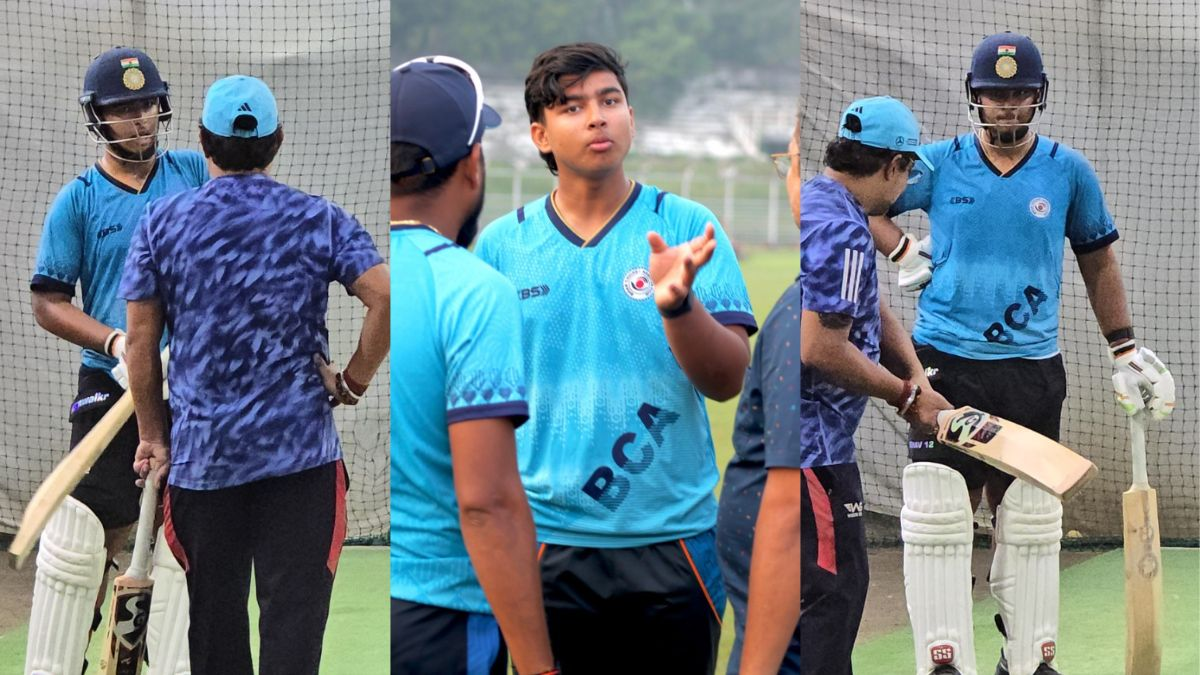
Strong bond: From early drills in Patna to bigger stages, Manish Ojha with Vaibhav Sooryavanshi — a journey still in motion.
| Photo Credit:
Special Arrangement
Strong bond: From early drills in Patna to bigger stages, Manish Ojha with Vaibhav Sooryavanshi — a journey still in motion.
| Photo Credit:
Special Arrangement
“(When teaching Sooryavanshi how to play the front-foot drive) Around 70 per cent of the balls that day would be for him to go for the front-foot drive. I tried to maintain continuity. He used to try and execute it in the best way possible,” he says. Later, the focus shifted entirely to strategy and planning.
“He was put in open-air match simulations. There used to be targets, like trying to find out how many runs he could make in 20 overs. Or how to protect his wicket in a 40-over game? How does one rotate strike then? How does one contribute to the team’s overall total? According to such situations, we started giving him plans. And he used to play accordingly.”
While Ojha takes pride in watching his ward scale new heights, he acknowledges there were certain “invisible flaws” in Sooryavanshi’s game, ones the youngster worked through and refined.
“You will see that he bats very aggressively. And most aggressive batters use the bottom hand a lot,” he says. “When you initiate any shot with the bottom hand, the downswing of the bat is a little dodgy. The flow of the bat deviates from the line slightly during shot-making. So, that is one thing that Vaibhav has improved. We have been marking him for a long time.”
If Sooryavanshi eventually makes the Indian team, he will be the first cricketer from Bihar to don the national colours since the State was reinstated as a BCCI affiliate in 2018.
In the past, several cricketers from the undivided State, including Subroto Banerjee and Syed Saba Karim, have featured for India. However, after the formation of Jharkhand, Mahendra Singh Dhoni, Ishan Kishan, Shahbaz Nadeem and several others have represented the new State, even as Bihar remained suspended from the BCCI due to political infighting. In recent years, a couple of Bihar-born players like Mukesh Kumar and Akash Deep have represented India, but both played domestic cricket for Bengal.
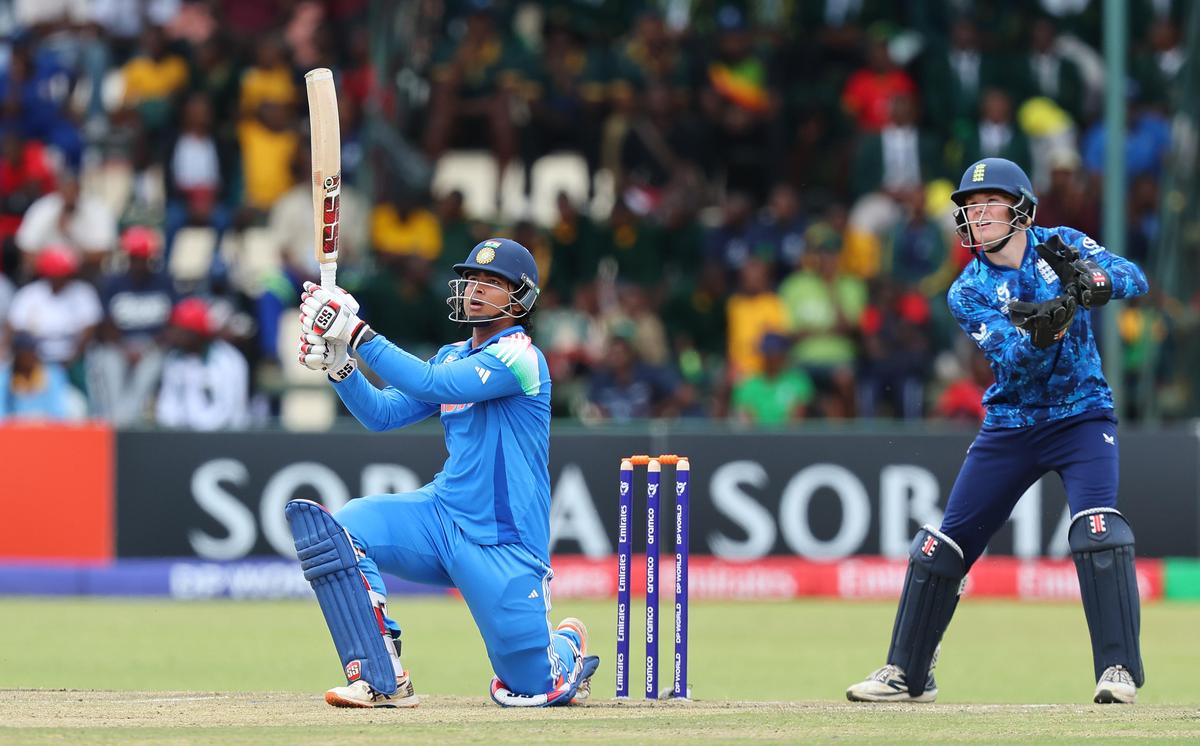
Stamping authority: Led by the then 14-year-old Vaibhav Sooryavanshi’s century, India secured a sixth Under-19 World Cup title in Harare earlier this year.
| Photo Credit:
Getty Images
Stamping authority: Led by the then 14-year-old Vaibhav Sooryavanshi’s century, India secured a sixth Under-19 World Cup title in Harare earlier this year.
| Photo Credit:
Getty Images
Playing the ball, not the bowler
At the local level, the lack of serious competition made things relatively easy. But at the highest tier, the demands are far greater.
“The heavy bottom-hand domination is still there. There is a quick bat flow, but he manages it somehow,” Ojha says, referring to the recent game against Royal Challengers Bengaluru, where his ward handled the seasoned Bhuvneshwar Kumar tactfully.
“When Vaibhav faced Bhuvneshwar’s ball (second ball of Bhuvneshwar’s second over), if he had shifted his whole body towards mid-on instead of opening up his back shoulder and keeping the bat’s downswing right, he would have been out. But he controlled himself so well on the batswing that it became a six,” Ojha explains.
“Even in the first over (of Bhuvneshwar), his backlift was so high, but he managed to connect the ball right next to his toe and it raced away for four,” he adds.
Ojha admits he is often struck by how Sooryavanshi continues to thrive, finding answers even while carrying a clear technical flaw.
“We were expecting bowlers to target the gap that opens up between the bat and pad when you use a lot of bottom hand. You tend to go against your line and there is a possibility of getting out… In the IPL, there are so many big coaches and players, and we thought they would detect the loophole easily. But Vaibhav has managed it well. He has been able to work on it.”
Sooryavanshi was the raging trend on social media after he fearlessly smashed Mumbai Indians’ Bumrah for two sixes in an over. And, of course, there was no one happier than Ojha.
“It was a very proud moment,” he says. “But a few things have to be taken into consideration here. Firstly, Vaibhav is a player who initiates. He is willing to take risks. Secondly, when he is making so many runs, his confidence is very high. And the third factor is that he sticks to his strategy and planning. Whatever target the team has, he is ready to strike from the very first ball,” Ojha continues.
“If you let the bowler dominate your mind, then he will not let you bat. Especially at this level, if you start thinking about the bowler’s face value, his records, his reputation, then you will not be able to play. You need to play by watching the ball and making your judgement according to its merit.”
Despite being among the world’s finest, Bumrah was left looking helpless against Sooryavanshi.
“Bumrah is a player with so many years of experience. But when Vaibhav hit that six, he was not playing Bumrah. He was playing Bumrah’s ball. This mindset is instilled within him. It doesn’t matter who is bowling,” Ojha says.
It is a simple idea, but one that requires immense clarity to execute at the highest level. Perhaps that is what sets Sooryavanshi apart. The ability to remain anchored in the moment, to see the ball rather than the reputation attached to it, to trust instinct without losing structure.
The journey ahead will bring its own set of challenges, as every promising career inevitably does. That’s why, for now, the essence remains unchanged.
The boy at Beckenham, asking for a few more minutes. The teenager unsure why people wanted his photograph. And the cricketer who, despite everything, still seems driven by that one simple desire.
“Abhi nahin… abhi toh thoda aur batting karna hai…”
Published on Apr 22, 2026
#boy #asked #rise #Vaibhav #Sooryavanshi
“Abhi nahin… abhi toh thoda aur batting karna hai…”
A strident voice cut through the hush of a fading afternoon at the Beckenham County Ground, where India’s Under-19 team had just endured a long, draining session ahead of its Youth Test against England U-19.
One boy, however, wasn’t ready to leave. Not yet. He wanted more: more balls, more time, more of the crease.
The coaches exchanged confused glances before giving in. Thirty more minutes.
He batted on, unhurried and unwilling to surrender the moment. It eventually took the ground staff to step in, a gentle reminder that the day was done, for him to finally walk off, bat tucked under his arm, head still somewhere in the middle.
But the day was far from over.
As he sauntered towards the dressing room, a small group of girls, dressed in the pink and blue of the Rajasthan Royals (RR), called out his name from outside the boundary rope.
He paused. Slightly overwhelmed, but smiling.
“Samajh nahin aa raha hai bhaiya. Yeh sab meri photo kyun le rahein hain?”
There was no pretence in that awkward query. Just the disarming honesty of a 14-year-old.
It’s been a year since then. By now, Vaibhav Sooryavanshi must know what the fuss is about.
Having made his First-Class debut for Bihar at just 12, Sooryavanshi has spent the last few years dismantling bowling attacks far more experienced than him. His exploits for his State and India U-19 earned him an Indian Premier League (IPL) contract with RR. He wasted little time in justifying the hype, smashing a breathtaking 100 off 35 balls in only his second game.
What followed silenced any lingering doubt. In the Vijay Hazare Trophy, representing Bihar against Arunachal Pradesh, he hammered a stunning 190 off 84 balls, breaking AB de Villiers’ record for the fastest 150 in List A cricket.
There’s more.
Earlier this year, he emerged as India’s leading run-scorer at the U-19 World Cup, amassing 439 runs at an average of 62.71 and a staggering strike rate of 169.49, with fifties against Afghanistan, Zimbabwe and Bangladesh.
In the ongoing edition of the IPL, he has raced to 246 runs in his first six matches at 236.54, taking apart some of the best in the business, including Jasprit Bumrah, with a defiance that belies his age.
Understandably, the calls for fast-tracking him into India’s senior side have only grown louder.
Sooryavanshi turned 15 in March this year, which means that, according to the International Cricket Council’s (ICC) Minimum Age Eligibility criteria, he can represent the senior national side.
The rule states: “A player will only be eligible to represent a National Cricket Federation in an International Match (including ICC Events and U-19 Events) if he or she is aged 15 or over on the relevant squad submission date (in the case of ICC Events including U-19 Events) or on the date of the first match of the series/tournament to be played (in the case of all other International Matches).”
A large section of the cricketing fraternity is of the opinion that Sooryavanshi should be picked for India’s T20I tour to Ireland in June. That would make the Samastipur-born the youngest player to debut for India, surpassing Sachin Tendulkar, who earned his first cap at 16.
However, Pakistan’s Hasan Raza, who debuted at 14 years and 233 days in 1996, would still remain the youngest to have made an international appearance.
Whether it is too soon for Sooryavanshi to wear the hallowed Blues can be a debate for another day. What is undeniable is that behind the baby face lies a rare mix of audacity and assurance, perhaps even the outline of India’s next big story.
One call away
The transformation, in many ways, has been as rapid as it has been remarkable. Let’s rewind to January 2024. Zubin Bharucha, director of High Performance at RR, received a call from Samar Qadri, a former Bihar cricketer and a scout associated with the IPL franchise.
Qadri spoke enthusiastically about a young player who had begun attracting attention immediately after making his First-Class debut.
Although Qadri believed the kid warranted serious consideration, Bharucha approached the matter with measured restraint.
“Everyone wanted to know who this 12-year-old making his Ranji debut was, and that’s when Samar told me about his talent. My thinking was clear: let’s see him bat live and put him under pressure at the trials,” Bharucha tells Sportstar.
Interest from other franchises soon followed, but RR maintained a particularly close watch, thanks to Qadri’s timely updates. As Sooryavanshi continued to perform for India U-19, internal discussions gathered momentum, eventually culminating in a message from talent identification coordinator Akshay Karanje: “There’s an amazing young player who deserves a look in…”
That one text set things in motion.
The Boy Wonder
Sooryavanshi was invited to the Royals’ academy in Talegaon for trials, where Bharucha had his first close look.
Curiosity prompted a simple question: who is your favourite cricketer? Bharucha expected an answer like Rishabh Pant, given their similarity in approach.
But Sooryavanshi’s response surprised him.
“Brian Lara,” he said.
The reply was unexpected, not just because of the generational gap, but because it hinted at a deeper engagement with the game. Sooryavanshi had gone back, watched Lara’s batting, studied it, and internalised aspects of it.
As the trials progressed, those influences began to surface.
“There is an almost Laraesque aspect in his game,” Bharucha says. “He has got a lovely backlift that goes over his head and comes through. It’s very rare. The bat actually crosses the vertical, almost goes in front of his hands and wrists. It’s unbelievable.”
Even then, Bharucha chose not to rush to a conclusion. He preferred evidence under pressure.
When Sooryavanshi faced a left-arm quick during the trials, Bharucha anticipated a difficult start.
Instead, he witnessed a moment that shifted his perspective. A delivery expected to beat the outside edge was dispatched over extra cover for six.
A glitch in the matrix, Bharucha might have thought, before asking Sooryavanshi to stay back for a more intense test. Side-arm specialists, capable of delivering at speeds touching 157-158 kmph, were instructed to test him with a new ball.
Bharucha thought he was in command.
“I was clear in my head that this kid won’t have it easy now.”
Sooryavanshi began cautiously, leaving the initial deliveries with almost ascetic discipline. Then came the statement.
“As the sidearmer continued to hit the deck hard, Sooryavanshi smashed two straight sixes over the sightscreen. Back to back. I asked for the speed, and was surprised to know that they were 155 kph and 157 kmph respectively. That was unbelievable!”
Bharucha was seeing flashes of a young Tendulkar. That was when he became “100 per cent sure” that RR had to sign him.
As soon as the trials ended for the day, he texted Jake Lush McCrum, then CEO of the franchise: “All plans gone for a toss, boss. Generational talent on display at trials.”
A curious McCrum wanted to know more. Bharucha simply asked him to set aside Rs. 10 crore for Sooryavanshi at the auction before adding that the lad was “probably better than [Yashasvi] Jaiswal when he first came in.”
“This guy is only 13. Probably the best 13-year-old in the history of our sport after SRT,” Bharucha wrote.
Rahul Dravid, then head coach, was the next to be informed.
Royals eventually secured Sooryavanshi for just Rs. 1.1 crore. The real challenge, however, was ensuring he was not swayed by money and fame.
Dravid believed the focus should not merely be on development, but also on protection, creating an environment where the youngster could grow without being overwhelmed by external pressures.
“Rahul was very clear about it. He brought all these guys into the room and basically laid out how we are supposed to let this kid be a kid,” Bharucha says.
The philosophy has endured.
Under Kumar Sangakkara, the emphasis remains on preserving Sooryavanshi’s natural approach while ensuring he is not burdened by expectations. During pre-season, he spends most of his time at the Talegaon facility under the watchful eye of manager Romi Bhinder, whom he considers a guardian.
Over the years, the Royals have transformed several young cricketers into stars, from Ravindra Jadeja to Sanju Samson and now Jaiswal. Bharucha believes the environment has been key.
“When Dhruv Jurel came in, he saw Jaiswal spending hours at the nets and making it to the national team. So Dhruv followed. Then Riyan Parag. And now Vaibhav sees them doing the same,” Bharucha says, adding: “This is a very contagious habit, perhaps the best thing to happen in Indian cricket!”
Perhaps it is. But it is imperative that Sooryavanshi, given his age, is handled carefully, especially considering how talents like Prithvi Shaw have faded despite promising starts.
Sangakkara, however, wants him to stay in the present.
“For Vaibhav, the most important thing is to enjoy playing cricket. And he must never lose that freedom,” he says.
“Failure is a very strong word. My message to Vaibhav is that he’s got to enjoy everything. Whether it’s 100 off 35 balls, 50 off 15, or a first-ball duck, you’re allowed to score runs, and you’re allowed to fail.”
It helps that Sooryavanshi remains a kid at heart. Jitesh Sharma, who captained him in India A, had said, “He is very professional on the field, but off the field, he is (still a kid)… I’m trying my best, asking him not to eat ice cream at night. But he still has those cravings.”
Young Turk: Rajasthan Royals opener Vaibhav Sooryavanshi, 14 at the time, made history as the youngest player to hit a century in men’s T20s when he smacked 101 from 38 balls in 2025 against Gujarat Titans. | Photo Credit: R.V. MOORTHY
Young Turk: Rajasthan Royals opener Vaibhav Sooryavanshi, 14 at the time, made history as the youngest player to hit a century in men’s T20s when he smacked 101 from 38 balls in 2025 against Gujarat Titans. | Photo Credit: R.V. MOORTHY
The A-B-C-D of Cricket
Back in Patna, Manish Ojha reflects on a journey that began in far more modest surroundings.
He still remembers the day in 2018, when Sooryavanshi came to Ojha’s GenNex Academy in the city, holding his father Sanjeev’s hand. The boy had just been gifted a Kashmiri willow on his birthday, and Sanjeev, a failed cricketer himself, wanted Ojha to work with his son.
That’s how the narrative began to take shape.
“When Vaibhav came to me, he started from the A-B-C-D of cricket. So, the technical inputs or processes that he was taught, he never doubted,” Ojha says. “He was a small kid and, for him, the belief system in his coach was immense. He must have been between 8-9 years old. So, the technical aspects that I gave him, he used to adopt very quickly,” Ojha reminisces. Initially, Ojha would make Sooryavanshi repeat the same exercise all day.
Strong bond: From early drills in Patna to bigger stages, Manish Ojha with Vaibhav Sooryavanshi — a journey still in motion. | Photo Credit: Special Arrangement
Strong bond: From early drills in Patna to bigger stages, Manish Ojha with Vaibhav Sooryavanshi — a journey still in motion. | Photo Credit: Special Arrangement
“(When teaching Sooryavanshi how to play the front-foot drive) Around 70 per cent of the balls that day would be for him to go for the front-foot drive. I tried to maintain continuity. He used to try and execute it in the best way possible,” he says. Later, the focus shifted entirely to strategy and planning.
“He was put in open-air match simulations. There used to be targets, like trying to find out how many runs he could make in 20 overs. Or how to protect his wicket in a 40-over game? How does one rotate strike then? How does one contribute to the team’s overall total? According to such situations, we started giving him plans. And he used to play accordingly.”
While Ojha takes pride in watching his ward scale new heights, he acknowledges there were certain “invisible flaws” in Sooryavanshi’s game, ones the youngster worked through and refined.
“You will see that he bats very aggressively. And most aggressive batters use the bottom hand a lot,” he says. “When you initiate any shot with the bottom hand, the downswing of the bat is a little dodgy. The flow of the bat deviates from the line slightly during shot-making. So, that is one thing that Vaibhav has improved. We have been marking him for a long time.”
If Sooryavanshi eventually makes the Indian team, he will be the first cricketer from Bihar to don the national colours since the State was reinstated as a BCCI affiliate in 2018.
In the past, several cricketers from the undivided State, including Subroto Banerjee and Syed Saba Karim, have featured for India. However, after the formation of Jharkhand, Mahendra Singh Dhoni, Ishan Kishan, Shahbaz Nadeem and several others have represented the new State, even as Bihar remained suspended from the BCCI due to political infighting. In recent years, a couple of Bihar-born players like Mukesh Kumar and Akash Deep have represented India, but both played domestic cricket for Bengal.
Stamping authority: Led by the then 14-year-old Vaibhav Sooryavanshi’s century, India secured a sixth Under-19 World Cup title in Harare earlier this year. | Photo Credit: Getty Images
Stamping authority: Led by the then 14-year-old Vaibhav Sooryavanshi’s century, India secured a sixth Under-19 World Cup title in Harare earlier this year. | Photo Credit: Getty Images
Playing the ball, not the bowler
At the local level, the lack of serious competition made things relatively easy. But at the highest tier, the demands are far greater.
“The heavy bottom-hand domination is still there. There is a quick bat flow, but he manages it somehow,” Ojha says, referring to the recent game against Royal Challengers Bengaluru, where his ward handled the seasoned Bhuvneshwar Kumar tactfully.
“When Vaibhav faced Bhuvneshwar’s ball (second ball of Bhuvneshwar’s second over), if he had shifted his whole body towards mid-on instead of opening up his back shoulder and keeping the bat’s downswing right, he would have been out. But he controlled himself so well on the batswing that it became a six,” Ojha explains.
“Even in the first over (of Bhuvneshwar), his backlift was so high, but he managed to connect the ball right next to his toe and it raced away for four,” he adds.
Ojha admits he is often struck by how Sooryavanshi continues to thrive, finding answers even while carrying a clear technical flaw.
“We were expecting bowlers to target the gap that opens up between the bat and pad when you use a lot of bottom hand. You tend to go against your line and there is a possibility of getting out… In the IPL, there are so many big coaches and players, and we thought they would detect the loophole easily. But Vaibhav has managed it well. He has been able to work on it.”
Sooryavanshi was the raging trend on social media after he fearlessly smashed Mumbai Indians’ Bumrah for two sixes in an over. And, of course, there was no one happier than Ojha.
“It was a very proud moment,” he says. “But a few things have to be taken into consideration here. Firstly, Vaibhav is a player who initiates. He is willing to take risks. Secondly, when he is making so many runs, his confidence is very high. And the third factor is that he sticks to his strategy and planning. Whatever target the team has, he is ready to strike from the very first ball,” Ojha continues.
“If you let the bowler dominate your mind, then he will not let you bat. Especially at this level, if you start thinking about the bowler’s face value, his records, his reputation, then you will not be able to play. You need to play by watching the ball and making your judgement according to its merit.”
Despite being among the world’s finest, Bumrah was left looking helpless against Sooryavanshi.
“Bumrah is a player with so many years of experience. But when Vaibhav hit that six, he was not playing Bumrah. He was playing Bumrah’s ball. This mindset is instilled within him. It doesn’t matter who is bowling,” Ojha says.
It is a simple idea, but one that requires immense clarity to execute at the highest level. Perhaps that is what sets Sooryavanshi apart. The ability to remain anchored in the moment, to see the ball rather than the reputation attached to it, to trust instinct without losing structure.
The journey ahead will bring its own set of challenges, as every promising career inevitably does. That’s why, for now, the essence remains unchanged.
The boy at Beckenham, asking for a few more minutes. The teenager unsure why people wanted his photograph. And the cricketer who, despite everything, still seems driven by that one simple desire.
“Abhi nahin… abhi toh thoda aur batting karna hai…”
Published on Apr 22, 2026


Post Comment