
Deadspin | France to host 2031 FIBA World Cup; Tokyo gets women’s tourney 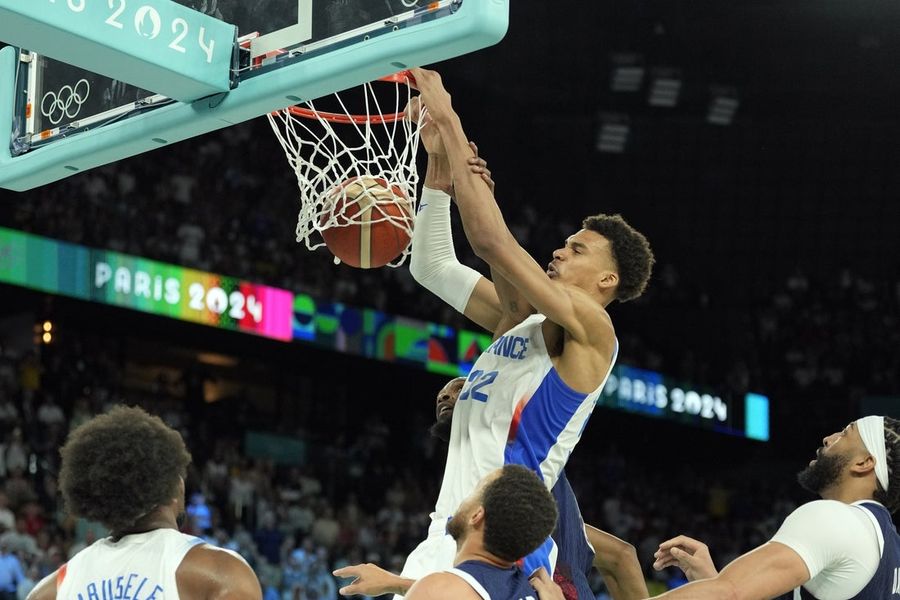 Aug 10, 2024; Paris, France; France power forward Victor Wembanyama (32) shoots against the United States in the second half in the men’s basketball gold medal game during the Paris 2024 Olympic Summer Games at Accor Arena. Mandatory Credit: Kyle Terada-Imagn Images
 The FIBA Central Board has chosen France as the host of the 2031 FIBA Basketball World Cup, with Japan getting the Women’s World Cup in 2030.
The French cities of Lille, Lyon, and Paris will co-host the event from Aug. 29 to Sept. 14, with the final taking place in Paris.
The women’s tournament will be held in Tokyo from Nov. 26 to Dec.. 8.
Japan and France achieved success in the sport as Japan’s women and France’s men both won silver medals in basketball in their recent home Olympics. Japan hosted the 2020 Summer Games and Paris held the 2024 Summer Games.
The two locations were chosen in part because of their history of hosting major sporting events.
“Japan and France are two basketball-loving nations, two destinations extremely popular with our fans, players and partners,” FIBA Secretary General Andreas Zagklis said. “The FIBA World Cups have become synonymous with success in large part because selecting the appropriate host each time is the cornerstone of our mission to make basketball the most popular sports community.”
French star and San Antonio Spurs forward Victor Wembanyama is likely to headline the 2031 World Cup after the young superstar led the 2024 Olympic Gold Medal game in scoring with 26 points in a losing effort to the United States.
–Field Level Media
#Deadspin #France #host #FIBA #World #Cup #Tokyo #womens #tourney
Aug 10, 2024; Paris, France; France power forward Victor Wembanyama (32) shoots against the United States in the second half in the men’s basketball gold medal game during the Paris 2024 Olympic Summer Games at Accor Arena. Mandatory Credit: Kyle Terada-Imagn Images The FIBA Central Board has chosen France as the host of the 2031 FIBA Basketball World Cup, with Japan getting the Women’s World Cup in 2030.
The French cities of Lille, Lyon, and Paris will co-host the event from Aug. 29 to Sept. 14, with the final taking place in Paris.
The women’s tournament will be held in Tokyo from Nov. 26 to Dec.. 8.
Japan and France achieved success in the sport as Japan’s women and France’s men both won silver medals in basketball in their recent home Olympics. Japan hosted the 2020 Summer Games and Paris held the 2024 Summer Games.
The two locations were chosen in part because of their history of hosting major sporting events.
“Japan and France are two basketball-loving nations, two destinations extremely popular with our fans, players and partners,” FIBA Secretary General Andreas Zagklis said. “The FIBA World Cups have become synonymous with success in large part because selecting the appropriate host each time is the cornerstone of our mission to make basketball the most popular sports community.”
French star and San Antonio Spurs forward Victor Wembanyama is likely to headline the 2031 World Cup after the young superstar led the 2024 Olympic Gold Medal game in scoring with 26 points in a losing effort to the United States.
–Field Level Media

![MLB trade rumors on Twins, Red Sox, Tarik Skubal, and more ahead of Monday’s deadline The 2026 MLB Trade Deadline is just a few days away.And the rumors are heating up.The Deadline arrives at 6:00 p.m. Eastern on Monday, August 3, but we are already seeing some deals being made, including one between the surging Boston Red Sox and the Washington Nationals. Let’s take our first look at the MLB rumor mill as we get ready for this year’s MLB Trade Deadline.Marlins open to offers on “several” playersWhile the Miami Marlins finished seven games above .500 in the first half of the season, they lost the final three games before the All-Star Break, and with eight losses to open the second half, that 12 game losing streak has dropped the Marlins down the NL East standings. Wins the past few nights have moved them back above .500 on the year, but Miami could be creative sellers at the deadline.Or at least entertain offers on cost-controlled players over these next few days.Bats remain the major options. According to The Athletic the Marlins will at least “listen” to offers on controllable bats, including shortstop Otto Lopez, 2B Xavier Edwards, and OF Heriberto Hernández. Mark Feinsand of MLB.com reported on Tuesday that the Marlins are also open to trading C/OF/DH Liam Hicks, due in large part to the emergence of young catcher Joe Mack.Speaking of Mack, the rookie catcher is one of a few Marlins that are reportedly off limits, including pitchers Sandy Alcantara, Max Meyer, and Eury Pérez.The Minnesota Twins are one game above .500, with the MLB Trade Deadline fast approaching.But unlike the Marlins, who were 8.5 games out of first place in the division on Thursday morning, the Twins sit just three games out of first in the AL Central, and just 1.5 games behind the second-place Cleveland Guardians in both the division and the Wild Card chase.Given that, the Twins are officially buyers at the deadline, according to general manager Jeremy Zoll. In a story on The Athletic filed on Tuesday night, Zoll made the case for Minnesota, and highlighted an improved bullpen as a focus at the deadline.“All along, we were optimistic we were going to be in this spot to be able to add,” Zoll said. “We’re active on the phones and in touch across the board in trying to do everything we can to find ways to improve the team.”Zoll also indicated that the recent play from Minnesota — the Twins entered Wednesday on a three-game winning streak — made the decision easier.“We’re really excited about how the team has played over this last stretch,” Zoll said. “We’re really encouraged about that. In turn, we’re going to use this next stretch to do everything we can to find ways to improve the club and continue to execute on that goal and make it a reality.”Catching market heating upPitching is always a focus at the MLB Trade Deadline, and a potential deal involving Tarik Skubal is at the front of many shopping lists around the league.But catching has become a focus for several teams looking to bolster their playoff chances, according to a report from Mark Feinsand of MLB.com. According to the long-time MLB insider six teams — the Red Sox, the Yankees, the Rays, the White Sox, the Rangers, and the Dodgers — could be looking for help behind the plate.One problem, according to one source?There might not be enough good catchers to go around.“There are about a half-dozen teams looking for catching help,” one NL executive said to Feinsand. “There just aren’t a half-dozen catchers out there to trade for.”As noted in Feinsand’s report, the name most often mentioned is that of Ryan Jeffers, who is on an expiring contract. But as mentioned above, the Twins are looking to buy, not sell, at the deadline, which could complicate such a move. Other options include Hunter Goodman with the Colorado Rockies — but he is under club control for the next three years, which increases the asking price dramatically — and Adley Rutschman, although moving him from Baltimore would mean the Orioles would “concede” the AL Wild Card race, where Baltimore sits just 2.5 games off the pace.Then there is Liam Hicks, who the Marlins are reportedly open to trading given the emergence of Joe Mack. While he has four more years of club control, Mack’s development coupled with the growth of Triple-A catcher Agustín Ramirez makes moving Hicks easier for Miami.Boston looking for SS helpRed Sox fans were ready to write off the season back in June, after losing two-out-of-three to Colorado dropped Boston to 32-46, and 15.5 games out in the division.But a 15-game winning streak changed everything, and with a win Wednesday night against the Athletics, the Red Sox are now five games above .500, just seven back in the AL East, and if the playoffs were to begin today, Boston would be in as a Wild Card team.That rapid turnaround has seen the Red Sox emerge as buyers at the MLB Trade Deadline and they already made one move, acquiring infielder Curtis Mead in a deal with the Washington Nationals. But he was hit by a pitch in his Boston debut, and is headed to the IL with a broken wrist.Zach Neto is a popular name linked to Boston, but the Los Angeles Angels might be reluctant to move the 25-year-old infielder who is under team control for the next three-plus seasons. Other options include Houston’s Jeremy Peña, Miami’s Otto Lopez, and perhaps another deal with Washington for CJ Abrams.The latest on Tarik SkubalThe Detroit Tigers ace took the bump on Wednesday for his last start ahead of the MLB Trade Deadline.Will it be his final start for the Tigers?Detroit is in a fascinating position. At the moment the Tigers are just 4.5 games out of the final AL Wild Card spot, and having an ace like Skubal down the stretch could ease a playoff push.But with Skubal set to hit free agency — and expected to look for a contract in the $400 million range this offseason — the Tigers might look to get something in return for him now, rather than see him walk in free agency.It is a decision that could shape not just Detroit, but all of baseball, for the future.MLB.com put together a roundtable with Mark Feinsand, Tigers beat writer Jason Beck, and several other beat writers for teams that could put together an offer for the ace. According to Beck, Detroit would prioritize young arms in any such deal. “[The] Tigers will look for young pitching in pretty much any deal. They have good young arms in Troy Melton, Jackson Jobe, Reese Olson and Ty Madden, but their farm system is thin on projectable starting pitchers,” wrote Beck.The most intriguing team, at least according to this writer, is Milwaukee. As noted by Brewers beat writer Adam McCalvy, while Milwaukee is one of those teams that “must stockpile prospects, especially position player prospects, in order to contend year after year” the Brewers are “very interested” in Skubal.Pairing Skubal with Jacob Misiorowski would give Milwaukee one heck of a one-two combination at the top of the rotation down the stretch, and into the playoffs.It is worth noting that Skubal notched his 1,000th career strikeout on Wednesday, so if it was indeed his last outing for the Tigers, he will go out in style. #MLB #trade #rumors #Twins #Red #Sox #Tarik #Skubal #ahead #Mondays #deadline](https://i0.wp.com/platform.sbnation.com/wp-content/uploads/sites/2/2026/07/gettyimages-2287531308.jpg?quality=90&strip=all&crop=0%2C10.732984293194%2C100%2C78.534031413613&w=1200&ssl=1 "MLB trade rumors on Twins, Red Sox, Tarik Skubal, and more ahead of Monday’s deadline The 2026 MLB Trade Deadline is just a few days away.And the rumors are heating up.The Deadline arrives at 6:00 p.m. Eastern on Monday, August 3, but we are already seeing some deals being made, including one between the surging Boston Red Sox and the Washington Nationals. Let’s take our first look at the MLB rumor mill as we get ready for this year’s MLB Trade Deadline.Marlins open to offers on “several” playersWhile the Miami Marlins finished seven games above .500 in the first half of the season, they lost the final three games before the All-Star Break, and with eight losses to open the second half, that 12 game losing streak has dropped the Marlins down the NL East standings. Wins the past few nights have moved them back above .500 on the year, but Miami could be creative sellers at the deadline.Or at least entertain offers on cost-controlled players over these next few days.Bats remain the major options. According to The Athletic the Marlins will at least “listen” to offers on controllable bats, including shortstop Otto Lopez, 2B Xavier Edwards, and OF Heriberto Hernández. Mark Feinsand of MLB.com reported on Tuesday that the Marlins are also open to trading C/OF/DH Liam Hicks, due in large part to the emergence of young catcher Joe Mack.Speaking of Mack, the rookie catcher is one of a few Marlins that are reportedly off limits, including pitchers Sandy Alcantara, Max Meyer, and Eury Pérez.The Minnesota Twins are one game above .500, with the MLB Trade Deadline fast approaching.But unlike the Marlins, who were 8.5 games out of first place in the division on Thursday morning, the Twins sit just three games out of first in the AL Central, and just 1.5 games behind the second-place Cleveland Guardians in both the division and the Wild Card chase.Given that, the Twins are officially buyers at the deadline, according to general manager Jeremy Zoll. In a story on The Athletic filed on Tuesday night, Zoll made the case for Minnesota, and highlighted an improved bullpen as a focus at the deadline.“All along, we were optimistic we were going to be in this spot to be able to add,” Zoll said. “We’re active on the phones and in touch across the board in trying to do everything we can to find ways to improve the team.”Zoll also indicated that the recent play from Minnesota — the Twins entered Wednesday on a three-game winning streak — made the decision easier.“We’re really excited about how the team has played over this last stretch,” Zoll said. “We’re really encouraged about that. In turn, we’re going to use this next stretch to do everything we can to find ways to improve the club and continue to execute on that goal and make it a reality.”Catching market heating upPitching is always a focus at the MLB Trade Deadline, and a potential deal involving Tarik Skubal is at the front of many shopping lists around the league.But catching has become a focus for several teams looking to bolster their playoff chances, according to a report from Mark Feinsand of MLB.com. According to the long-time MLB insider six teams — the Red Sox, the Yankees, the Rays, the White Sox, the Rangers, and the Dodgers — could be looking for help behind the plate.One problem, according to one source?There might not be enough good catchers to go around.“There are about a half-dozen teams looking for catching help,” one NL executive said to Feinsand. “There just aren’t a half-dozen catchers out there to trade for.”As noted in Feinsand’s report, the name most often mentioned is that of Ryan Jeffers, who is on an expiring contract. But as mentioned above, the Twins are looking to buy, not sell, at the deadline, which could complicate such a move. Other options include Hunter Goodman with the Colorado Rockies — but he is under club control for the next three years, which increases the asking price dramatically — and Adley Rutschman, although moving him from Baltimore would mean the Orioles would “concede” the AL Wild Card race, where Baltimore sits just 2.5 games off the pace.Then there is Liam Hicks, who the Marlins are reportedly open to trading given the emergence of Joe Mack. While he has four more years of club control, Mack’s development coupled with the growth of Triple-A catcher Agustín Ramirez makes moving Hicks easier for Miami.Boston looking for SS helpRed Sox fans were ready to write off the season back in June, after losing two-out-of-three to Colorado dropped Boston to 32-46, and 15.5 games out in the division.But a 15-game winning streak changed everything, and with a win Wednesday night against the Athletics, the Red Sox are now five games above .500, just seven back in the AL East, and if the playoffs were to begin today, Boston would be in as a Wild Card team.That rapid turnaround has seen the Red Sox emerge as buyers at the MLB Trade Deadline and they already made one move, acquiring infielder Curtis Mead in a deal with the Washington Nationals. But he was hit by a pitch in his Boston debut, and is headed to the IL with a broken wrist.Zach Neto is a popular name linked to Boston, but the Los Angeles Angels might be reluctant to move the 25-year-old infielder who is under team control for the next three-plus seasons. Other options include Houston’s Jeremy Peña, Miami’s Otto Lopez, and perhaps another deal with Washington for CJ Abrams.The latest on Tarik SkubalThe Detroit Tigers ace took the bump on Wednesday for his last start ahead of the MLB Trade Deadline.Will it be his final start for the Tigers?Detroit is in a fascinating position. At the moment the Tigers are just 4.5 games out of the final AL Wild Card spot, and having an ace like Skubal down the stretch could ease a playoff push.But with Skubal set to hit free agency — and expected to look for a contract in the $400 million range this offseason — the Tigers might look to get something in return for him now, rather than see him walk in free agency.It is a decision that could shape not just Detroit, but all of baseball, for the future.MLB.com put together a roundtable with Mark Feinsand, Tigers beat writer Jason Beck, and several other beat writers for teams that could put together an offer for the ace. According to Beck, Detroit would prioritize young arms in any such deal. “[The] Tigers will look for young pitching in pretty much any deal. They have good young arms in Troy Melton, Jackson Jobe, Reese Olson and Ty Madden, but their farm system is thin on projectable starting pitchers,” wrote Beck.The most intriguing team, at least according to this writer, is Milwaukee. As noted by Brewers beat writer Adam McCalvy, while Milwaukee is one of those teams that “must stockpile prospects, especially position player prospects, in order to contend year after year” the Brewers are “very interested” in Skubal.Pairing Skubal with Jacob Misiorowski would give Milwaukee one heck of a one-two combination at the top of the rotation down the stretch, and into the playoffs.It is worth noting that Skubal notched his 1,000th career strikeout on Wednesday, so if it was indeed his last outing for the Tigers, he will go out in style. #MLB #trade #rumors #Twins #Red #Sox #Tarik #Skubal #ahead #Mondays #deadline")

Post Comment