SCAD's New Dior Exhibit Chronicles Nearly 80 Years of Couture

SCAD's New Dior Exhibit Chronicles Nearly 80 Years of Couture

Ahead of the House of Dior’s 80th anniversary next year, the Savannah College of Art and Design (SCAD) unveiled a new exhibit at its SCAD FASH Museum of Fashion + Film in Atlanta. Entitled “Dior: Crafting Fashion,” it chronicles the maison’s enduring legacy, eight head designers and behind-the-scenes process of bringing garments from ideation to presentation.

View this post on Instagram

Boasting more than 100 archival pieces, the exhibit spotlights Dior icons like the Bar Suit (the manifestation of the “New Look”) and the Lady Dior bag (named for Lady Diana herself) while also exposing students to the many careers available within the fashion industry by spotlighting roles across design, photography, styling, millinery, modeling and more. As Hélène Starkman, the exhibition curator for Christian Dior Couture and the curator of “Dior: Crafting Fashion,” tells Fashionista: “Fashion is not just one person, fashion is such a collaborative environment.”

A look from Dior Haute Couture Spring 2026, Jonathan Anderson’s first couture collection for the label.

Photo: Courtesy of SCAD

Upon entering the exhibit, visitors are met with key looks created by each of Dior’s designers, including Christian Dior, Yves Saint Laurent, Marc Bohan, Gianfranco Ferré, John Galliano, Raf Simons, Maria Grazia Chiuri and, most recently, Jonathan Anderson. One of Anderson’s first Dior couture designs (which debuted this January) — a bulbous black gown adorned with purple flowers that was inspired by Magdalene Odundo’s sculptures — is on display, offering a glimpse into the maison’s current era.

“Couture, I think, is something that people are used to seeing online,” Starkman says. “And online is usually kind of flat and you don’t really understand the details. But what [Anderson] says about his first couture is that every fabric or every detail is not what it seems to be.”

A look from Dior Haute Couture Spring 2011 by John Galliano.

Photo: Courtesy of SCAD

Moving through the space, toiles (a garment’s first draft) illustrate the atelier’s intricate construction process, with select prototypes appearing alongside their finished versions. For example, the toile (pictured below) for a black-and-red dress from Galliano’s Spring 2011 couture collection (pictured above) highlights the garment’s complex layering techniques.

“It was really important for us to show the garment and then show the toile so you understand the process of it,” Starkman explains.
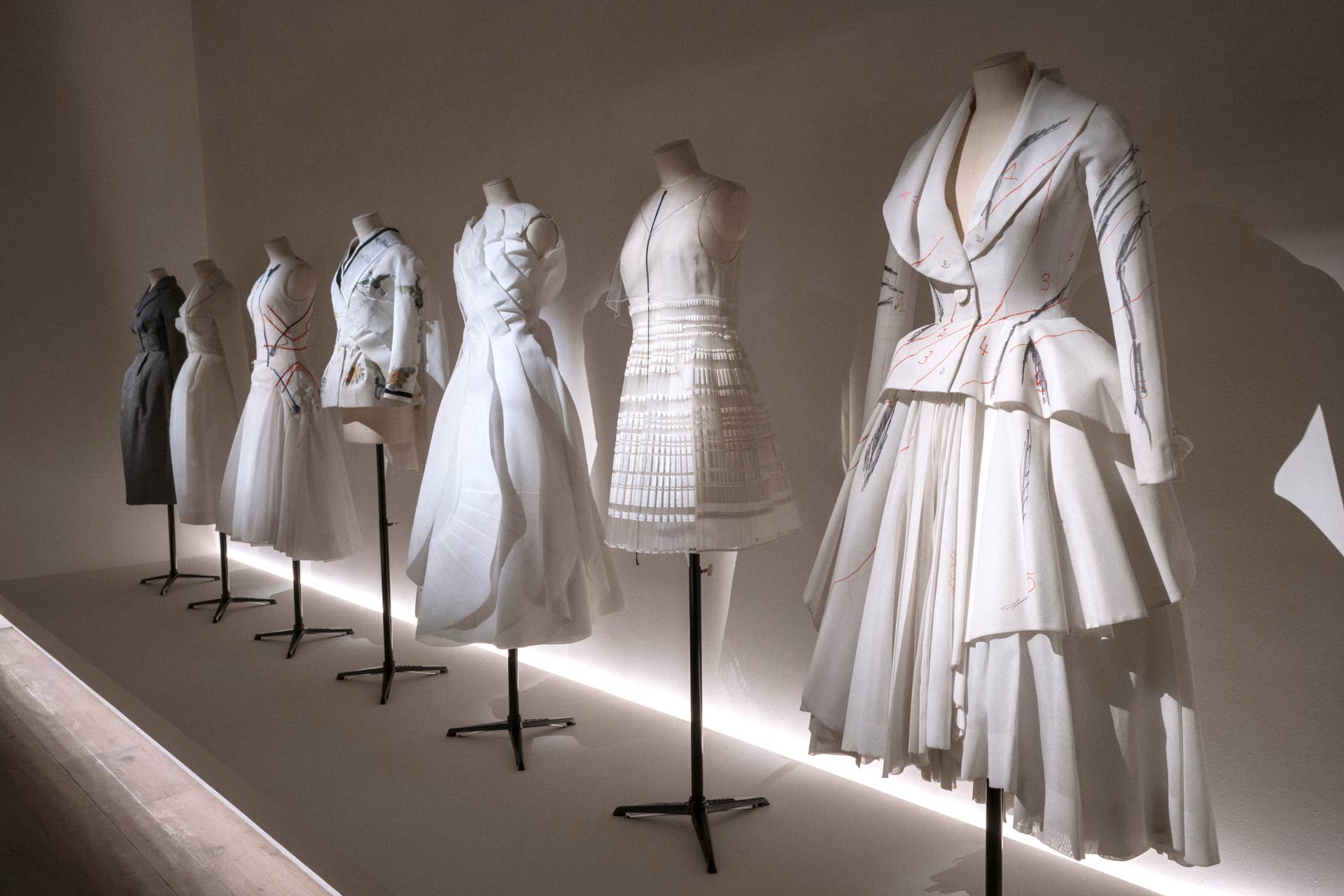
Dior’s toiles, including the toile for the above Dior Haute Couture Spring 2011 dress (far right).

Photo: Courtesy of SCAD

Visitors then step into a garden of historical couture, which places each designer’s floral-inspired creations in conversation with one another, highlighting the maison’s common thread of referencing the founding designer’s ideas. Couture accessories, including hats and footwear from throughout Dior’s history also line the walls (which Starkman refers to as the “cabinet of curiosities”).

Dior couture accessories in the “cabinet of curiosities.”

Photo: Courtesy of SCAD

Though Dior spent only 10 years at the helm of his eponymous label, his impact on the fashion industry continues to serve as inspiration for his successors and aspiring designers alike. “Christian Dior founded his house when he was 42. There’s no rush, you know?” Starkman points out. “So you can be creative, you can be any age and you never know what’s going to happen.”

The “Dior: Crafting Fashion” exhibit is open from April 16 through Aug. 23, 2026 at 1600 Peachtree St. in Atlanta, GA. To reserve your tickets, visit here.

Fashionista’s audience includes 1 million site visitors, 110,000 newsletter subscribers and 4.74 million social media followers. Want to know how to reach them? Learn more.


Source link
#SCAD039s #Dior #Exhibit #Chronicles #Years #Couture

Previous post

How Ukraine is rebuilding its energy system under fire<div data-tracking-skip="true" data-tracking-name="rich-text"><p>In autumn 2024, Russia launched massive aerial assaults on Ukraine, pounding its energy system and raising fears about the <a class="internal-link" href="https://www.dw.com/en/russias-strikes-threaten-ukraines-nuclear-safety/a-74713399">safety of its nuclear power plants.</a> Several reactors disconnected from the grid. One shut down entirely.</p> <p>“It wasn’t that we were scared,” says Shaun Burnie, recalling that night. “It was that we were terrified.”</p> <p>For Greenpeace veteran nuclear specialist Burnie, who has worked in some of the most <a class="internal-link" href="https://www.dw.com/en/fukushima/t-17452953">radioactive places</a> on earth, the danger lay in what could have followed.</p><figure class="placeholder-image master_landscape big"><img data-format="MASTER_LANDSCAPE" data-id="76907621" data-url="https://static.dw.com/image/76907621_${formatId}.jpg" data-aspect-ratio="16/9" alt="A man wearing glasses, an orange hard hat, face mask and protective gear standing inside the Chernobyl new safe confinement. He is being interviewed." style="padding-bottom: 56.25%; height: 0; max-height: 0;"/><figcaption class="img-caption">Shaun Burnie has been inside the structure protecing the Chernobyl reactor three times and says he’s not keen to have to make too many return visits<small class="copyright">Image: Pavlo Siromenko/Greenpeace</small></figcaption></figure> <p>Nuclear plants rely on a constant external power supply to run cooling systems for the reactor core and spent fuel. If the grid buckles and plants disconnect, they switch to diesel generators.</p> <p>In a worst-case scenario, if they can’t reconnect, cooling systems fail and reactors overheat. Ukraine knows what that means. On April 26 1986, <a class="internal-link" href="https://www.dw.com/en/chernobyl/t-17453512">a reactor at the Chernobyl Nuclear Power Plant</a> exploded, forcing the evacuation of hundreds of thousands from the area and contaminating large parts of Europe.</p> <p>“Chernobyl is part of our collective memory. Everyone has family or community stories about it,” says Lena Kondratiuk, a 25-year-old from Rivne in western Ukraine. “And now, during the war, this meaning has become even more real.”</p><div class="vjs-wrapper embed big"><h2 aria-label="Embedded video — The lasting legacy of Chernobyl" class="headline"><svg xmlns="http://www.w3.org/2000/svg" viewbox="0 0 20 20"><g fill-rule="evenodd"><path d="M14.114 7.599H13.5l.002 4.706h.601l4.582 3.25-.005-11.11zM11.084 4.444l-9.007.002-1.336.797.002 9.514 1.334.793 9.007.006 1.509-.799-.004-9.516z"/></g></svg>The lasting legacy of Chernobyl</h2><video id="video-76838299" controls="" playsinline="" preload="none" poster="data:image/png;base64,iVBORw0KGgoAAAANSUhEUgAAAAEAAAABCAQAAAC1HAwCAAAAC0lEQVR42mNkYAAAAAYAAjCB0C8AAAAASUVORK5CYII=" data-id="76838299" data-posterurl="https://static.dw.com/image/76816641_605.webp" data-duration="11:11"><source src="https://hlsvod.dw.com/i/dwtv_video/flv/a21/a2120260418_ChernobylB2_,AVC_480x270,AVC_512x288,AVC_640x360,AVC_960x540,AVC_1280x720,AVC_1920x1080,.mp4.csmil/master.m3u8" type="application/x-mpegURL"><source src="https://tvdownloaddw-a.akamaihd.net/dwtv_video/flv/a21/a2120260418_ChernobylB2_AVC_1920x1080.mp4" type="video/mp4"><track src="https://www.dw.com/media/subtitles/76841191" srclang="en" label="ENGLISH" default=""><p class="vjs-no-js">To view this video please enable JavaScript, and consider upgrading to a web browser that <a href="https://videojs.com/html5-video-support/" target="_blank">supports HTML5 video</a></p></track></source></source></video></div> <h2>A system under pressure</h2> <p>Though Ukraine still depends on nuclear energy for more than half of its electricity and plans to build more reactors, the worst-case scenario hasn’t happened. But the threat <a class="internal-link" href="https://www.dw.com/en/russia-ukraine-report-overnight-strikes-on-energy-infrastructure/a-76078205">remains as Russia continues to target energy infrastructure.</a></p> <p>More than half of Ukraine’s power generation capacity has been damaged or destroyed. UN nuclear watchdog, the <a class="internal-link" href="https://www.dw.com/en/international-atomic-energy-agency-iaea/t-17449170">International Atomic Energy Agency,</a> has called the situation <a rel="noopener follow" target="_blank" class="external-link" href="https://news.un.org/en/story/2026/01/1166863" title="External link — "the world's biggest threat to nuclear safety."">“the world’s biggest threat to nuclear safety.” <svg xmlns="http://www.w3.org/2000/svg" width="20" height="20" viewbox="0 0 20 20"><path d="M11.5 3.5 11.5 4.233C14.342 4.233 15.167 4.245 15.167 4.258L8.984 10.467 10.033 11.516C14.826 6.725 16.228 5.333 16.242 5.333L16.267 9 17.733 9 17.733 2.767 11.5 2.767 11.5 3.5M2.267 11 2.267 17.233 16.733 17.233 16.733 12 15.267 12 15.25 15.75 9.5 15.75 3.75 15.75 3.75 6.25 9.5 6.233 9.5 4.767 2.267 4.767 2.267 11 "/></svg></a></p> <p>Because large, centralized plants — nuclear, coal, or gas — that generate huge amounts of electricity in one place are such easy targets, decentralization is an attractive idea.</p> <p>And that also means more <a class="internal-link" href="https://www.dw.com/en/renewable-energy/t-19008095">renewable energy,</a> which is harder to target, cheaper to fix, and faster to deploy.</p> <p>Chris Alyett, an energy specialist at UK think tank Chatham House said that while a single missile can take out a 250-megawatt coal plant, it would require 40 to destroy the same capacity in <a class="internal-link" href="https://www.dw.com/en/wind-power/t-19044460">wind generation.</a> Solar parks are also more resistant.</p> <p>“If there is damage to that, it doesn’t necessarily need to take everything out — you could swap new panels in,” Aylett said.</p> <figure class="placeholder-image master_landscape big"><img data-format="MASTER_LANDSCAPE" data-id="76062407" data-url="https://static.dw.com/image/76062407_${formatId}.jpg" data-aspect-ratio="16/9" alt="A man in an orange hard hat repairing a damaged electricity substation" style="padding-bottom: 56.25%; height: 0; max-height: 0;"/><figcaption class="img-caption">Engineers repairing the grid have helped avert disaster, but some have been killed in Russian “double tap” strikes in the course of their work<small class="copyright">Image: Vyacheslav Madiyevskyy/REUTERS</small></figcaption></figure><p>These benefits are driving Ukrainian energy companies and NGOs to push renewables. <a class="internal-link" href="https://www.dw.com/en/solar-power/t-19029982">Rooftop solar</a> now covers hospitals, schools, and public buildings. In 2025, the country installed enough to power over a million homes, all while under fire.</p> <h2>Keeping the lights on with renewables</h2> <p>Lena Kondratiuk is part of that effort. She joined the NGO Ecoclub as a volunteer at 18, before taking on a job as renewables analyst there in 2020. After <a class="internal-link" href="https://www.dw.com/en/russias-war-in-ukraine/t-60931789">Russia’s full-scale invasion,</a> the organization shifted from advocacy worked and launched the <a rel="noopener follow" target="_blank" class="external-link" href="https://ecoclubrivne.org/en/solar_aid4ukraine_en/" title="External link — Solar Aid for Ukraine campaign">Solar Aid for Ukraine campaign<svg xmlns="http://www.w3.org/2000/svg" width="20" height="20" viewbox="0 0 20 20"><path d="M11.5 3.5 11.5 4.233C14.342 4.233 15.167 4.245 15.167 4.258L8.984 10.467 10.033 11.516C14.826 6.725 16.228 5.333 16.242 5.333L16.267 9 17.733 9 17.733 2.767 11.5 2.767 11.5 3.5M2.267 11 2.267 17.233 16.733 17.233 16.733 12 15.267 12 15.25 15.75 9.5 15.75 3.75 15.75 3.75 6.25 9.5 6.233 9.5 4.767 2.267 4.767 2.267 11 "/></svg></a>, as <a class="internal-link" href="https://www.dw.com/en/blankets-batteries-fires-how-kyiv-is-surviving-icy-winter/a-75525775">power outages</a> became a part of daily life.</p> <p>At 21, she began managing projects. At first, she was daunted by the responsibility but agreed to it “because of the war, because I understand that, for example, I can die tomorrow.”</p><figure class="placeholder-image master_landscape big"><img data-format="MASTER_LANDSCAPE" data-id="76909510" data-url="https://static.dw.com/image/76909510_${formatId}.jpg" data-aspect-ratio="16/9" alt="A woman smiling and standing in front of solar panels " style="padding-bottom: 56.25%; height: 0; max-height: 0;"/><figcaption class="img-caption">Lena Kondratiuk travels around the country bringing solar power to communities with NGO Ecoclub <small class="copyright">Image: Ecoclub</small></figcaption></figure> <p>Like many Ukrainians she has learned to adapt. Her work now takes her all over the country, including south to Mykolaiv, about 60 kilometers (37 miles) from the front line. On her first trip to the city, it was being shelled and running on diesel generators.</p> <p>“I didn’t want to come back to the city because I’m scared,” she says.</p> <p>Now Kondraktiuk makes the 13-hour trip around once a month, even as Russia targets passenger trains. She loves it there because of the people. “They teach that even during such a war time it’s still possible to find happy moments in your life and continue it.”</p><span data-slot-id="Article_InContent-1" class="rich-text-ad"/> <h2>Renewable energy as survival</h2> <p>Despite the risks, Kondratiuk has helped bring nearly 90 solar systems online. In places like Mykolaiv, these systems are more than green energy, they are lifelines.</p> <p>“Renewable energy in Ukraine is not about the climate and sustainability; it’s about surviving now,” says Kondratiuk. “It’s about the access to basic needs.”</p> <p>These solar and battery systems keep water utilities running during blackouts. They also enable hospitals to operate and children to charge their phones during outages so they can keep in touch with their parents.</p><figure class="placeholder-image master_landscape big"><img data-format="MASTER_LANDSCAPE" data-id="76909046" data-url="https://static.dw.com/image/76909046_${formatId}.jpg" data-aspect-ratio="16/9" alt="Three men installing solar panels on a rooftop" style="padding-bottom: 56.25%; height: 0; max-height: 0;"/><figcaption class="img-caption">Hybrid solar and battery systems have proven to be a lifeline for Ukrainians during blackouts<small class="copyright">Image: Anatolii Stepanov/AFP</small></figcaption></figure> <p>One project she worked on installed solar panels at a care home for women with mental health and neurological conditions. Before the installation, staff woke at 4am to try and prepare meals ahead of power cuts, but the patients often went without warm food.</p> <p>“And after that they were happy because they have like access to everything,” she says.</p> <h2>Lessons learned from Ukraine</h2> <p>The priority for Ukrainians is to keep power flowing. Nuclear has been essential to that, and without it, experts say Ukraine would be in a far worse position given how much fossil fuel capacity has been destroyed during the war. The country still needs baseload power.</p> <p>Chris Aylett has been looking at what other countries in Europe can learn from Ukraine’s experience of running an energy grid under constant attack.</p> <p>“They’ve gone through this terrible experience, they’re continuing to go through it, they’ve shown amazing sort of ingenuity at rebuilding fast and it’s told us a lot about what’s vulnerable and what you need to consider,” he says.</p><div class="vjs-wrapper embed big"><h2 aria-label="Embedded video — The hidden cost of nuclear power" class="headline"><svg xmlns="http://www.w3.org/2000/svg" viewbox="0 0 20 20"><g fill-rule="evenodd"><path d="M14.114 7.599H13.5l.002 4.706h.601l4.582 3.25-.005-11.11zM11.084 4.444l-9.007.002-1.336.797.002 9.514 1.334.793 9.007.006 1.509-.799-.004-9.516z"/></g></svg>The hidden cost of nuclear power</h2><video id="video-75412400" controls="" playsinline="" preload="none" poster="data:image/png;base64,iVBORw0KGgoAAAANSUhEUgAAAAEAAAABCAQAAAC1HAwCAAAAC0lEQVR42mNkYAAAAAYAAjCB0C8AAAAASUVORK5CYII=" data-id="75412400" data-posterurl="https://static.dw.com/image/75452808_605.webp" data-duration="15:13"><source src="https://hlsvod.dw.com/i/vps/webvideos/ENG/2026/PLNA/PLNAENG251223_NuclearDecom_01SMW_,AVC_480x270,AVC_512x288,AVC_640x360,AVC_960x540,AVC_1280x720,AVC_1920x1080,.mp4.csmil/master.m3u8" type="application/x-mpegURL"><source src="https://tvdownloaddw-a.akamaihd.net/vps/webvideos/ENG/2026/PLNA/PLNAENG251223_NuclearDecom_01SMW_AVC_1920x1080.mp4" type="video/mp4"><track src="https://www.dw.com/media/subtitles/75453180" srclang="en" label="ENGLISH" default=""><p class="vjs-no-js">To view this video please enable JavaScript, and consider upgrading to a web browser that <a href="https://videojs.com/html5-video-support/" target="_blank">supports HTML5 video</a></p></track></source></source></video></div> <p>The main lesson is the geographical spread of infrastructure — and that applies regardless of energy source. Diversifying the mix, with more renewables and storage, is another. As is stockpiling the right components that keep a system running — and standardizing them, so restoration takes weeks rather than months.</p> <p>Alyett says the war, and the <a class="internal-link" href="https://www.dw.com/en/strait-of-hormuz/t-76193780">conflict in the Strait of Hormuz,</a> have further made the case for rapid decarbonization and renewables in “fossil-fuel poor” Europe, alongside “tackling <a class="internal-link" href="https://www.dw.com/en/climate-change/t-18614374">climate change by reducing greenhouse gas emissions.”</a></p> <p>On nuclear’s future, he is pragmatic, saying that in countries such as France, where it is a major energy source, he sees no reason for that to stop. “Ultimately you just want to build out as much low carbon as you can, and make it as secure as you can while you’re doing it.”</p> <p>Kondratiuk says she’s glad she was born long after Chernobyl — even as she lives through a different kind of disaster in Ukraine, one she doesn’t expect to end soon. But she’s still looking to a time when the war is over.</p> <p>“I still want to help my country, still want to continue my work at the Ecoclub and I still think that even after the war and after our victory there would be even more work compared to now because we have to rebuild the country and rebuild it in greener and better way,” she says.</p> <p><em>Edited by: Tamsin Walker</em></p> <p><em>This story was adapted from an episode of DW’s Living Planet podcast. </em></p> </div>#Ukraine #rebuilding #energy #system #fire

Next post

Four foreign coaches to prepare Indian wrestlers for Asian Games, Olympics <div id="content-body-70897220" itemprop="articleBody"><p>The Wrestling Federation of India (WFI) and the Sports Authority of India (SAI) have finalised four coaches, including high performance director Ian Butler from the USA, to train the country’s elite wrestlers in the run-up to this year’s Asian Games and 2028 Olympics.</p><p>The other three coaches are Shako Bentinidis, Gogi Koguashvili and Kosei Akaishi. They are expected to sign their contracts next week.</p><p>Hailing from Georgia, Bentinidis, a three-time Olympian and a former European champion, is well known as Worlds and Olympics medallist Bajrang Punia’s personal coach. Under Bentinidis’ guidance, Bajrang bagged two Worlds medals, Tokyo Olympics bronze and Asian Games gold. Bentinidis, who has also coached international athletes to Worlds and European medals, will work with India’s freestyle wrestlers.</p><p>Koguashvili, a five-time World championships medallist and a 1992 Olympics bronze medallist, has worked as the head coach of Russia’s national team and led it to 62 World Championships medals and 15 Olympic medals, including those by Olympic champions Roman Vlasov and Nazir Mankiev. The Russian will serve as the Greco-Roman coach in India.</p><p>Akaishi is a two-time Olympic medallist (1984 and 1992). He has coached wrestlers from his own country, Japan, and Afghanistan. He worked at top positions in Japan’s high performance department during the Tokyo and Paris Olympics. In his coaching career spanning more than 25 years, Akaishi has guided several athletes, such as Kyoko Hamaguchi and Yukako Kawai, to Olympic medals. He will coach the women.</p><p>Butler is a professional fighter and world level grappler. Competing across global combat sports platforms, he has secured multiple medals. The founder and owner of Silverback Wrestling Club, Butler has worked with the USA and Canada teams. He will coordinate between Indian and foreign coaches, monitor training plans and athletes’ progress, ensure good communication across camps and ensure accountability for better performance.</p><p class="publish-time" id="end-of-article">Published on Apr 23, 2026</p></div> #foreign #coaches #prepare #Indian #wrestlers #Asian #Games #Olympics

Post Comment