×
Deadspin | Rockies deliver shutout to finish doubleheader sweep of miserable Mets  Apr 26, 2026; New York City, New York, USA;  Colorado Rockies starting pitcher Chase Dollander (32) pitches in the third inning against the New York Mets at Citi Field. Mandatory Credit: Wendell Cruz-Imagn Images   Chase Dollander threw seven scoreless innings in the longest outing of his career as the visiting Colorado Rockies completed a doubleheader sweep of the sinking New York Mets with a 3-0 win in Sunday’s nightcap.  Four Rockies pitchers combined on a four-hitter in a 3-1 win in the opener. The doubleheader was necessitated by a rainout Saturday.  Troy Johnston had an RBI single in the second inning of the nightcap and Hunter Goodman hit a two-run homer one inning later for Colorado, which swept a series from the Mets in New York for the first time since 2018 to improve to 13-16.  The Rockies didn’t record their 13th win last season until June 12, when they improved to 13-55 on their way to a 43-119 finish.  The Mets have lost 15 of 17 – their worst 17-game stretch since a 2-15 skid from Aug. 28 through Sept, 13, 2004.  New York scored one run or fewer in a traditional doubleheader Sunday for the first time since Oct, 3, 2015, when the Mets scored one run while being swept by the Washington Nationals.   Dollander (3-2), who made his first start of the season after six long relief outings, allowed five hits and two walks while striking out seven over a career-high 105 pitches.  The scoreless start was the first of Dollander’s career, though he threw 5 1/3 scoreless innings as a bulk reliever and earned the win in a 3-2 victory over the Houston Astros on Apr. 16.  Dollander wriggled out of a two-on, two-out jam in the first when he got MJ Melendez to fly out. Carson Benge and Ronny Mauricio singled to open the fifth, but Tyrone Taylor lined into a double play before Dollander retired Bo Bichette on a grounder.  Seth Halvorsen threw a hitless eighth before Zach Agnos worked around Melendez’s one-out double in the ninth to notch his second save.  The struggling Kodai Senga (0-4) took the loss after allowing three runs on three hits and three walks while striking out three in 2 2/3 innings. Senga has given up 17 runs (16 earned) over 8 1/3 innings in his last three starts.  –Field Level Media    #Deadspin #Rockies #deliver #shutout #finish #doubleheader #sweep #miserable #Mets
Deadspin | Rockies deliver shutout to finish doubleheader sweep of miserable Mets
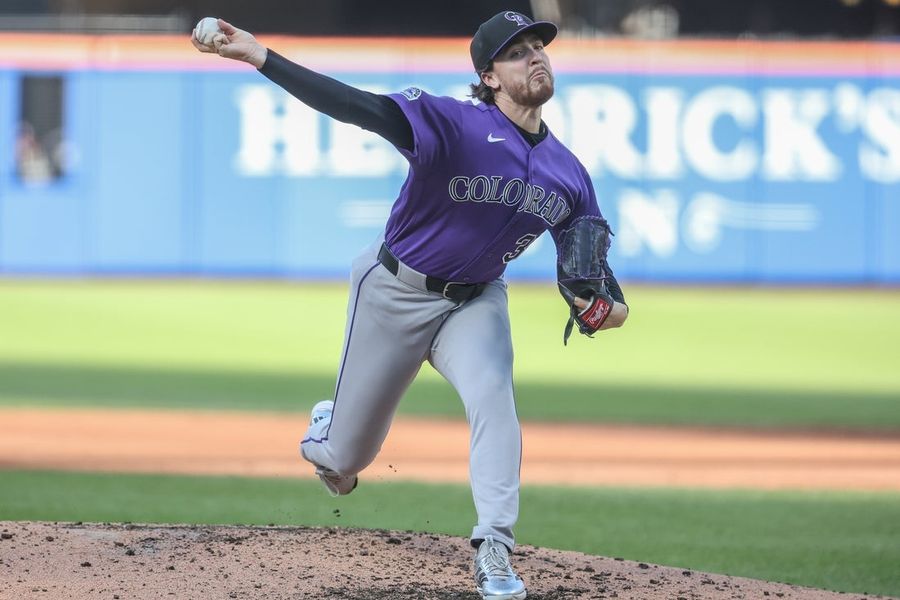
Deadspin | Rockies deliver shutout to finish doubleheader sweep of miserable Mets  Apr 26, 2026; New York City, New York, USA;  Colorado Rockies starting pitcher Chase Dollander (32) pitches in the third inning against the New York Mets at Citi Field. Mandatory Credit: Wendell Cruz-Imagn Images   Chase Dollander threw seven scoreless innings in the longest outing of his career as the visiting Colorado Rockies completed a doubleheader sweep of the sinking New York Mets with a 3-0 win in Sunday’s nightcap.  Four Rockies pitchers combined on a four-hitter in a 3-1 win in the opener. The doubleheader was necessitated by a rainout Saturday.  Troy Johnston had an RBI single in the second inning of the nightcap and Hunter Goodman hit a two-run homer one inning later for Colorado, which swept a series from the Mets in New York for the first time since 2018 to improve to 13-16.  The Rockies didn’t record their 13th win last season until June 12, when they improved to 13-55 on their way to a 43-119 finish.  The Mets have lost 15 of 17 – their worst 17-game stretch since a 2-15 skid from Aug. 28 through Sept, 13, 2004.  New York scored one run or fewer in a traditional doubleheader Sunday for the first time since Oct, 3, 2015, when the Mets scored one run while being swept by the Washington Nationals.   Dollander (3-2), who made his first start of the season after six long relief outings, allowed five hits and two walks while striking out seven over a career-high 105 pitches.  The scoreless start was the first of Dollander’s career, though he threw 5 1/3 scoreless innings as a bulk reliever and earned the win in a 3-2 victory over the Houston Astros on Apr. 16.  Dollander wriggled out of a two-on, two-out jam in the first when he got MJ Melendez to fly out. Carson Benge and Ronny Mauricio singled to open the fifth, but Tyrone Taylor lined into a double play before Dollander retired Bo Bichette on a grounder.  Seth Halvorsen threw a hitless eighth before Zach Agnos worked around Melendez’s one-out double in the ninth to notch his second save.  The struggling Kodai Senga (0-4) took the loss after allowing three runs on three hits and three walks while striking out three in 2 2/3 innings. Senga has given up 17 runs (16 earned) over 8 1/3 innings in his last three starts.  –Field Level Media    #Deadspin #Rockies #deliver #shutout #finish #doubleheader #sweep #miserable #MetsApr 26, 2026; New York City, New York, USA; Colorado Rockies starting pitcher Chase Dollander (32) pitches in the third inning against the New York Mets at Citi Field. Mandatory Credit: Wendell Cruz-Imagn Images

Chase Dollander threw seven scoreless innings in the longest outing of his career as the visiting Colorado Rockies completed a doubleheader sweep of the sinking New York Mets with a 3-0 win in Sunday’s nightcap.

Four Rockies pitchers combined on a four-hitter in a 3-1 win in the opener. The doubleheader was necessitated by a rainout Saturday.

Troy Johnston had an RBI single in the second inning of the nightcap and Hunter Goodman hit a two-run homer one inning later for Colorado, which swept a series from the Mets in New York for the first time since 2018 to improve to 13-16.

The Rockies didn’t record their 13th win last season until June 12, when they improved to 13-55 on their way to a 43-119 finish.

The Mets have lost 15 of 17 – their worst 17-game stretch since a 2-15 skid from Aug. 28 through Sept, 13, 2004.


New York scored one run or fewer in a traditional doubleheader Sunday for the first time since Oct, 3, 2015, when the Mets scored one run while being swept by the Washington Nationals.

Dollander (3-2), who made his first start of the season after six long relief outings, allowed five hits and two walks while striking out seven over a career-high 105 pitches.

The scoreless start was the first of Dollander’s career, though he threw 5 1/3 scoreless innings as a bulk reliever and earned the win in a 3-2 victory over the Houston Astros on Apr. 16.

Dollander wriggled out of a two-on, two-out jam in the first when he got MJ Melendez to fly out. Carson Benge and Ronny Mauricio singled to open the fifth, but Tyrone Taylor lined into a double play before Dollander retired Bo Bichette on a grounder.

Seth Halvorsen threw a hitless eighth before Zach Agnos worked around Melendez’s one-out double in the ninth to notch his second save.

The struggling Kodai Senga (0-4) took the loss after allowing three runs on three hits and three walks while striking out three in 2 2/3 innings. Senga has given up 17 runs (16 earned) over 8 1/3 innings in his last three starts.


–Field Level Media

#Deadspin #Rockies #deliver #shutout #finish #doubleheader #sweep #miserable #Mets

Apr 26, 2026; New York City, New York, USA; Colorado Rockies starting pitcher Chase Dollander (32) pitches in the third inning against the New York Mets at Citi Field. Mandatory Credit: Wendell Cruz-Imagn Images

Chase Dollander threw seven scoreless innings in the longest outing of his career as the visiting Colorado Rockies completed a doubleheader sweep of the sinking New York Mets with a 3-0 win in Sunday’s nightcap.

Four Rockies pitchers combined on a four-hitter in a 3-1 win in the opener. The doubleheader was necessitated by a rainout Saturday.

Troy Johnston had an RBI single in the second inning of the nightcap and Hunter Goodman hit a two-run homer one inning later for Colorado, which swept a series from the Mets in New York for the first time since 2018 to improve to 13-16.

The Rockies didn’t record their 13th win last season until June 12, when they improved to 13-55 on their way to a 43-119 finish.

The Mets have lost 15 of 17 – their worst 17-game stretch since a 2-15 skid from Aug. 28 through Sept, 13, 2004.

New York scored one run or fewer in a traditional doubleheader Sunday for the first time since Oct, 3, 2015, when the Mets scored one run while being swept by the Washington Nationals.

Dollander (3-2), who made his first start of the season after six long relief outings, allowed five hits and two walks while striking out seven over a career-high 105 pitches.

The scoreless start was the first of Dollander’s career, though he threw 5 1/3 scoreless innings as a bulk reliever and earned the win in a 3-2 victory over the Houston Astros on Apr. 16.

Dollander wriggled out of a two-on, two-out jam in the first when he got MJ Melendez to fly out. Carson Benge and Ronny Mauricio singled to open the fifth, but Tyrone Taylor lined into a double play before Dollander retired Bo Bichette on a grounder.

Seth Halvorsen threw a hitless eighth before Zach Agnos worked around Melendez’s one-out double in the ninth to notch his second save.

The struggling Kodai Senga (0-4) took the loss after allowing three runs on three hits and three walks while striking out three in 2 2/3 innings. Senga has given up 17 runs (16 earned) over 8 1/3 innings in his last three starts.

–Field Level Media

Source link
#Deadspin #Rockies #deliver #shutout #finish #doubleheader #sweep #miserable #Mets

Previous post

Sanjay Manjrekar on why Impact Player rule, short boundaries are reducing venues to bowler graveyards <div id="content-body-70911580" itemprop="articleBody"><p>The debate surrounding the Impact Player rule in Indian Premier League (IPL) isn’t new, but this season has once again pushed it into sharper focus.</p><p>This is also the fourth year of the Impact Player rule. Despite strong calls from players to scrap it, the IPL has made it clear there will be no review before the 2027 season.</p><p>The balance between bat and ball, always a delicate balance in T20 cricket, now appears to have tipped decisively in one direction.</p><p>Former India cricketer Sanjay Manjrekar believes the shift is no longer subtle, but stark.</p><p>“Yes, that’s the burning topic. Everyone’s talking about it. I can recall at least five batters [in IPL 2026] scoring not just hundreds, but hundreds off around 50 balls, striking at 200. I’ve felt strongly for a number of years about the balance between bat and ball, and I think we’ve now gone beyond a certain limit,” Manjrekar said on <i>Sportstar’s Insight Edge</i> podcast.</p><p>For Manjrekar, the concern is not limited to purists longing for the past. Even the modern T20 audience, conditioned to expect high-scoring thrillers, is beginning to feel the excess.</p><p>“Even T20 fans, not just traditional Test cricket followers, are starting to feel slightly disillusioned by the sheer dominance of bat over ball.”</p><p><b>The pitch problem</b></p><p>At the heart of this imbalance, he argues, lies the nature of Indian pitches. “Let’s start with one fact: the IPL is played on Indian pitches. While not every ground is high-scoring, venues like Lucknow and occasionally Chennai have maintained some balance. But most grounds, including the new one in Chandigarh, are heavily skewed in favour of batters.”</p><p>The issue is not just flatness, but predictability. “Why do I say that? Because on Indian pitches, once the ball lands, it does very little. It comes on straight, which makes batting much easier. Even on flat pitches in Australia, South Africa, or England, the ball still does something occasionally. That’s not the case here.”</p><p><b>Unintended consequences</b></p><p>Layered onto these conditions is the Impact Player rule, which Manjrekar believes has amplified the imbalance. “Reason number two is the Impact Player rule. I think it has impacted bowlers far more negatively than it has benefited batters. Imagine this rule in New Zealand, where the ball swings. Bringing in a seam bowler could balance things. But in India, it hasn’t worked that way.”</p><p>Interestingly, he admits he initially welcomed the rule. “When it was introduced, I was actually excited. I thought we’d see more specialist players, an extra pure batter or bowler, raising the overall quality. So the players who I used to call bits and pieces, I don’t do that anymore, because that term is misunderstood. So I would say, non-specialists.”</p><p>The effect is visible in team composition and intent. “You now have pure batters like Ashutosh Sharma coming in at No. 8. When you have batting depth till No. 8, players at the top can go all out because they know there’s cover.”</p><p>That safety net, he suggests, has fundamentally altered risk-taking. “Imagine a scenario where the overs were reduced to 20, you know, from 50 and teams could only use seven batters and the innings ended after five wickets. It would be a completely different game.”</p><p><b>Grounds stuck in another era</b></p><p>Then comes a structural issue that often escapes scrutiny: ground dimensions. “Many were built decades ago, with dimensions suited to a different era of cricket. The game has evolved, but the grounds haven’t.”</p><p>If anything, the problem has worsened. “Boundaries need to be longer. Instead, in some cases, like at Wankhede, they’re brought in further for advertising boards. It’s ridiculous. You see shots reaching the boundary in seconds, with no real fielding contest. You don’t see the chasing, you know, the old-fashioned somebody running after the ball and people going, ‘oh, is he going to stop it?’ It’s just four or six.”</p><p><b>Is the middle order being exposed or protected?</b></p><p>While some argue that the Impact Player rule masks weak middle orders, Manjrekar sees it differently. “Not necessarily. Teams with strong middle orders, like RCB, still see contributions from those players. The bigger issue is how conditions favour batters so heavily.”</p><p>He even questions whether certain T20 staples remain relevant in current conditions. “In fact, someone suggested whether we even need the six-over PowerPlay in these conditions. With a hard new ball and only two fielders outside the circle, teams at the top are maximising this phase.”</p><p><b>What can be fixed?</b></p><p>If given the power to intervene, Manjrekar points to both ideal and practical solutions. “Two or three things come to mind. First, reconsider the six-over PowerPlay. It’s pragmatic.”</p><p>Longer boundaries would help, but aren’t always feasible. “Ideally, I’d like longer boundaries, but not all grounds allow that. Some venues are simply too small. After watching recent games, especially at Wankhede Stadium in Mumbai, I feel some grounds just aren’t suited for T20 anymore… Same with [Chinnaswamy Stadium] in Bengaluru… They’ve become bowler graveyards.”</p><p>He offers a telling example. “Take Vaibhav Sooryavanshi’s hundred [against Sunrisers Hyderabad], for instance. At least four sixes he hit would’ve been catches if the boundaries were even slightly longer. That would bring some sanity back to the game.”</p><p>One unintended casualty of the current ecosystem is the genuine all-rounder.</p><p>“Yes, it does,” Manjrekar says when asked if the Impact Player rule hurts them. “For example, Shivam Dube showed his value in the T20 World Cup and Asia Cup by contributing with both bat and ball. In the IPL, he barely bowls.”</p><p>The broader issue, he feels, is the loss of in-game adaptability.</p><p>“In hindsight, I’d like to see teams forced to adapt when bowlers struggle, instead of relying on substitutions. That unpredictability adds to the charm.”</p><p class="publish-time" id="end-of-article">Published on Apr 27, 2026</p></div> #Sanjay #Manjrekar #Impact #Player #rule #short #boundaries #reducing #venues #bowler #graveyards

Next post

ITTF President Sorling: Extremely happy to see table tennis grow in India <div id="content-body-70912127" itemprop="articleBody"><p>For Petra Sorling and the International Table Tennis Federation (ITTF), 2025 was a tumultuous year. The Swede, the first-ever female President in the history of the sport, was re-elected in Doha in May after beating Khalil Al-Mohannadi, her Qatari opponent, by just two votes. There were protests regarding the validity of the online votes which led to the suspension of that Annual General Meeting. The matter even reached the Court of Arbitration for Sport.</p><p>Now, the dust has settled. With big ticket events such as the Los Angeles Olympics on the horizon and several important issues impacting the sport, Sorling’s second term as President is a crucial one.</p><p>In an exclusive interview with  <i>Sportstar</i> on the sidelines of the World Table Tennis Day celebrations in Kapadwanj, Gujarat, Sorling shares her thoughts on the importance of making the LA Olympics count, the controversy regarding the 2025 elections, the issue of prize money, technology, the review system, and more:</p><p><b>Q: What are your thoughts on celebrating World Table Tennis Day and commemorating 100 years of the ITTF in a small place like Kapadwanj. What does it mean to you and how did you plan this?</b></p><p>First and foremost, I’m very happy with the warm welcome in India and the celebration in Kapadwanj. We have been so warmly welcomed by the communities and it goes without saying that I feel very happy and proud of this celebration. But it’s also not only a celebration on this day, this is a long-term project and we work together with the communities and with our partners here, KKM (Kapadwanj Kelavani Mandal) and the Dani Sports Foundation. And I’m very happy to meet the young boys and girls here who tell the story of how table tennis has impacted their lives.</p><p><b>Q: ITTF and India have a long association. India is now hosting a lot of international events as well. Chennai hosted a WTT Star Contender. There were a couple of feeder and youth contender events as well. And later this year, the country is going to host the Commonwealth Championships. What is in store for India when it comes to the future? Will Indians fans also get to witness bigger events like WTT Champions or Grand Smash soon?</b></p><p>Table Tennis Federation of India was one of the founding members of ITTF 100 years ago. So, yes, there is a long tradition of table tennis in India. What I’m extremely happy about is to see the growth of table tennis in India in the last few years. We feel that we can do much more in such a big country where table tennis is a very good sport. You can pick a racket and you can play literally everywhere. I was extremely proud to present medals to the players from India at last year’s edition of the Youth World Championships because it’s a very high-level event. I come from Sweden, a country with a long tradition, and we were not even qualified to play.</p><p>I do believe that these results come by all the investments that you have done locally with a lot of events. Not least, the UTT League where players have been used to this international environment. When the players have been able to play at home but also learn a lot from the international coaches and players. You have also been very good at investing in players travelling the world, playing a lot of events on all levels. So, on that topic, of course, you’re more than ready to take on the next level of events – title events or a Grand Smash. So, I’m looking forward to coming to India also for those events in the future.</p><p><b>Q: At the global level, table tennis is a growing sport. It’s one of the most popular sports. But still, there are some markets which it is yet to capture. And in that aspect, how big is the LA 2028 Olympics for table tennis? You’ve mentioned in past interviews that you’re not happy with the capacity of the venue there. How important is it for your sport to capitalise on these coming Olympics?</b></p><p>When I took office as president, I identified two markets as priority for us. One was India and the other was America. Table tennis in LA 2028 offers six medals (men’s singles, women’s singles, mixed doubles, men’s doubles, women’s doubles and mixed team). We are very happy that we are the racquet sport with the most medals. However, we do have a small venue and it will be filled up very easily which I think is good in a way because we can already see the demand for the tickets released recently.</p><p>But we have to work very hard to establish ourselves as one of the top eight sports in the Olympic program. We are on a good journey there. If the venue is too small, we have to use outdoor parks and try to add value so that everyone who likes to see table tennis can be part of the family. This holds up for the next editions as well.</p><p>But I already see table tennis growing in the U.S. Last year, we had a Grand Smash in Las Vegas. This year, we will have it at the Ontario Convention Centre in Los Angeles. That’s also a very good segue into LA 2028 and for what comes afterwards. We are working very hard on growing in these markets.</p><p><b>Q: You’re one of the few female presidents of a global sports body. How has your experience been so far?</b></p><p>It’s been five years. I was elected to the ITTF Executive Board in 2009 and I was the only female in the Executive Board during that time until 2021, when I was elected as the first-ever woman president in 95 years. So, I’m happy to be the one that shows that it’s possible but I’m even more happy that after the 2025 elections, we now have a gender equal Executive Board. And I do believe that it’s not a coincidence. I think that by opening doors, we can be more diverse.</p><p>Being one of the very few female presidents of an international federation is also a big task to carry because I really try to motivate and provide that spirit for more women to take on that office and to go for elections. At the moment, we are four female presidents in all sports – Summer and Winter Olympics. So, there is room for many more.</p><p><b>Q: Coming to last year’s elections, there was a little bit of controversy and it took some time to solve all those issues. How did that affect the sport?</b></p><p>The last year had been stressful for us with the AGM turning out to create a lot of political stress. However, I must say that I’m very proud of how we went through that year due to the robust structure that we have. ITTF, of course, is the heart but our commercial arm, WTT, running the events as usual and the foundation, the social arm running all the social activities as usual. We, at ITTF, stabilized ourselves and we came out with a stronger board and a stronger ITTF than before. Hard work pays off. I really believe that it turned out to be a good platform for the next 100 years to come.</p><p><b>Q: You also come from a business background. Table tennis is not one of the lucrative sports. Sometimes, it’s not easy for a player to make ends meet. Many players have complained that unless they make it to the very deep end of the tournament, it’s not easy for them to break even. How do you address this issue of prize money and better pay for players?</b></p><p>It’s a very important question for us. We were very proud already in 2008 when we had equal prize money. But it doesn’t mean that the prize money is enough.</p><p>The prize money must be on a level. So, as a player, you can live your dream and be a table tennis player professionally. We are working hard now to make our WTT profitable so that we can return those investments also in higher prize money.</p><p>This is a job that we do together with the athletes and I must acknowledge here that we have very good athletes. They are really contributing in every aspect of our sport.</p><p><b>Q: Players are a lot happier when there is the presence of technology in bigger events like the review system for World Championships, World Cups and Olympics as well. But when it comes to other events, what is the plan? Is it too big a financial ask for any event or are you planning to somehow make it affordable for everyone?</b></p><p>When it comes to new technology, of course, it’s very expensive in the beginning. And today, actually, it’s only the financial aspect that is the reason for us not to go all out because we can see that it creates a good fair play. Of course, we can still improve a little bit on how we are using the cameras, etc. but this is the way to go.</p><p>Hopefully, with new technology, when there will be competition, more people will deliver this kind of system and we can launch it on a wider scale.</p><p class="publish-time" id="end-of-article">Published on Apr 27, 2026</p></div> #ITTF #President #Sorling #Extremely #happy #table #tennis #grow #India

Deadspin | Trump Turnberry passed over for ’28 Open Championship  July 18, 2009; Turnberry, SCOTLAND; Stewart Cink (USA) (left) and Tom Watson (USA) after Cink defeated Watson in a playoff at the 2009 British Open at Turnberry Country Club. Mandatory Credit: Simon Stacpoole/Offside Sports via Imagn Images   The 2028 Open Championship was awarded to England’s Royal Lytham & St Annes Golf Club on Monday.  The official announcement from the R&A means Scotland’s Trump Turnberry must wait until at least 2029 to host the Open.  “Turnberry is still in our thinking,” R&A CEO Mark Darbon said Monday at Royal Birkdale Golf Club during media day for this year’s Open Championship in July.  Turnberry last hosted the Open in 2009, five years before the Trump Organization — parent company of U.S. President Donald Trump’s real estate portfolio —  purchased the property for  million.  Turnberry, which also hosted the major championship in 1977, 1986 and 1994, has undergone a reported 0 million in renovations and upgrades since joining the Trump umbrella, according to Front Office Sports. Trump’s sons, Donald Jr. and Eric, have been in charge of the day-to-day operations of the Trump Organization since 2017.   Attendance at the 2009 Open at Turnberry was an estimated 123,000 fans, far below the 200,000-plus common at many of the other venues in rotation.  “We really like the golf course,” Darbon said Monday. “We know that there are some logistical challenges that relate to staging a modern Open Championship there primarily off the course–road, rail, and accommodation infrastructure. We’ve got a really good dialogue with the club and its ownership, pretty transparent discussion there.”  Stewart Cink defeated 59-year-old Tom Watson in a four-hole playoff to win the Open at Turnberry in 2009.  Royal Lytham & St Annes has hosted the Open Championship 11 times since 1926, most recently in 2012 when South Africa’s Ernie Els defeated Adam Scott by one stroke.  –Field Level Media    #Deadspin #Trump #Turnberry #passed #Open #ChampionshipJuly 18, 2009; Turnberry, SCOTLAND; Stewart Cink (USA) (left) and Tom Watson (USA) after Cink defeated Watson in a playoff at the 2009 British Open at Turnberry Country Club. Mandatory Credit: Simon Stacpoole/Offside Sports via Imagn Images

The 2028 Open Championship was awarded to England’s Royal Lytham & St Annes Golf Club on Monday.

The official announcement from the R&A means Scotland’s Trump Turnberry must wait until at least 2029 to host the Open.

“Turnberry is still in our thinking,” R&A CEO Mark Darbon said Monday at Royal Birkdale Golf Club during media day for this year’s Open Championship in July.

Turnberry last hosted the Open in 2009, five years before the Trump Organization — parent company of U.S. President Donald Trump’s real estate portfolio — purchased the property for $60 million.


Turnberry, which also hosted the major championship in 1977, 1986 and 1994, has undergone a reported $200 million in renovations and upgrades since joining the Trump umbrella, according to Front Office Sports. Trump’s sons, Donald Jr. and Eric, have been in charge of the day-to-day operations of the Trump Organization since 2017.

Attendance at the 2009 Open at Turnberry was an estimated 123,000 fans, far below the 200,000-plus common at many of the other venues in rotation.

“We really like the golf course,” Darbon said Monday. “We know that there are some logistical challenges that relate to staging a modern Open Championship there primarily off the course–road, rail, and accommodation infrastructure. We’ve got a really good dialogue with the club and its ownership, pretty transparent discussion there.”

Stewart Cink defeated 59-year-old Tom Watson in a four-hole playoff to win the Open at Turnberry in 2009.

Royal Lytham & St Annes has hosted the Open Championship 11 times since 1926, most recently in 2012 when South Africa’s Ernie Els defeated Adam Scott by one stroke.


–Field Level Media

#Deadspin #Trump #Turnberry #passed #Open #Championship">Deadspin | Trump Turnberry passed over for ’28 Open Championship  July 18, 2009; Turnberry, SCOTLAND; Stewart Cink (USA) (left) and Tom Watson (USA) after Cink defeated Watson in a playoff at the 2009 British Open at Turnberry Country Club. Mandatory Credit: Simon Stacpoole/Offside Sports via Imagn Images   The 2028 Open Championship was awarded to England’s Royal Lytham & St Annes Golf Club on Monday.  The official announcement from the R&A means Scotland’s Trump Turnberry must wait until at least 2029 to host the Open.  “Turnberry is still in our thinking,” R&A CEO Mark Darbon said Monday at Royal Birkdale Golf Club during media day for this year’s Open Championship in July.  Turnberry last hosted the Open in 2009, five years before the Trump Organization — parent company of U.S. President Donald Trump’s real estate portfolio —  purchased the property for  million.  Turnberry, which also hosted the major championship in 1977, 1986 and 1994, has undergone a reported 0 million in renovations and upgrades since joining the Trump umbrella, according to Front Office Sports. Trump’s sons, Donald Jr. and Eric, have been in charge of the day-to-day operations of the Trump Organization since 2017.   Attendance at the 2009 Open at Turnberry was an estimated 123,000 fans, far below the 200,000-plus common at many of the other venues in rotation.  “We really like the golf course,” Darbon said Monday. “We know that there are some logistical challenges that relate to staging a modern Open Championship there primarily off the course–road, rail, and accommodation infrastructure. We’ve got a really good dialogue with the club and its ownership, pretty transparent discussion there.”  Stewart Cink defeated 59-year-old Tom Watson in a four-hole playoff to win the Open at Turnberry in 2009.  Royal Lytham & St Annes has hosted the Open Championship 11 times since 1926, most recently in 2012 when South Africa’s Ernie Els defeated Adam Scott by one stroke.  –Field Level Media    #Deadspin #Trump #Turnberry #passed #Open #Championship

Fans will be allowed to attend the remaining games of the Pakistan Super League after prime minister Shehbaz Sharif on Monday approved spectators for three Playoffs matches.

It comes two days after Sharif approved a request from franchise owners to allow fans for the PSL’s May 3 final in Lahore.

Pakistan Cricket Board Chairman Mohsin Naqvi, who is also interior minister in the government, announced the decision on social media after his meeting with Sharif in Islamabad.

He wrote on X that Sharif wanted the fans to “use public transport or minimize fuel consumption while attending the matches, in line with the ongoing national austerity efforts.”

Pakistan’s biggest sports spectacle of the year started behind closed doors late last month with fans asked to stay home because of soaring fuel prices related to the Iran war.

Pakistan’s government had urged people to restrict travel and to work from home and Naqvi had said it wouldn’t be right to have 30,000 fans attending cricket matches every day while the government is asking the public to stay home.

The PCB also reduced the number of PSL venues from six to two as part of austerity measures, but barred spectators from PSL games at Lahore and Karachi.

Peshawar Zalmi, led by Babar Azam, will take on three-time champion Islamabad United in the qualifier in Karachi on Tuesday with the winner advancing to the final.

The loser faces the winner of Wednesday’s eliminator between first-timer Hyderabad Kingsmen and Multan Sultans on May 1 for the second spot in the finale, with all three of those matches in Lahore.

Published on Apr 27, 2026

#Fans #allowed #attend #Playoff #matches #Pakistan #Super #League">Fans to be allowed to attend Playoff matches of Pakistan Super League  Fans will be allowed to attend the remaining games of the Pakistan Super League after prime minister Shehbaz Sharif on Monday approved spectators for three Playoffs matches.It comes two days after Sharif approved a request from franchise owners to allow fans for the PSL’s May 3 final in Lahore.Pakistan Cricket Board Chairman Mohsin Naqvi, who is also interior minister in the government, announced the decision on social media after his meeting with Sharif in Islamabad.He wrote on        X that Sharif wanted the fans to “use public transport or minimize fuel consumption while attending the matches, in line with the ongoing national austerity efforts.”Pakistan’s biggest sports spectacle of the year started behind closed doors late last month with fans asked to stay home because of soaring fuel prices related to the Iran war.Pakistan’s government had urged people to restrict travel and to work from home and Naqvi had said it wouldn’t be right to have 30,000 fans attending cricket matches every day while the government is asking the public to stay home.The PCB also reduced the number of PSL venues from six to two as part of austerity measures, but barred spectators from PSL games at Lahore and Karachi.Peshawar Zalmi, led by Babar Azam, will take on three-time champion Islamabad United in the qualifier in Karachi on Tuesday with the winner advancing to the final.The loser faces the winner of Wednesday’s eliminator between first-timer Hyderabad Kingsmen and Multan Sultans on May 1 for the second spot in the finale, with all three of those matches in Lahore.Published on Apr 27, 2026  #Fans #allowed #attend #Playoff #matches #Pakistan #Super #League

Post Comment