×
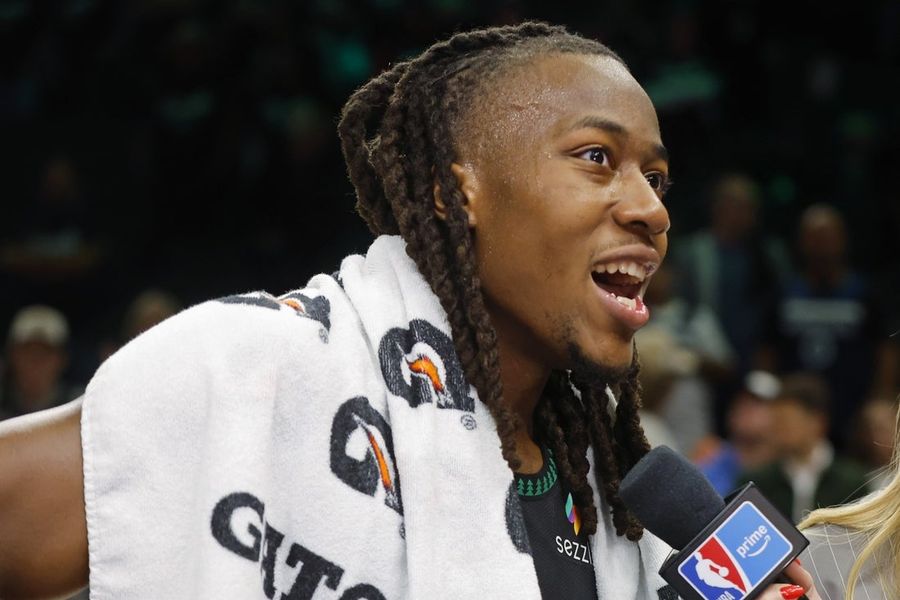
Deadspin | Timberwolves G Ayo Dosunmu (calf) out for Game 6 vs. Nuggets  Apr 23, 2026; Minneapolis, Minnesota, USA; Minnesota Timberwolves guard Ayo Dosunmu (13) talks with a reporter after the game with the Denver Nuggets at Target Center. Mandatory Credit: Bruce Kluckhohn-Imagn Images   Minnesota guard Ayo Dosunmu, dealing with a sore right calf, was ruled out for Game 6 of the Timberwolves’ Western Conference first-round series vs. the Denver Nuggets in Minneapolis on Thursday.  Dosunmu was a late addition to the injury report for the Timberwolves, who hold a 3-2 lead in the best-of-seven series. The news that he wouldn’t play broke more than an hour before tipoff.  Game 7, if necessary, is Saturday in Denver.  A late-season acquisition via trade from Chicago, Dosunmu emerged as the hero in Game 4 after star Anthony Edwards (knee) and backcourt mate Donte DiVincenzo (Achilles) exited due to injury. Dosunmu scored 43 points, bookended by performances of 25 and 18 points, respectively, in Games 3 and 5.   Minnesota also ruled out Edwards and DiVincenzo for the Thursday game, but guard Bones Hyland was made available for the contest despite dealing with left knee soreness.  Dosunmu, 26, averaged a combined 14.8 points, 3.6 assists and 3.4 rebounds for the Bulls and the Timberwolves in 69 games (19 starts) this season.  The University of Illinois product was selected by the Bulls in the second round of the 2021 draft. In five NBA seasons, he has averages of 11.1 points, 3.3 assists and 3.0 rebounds in 348 games (173 starts).  –Field Level Media    #Deadspin #Timberwolves #Ayo #Dosunmu #calf #Game #Nuggets
Deadspin | Timberwolves G Ayo Dosunmu (calf) out for Game 6 vs. Nuggets
Deadspin | Timberwolves G Ayo Dosunmu (calf) out for Game 6 vs. Nuggets  Apr 23, 2026; Minneapolis, Minnesota, USA; Minnesota Timberwolves guard Ayo Dosunmu (13) talks with a reporter after the game with the Denver Nuggets at Target Center. Mandatory Credit: Bruce Kluckhohn-Imagn Images   Minnesota guard Ayo Dosunmu, dealing with a sore right calf, was ruled out for Game 6 of the Timberwolves’ Western Conference first-round series vs. the Denver Nuggets in Minneapolis on Thursday.  Dosunmu was a late addition to the injury report for the Timberwolves, who hold a 3-2 lead in the best-of-seven series. The news that he wouldn’t play broke more than an hour before tipoff.  Game 7, if necessary, is Saturday in Denver.  A late-season acquisition via trade from Chicago, Dosunmu emerged as the hero in Game 4 after star Anthony Edwards (knee) and backcourt mate Donte DiVincenzo (Achilles) exited due to injury. Dosunmu scored 43 points, bookended by performances of 25 and 18 points, respectively, in Games 3 and 5.   Minnesota also ruled out Edwards and DiVincenzo for the Thursday game, but guard Bones Hyland was made available for the contest despite dealing with left knee soreness.  Dosunmu, 26, averaged a combined 14.8 points, 3.6 assists and 3.4 rebounds for the Bulls and the Timberwolves in 69 games (19 starts) this season.  The University of Illinois product was selected by the Bulls in the second round of the 2021 draft. In five NBA seasons, he has averages of 11.1 points, 3.3 assists and 3.0 rebounds in 348 games (173 starts).  –Field Level Media    #Deadspin #Timberwolves #Ayo #Dosunmu #calf #Game #NuggetsApr 23, 2026; Minneapolis, Minnesota, USA; Minnesota Timberwolves guard Ayo Dosunmu (13) talks with a reporter after the game with the Denver Nuggets at Target Center. Mandatory Credit: Bruce Kluckhohn-Imagn Images

Minnesota guard Ayo Dosunmu, dealing with a sore right calf, was ruled out for Game 6 of the Timberwolves’ Western Conference first-round series vs. the Denver Nuggets in Minneapolis on Thursday.

Dosunmu was a late addition to the injury report for the Timberwolves, who hold a 3-2 lead in the best-of-seven series. The news that he wouldn’t play broke more than an hour before tipoff.

Game 7, if necessary, is Saturday in Denver.


A late-season acquisition via trade from Chicago, Dosunmu emerged as the hero in Game 4 after star Anthony Edwards (knee) and backcourt mate Donte DiVincenzo (Achilles) exited due to injury. Dosunmu scored 43 points, bookended by performances of 25 and 18 points, respectively, in Games 3 and 5.

Minnesota also ruled out Edwards and DiVincenzo for the Thursday game, but guard Bones Hyland was made available for the contest despite dealing with left knee soreness.

Dosunmu, 26, averaged a combined 14.8 points, 3.6 assists and 3.4 rebounds for the Bulls and the Timberwolves in 69 games (19 starts) this season.

The University of Illinois product was selected by the Bulls in the second round of the 2021 draft. In five NBA seasons, he has averages of 11.1 points, 3.3 assists and 3.0 rebounds in 348 games (173 starts).


–Field Level Media

#Deadspin #Timberwolves #Ayo #Dosunmu #calf #Game #Nuggets

Apr 23, 2026; Minneapolis, Minnesota, USA; Minnesota Timberwolves guard Ayo Dosunmu (13) talks with a reporter after the game with the Denver Nuggets at Target Center. Mandatory Credit: Bruce Kluckhohn-Imagn Images

Minnesota guard Ayo Dosunmu, dealing with a sore right calf, was ruled out for Game 6 of the Timberwolves’ Western Conference first-round series vs. the Denver Nuggets in Minneapolis on Thursday.

Dosunmu was a late addition to the injury report for the Timberwolves, who hold a 3-2 lead in the best-of-seven series. The news that he wouldn’t play broke more than an hour before tipoff.

Game 7, if necessary, is Saturday in Denver.

A late-season acquisition via trade from Chicago, Dosunmu emerged as the hero in Game 4 after star Anthony Edwards (knee) and backcourt mate Donte DiVincenzo (Achilles) exited due to injury. Dosunmu scored 43 points, bookended by performances of 25 and 18 points, respectively, in Games 3 and 5.

Minnesota also ruled out Edwards and DiVincenzo for the Thursday game, but guard Bones Hyland was made available for the contest despite dealing with left knee soreness.

Dosunmu, 26, averaged a combined 14.8 points, 3.6 assists and 3.4 rebounds for the Bulls and the Timberwolves in 69 games (19 starts) this season.

The University of Illinois product was selected by the Bulls in the second round of the 2021 draft. In five NBA seasons, he has averages of 11.1 points, 3.3 assists and 3.0 rebounds in 348 games (173 starts).

–Field Level Media

Source link
#Deadspin #Timberwolves #Ayo #Dosunmu #calf #Game #Nuggets

Previous post

South Africa series exposes India’s familiar squad-selection woes ahead of T20 World Cup <div id="content-body-70927999" itemprop="articleBody"><p>Imagine your favourite meal. A nice <i>thali</i>? Or a hot plate of biriyani? A decadent cheesy pizza? Now imagine the comfort of the perfect nap that inevitably follows said savoured spread, paired with a nice cool breeze on a hot Indian summer day.</p><p>What if someone comes and slaps you awake from that siesta? That might be how the team India is feeling after a 1-4 drubbing in the five-match T20I series against South Africa, weeks away from the 2026 T20 World Cup in England. The afterglow of a maiden ODI World Cup win, the team’s first major ICC title at the senior level, was enduring and generous, but the bubble had to pop sometime, and that pointy pin that did the job had Laura Wolvaardt’s kind face on it.</p><h4 class="sub_head">Wolvaardt supremacy</h4><p>The South African captain is on a hot streak like never before and looks unstoppable heading into the T20 showpiece. In the 825 runs the Proteas scored against India in five T20Is, Wolvaardt accounted for 330 – a whopping 40 percent. Her series haul is also the most runs a woman has scored in a single series/tournament in the format.</p><p>She has three fifties, a century (struck at a series-best strike rate of 216.98) and a solitary 18-run blip within her returns in the series. Incidentally, that was the game the Proteas lost. Naturally, she finished as the Player of the Series. For additional context, India’s top-scorer for its tour was her counterpart Harmanpreet Kaur, who scored little more than half of Wolvaardt’s aggregate – 169 runs.</p><p>That top-order brilliance masked frailties in the spine for South Africa. The middle order continues to be shaky. Sune Luus has been effective as Wolvaardt’s partner at the top, but the batting order thereafter has not managed an ounce of consistency.</p><p>Wolvaardt loves responsibility and has often tried to negotiate cricket’s tug of war on her own. Think of the semifinal and final in the ODI World Cup in 2025. But how much can she really do all by herself, year after year?</p><p>The side’s batting dynamite was on display in that 50-over showpiece when Wolvaardt and Tazmin Brits sculpted a <i>Travishek</i> (to borrow from the ongoing IPL)-style dominance over teams. Much like fellow South African Heinrich Klaasen for the Sunrisers Hyderabad, Nadine de Klerk, along with Chloe Tryon, gave South Africa its fangs lower down the order and finished several tight games for the side. With no official fixtures before the World Cup, the Proteas need to tap into these core strengths to fashion another surge to the summit clash.</p><h4 class="sub_head">Deja vu</h4><p>India, meanwhile, has stumbled back in time to 2024, where indecision rules. While the No. 3 slot was Amol Muzumdar’s biggest headache then, Jemimah Rodrigues has settled the nerves with a stable showing in that position. While the itch to use tours like this to experiment is understandable and even justified, a few of India’s calls are hard to understand. Smriti Mandhana and Shafali Verma have scored 37 percent (416 out of 1120) of the runs India has managed in the format this year, so resting the former to allow youngsters like Anushka Sharma a chance was fairly prudent.</p><p>What was puzzling was the organisation of the lower order. The handling of Deepti Sharma, Richa Ghosh, and a player like Bharti Fulmali – inducted into the team for her power and quick-scoring abilities under pressure – felt scatterbrained at best. Bharti, returning to the Indian T20I fold after a considerable time in the wilderness, needs to be moulded in Richa’s template, someone who can usurp the reins of an innings and firmly steer it away from the opposition’s control. The Gujarat Giants and Vidarbha finisher has a best effort of 30-ball 40 in the 5th T20I, returning single-digit scores in the other two games she featured in. Should India have considered pushing her ahead of Richa to allow her an additional ball or two to settle in and get going? Richa’s own stutters mean she needs game time too – a Catch-22 for the think tank.</p><p>Beyond it all, will Bharti continue to get a run if Amanjot Kaur’s pace option makes her a better choice?</p><p>One can imagine Deepti was worried more about her returns with the ball than with the bat. She went wicketless in the first three games and then dug her way to a match-winning fifer in the fourth fixture, but her economy rates remained erratic throughout. England is the last preparatory stop for the Women in Blue, an opponent that brings out Deepti’s competitive best. Muzumdar and Co. will hope Deepti finds her rhythm in time to get going in the World Cup, should she make the squad.</p><p>Kranti Goud’s aggression and Renuka Singh’s ability to swing the ball early mean little if wickets don’t follow with the new ball. India managed just two PowerPlay wickets in five games. Renuka and Deepti are Harmanpreet’s strike bowlers of choice, and they clocked economy rates exceeding 11. Persistent fielding slip-ups do not help.</p><p>Harmanpreet, Smriti, and Muzumdar will also be eyeing that strike rate column with some worry. While Harmanpreet’s jump from 104.83 in 2025 to 131.01 this year is the most dramatic improvement, everyone else has plateaued. Shafali’s strike rate in the format has dropped from 158.5 to 142.4, with a six percent drop in her boundary percentage. Credit to good opposition bowling too, but she will need to grind her way back to her ‘normal’ range and unlock a way to stay put for longer to maximise the efficacy of the pressure she brings to the table. In Wolvaardt, there’s a template ready to be emulated.</p><p>India is not known for bravado with squad selections. While this squad and this think tank have experimented, it often errs on the side of caution when tournament cricket comes calling. The 2024 group-stage exit was a humbling experience of epic proportions. That opening defeat at the hands of New Zealand buoyed the White Ferns right to the podium. All eyes will be on the squad India carts to the British Isles and what the unit does with the time it has to lock in some last-minute preparation as a challenging World Cup, with spirited opponents, beckons.</p><p class="publish-time" id="end-of-article">Published on May 01, 2026</p></div> #South #Africa #series #exposes #Indias #familiar #squadselection #woes #ahead #T20 #World #Cup

Next post

Study Up on These Devil Wears Prada Secrets Before Watching the Sequel. That’s All. 

Soccer Meets America focuses around the meteoric rise in popularity, from the North American Soccer League days of the 1970s and 1980s to the 1984 Olympics, leading up to the 1994 World Cup. At the center of that history was Alan Rothenberg, who served as soccer commissioner for the 1984 Olympics, the president of the U.S. Soccer Federation from 1990 to 1998, and the CEO of the 1994 World Cup. He also had a hand in the start of Major League Soccer, adding women’s soccer to the Olympic program in 1996, and bringing the 1999 Women’s World Cup to the United States.

Rothenberg recently released a new book entitled The Big Bounce: The Surge that Shaped the Future of U.S. Soccer. In the book, Rothenberg gives an inside account at how American soccer went from the days where leagues were not organized and fizzled quickly to some of the success we have today with leagues like Major League Soccer, the National Women’s Soccer League, and the United Soccer Leagues. He details his firsthand knowledge of what it took for the United States to host a successful soccer tournament at the 1984 Olympics, how the nation won the bid to host the 1994 World Cup, and how he was able to organize the federation to get everything done and push the game forward. He recently sat down for an interview on the USA Soccercast, and in that interview, he mentioned that the rise in popularity of the game wasn’t based on one big moment, but a sustained buildup of momentum.

“[American soccer] sort of grew when I was starting in 1990,” Alan Rothenberg, former U.S. Soccer president and CEO of the 1994 World Cup, said in an interview for the USA Soccercast. “I had a glimpse of it back in the 70s when we had a team in Los Angeles ,and obviously the Cosmos set the world on fire at that time with Pelé and [Franz] Beckebauer…you had Giants Stadium. So there were those glimpses of what the future could hold. But as we started to build the soccer federation, our [1994] World cup team and the World cup organization, it just started to accelerate. So there wasn’t one ‘a ha!’ moment.”

Soccer Meets America takes the unique yet unexpected path of professional soccer in the United States andn gives the story some definition. Through people like Rothenberg, we see that the history is shaped by chance, persistence, and communities that kept the game alive long before it found mainstream recognition. Starting with the sport’s deep roots in immigrant communities in the 1920s, each episode of the docuseries explores soccer on a personal and professional level. Both nostalgic and forward-facing, the series features a variety of influential figures in American soccer and aims to resonate with new and old fans of the sport alike.

But there’s also the legacy of the 2026 World Cup, which will be different from what it was in 1994. “Well, obviously we’re starting from a different baseline,” Rothenberg said. “We started at virtually zero back in [1990], and now we’re starting from level 60 or 75…so the dramatic consequences will not be the same as they were after 94, but I think it’s going to be a huge spike in interest in the sport at all levels.”

To grow the history, you must learn from it. And Soccer Meets America gives you a review of America’s soccer history and strengthes the foundations from which the sport’s culture and passion were created. As we approach the World Cup, that knowledge will be essential to craft the legacy that will carry long after the tournament ends.

#Vox #Creative #Roku #debut #docuseries #history #American #soccer">Vox Creative, Roku debut new docuseries on history of American soccer  The history of American soccer has spanned well over 120 years, and to date there hasn’t been many opportunities to look back at that history. With the 2026 World Cup about a month away, we now have a chance to do just that. Yesterday, SB Nation collaborated with Vox Creative and Roku to release Soccer Meets America, a 3-part docuseries that focuses on the rise of soccer in the United States.Soccer Meets America focuses around the meteoric rise in popularity, from the North American Soccer League days of the 1970s and 1980s to the 1984 Olympics, leading up to the 1994 World Cup. At the center of that history was Alan Rothenberg, who served as soccer commissioner for the 1984 Olympics, the president of the U.S. Soccer Federation from 1990 to 1998, and the CEO of the 1994 World Cup. He also had a hand in the start of Major League Soccer, adding women’s soccer to the Olympic program in 1996, and bringing the 1999 Women’s World Cup to the United States.Rothenberg recently released a new book entitled The Big Bounce: The Surge that Shaped the Future of U.S. Soccer. In the book, Rothenberg gives an inside account at how American soccer went from the days where leagues were not organized and fizzled quickly to some of the success we have today with leagues like Major League Soccer, the National Women’s Soccer League, and the United Soccer Leagues. He details his firsthand knowledge of what it took for the United States to host a successful soccer tournament at the 1984 Olympics, how the nation won the bid to host the 1994 World Cup, and how he was able to organize the federation to get everything done and push the game forward. He recently sat down for an interview on the USA Soccercast, and in that interview, he mentioned that the rise in popularity of the game wasn’t based on one big moment, but a sustained buildup of momentum.“[American soccer] sort of grew when I was starting in 1990,” Alan Rothenberg, former U.S. Soccer president and CEO of the 1994 World Cup, said in an interview for the USA Soccercast. “I had a glimpse of it back in the 70s when we had a team in Los Angeles ,and obviously the Cosmos set the world on fire at that time with Pelé and [Franz] Beckebauer…you had Giants Stadium. So there were those glimpses of what the future could hold. But as we started to build the soccer federation, our [1994] World cup team and the World cup organization, it just started to accelerate. So there wasn’t one ‘a ha!’ moment.”Soccer Meets America takes the unique yet unexpected path of professional soccer in the United States andn gives the story some definition. Through people like Rothenberg, we see that the history is shaped by chance, persistence, and communities that kept the game alive long before it found mainstream recognition. Starting with the sport’s deep roots in immigrant communities in the 1920s, each episode of the docuseries explores soccer on a personal and professional level. Both nostalgic and forward-facing, the series features a variety of influential figures in American soccer and aims to resonate with new and old fans of the sport alike.But there’s also the legacy of the 2026 World Cup, which will be different from what it was in 1994. “Well, obviously we’re starting from a different baseline,” Rothenberg said. “We started at virtually zero back in [1990], and now we’re starting from level 60 or 75…so the dramatic consequences will not be the same as they were after 94, but I think it’s going to be a huge spike in interest in the sport at all levels.”To grow the history, you must learn from it. And Soccer Meets America gives you a review of America’s soccer history and strengthes the foundations from which the sport’s culture and passion were created. As we approach the World Cup, that knowledge will be essential to craft the legacy that will carry long after the tournament ends.  #Vox #Creative #Roku #debut #docuseries #history #American #soccer

Soccer Meets America, a 3-part docuseries that focuses on the rise of soccer in the United States.

Soccer Meets America focuses around the meteoric rise in popularity, from the North American Soccer League days of the 1970s and 1980s to the 1984 Olympics, leading up to the 1994 World Cup. At the center of that history was Alan Rothenberg, who served as soccer commissioner for the 1984 Olympics, the president of the U.S. Soccer Federation from 1990 to 1998, and the CEO of the 1994 World Cup. He also had a hand in the start of Major League Soccer, adding women’s soccer to the Olympic program in 1996, and bringing the 1999 Women’s World Cup to the United States.

Rothenberg recently released a new book entitled The Big Bounce: The Surge that Shaped the Future of U.S. Soccer. In the book, Rothenberg gives an inside account at how American soccer went from the days where leagues were not organized and fizzled quickly to some of the success we have today with leagues like Major League Soccer, the National Women’s Soccer League, and the United Soccer Leagues. He details his firsthand knowledge of what it took for the United States to host a successful soccer tournament at the 1984 Olympics, how the nation won the bid to host the 1994 World Cup, and how he was able to organize the federation to get everything done and push the game forward. He recently sat down for an interview on the USA Soccercast, and in that interview, he mentioned that the rise in popularity of the game wasn’t based on one big moment, but a sustained buildup of momentum.

“[American soccer] sort of grew when I was starting in 1990,” Alan Rothenberg, former U.S. Soccer president and CEO of the 1994 World Cup, said in an interview for the USA Soccercast. “I had a glimpse of it back in the 70s when we had a team in Los Angeles ,and obviously the Cosmos set the world on fire at that time with Pelé and [Franz] Beckebauer…you had Giants Stadium. So there were those glimpses of what the future could hold. But as we started to build the soccer federation, our [1994] World cup team and the World cup organization, it just started to accelerate. So there wasn’t one ‘a ha!’ moment.”

Soccer Meets America takes the unique yet unexpected path of professional soccer in the United States andn gives the story some definition. Through people like Rothenberg, we see that the history is shaped by chance, persistence, and communities that kept the game alive long before it found mainstream recognition. Starting with the sport’s deep roots in immigrant communities in the 1920s, each episode of the docuseries explores soccer on a personal and professional level. Both nostalgic and forward-facing, the series features a variety of influential figures in American soccer and aims to resonate with new and old fans of the sport alike.

But there’s also the legacy of the 2026 World Cup, which will be different from what it was in 1994. “Well, obviously we’re starting from a different baseline,” Rothenberg said. “We started at virtually zero back in [1990], and now we’re starting from level 60 or 75…so the dramatic consequences will not be the same as they were after 94, but I think it’s going to be a huge spike in interest in the sport at all levels.”

To grow the history, you must learn from it. And Soccer Meets America gives you a review of America’s soccer history and strengthes the foundations from which the sport’s culture and passion were created. As we approach the World Cup, that knowledge will be essential to craft the legacy that will carry long after the tournament ends.

#Vox #Creative #Roku #debut #docuseries #history #American #soccer">Vox Creative, Roku debut new docuseries on history of American soccer

The history of American soccer has spanned well over 120 years, and to date there hasn’t been many opportunities to look back at that history. With the 2026 World Cup about a month away, we now have a chance to do just that. Yesterday, SB Nation collaborated with Vox Creative and Roku to release Soccer Meets America, a 3-part docuseries that focuses on the rise of soccer in the United States.

Soccer Meets America focuses around the meteoric rise in popularity, from the North American Soccer League days of the 1970s and 1980s to the 1984 Olympics, leading up to the 1994 World Cup. At the center of that history was Alan Rothenberg, who served as soccer commissioner for the 1984 Olympics, the president of the U.S. Soccer Federation from 1990 to 1998, and the CEO of the 1994 World Cup. He also had a hand in the start of Major League Soccer, adding women’s soccer to the Olympic program in 1996, and bringing the 1999 Women’s World Cup to the United States.

Rothenberg recently released a new book entitled The Big Bounce: The Surge that Shaped the Future of U.S. Soccer. In the book, Rothenberg gives an inside account at how American soccer went from the days where leagues were not organized and fizzled quickly to some of the success we have today with leagues like Major League Soccer, the National Women’s Soccer League, and the United Soccer Leagues. He details his firsthand knowledge of what it took for the United States to host a successful soccer tournament at the 1984 Olympics, how the nation won the bid to host the 1994 World Cup, and how he was able to organize the federation to get everything done and push the game forward. He recently sat down for an interview on the USA Soccercast, and in that interview, he mentioned that the rise in popularity of the game wasn’t based on one big moment, but a sustained buildup of momentum.

“[American soccer] sort of grew when I was starting in 1990,” Alan Rothenberg, former U.S. Soccer president and CEO of the 1994 World Cup, said in an interview for the USA Soccercast. “I had a glimpse of it back in the 70s when we had a team in Los Angeles ,and obviously the Cosmos set the world on fire at that time with Pelé and [Franz] Beckebauer…you had Giants Stadium. So there were those glimpses of what the future could hold. But as we started to build the soccer federation, our [1994] World cup team and the World cup organization, it just started to accelerate. So there wasn’t one ‘a ha!’ moment.”

Soccer Meets America takes the unique yet unexpected path of professional soccer in the United States andn gives the story some definition. Through people like Rothenberg, we see that the history is shaped by chance, persistence, and communities that kept the game alive long before it found mainstream recognition. Starting with the sport’s deep roots in immigrant communities in the 1920s, each episode of the docuseries explores soccer on a personal and professional level. Both nostalgic and forward-facing, the series features a variety of influential figures in American soccer and aims to resonate with new and old fans of the sport alike.

But there’s also the legacy of the 2026 World Cup, which will be different from what it was in 1994. “Well, obviously we’re starting from a different baseline,” Rothenberg said. “We started at virtually zero back in [1990], and now we’re starting from level 60 or 75…so the dramatic consequences will not be the same as they were after 94, but I think it’s going to be a huge spike in interest in the sport at all levels.”

To grow the history, you must learn from it. And Soccer Meets America gives you a review of America’s soccer history and strengthes the foundations from which the sport’s culture and passion were created. As we approach the World Cup, that knowledge will be essential to craft the legacy that will carry long after the tournament ends.

#Vox #Creative #Roku #debut #docuseries #history #American #soccer

Delhi Capitals will host Chennai Super Kings at the Arun Jaitley Stadium in Delhi on Wednesday. Both teams have won four out of the nine games they have played.

In the reverse fixture, CSK beat DC by 23 runs in Chennai.

Here are the complete stats and head-to-head numbers you need to know before the teams face off:

DC vs CSK Head-to-Head Record in IPL

Matches Played: 32

Delhi Capitals: 12

Chennai Super Kings: 20

MOST RUNS IN DC vs CSK IPL MATCHES

Batter Innings Runs Average Strike Rate HS
MS Dhoni 29 696 38.66 142.04 63*
Suresh Raina 22 552 29.05 132.05 59
Shikhar Dhawan 10 433 54.12 136.16 101*
Rishabh Pant 11 375 46.87 156.9 79
Murali Vijay 12 346 34.6 136.22 113

MOST WICKETS IN DC vs CSK IPL MATCHES

Bowler Innings Wickets Economy Average BBI
Ravichandran Ashwin 17 19 6.52 21 3/23
Dwayne Bravo 17 19 8.06 22.42 3/33
Ravindra Jadeja 20 19 7.75 25.78 3/9
Deepak Chahar 12 13 8.06 26.69 3/22
Albie Morkel 14 13 8.29 29.76 3/32

Published on May 04, 2026

#CSK #headtohead #record #IPL #Delhi #Capitals #Chennai #Super #Kings #stats #runs #wickets">DC vs CSK head-to-head record, IPL 2026: Delhi Capitals vs Chennai Super Kings stats, runs, wickets  Delhi Capitals will host Chennai Super Kings at the Arun Jaitley Stadium in Delhi on Wednesday. Both teams have won four out of the nine games they have played.In the reverse fixture, CSK beat DC by 23 runs in Chennai.Here are the complete stats and head-to-head numbers you need to know before the teams face off:
DC vs CSK Head-to-Head Record in IPL

Matches Played: 32

Delhi Capitals: 12

Chennai Super Kings: 20
MOST RUNS IN DC vs CSK IPL MATCHES  Batter  Innings  Runs  Average  Strike Rate  HS   MS Dhoni  29  696  38.66  142.04  63*  Suresh Raina  22  552  29.05  132.05  59  Shikhar Dhawan  10  433  54.12  136.16  101*  Rishabh Pant  11  375  46.87  156.9  79  Murali Vijay  12  346  34.6  136.22  113MOST WICKETS IN DC vs CSK IPL MATCHES  Bowler  Innings  Wickets  Economy  Average  BBI  Ravichandran Ashwin  17  19  6.52  21  3/23  Dwayne Bravo  17  19  8.06  22.42  3/33  Ravindra Jadeja  20  19  7.75  25.78  3/9  Deepak Chahar  12  13  8.06  26.69  3/22  Albie Morkel  14  13  8.29  29.76  3/32Published on May 04, 2026  #CSK #headtohead #record #IPL #Delhi #Capitals #Chennai #Super #Kings #stats #runs #wickets

Post Comment