×
How MLB’s ABS challenge system works, and why it’s successful  Major League Baseball introduced a new innovation for the 2026 season by implementing the ABS Challenge System. The All-Star break provided an opportunity to reflect on how the Automatic ball-strike system has changed the game and overall, the reception has been positive.It is impossible to discuss the ABS system without talking about the technology behind it. T-Mobile has played a huge role in the system. Go to a baseball game or watch one from home and you will instantly see all of the T-Mobile branding throughout the ballpark. However, it is important to point out that T-Mobile’s partnership with Major League Baseball simply isn’t branding. They are powering the technology behind the ABS system.“We have been a partner with Major League Baseball for over a decade now and I think one of the things and the reasons it’s worked so well is we’ve kept innovating together,” T-Mobile Vice President of Sponsorships Amy Azzi said during All-Star festivities at Citizens Bank Park.Major League Baseball began testing the ABS system back in 2022 in the minor leagues. A priority was of course that it needed to be accurate but it also had to be fast so that it wouldn’t take away from the game experience. The system is powered by Hawkeye Cameras that have been installed in every Major League park. The data is transferred over a private 5G network that is provided by T-Mobile. That leads to an almost instantaneous result.“All of that data is transmitted into a software system that we’ve developed via the T-Mobile network,” said Morgan Sword who is the Executive Vice President of Baseball Operations at MLB. “That software system determines whether the trajectory of the ball matches with the strike zone we’ve loaded in. Then if it’s challenged, that produces a call.””That’s the call you see on the big board and then also on the broadcast. It’s a lot of technology that has to happen very quickly to keep that pace and rhythm going in the game.”So far there have been over 6,000 challenges during the first half of the regular season. Teams start with two challenges each and lose one for every unsuccessful attempt. Sword said that the number of challenges was something that the league had tested in the minors and listened to feedback from fans. Two felt like the sweet spot.“We decided on two challenges per team because that was the overwhelming fan feedback in the minor leagues that we started out at three. Fans told us that, you know, ABS challenges are great and exciting to a point. If you have games where there’s 12, 15 challenges, then it starts to feel a little like it’s disrupting the game a little bit. So we dialed it back to two and that’s produced about four challenges per game, which we think is kind of right on the money and fans have responded well to that.”The overwhelming reaction to ABS from fans has been positive, but what about the players? Brewers’ Cy Young candidate Jacob Misiorowski talked about the ABS system at T-Mobile’s Club Magenta. Misiorowski said that he thinks that the system gives an advantage to the hitters.“I mean, sure, yes, there’s an advantage for pitchers to get a corner call, but I think you have a bigger advantage to get a call reversed to a ball over a strike.”While he thinks that ABS is tipped slightly in hitters favor, he is a fan of all of the technology that has made its way into baseball.“All the technology that you’re getting, all the information that they throw up on the scoreboard, all that stuff is really cool. The tech comes back to us and we get that information and stuff like that to tweak pitches, tweak everything around it. There’s Hawkeye, stuff like that is huge.”Phillies legends Ryan Howard and Chase Utley both agreed that they would have benefitted from having the ABS system.“I think we both had a pretty good knowledge of the strike zone and I think that guys now, pitchers, catchers, and hitters are starting to get a better understanding of what that strike zone is,” Howard said. “We’ve seen pitches that are this far off, that are a ball, and then just a hair on, that are strikes.”“Yeah, I think it would have helped. I think, right now, what we’re seeing is, calls are getting right,” said Utley. “At the end of the day, it’s about getting the calls correct.While the ABS system looks like a success, Major League Baseball is currently looking for other ways that they can use technology to improve the game. They are testing a check swing system in the minors.“It is the same Hawkeye tracking system. It actually tracks the bat, when a hitter swings. So you can finally, for the first time in the history of baseball, decide what a swing is,” Sword said. “We actually don’t really define that for anybody. So, we’ve made up a definition for the purpose of Triple-A just to see how it goes. But, we may tweak that.”A lot of thought has gone into developing these systems and how they would impact the fan experience.“It’s been really fun to watch it in the stadium, and I think I was telling Morgan before this, that some of the loudest moments in the stadium, you’d think someone hit a home run,” Azzi said of the ABS system.“It’s really fun to see the impact it’s had on getting people to engage in even more. It supports the great momentum that the sport has right now.”  #MLBs #ABS #challenge #system #works #successful

How MLB’s ABS challenge system works, and why it’s successful

Major League Baseball introduced a new innovation for the 2026 season by implementing the ABS Challenge System. The All-Star break provided an opportunity to reflect on how the Automatic ball-strike system has changed the game and overall, the reception has been positive.

It is impossible to discuss the ABS system without talking about the technology behind it. T-Mobile has played a huge role in the system. Go to a baseball game or watch one from home and you will instantly see all of the T-Mobile branding throughout the ballpark. However, it is important to point out that T-Mobile’s partnership with Major League Baseball simply isn’t branding. They are powering the technology behind the ABS system.

“We have been a partner with Major League Baseball for over a decade now and I think one of the things and the reasons it’s worked so well is we’ve kept innovating together,” T-Mobile Vice President of Sponsorships Amy Azzi said during All-Star festivities at Citizens Bank Park.

Major League Baseball began testing the ABS system back in 2022 in the minor leagues. A priority was of course that it needed to be accurate but it also had to be fast so that it wouldn’t take away from the game experience. The system is powered by Hawkeye Cameras that have been installed in every Major League park. The data is transferred over a private 5G network that is provided by T-Mobile. That leads to an almost instantaneous result.

“All of that data is transmitted into a software system that we’ve developed via the T-Mobile network,” said Morgan Sword who is the Executive Vice President of Baseball Operations at MLB. “That software system determines whether the trajectory of the ball matches with the strike zone we’ve loaded in. Then if it’s challenged, that produces a call.”

”That’s the call you see on the big board and then also on the broadcast. It’s a lot of technology that has to happen very quickly to keep that pace and rhythm going in the game.”

So far there have been over 6,000 challenges during the first half of the regular season. Teams start with two challenges each and lose one for every unsuccessful attempt. Sword said that the number of challenges was something that the league had tested in the minors and listened to feedback from fans. Two felt like the sweet spot.

“We decided on two challenges per team because that was the overwhelming fan feedback in the minor leagues that we started out at three. Fans told us that, you know, ABS challenges are great and exciting to a point. If you have games where there’s 12, 15 challenges, then it starts to feel a little like it’s disrupting the game a little bit. So we dialed it back to two and that’s produced about four challenges per game, which we think is kind of right on the money and fans have responded well to that.”

The overwhelming reaction to ABS from fans has been positive, but what about the players? Brewers’ Cy Young candidate Jacob Misiorowski talked about the ABS system at T-Mobile’s Club Magenta. Misiorowski said that he thinks that the system gives an advantage to the hitters.

“I mean, sure, yes, there’s an advantage for pitchers to get a corner call, but I think you have a bigger advantage to get a call reversed to a ball over a strike.”

While he thinks that ABS is tipped slightly in hitters favor, he is a fan of all of the technology that has made its way into baseball.

“All the technology that you’re getting, all the information that they throw up on the scoreboard, all that stuff is really cool. The tech comes back to us and we get that information and stuff like that to tweak pitches, tweak everything around it. There’s Hawkeye, stuff like that is huge.”

Phillies legends Ryan Howard and Chase Utley both agreed that they would have benefitted from having the ABS system.

“I think we both had a pretty good knowledge of the strike zone and I think that guys now, pitchers, catchers, and hitters are starting to get a better understanding of what that strike zone is,” Howard said. “We’ve seen pitches that are this far off, that are a ball, and then just a hair on, that are strikes.”

“Yeah, I think it would have helped. I think, right now, what we’re seeing is, calls are getting right,” said Utley. “At the end of the day, it’s about getting the calls correct.

While the ABS system looks like a success, Major League Baseball is currently looking for other ways that they can use technology to improve the game. They are testing a check swing system in the minors.

“It is the same Hawkeye tracking system. It actually tracks the bat, when a hitter swings. So you can finally, for the first time in the history of baseball, decide what a swing is,” Sword said. “We actually don’t really define that for anybody. So, we’ve made up a definition for the purpose of Triple-A just to see how it goes. But, we may tweak that.”

A lot of thought has gone into developing these systems and how they would impact the fan experience.

“It’s been really fun to watch it in the stadium, and I think I was telling Morgan before this, that some of the loudest moments in the stadium, you’d think someone hit a home run,” Azzi said of the ABS system.

“It’s really fun to see the impact it’s had on getting people to engage in even more. It supports the great momentum that the sport has right now.”
#MLBs #ABS #challenge #system #works #successful

Major League Baseball introduced a new innovation for the 2026 season by implementing the ABS Challenge System. The All-Star break provided an opportunity to reflect on how the Automatic ball-strike system has changed the game and overall, the reception has been positive.

It is impossible to discuss the ABS system without talking about the technology behind it. T-Mobile has played a huge role in the system. Go to a baseball game or watch one from home and you will instantly see all of the T-Mobile branding throughout the ballpark. However, it is important to point out that T-Mobile’s partnership with Major League Baseball simply isn’t branding. They are powering the technology behind the ABS system.

“We have been a partner with Major League Baseball for over a decade now and I think one of the things and the reasons it’s worked so well is we’ve kept innovating together,” T-Mobile Vice President of Sponsorships Amy Azzi said during All-Star festivities at Citizens Bank Park.

Major League Baseball began testing the ABS system back in 2022 in the minor leagues. A priority was of course that it needed to be accurate but it also had to be fast so that it wouldn’t take away from the game experience. The system is powered by Hawkeye Cameras that have been installed in every Major League park. The data is transferred over a private 5G network that is provided by T-Mobile. That leads to an almost instantaneous result.

“All of that data is transmitted into a software system that we’ve developed via the T-Mobile network,” said Morgan Sword who is the Executive Vice President of Baseball Operations at MLB. “That software system determines whether the trajectory of the ball matches with the strike zone we’ve loaded in. Then if it’s challenged, that produces a call.”

”That’s the call you see on the big board and then also on the broadcast. It’s a lot of technology that has to happen very quickly to keep that pace and rhythm going in the game.”

So far there have been over 6,000 challenges during the first half of the regular season. Teams start with two challenges each and lose one for every unsuccessful attempt. Sword said that the number of challenges was something that the league had tested in the minors and listened to feedback from fans. Two felt like the sweet spot.

“We decided on two challenges per team because that was the overwhelming fan feedback in the minor leagues that we started out at three. Fans told us that, you know, ABS challenges are great and exciting to a point. If you have games where there’s 12, 15 challenges, then it starts to feel a little like it’s disrupting the game a little bit. So we dialed it back to two and that’s produced about four challenges per game, which we think is kind of right on the money and fans have responded well to that.”

The overwhelming reaction to ABS from fans has been positive, but what about the players? Brewers’ Cy Young candidate Jacob Misiorowski talked about the ABS system at T-Mobile’s Club Magenta. Misiorowski said that he thinks that the system gives an advantage to the hitters.

“I mean, sure, yes, there’s an advantage for pitchers to get a corner call, but I think you have a bigger advantage to get a call reversed to a ball over a strike.”

While he thinks that ABS is tipped slightly in hitters favor, he is a fan of all of the technology that has made its way into baseball.

“All the technology that you’re getting, all the information that they throw up on the scoreboard, all that stuff is really cool. The tech comes back to us and we get that information and stuff like that to tweak pitches, tweak everything around it. There’s Hawkeye, stuff like that is huge.”

Phillies legends Ryan Howard and Chase Utley both agreed that they would have benefitted from having the ABS system.

“I think we both had a pretty good knowledge of the strike zone and I think that guys now, pitchers, catchers, and hitters are starting to get a better understanding of what that strike zone is,” Howard said. “We’ve seen pitches that are this far off, that are a ball, and then just a hair on, that are strikes.”

“Yeah, I think it would have helped. I think, right now, what we’re seeing is, calls are getting right,” said Utley. “At the end of the day, it’s about getting the calls correct.

While the ABS system looks like a success, Major League Baseball is currently looking for other ways that they can use technology to improve the game. They are testing a check swing system in the minors.

“It is the same Hawkeye tracking system. It actually tracks the bat, when a hitter swings. So you can finally, for the first time in the history of baseball, decide what a swing is,” Sword said. “We actually don’t really define that for anybody. So, we’ve made up a definition for the purpose of Triple-A just to see how it goes. But, we may tweak that.”

A lot of thought has gone into developing these systems and how they would impact the fan experience.

“It’s been really fun to watch it in the stadium, and I think I was telling Morgan before this, that some of the loudest moments in the stadium, you’d think someone hit a home run,” Azzi said of the ABS system.

“It’s really fun to see the impact it’s had on getting people to engage in even more. It supports the great momentum that the sport has right now.”

Source link
#MLBs #ABS #challenge #system #works #successful

Previous post

Indore Sarafa Rate 17 July: इंदौर में चांदी 1500, सोना 350 रुपये तक सस्‍ता

Next post

इंदौर नगर निगम वार्ड-60 का चुनाव निरस्त: पार्षद सुनेहरा अंसारी की जीत रद्द; चार साल पुराने चुनावी विवाद में जिला कोर्ट का फैसला – Indore News

When I arrived to cover the Minnesota Vikings for the St. Paul Pioneer Press in 2000, it was clear I was dealing with a star-studded roster.

The team boasted future Pro Football Hall of Famers; wide receivers Cris Carter and Randy Moss and defensive tackle John Randle. Plus, there were a ton of other stars including quarterback Daunte Culpepper, center Matt Birk and running back Robert Smith. The Vikings were loaded with star power.

The talent around the team wasn’t relegated simply to the roster, however.

That summer I first laid my eyes on a 16-year-old high school junior named Larry Fitzgerald Jr. The son of a local media member and close friend of Vikings’ head coach Dennis Green, Little Fitzy was a ball boy during training camp and on game days. It turns out, Larry Fitzgerald Jr. is very likely the most famous former NFL ball boy in history.

On reporting date, fellow reporter Kevin Seifert pointed out Fitzgerald to me and said “that’s a bad man.” Seifert didn’t say that about any of the actual Vikings that day.

Fitzgerald was already known as the best Minnesota high school prospect in years and he was considered one of the best high school players in the country. Seifert told me the buzz was that the kid was, no doubt, headed to the NFL in a half decade or so. Seifert was on the money. I’m not sure the Hall of Fame was mentioned or not.

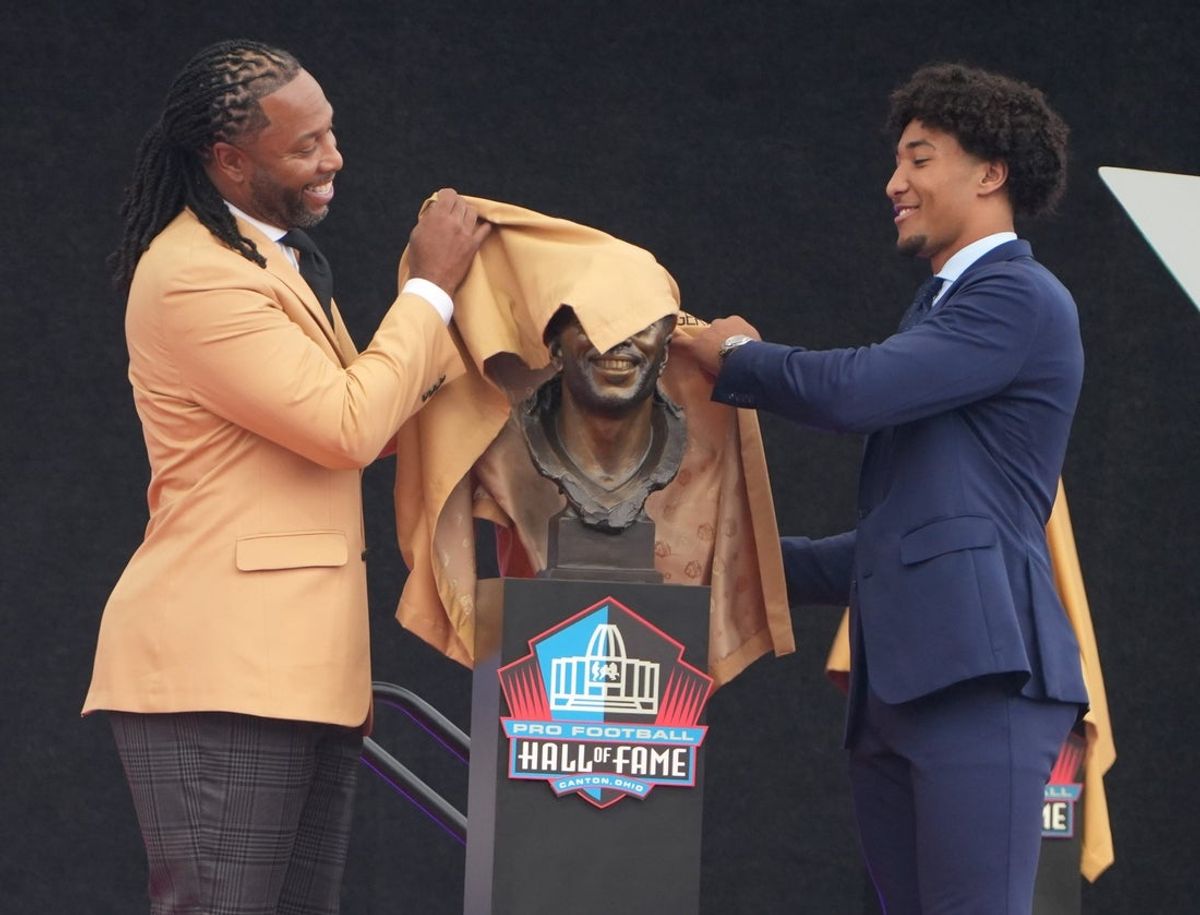
But this weekend of course, that’s exactly where Little Fitzy is headed. He will be enshrined into the Pro Football Hall of Fame in Canton, Ohio, on Saturday as a first-ballot Hall of Famer.

Fitzgerald will be remembered as one of the best and most productive wide receivers in league history after an incredible 17-season career with the Arizona Cardinals.

I have a ton of memories of being around Fitzgerald, but there’s one that stands out among them all.

One day after training camp, a nameless Vikings’ wide receiver camp body was getting extra work on a JUGS machine, catching balls. He was being tutored by Fitzgerald, who was showing this player how to properly approach the incoming ball. This was a child instructing a grown man an NFL team deemed good enough to attend training camp.

Larry Fitzgerald Jr. was special even back then.

In addition to his incredible natural football ability, Larry Fitzgerald Jr. stood out for his politeness and good nature. You could tell he was a good kid from the first time you met him.

There was no I’m-going-to-be-a-star attitude. He was genuine and he worked his tail off with the rest of the ball boys. There was no entitlement. It was as if he was using his time around an NFL camp as an internship for his future. He passed with flying colors.

I’ve always cherished following his career from his days at Pittsburgh in college to his days of dominating the NFL and I’ve enjoyed running into him over the years now and again.

Enjoy Canton, Little Fitzy, you’ve earned it.

#Larry #Fitzgeralds #Hall #Fame #induction #years #making">Larry Fitzgerald’s Hall of Fame induction is 25 years in the making  When I arrived to cover the Minnesota Vikings for the St. Paul Pioneer Press in 2000, it was clear I was dealing with a star-studded roster.The team boasted future Pro Football Hall of Famers; wide receivers Cris Carter and Randy Moss and defensive tackle John Randle. Plus, there were a ton of other stars including quarterback Daunte Culpepper, center Matt Birk and running back Robert Smith. The Vikings were loaded with star power.The talent around the team wasn’t relegated simply to the roster, however.That summer I first laid my eyes on a 16-year-old high school junior named Larry Fitzgerald Jr. The son of a local media member and close friend of Vikings’ head coach Dennis Green, Little Fitzy was a ball boy during training camp and on game days. It turns out, Larry Fitzgerald Jr. is very likely the most famous former NFL ball boy in history.On reporting date, fellow reporter Kevin Seifert pointed out Fitzgerald to me and said “that’s a bad man.” Seifert didn’t say that about any of the actual Vikings that day.Fitzgerald was already known as the best Minnesota high school prospect in years and he was considered one of the best high school players in the country. Seifert told me the buzz was that the kid was, no doubt, headed to the NFL in a half decade or so. Seifert was on the money. I’m not sure the Hall of Fame was mentioned or not.But this weekend of course, that’s exactly where Little Fitzy is headed. He will be enshrined into the Pro Football Hall of Fame in Canton, Ohio, on Saturday as a first-ballot Hall of Famer.Fitzgerald will be remembered as one of the best and most productive wide receivers in league history after an incredible 17-season career with the Arizona Cardinals.I have a ton of memories of being around Fitzgerald, but there’s one that stands out among them all.One day after training camp, a nameless Vikings’ wide receiver camp body was getting extra work on a JUGS machine, catching balls. He was being tutored by Fitzgerald, who was showing this player how to properly approach the incoming ball. This was a child instructing a grown man an NFL team deemed good enough to attend training camp.Larry Fitzgerald Jr. was special even back then.In addition to his incredible natural football ability, Larry Fitzgerald Jr. stood out for his politeness and good nature. You could tell he was a good kid from the first time you met him.There was no I’m-going-to-be-a-star attitude. He was genuine and he worked his tail off with the rest of the ball boys. There was no entitlement. It was as if he was using his time around an NFL camp as an internship for his future. He passed with flying colors.I’ve always cherished following his career from his days at Pittsburgh in college to his days of dominating the NFL and I’ve enjoyed running into him over the years now and again.Enjoy Canton, Little Fitzy, you’ve earned it.  #Larry #Fitzgeralds #Hall #Fame #induction #years #making

Follow Sportstar for extensive coverage of the tenth edition of the TNPL, from live scores and match reports to exclusive analysis and features.

TOSS

Tiruppur Tamizhans won the toss and chose to bowl first.

PLAYING XIs

Nellai Royal Kings: Athish SR(w), D Santhosh Kumar, Ajitesh Guruswamy, U Mukilesh, Rithik Easwaran, Sonu Yadav(c), Muhammed Adnan Khan, Ramalingam Rohit, Emmanuel Cherian, NS Harish, Rocky Bhasker

Tiruppur Tamizhans: Tushar Raheja(w), Amit Sathvik, Pradosh Ranjan Paul, Mohamed Ali, Uthirasamy Sasidev, Ravisrinivasan Sai Kishore(c), M Mathivannan, S Mohan Prasath, R Silambarasan, Esakkimuthu A, T Natarajan

Published on Aug 09, 2026

#TNPL #Live #Allround #batting #display #propels #Nellai #Royal #Kings">TNPL 2026 Live: All-round batting display propels Nellai Royal Kings to 206/8  Follow Sportstar for extensive coverage of the tenth edition of the TNPL, from live scores and match reports to exclusive analysis and features.TOSSTiruppur Tamizhans won the toss and chose to bowl first.PLAYING XIsNellai Royal Kings: Athish SR(w), D Santhosh Kumar, Ajitesh Guruswamy, U Mukilesh, Rithik Easwaran, Sonu Yadav(c), Muhammed Adnan Khan, Ramalingam Rohit, Emmanuel Cherian, NS Harish, Rocky BhaskerTiruppur Tamizhans: Tushar Raheja(w), Amit Sathvik, Pradosh Ranjan Paul, Mohamed Ali, Uthirasamy Sasidev, Ravisrinivasan Sai Kishore(c), M Mathivannan, S Mohan Prasath, R Silambarasan, Esakkimuthu A, T NatarajanPublished on Aug 09, 2026  #TNPL #Live #Allround #batting #display #propels #Nellai #Royal #Kings

Post Comment