What each side wants from Ukraine talks at White House

What each side wants from Ukraine talks at White House

Laura Gozzi and Tom Geoghegan

BBC News
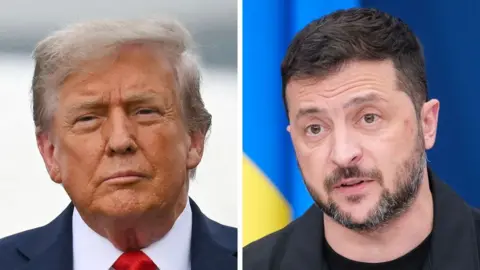
AFP via Getty Images Headshots of Trump and Zelensky - Trump is wearing a blue suit and red tie while Zelensky is wearing a dark jacket and round-necked topAFP via Getty Images

It promises to be a day unlike any other at the White House later, when world leaders make a rare collective visit for crunch talks on Ukraine.

What had been billed as a meeting between two presidents, Donald Trump and Volodomyr Zelensky, has now become more of a summit.

Leaders from the UK, France, Germany, Italy, Finland, the EU and Nato have dashed across the Atlantic to have their say on how the three-year-old war with Russia should end and on what terms.

It’s a reflection of how high the stakes are and increased European concerns that the US has shifted its position to one less favourable to Ukraine.

We break down what each of those present – and one who is not – would regard as a win when the sun sets on a long day of talks.

US – a deal, any deal

Trump’s campaign promise was that he would solve this conflict on his first day in office but six months later the breakthrough he wants still eludes him.

The terms of any agreement have seemed less important to Trump than the deal itself, so the conditions have shifted over time.

Since meeting Russian President Vladimir Putin in Alaska on Friday, Trump appears to have ditched his criticism of Moscow and the threat of sanctions, and decided to pile the pressure on Zelensky instead.

On Sunday night he warned the Ukrainian president he must forgo hopes of Nato membership and will have to concede Crimea, which Putin illegally annexed in 2014.

Trump’s envoy Steve Witkoff said that Washington would provide security guarantees to Europe aimed at deterring further Russian aggression. But the details remain unclear.

Up to now, the US has resisted European demands that it commits to the future security of Ukraine. All eyes will be on the White House later to see if that has really changed.

Ukraine – avoid giving up territory

Zelensky finds himself in the unenviable position of having to stand his ground in the face of an increasingly impatient Donald Trump, who appears to have been swayed by Putin and who has already accused Zelensky of standing in the way of peace.

Trump will probably tell Zelensky he must agree to give up land. This will be extraordinarily difficult for the Ukrainian president to give in to as it would entail retreating from Donetsk and Luhansk, regions which thousands of Ukrainian soldiers have fought and died to protect since 2022.

It would also allow Russia to end up in control of huge swathes of territory it could later use as a launchpad for further aggression.

So Zelensky cannot agree to land concessions without strong security guarantees that would kick in should Russia attack again. Those could have been provided by Nato, but Trump has made it clear Ukraine will not join the alliance.

Details of any alternative guarantees have likely not been worked out yet, but without them it will be difficult for Zelensky to make any commitments.

Ukraine is also concerned by the fact that Trump seems to have moved on from wanting a ceasefire to pushing for a full peace deal. This could take an exceptionally long time, allowing in the meantime for continued Russian attacks, civilian deaths and frontline losses.

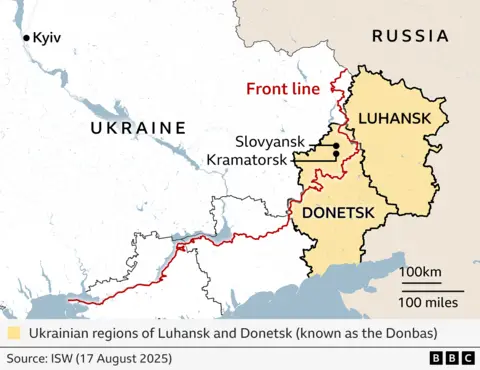
Map showing Russian gains in eastern Ukraine regions of Lukansk and Donetsk

Europe – a US commitment to Ukraine’s security

European leaders will be trying to push Trump to flesh out what US security guarantees for Ukraine could look like.

The vagueness of US statements on the matter is alarming to Europeans who feel protection from potential future attacks by Russia will have to come from a credible American commitment.

There is also nervousness around the idea the US may insist Ukraine gives up land to Russia. The European continent has a long history of bloody wars and leaders want to avoid a scenario in which a sovereign country’s borders are redrawn by force.

These serious concerns explain the unprecedented decision for such a large contingent of leaders to visit the White House at the last minute.

Last week, a virtual US-EU meeting ahead of the Alaska summit seemed to harden Trump’s criticism of Russia; now that he appears to be teetering on Moscow’s side again, European leaders will try to impress on him that their concerns about the continent’s long-term security have not changed.

Russia – more Ukrainian land

There will be no Russian representative at the White House today. That may not matter: it appears Putin made enough of an impression on Trump last week that Moscow may be confident its point of view will be adequately represented.

Trump has already stated Ukraine would not join Nato – and Russia wants that commitment reiterated and ratified. It also wants full control over the Donbas, which would entail Kyiv giving up the land it still holds in the Donetsk and Luhansk regions.

Perhaps most importantly Moscow has managed to instil in Trump that it is now up to Zelensky to make a deal to end the war – while knowing full well he cannot agree to ceding territory outright. A win for Russia would be for this friction to lead to Trump walking away from the negotiating table for good and leaving Ukraine and the Europeans to fend for themselves.

Source link
#side #Ukraine #talks #White #House


Cuba and the United States say officials recently held talks on the island as tensions remain high over the US energy blockade on the Caribbean nation. A US State Department official said the meeting took place on April 10th, while Cuba identified lifting the blockade as a key priority. Morgan Ayre reports.#held #secret #talks #Cuba">US held secret talks with CubaCuba and the United States say officials recently held talks on the island as tensions remain high over the US energy blockade on the Caribbean nation. A US State Department official said the meeting took place on April 10th, while Cuba identified lifting the blockade as a key priority. Morgan Ayre reports.#held #secret #talks #Cuba
 

Greek firm warns ships of “fraudulent messages” offering safe Strait of Hormuz passage for cryptocurrency

The Greek maritime risk management firm MARISKS has warned mariners in the Middle East of fraudulent messages being issued to shipping companies offering vessels safe passage through the Strait of Hormuz in exchange for cryptocurrency, according to the Reuters news agency.

After a brief reopening of the vital waterway, Iran reimposed restrictions on vessels transiting the strait in response to the U.S. naval blockade of its own ships and ports over the weekend. As of now, Iran demands that any commercial vessel seeking passage do so in direct coordination with its military authorities, and that it use a designated route that passes close to its Larak Island in the far north of the narrow strait.

MARISKS issued an alert to shipowners on Monday warning that unknown actors claiming to represent Iranian authorities were sending some shipping companies messages demanding fees payable in cryptocurrencies such as Bitcoin for permission to transit the strait.

“These specific messages are a scam,” and not actually sent by Iranian authorities, the firm warned.

Reuters said there was no comment from Tehran about the messages, noting that hundreds of ships, with about 20,000 seafarers on board, remained stranded in the Gulf as of Tuesday. 

CBS News has seen the gridlock first-hand. Journalists are not meant to be on the waters of the strait, so correspondent Imtiaz Tyab and producer Sohel Uddin posed as tourists to get a short journey into the choked waterway on a pleasure boat. 

They saw dozens of cargo ships and tankers, all of which have sat idle for weeks, waiting and hoping for passage through the strait.


Iranian state TV says nobody sent to Pakistan yet, participation in talks requires change in U.S. “behavior”

Iranian state TV on Tuesday rejected reports suggesting a lower-level preliminary delegation had arrived in Pakistan’s capital ahead of possible peace talks with Trump administration officials.

“Since Saturday, numerous reports have circulated about the ‘departure’ or ‘arrival’ of an Iranian delegation to Pakistan, and even announcements of the meeting time as ‘Monday afternoon’ or ‘Tuesday morning’ by international and regional media — all of which are inaccurate,” the state TV broadcast said.

The report then reiterated a remark by the speaker of Iran’s parliament, Mohammad-Bagher Ghalibaf, who said Monday: “We do not accept negotiations under the shadow of threats.”

“Continuing participation in the talks depends on a change in the behavior and positions of the Americans,” the state TV report said. 

PAKISTAN-WAR-IRAN-US-ISRAEL-DIPLOMACY
Security personnel stand guard at a checkpoint near the Serena Hotel in Islamabad, Pakistan, April 21, 2026, amid heightened security measures ahead of anticipated U.S.-Iran peace talks. Aamir QURESHI/AFP/Getty
 

Trump says recovering Iran’s uranium will be “long and difficult process”

President Trump said late Monday that obtaining uranium from Iran would be “long” and “difficult” in the aftermath of last year’s U.S. strikes on Tehran’s nuclear sites.

“Operation Midnight Hammer was a complete and total obliteration of the Nuclear Dust sites in Iran,” he wrote on his Truth Social platform, adding: “Therefore, digging it out will be a long and difficult process.”

Mr. Trump regularly uses the term “nuclear dust” to refer to Iran’s stock of enriched uranium, which the United States accuses Iran of hoarding in order to use in a nuclear bomb. But he has also sometimes used it to refer to material left over from U.S. strikes on Iran’s nuclear facilities in June last year.

Mr. Trump has said Iran’s stockpile of enriched uranium will ultimately be transferred to U.S. territory, despite Iran’s foreign ministry disputing any such plans.

Israeli officials say Tehran had stepped up efforts to acquire a nuclear weapon since the end of the 12-day war last June, which was launched by Israel and included U.S. bombings of three nuclear facilities, including an enrichment plant.  


Trump warns Iran will “see problems like they’ve never seen before” if they don’t negotiate

Speaking on the John Fredericks radio show, President Trump predicted Monday that Iran will negotiate with the U.S., but “if they don’t, they’re going to see problems like they’ve never seen before.”

He also reiterated that he believes the Iran war is “very close to being over.”

Mr. Trump has said his Vice President JD Vance, senior envoy Steve Witkoff and son-in-law Jared Kushner will travel to Pakistan for another possible round of U.S.-Iran peace talks, as a two-week ceasefire between the two countries is set to expire this week. It’s not clear whether Iran plans to send a delegation to Islamabad.


Iran’s parliament speaker casts more doubt on further negotiations with U.S.

Iran’s parliament speaker, Mohammad-Bagher Ghalibaf, cast further doubt on future negotiations with the U.S. on Monday, saying: “We do not accept negotiations under the shadow of threats.”

“Trump, by imposing a siege and violating the ceasefire, seeks to turn this negotiating table — in his own imagination — into a table of surrender or to justify renewed warmongering,” Ghalibaf said on X.

“In the past two weeks, we have prepared to reveal new cards on the battlefield.”

Ghalibaf was among the Iranian officials who met with Vice President JD Vance, President Trump’s son-in-law Jared Kushner, and special envoy Steve Witkoff earlier this month for direct talks in Pakistan that did not result in a breakthrough.


How Trump’s messaging on Iran has shifted since saying they “agreed to everything”

In less than 48 hours this weekend, President Trump went from saying Iran has “agreed to everything,” including working with the U.S. to remove its enriched uranium, to warning that if Iran doesn’t sign a U.S.-backed deal, the “whole country is getting blown up.” 

The president’s rapid shifts in messaging, expressed in phone calls with individual reporters and on Truth Social, come as the two-week ceasefire in the war with Iran enters its final days, and as the state of negotiations with Iran is uncertain. 

Read more here.


Trump says “time is not my adversary” in reaching a deal with Iran

Only a day after threatening that Iran would be “getting blown up” unless the regime signed a U.S.-backed deal, the president on Monday said he’s in no rush to reach an agreement with Tehran. 

“The Democrats are doing everything possible to hurt the very strong position we are in with respect to Iran,” Mr. Trump wrote on Truth Social, noting that Democrats “like to say that I promised 6 weeks to defeat Iran.”

The president insisted that from a military standpoint, it was “far faster” than six weeks to defeat Iran. Still, he said, “I’m not going to let them rush the United States into making a deal that is not as good as it could have been.” 

“I read the Fake News saying that I am under ‘pressure’ to make a Deal,” he wrote. “THIS IS NOT TRUE! I am under no pressure whatsoever, although, it will all happen, relatively quickly! Time is not my adversary, the only thing that matters is that we finally, after 47 years, straighten out the MESS that other Presidents let happen because they didn’t have the Courage or Foresight to do what had to be done with respect to Iran.”

#Live #Updates #Unclear #U.S.Iran #peace #talks #happen #day #Trumps #latest #ultimatum #expiresWar, Pakistan, Iran, Israel, Nuclear Weapons, Ceasefire, Donald Trump, Middle East, Strait of Hormuz">Live Updates: Unclear if U.S.-Iran peace talks will happen one day before Trump’s latest ultimatum expires


              23m ago
            

                          Greek firm warns ships of “fraudulent messages” offering safe Strait of Hormuz passage for cryptocurrency
            
                          
                The Greek maritime risk management firm MARISKS has warned mariners in the Middle East of fraudulent messages being issued to shipping companies offering vessels safe passage through the Strait of Hormuz in exchange for cryptocurrency, according to the Reuters news agency.After a brief reopening of the vital waterway, Iran reimposed restrictions on vessels transiting the strait in response to the U.S. naval blockade of its own ships and ports over the weekend. As of now, Iran demands that any commercial vessel seeking passage do so in direct coordination with its military authorities, and that it use a designated route that passes close to its Larak Island in the far north of the narrow strait.MARISKS issued an alert to shipowners on Monday warning that unknown actors claiming to represent Iranian authorities were sending some shipping companies messages demanding fees payable in cryptocurrencies such as Bitcoin for permission to transit the strait.“These specific messages are a scam,” and not actually sent by Iranian authorities, the firm warned.Reuters said there was no comment from Tehran about the messages, noting that hundreds of ships, with about 20,000 seafarers on board, remained stranded in the Gulf as of Tuesday. CBS News has seen the gridlock first-hand. Journalists are not meant to be on the waters of the strait, so correspondent Imtiaz Tyab and producer Sohel Uddin posed as tourists to get a short journey into the choked waterway on a pleasure boat. They saw dozens of cargo ships and tankers, all of which have sat idle for weeks, waiting and hoping for passage through the strait.


              43m ago
            

                          Iranian state TV says nobody sent to Pakistan yet, participation in talks requires change in U.S. “behavior”
            
                          
                Iranian state TV on Tuesday rejected reports suggesting a lower-level preliminary delegation had arrived in Pakistan’s capital ahead of possible peace talks with Trump administration officials.“Since Saturday, numerous reports have circulated about the ‘departure’ or ‘arrival’ of an Iranian delegation to Pakistan, and even announcements of the meeting time as ‘Monday afternoon’ or ‘Tuesday morning’ by international and regional media — all of which are inaccurate,” the state TV broadcast said.The report then reiterated a remark by the speaker of Iran’s parliament, Mohammad-Bagher Ghalibaf, who said Monday: “We do not accept negotiations under the shadow of threats.”“Continuing participation in the talks depends on a change in the behavior and positions of the Americans,” the state TV report said. 


                  Security personnel stand guard at a checkpoint near the Serena Hotel in Islamabad, Pakistan, April 21, 2026, amid heightened security measures ahead of anticipated U.S.-Iran peace talks.


                Aamir QURESHI/AFP/Getty


              43m ago
            

                          Trump says recovering Iran’s uranium will be “long and difficult process”
            
                          
                President Trump said late Monday that obtaining uranium from Iran would be “long” and “difficult” in the aftermath of last year’s U.S. strikes on Tehran’s nuclear sites.“Operation Midnight Hammer was a complete and total obliteration of the Nuclear Dust sites in Iran,” he wrote on his Truth Social platform, adding: “Therefore, digging it out will be a long and difficult process.”Mr. Trump regularly uses the term “nuclear dust” to refer to Iran’s stock of enriched uranium, which the United States accuses Iran of hoarding in order to use in a nuclear bomb. But he has also sometimes used it to refer to material left over from U.S. strikes on Iran’s nuclear facilities in June last year.Mr. Trump has said Iran’s stockpile of enriched uranium will ultimately be transferred to U.S. territory, despite Iran’s foreign ministry disputing any such plans.Israeli officials say Tehran had stepped up efforts to acquire a nuclear weapon since the end of the 12-day war last June, which was launched by Israel and included U.S. bombings of three nuclear facilities, including an enrichment plant.  


              43m ago
            

                          Trump warns Iran will “see problems like they’ve never seen before” if they don’t negotiate
            
                          
                Speaking on the John Fredericks radio show, President Trump predicted Monday that Iran will negotiate with the U.S., but “if they don’t, they’re going to see problems like they’ve never seen before.”He also reiterated that he believes the Iran war is “very close to being over.”Mr. Trump has said his Vice President JD Vance, senior envoy Steve Witkoff and son-in-law Jared Kushner will travel to Pakistan for another possible round of U.S.-Iran peace talks, as a two-week ceasefire between the two countries is set to expire this week. It’s not clear whether Iran plans to send a delegation to Islamabad.


              43m ago
            

                          Iran’s parliament speaker casts more doubt on further negotiations with U.S.
            
                          
                Iran’s parliament speaker, Mohammad-Bagher Ghalibaf, cast further doubt on future negotiations with the U.S. on Monday, saying: “We do not accept negotiations under the shadow of threats.”“Trump, by imposing a siege and violating the ceasefire, seeks to turn this negotiating table — in his own imagination — into a table of surrender or to justify renewed warmongering,” Ghalibaf said on X.“In the past two weeks, we have prepared to reveal new cards on the battlefield.”Ghalibaf was among the Iranian officials who met with Vice President JD Vance, President Trump’s son-in-law Jared Kushner, and special envoy Steve Witkoff earlier this month for direct talks in Pakistan that did not result in a breakthrough.


              43m ago
            

                          How Trump’s messaging on Iran has shifted since saying they “agreed to everything”
            
                          
                In less than 48 hours this weekend, President Trump went from saying Iran has “agreed to everything,” including working with the U.S. to remove its enriched uranium, to warning that if Iran doesn’t sign a U.S.-backed deal, the “whole country is getting blown up.” The president’s rapid shifts in messaging, expressed in phone calls with individual reporters and on Truth Social, come as the two-week ceasefire in the war with Iran enters its final days, and as the state of negotiations with Iran is uncertain. Read more here.


              43m ago
            

                          Trump says “time is not my adversary” in reaching a deal with Iran
            
                          
                Only a day after threatening that Iran would be “getting blown up” unless the regime signed a U.S.-backed deal, the president on Monday said he’s in no rush to reach an agreement with Tehran. “The Democrats are doing everything possible to hurt the very strong position we are in with respect to Iran,” Mr. Trump wrote on Truth Social, noting that Democrats “like to say that I promised 6 weeks to defeat Iran.”The president insisted that from a military standpoint, it was “far faster” than six weeks to defeat Iran. Still, he said, “I’m not going to let them rush the United States into making a deal that is not as good as it could have been.” “I read the Fake News saying that I am under ‘pressure’ to make a Deal,” he wrote. “THIS IS NOT TRUE! I am under no pressure whatsoever, although, it will all happen, relatively quickly! Time is not my adversary, the only thing that matters is that we finally, after 47 years, straighten out the MESS that other Presidents let happen because they didn’t have the Courage or Foresight to do what had to be done with respect to Iran.”


          #Live #Updates #Unclear #U.S.Iran #peace #talks #happen #day #Trumps #latest #ultimatum #expiresWar, Pakistan, Iran, Israel, Nuclear Weapons, Ceasefire, Donald Trump, Middle East, Strait of Hormuz


Greek firm warns ships of “fraudulent messages” offering safe Strait of Hormuz passage for cryptocurrency

The Greek maritime risk management firm MARISKS has warned mariners in the Middle East of fraudulent messages being issued to shipping companies offering vessels safe passage through the Strait of Hormuz in exchange for cryptocurrency, according to the Reuters news agency.

After a brief reopening of the vital waterway, Iran reimposed restrictions on vessels transiting the strait in response to the U.S. naval blockade of its own ships and ports over the weekend. As of now, Iran demands that any commercial vessel seeking passage do so in direct coordination with its military authorities, and that it use a designated route that passes close to its Larak Island in the far north of the narrow strait.

MARISKS issued an alert to shipowners on Monday warning that unknown actors claiming to represent Iranian authorities were sending some shipping companies messages demanding fees payable in cryptocurrencies such as Bitcoin for permission to transit the strait.

“These specific messages are a scam,” and not actually sent by Iranian authorities, the firm warned.

Reuters said there was no comment from Tehran about the messages, noting that hundreds of ships, with about 20,000 seafarers on board, remained stranded in the Gulf as of Tuesday. 

CBS News has seen the gridlock first-hand. Journalists are not meant to be on the waters of the strait, so correspondent Imtiaz Tyab and producer Sohel Uddin posed as tourists to get a short journey into the choked waterway on a pleasure boat. 

They saw dozens of cargo ships and tankers, all of which have sat idle for weeks, waiting and hoping for passage through the strait.


Iranian state TV says nobody sent to Pakistan yet, participation in talks requires change in U.S. “behavior”

Iranian state TV on Tuesday rejected reports suggesting a lower-level preliminary delegation had arrived in Pakistan’s capital ahead of possible peace talks with Trump administration officials.

“Since Saturday, numerous reports have circulated about the ‘departure’ or ‘arrival’ of an Iranian delegation to Pakistan, and even announcements of the meeting time as ‘Monday afternoon’ or ‘Tuesday morning’ by international and regional media — all of which are inaccurate,” the state TV broadcast said.

The report then reiterated a remark by the speaker of Iran’s parliament, Mohammad-Bagher Ghalibaf, who said Monday: “We do not accept negotiations under the shadow of threats.”

“Continuing participation in the talks depends on a change in the behavior and positions of the Americans,” the state TV report said. 

PAKISTAN-WAR-IRAN-US-ISRAEL-DIPLOMACY
Security personnel stand guard at a checkpoint near the Serena Hotel in Islamabad, Pakistan, April 21, 2026, amid heightened security measures ahead of anticipated U.S.-Iran peace talks. Aamir QURESHI/AFP/Getty
 

Trump says recovering Iran’s uranium will be “long and difficult process”

President Trump said late Monday that obtaining uranium from Iran would be “long” and “difficult” in the aftermath of last year’s U.S. strikes on Tehran’s nuclear sites.

“Operation Midnight Hammer was a complete and total obliteration of the Nuclear Dust sites in Iran,” he wrote on his Truth Social platform, adding: “Therefore, digging it out will be a long and difficult process.”

Mr. Trump regularly uses the term “nuclear dust” to refer to Iran’s stock of enriched uranium, which the United States accuses Iran of hoarding in order to use in a nuclear bomb. But he has also sometimes used it to refer to material left over from U.S. strikes on Iran’s nuclear facilities in June last year.

Mr. Trump has said Iran’s stockpile of enriched uranium will ultimately be transferred to U.S. territory, despite Iran’s foreign ministry disputing any such plans.

Israeli officials say Tehran had stepped up efforts to acquire a nuclear weapon since the end of the 12-day war last June, which was launched by Israel and included U.S. bombings of three nuclear facilities, including an enrichment plant.  


Trump warns Iran will “see problems like they’ve never seen before” if they don’t negotiate

Speaking on the John Fredericks radio show, President Trump predicted Monday that Iran will negotiate with the U.S., but “if they don’t, they’re going to see problems like they’ve never seen before.”

He also reiterated that he believes the Iran war is “very close to being over.”

Mr. Trump has said his Vice President JD Vance, senior envoy Steve Witkoff and son-in-law Jared Kushner will travel to Pakistan for another possible round of U.S.-Iran peace talks, as a two-week ceasefire between the two countries is set to expire this week. It’s not clear whether Iran plans to send a delegation to Islamabad.


Iran’s parliament speaker casts more doubt on further negotiations with U.S.

Iran’s parliament speaker, Mohammad-Bagher Ghalibaf, cast further doubt on future negotiations with the U.S. on Monday, saying: “We do not accept negotiations under the shadow of threats.”

“Trump, by imposing a siege and violating the ceasefire, seeks to turn this negotiating table — in his own imagination — into a table of surrender or to justify renewed warmongering,” Ghalibaf said on X.

“In the past two weeks, we have prepared to reveal new cards on the battlefield.”

Ghalibaf was among the Iranian officials who met with Vice President JD Vance, President Trump’s son-in-law Jared Kushner, and special envoy Steve Witkoff earlier this month for direct talks in Pakistan that did not result in a breakthrough.


How Trump’s messaging on Iran has shifted since saying they “agreed to everything”

In less than 48 hours this weekend, President Trump went from saying Iran has “agreed to everything,” including working with the U.S. to remove its enriched uranium, to warning that if Iran doesn’t sign a U.S.-backed deal, the “whole country is getting blown up.” 

The president’s rapid shifts in messaging, expressed in phone calls with individual reporters and on Truth Social, come as the two-week ceasefire in the war with Iran enters its final days, and as the state of negotiations with Iran is uncertain. 

Read more here.


Trump says “time is not my adversary” in reaching a deal with Iran

Only a day after threatening that Iran would be “getting blown up” unless the regime signed a U.S.-backed deal, the president on Monday said he’s in no rush to reach an agreement with Tehran. 

“The Democrats are doing everything possible to hurt the very strong position we are in with respect to Iran,” Mr. Trump wrote on Truth Social, noting that Democrats “like to say that I promised 6 weeks to defeat Iran.”

The president insisted that from a military standpoint, it was “far faster” than six weeks to defeat Iran. Still, he said, “I’m not going to let them rush the United States into making a deal that is not as good as it could have been.” 

“I read the Fake News saying that I am under ‘pressure’ to make a Deal,” he wrote. “THIS IS NOT TRUE! I am under no pressure whatsoever, although, it will all happen, relatively quickly! Time is not my adversary, the only thing that matters is that we finally, after 47 years, straighten out the MESS that other Presidents let happen because they didn’t have the Courage or Foresight to do what had to be done with respect to Iran.”

#Live #Updates #Unclear #U.S.Iran #peace #talks #happen #day #Trumps #latest #ultimatum #expiresWar, Pakistan, Iran, Israel, Nuclear Weapons, Ceasefire, Donald Trump, Middle East, Strait of Hormuz">Live Updates: Unclear if U.S.-Iran peace talks will happen one day before Trump’s latest ultimatum expires
 

Greek firm warns ships of “fraudulent messages” offering safe Strait of Hormuz passage for cryptocurrency

The Greek maritime risk management firm MARISKS has warned mariners in the Middle East of fraudulent messages being issued to shipping companies offering vessels safe passage through the Strait of Hormuz in exchange for cryptocurrency, according to the Reuters news agency.

After a brief reopening of the vital waterway, Iran reimposed restrictions on vessels transiting the strait in response to the U.S. naval blockade of its own ships and ports over the weekend. As of now, Iran demands that any commercial vessel seeking passage do so in direct coordination with its military authorities, and that it use a designated route that passes close to its Larak Island in the far north of the narrow strait.

MARISKS issued an alert to shipowners on Monday warning that unknown actors claiming to represent Iranian authorities were sending some shipping companies messages demanding fees payable in cryptocurrencies such as Bitcoin for permission to transit the strait.

“These specific messages are a scam,” and not actually sent by Iranian authorities, the firm warned.

Reuters said there was no comment from Tehran about the messages, noting that hundreds of ships, with about 20,000 seafarers on board, remained stranded in the Gulf as of Tuesday. 

CBS News has seen the gridlock first-hand. Journalists are not meant to be on the waters of the strait, so correspondent Imtiaz Tyab and producer Sohel Uddin posed as tourists to get a short journey into the choked waterway on a pleasure boat. 

They saw dozens of cargo ships and tankers, all of which have sat idle for weeks, waiting and hoping for passage through the strait.


Iranian state TV says nobody sent to Pakistan yet, participation in talks requires change in U.S. “behavior”

Iranian state TV on Tuesday rejected reports suggesting a lower-level preliminary delegation had arrived in Pakistan’s capital ahead of possible peace talks with Trump administration officials.

“Since Saturday, numerous reports have circulated about the ‘departure’ or ‘arrival’ of an Iranian delegation to Pakistan, and even announcements of the meeting time as ‘Monday afternoon’ or ‘Tuesday morning’ by international and regional media — all of which are inaccurate,” the state TV broadcast said.

The report then reiterated a remark by the speaker of Iran’s parliament, Mohammad-Bagher Ghalibaf, who said Monday: “We do not accept negotiations under the shadow of threats.”

“Continuing participation in the talks depends on a change in the behavior and positions of the Americans,” the state TV report said. 

PAKISTAN-WAR-IRAN-US-ISRAEL-DIPLOMACY
Security personnel stand guard at a checkpoint near the Serena Hotel in Islamabad, Pakistan, April 21, 2026, amid heightened security measures ahead of anticipated U.S.-Iran peace talks. Aamir QURESHI/AFP/Getty
 

Trump says recovering Iran’s uranium will be “long and difficult process”

President Trump said late Monday that obtaining uranium from Iran would be “long” and “difficult” in the aftermath of last year’s U.S. strikes on Tehran’s nuclear sites.

“Operation Midnight Hammer was a complete and total obliteration of the Nuclear Dust sites in Iran,” he wrote on his Truth Social platform, adding: “Therefore, digging it out will be a long and difficult process.”

Mr. Trump regularly uses the term “nuclear dust” to refer to Iran’s stock of enriched uranium, which the United States accuses Iran of hoarding in order to use in a nuclear bomb. But he has also sometimes used it to refer to material left over from U.S. strikes on Iran’s nuclear facilities in June last year.

Mr. Trump has said Iran’s stockpile of enriched uranium will ultimately be transferred to U.S. territory, despite Iran’s foreign ministry disputing any such plans.

Israeli officials say Tehran had stepped up efforts to acquire a nuclear weapon since the end of the 12-day war last June, which was launched by Israel and included U.S. bombings of three nuclear facilities, including an enrichment plant.  


Trump warns Iran will “see problems like they’ve never seen before” if they don’t negotiate

Speaking on the John Fredericks radio show, President Trump predicted Monday that Iran will negotiate with the U.S., but “if they don’t, they’re going to see problems like they’ve never seen before.”

He also reiterated that he believes the Iran war is “very close to being over.”

Mr. Trump has said his Vice President JD Vance, senior envoy Steve Witkoff and son-in-law Jared Kushner will travel to Pakistan for another possible round of U.S.-Iran peace talks, as a two-week ceasefire between the two countries is set to expire this week. It’s not clear whether Iran plans to send a delegation to Islamabad.


Iran’s parliament speaker casts more doubt on further negotiations with U.S.

Iran’s parliament speaker, Mohammad-Bagher Ghalibaf, cast further doubt on future negotiations with the U.S. on Monday, saying: “We do not accept negotiations under the shadow of threats.”

“Trump, by imposing a siege and violating the ceasefire, seeks to turn this negotiating table — in his own imagination — into a table of surrender or to justify renewed warmongering,” Ghalibaf said on X.

“In the past two weeks, we have prepared to reveal new cards on the battlefield.”

Ghalibaf was among the Iranian officials who met with Vice President JD Vance, President Trump’s son-in-law Jared Kushner, and special envoy Steve Witkoff earlier this month for direct talks in Pakistan that did not result in a breakthrough.


How Trump’s messaging on Iran has shifted since saying they “agreed to everything”

In less than 48 hours this weekend, President Trump went from saying Iran has “agreed to everything,” including working with the U.S. to remove its enriched uranium, to warning that if Iran doesn’t sign a U.S.-backed deal, the “whole country is getting blown up.” 

The president’s rapid shifts in messaging, expressed in phone calls with individual reporters and on Truth Social, come as the two-week ceasefire in the war with Iran enters its final days, and as the state of negotiations with Iran is uncertain. 

Read more here.


Trump says “time is not my adversary” in reaching a deal with Iran

Only a day after threatening that Iran would be “getting blown up” unless the regime signed a U.S.-backed deal, the president on Monday said he’s in no rush to reach an agreement with Tehran. 

“The Democrats are doing everything possible to hurt the very strong position we are in with respect to Iran,” Mr. Trump wrote on Truth Social, noting that Democrats “like to say that I promised 6 weeks to defeat Iran.”

The president insisted that from a military standpoint, it was “far faster” than six weeks to defeat Iran. Still, he said, “I’m not going to let them rush the United States into making a deal that is not as good as it could have been.” 

“I read the Fake News saying that I am under ‘pressure’ to make a Deal,” he wrote. “THIS IS NOT TRUE! I am under no pressure whatsoever, although, it will all happen, relatively quickly! Time is not my adversary, the only thing that matters is that we finally, after 47 years, straighten out the MESS that other Presidents let happen because they didn’t have the Courage or Foresight to do what had to be done with respect to Iran.”

#Live #Updates #Unclear #U.S.Iran #peace #talks #happen #day #Trumps #latest #ultimatum #expiresWar, Pakistan, Iran, Israel, Nuclear Weapons, Ceasefire, Donald Trump, Middle East, Strait of Hormuz

Post Comment