×
El-Fasher: Rebel group claims capture of key city in Sudan

El-Fasher: Rebel group claims capture of key city in Sudan

Damian Zane and

Danai Nesta Kupemba
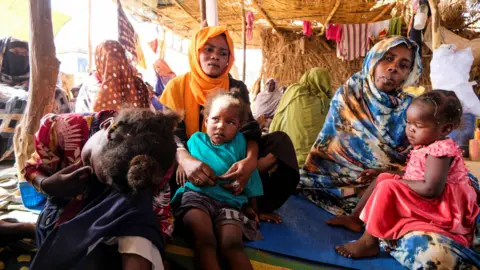
Reuters Two women sit holding two young children. An older child sits to the left of them with her face in her hands. They are in a shelter in a displacement camp after fleeing El-Fasher.Reuters

Hundreds of thousands of people have been forced to flee their homes because of the ongoing conflict

Sudan’s paramilitary Rapid Support Forces (RSF) says it has taken control of the western city of el-Fasher, marking a turning point in the civil war.

The group said in a statement on social media that it had seized el-Fasher “from the grip of mercenaries and militias allied with the terrorist army”.

The loss would be a huge blow to the Sudanese army as el-Fasher is its last remaining foothold in the Darfur region, leaving the RSF effectively in control of the area. The army has yet to comment.

It comes after the rebel group announced the capture of the army’s 6th Division Headquarters, saying that it had destroyed “huge military vehicles” and taken military equipment.

BBC Verify has confirmed the authenticity of videos circulating on social media that show RSF fighters inside the army base.

Local pro-army fighters, the Popular Resistance, accused the RSF of running a “media disinformation campaign” to undermine the “high morale of the forces”.

The RSF has surrounded el-Fasher for the last 18 months, with army positions and civilians under frequent bombardment. An estimated 300,000 people have been trapped by the fighting.

In August, satellite imagery showed a series of extensive earthen walls being constructed around the city, aimed at trapping people inside.

The RSF have been steadily advancing towards the 6th Infantry Division command – widely regarded as the army headquarters in the city – from several directions for weeks.

There are still some parts of el-Fasher under the control of the army and allied armed groups – but those are not expected to hold out for long now.

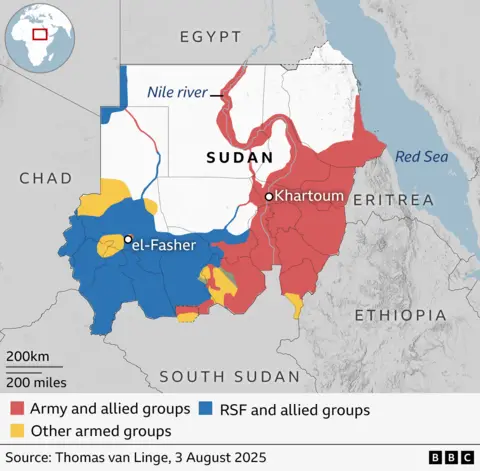
Map showing which group controls which part of Sudan

Hunger and disease has spread across the city as residents contend with constant bombardment and dwindling food and medical supplies.

UN investigators have accused the RSF of committing numerous crimes against humanity during the siege. The US has said the RSF has committed genocide against Darfur’s non-Arab population.

Sudan has been ravished by conflict since 2023, after top commanders of the RSF and Sudanese army fell out and a vicious power struggle ensued.

More than 150,000 people have died across the country and about 12 million have fled their homes, creating one of the worst humanitarian crises.

The army controls most of the north and the east, with el-Fasher being until now the last major urban centre in Darfur still held by government forces and its allies.

The RSF controls almost all of Darfur and much of the neighbouring Kordofan region.

The group has previously said that it hopes to form a rival government in al-Fasher when it assumes complete control.

Additional reporting by Peter Mwai

More BBC Africa stories:

Getty Images/BBC A woman looking at her mobile phone and the graphic BBC News AfricaGetty Images/BBC

Source link
#ElFasher #Rebel #group #claims #capture #key #city #Sudan

Australia and Japan have signed contracts for the first three of 11 warships set to be delivered to the Australian navy under a landmark $7bn defence deal, as the two close US allies in the Asia Pacific region deepen defence cooperation.

Australia’s Defence Minister Richard Marles and Japanese Defence Minister Koizumi Shinjiro made the announcement in Melbourne on Saturday at the signing ceremony for the Mogami-class warships.

Recommended Stories

list of 4 itemsend of list

The “Mogami Memorandum” pledges to deepen military ties, including through “closer industrial cooperation” in defence.

Japan’s Mitsubishi Heavy Industries will build three of the stealth frigates in southern Nagasaki Prefecture, while Australia’s Austal will build eight in Western Australia.

The first of the Japanese-built warships is scheduled to be delivered in 2029 and enter service in 2030.

“Our surface fleet is more important than at any time in decades,” Marles said in a statement.

“These general-purpose frigates will help secure our maritime trade routes and northern approaches as part of a larger and more lethal surface combatant fleet.”

Shinjiro said closer defence coordination was becoming more important as Australia and Japan faced an “increasingly severe security environment”.

Australia’s government last year announced that it had chosen Mitsubishi Heavy Industries to build its fleet of next-generation warships, following a bidding war between the Tokyo-based firm and Germany’s Thyssenkrupp.

Australia has committed to a record $305bn in military spending over the next decade, as part of a widespread defence overhaul aimed at boosting the country’s naval power to levels not seen since World War II.

Under the plans, Canberra’s defence spending is set to rise to 3 percent of gross domestic product (GDP) by 3033, from about 2 percent now.

Australia and Japan, two of the United States’ closest allies, have ramped up military cooperation in recent years amid shared concerns about shifts in the regional security environment, particularly China’s rising influence. Tokyo and Canberra are also members of the Quad security bloc led by the US.

#Australia #Japan #sign #contracts #7bn #warships #dealEconomy, News, Business and Economy, Military, Asia Pacific, Australia">Australia and Japan sign contracts for bn warships dealDefence deal is latest example of deepening ties between Canberra and Tokyo amid shared concerns over China’s rise.Published On 19 Apr 202619 Apr 2026Australia and Japan have signed contracts for the first three of 11 warships set to be delivered to the Australian navy under a landmark bn defence deal, as the two close US allies in the Asia Pacific region deepen defence cooperation.Australia’s Defence Minister Richard Marles and Japanese Defence Minister Koizumi Shinjiro made the announcement in Melbourne on Saturday at the signing ceremony for the Mogami-class warships.Recommended Stories list of 4 itemsend of listThe “Mogami Memorandum” pledges to deepen military ties, including through “closer industrial cooperation” in defence.Japan’s Mitsubishi Heavy Industries will build three of the stealth frigates in southern Nagasaki Prefecture, while Australia’s Austal will build eight in Western Australia.The first of the Japanese-built warships is scheduled to be delivered in 2029 and enter service in 2030.“Our surface fleet is more important than at any time in decades,” Marles said in a statement.“These general-purpose frigates will help secure our maritime trade routes and northern approaches as part of a larger and more lethal surface combatant fleet.”Shinjiro said closer defence coordination was becoming more important as Australia and Japan faced an “increasingly severe security environment”.Australia’s government last year announced that it had chosen Mitsubishi Heavy Industries to build its fleet of next-generation warships, following a bidding war between the Tokyo-based firm and Germany’s Thyssenkrupp.Australia has committed to a record 5bn in military spending over the next decade, as part of a widespread defence overhaul aimed at boosting the country’s naval power to levels not seen since World War II.Under the plans, Canberra’s defence spending is set to rise to 3 percent of gross domestic product (GDP) by 3033, from about 2 percent now.Australia and Japan, two of the United States’ closest allies, have ramped up military cooperation in recent years amid shared concerns about shifts in the regional security environment, particularly China’s rising influence. Tokyo and Canberra are also members of the Quad security bloc led by the US.#Australia #Japan #sign #contracts #7bn #warships #dealEconomy, News, Business and Economy, Military, Asia Pacific, Australia

Australia and Japan have signed contracts for the first three of 11 warships set to be delivered to the Australian navy under a landmark $7bn defence deal, as the two close US allies in the Asia Pacific region deepen defence cooperation.

Australia’s Defence Minister Richard Marles and Japanese Defence Minister Koizumi Shinjiro made the announcement in Melbourne on Saturday at the signing ceremony for the Mogami-class warships.

Recommended Stories

list of 4 itemsend of list

The “Mogami Memorandum” pledges to deepen military ties, including through “closer industrial cooperation” in defence.

Japan’s Mitsubishi Heavy Industries will build three of the stealth frigates in southern Nagasaki Prefecture, while Australia’s Austal will build eight in Western Australia.

The first of the Japanese-built warships is scheduled to be delivered in 2029 and enter service in 2030.

“Our surface fleet is more important than at any time in decades,” Marles said in a statement.

“These general-purpose frigates will help secure our maritime trade routes and northern approaches as part of a larger and more lethal surface combatant fleet.”

Shinjiro said closer defence coordination was becoming more important as Australia and Japan faced an “increasingly severe security environment”.

Australia’s government last year announced that it had chosen Mitsubishi Heavy Industries to build its fleet of next-generation warships, following a bidding war between the Tokyo-based firm and Germany’s Thyssenkrupp.

Australia has committed to a record $305bn in military spending over the next decade, as part of a widespread defence overhaul aimed at boosting the country’s naval power to levels not seen since World War II.

Under the plans, Canberra’s defence spending is set to rise to 3 percent of gross domestic product (GDP) by 3033, from about 2 percent now.

Australia and Japan, two of the United States’ closest allies, have ramped up military cooperation in recent years amid shared concerns about shifts in the regional security environment, particularly China’s rising influence. Tokyo and Canberra are also members of the Quad security bloc led by the US.

#Australia #Japan #sign #contracts #7bn #warships #dealEconomy, News, Business and Economy, Military, Asia Pacific, Australia">Australia and Japan sign contracts for $7bn warships deal

Defence deal is latest example of deepening ties between Canberra and Tokyo amid shared concerns over China’s rise.

Australia and Japan have signed contracts for the first three of 11 warships set to be delivered to the Australian navy under a landmark $7bn defence deal, as the two close US allies in the Asia Pacific region deepen defence cooperation.

Australia’s Defence Minister Richard Marles and Japanese Defence Minister Koizumi Shinjiro made the announcement in Melbourne on Saturday at the signing ceremony for the Mogami-class warships.

Recommended Stories

list of 4 itemsend of list

The “Mogami Memorandum” pledges to deepen military ties, including through “closer industrial cooperation” in defence.

Japan’s Mitsubishi Heavy Industries will build three of the stealth frigates in southern Nagasaki Prefecture, while Australia’s Austal will build eight in Western Australia.

The first of the Japanese-built warships is scheduled to be delivered in 2029 and enter service in 2030.

“Our surface fleet is more important than at any time in decades,” Marles said in a statement.

“These general-purpose frigates will help secure our maritime trade routes and northern approaches as part of a larger and more lethal surface combatant fleet.”

Shinjiro said closer defence coordination was becoming more important as Australia and Japan faced an “increasingly severe security environment”.

Australia’s government last year announced that it had chosen Mitsubishi Heavy Industries to build its fleet of next-generation warships, following a bidding war between the Tokyo-based firm and Germany’s Thyssenkrupp.

Australia has committed to a record $305bn in military spending over the next decade, as part of a widespread defence overhaul aimed at boosting the country’s naval power to levels not seen since World War II.

Under the plans, Canberra’s defence spending is set to rise to 3 percent of gross domestic product (GDP) by 3033, from about 2 percent now.

Australia and Japan, two of the United States’ closest allies, have ramped up military cooperation in recent years amid shared concerns about shifts in the regional security environment, particularly China’s rising influence. Tokyo and Canberra are also members of the Quad security bloc led by the US.

#Australia #Japan #sign #contracts #7bn #warships #dealEconomy, News, Business and Economy, Military, Asia Pacific, Australia

Post Comment