×
Mumbai’s glorious Art Deco legacy at 100

Mumbai’s glorious Art Deco legacy at 100

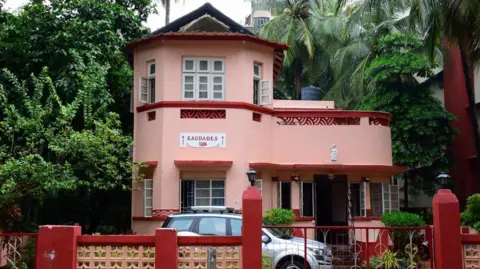
Art Deco Mumbai Trust The pink facade of the Saudades art deco-style family bungalow, built in 1936 in Mumbai's Bandra suburb, features local elements like lattice balcony screens.Art Deco Mumbai Trust

Architects blended local elements into Art Deco, like the lattice balcony screens on this Mumbai bungalow

It was at a landmark architecture exhibition in Paris in 1925 that the Art Deco aesthetic first exploded on the scene.

In the 100 years since, the glamorous building style – evocative of neon-lit jazz bars and the golden age of big motion pictures – rapidly spread around the world.

It moved from the famous pastel hotel facades of Miami’s South Beach to the sprawling necklace of mansion apartments along Mumbai’s Marine Drive seafront.

Art Deco’s distinct motifs – typified by geometrical ziggurats (step towers), sweeping curves, sunburst designs, nautical elements and circular or turreted rooftops – symbolised an unequivocal break from the past, celebrating the dawn of a new, unabashed, post-war 20th Century modern age.

In a short time, the style transcended architecture to influence the design sensibility of home interiors, furniture, fonts, jewellery and some of the world’s most iconic cinema halls – from Radio City Music Hall in New York City to Regal, Liberty and Eros cinemas in Mumbai.

“It represented hope, optimism and speed, coinciding with the emergence of the motor car and also concrete as a building material, which when compared with stone, could be worked with in a tenth of the time and fifth of the cost,” Atul Kumar, founder of the Art Deco Mumbai Trust and curator of a new exhibition celebrating the centenary of Art Deco in the city, told the BBC.

“It was not elaborate like Victorian Gothic design that preceded it, and came with a classicism and simplicity that has survived the test of time,” he said.

And nowhere has that been more apparent than in Mumbai, which, according to Mr Kumar, is home to the world’s largest documented collection of Art Deco buildings. Other estimates put Mumbai in the second spot behind Miami.

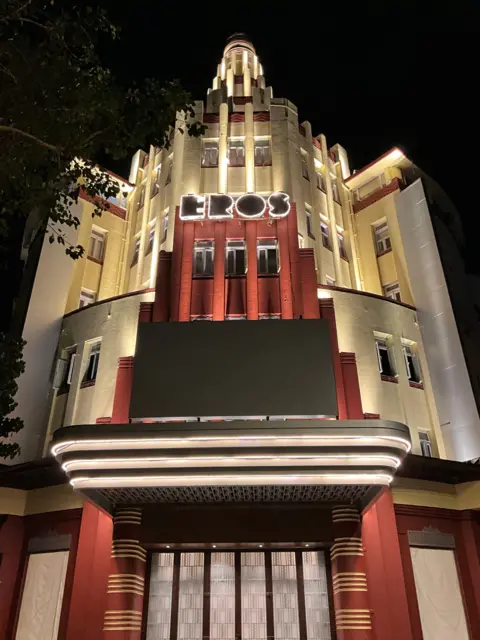
Art Deco Mumbai Trust A night-time image of a lit up Eros Cinema, a Unesco-designated Art Deco theatre at Churchgate in Mumbai. The multi-storey building, which has a spherical tower at its top, is painted cream and partially faced with red sandstone. Art Deco Mumbai Trust

The world’s most iconic cinema halls, including Eros in Mumbai, are built in the Art Deco style

Getty Images Nazir Hoosein, owner of Liberty Cinema, pictured smiling into the camera. His figure is framed by an arch, with circular Art Deco lights also behind him.Getty Images

The dim, opulent interiors of Mumbai’s Liberty Cinema captured the glamour of early 20th Century films

What made Mumbai’s tryst with Art Deco particularly interesting was how the city embraced its hallmarks in a truly all-encompassing manner.

Just like Miami, the style emerged in the city at a time of economic flux and transformation, spurred by its modern, mercantile port-city energy.

But unlike Miami where it “arrived as a projection of leisure or spectacle”, in Mumbai the “style resonated across various building typologies, including schools, cinemas, bungalows, petrol stations and banks,” Mr Kumar said.

Art Deco buildings in Mumbai were, and still often are, hidden in plain sight, with even their occupants often blissfully unaware of their cultural moorings.

But their all-pervading architectural shadow over the city is perhaps why Art Deco is “seeped into the larger public imagination, and remains relevant in Mumbai’s emotional quotient”, Mr Kumar added.
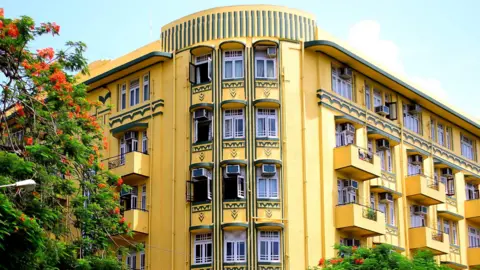
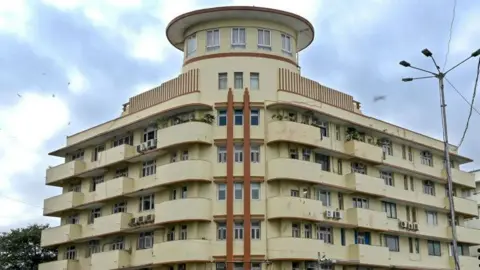
Art Deco Mumbai Trust The butter-yellow, bottle-green, dual-toned facade of the multi-storey Shiv Shanti Bhuvan building at Mumbai's Oval Maidan.Art Deco Mumbai Trust

Shiv Shanti Bhuvan, in Mumbai’s Oval Maidan, is among the first Art Deco buildings developed in the area

Getty Images An Art Deco apartment block on Mumbai's marine drive with a turreted rooftop typical of the style. Getty Images

Turreted rooftops are typical of the Art Deco style

The style was brought to Mumbai at a time when it was under colonial rule.

It was India’s first bunch of home-grown architects – pivotal figures like Chimanlal Master, Laxman Vishnu Sathe and Gopalji Mulji Bhuta – who integrated it into their designs after returning home with degrees from the Royal Institute of British Architects in London.

“They were suddenly exposed to new European sensibilities and wanted to bring them back to their country, which was deeply colonised by the imposition of Victorian buildings,” Mr Kumar said.
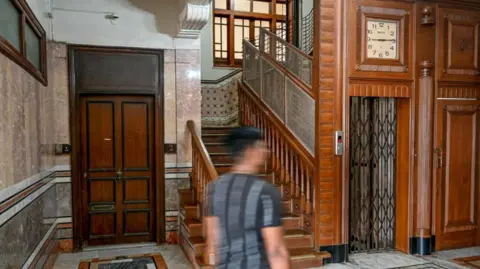
Getty Images A man walks past the lobby area of the Seksaria building, a Unesco-designated Art Deco apartment along the Marine Drive seafront in Mumbai. Inside the building are wooden doors, stairs and wall pannelling. Tile-work also features on the floor and walls. Getty Images

A grand Art Deco foyer featuring polished woods and elegant stones like granite and marble

Moorthy’s Furniture Example of Art Deco lighting at the Seksaria building in Marine Drive. The light has five bulbs in a candelabra-style fitting, with a geometric star design on the ceiling around it. Moorthy’s Furniture

The Art Deco style influenced the design of home objects

But they adapted Art Deco and vernacularised it, throwing in native design patterns, drawing inspiration from disparate local elements including ocean liners docked at Mumbai’s ports and even lattice screens that are so typical of Mughal architecture.

The British were initially dismissive, calling Art Deco “lesser architecture”, but were presumably threatened, said Mr Kumar, as it signalled the dawn of a new age and of new identities that were shaping India’s public spaces.

It was only a matter of time before South Mumbai’s skyline would become a rich confluence of Indo-Saracenic, Gothic and Art Deco buildings.
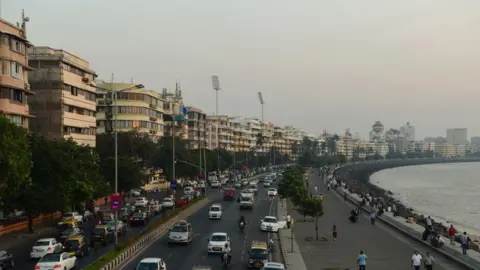
Getty Images A long-shot of Mumbai's Marine Drive corniche lined with Art Deco buildings overlooking the sea. Getty Images

Mumbai’s Marine Drive seafront has more than 30 Art Deco buildings

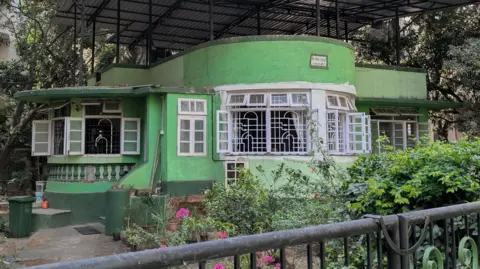
Art Deco Mumbai Trust Arthur Lodge in Mumbai's Borivali suburb, which is a pistachio-coloured building with a circular front constructed in the Art Deco style.Art Deco Mumbai Trust

Arthur Lodge was built in the Art Deco style in Mumbai’s Borivali suburb in 1950

Today, Mumbai is yet again a city in rapid flux – its building code governed by real estate moguls trying to maximise the floor space index, giving way to utilitarian rather than stylistic considerations.

Dozens of Art Deco buildings have been erased to give way to glass and steel facades, and hundreds more are under threat.

Over the past decade, Mr Kumar has documented more than 1,500 buildings that are truly representative of the style, but only 70-odd of those are protected.

Authorities are apathetic to their preservation, so his organisation is engaging directly with people, offering pro-bono repair and restoration consultancies to prevent them from giving away their properties to builders for redevelopment.

“The response has been positive as people have seen the value of their real estate go up after the renovations,” said Mr Kumar.

Then there are others, like architect and designer Nidhi Tekwani, who is re-imagining Art Deco objects and hoping to adapt them for a contemporary context.

For example, Art Deco furniture was often bulky, its light fittings were meant for high ceilings, and its dressing tables too elaborate for today’s compact apartments. Ms Tekwani aims to design and launch products that are sleeker while preserving core Art Deco principles.

“The hope is to translate it to something modern and well-fitting of our current lifestyle requirements,” said Ms Tekwani of her efforts to keep Art Deco a living tradition in a city that’s remaking itself between one blink and the next.

Follow BBC News India on Instagram, YouTube, X and Facebook.


Source link
#Mumbais #glorious #Art #Deco #legacy

Australia and Japan have signed contracts for the first three of 11 warships set to be delivered to the Australian navy under a landmark $7bn defence deal, as the two close US allies in the Asia Pacific region deepen defence cooperation.

Australia’s Defence Minister Richard Marles and Japanese Defence Minister Koizumi Shinjiro made the announcement in Melbourne on Saturday at the signing ceremony for the Mogami-class warships.

Recommended Stories

list of 4 itemsend of list

The “Mogami Memorandum” pledges to deepen military ties, including through “closer industrial cooperation” in defence.

Japan’s Mitsubishi Heavy Industries will build three of the stealth frigates in southern Nagasaki Prefecture, while Australia’s Austal will build eight in Western Australia.

The first of the Japanese-built warships is scheduled to be delivered in 2029 and enter service in 2030.

“Our surface fleet is more important than at any time in decades,” Marles said in a statement.

“These general-purpose frigates will help secure our maritime trade routes and northern approaches as part of a larger and more lethal surface combatant fleet.”

Shinjiro said closer defence coordination was becoming more important as Australia and Japan faced an “increasingly severe security environment”.

Australia’s government last year announced that it had chosen Mitsubishi Heavy Industries to build its fleet of next-generation warships, following a bidding war between the Tokyo-based firm and Germany’s Thyssenkrupp.

Australia has committed to a record $305bn in military spending over the next decade, as part of a widespread defence overhaul aimed at boosting the country’s naval power to levels not seen since World War II.

Under the plans, Canberra’s defence spending is set to rise to 3 percent of gross domestic product (GDP) by 3033, from about 2 percent now.

Australia and Japan, two of the United States’ closest allies, have ramped up military cooperation in recent years amid shared concerns about shifts in the regional security environment, particularly China’s rising influence. Tokyo and Canberra are also members of the Quad security bloc led by the US.

#Australia #Japan #sign #contracts #7bn #warships #dealEconomy, News, Business and Economy, Military, Asia Pacific, Australia">Australia and Japan sign contracts for bn warships dealDefence deal is latest example of deepening ties between Canberra and Tokyo amid shared concerns over China’s rise.Published On 19 Apr 202619 Apr 2026Australia and Japan have signed contracts for the first three of 11 warships set to be delivered to the Australian navy under a landmark bn defence deal, as the two close US allies in the Asia Pacific region deepen defence cooperation.Australia’s Defence Minister Richard Marles and Japanese Defence Minister Koizumi Shinjiro made the announcement in Melbourne on Saturday at the signing ceremony for the Mogami-class warships.Recommended Stories list of 4 itemsend of listThe “Mogami Memorandum” pledges to deepen military ties, including through “closer industrial cooperation” in defence.Japan’s Mitsubishi Heavy Industries will build three of the stealth frigates in southern Nagasaki Prefecture, while Australia’s Austal will build eight in Western Australia.The first of the Japanese-built warships is scheduled to be delivered in 2029 and enter service in 2030.“Our surface fleet is more important than at any time in decades,” Marles said in a statement.“These general-purpose frigates will help secure our maritime trade routes and northern approaches as part of a larger and more lethal surface combatant fleet.”Shinjiro said closer defence coordination was becoming more important as Australia and Japan faced an “increasingly severe security environment”.Australia’s government last year announced that it had chosen Mitsubishi Heavy Industries to build its fleet of next-generation warships, following a bidding war between the Tokyo-based firm and Germany’s Thyssenkrupp.Australia has committed to a record 5bn in military spending over the next decade, as part of a widespread defence overhaul aimed at boosting the country’s naval power to levels not seen since World War II.Under the plans, Canberra’s defence spending is set to rise to 3 percent of gross domestic product (GDP) by 3033, from about 2 percent now.Australia and Japan, two of the United States’ closest allies, have ramped up military cooperation in recent years amid shared concerns about shifts in the regional security environment, particularly China’s rising influence. Tokyo and Canberra are also members of the Quad security bloc led by the US.#Australia #Japan #sign #contracts #7bn #warships #dealEconomy, News, Business and Economy, Military, Asia Pacific, Australia

Australia and Japan have signed contracts for the first three of 11 warships set to be delivered to the Australian navy under a landmark $7bn defence deal, as the two close US allies in the Asia Pacific region deepen defence cooperation.

Australia’s Defence Minister Richard Marles and Japanese Defence Minister Koizumi Shinjiro made the announcement in Melbourne on Saturday at the signing ceremony for the Mogami-class warships.

Recommended Stories

list of 4 itemsend of list

The “Mogami Memorandum” pledges to deepen military ties, including through “closer industrial cooperation” in defence.

Japan’s Mitsubishi Heavy Industries will build three of the stealth frigates in southern Nagasaki Prefecture, while Australia’s Austal will build eight in Western Australia.

The first of the Japanese-built warships is scheduled to be delivered in 2029 and enter service in 2030.

“Our surface fleet is more important than at any time in decades,” Marles said in a statement.

“These general-purpose frigates will help secure our maritime trade routes and northern approaches as part of a larger and more lethal surface combatant fleet.”

Shinjiro said closer defence coordination was becoming more important as Australia and Japan faced an “increasingly severe security environment”.

Australia’s government last year announced that it had chosen Mitsubishi Heavy Industries to build its fleet of next-generation warships, following a bidding war between the Tokyo-based firm and Germany’s Thyssenkrupp.

Australia has committed to a record $305bn in military spending over the next decade, as part of a widespread defence overhaul aimed at boosting the country’s naval power to levels not seen since World War II.

Under the plans, Canberra’s defence spending is set to rise to 3 percent of gross domestic product (GDP) by 3033, from about 2 percent now.

Australia and Japan, two of the United States’ closest allies, have ramped up military cooperation in recent years amid shared concerns about shifts in the regional security environment, particularly China’s rising influence. Tokyo and Canberra are also members of the Quad security bloc led by the US.

#Australia #Japan #sign #contracts #7bn #warships #dealEconomy, News, Business and Economy, Military, Asia Pacific, Australia">Australia and Japan sign contracts for $7bn warships deal

Defence deal is latest example of deepening ties between Canberra and Tokyo amid shared concerns over China’s rise.

Australia and Japan have signed contracts for the first three of 11 warships set to be delivered to the Australian navy under a landmark $7bn defence deal, as the two close US allies in the Asia Pacific region deepen defence cooperation.

Australia’s Defence Minister Richard Marles and Japanese Defence Minister Koizumi Shinjiro made the announcement in Melbourne on Saturday at the signing ceremony for the Mogami-class warships.

Recommended Stories

list of 4 itemsend of list

The “Mogami Memorandum” pledges to deepen military ties, including through “closer industrial cooperation” in defence.

Japan’s Mitsubishi Heavy Industries will build three of the stealth frigates in southern Nagasaki Prefecture, while Australia’s Austal will build eight in Western Australia.

The first of the Japanese-built warships is scheduled to be delivered in 2029 and enter service in 2030.

“Our surface fleet is more important than at any time in decades,” Marles said in a statement.

“These general-purpose frigates will help secure our maritime trade routes and northern approaches as part of a larger and more lethal surface combatant fleet.”

Shinjiro said closer defence coordination was becoming more important as Australia and Japan faced an “increasingly severe security environment”.

Australia’s government last year announced that it had chosen Mitsubishi Heavy Industries to build its fleet of next-generation warships, following a bidding war between the Tokyo-based firm and Germany’s Thyssenkrupp.

Australia has committed to a record $305bn in military spending over the next decade, as part of a widespread defence overhaul aimed at boosting the country’s naval power to levels not seen since World War II.

Under the plans, Canberra’s defence spending is set to rise to 3 percent of gross domestic product (GDP) by 3033, from about 2 percent now.

Australia and Japan, two of the United States’ closest allies, have ramped up military cooperation in recent years amid shared concerns about shifts in the regional security environment, particularly China’s rising influence. Tokyo and Canberra are also members of the Quad security bloc led by the US.

#Australia #Japan #sign #contracts #7bn #warships #dealEconomy, News, Business and Economy, Military, Asia Pacific, Australia

Post Comment