×
Hong Kong residents react as deadly fire tears through housing estate

Hong Kong residents react as deadly fire tears through housing estate

Phoebe Kong & Koey Lee,BBC Chinese , Hong Kong,

Danny Vincent,Hong Kongand

Kathryn Armstrong,London

Watch: Deadly fire engulfs Hong Kong apartment blocks

“When you get closer the heat rises and you can feel it and the smoke is really heavy.”

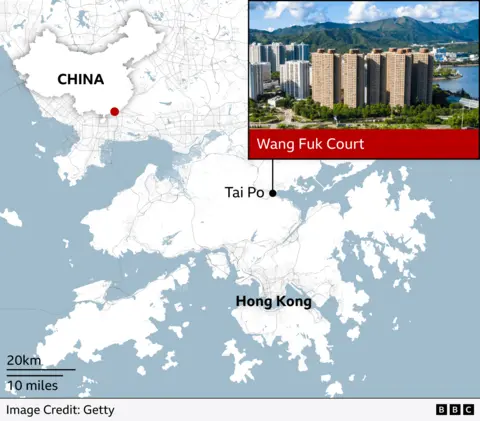
Student Thomas Liu was one of many people drawn to the scene of a deadly fire that tore through much of the eight-block Wang Fuk Court housing complex in Hong Kong’s Tai Po district.

At least 36 people have died in Wednesday’s devastating blaze so far, and with hundreds still missing it’s expected this number will rise. The cause is not yet known.

“It’s a disaster,” Thomas said of the fire, telling the BBC he had seen a body being taken away.

“Many people sent us WhatsApp messages or called us, saying they still have relatives inside or can’t find them,” Mui Siu-fung, a councillor for the Tai Po district, told BBC Chinese.

More than a thousand other people were forced to evacuate the estate as the flames spread, with some heading to centres that have been set up to house them. Police also moved people from nearby buildings.

The fire is gradually being contained but officials say they do not know when it will be fully extinguished. Flames could be seen coming from individual apartments as many people watched on in silence.

One woman said her friends live inside the building and she was waiting to hear if they managed to get out.
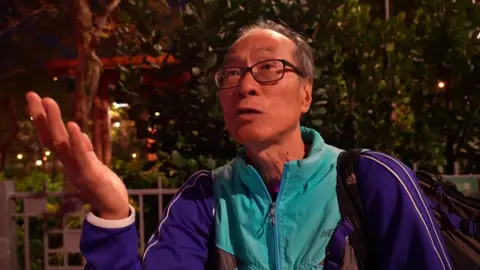
Reuters A man wearing a jacket and with a backpack slung over his shoulder speaks to the cameraReuters

Harry Cheung has lived in block two of the Wang Fuk Court complex for decades

Harry Cheung, who has lived in block two of the Wang Fuk Court complex for more than 40 years, told Reuters he heard “a very loud noise” and saw fire erupt in a nearby block.

“I immediately went back to pack up my things,” the 66-year-old resident said.

“I don’t even know how I feel right now. I’m just thinking about where I’m going to sleep tonight because I probably won’t be able to go back home.”

A woman in her sixties, whose surname is Kam and who lives in the adjacent Kwong Fuk Estate, told the South China Morning Post (SCMP) that several of her friends living in Wang Fuk Court have been accounted for – but not all.

One friend has daily afternoon naps and may have been sleeping when the fire broke out at 14:51 local time (06:51 GMT), Ms Kam said, adding that the woman’s daughters have not yet been able to contact her.

Another resident, 65-year-old Jason Kong, told Reuters that a neighbour called him and said he was still trapped inside one of the tower blocks.

“I am devastated. There are so many neighbours and friends. I do not know what is going on anymore. Look, all the apartments are just burning. I do not know what to do. I hope the government can help us to settle down after this.”

An elderly woman who lives in one of the affected blocks told the BBC she was not at home when the fire broke out but that she is worried about her apartment because it is not insured.

“I’m very upset that I have no home to go to now,” she said.

Map that labels China, Hong Kong and Tai Po, which is in the centre of the map. Tai Po has a pin, which leads to a box showing what Wang Fuk Court looked like before the fire

While the cause of the fire that engulfed the multiple high-rise blocks is unknown, the flames are believed to have spread quickly through the bamboo scaffolding that covered the buildings, which were undergoing renovations.

Some people have expressed anger that such a massive fire could have happened and criticised the response.

“When there’s a wildfire, they will deploy helicopters and drop water bombs, but why is there no such deployment and how can they leave other buildings burning?” Ms Poon, another resident of Wang Fuk Court, who is in her sixties, asked.

“The community is so close to the fire station and we thought the fire could be put out soon, but now the fire has spread. I’m so disappointed,” she told the SCMP.

Ms Poon noted that she had been given no instructions from the government on where to seek help.

The BBC spoke to some Tai Po residents who had brought supplies to the victims and affected residents – including dozens of blankets and heat packs.

Hong Kong chief executive John Lee said government departments were assisting residents affected by the fire.

When asked about their feelings about the fire, the residents said “the government is incompetent” and that they were “immensely heartbroken”.

“We don’t want to see any more casualties,” said one.

Source link
#Hong #Kong #residents #react #deadly #fire #tears #housing #estate

The picturesque town of Gabala in northwest Azerbaijan hosted the fourth round of civil societies talks between Armenia and Azerbaijan representatives as the two countries continue to build on their process of peaceful future together after decades of tragic conflicts.

ADVERTISEMENT
ADVERTISEMENT

Amernia and Azerbaijan established together the so-called Peace Initiative Bridge format shortly after the two former foes signed their historic peace agreement in Washington DC. The Peace Initiative Bridge includes multiple participants from the two countries’ civil society who visit each other to conduct the ongoing peace dialogue by addressing all common issues openly and in an atmosphere of trust.

In an answer to Euronews, Armenia’s Areg Kochinyan, president of the Armenian Council and the Armenian coordinator of the Peace Initiative Bridge, said the two countries have to deal with a “gigantic amount of trauma,” as both nations are making significant efforts to move on as part of their historic peace agreement.

However, he added that “the normalistion and the peace in South Caucuses is well-needed in the West, in Europe, in the United States and that’s partially the reason why we have seen this level of interest of the United States in the region.”

On Azerbaijan’s side, Farhad Mammadov, director of the Center for Studies of the South Caucasus and Azerbaijan’s coordinator of the Peace Initiative Bridge, said that “the conflicts in the region did not have a negative effect on the peace-building process.”

“This is a two-way peace-building process and it is autonomous,” he added.

The focus of Saturday’s meeting in Gabala was on building momentum for the ongoing peace process between Armenia and Azerbaijan.

Armenia’s Lusine Kharatyan, writer and cultural anthropologist as well as member of the Peace Bridge Initiative, told Euronews that “it is extremely important to continue these talks in this world where violence and conflict grows around us, so it’s very important to keep the track of peace.”

“I think the talks went very well because we were able to discuss very important and sensitive issues for both societies and do it very deeply and very sensitively towards each other,” she added.

Eleonora Sargsyan from Armenia, a youth worker and member of the Peace Bridge Initiative said that “for 30 years, we’ve lived with closed borders and we haven’t had the chance of structured dialogue, which created a framework of mutual dehumanisation.”

“I believe that one of the primary objectives of peacebuilding initiatives and any civil society initiatives that untites Armenian and Azerbaijani experts is to start the process of rehumanisation.”

In its turn, Azerbaijan’s representatives underlined the importance to both countries to deepen the dialogue at civil society level.

Orkhan Amashov, Azerbaijan’s participant of the Peace Bridge Participant, described the discussions as being “incredibly comprehensive and wide-ranging.”

“The participants here are to prepare their respective societies for that ultimate eventuality – a peace agreement – and its consequences.” , he added.

Ramil Iskandarli, chairman of the Board of Azerbaijan’s National NGO Forum, and member of the Peace Bridge Initiative, described the symbolism of both sides crossing each other’s borders for peace talks.

“Both I and (the) other group members crossed the border between Azerbaijan and Armenia twice and our Armenian colleagues did the same to come to Gabala,” he said.

He added that “this particular meeting is important because it represents the fourth step actually. I am participating from the very first day of this process,” underlining that “there is also a certain symbolism in this process.”

Energy disruption has become a dominant challenge due to the global climate of instability also due to Iran’s Strait of Hormuz blockade crisis, which has shifted attention to the South Caucasus as a critical alternative route that Azerbaijan and Armenia are now working together to develop as a joint opportunity.

Hikmet Hajiyev, foreign policy advisor to the president of Azerbaijan, led Saturday’s peace talks and greeted each participant.

In a post on X after the talks, he announced that Azerbaijan is “fully committed to the Washington agenda” of the peace process and that “this commitment is not merely declarative or confined to paper; rather, concrete and pragmatic steps are being taken to strengthen the peace agenda,” in the context of both countries continuing the development of the major regional project of the Trump Route for International Peace and Prosperity, also known as the TRIPP corridor, which is a US-backed, 42-kilometre transit corridor through Armenia’s Syunik region which connects Azerbaijan to its Nakhchivan exclave.

Hajiyev underlined the fast developing economic cooperation between Azerbaijan and Armenia stating that “these include bilateral trade, transit shipments to Armenia via Azerbaijan, and people-to-people contacts, all of which reflect the concept of the economic dividends of peace.”

The participants concluded the Gabala talks agreeing that continued dialogue is an important step in maintaining communication between the two sides.

#Armenia #Azerbaijan #civil #societies #hold #talks #push #peace #plansPeace process,Armenia,Caucasus">Armenia and Azerbaijan civil societies hold talks to push peace plans 
  The picturesque town of Gabala in northwest Azerbaijan hosted the fourth round of civil societies talks between Armenia and Azerbaijan representatives as the two countries continue to build on their process of peaceful future together after decades of tragic conflicts.


          ADVERTISEMENT


          ADVERTISEMENT


Amernia and Azerbaijan established together the so-called Peace Initiative Bridge format shortly after the two former foes signed their historic peace agreement in Washington DC. The Peace Initiative Bridge includes multiple participants from the two countries’ civil society who visit each other to conduct the ongoing peace dialogue by addressing all common issues openly and in an atmosphere of trust.


In an answer to Euronews, Armenia’s Areg Kochinyan, president of the Armenian Council and the Armenian coordinator of the Peace Initiative Bridge, said the two countries have to deal with a “gigantic amount of trauma,” as both nations are making significant efforts to move on as part of their historic peace agreement.
However, he added that “the normalistion and the peace in South Caucuses is well-needed in the West, in Europe, in the United States and that’s partially the reason why we have seen this level of interest of the United States in the region.” 
On Azerbaijan’s side, Farhad Mammadov, director of the Center for Studies of the South Caucasus and Azerbaijan’s coordinator of the Peace Initiative Bridge, said that “the conflicts in the region did not have a negative effect on the peace-building process.” 
“This is a two-way peace-building process and it is autonomous,” he added. 
The focus of Saturday’s meeting in Gabala was on building momentum for the ongoing peace process between Armenia and Azerbaijan. 
Armenia’s Lusine Kharatyan, writer and cultural anthropologist as well as member of the Peace Bridge Initiative, told Euronews that “it is extremely important to continue these talks in this world where violence and conflict grows around us, so it’s very important to keep the track of peace.” 
“I think the talks went very well because we were able to discuss very important and sensitive issues for both societies and do it very deeply and very sensitively towards each other,” she added. 


Eleonora Sargsyan from Armenia, a youth worker and member of the Peace Bridge Initiative said that “for 30 years, we’ve lived with closed borders and we haven’t had the chance of structured dialogue, which created a framework of mutual dehumanisation.” 
“I believe that one of the primary objectives of peacebuilding initiatives and any civil society initiatives that untites Armenian and Azerbaijani experts is to start the process of rehumanisation.” 
In its turn, Azerbaijan’s representatives underlined the importance to both countries to deepen the dialogue at civil society level. 
Orkhan Amashov, Azerbaijan’s participant of the Peace Bridge Participant, described the discussions as being “incredibly comprehensive and wide-ranging.” 
“The participants here are to prepare their respective societies for that ultimate eventuality – a peace agreement – and its consequences.” , he added. 
Ramil Iskandarli, chairman of the Board of Azerbaijan’s National NGO Forum, and member of the Peace Bridge Initiative, described the symbolism of both sides crossing each other’s borders for peace talks. 
“Both I and (the) other group members crossed the border between Azerbaijan and Armenia twice and our Armenian colleagues did the same to come to Gabala,” he said. 
He added that “this particular meeting is important because it represents the fourth step actually. I am participating from the very first day of this process,” underlining that “there is also a certain symbolism in this process.” 
Energy disruption has become a dominant challenge due to the global climate of instability also due to Iran’s Strait of Hormuz blockade crisis, which has shifted attention to the South Caucasus as a critical alternative route that Azerbaijan and Armenia are now working together to develop as a joint opportunity. 
Hikmet Hajiyev, foreign policy advisor to the president of Azerbaijan, led Saturday’s peace talks and greeted each participant.
In a post on X after the talks, he announced that Azerbaijan is “fully committed to the Washington agenda” of the peace process and that “this commitment is not merely declarative or confined to paper; rather, concrete and pragmatic steps are being taken to strengthen the peace agenda,” in the context of both countries continuing the development of the major regional project of the Trump Route for International Peace and Prosperity, also known as the TRIPP corridor, which is a US-backed, 42-kilometre transit corridor through Armenia’s Syunik region which connects Azerbaijan to its Nakhchivan exclave. 


Hajiyev underlined the fast developing economic cooperation between Azerbaijan and Armenia stating that “these include bilateral trade, transit shipments to Armenia via Azerbaijan, and people-to-people contacts, all of which reflect the concept of the economic dividends of peace.” 
The participants concluded the Gabala talks agreeing that continued dialogue is an important step in maintaining communication between the two sides. 

  #Armenia #Azerbaijan #civil #societies #hold #talks #push #peace #plansPeace process,Armenia,Caucasus

“米・イラン代表団がパキスタン交え対面協議” 米高官 | NHKニュースアメリカ、ホワイトハウスの高官は11日、アメリカとイランの代表団が、仲介国のパキスタンを交えて、対面での協議を行っていると明らかにしました。それによりますと、アメリカ側からは、バンス副大統領とウィトコフ特使、それにトランプ大統領の娘の夫のクシュナー氏のほか、国家安全保障に関わる担当者などが参加しているということです。この協議についてロイター通信はイラン側からは、ガリバフ議長やアラグチ外相、パキスタン側からはムニール陸軍参謀長らが参加したと伝えています。#米イラン代表団がパキスタン交え対面協議 #米高官 #NHKニュースNHK,ニュース,NHK ONE,イラン情勢,アメリカ,イラン,パキスタン,中東,ホルムズ海峡,レバノン,イスラエル,一覧

Post Comment