×
‘A Wake-Up Call from the Womb’—Indigenous People Rally for a Binding Plastics Treaty

‘A Wake-Up Call from the Womb’—Indigenous People Rally for a Binding Plastics Treaty

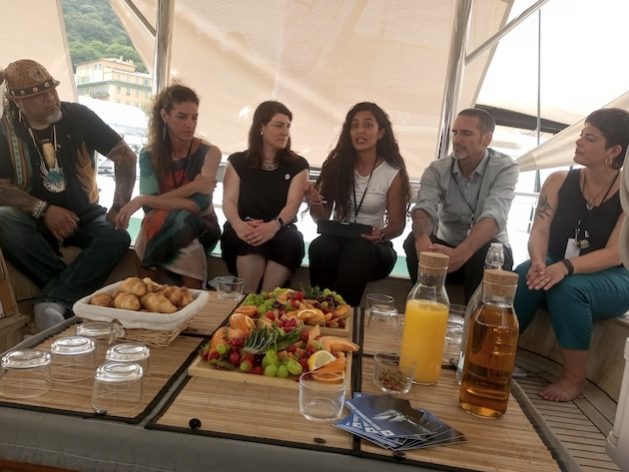
Panelists engaged in a discussion with reporters about plastic pollution. Credit: Kizito Makoye/IPS
  • by Kizito Makoye (nice, france)
  • Inter Press Service

NICE, France, Jun 11 (IPS) – As the sun peeked through the French Riviera clouds and a dozen reporters sipped orange juice aboard the WWF Panda Boat docked at Port Lympia, Frankie Orona, a Native American rights advocate from the Society of Native Nations in San Antonio, Texas, stunned the room into a moment of absolute stillness.

“Imagine a baby in the womb, completely reliant on its mother for air, water, and nutrients—and yet, plastic chemicals are already finding their way into that sacred space,” he said, his voice trembling with emotion. “That baby has no choice. And neither do future generations if we don’t act now.”

Orona’s stark imagery marked a powerful appeal to the high-level delegation at the UN Ocean Conference on June 10 in Nice, where ministers and representatives from 95 countries backed The Nice Wake-Up Call—a collective demand for an ambitious, legally binding U.N. plastics treaty that addresses the full lifecycle of plastic pollution.

For Orona, the issue is deeply personal and spiritual. “In our culture, the womb is the beginning of the circle of life. Polluting it with plastics is like violating a sacred trust,” he said.

A Crisis in the Making

Plastics are now everywhere—in our oceans, our food, and even our bodies. In 2019 alone, an estimated 28 million metric tons of plastic ended up in the environment—equivalent to dumping the weight of the Titanic into nature every day. Without aggressive intervention, that figure could nearly double by 2040.

For  Orona, who doubles as UNEP co-chair of the Indigenous Peoples Major Group, the negotiations unfolding ahead of the August talks in Geneva are a fight for survival.

Speaking to reporters aboard the WWF Panda, Orona, a descendant of the Tonkawa and Apache tribes, did not mince words. “For Indigenous peoples and frontline communities, plastic pollution is not just an environmental issue—it is a human rights crisis that has been going on for generations,” he said.

With the Mediterranean breeze brushing across the harbor, Orona’s voice cut through the chatter of press briefings and policy handouts. “Our communities live near the extraction sites, the refineries, the chemical plants, the incinerators, and the waste dumps. We are the first to feel the impacts—in our lungs, our water, our food, and our children’s health. And too often, we are the last to be consulted.”

The declaration known as The Nice Wake-Up Call, endorsed by 95 countries at the conference, was a welcome shift in tone for many in the Indigenous rights movement. “It sends a strong signal that many governments are now recognizing what we’ve been saying for decades—that ending plastic pollution means addressing the full life cycle of plastics: from extraction to production to disposal,” Orona said.

From Environmental Damage to Systemic Injustice

Orona, who also represents the International Indigenous Peoples Forum on Plastics and is part of the Plastics Environment Justice Delegation, emphasized that plastic pollution must be understood in the context of historical and ongoing systems of exploitation.

“This is a continuation of environmental racism and systemic injustices. The human rights violations and violence that have been normalized in our communities for generations must stop,” he said.

Citing the disproportionate exposure of Indigenous populations to toxic chemicals used in plastics—some linked to cancer, reproductive harm, and endocrine disruption—he called for a global ban on these additives. “Many of these chemicals are dumped, burned, and leached into our waters, into our sacred lands,” Orona said. “We cannot talk about justice if these harms continue.”

A Just Transition Rooted in Indigenous Knowledge

While many governments are pushing for ambitious production caps and bans on single-use plastics, Orona warned that these measures must not shift the burden onto those least responsible for the crisis.

“A just transition means phasing out fossil fuel-based plastics while investing in community-led solutions, including Indigenous knowledge and science,” he said. “This isn’t just about cleaning up trash; it’s about restoring balance and protecting future generations.”

In a system long dominated by fossil fuel interests and extractive economies, Indigenous communities have often led the way in conservation and sustainable living. “Our knowledge systems are not just cultural—they are scientific. They are proven. And they are part of the solution,” Orona noted.

Follow the Money—and Ensure It Reaches the Frontlines

Orona’s final message was financial. Any treaty, he insisted, must include a mechanism that guarantees direct access to funds for Indigenous and frontline communities.

“Too often, we are shut out of global financing streams—even when we are the ones on the front lines, creating the very solutions the world needs,” he said. “That must end.”

While images of floating plastic bottles and entangled turtles often dominate headlines, experts at the Nice panel were adamant: the crisis begins long before a straw hits the ocean.

Disproportionate Impacts

Plastic production facilities are often located in marginalized communities—adding a layer of environmental injustice to the crisis.

“Indigenous peoples, rural communities, and minority populations suffer the worst impacts,” said Orona. “We’re talking about asthma, cancers, and cardiovascular diseases—especially in children. These are not abstract consequences; these are lived experiences.”

Reporters on the Panda Boat scribbled notes between bites of Mediterranean pastries, visibly moved by Orona’s personal account.

“This is genocide by pollution,” he added. “Our people are dying, and it’s largely invisible to the rest of the world.”

Wildlife at Risk

The panel also underscored the devastating effects of plastic on marine life. Every species of sea turtle has been documented ingesting or getting entangled in plastic. For blue whales, the planet’s largest animals, the reality is even more daunting—they are believed to ingest up to 10 million pieces of microplastic every day, sometimes weighing as much as 44 kilograms.

The next round of negotiations for the plastics treaty is scheduled for August in Geneva, where pressure is mounting to solidify a legally binding agreement that includes all five critical points outlined in the Nice declaration.

The sense of urgency also echoes in the corridors of the International Maritime Organization (IMO), the U.N. agency overseeing the global shipping industry. Tasked with ensuring environmental safety on the high seas, the IMO has stepped up efforts to address plastic waste, among other pressing marine threats.

In response to a question about the devastating 2021 marine spill in Sri Lanka—where a burning cargo vessel released over 1,680 metric tons of plastic pellets into the Indian Ocean—IMO Secretary-General Arsenio Dominguez noted that the agency has been developing new regulations specifically targeting the handling, packaging, and cleanup of plastic pellets. These measures, initially adopted by the European Union, mark a significant step in tightening maritime controls on plastic pollution.

Dominguez stressed that tackling marine pollution also demands inclusive governance. The IMO is increasingly encouraging the participation of Indigenous communities and young people—groups historically sidelined from international maritime decision-making. Their voices, he said, are crucial for shaping policies that are both just and effective.

Next Steps

Professor Bethany Carney Almroth—a renowned environmental toxicologist and one of the leading scientific voices in the negotiations—believes the business world is not the obstacle many assume it to be. Instead, she says, it’s a matter of giving business the legal clarity to act.

“Business follows the rule of law,” she said. “The situation we have today is a mix—some laws are written, others are absent. That’s the problem. If we create new regulations, then it’s no longer a question of whether businesses are voluntarily doing enough. It becomes a question of compliance.”

Carney Almroth, who has worked extensively on the science-policy interface for chemicals and plastics, said that a strong, enforceable treaty is essential to shift the status quo.

“The status quo is broken,” she said plainly. “We need to change the framework so regulations guide businesses to do the best thing possible—for the economy, for the environment, and for people.”

As one of the few experts who has consistently called for systemic reform in how plastics are managed, Carney Almroth said that relying on voluntary industry movements is simply not enough.

“We’ve seen global treaties deliver meaningful results before,” she said. “The Montreal Protocol worked. It changed how we handled chlorofluorocarbons, and it protected the ozone layer. People may not even realize how much their lives have improved because of those decisions—but they have.”

The Hidden Cost of Profit

Responding to a question about the profitability of the plastics industry—especially in countries where it contributes significantly to government revenues—Carney Almroth offered a sobering perspective.

“When we say plastics are profitable, that’s only because we’re not accounting for the real costs,” she said. “Those costs aren’t paid by the companies producing plastics. They’re paid by nature, and they’re paid by people.”

She cited staggering health implications, pointing out that plastics contain thousands of chemicals—many of which are toxic, carcinogenic, or endocrine-disrupting. “The human healthcare costs associated with exposure to these chemicals are astronomical—running into billions of dollars each year. But they’re not included in the price tag of plastic production.”

Building Standards that Protect People and the Planet

So what does it take to eliminate hazardous plastics from global markets?

According to Carney Almroth, we’re still missing a critical piece: effective, fit-for-purpose international standards.

“Right now, most of the existing standards—developed by organizations like ISO or OECD—are geared toward material quality or industrial use. They were never designed to protect human health or the environment,” she explained. “We need new standards. Ones that are developed by independent experts and shielded from vested interests.”

For such standards to be truly effective, she said, they must be holistic and interdisciplinary. “We need to move away from just focusing on economic sustainability. That’s what we’ve done in the past—and it’s failed us. Environmental and social sustainability must be given equal weight.”

As the panel wrapped up, Orona gazed over the Port Lympia waters.

“We have a choice right now,” he said. “To continue poisoning the womb of the Earth—or to become caretakers, protectors.”

And as the reporters descended the gangway of the Panda Boat, the symbolism was not lost: we’re all adrift in this ocean of plastic. Whether we sink or swim depends on what happens next.

IPS UN Bureau Report

Follow @IPSNewsUNBureau
Follow IPS News UN Bureau on Instagram

© Inter Press Service (2025) — All Rights Reserved. Original source: Inter Press Service


Source link
#WakeUp #Call #WombIndigenous #People #Rally #Binding #Plastics #Treaty

Previous post

डिजायर 5-स्टार सेफ्टी रेटिंग वाली मारुति की पहली कार: BNCAP क्रैश टेस्ट में बच्चों की सेफ्टी के लिए 41.57 पॉइंट मिले, बलेनो को 4 स्टार

Next post

WTC फाइनल- ऑस्ट्रेलिया 169 रन से आगे:पहली पारी में साउथ अफ्रीका 43/4; दोपहर 3 बजे शुरू होगा दूसरे दिन का खेल

京都 南丹 子どもとみられる遺体が見つかる | NHKニュース捜査関係者によりますと、京都府南丹市で13日、子どもとみられる遺体が見つかったということです。南丹市では先月23日から小学生の安達結希さん(11)が行方不明になっていて、警察が捜索を進めています。警察は身元の確認を進めるとともに関連を調べることにしています。#京都 #南丹 #子どもとみられる遺体が見つかる #NHKニュースNHK,ニュース,NHK ONE,京都府,一覧

Hungarian voters turned out in force on Sunday to deliver a landslide victory to pro-European candidate Peter Magyar, who has pledged to turn the country away from its far-right, authoritarian course under Prime Minister Viktor Orban.

Magyar’s center-right Tisza party is set to gain 138 seats in Hungary’s 199-seat parliament, giving it five seats more than the two-thirds needed to push through the reforms the 45-year-old former Orban loyalist promised on the campaign trail.

The victory came despite Orban’s control of Hungary’s public media, gerrymandering of voting districts that required Tisza to gain an estimated 5% more votes than Orban’s Fidesz party and efforts both by European far-right parties and the US to urge voters to retain the government in power.

Turnout reached almost 80%, according to the National Election Office — a record number in any vote in post-communist Hungary.

Viktor Orban, gray-haired man in suit without tie raising both hands, several people behind him, clapping
Orban conceded defeat before supporters in BudapestImage: Attila Kisbenedek/AFP

What has Peter Magyar promised?

In a speech to supporters following his landslide victory, Magyar reiterated campaign promises to rebuild ties with Brussels and NATO, which were badly eroded during Orban’s rule, and vigorously fight the corruption that also flourished under the populist leader.

“With the two-thirds majority allowing us to amend the constitution, we will restore the system of checks and balances,” Magyar said.

“We will join the European Public Prosecutor’s Office and guarantee the democratic functioning of our country. We will never again allow anyone to hold free Hungary captive or to abandon it,” he said.

“Tonight, truth prevailed over lies. Today, we won because Hungarians didn’t ask what their homeland could do for them — they asked what they could do for their homeland. You found the answer. And you followed through,” he said.

Many in the crowd chanted “Europe, Europe” during his speech.

Among other things, Magyar has pledged to carry out reforms that could potentially unlock billions in European Union funding, frozen over concerns in Brussels about Orban’s dismantling of the rule of law and repression of media freedom. He has said he also wants Hungary to adopt the euro as currency.

Some diplomats and analysts say, however, that the new government must first demonstrate concrete results from its reform drive before the release of the funds, which would deliver a much-needed boost to the country’s nearly stagnant economy.

Magyar’s stance on LGBTQ+ rights, which were gravely undermined by Orban, is also unclear, as he said little about the issue during his campaign — a move observers said was aimed at keeping conservative voters on side. He has, however, said that he supports equality of all before the law.

European leaders, Ukraine welcome Magyar victory

Magyar’s win has been hailed by many leaders in the EU and Europe who hope that the change in government will lead not only to internal reforms in Hungary but also a radical change in policy toward Ukraine.

Althought Magyar, like Orban, rejects sending arms to Ukraine and opposes the country’s quick EU integration, he is unlikely to repeat his predecessor’s vituperative rhetoric toward Kyiv.

Orban repeatedly used his veto to frustrate the EU’s efforts to support Kyiv in its war against Russia’s full-scale invasion and was one of the few leaders within the bloc to maintain close ties to Russian President Vladimir Putin. He also refused to end Hungary’s dependence on Russian energy imports, which help finance Russia’s illegal war.

This Moscow-friendly approach was also rejected by many in Hungary, and chants of “Ruszkik haza!” or “Russians go home!” — a phrase used widely during Hungary’s 1956 anti-Soviet revolution — were widely heard in Budapest as Orban’s defeat became clear.

European Commission President Ursula von der Leyen hailed Magyar’s victory on X in English and Hungarian, saying “Europe’s heart is beating stronger in Hungary tonight” as the results were announced.

German Chancellor Friedrich Merz addressed Magyar on social media, saying “”I am looking forward to working with you. “Let’s join forces for a strong, secure and, above all, united Europe.”

French President Emmanuel Macron posted on X that “France welcomes this victory for democratic participation, for the Hungarian people’s commitment to the values of the European Union, and for Hungary in Europe.”  

“Today Europe wins and European values win,” Prime Minister Pedro Sanchez said on X, congratulating Hungarian citizens on “historic elections”. 

Ukrainian President Volodymyr Zelenskyy also congratulated Magyar on his “resounding victory.”

 “We are ready for meetings and joint constructive work for the benefit of both nations, as well as peace, security, and stability in Europe,” Zelenskyy said in a post on X.

Edited by: Louis Oelofse

#Hungary #Orbans #ouster #heralds #thaw #ties">Hungary: Orban’s ouster heralds thaw in EU tiesHungarian voters turned out in force on Sunday to deliver a landslide victory to pro-European candidate Peter Magyar, who has pledged to turn the country away from its far-right, authoritarian course under Prime Minister Viktor Orban.

Magyar’s center-right Tisza party is set to gain 138 seats in Hungary’s 199-seat parliament, giving it five seats more than the two-thirds needed to push through the reforms the 45-year-old former Orban loyalist promised on the campaign trail.

The victory came despite Orban’s control of Hungary’s public media, gerrymandering of voting districts that required Tisza to gain an estimated 5% more votes than Orban’s Fidesz party and efforts both by European far-right parties and the US to urge voters to retain the government in power.

Turnout reached almost 80%, according to the National Election Office — a record number in any vote in post-communist Hungary.Orban conceded defeat before supporters in BudapestImage: Attila Kisbenedek/AFP

What has Peter Magyar promised?

In a speech to supporters following his landslide victory, Magyar reiterated campaign promises to rebuild ties with Brussels and NATO, which were badly eroded during Orban’s rule, and vigorously fight the corruption that also flourished under the populist leader.

“With the two-thirds majority allowing us to amend the constitution, we will restore the system of checks and balances,” Magyar said.

“We will join the European Public Prosecutor’s Office and guarantee the democratic functioning of our country. We will never again allow anyone to hold free Hungary captive or to abandon it,” he said.

“Tonight, truth prevailed over lies. Today, we won because Hungarians didn’t ask what their homeland could do for them — they asked what they could do for their homeland. You found the answer. And you followed through,” he said.

Many in the crowd chanted “Europe, Europe” during his speech.

Among other things, Magyar has pledged to carry out reforms that could potentially unlock billions in European Union funding, frozen over concerns in Brussels about Orban’s dismantling of the rule of law and repression of media freedom. He has said he also wants Hungary to adopt the euro as currency.

Some diplomats and analysts say, however, that the new government must first demonstrate concrete results from its reform drive before the release of the funds, which would deliver a much-needed boost to the country’s nearly stagnant economy.

Magyar’s stance on LGBTQ+ rights, which were gravely undermined by Orban, is also unclear, as he said little about the issue during his campaign — a move observers said was aimed at keeping conservative voters on side. He has, however, said that he supports equality of all before the law.

European leaders, Ukraine welcome Magyar victory

Magyar’s win has been hailed by many leaders in the EU and Europe who hope that the change in government will lead not only to internal reforms in Hungary but also a radical change in policy toward Ukraine.

Althought Magyar, like Orban, rejects sending arms to Ukraine and opposes the country’s quick EU integration, he is unlikely to repeat his predecessor’s vituperative rhetoric toward Kyiv.

Orban repeatedly used his veto to frustrate the EU’s efforts to support Kyiv in its war against Russia’s full-scale invasion and was one of the few leaders within the bloc to maintain close ties to Russian President Vladimir Putin. He also refused to end Hungary’s dependence on Russian energy imports, which help finance Russia’s illegal war.

This Moscow-friendly approach was also rejected by many in Hungary, and chants of “Ruszkik haza!” or “Russians go home!” — a phrase used widely during Hungary’s 1956 anti-Soviet revolution — were widely heard in Budapest as Orban’s defeat became clear.

European Commission President Ursula von der Leyen hailed Magyar’s victory on X in English and Hungarian, saying “Europe’s heart is beating stronger in Hungary tonight” as the results were announced.

German Chancellor Friedrich Merz addressed Magyar on social media, saying “”I am looking forward to working with you. “Let’s join forces for a strong, secure and, above all, united Europe.”

French President Emmanuel Macron posted on X that “France welcomes this victory for democratic participation, for the Hungarian people’s commitment to the values of the European Union, and for Hungary in Europe.”  

“Today Europe wins and European values win,” Prime Minister Pedro Sanchez said on X, congratulating Hungarian citizens on “historic elections”. 

Ukrainian President Volodymyr Zelenskyy also congratulated Magyar on his “resounding victory.”

 “We are ready for meetings and joint constructive work for the benefit of both nations, as well as peace, security, and stability in Europe,” Zelenskyy said in a post on X.

Edited by: Louis Oelofse
#Hungary #Orbans #ouster #heralds #thaw #ties

Hungarian voters turned out in force on Sunday to deliver a landslide victory to pro-European candidate Peter Magyar, who has pledged to turn the country away from its far-right, authoritarian course under Prime Minister Viktor Orban.

Magyar’s center-right Tisza party is set to gain 138 seats in Hungary’s 199-seat parliament, giving it five seats more than the two-thirds needed to push through the reforms the 45-year-old former Orban loyalist promised on the campaign trail.

The victory came despite Orban’s control of Hungary’s public media, gerrymandering of voting districts that required Tisza to gain an estimated 5% more votes than Orban’s Fidesz party and efforts both by European far-right parties and the US to urge voters to retain the government in power.

Turnout reached almost 80%, according to the National Election Office — a record number in any vote in post-communist Hungary.

Viktor Orban, gray-haired man in suit without tie raising both hands, several people behind him, clapping
Orban conceded defeat before supporters in BudapestImage: Attila Kisbenedek/AFP

What has Peter Magyar promised?

In a speech to supporters following his landslide victory, Magyar reiterated campaign promises to rebuild ties with Brussels and NATO, which were badly eroded during Orban’s rule, and vigorously fight the corruption that also flourished under the populist leader.

“With the two-thirds majority allowing us to amend the constitution, we will restore the system of checks and balances,” Magyar said.

“We will join the European Public Prosecutor’s Office and guarantee the democratic functioning of our country. We will never again allow anyone to hold free Hungary captive or to abandon it,” he said.

“Tonight, truth prevailed over lies. Today, we won because Hungarians didn’t ask what their homeland could do for them — they asked what they could do for their homeland. You found the answer. And you followed through,” he said.

Many in the crowd chanted “Europe, Europe” during his speech.

Among other things, Magyar has pledged to carry out reforms that could potentially unlock billions in European Union funding, frozen over concerns in Brussels about Orban’s dismantling of the rule of law and repression of media freedom. He has said he also wants Hungary to adopt the euro as currency.

Some diplomats and analysts say, however, that the new government must first demonstrate concrete results from its reform drive before the release of the funds, which would deliver a much-needed boost to the country’s nearly stagnant economy.

Magyar’s stance on LGBTQ+ rights, which were gravely undermined by Orban, is also unclear, as he said little about the issue during his campaign — a move observers said was aimed at keeping conservative voters on side. He has, however, said that he supports equality of all before the law.

European leaders, Ukraine welcome Magyar victory

Magyar’s win has been hailed by many leaders in the EU and Europe who hope that the change in government will lead not only to internal reforms in Hungary but also a radical change in policy toward Ukraine.

Althought Magyar, like Orban, rejects sending arms to Ukraine and opposes the country’s quick EU integration, he is unlikely to repeat his predecessor’s vituperative rhetoric toward Kyiv.

Orban repeatedly used his veto to frustrate the EU’s efforts to support Kyiv in its war against Russia’s full-scale invasion and was one of the few leaders within the bloc to maintain close ties to Russian President Vladimir Putin. He also refused to end Hungary’s dependence on Russian energy imports, which help finance Russia’s illegal war.

This Moscow-friendly approach was also rejected by many in Hungary, and chants of “Ruszkik haza!” or “Russians go home!” — a phrase used widely during Hungary’s 1956 anti-Soviet revolution — were widely heard in Budapest as Orban’s defeat became clear.

European Commission President Ursula von der Leyen hailed Magyar’s victory on X in English and Hungarian, saying “Europe’s heart is beating stronger in Hungary tonight” as the results were announced.

German Chancellor Friedrich Merz addressed Magyar on social media, saying “”I am looking forward to working with you. “Let’s join forces for a strong, secure and, above all, united Europe.”

French President Emmanuel Macron posted on X that “France welcomes this victory for democratic participation, for the Hungarian people’s commitment to the values of the European Union, and for Hungary in Europe.”  

“Today Europe wins and European values win,” Prime Minister Pedro Sanchez said on X, congratulating Hungarian citizens on “historic elections”. 

Ukrainian President Volodymyr Zelenskyy also congratulated Magyar on his “resounding victory.”

 “We are ready for meetings and joint constructive work for the benefit of both nations, as well as peace, security, and stability in Europe,” Zelenskyy said in a post on X.

Edited by: Louis Oelofse

#Hungary #Orbans #ouster #heralds #thaw #ties">Hungary: Orban’s ouster heralds thaw in EU ties

Hungarian voters turned out in force on Sunday to deliver a landslide victory to pro-European candidate Peter Magyar, who has pledged to turn the country away from its far-right, authoritarian course under Prime Minister Viktor Orban.

Magyar’s center-right Tisza party is set to gain 138 seats in Hungary’s 199-seat parliament, giving it five seats more than the two-thirds needed to push through the reforms the 45-year-old former Orban loyalist promised on the campaign trail.

The victory came despite Orban’s control of Hungary’s public media, gerrymandering of voting districts that required Tisza to gain an estimated 5% more votes than Orban’s Fidesz party and efforts both by European far-right parties and the US to urge voters to retain the government in power.

Turnout reached almost 80%, according to the National Election Office — a record number in any vote in post-communist Hungary.

Viktor Orban, gray-haired man in suit without tie raising both hands, several people behind him, clapping
Orban conceded defeat before supporters in BudapestImage: Attila Kisbenedek/AFP

What has Peter Magyar promised?

In a speech to supporters following his landslide victory, Magyar reiterated campaign promises to rebuild ties with Brussels and NATO, which were badly eroded during Orban’s rule, and vigorously fight the corruption that also flourished under the populist leader.

“With the two-thirds majority allowing us to amend the constitution, we will restore the system of checks and balances,” Magyar said.

“We will join the European Public Prosecutor’s Office and guarantee the democratic functioning of our country. We will never again allow anyone to hold free Hungary captive or to abandon it,” he said.

“Tonight, truth prevailed over lies. Today, we won because Hungarians didn’t ask what their homeland could do for them — they asked what they could do for their homeland. You found the answer. And you followed through,” he said.

Many in the crowd chanted “Europe, Europe” during his speech.

Among other things, Magyar has pledged to carry out reforms that could potentially unlock billions in European Union funding, frozen over concerns in Brussels about Orban’s dismantling of the rule of law and repression of media freedom. He has said he also wants Hungary to adopt the euro as currency.

Some diplomats and analysts say, however, that the new government must first demonstrate concrete results from its reform drive before the release of the funds, which would deliver a much-needed boost to the country’s nearly stagnant economy.

Magyar’s stance on LGBTQ+ rights, which were gravely undermined by Orban, is also unclear, as he said little about the issue during his campaign — a move observers said was aimed at keeping conservative voters on side. He has, however, said that he supports equality of all before the law.

European leaders, Ukraine welcome Magyar victory

Magyar’s win has been hailed by many leaders in the EU and Europe who hope that the change in government will lead not only to internal reforms in Hungary but also a radical change in policy toward Ukraine.

Althought Magyar, like Orban, rejects sending arms to Ukraine and opposes the country’s quick EU integration, he is unlikely to repeat his predecessor’s vituperative rhetoric toward Kyiv.

Orban repeatedly used his veto to frustrate the EU’s efforts to support Kyiv in its war against Russia’s full-scale invasion and was one of the few leaders within the bloc to maintain close ties to Russian President Vladimir Putin. He also refused to end Hungary’s dependence on Russian energy imports, which help finance Russia’s illegal war.

This Moscow-friendly approach was also rejected by many in Hungary, and chants of “Ruszkik haza!” or “Russians go home!” — a phrase used widely during Hungary’s 1956 anti-Soviet revolution — were widely heard in Budapest as Orban’s defeat became clear.

European Commission President Ursula von der Leyen hailed Magyar’s victory on X in English and Hungarian, saying “Europe’s heart is beating stronger in Hungary tonight” as the results were announced.

German Chancellor Friedrich Merz addressed Magyar on social media, saying “”I am looking forward to working with you. “Let’s join forces for a strong, secure and, above all, united Europe.”

French President Emmanuel Macron posted on X that “France welcomes this victory for democratic participation, for the Hungarian people’s commitment to the values of the European Union, and for Hungary in Europe.”  

“Today Europe wins and European values win,” Prime Minister Pedro Sanchez said on X, congratulating Hungarian citizens on “historic elections”. 

Ukrainian President Volodymyr Zelenskyy also congratulated Magyar on his “resounding victory.”

 “We are ready for meetings and joint constructive work for the benefit of both nations, as well as peace, security, and stability in Europe,” Zelenskyy said in a post on X.

Edited by: Louis Oelofse

#Hungary #Orbans #ouster #heralds #thaw #ties

Post Comment