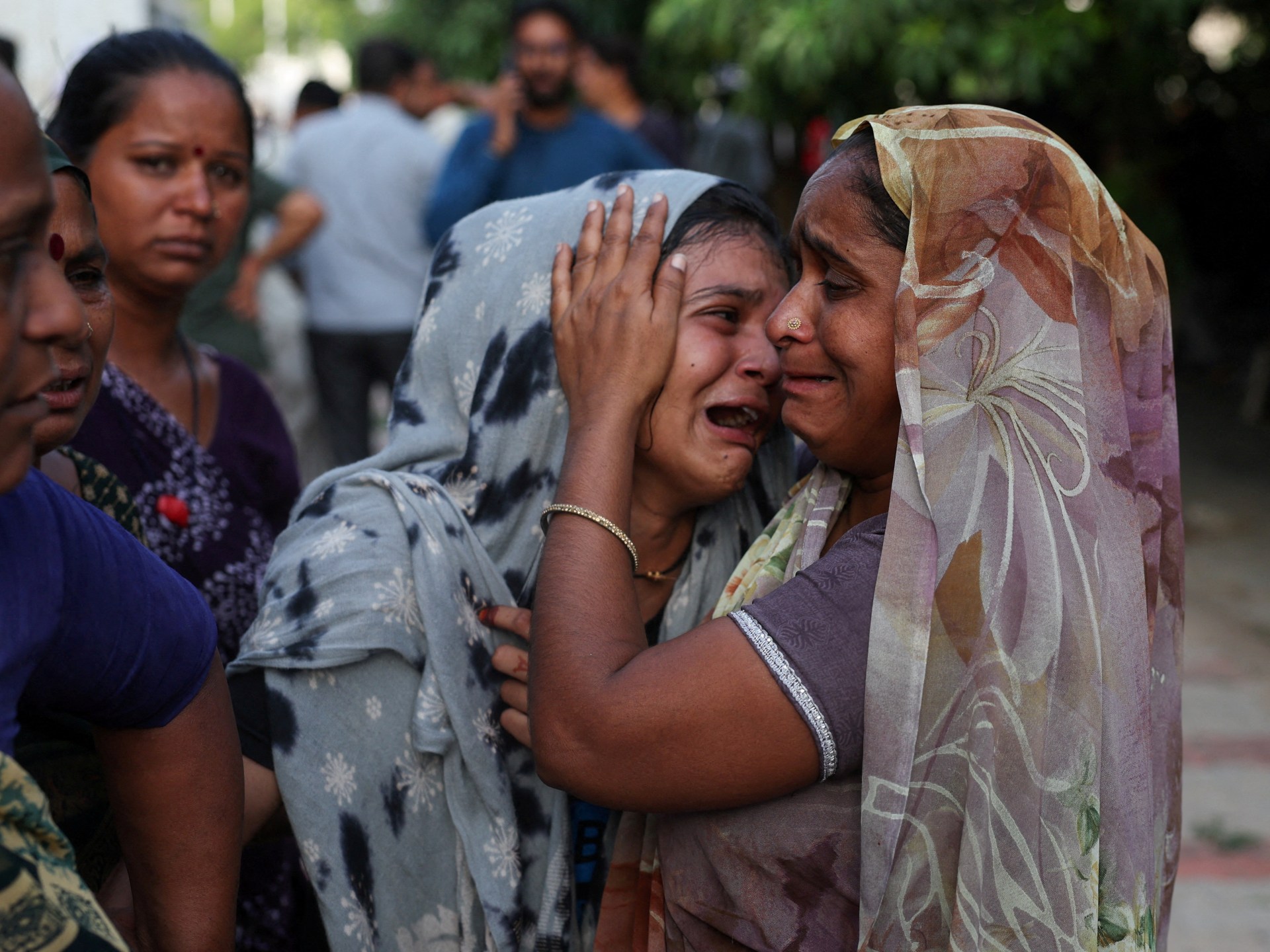
Most bodies are charred or mutilated, and the local authorities are working to identify them by matching DNA samples.
At least 270 bodies have been recovered after a London-bound Air India plane crashed in the western Indian city of Ahmedabad, as a rescue team continues to search the site of India’s worst aviation disaster in three decades.
The Boeing 787 Dreamliner, with 242 people on board and 125,000 litres of fuel, lost altitude seconds after takeoff on Thursday and crashed into a residential area, killing all but one on board and at least two dozen others on the ground.
Dhaval Gameti, a doctor at Civil Hospital in Ahmedabad, told The Associated Press news agency on Saturday that they have received 270 bodies so far.
Most bodies were charred or mutilated, and the local authorities are working to identify them by matching DNA samples as their relatives waited to perform their last rites. Authorities said it normally takes up to 72 hours to complete DNA matching.
Nearly 10 bodies – not of the passengers – found at the crash site have been returned to their families after identification, a local official told Al Jazeera on condition of anonymity because he was not authorised to speak to the media.
Of the 242 passengers and crew on board the Air India plane, 169 were Indian nationals, 53 were British, seven were Portuguese, and one was Canadian.
The lone survivor, Vishwash Kumar Ramesh, 40, is under observation at the Civil Hospital for his impact wounds. Gameti said he was “doing very well and will be ready to be discharged any time soon”.
India’s Civil Aviation Minister, Ram Mohan Naidu Kinjarapu, said the flight’s digital data recorder, or the black box, was recovered from a rooftop near the crash site by the Aircraft Accident Investigation Bureau (AAIB), which is leading the investigation into the crash. He said the government will look into all possible theories of what could have caused the crash.
The AAIB said it was working with “full force” to extract the data, which is expected to reveal information about the engine and control settings. Meanwhile, forensic teams are still looking for a second black box.
Jeff Guzzetti, an aviation safety consultant and former crash investigator for both the US National Transportation Safety Board and Federal Aviation Administration, told the AP the investigators should be able to answer some important questions about what caused the crash as soon as next week as long as the flight data recorder is in good shape.
Guzzetti said the investigators are likely looking into whether wing flaps were set correctly, the engine lost power, alarms were going off inside the cockpit, and if the plane’s crew correctly logged information about the hot temperature outside, and the weight of the fuel and passengers. Mistakes in the data could result in the wing flaps being set incorrectly, he added.
There are currently about 1,200 of the 787 Dreamliner aircraft worldwide, and this was the first deadly crash in 16 years of operation, according to experts. The United States planemaker Boeing, whose planes have been plagued by safety issues on other types of aircraft, said it was in touch with Air India and stood “ready to support them” over the incident.
Source link
#bodies #recovered #Air #India #crash #site #Ahmedabad


![Russian Memorial human rights NGO labeled ‘extremist’Russia’s Supreme Court announced on Telegram on April 9 that the activities of human rights organization Memorial were now banned throughout the country. This came after a closed-door hearing that was treated as “top secret.” Media representatives and diplomats from Germany, Sweden, the Czech Republic and France were only allowed to attend the announcement of the ruling, which sparked strong reactions internationally.
The Nobel Committee, which awarded the 2022 Nobel Peace Prize to Memorial, condemned the court’s decision. The European Union delegation to Russia described the ruling as a “politically motivated blow to civil society in Russia.” The diplomats pointed out that the Russian state itself had “not only officially recognized Memorial’s merits but also provided direct support, and members of the organization served on the Human Rights Council for many years.”The Supreme Court hearing took place behind closed doorsImage: Alexander Zemlianichenko/AP Photo/picture alliance
Russian Supreme Court keeps wording deliberately vague
Lawyers for Memorial pointed out that the Supreme Court had classified the “International Public Movement Memorial” as “extremist,” but they pointed out that no organization of this name existed and had not been registered either in Russia or elsewhere.
They told DW that the wording had probably been kept deliberately vague to create a legal basis for potential repression against any Memorial structures, as well as their members and supporters. “The Justice Ministry’s action itself remained secret, and the organization’s representatives were barred from attending the hearing,” Sergei Davidis, the head of Memorial’s political prisoners support program, told DW.
He also stressed that in light of growing public dissatisfaction with the Russian government, the state was attempting to eliminate independent and reputable sources of information that could foster solidarity and networking in Russian society.
Memorial documents Soviet repression and the Gulag system
The international society Memorial was founded in 1987 and went on to become the leading independent organization dedicated to documenting Soviet-era repression in Russia. Its archives contain tens of thousands of documents about the victims of Soviet repression, including thousands of memoirs, hundreds of personal collections, as well as a wealth of material from researchers on the history of the gulags, the system of labor camps that was a major instrument of political repression in the Soviet era, and other human rights violations.
According to the independent online media outlet Mediazona, the authorities could now lay claim to the archive as the “property of an extremist organization.” In 2023, the head of the Perm NGO Center of Historical Memory, Aleksandr Chernyshov, was arrested after allegedly trying to smuggle archival documents from Russia to Germany.
The persecution of the Russian branch of Memorial began in 2014 when it was placed on a list of “foreign agents” by the Russian Justice Ministry. This status was later extended to the organization’s international branch, which required all publications and reports to be labeled accordingly. In case of non-compliance, there were fines and restrictions on Memorial’s activities.
In 2021, the Supreme Court ordered the dissolution of Memorial International for “repeated” and “gross” violations of Russia’s foreign agent laws. Memorial was also accused of depicting a false image of the Soviet Union.
Pressure continued to mount in March 2023, when the homes and offices of nine Memorial staff members, including Oleg Orlov and Yan Rachinsky, were subjected to searches as part of a targeted campaign against independent human rights organizations. The same year, Orlov was sentenced to two and a half years in prison for “discrediting” the army. He was released with other political prisoners as part of a prisoner exchange in August 2024 and has since been living in Germany.
Memorial will continue its human rights activities
Since this year’s ruling on April 9, Memorial has announced that it will have to suspend all activities in Russia but will continue its activities abroad. It has blocked the sharing and commenting of posts on social media. All supporters in Russia have been urged to follow the safety guidelines published on Memorial’s website.
Although the court has used the term “international social movement” to describe Memorial and this does not actually exist as such, all people, associations and organizations associated with the NGO could now be at risk. Memorial has called on people in Russia to not make any donations, to remove any logos and links on social media, and to delete any compromising content on all digital devices. It warned that people could draw attention from law enforcement agencies even by subscribing to Memorial channels.
It also said that though the risks outside Russia were not as high, people could still be subject to persecution abroad. Nonetheless, it said it would continue its work to protect human rights and preserve historical memory. Politzek — voices that defy the KremlinTo view this video please enable JavaScript, and consider upgrading to a web browser that supports HTML5 video
Nobel Committee: ‘Affront to fundamental values of human dignity’
Earlier this week, the chair of the Norwegian Nobel Committee Jorgen Watne Frydnes said that to designate Memorial as “extremist” was “an affront to the fundamental values of human dignity and freedom of expression.”
On his Telegram channel, the Russian political scientist Aleksandr Kynev wrote that the persecution of Memorial marked a new level of repression in Russia. He added that the new status of the organization would allow the authorities to target even ordinary employees.
Davidis pointed out that Memorial did not have a unified, centralized structure, but constituted a broad network of different groups. He said that people continued to be interested in political repression, both in the past and today. He said that the work of human rights activists had to continue despite the more difficult and risky circumstances.
Russian government strategy to suppress memory of Soviet crimes
According to Irina Sherbakova, a co-founding member of Memorial, the latest move against the organization is part of the Russian government’s overall strategy. She explained that it was in keeping with the closure of the Moscow-based Gulag History Museum in 2024, the systematic removal of commemorative plaques installed by the Last Address memorial project, the restrictions on access to official archives and the amendment to the official concept for commemorating victims of political repression, from which the mention of mass repression and later mass rehabilitation has been removed.Irina Sherbakova co-founded Memorial. She now lives in GermanyImage: dts-Agentur/picture alliance
Sherbakova said that these measures were all aimed at controlling the collective memory of Soviet repression and human rights work today: “This is part of [Russian President Vladimir] Putin’s ideology, which is becoming increasingly ultranationalist.”
Human rights activist Anna Karetnikova agreed, and pointed out that the initiative to persecute Memorial went back to the Russian Federal Security Service (FSB), which succeeded the Soviet secret service, the KGB, itself preceded by the NKVD. She said that the FSB viewed Memorial’s efforts to preserve the memory of Soviet repression and support of political prisoners today as a thorn in its side. She said that Memorial’s new status would lay the path for more criminal proceedings and increase pressure on civil society.
This article was originally published in Russian.
What’s really behind ‘foreign agent’ laws? To view this video please enable JavaScript, and consider upgrading to a web browser that supports HTML5 video
#Russian #Memorial #human #rights #NGO #labeled #extremist](https://i1.wp.com/static.dw.com/image/76090686_6.jpg?ssl=1 "Russian Memorial human rights NGO labeled ‘extremist’Russia’s Supreme Court announced on Telegram on April 9 that the activities of human rights organization Memorial were now banned throughout the country. This came after a closed-door hearing that was treated as “top secret.” Media representatives and diplomats from Germany, Sweden, the Czech Republic and France were only allowed to attend the announcement of the ruling, which sparked strong reactions internationally.
The Nobel Committee, which awarded the 2022 Nobel Peace Prize to Memorial, condemned the court’s decision. The European Union delegation to Russia described the ruling as a “politically motivated blow to civil society in Russia.” The diplomats pointed out that the Russian state itself had “not only officially recognized Memorial’s merits but also provided direct support, and members of the organization served on the Human Rights Council for many years.”The Supreme Court hearing took place behind closed doorsImage: Alexander Zemlianichenko/AP Photo/picture alliance
Russian Supreme Court keeps wording deliberately vague
Lawyers for Memorial pointed out that the Supreme Court had classified the “International Public Movement Memorial” as “extremist,” but they pointed out that no organization of this name existed and had not been registered either in Russia or elsewhere.
They told DW that the wording had probably been kept deliberately vague to create a legal basis for potential repression against any Memorial structures, as well as their members and supporters. “The Justice Ministry’s action itself remained secret, and the organization’s representatives were barred from attending the hearing,” Sergei Davidis, the head of Memorial’s political prisoners support program, told DW.
He also stressed that in light of growing public dissatisfaction with the Russian government, the state was attempting to eliminate independent and reputable sources of information that could foster solidarity and networking in Russian society.
Memorial documents Soviet repression and the Gulag system
The international society Memorial was founded in 1987 and went on to become the leading independent organization dedicated to documenting Soviet-era repression in Russia. Its archives contain tens of thousands of documents about the victims of Soviet repression, including thousands of memoirs, hundreds of personal collections, as well as a wealth of material from researchers on the history of the gulags, the system of labor camps that was a major instrument of political repression in the Soviet era, and other human rights violations.
According to the independent online media outlet Mediazona, the authorities could now lay claim to the archive as the “property of an extremist organization.” In 2023, the head of the Perm NGO Center of Historical Memory, Aleksandr Chernyshov, was arrested after allegedly trying to smuggle archival documents from Russia to Germany.
The persecution of the Russian branch of Memorial began in 2014 when it was placed on a list of “foreign agents” by the Russian Justice Ministry. This status was later extended to the organization’s international branch, which required all publications and reports to be labeled accordingly. In case of non-compliance, there were fines and restrictions on Memorial’s activities.
In 2021, the Supreme Court ordered the dissolution of Memorial International for “repeated” and “gross” violations of Russia’s foreign agent laws. Memorial was also accused of depicting a false image of the Soviet Union.
Pressure continued to mount in March 2023, when the homes and offices of nine Memorial staff members, including Oleg Orlov and Yan Rachinsky, were subjected to searches as part of a targeted campaign against independent human rights organizations. The same year, Orlov was sentenced to two and a half years in prison for “discrediting” the army. He was released with other political prisoners as part of a prisoner exchange in August 2024 and has since been living in Germany.
Memorial will continue its human rights activities
Since this year’s ruling on April 9, Memorial has announced that it will have to suspend all activities in Russia but will continue its activities abroad. It has blocked the sharing and commenting of posts on social media. All supporters in Russia have been urged to follow the safety guidelines published on Memorial’s website.
Although the court has used the term “international social movement” to describe Memorial and this does not actually exist as such, all people, associations and organizations associated with the NGO could now be at risk. Memorial has called on people in Russia to not make any donations, to remove any logos and links on social media, and to delete any compromising content on all digital devices. It warned that people could draw attention from law enforcement agencies even by subscribing to Memorial channels.
It also said that though the risks outside Russia were not as high, people could still be subject to persecution abroad. Nonetheless, it said it would continue its work to protect human rights and preserve historical memory. Politzek — voices that defy the KremlinTo view this video please enable JavaScript, and consider upgrading to a web browser that supports HTML5 video
Nobel Committee: ‘Affront to fundamental values of human dignity’
Earlier this week, the chair of the Norwegian Nobel Committee Jorgen Watne Frydnes said that to designate Memorial as “extremist” was “an affront to the fundamental values of human dignity and freedom of expression.”
On his Telegram channel, the Russian political scientist Aleksandr Kynev wrote that the persecution of Memorial marked a new level of repression in Russia. He added that the new status of the organization would allow the authorities to target even ordinary employees.
Davidis pointed out that Memorial did not have a unified, centralized structure, but constituted a broad network of different groups. He said that people continued to be interested in political repression, both in the past and today. He said that the work of human rights activists had to continue despite the more difficult and risky circumstances.
Russian government strategy to suppress memory of Soviet crimes
According to Irina Sherbakova, a co-founding member of Memorial, the latest move against the organization is part of the Russian government’s overall strategy. She explained that it was in keeping with the closure of the Moscow-based Gulag History Museum in 2024, the systematic removal of commemorative plaques installed by the Last Address memorial project, the restrictions on access to official archives and the amendment to the official concept for commemorating victims of political repression, from which the mention of mass repression and later mass rehabilitation has been removed.Irina Sherbakova co-founded Memorial. She now lives in GermanyImage: dts-Agentur/picture alliance
Sherbakova said that these measures were all aimed at controlling the collective memory of Soviet repression and human rights work today: “This is part of [Russian President Vladimir] Putin’s ideology, which is becoming increasingly ultranationalist.”
Human rights activist Anna Karetnikova agreed, and pointed out that the initiative to persecute Memorial went back to the Russian Federal Security Service (FSB), which succeeded the Soviet secret service, the KGB, itself preceded by the NKVD. She said that the FSB viewed Memorial’s efforts to preserve the memory of Soviet repression and support of political prisoners today as a thorn in its side. She said that Memorial’s new status would lay the path for more criminal proceedings and increase pressure on civil society.
This article was originally published in Russian.
What’s really behind ‘foreign agent’ laws? To view this video please enable JavaScript, and consider upgrading to a web browser that supports HTML5 video
#Russian #Memorial #human #rights #NGO #labeled #extremist")
Post Comment