×
Deadspin | Capitals, Blue Jackets play finale with all eyes on Alex Ovechkin  Apr 12, 2026; Washington, District of Columbia, USA; Washington Capitals left wing Alex Ovechkin (8) smiles while waving off a handshake line by the Pittsburgh Penguins after their game at Capital One Arena. Mandatory Credit: Geoff Burke-Imagn Images   Alex Ovechkin may be playing his final NHL game when the Washington Capitals visit the Columbus Blue Jackets on Tuesday night.  Or he may not be. Either way, he isn’t playoff-bound, as the Philadelphia Flyers’ 3-2 shootout win over the Carolina Hurricanes eliminated both the Capitals and the Blue Jackets from playoff contention.  Ovechkin, the NHL’s all-time leading goal-scorer, is nearing the end of his 21st NHL season and is in the final season of a five-year contract. The 40-year-old left wing, who has scored 929 regular-season goals, has announced he will not make a decision regarding his future until this summer.  There was no ceremony of any kind during Washington’s final home game, a much-needed 3-0 victory over the Pittsburgh Penguins on Sunday. Fans chanted “one more year” and the Penguins stayed on the ice after the game for a ceremonial handshake, but a smiling Ovechkin waved them off after Washington won its third straight game.  “The fans always support me, support the organization, team, boys,” Ovechkin said. “It was loud. It was the energy (that) we need. You can see how the boys played.”  Washington (42-30-9, 93 points) and Columbus (40-29-12, 92 points) were still alive in the playoff hunt until Philadelphia (42-27-12, 96 points) wrapped up third place in the Metropolitan Division on Monday.  After a disastrous six-game losing streak that knocked them down the standings and closer to elimination from playoff contention, the Blue Jackets have split their past four games, the latest being a 3-2 loss to the Boston Bruins on Sunday.  Mason Marchment and Adam Fantilli scored, and Jet Greaves made 19 saves for the Blue Jackets.   “We’re all very, very disappointed in how it went tonight,” Blue Jackets coach Rick Bowness said Sunday. “The guys are heartbroken, we’re heartbroken, and now we’ve lost total control of what’s going to happen.”  Columbus tied the score 2-2 early in the third period, but Boston scored the go-ahead goal midway through the period.  “I think we had to maybe up our urgency a little bit,” Blue Jackets defenseman Zach Werenski said. “I thought in the third we had a lot of grade-A chances to either take the lead or tie it back up. We missed on a few of them.”  In Washington on Sunday, Connor McMichael scored twice and had an assist and Ovechkin had an assist for the Capitals, who have won seven of nine. Logan Thompson made 24 saves for his fourth shutout of the season and second in three starts.  “I know our guys,” Capitals coach Spencer Carbery said. “And I know that there was no way we were gonna throw the towel in and just cruise in and hopefully play .500 hockey and ride it out. … I knew we would not pack it in, and we were gonna fight to win hockey games.”  Thompson is 5-1-0 with a 1.90 goals-against average and .942 save percentage against Columbus. Greaves, expected to start for the sixth straight game, is 2-2-1 with a 1.80 GAA and a .943 save percentage versus Washington.  Washington leads the season series 3-0-0. The teams have not met since Dec. 7 when Thompson made 39 saves in a 2-0 Washington home win. The Capitals won 5-1 on Nov. 24 behind two goals from Jakob Chychrun and 5-1 on Oct. 24 when Ovechkin scored his 899th goal and added an assist.  –Field Level Media    #Deadspin #Capitals #Blue #Jackets #play #finale #eyes #Alex #Ovechkin
Deadspin | Capitals, Blue Jackets play finale with all eyes on Alex Ovechkin
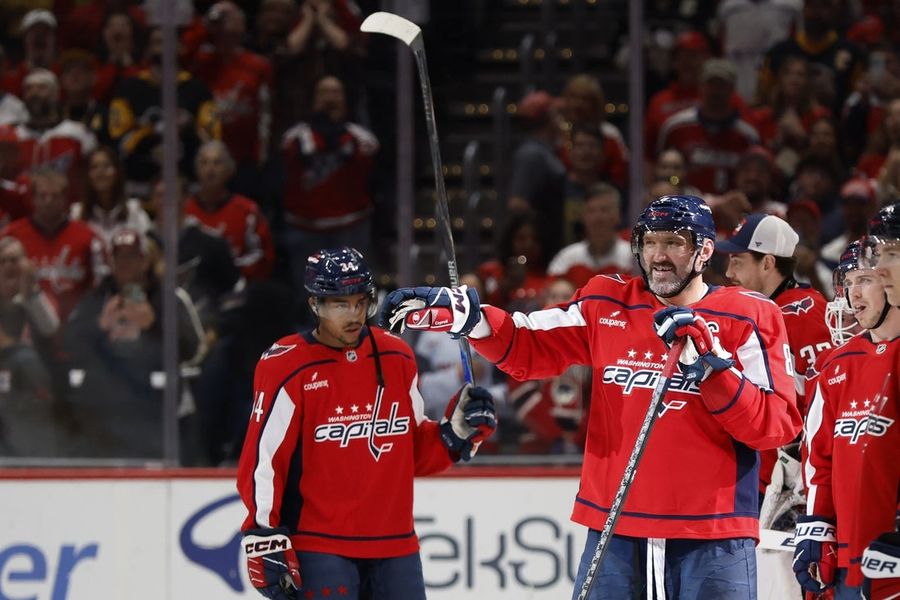
Deadspin | Capitals, Blue Jackets play finale with all eyes on Alex Ovechkin  Apr 12, 2026; Washington, District of Columbia, USA; Washington Capitals left wing Alex Ovechkin (8) smiles while waving off a handshake line by the Pittsburgh Penguins after their game at Capital One Arena. Mandatory Credit: Geoff Burke-Imagn Images   Alex Ovechkin may be playing his final NHL game when the Washington Capitals visit the Columbus Blue Jackets on Tuesday night.  Or he may not be. Either way, he isn’t playoff-bound, as the Philadelphia Flyers’ 3-2 shootout win over the Carolina Hurricanes eliminated both the Capitals and the Blue Jackets from playoff contention.  Ovechkin, the NHL’s all-time leading goal-scorer, is nearing the end of his 21st NHL season and is in the final season of a five-year contract. The 40-year-old left wing, who has scored 929 regular-season goals, has announced he will not make a decision regarding his future until this summer.  There was no ceremony of any kind during Washington’s final home game, a much-needed 3-0 victory over the Pittsburgh Penguins on Sunday. Fans chanted “one more year” and the Penguins stayed on the ice after the game for a ceremonial handshake, but a smiling Ovechkin waved them off after Washington won its third straight game.  “The fans always support me, support the organization, team, boys,” Ovechkin said. “It was loud. It was the energy (that) we need. You can see how the boys played.”  Washington (42-30-9, 93 points) and Columbus (40-29-12, 92 points) were still alive in the playoff hunt until Philadelphia (42-27-12, 96 points) wrapped up third place in the Metropolitan Division on Monday.  After a disastrous six-game losing streak that knocked them down the standings and closer to elimination from playoff contention, the Blue Jackets have split their past four games, the latest being a 3-2 loss to the Boston Bruins on Sunday.  Mason Marchment and Adam Fantilli scored, and Jet Greaves made 19 saves for the Blue Jackets.   “We’re all very, very disappointed in how it went tonight,” Blue Jackets coach Rick Bowness said Sunday. “The guys are heartbroken, we’re heartbroken, and now we’ve lost total control of what’s going to happen.”  Columbus tied the score 2-2 early in the third period, but Boston scored the go-ahead goal midway through the period.  “I think we had to maybe up our urgency a little bit,” Blue Jackets defenseman Zach Werenski said. “I thought in the third we had a lot of grade-A chances to either take the lead or tie it back up. We missed on a few of them.”  In Washington on Sunday, Connor McMichael scored twice and had an assist and Ovechkin had an assist for the Capitals, who have won seven of nine. Logan Thompson made 24 saves for his fourth shutout of the season and second in three starts.  “I know our guys,” Capitals coach Spencer Carbery said. “And I know that there was no way we were gonna throw the towel in and just cruise in and hopefully play .500 hockey and ride it out. … I knew we would not pack it in, and we were gonna fight to win hockey games.”  Thompson is 5-1-0 with a 1.90 goals-against average and .942 save percentage against Columbus. Greaves, expected to start for the sixth straight game, is 2-2-1 with a 1.80 GAA and a .943 save percentage versus Washington.  Washington leads the season series 3-0-0. The teams have not met since Dec. 7 when Thompson made 39 saves in a 2-0 Washington home win. The Capitals won 5-1 on Nov. 24 behind two goals from Jakob Chychrun and 5-1 on Oct. 24 when Ovechkin scored his 899th goal and added an assist.  –Field Level Media    #Deadspin #Capitals #Blue #Jackets #play #finale #eyes #Alex #OvechkinApr 12, 2026; Washington, District of Columbia, USA; Washington Capitals left wing Alex Ovechkin (8) smiles while waving off a handshake line by the Pittsburgh Penguins after their game at Capital One Arena. Mandatory Credit: Geoff Burke-Imagn Images
Alex Ovechkin may be playing his final NHL game when the Washington Capitals visit the Columbus Blue Jackets on Tuesday night.

Or he may not be. Either way, he isn’t playoff-bound, as the Philadelphia Flyers’ 3-2 shootout win over the Carolina Hurricanes eliminated both the Capitals and the Blue Jackets from playoff contention.

Ovechkin, the NHL’s all-time leading goal-scorer, is nearing the end of his 21st NHL season and is in the final season of a five-year contract. The 40-year-old left wing, who has scored 929 regular-season goals, has announced he will not make a decision regarding his future until this summer.

There was no ceremony of any kind during Washington’s final home game, a much-needed 3-0 victory over the Pittsburgh Penguins on Sunday. Fans chanted “one more year” and the Penguins stayed on the ice after the game for a ceremonial handshake, but a smiling Ovechkin waved them off after Washington won its third straight game.

“The fans always support me, support the organization, team, boys,” Ovechkin said. “It was loud. It was the energy (that) we need. You can see how the boys played.”

Washington (42-30-9, 93 points) and Columbus (40-29-12, 92 points) were still alive in the playoff hunt until Philadelphia (42-27-12, 96 points) wrapped up third place in the Metropolitan Division on Monday.

After a disastrous six-game losing streak that knocked them down the standings and closer to elimination from playoff contention, the Blue Jackets have split their past four games, the latest being a 3-2 loss to the Boston Bruins on Sunday.


Mason Marchment and Adam Fantilli scored, and Jet Greaves made 19 saves for the Blue Jackets.

“We’re all very, very disappointed in how it went tonight,” Blue Jackets coach Rick Bowness said Sunday. “The guys are heartbroken, we’re heartbroken, and now we’ve lost total control of what’s going to happen.”

Columbus tied the score 2-2 early in the third period, but Boston scored the go-ahead goal midway through the period.

“I think we had to maybe up our urgency a little bit,” Blue Jackets defenseman Zach Werenski said. “I thought in the third we had a lot of grade-A chances to either take the lead or tie it back up. We missed on a few of them.”

In Washington on Sunday, Connor McMichael scored twice and had an assist and Ovechkin had an assist for the Capitals, who have won seven of nine. Logan Thompson made 24 saves for his fourth shutout of the season and second in three starts.

“I know our guys,” Capitals coach Spencer Carbery said. “And I know that there was no way we were gonna throw the towel in and just cruise in and hopefully play .500 hockey and ride it out. … I knew we would not pack it in, and we were gonna fight to win hockey games.”

Thompson is 5-1-0 with a 1.90 goals-against average and .942 save percentage against Columbus. Greaves, expected to start for the sixth straight game, is 2-2-1 with a 1.80 GAA and a .943 save percentage versus Washington.

Washington leads the season series 3-0-0. The teams have not met since Dec. 7 when Thompson made 39 saves in a 2-0 Washington home win. The Capitals won 5-1 on Nov. 24 behind two goals from Jakob Chychrun and 5-1 on Oct. 24 when Ovechkin scored his 899th goal and added an assist.


–Field Level Media

#Deadspin #Capitals #Blue #Jackets #play #finale #eyes #Alex #Ovechkin

Apr 12, 2026; Washington, District of Columbia, USA; Washington Capitals left wing Alex Ovechkin (8) smiles while waving off a handshake line by the Pittsburgh Penguins after their game at Capital One Arena. Mandatory Credit: Geoff Burke-Imagn Images

Alex Ovechkin may be playing his final NHL game when the Washington Capitals visit the Columbus Blue Jackets on Tuesday night.

Or he may not be. Either way, he isn’t playoff-bound, as the Philadelphia Flyers’ 3-2 shootout win over the Carolina Hurricanes eliminated both the Capitals and the Blue Jackets from playoff contention.

Ovechkin, the NHL’s all-time leading goal-scorer, is nearing the end of his 21st NHL season and is in the final season of a five-year contract. The 40-year-old left wing, who has scored 929 regular-season goals, has announced he will not make a decision regarding his future until this summer.

There was no ceremony of any kind during Washington’s final home game, a much-needed 3-0 victory over the Pittsburgh Penguins on Sunday. Fans chanted “one more year” and the Penguins stayed on the ice after the game for a ceremonial handshake, but a smiling Ovechkin waved them off after Washington won its third straight game.

“The fans always support me, support the organization, team, boys,” Ovechkin said. “It was loud. It was the energy (that) we need. You can see how the boys played.”

Washington (42-30-9, 93 points) and Columbus (40-29-12, 92 points) were still alive in the playoff hunt until Philadelphia (42-27-12, 96 points) wrapped up third place in the Metropolitan Division on Monday.

After a disastrous six-game losing streak that knocked them down the standings and closer to elimination from playoff contention, the Blue Jackets have split their past four games, the latest being a 3-2 loss to the Boston Bruins on Sunday.

Mason Marchment and Adam Fantilli scored, and Jet Greaves made 19 saves for the Blue Jackets.

“We’re all very, very disappointed in how it went tonight,” Blue Jackets coach Rick Bowness said Sunday. “The guys are heartbroken, we’re heartbroken, and now we’ve lost total control of what’s going to happen.”

Columbus tied the score 2-2 early in the third period, but Boston scored the go-ahead goal midway through the period.

“I think we had to maybe up our urgency a little bit,” Blue Jackets defenseman Zach Werenski said. “I thought in the third we had a lot of grade-A chances to either take the lead or tie it back up. We missed on a few of them.”

In Washington on Sunday, Connor McMichael scored twice and had an assist and Ovechkin had an assist for the Capitals, who have won seven of nine. Logan Thompson made 24 saves for his fourth shutout of the season and second in three starts.

“I know our guys,” Capitals coach Spencer Carbery said. “And I know that there was no way we were gonna throw the towel in and just cruise in and hopefully play .500 hockey and ride it out. … I knew we would not pack it in, and we were gonna fight to win hockey games.”

Thompson is 5-1-0 with a 1.90 goals-against average and .942 save percentage against Columbus. Greaves, expected to start for the sixth straight game, is 2-2-1 with a 1.80 GAA and a .943 save percentage versus Washington.

Washington leads the season series 3-0-0. The teams have not met since Dec. 7 when Thompson made 39 saves in a 2-0 Washington home win. The Capitals won 5-1 on Nov. 24 behind two goals from Jakob Chychrun and 5-1 on Oct. 24 when Ovechkin scored his 899th goal and added an assist.

–Field Level Media

Source link
#Deadspin #Capitals #Blue #Jackets #play #finale #eyes #Alex #Ovechkin

Previous post

UEFA rejects Barcelona handball complaint ahead of Champions League second leg quarterfinal against Atletico Madrid <div id="content-body-70860942" itemprop="articleBody"><p>European football governing body UEFA on Tuesday rejected Barcelona’s complaint over a handball incident in its Champions League quarterfinal first leg defeat by Atletico Madrid, hours before the second leg.</p><p>Diego Simeone’s side won 2-0 at Camp Nou last week, and Barca was upset by an incident where Atletico defender Marc Pubill touched the ball with his hand after it appeared a goal kick had been passed to him.</p><p>“(After the first leg) Barcelona filed a protest relating to a referee decision. On 13 April 2026, the UEFA Control Ethics and Disciplinary Body declared the protest to be inadmissible,” said UEFA in a statement.</p><p>Five-time Champions League winner Barca said last week the decision not to award it a penalty was a “major error” which influenced the result, and was upset referee Istvan Kovacs was not told to review the incident by the VAR team.</p><p class="publish-time" id="end-of-article">Published on Apr 14, 2026</p></div> #UEFA #rejects #Barcelona #handball #complaint #ahead #Champions #League #leg #quarterfinal #Atletico #Madrid

Next post

‘No one will remember if I finish 4th or 10th’: Abdulla Aboobacker eyes NR and Asian Games glory <div id="content-body-70861044" itemprop="articleBody"><p>Learning from past mistakes but not dwelling too much on missed medals and focussing on the future is what an athlete’s life is all about.</p><p>Triple jumper Abdulla Aboobacker knows it all too well.</p><p>The 30-year-old Abdulla, a Junior Warrant Officer in the Indian Air Force, is ready for another crucial season in his career after a disappointing end to 2025. On the agenda this year are two mega events – Commonwealth Games (CWG), where he won silver in 2022, and the Asian Games.</p><p>In an exclusive interview with <i>Sportstar</i>, Abdulla reveals how he is approaching the 2026 season, his thoughts on the qualification criteria for CWG and Asian Games and more:-</p><p><b>When did you end your 2025 season and begin your off season?</b></p><p>I ended my season at the World Championship in Japan (where he failed to qualify for the final). Then, I started the off season at the Air Force base in Bengaluru. Even now, I have taken part in two competitions but it is still the off season. I haven’t started my season yet.</p><p><b>Did you take a break after the World Championships?</b></p><p>After the World Championships, I took a one-and-a-half-month break. Then, I went to Inspire Institute of Sport (IIS) for rehab and strength and conditioning before joining training at Air Force in December. Since then, I have been training there under coach Harikrishnan along with Karthik Unnikrishnan & long jumper Siddharth Mohan Naik.</p><p><b>Did you make any changes in your technique or strategy during the off season?</b></p><p>Last year, I hit my peak in the off season itself. I thought I’ll start with explosive speed and then, maintain stability. I jumped 17.19m in the first competition itself. I did so well in the off season but could not be consistent later. I could not do the off season properly.</p><p>This year, I thought that I’ll compete in two events in the off season itself but won’t hit my peak yet. If I peaked too soon, it will cause issues later in the year when there is Asian Games in September-October.</p><div class=" article-picture center"><img src="https://ss-i.thgim.com/public/incoming/i7dufs/article70861129.ece/alternates/FREE_1200/IMG_TH24TRIPLE_2_1_TNALTLS4.jpg" data-original="https://ss-i.thgim.com/public/incoming/i7dufs/article70861129.ece/alternates/FREE_1200/IMG_TH24TRIPLE_2_1_TNALTLS4.jpg" alt="Gold medal winner Eldhose Paul, left, of India and compatriot and silver medal winner Abdulla Aboobacker celebrate after the men's triple jump final at the 2022 Commonwealth Games in Birmingham." title="Gold medal winner Eldhose Paul, left, of India and compatriot and silver medal winner Abdulla Aboobacker celebrate after the men's triple jump final at the 2022 Commonwealth Games in Birmingham." class=" lazy" width="100%" height="100%"/><div class="pic-caption"><figcaption class="figure-caption align-text-bottom"><p> Gold medal winner Eldhose Paul, left, of India and compatriot and silver medal winner Abdulla Aboobacker celebrate after the men’s triple jump final at the 2022 Commonwealth Games in Birmingham. | Photo Credit: AP </p><img class="caption-image" src="https://assetsss.thehindu.com/theme/images/SSRX/lightbox-info.svg" alt="lightbox-info"/></figcaption></div><p class="caption"> Gold medal winner Eldhose Paul, left, of India and compatriot and silver medal winner Abdulla Aboobacker celebrate after the men’s triple jump final at the 2022 Commonwealth Games in Birmingham. | Photo Credit: AP </p></div><p>My target is to put in full effort during the Federation Cup now.</p><p>My coach told me to do only three jumps during the first two competitions. I did three jumps during the Indian Open Jumps Competition. In Indian Athletics Series 1, I did three. I felt I was jumping well and could potentially break the National Record (17.37m), so I attempted a fourth one but it was a foul.</p><p>Then I thought that it is okay. There is good competition this year with Praveen (Chithravel) and also, Selva Prabhu who cleared 17m (17.05 at the NCAA Indoor Championships). So, I feel we can break the NR at the Fed Cup.</p><p><b>How do you see the qualification criteria set by the Athletics Federation of India (AFI) for CWG and Asian Games? You can’t qualify by meeting the entry standard once. You have to take part in two meets, state championships, Fed Cup and then, at Inter-State, which will be the final selection trial, to achieve the entry standard again.</b></p><p>Our target is the Asian Games. Jumping at the state meet and nationals will provide experience and help our coordination. If this is my mentality, then I won’t feel any pressure or mental stress.</p><p>If we think about why AFI is doing this while our focus is just on one competition, then we won’t be able to concentrate. We have to be ready for anything. I feel the federation is right as they want consistent performances. If I do well in one event and I’m down in the next, even they’ll start doubting.</p><p><b>What is your main goal for this season? You have already achieved the qualifying mark for Asian Games (16.28m). And CWG shouldn’t be a problem either.</b></p><p>The qualification standard for CWG is 16.89m. In my first two events, I did 16.83m and 16.82m. So, it is manageable. What’s in my mind is that I won silver at last CWG while Eldhose Paul won gold. In that same competition, there was a Jamaican triple jumper, Jordan Scott, who is doing well globally now. He did 17.52m in 2025. Right now, he is close to 17.30-17.40. My mindset is to compete with him and beat him. He won silver in World Indoors and is a consistent jumper.</p><p>For Asian Games, the Chinese and the Korean teams are good competitors.</p><p><b>Triple jump is such an explosive and technical discipline. How do you manage injuries?</b></p><p>Injuries will come and go in sports. JSW supports so much that I just need to make one call and everything will be ready before I go to IIS for rehab. That’s why, I don’t feel any tension.</p><p>Right now, I’m training at the Air Force base but in case I need any help in terms of facilities or focussed rehab, I can put in a request here and go to IIS.</p><p>I had heel pain in 2022 and 2025. Back pain, ankle pain…. All this is normal since we are pushing our bodies a lot.</p><p>I notice the symptoms early and adjust my recovery accordingly. I am not alone. I have a big support system behind me.</p><p><b>At the last Asian Games, you finished fourth. Does it still bother you that you came so close to a medal?</b></p><p>Actually, even at CWG, the difference between Eldhose and me was one centimetre. Next year, at the Asian Games, the gap between me and Praveen, who finished third, was six centimetres.</p><p>This time, I don’t want it to be so close and therefore, I’m targeting bigger jumps.</p><p>The last Asian Games was three years ago and I can’t do anything about it. But it felt really bad to finish fourth because finishing fourth, 10th or 100th is all equal in terms of participation value. No one will even remember if I finished fourth or 10th.</p><p>Nevertheless, now it is about focussing on the future.</p><p class="publish-time" id="end-of-article">Published on Apr 14, 2026</p></div> #remember #finish #4th #10th #Abdulla #Aboobacker #eyes #Asian #Games #glory

We all love draft-day steals.

Sure, the players that come off the board at the top of the draft arrive with much fanfare. But part of the beauty of the NFL Draft process is finding that “diamond in the rough,” whether players from lower levels or prospects that maybe never fully developed at the college level, but showed flashes of brilliance along the way.

Those steals come every year.

Here are the ten biggest steals in NFL Draft history, ahead of the 2026 installment.

Brock Purdy was not just the last quarterback taken in the 2022 NFL Draft (where eight quarterbacks went ahead of him) but he was the last player selected overall, coming off the board at No. 262 to earn the title “Mr. Irrelevant.”

All he has done since then is guide the San Francisco 49ers to multiple playoff appearances, including in his rookie season, and lead the 49ers to one Super Bowl appearance since taking over as the team’s starting quarterback. Purdy and the 49ers were decimated by injuries a season ago, but still advanced to the NFC Divisional Round, losing to the eventual Super Bowl champions.

Jason Kelce was an undersized center coming out of Cincinnati, who fell to the 191st pick overall as the fourth center drafted.

But over his NFL career Kelce put together a Hall of Fame resume, earning six First-Team All-Pro selections. Kelce was also part of the 2017 Philadelphia Eagles team that shocked the New England Patriots to win Super Bowl LII.

Certainly his career has entered a new stage, as Kelce shows up almost any time you turn on a television, and the podcast he co-hosts with his brother Travis has transcended the sporting world. But before he became a celebrity, he was one of the biggest NFL Draft steals.

Before the NFL Draft shifted to the current seven-round format, the number of rounds would often reach into the double digits.

That class is known for the quarterbacks that came off the board in the first round, a list of names that includes John Elway, Jim Kelly, Ken O’Brien, and Dan Marino. That draft lasted a whopping 12 rounds.

And coming off the board in the eighth round, at pick 203, was a defensive end out of Tennessee State. Richard Dent would go on to produce a Hall of Fame career, amassing 137.5 sacks over his time in the league. That currently places him 11th on the all-time list. Dent also helped the Chicago Bears win Super Bowl XX, where he was named the game’s Most Valuable Player after recording 1.5 sacks, forcing a pair of fumbles, and breaking up a pass.

While pick 203 would come off the board in the sixth round of the modern draft, due to compensatory selections and the number of teams picking in each round, a player with that resume would still be a steal even by today’s standards.

Again, the draft looked very different in 1955. That year, the draft lasted a staggering 30 rounds.

Imagine writing a 30-round mock draft? But I digress …

Coming off the board in the ninth round, at pick No. 102, was Louisville quarterback Johnny Unitas. Unitas would go on to become one of the greatest players in league history, winning three NFL championships, earning NFL MVP honors three times, and securing a win in Super Bowl V. Unitas also secured five First-Team All-Pro honors, and still stands among league leaders in several statistical categories, despite playing in a completely different era of football.

In 1960, he set a record for the most consecutive games with a touchdown pass, one that did not fall until Drew Brees eclipsed that mark during the 2012 NFL season.

21 running backs came off the board during the 1995 NFL Draft starting with Penn State’s Ki-Jana Carter, who was the first player selected.

Terrell Davis was the 18th RB selected that year, coming in the sixth round at No. 196 overall.

Still, Davis put together a legendary three-year start to his career that might be one of the best stretches ever from a running back. He ran for 1,117 yards during his rookie season, increasing that number to 1,538 during the 1996 campaign before leading the NFL with 2,008 yards during 1998. During that 1997 season he ran for 15 touchdowns, followed by 19 TD runs the following year.

Both times he led the league in that statistic.

Davis was named league MVP in 1998, and was a First-Team All-Pro in each of those three seasons. His performance in Super Bowl XXXII — where he endured a brutal migraine to run for 157 yards and three touchdowns, securing MVP honors — stands out as one of the truly legendary Super Bowl performances in league history.

He was named to the Pro Football Hall of Fame in 1997.

Tight end is notoriously a difficult position to evaluate when it comes to the NFL Draft. What NFL tight ends are asked to do in the league varies greatly from what they are asked to do in the college game.

During the 1990 NFL Draft, which lasted 12 rounds, 18 tight ends were drafted. Shannon Sharpe, out of Savannah State, came off the board as the tenth TE selected, when his name was called at pick No. 192 overall, and in the seventh round.

All he did in the league was haul in 815 career catches for 10,060 receiving yards and 62 touchdowns.

Sharpe also secured four First-Team All-Pro selections — including three consecutive picks from 1996 through 1998 — and was named to eight Pro Bowls. A member of the 2011 Pro Football Hall of Fame Class, Sharpe is still considered one of the best tight ends in league history.

Roger Staubach’s status as a draft steal certainly requires some context.

Staubach became a household name during the 1963 college football season, where he led Navy to the Cotton Bowl at the end of the season against No. 1 Texas, with a chance to win the national championship. Although Navy lost that game, Staubach still secured the Heisman Trophy that season, and stands as the last Navy player to secure those honors.

While the Dallas Cowboys drafted him in the tenth round of the 1964 NFL Draft as a “futures” selection, they did so knowing Staubach had four years of military service awaiting him. After serving his time, including one year spent in South Vietnam during the Vietnam war as part of the supply chain (due to his colorblindness) he joined Dallas for the 1969 season.

He took over as the Cowboys’ starting quarterback soon enough, and during his time in Dallas, Staubach won two Super Bowls (VI and XII) and was named MVP of Super Bowl VI. He was the league’s Man of the Year in 1978, and a Second-Team All-Pro selection in 1971. He was also a six-time Pro Bowl selection, a member of the NFL’s All-Decade Team for the 1970s, and he was named to the NFL’s 100th Anniversary All-Time Team.

The 1956 NFL Draft lasted 30 rounds, coming at a time when there were 12 teams in the league.

In the 17th round, the Green Bay Packers made Bart Starr the ninth quarterback selected, and the 200th player picked overall.

But Starr eventually took over as the team’s starting quarterback during the 1959 campaign, under new head coach Vince Lombardi, and he never looked back. He helped the Packers to an appearance in the 1960 NFL Championship Game against the Philadelphia Eagles, and while they lost that game, Starr and the Packers won a title the following year.

He was also the winner of the first two Super Bowl MVP awards, as he led the Packers to victories in both Super Bowl I and Super Bowl II. He was a member of the Pro Football Hall of Fame Class of 1977.

In his fourth season, 1959, new head coach Vince Lombardi named him the starting quarterback. The next year, he was named to the Pro Bowl for the first time and led the Packers to the NFL championship game, though they lost to the Eagles. In 1961, he earned a second straight Pro Bowl nod and won his first championship.

Starr went on to win four more NFL championships as the Packers’ starter and led Green Bay to wins in the first two Super Bowls after the 1966 and 1967 seasons. Starr was the winner of the first two Super Bowl MVP awards. He was also the NFL MVP in 1966 and was enshrined in the Pro Football Hall of Fame in 1977.

Despite a legendary collegiate career at Notre Dame, including a win in the famous “Chicken Soup” game, Joe Montana fell to the end of the third round of the 1977 NFL Draft, where he was pick No. 82 overall.

But he landed in San Francisco with Bill Walsh, and the rest is history. That history includes four Super Bowl wins, two NFL MVP awards, three first-team All-Pro nods, and eight Pro Bowls. Montana is known for the game-winning drive at the end of Super Bowl XXIII, as well as “The Catch,” his completion to Dwight Clark to cap off a win over the Dallas Cowboys in the 1982 NFC Championship Game.

You know the story by now.

Pick No. 199, coming in the sixth round of the 2000 NFL Draft. A surprise member of the New England Patriots roster despite beginning the 2000 season as the team’s fourth quarterback.

Then a hit on starting quarterback Drew Bledsoe by Mo Lewis during the 2001 NFL season that changed not just Patriots’ history, but NFL history.

Seven Super Bowl titles later, only Canton awaits.

#NFL #Drafts #biggest #steals #alltime #ranked">NFL Draft’s 10 biggest steals of all-time, ranked  We all love draft-day steals.Sure, the players that come off the board at the top of the draft arrive with much fanfare. But part of the beauty of the NFL Draft process is finding that “diamond in the rough,” whether players from lower levels or prospects that maybe never fully developed at the college level, but showed flashes of brilliance along the way.Those steals come every year.Here are the ten biggest steals in NFL Draft history, ahead of the 2026 installment.Brock Purdy was not just the last quarterback taken in the 2022 NFL Draft (where eight quarterbacks went ahead of him) but he was the last player selected overall, coming off the board at No. 262 to earn the title “Mr. Irrelevant.”All he has done since then is guide the San Francisco 49ers to multiple playoff appearances, including in his rookie season, and lead the 49ers to one Super Bowl appearance since taking over as the team’s starting quarterback. Purdy and the 49ers were decimated by injuries a season ago, but still advanced to the NFC Divisional Round, losing to the eventual Super Bowl champions.Jason Kelce was an undersized center coming out of Cincinnati, who fell to the 191st pick overall as the fourth center drafted.But over his NFL career Kelce put together a Hall of Fame resume, earning six First-Team All-Pro selections. Kelce was also part of the 2017 Philadelphia Eagles team that shocked the New England Patriots to win Super Bowl LII.Certainly his career has entered a new stage, as Kelce shows up almost any time you turn on a television, and the podcast he co-hosts with his brother Travis has transcended the sporting world. But before he became a celebrity, he was one of the biggest NFL Draft steals.Before the NFL Draft shifted to the current seven-round format, the number of rounds would often reach into the double digits.That class is known for the quarterbacks that came off the board in the first round, a list of names that includes John Elway, Jim Kelly, Ken O’Brien, and Dan Marino. That draft lasted a whopping 12 rounds.And coming off the board in the eighth round, at pick 203, was a defensive end out of Tennessee State. Richard Dent would go on to produce a Hall of Fame career, amassing 137.5 sacks over his time in the league. That currently places him 11th on the all-time list. Dent also helped the Chicago Bears win Super Bowl XX, where he was named the game’s Most Valuable Player after recording 1.5 sacks, forcing a pair of fumbles, and breaking up a pass.While pick 203 would come off the board in the sixth round of the modern draft, due to compensatory selections and the number of teams picking in each round, a player with that resume would still be a steal even by today’s standards.Again, the draft looked very different in 1955. That year, the draft lasted a staggering 30 rounds.Imagine writing a 30-round mock draft? But I digress …Coming off the board in the ninth round, at pick No. 102, was Louisville quarterback Johnny Unitas. Unitas would go on to become one of the greatest players in league history, winning three NFL championships, earning NFL MVP honors three times, and securing a win in Super Bowl V. Unitas also secured five First-Team All-Pro honors, and still stands among league leaders in several statistical categories, despite playing in a completely different era of football.In 1960, he set a record for the most consecutive games with a touchdown pass, one that did not fall until Drew Brees eclipsed that mark during the 2012 NFL season.21 running backs came off the board during the 1995 NFL Draft starting with Penn State’s Ki-Jana Carter, who was the first player selected.Terrell Davis was the 18th RB selected that year, coming in the sixth round at No. 196 overall.Still, Davis put together a legendary three-year start to his career that might be one of the best stretches ever from a running back. He ran for 1,117 yards during his rookie season, increasing that number to 1,538 during the 1996 campaign before leading the NFL with 2,008 yards during 1998. During that 1997 season he ran for 15 touchdowns, followed by 19 TD runs the following year.Both times he led the league in that statistic.Davis was named league MVP in 1998, and was a First-Team All-Pro in each of those three seasons. His performance in Super Bowl XXXII — where he endured a brutal migraine to run for 157 yards and three touchdowns, securing MVP honors — stands out as one of the truly legendary Super Bowl performances in league history.He was named to the Pro Football Hall of Fame in 1997.Tight end is notoriously a difficult position to evaluate when it comes to the NFL Draft. What NFL tight ends are asked to do in the league varies greatly from what they are asked to do in the college game.During the 1990 NFL Draft, which lasted 12 rounds, 18 tight ends were drafted. Shannon Sharpe, out of Savannah State, came off the board as the tenth TE selected, when his name was called at pick No. 192 overall, and in the seventh round.All he did in the league was haul in 815 career catches for 10,060 receiving yards and 62 touchdowns.Sharpe also secured four First-Team All-Pro selections — including three consecutive picks from 1996 through 1998 — and was named to eight Pro Bowls. A member of the 2011 Pro Football Hall of Fame Class, Sharpe is still considered one of the best tight ends in league history.Roger Staubach’s status as a draft steal certainly requires some context.Staubach became a household name during the 1963 college football season, where he led Navy to the Cotton Bowl at the end of the season against No. 1 Texas, with a chance to win the national championship. Although Navy lost that game, Staubach still secured the Heisman Trophy that season, and stands as the last Navy player to secure those honors.While the Dallas Cowboys drafted him in the tenth round of the 1964 NFL Draft as a “futures” selection, they did so knowing Staubach had four years of military service awaiting him. After serving his time, including one year spent in South Vietnam during the Vietnam war as part of the supply chain (due to his colorblindness) he joined Dallas for the 1969 season.He took over as the Cowboys’ starting quarterback soon enough, and during his time in Dallas, Staubach won two Super Bowls (VI and XII) and was named MVP of Super Bowl VI. He was the league’s Man of the Year in 1978, and a Second-Team All-Pro selection in 1971. He was also a six-time Pro Bowl selection, a member of the NFL’s All-Decade Team for the 1970s, and he was named to the NFL’s 100th Anniversary All-Time Team.The 1956 NFL Draft lasted 30 rounds, coming at a time when there were 12 teams in the league.In the 17th round, the Green Bay Packers made Bart Starr the ninth quarterback selected, and the 200th player picked overall.But Starr eventually took over as the team’s starting quarterback during the 1959 campaign, under new head coach Vince Lombardi, and he never looked back. He helped the Packers to an appearance in the 1960 NFL Championship Game against the Philadelphia Eagles, and while they lost that game, Starr and the Packers won a title the following year.He was also the winner of the first two Super Bowl MVP awards, as he led the Packers to victories in both Super Bowl I and Super Bowl II. He was a member of the Pro Football Hall of Fame Class of 1977.In his fourth season, 1959, new head coach Vince Lombardi named him the starting quarterback. The next year, he was named to the Pro Bowl for the first time and led the Packers to the NFL championship game, though they lost to the Eagles. In 1961, he earned a second straight Pro Bowl nod and won his first championship.Starr went on to win four more NFL championships as the Packers’ starter and led Green Bay to wins in the first two Super Bowls after the 1966 and 1967 seasons. Starr was the winner of the first two Super Bowl MVP awards. He was also the NFL MVP in 1966 and was enshrined in the Pro Football Hall of Fame in 1977.Despite a legendary collegiate career at Notre Dame, including a win in the famous “Chicken Soup” game, Joe Montana fell to the end of the third round of the 1977 NFL Draft, where he was pick No. 82 overall.But he landed in San Francisco with Bill Walsh, and the rest is history. That history includes four Super Bowl wins, two NFL MVP awards, three first-team All-Pro nods, and eight Pro Bowls. Montana is known for the game-winning drive at the end of Super Bowl XXIII, as well as “The Catch,” his completion to Dwight Clark to cap off a win over the Dallas Cowboys in the 1982 NFC Championship Game.You know the story by now.Pick No. 199, coming in the sixth round of the 2000 NFL Draft. A surprise member of the New England Patriots roster despite beginning the 2000 season as the team’s fourth quarterback.Then a hit on starting quarterback Drew Bledsoe by Mo Lewis during the 2001 NFL season that changed not just Patriots’ history, but NFL history.Seven Super Bowl titles later, only Canton awaits.  #NFL #Drafts #biggest #steals #alltime #ranked

all-time list. Dent also helped the Chicago Bears win Super Bowl XX, where he was named the game’s Most Valuable Player after recording 1.5 sacks, forcing a pair of fumbles, and breaking up a pass.

While pick 203 would come off the board in the sixth round of the modern draft, due to compensatory selections and the number of teams picking in each round, a player with that resume would still be a steal even by today’s standards.

Again, the draft looked very different in 1955. That year, the draft lasted a staggering 30 rounds.

Imagine writing a 30-round mock draft? But I digress …

Coming off the board in the ninth round, at pick No. 102, was Louisville quarterback Johnny Unitas. Unitas would go on to become one of the greatest players in league history, winning three NFL championships, earning NFL MVP honors three times, and securing a win in Super Bowl V. Unitas also secured five First-Team All-Pro honors, and still stands among league leaders in several statistical categories, despite playing in a completely different era of football.

In 1960, he set a record for the most consecutive games with a touchdown pass, one that did not fall until Drew Brees eclipsed that mark during the 2012 NFL season.

21 running backs came off the board during the 1995 NFL Draft starting with Penn State’s Ki-Jana Carter, who was the first player selected.

Terrell Davis was the 18th RB selected that year, coming in the sixth round at No. 196 overall.

Still, Davis put together a legendary three-year start to his career that might be one of the best stretches ever from a running back. He ran for 1,117 yards during his rookie season, increasing that number to 1,538 during the 1996 campaign before leading the NFL with 2,008 yards during 1998. During that 1997 season he ran for 15 touchdowns, followed by 19 TD runs the following year.

Both times he led the league in that statistic.

Davis was named league MVP in 1998, and was a First-Team All-Pro in each of those three seasons. His performance in Super Bowl XXXII — where he endured a brutal migraine to run for 157 yards and three touchdowns, securing MVP honors — stands out as one of the truly legendary Super Bowl performances in league history.

He was named to the Pro Football Hall of Fame in 1997.

Tight end is notoriously a difficult position to evaluate when it comes to the NFL Draft. What NFL tight ends are asked to do in the league varies greatly from what they are asked to do in the college game.

During the 1990 NFL Draft, which lasted 12 rounds, 18 tight ends were drafted. Shannon Sharpe, out of Savannah State, came off the board as the tenth TE selected, when his name was called at pick No. 192 overall, and in the seventh round.

All he did in the league was haul in 815 career catches for 10,060 receiving yards and 62 touchdowns.

Sharpe also secured four First-Team All-Pro selections — including three consecutive picks from 1996 through 1998 — and was named to eight Pro Bowls. A member of the 2011 Pro Football Hall of Fame Class, Sharpe is still considered one of the best tight ends in league history.

Roger Staubach’s status as a draft steal certainly requires some context.

Staubach became a household name during the 1963 college football season, where he led Navy to the Cotton Bowl at the end of the season against No. 1 Texas, with a chance to win the national championship. Although Navy lost that game, Staubach still secured the Heisman Trophy that season, and stands as the last Navy player to secure those honors.

While the Dallas Cowboys drafted him in the tenth round of the 1964 NFL Draft as a “futures” selection, they did so knowing Staubach had four years of military service awaiting him. After serving his time, including one year spent in South Vietnam during the Vietnam war as part of the supply chain (due to his colorblindness) he joined Dallas for the 1969 season.

He took over as the Cowboys’ starting quarterback soon enough, and during his time in Dallas, Staubach won two Super Bowls (VI and XII) and was named MVP of Super Bowl VI. He was the league’s Man of the Year in 1978, and a Second-Team All-Pro selection in 1971. He was also a six-time Pro Bowl selection, a member of the NFL’s All-Decade Team for the 1970s, and he was named to the NFL’s 100th Anniversary All-Time Team.

The 1956 NFL Draft lasted 30 rounds, coming at a time when there were 12 teams in the league.

In the 17th round, the Green Bay Packers made Bart Starr the ninth quarterback selected, and the 200th player picked overall.

But Starr eventually took over as the team’s starting quarterback during the 1959 campaign, under new head coach Vince Lombardi, and he never looked back. He helped the Packers to an appearance in the 1960 NFL Championship Game against the Philadelphia Eagles, and while they lost that game, Starr and the Packers won a title the following year.

He was also the winner of the first two Super Bowl MVP awards, as he led the Packers to victories in both Super Bowl I and Super Bowl II. He was a member of the Pro Football Hall of Fame Class of 1977.

In his fourth season, 1959, new head coach Vince Lombardi named him the starting quarterback. The next year, he was named to the Pro Bowl for the first time and led the Packers to the NFL championship game, though they lost to the Eagles. In 1961, he earned a second straight Pro Bowl nod and won his first championship.

Starr went on to win four more NFL championships as the Packers’ starter and led Green Bay to wins in the first two Super Bowls after the 1966 and 1967 seasons. Starr was the winner of the first two Super Bowl MVP awards. He was also the NFL MVP in 1966 and was enshrined in the Pro Football Hall of Fame in 1977.

Despite a legendary collegiate career at Notre Dame, including a win in the famous “Chicken Soup” game, Joe Montana fell to the end of the third round of the 1977 NFL Draft, where he was pick No. 82 overall.

But he landed in San Francisco with Bill Walsh, and the rest is history. That history includes four Super Bowl wins, two NFL MVP awards, three first-team All-Pro nods, and eight Pro Bowls. Montana is known for the game-winning drive at the end of Super Bowl XXIII, as well as “The Catch,” his completion to Dwight Clark to cap off a win over the Dallas Cowboys in the 1982 NFC Championship Game.

You know the story by now.

Pick No. 199, coming in the sixth round of the 2000 NFL Draft. A surprise member of the New England Patriots roster despite beginning the 2000 season as the team’s fourth quarterback.

Then a hit on starting quarterback Drew Bledsoe by Mo Lewis during the 2001 NFL season that changed not just Patriots’ history, but NFL history.

Seven Super Bowl titles later, only Canton awaits.

#NFL #Drafts #biggest #steals #alltime #ranked">NFL Draft’s 10 biggest steals of all-time, ranked

We all love draft-day steals.

Sure, the players that come off the board at the top of the draft arrive with much fanfare. But part of the beauty of the NFL Draft process is finding that “diamond in the rough,” whether players from lower levels or prospects that maybe never fully developed at the college level, but showed flashes of brilliance along the way.

Those steals come every year.

Here are the ten biggest steals in NFL Draft history, ahead of the 2026 installment.

Brock Purdy was not just the last quarterback taken in the 2022 NFL Draft (where eight quarterbacks went ahead of him) but he was the last player selected overall, coming off the board at No. 262 to earn the title “Mr. Irrelevant.”

All he has done since then is guide the San Francisco 49ers to multiple playoff appearances, including in his rookie season, and lead the 49ers to one Super Bowl appearance since taking over as the team’s starting quarterback. Purdy and the 49ers were decimated by injuries a season ago, but still advanced to the NFC Divisional Round, losing to the eventual Super Bowl champions.

Jason Kelce was an undersized center coming out of Cincinnati, who fell to the 191st pick overall as the fourth center drafted.

But over his NFL career Kelce put together a Hall of Fame resume, earning six First-Team All-Pro selections. Kelce was also part of the 2017 Philadelphia Eagles team that shocked the New England Patriots to win Super Bowl LII.

Certainly his career has entered a new stage, as Kelce shows up almost any time you turn on a television, and the podcast he co-hosts with his brother Travis has transcended the sporting world. But before he became a celebrity, he was one of the biggest NFL Draft steals.

Before the NFL Draft shifted to the current seven-round format, the number of rounds would often reach into the double digits.

That class is known for the quarterbacks that came off the board in the first round, a list of names that includes John Elway, Jim Kelly, Ken O’Brien, and Dan Marino. That draft lasted a whopping 12 rounds.

And coming off the board in the eighth round, at pick 203, was a defensive end out of Tennessee State. Richard Dent would go on to produce a Hall of Fame career, amassing 137.5 sacks over his time in the league. That currently places him 11th on the all-time list. Dent also helped the Chicago Bears win Super Bowl XX, where he was named the game’s Most Valuable Player after recording 1.5 sacks, forcing a pair of fumbles, and breaking up a pass.

While pick 203 would come off the board in the sixth round of the modern draft, due to compensatory selections and the number of teams picking in each round, a player with that resume would still be a steal even by today’s standards.

Again, the draft looked very different in 1955. That year, the draft lasted a staggering 30 rounds.

Imagine writing a 30-round mock draft? But I digress …

Coming off the board in the ninth round, at pick No. 102, was Louisville quarterback Johnny Unitas. Unitas would go on to become one of the greatest players in league history, winning three NFL championships, earning NFL MVP honors three times, and securing a win in Super Bowl V. Unitas also secured five First-Team All-Pro honors, and still stands among league leaders in several statistical categories, despite playing in a completely different era of football.

In 1960, he set a record for the most consecutive games with a touchdown pass, one that did not fall until Drew Brees eclipsed that mark during the 2012 NFL season.

21 running backs came off the board during the 1995 NFL Draft starting with Penn State’s Ki-Jana Carter, who was the first player selected.

Terrell Davis was the 18th RB selected that year, coming in the sixth round at No. 196 overall.

Still, Davis put together a legendary three-year start to his career that might be one of the best stretches ever from a running back. He ran for 1,117 yards during his rookie season, increasing that number to 1,538 during the 1996 campaign before leading the NFL with 2,008 yards during 1998. During that 1997 season he ran for 15 touchdowns, followed by 19 TD runs the following year.

Both times he led the league in that statistic.

Davis was named league MVP in 1998, and was a First-Team All-Pro in each of those three seasons. His performance in Super Bowl XXXII — where he endured a brutal migraine to run for 157 yards and three touchdowns, securing MVP honors — stands out as one of the truly legendary Super Bowl performances in league history.

He was named to the Pro Football Hall of Fame in 1997.

Tight end is notoriously a difficult position to evaluate when it comes to the NFL Draft. What NFL tight ends are asked to do in the league varies greatly from what they are asked to do in the college game.

During the 1990 NFL Draft, which lasted 12 rounds, 18 tight ends were drafted. Shannon Sharpe, out of Savannah State, came off the board as the tenth TE selected, when his name was called at pick No. 192 overall, and in the seventh round.

All he did in the league was haul in 815 career catches for 10,060 receiving yards and 62 touchdowns.

Sharpe also secured four First-Team All-Pro selections — including three consecutive picks from 1996 through 1998 — and was named to eight Pro Bowls. A member of the 2011 Pro Football Hall of Fame Class, Sharpe is still considered one of the best tight ends in league history.

Roger Staubach’s status as a draft steal certainly requires some context.

Staubach became a household name during the 1963 college football season, where he led Navy to the Cotton Bowl at the end of the season against No. 1 Texas, with a chance to win the national championship. Although Navy lost that game, Staubach still secured the Heisman Trophy that season, and stands as the last Navy player to secure those honors.

While the Dallas Cowboys drafted him in the tenth round of the 1964 NFL Draft as a “futures” selection, they did so knowing Staubach had four years of military service awaiting him. After serving his time, including one year spent in South Vietnam during the Vietnam war as part of the supply chain (due to his colorblindness) he joined Dallas for the 1969 season.

He took over as the Cowboys’ starting quarterback soon enough, and during his time in Dallas, Staubach won two Super Bowls (VI and XII) and was named MVP of Super Bowl VI. He was the league’s Man of the Year in 1978, and a Second-Team All-Pro selection in 1971. He was also a six-time Pro Bowl selection, a member of the NFL’s All-Decade Team for the 1970s, and he was named to the NFL’s 100th Anniversary All-Time Team.

The 1956 NFL Draft lasted 30 rounds, coming at a time when there were 12 teams in the league.

In the 17th round, the Green Bay Packers made Bart Starr the ninth quarterback selected, and the 200th player picked overall.

But Starr eventually took over as the team’s starting quarterback during the 1959 campaign, under new head coach Vince Lombardi, and he never looked back. He helped the Packers to an appearance in the 1960 NFL Championship Game against the Philadelphia Eagles, and while they lost that game, Starr and the Packers won a title the following year.

He was also the winner of the first two Super Bowl MVP awards, as he led the Packers to victories in both Super Bowl I and Super Bowl II. He was a member of the Pro Football Hall of Fame Class of 1977.

In his fourth season, 1959, new head coach Vince Lombardi named him the starting quarterback. The next year, he was named to the Pro Bowl for the first time and led the Packers to the NFL championship game, though they lost to the Eagles. In 1961, he earned a second straight Pro Bowl nod and won his first championship.

Starr went on to win four more NFL championships as the Packers’ starter and led Green Bay to wins in the first two Super Bowls after the 1966 and 1967 seasons. Starr was the winner of the first two Super Bowl MVP awards. He was also the NFL MVP in 1966 and was enshrined in the Pro Football Hall of Fame in 1977.

Despite a legendary collegiate career at Notre Dame, including a win in the famous “Chicken Soup” game, Joe Montana fell to the end of the third round of the 1977 NFL Draft, where he was pick No. 82 overall.

But he landed in San Francisco with Bill Walsh, and the rest is history. That history includes four Super Bowl wins, two NFL MVP awards, three first-team All-Pro nods, and eight Pro Bowls. Montana is known for the game-winning drive at the end of Super Bowl XXIII, as well as “The Catch,” his completion to Dwight Clark to cap off a win over the Dallas Cowboys in the 1982 NFC Championship Game.

You know the story by now.

Pick No. 199, coming in the sixth round of the 2000 NFL Draft. A surprise member of the New England Patriots roster despite beginning the 2000 season as the team’s fourth quarterback.

Then a hit on starting quarterback Drew Bledsoe by Mo Lewis during the 2001 NFL season that changed not just Patriots’ history, but NFL history.

Seven Super Bowl titles later, only Canton awaits.

#NFL #Drafts #biggest #steals #alltime #ranked

The trial of seven health care professionals accused of negligence in the death of football great Diego Maradona resumed on Tuesday, nearly a year after the original proceedings collapsed when a presiding judge stepped down after appearing in a documentary about the case.

The negligence case centres on seven medical professionals accused of failing to provide adequate care in the weeks leading up to Maradona’s death five years ago at a home outside Buenos Aires. Maradona, widely regarded as one of the greatest football players of all time, died at age 60 from cardiac arrest while recovering from a procedure to treat a blood clot on his brain.

The seven defendants are charged with culpable homicide, a crime similar to involuntary manslaughter, which alleges that the accused were aware that their reckless conduct posed a risk and failed to prevent it. If convicted, they face prison sentences ranging from eight to 25 years.

Defence attorneys argue that the captain of Argentina’s 1986 World Cup-winning team suffered from multiple serious medical conditions and that no crime was committed.

Maradona had suffered a series of medical problems, some because of an excess of drug and alcohol consumption. He was reportedly near death in 2000 and 2004.

Among those on trial are physician Leopoldo Luque, Maradona’s personal doctor during the final years of his life, psychiatrist Agustina Cosachov and psychologist Carlos Diaz.

ALSO READ | Home where Diego Maradona grew up now feeds the hungry in Argentina

Hearings will take place twice a week, on Tuesdays and Thursdays. Slightly less than 100 witnesses are expected to testify, including family members, people close to the former player, medical professionals and police officers.

Judges Alberto Gaig, Alberto Ortolani and Pablo Rolón are expected to deliver a verdict in early June.

The initial trial ended in a mistrial last May after Julieta Makintach, one of the three judges overseeing the proceedings, stepped down following criticism over her participation in a documentary about the case.

Makintach withdrew after prosecutors presented footage showing her featured prominently in the documentary “Divine Justice,” which covered events from the aftermath of Maradona’s death, when allegations and suspicions of foul play first emerged, through the start of the trial.

“I present my resignation with serenity, without renouncing the right to exercise my defense in the appropriate arenas,” Makintach wrote in a letter sent to judicial authorities in June.

Maradona died on November 25, 2020, weeks after undergoing surgery for a subdural hematoma. He had been admitted earlier that month to a clinic in La Plata, suffering from anaemia and dehydration, before being transferred to Clínica Olivos, where he underwent the procedure. After being discharged on Nov. 11, he moved to a home outside Buenos Aires, where he remained under medical supervision.

A 20-member medical panel appointed to investigate Maradona’s death released a report in 2021, where they accused Maradona’s medical team of acting in an “inappropriate, deficient and reckless manner,” leaving him in agony and without help for more than 12 hours before his death.

Published on Apr 14, 2026

#trial #Maradonas #death #resumes #Argentina #health #care #professionals">New trial over Maradona’s death resumes in Argentina against seven health care professionals  The trial of seven health care professionals accused of negligence in the death of football great Diego Maradona resumed on Tuesday, nearly a year after the original proceedings collapsed when a presiding judge stepped down after appearing in a documentary about the case.The negligence case centres on seven medical professionals accused of failing to provide adequate care in the weeks leading up to Maradona’s death five years ago at a home outside Buenos Aires. Maradona, widely regarded as one of the greatest football players of all time, died at age 60 from cardiac arrest while recovering from a procedure to treat a blood clot on his brain.The seven defendants are charged with culpable homicide, a crime similar to involuntary manslaughter, which alleges that the accused were aware that their reckless conduct posed a risk and failed to prevent it. If convicted, they face prison sentences ranging from eight to 25 years.Defence attorneys argue that the captain of Argentina’s 1986 World Cup-winning team suffered from multiple serious medical conditions and that no crime was committed.Maradona had suffered a series of medical problems, some because of an excess of drug and alcohol consumption. He was reportedly near death in 2000 and 2004.Among those on trial are physician Leopoldo Luque, Maradona’s personal doctor during the final years of his life, psychiatrist Agustina Cosachov and psychologist Carlos Diaz.ALSO READ | Home where Diego Maradona grew up now feeds the hungry in ArgentinaHearings will take place twice a week, on Tuesdays and Thursdays. Slightly less than 100 witnesses are expected to testify, including family members, people close to the former player, medical professionals and police officers.Judges Alberto Gaig, Alberto Ortolani and Pablo Rolón are expected to deliver a verdict in early June.The initial trial ended in a mistrial last May after Julieta Makintach, one of the three judges overseeing the proceedings, stepped down following criticism over her participation in a documentary about the case.Makintach withdrew after prosecutors presented footage showing her featured prominently in the documentary “Divine Justice,” which covered events from the aftermath of Maradona’s death, when allegations and suspicions of foul play first emerged, through the start of the trial.“I present my resignation with serenity, without renouncing the right to exercise my defense in the appropriate arenas,” Makintach wrote in a letter sent to judicial authorities in June.Maradona died on November 25, 2020, weeks after undergoing surgery for a subdural hematoma. He had been admitted earlier that month to a clinic in La Plata, suffering from anaemia and dehydration, before being transferred to Clínica Olivos, where he underwent the procedure. After being discharged on Nov. 11, he moved to a home outside Buenos Aires, where he remained under medical supervision.A 20-member medical panel appointed to investigate Maradona’s death released a report in 2021, where they accused Maradona’s medical team of acting in an “inappropriate, deficient and reckless manner,” leaving him in agony and without help for more than 12 hours before his death.Published on Apr 14, 2026  #trial #Maradonas #death #resumes #Argentina #health #care #professionals

Home where Diego Maradona grew up now feeds the hungry in Argentina

Hearings will take place twice a week, on Tuesdays and Thursdays. Slightly less than 100 witnesses are expected to testify, including family members, people close to the former player, medical professionals and police officers.

Judges Alberto Gaig, Alberto Ortolani and Pablo Rolón are expected to deliver a verdict in early June.

The initial trial ended in a mistrial last May after Julieta Makintach, one of the three judges overseeing the proceedings, stepped down following criticism over her participation in a documentary about the case.

Makintach withdrew after prosecutors presented footage showing her featured prominently in the documentary “Divine Justice,” which covered events from the aftermath of Maradona’s death, when allegations and suspicions of foul play first emerged, through the start of the trial.

“I present my resignation with serenity, without renouncing the right to exercise my defense in the appropriate arenas,” Makintach wrote in a letter sent to judicial authorities in June.

Maradona died on November 25, 2020, weeks after undergoing surgery for a subdural hematoma. He had been admitted earlier that month to a clinic in La Plata, suffering from anaemia and dehydration, before being transferred to Clínica Olivos, where he underwent the procedure. After being discharged on Nov. 11, he moved to a home outside Buenos Aires, where he remained under medical supervision.

A 20-member medical panel appointed to investigate Maradona’s death released a report in 2021, where they accused Maradona’s medical team of acting in an “inappropriate, deficient and reckless manner,” leaving him in agony and without help for more than 12 hours before his death.

Published on Apr 14, 2026

#trial #Maradonas #death #resumes #Argentina #health #care #professionals">New trial over Maradona’s death resumes in Argentina against seven health care professionals

The trial of seven health care professionals accused of negligence in the death of football great Diego Maradona resumed on Tuesday, nearly a year after the original proceedings collapsed when a presiding judge stepped down after appearing in a documentary about the case.

The negligence case centres on seven medical professionals accused of failing to provide adequate care in the weeks leading up to Maradona’s death five years ago at a home outside Buenos Aires. Maradona, widely regarded as one of the greatest football players of all time, died at age 60 from cardiac arrest while recovering from a procedure to treat a blood clot on his brain.

The seven defendants are charged with culpable homicide, a crime similar to involuntary manslaughter, which alleges that the accused were aware that their reckless conduct posed a risk and failed to prevent it. If convicted, they face prison sentences ranging from eight to 25 years.

Defence attorneys argue that the captain of Argentina’s 1986 World Cup-winning team suffered from multiple serious medical conditions and that no crime was committed.

Maradona had suffered a series of medical problems, some because of an excess of drug and alcohol consumption. He was reportedly near death in 2000 and 2004.

Among those on trial are physician Leopoldo Luque, Maradona’s personal doctor during the final years of his life, psychiatrist Agustina Cosachov and psychologist Carlos Diaz.

ALSO READ | Home where Diego Maradona grew up now feeds the hungry in Argentina

Hearings will take place twice a week, on Tuesdays and Thursdays. Slightly less than 100 witnesses are expected to testify, including family members, people close to the former player, medical professionals and police officers.

Judges Alberto Gaig, Alberto Ortolani and Pablo Rolón are expected to deliver a verdict in early June.

The initial trial ended in a mistrial last May after Julieta Makintach, one of the three judges overseeing the proceedings, stepped down following criticism over her participation in a documentary about the case.

Makintach withdrew after prosecutors presented footage showing her featured prominently in the documentary “Divine Justice,” which covered events from the aftermath of Maradona’s death, when allegations and suspicions of foul play first emerged, through the start of the trial.

“I present my resignation with serenity, without renouncing the right to exercise my defense in the appropriate arenas,” Makintach wrote in a letter sent to judicial authorities in June.

Maradona died on November 25, 2020, weeks after undergoing surgery for a subdural hematoma. He had been admitted earlier that month to a clinic in La Plata, suffering from anaemia and dehydration, before being transferred to Clínica Olivos, where he underwent the procedure. After being discharged on Nov. 11, he moved to a home outside Buenos Aires, where he remained under medical supervision.

A 20-member medical panel appointed to investigate Maradona’s death released a report in 2021, where they accused Maradona’s medical team of acting in an “inappropriate, deficient and reckless manner,” leaving him in agony and without help for more than 12 hours before his death.

Published on Apr 14, 2026

#trial #Maradonas #death #resumes #Argentina #health #care #professionals

Post Comment