×
Deadspin | Chris Sale notches 150th win as Braves take rubber match from Phillies  Apr 26, 2026; Cumberland, Georgia, USA; Atlanta Braves first baseman Matt Olson (28) hits a three run home run against the Philadelphia Phillies during the first inning at Truist Park. Mandatory Credit: Dale Zanine-Imagn Images   Chris Sale pitched six scoreless innings to earn the 150th victory of his career as the Atlanta Braves beat the visiting Philadelphia Phillies 6-2 on Sunday in the rubber game of their three-game series.  Sale (5-1) retired the first eight batters he faced and allowed only one hit, a single to Trea Turner, two walks and a hit-by-pitch. He struck out a season-high nine batters and moved past Chuck Finley into 28th place on the career strikeouts list with 2,617.  Sale became the fourth active pitcher with 150 wins, joining Justin Verlander (266), Max Scherzer (222) and Gerrit Cole (153).  Atlanta became the first team to win 20 games, a milestone they didn’t reach until May 12 in their 41st game in 2025. The Phillies, who ended their 10-game losing streak on Saturday, have lost 15 of their last 18.  The Braves are 5-0 in rubber games and have not lost a series this season, improving to 8-0-1. They are 5-1 against Philadelphia; the National League East rivals don’t play again until September.  Philadelphia right-hander Aaron Nola (1-3) allowed some hard contact early but managed to work through 4 2/3 innings. He allowed a season-high six runs on seven hits and three walks, striking out six.   The Braves struck quickly in the first inning. Ronald Acuna Jr. and Drake Baldwin singled and Matt Olson hit a three-run homer, his eighth, deep into the right field seats.  Atlanta teed off on Nola again in the second. Mauricio Dubon walked, stole second and scored on Baldwin’s RBI single to stretch the lead to 6-0.  The Phillies threatened in the third inning, loading the bases with two outs, but Sale came back from a 3-0 count to strike out Bryce Harper and end the threat.  Philadelphia ended the shutout in the eighth inning when Kyle Schwarber parked a two-run homer, his ninth, into the right field stands off left-hander Aaron Bummer.  –Field Level Media   #Deadspin #Chris #Sale #notches #150th #win #Braves #rubber #match #Phillies
Deadspin | Chris Sale notches 150th win as Braves take rubber match from Phillies
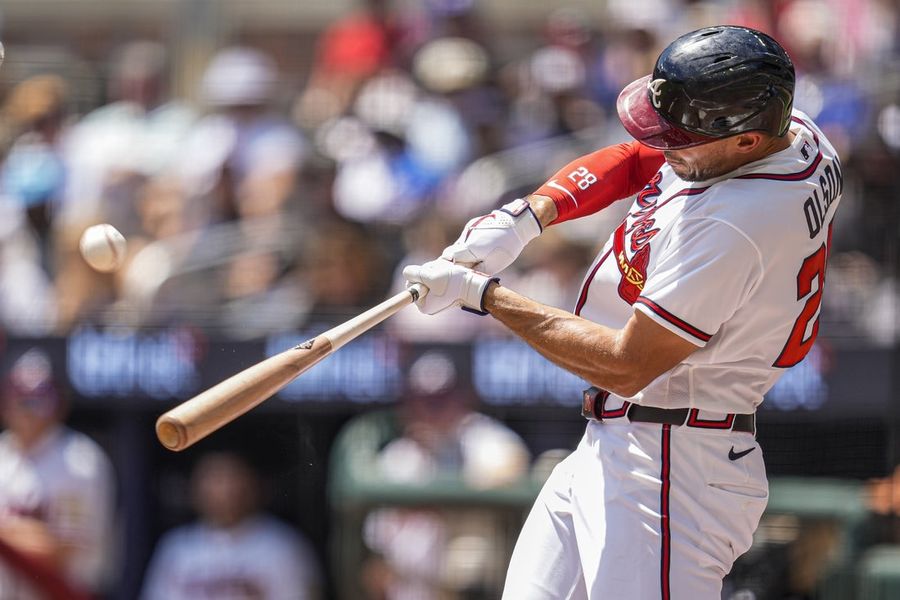
Deadspin | Chris Sale notches 150th win as Braves take rubber match from Phillies  Apr 26, 2026; Cumberland, Georgia, USA; Atlanta Braves first baseman Matt Olson (28) hits a three run home run against the Philadelphia Phillies during the first inning at Truist Park. Mandatory Credit: Dale Zanine-Imagn Images   Chris Sale pitched six scoreless innings to earn the 150th victory of his career as the Atlanta Braves beat the visiting Philadelphia Phillies 6-2 on Sunday in the rubber game of their three-game series.  Sale (5-1) retired the first eight batters he faced and allowed only one hit, a single to Trea Turner, two walks and a hit-by-pitch. He struck out a season-high nine batters and moved past Chuck Finley into 28th place on the career strikeouts list with 2,617.  Sale became the fourth active pitcher with 150 wins, joining Justin Verlander (266), Max Scherzer (222) and Gerrit Cole (153).  Atlanta became the first team to win 20 games, a milestone they didn’t reach until May 12 in their 41st game in 2025. The Phillies, who ended their 10-game losing streak on Saturday, have lost 15 of their last 18.  The Braves are 5-0 in rubber games and have not lost a series this season, improving to 8-0-1. They are 5-1 against Philadelphia; the National League East rivals don’t play again until September.  Philadelphia right-hander Aaron Nola (1-3) allowed some hard contact early but managed to work through 4 2/3 innings. He allowed a season-high six runs on seven hits and three walks, striking out six.   The Braves struck quickly in the first inning. Ronald Acuna Jr. and Drake Baldwin singled and Matt Olson hit a three-run homer, his eighth, deep into the right field seats.  Atlanta teed off on Nola again in the second. Mauricio Dubon walked, stole second and scored on Baldwin’s RBI single to stretch the lead to 6-0.  The Phillies threatened in the third inning, loading the bases with two outs, but Sale came back from a 3-0 count to strike out Bryce Harper and end the threat.  Philadelphia ended the shutout in the eighth inning when Kyle Schwarber parked a two-run homer, his ninth, into the right field stands off left-hander Aaron Bummer.  –Field Level Media   #Deadspin #Chris #Sale #notches #150th #win #Braves #rubber #match #PhilliesApr 26, 2026; Cumberland, Georgia, USA; Atlanta Braves first baseman Matt Olson (28) hits a three run home run against the Philadelphia Phillies during the first inning at Truist Park. Mandatory Credit: Dale Zanine-Imagn Images

Chris Sale pitched six scoreless innings to earn the 150th victory of his career as the Atlanta Braves beat the visiting Philadelphia Phillies 6-2 on Sunday in the rubber game of their three-game series.

Sale (5-1) retired the first eight batters he faced and allowed only one hit, a single to Trea Turner, two walks and a hit-by-pitch. He struck out a season-high nine batters and moved past Chuck Finley into 28th place on the career strikeouts list with 2,617.

Sale became the fourth active pitcher with 150 wins, joining Justin Verlander (266), Max Scherzer (222) and Gerrit Cole (153).

Atlanta became the first team to win 20 games, a milestone they didn’t reach until May 12 in their 41st game in 2025. The Phillies, who ended their 10-game losing streak on Saturday, have lost 15 of their last 18.

The Braves are 5-0 in rubber games and have not lost a series this season, improving to 8-0-1. They are 5-1 against Philadelphia; the National League East rivals don’t play again until September.


Philadelphia right-hander Aaron Nola (1-3) allowed some hard contact early but managed to work through 4 2/3 innings. He allowed a season-high six runs on seven hits and three walks, striking out six.

The Braves struck quickly in the first inning. Ronald Acuna Jr. and Drake Baldwin singled and Matt Olson hit a three-run homer, his eighth, deep into the right field seats.

Atlanta teed off on Nola again in the second. Mauricio Dubon walked, stole second and scored on Baldwin’s RBI single to stretch the lead to 6-0.

The Phillies threatened in the third inning, loading the bases with two outs, but Sale came back from a 3-0 count to strike out Bryce Harper and end the threat.

Philadelphia ended the shutout in the eighth inning when Kyle Schwarber parked a two-run homer, his ninth, into the right field stands off left-hander Aaron Bummer.

–Field Level Media

#Deadspin #Chris #Sale #notches #150th #win #Braves #rubber #match #Phillies

Apr 26, 2026; Cumberland, Georgia, USA; Atlanta Braves first baseman Matt Olson (28) hits a three run home run against the Philadelphia Phillies during the first inning at Truist Park. Mandatory Credit: Dale Zanine-Imagn Images

Chris Sale pitched six scoreless innings to earn the 150th victory of his career as the Atlanta Braves beat the visiting Philadelphia Phillies 6-2 on Sunday in the rubber game of their three-game series.

Sale (5-1) retired the first eight batters he faced and allowed only one hit, a single to Trea Turner, two walks and a hit-by-pitch. He struck out a season-high nine batters and moved past Chuck Finley into 28th place on the career strikeouts list with 2,617.

Sale became the fourth active pitcher with 150 wins, joining Justin Verlander (266), Max Scherzer (222) and Gerrit Cole (153).

Atlanta became the first team to win 20 games, a milestone they didn’t reach until May 12 in their 41st game in 2025. The Phillies, who ended their 10-game losing streak on Saturday, have lost 15 of their last 18.

The Braves are 5-0 in rubber games and have not lost a series this season, improving to 8-0-1. They are 5-1 against Philadelphia; the National League East rivals don’t play again until September.

Philadelphia right-hander Aaron Nola (1-3) allowed some hard contact early but managed to work through 4 2/3 innings. He allowed a season-high six runs on seven hits and three walks, striking out six.

The Braves struck quickly in the first inning. Ronald Acuna Jr. and Drake Baldwin singled and Matt Olson hit a three-run homer, his eighth, deep into the right field seats.

Atlanta teed off on Nola again in the second. Mauricio Dubon walked, stole second and scored on Baldwin’s RBI single to stretch the lead to 6-0.

The Phillies threatened in the third inning, loading the bases with two outs, but Sale came back from a 3-0 count to strike out Bryce Harper and end the threat.

Philadelphia ended the shutout in the eighth inning when Kyle Schwarber parked a two-run homer, his ninth, into the right field stands off left-hander Aaron Bummer.

–Field Level Media

Source link
#Deadspin #Chris #Sale #notches #150th #win #Braves #rubber #match #Phillies

Previous post

NBA playoffs: Durant sidelined again as Houston Rockets extends series, coach Udoka calls return ’a possibility’ <div id="content-body-70913292" itemprop="articleBody"><p>Kevin Durant missed Houston Rockets’ win over the Los Angeles Lakers in Game 4 of a NBA Western Conference first-round playoff series on Sunday night with an ankle injury, but coach Ime Udoka said Durant could return now that the series has been extended.</p><p>Udoka said Durant has a bone bruise on his ankle that is painful, and he has limited his mobility, but didn’t rule out his return this season.</p><p>“Yeah, a possibility, for sure,” Udoka said.</p><p>“I didn’t know how bad it was initially, and then we got that prognosis. But he’s doing what he can to get swelling out and mobility back. And just like the knee, we weren’t sure when he was going to come back, but he snapped back pretty quickly to be available for Game 2. So it is a true game-to-game, day-to-day thing,” he added.</p><p><b>ALSO READ | <a href="https://sportstar.thehindu.com/basketball/nikola-jokic-fined-julius-randle-minnesota-timberwolves-denver-nuggets-fight-amount-nba-playoff-series/article70912681.ece" target="_blank" rel="nofollow">NBA: Nikola Jokic, Julius Randle fined for altercation during Game 4 of Nuggets vs Timberwolves playoff series</a></b></p><p>Game 5 is on Wednesday night in Los Angeles.</p><p>Durant missed Game 3 on Friday night with the ankle injury, when the Rockets blew a six-point lead with less than 30 seconds to go in regulation of an eventual 112-108 overtime loss to fall to 0-3 in the series.</p><p>Sunday’s 115-96 win was the third game of the series that Durant has missed after he sat out the opener with a bruised right knee. He returned for Game 2, scoring 23 points in 41 minutes of the 101-94 loss, during which he injured his ankle late in the game.</p><p>His injury problems this postseason came after the 37-year-old ranked second in the league in the regular season by playing 2,840 minutes.</p><p>Durant, who is in his first season in Houston after an offseason trade from Phoenix, is the fifth-leading scorer in NBA history.</p><p class="publish-time" id="end-of-article">Published on Apr 27, 2026</p></div> #NBA #playoffs #Durant #sidelined #Houston #Rockets #extends #series #coach #Udoka #calls #return #possibility

Next post

IPL 2026: ‘For a first-time captain, Riyan Parag is doing a very good job,’ says RR’s Sandeep Sharma <div id="content-body-70913228" itemprop="articleBody"><p>Being an Indian Premier League (IPL) captain is a tough job, and Riyan Parag has done a terrific job in his first year as Rajasthan Royals skipper to cope with the pressure, fast bowler Sandeep Sharma said on Monday ahead of a clash against Punjab Kings at the Maharaja Yadavindra Singh International Cricket Stadium in New Chandigarh.</p><p>“For a first-time captain, it’s a tough role, and he’s doing a very good job,” Sandeep said.</p><p>The experienced fast bowler also noted that Parag doesn’t have the luxury of leaning on senior pros like Sanju Samson did with Jos Buttler and Ravichandran Ashwin when they were at Rajasthan Royals.</p><p>“Riyan doesn’t have that same level of experience around him, but that can actually help him grow faster. He’ll learn a lot this season and come back as a much-improved captain in the future,” Sandeep said.</p><p>This year’s IPL has seen massive scores, often pushing bowlers out of the game, but Sandeep remains optimistic. “Hitting ability has improved massively over the last four or five years, especially with younger players coming in with a different range. I think the next lot of bowlers will also bring something new, and experienced bowlers will have to keep evolving. Even today, if you execute your plans well – whether it’s yorkers, slower balls or targeting a batter’s weakness – you can succeed,” he added.</p><h4 class="sub_head">Room for improvement</h4><p>According to Punjab’s assistant coach Brad Haddin, the bowler’s role is to find ways to slow the scoring even as modern batters continue to push the limits.</p><p>“From a coach’s point of view, you’re constantly trying to find ways to slow the game down – whether that’s through wickets or forcing batters into areas you want them to hit. Sometimes, you execute a perfect ball, and it still ends up in the stands. That’s just the power of the modern-day batter,” Haddin said.</p><p>At the halfway mark, Punjab is the only unbeaten team, with six wins and one no result. Asked how the side is avoiding complacency, Haddin said the focus remains on improvement.</p><p>“We’re lucky with this group. You watch them train: they all turn up, they know their roles, and they’re always trying to get better. That’s what we’ve enjoyed most as coaches – their appetite to improve,” he said.</p><p>“The job’s not done. We’re halfway through the tournament, and it’s about playing your best cricket at the back end. There’s still a lot of room for improvement with bat, ball, and in the field. That’s what we’re most pleased with – yes, we’re playing good cricket, but there are still areas we can get better in,” Haddin added.</p><p>The Australian also confirmed that fast bowler Lockie Ferguson, who joined the Punjab Kings squad late, will be available for selection against the Royals.</p><p class="publish-time" id="end-of-article">Published on Apr 27, 2026</p></div> #IPL #firsttime #captain #Riyan #Parag #good #job #RRs #Sandeep #Sharma

KL Rahul’s scintillating unbeaten 152 against Punjab Kings in the ongoing Indian Premier League (IPL) season has once again brought to the fore the paradox posed by the 34-year-old in 20-over cricket.

Often criticised for his slow strike, Rahul has also shown glimpses of his aggressive avatar with knocks such as the 67-ball 152 on Saturday, which is the highest individual score by an Indian in the league’s history.

Former India cricketer Sanjay Manjrekar believes that Rahul possesses the skills to excel in the shortest format at any position, provided he doesn’t put too much of a premium on his wicket.

“KL Rahul has the ability to make an impact at any position. And I believe that if he thinks too much, the opening position is slightly risky because then he starts thinking that in these 20 overs, I’m a crucial player in the side,” Manrekar said on Sportstar’s Insight Edge podcast.

“And that’s when he has those 20 balls, you know, (slow) start. And that’s a dangerous one. I’m saying that today, and come the playoffs, if he does that and gets out in trying to accelerate, that’s a lot of damage done.

“Down the order, he doesn’t have to think. He just has to go and start hammering, as he does for India in 50-over cricket. So, I like him down the order, at the top of the order, provided he doesn’t think that his wicket matters.”

After batting in the middle order for the bulk of the last season for Delhi Capitals, Rahul has played as an opener in all games this year. Though he started this season with scores of 0 and 1, he bounced back with two fifties before smashing a scorching hundred.

Manjrekar believes Rahul has also been at the receiving end of some role-clarity confusion at Delhi Capitals.

“… With KL Rahul, there’s been some sort of role-clarity confusion for him as well. So, he originally was at number four for DC. Now he’s opening,” Manjrekar said, while acknowledging that DC’s lower-order firepower has allowed Rahul to play with more freedom.

Though Rahul has struck at an impressive 187.89 this season, Manjrekar highlighted the batter’s slow starts.

“So, he plays these kinds of innings, but the very next innings could be 20 of 20 balls. Starts off very slow for some reason… Even when he got a 90 recently, his first 20 balls, he got 20, 25 runs. The problem with that approach is that when you decide to change gears, OK, you’ve got 24 off, say, 21 balls or 32 of 24 balls. OK, now the time has come for me to accelerate. You’re taking a risk always. And if you get out at that time, trying to take a risk, and that has happened a lot with KL Rahul, more when he was batting for Punjab Kings. Then you’ve done your team harm because you can’t recover 20 balls or 30 balls; 30 balls is 25 per cent of the entire innings. And if you’ve gone at a strike rate of 110, you’re done, you’re finished. You won’t get as many runs on the board. So, that’s a very dangerous ploy.”

The likes of Rahul have often been termed ‘anchors’, a role that Manjrekar believes has no place in modern-day T20 cricket.

“I believe, in T20 cricket, no batter has the right to anchor the innings. When you have eight pure batters of a certain quality and just 20 overs, you just don’t have the right, especially when you’re batting first. You see a lot of teams get 190, 200 and lose games because there’s been somebody at the top who’s got 20 of 20 balls and went on to maybe accelerate later. But those 20, if they were 35, 40, you’ve got those 10, 15 extra runs. And with the impact sub, even more reason for nobody to start off getting 20 or 20, unless it is chasing 140, 150.”

Drawing a parallel between Rahul and Virat Kohli, Manjrekar said the latter had evolved his game and had started scoring more briskly by shunning the idea that he was indispensable to the Royal Challengers Bengaluru (RCB) lineup.

“Someone like KL Rahul and Virat Kohli’s style is similar in the way they sort of master and structure their innings. And I’ll say this, very methodical. And Kohli often talks about how he calculates when to attack, when to take that single… It’s only that he’s decided that he’s going to bat quicker. And why was it decided? Because you could see the pressure building and people talking about him batting a little too slow. This 150 strike rate was 125, 133 four years back.

“And it was only because Virat Kohli would hit a boundary and then pick up a one or two, because he wanted to extend his innings and play longer, because he felt that he had to be the man batting most of the innings and didn’t quite trust the batters down the order. RCB changed when Virat Kohli at the top started batting a little quicker and didn’t make himself sort of almost indispensable. And that’s when the others also blossomed under him.”

Published on Apr 27, 2026

#Sanjay #Manjrekar #Rahul #bat #position #providedhe #doesnt #wicket #matters">Sanjay Manjrekar: KL Rahul can bat at any position, provided he doesn’t think his wicket matters   KL Rahul’s scintillating unbeaten 152 against Punjab Kings in the ongoing Indian Premier League (IPL) season has once again brought to the fore the paradox posed by the 34-year-old in 20-over cricket.Often criticised for his slow strike, Rahul has also shown glimpses of his aggressive avatar with knocks such as the 67-ball 152 on Saturday, which is the highest individual score by an Indian in the league’s history.Former India cricketer Sanjay Manjrekar believes that Rahul possesses the skills to excel in the shortest format at any position, provided he doesn’t put too much of a premium on his wicket.“KL Rahul has the ability to make an impact at any position. And I believe that if he thinks too much, the opening position is slightly risky because then he starts thinking that in these 20 overs, I’m a crucial player in the side,” Manrekar said on        Sportstar’s Insight Edge podcast.“And that’s when he has those 20 balls, you know, (slow) start. And that’s a dangerous one. I’m saying that today, and come the playoffs, if he does that and gets out in trying to accelerate, that’s a lot of damage done.“Down the order, he doesn’t have to think. He just has to go and start hammering, as he does for India in 50-over cricket. So, I like him down the order, at the top of the order, provided he doesn’t think that his wicket matters.”After batting in the middle order for the bulk of the last season for Delhi Capitals, Rahul has played as an opener in all games this year. Though he started this season with scores of 0 and 1, he bounced back with two fifties before smashing a scorching hundred.Manjrekar believes Rahul has also been at the receiving end of some role-clarity confusion at Delhi Capitals.“… With KL Rahul, there’s been some sort of role-clarity confusion for him as well. So, he originally was at number four for DC. Now he’s opening,” Manjrekar said, while acknowledging that DC’s lower-order firepower has allowed Rahul to play with more freedom.Though Rahul has struck at an impressive 187.89 this season, Manjrekar highlighted the batter’s slow starts.“So, he plays these kinds of innings, but the very next innings could be 20 of 20 balls. Starts off very slow for some reason… Even when he got a 90 recently, his first 20 balls, he got 20, 25 runs. The problem with that approach is that when you decide to change gears, OK, you’ve got 24 off, say, 21 balls or 32 of 24 balls. OK, now the time has come for me to accelerate. You’re taking a risk always. And if you get out at that time, trying to take a risk, and that has happened a lot with KL Rahul, more when he was batting for Punjab Kings. Then you’ve done your team harm because you can’t recover 20 balls or 30 balls; 30 balls is 25 per cent of the entire innings. And if you’ve gone at a strike rate of 110, you’re done, you’re finished. You won’t get as many runs on the board. So, that’s a very dangerous ploy.”The likes of Rahul have often been termed ‘anchors’, a role that Manjrekar believes has no place in modern-day T20 cricket.“I believe, in T20 cricket, no batter has the right to anchor the innings. When you have eight pure batters of a certain quality and just 20 overs, you just don’t have the right, especially when you’re batting first. You see a lot of teams get 190, 200 and lose games because there’s been somebody at the top who’s got 20 of 20 balls and went on to maybe accelerate later. But those 20, if they were 35, 40, you’ve got those 10, 15 extra runs. And with the impact sub, even more reason for nobody to start off getting 20 or 20, unless it is chasing 140, 150.”Drawing a parallel between Rahul and Virat Kohli, Manjrekar said the latter had evolved his game and had started scoring more briskly by shunning the idea that he was indispensable to the Royal Challengers Bengaluru (RCB) lineup.“Someone like KL Rahul and Virat Kohli’s style is similar in the way they sort of master and structure their innings. And I’ll say this, very methodical. And Kohli often talks about how he calculates when to attack, when to take that single… It’s only that he’s decided that he’s going to bat quicker. And why was it decided? Because you could see the pressure building and people talking about him batting a little too slow. This 150 strike rate was 125, 133 four years back.“And it was only because Virat Kohli would hit a boundary and then pick up a one or two, because he wanted to extend his innings and play longer, because he felt that he had to be the man batting most of the innings and didn’t quite trust the batters down the order. RCB changed when Virat Kohli at the top started batting a little quicker and didn’t make himself sort of almost indispensable. And that’s when the others also blossomed under him.”Published on Apr 27, 2026  #Sanjay #Manjrekar #Rahul #bat #position #providedhe #doesnt #wicket #matters

I’ve seen the future of the NBA. It’s part Caitlin Clark, part Waymo and, of course, a heaping helping of IT.

There have been 30 NBA playoff games to date. And there have been – according to no better source than players on the losing team – 30 poorly officiated boat races.

Coincidence? Hardly.

For years, perimeter play in the NBA postseason has resembled that of the NFL, complete with the chucking, hand-fighting and illegal picking.

If you’re wondering why Stephen Curry shoots more 30-footers now than ever before, it’s because apparently bear-hugging is legal inside 25 feet. So what’s a little guy to do?

Clark has received this kind of hands-on treatment since Day 1 of her miserable WNBA life. She’s bumped endlessly attempting to dribble around screens and held constantly while simply trying to use picks to free herself without the ball.

To its credit, the WNBA has created (they don’t call it this, but let’s be honest) the “Clark Compromise” this season. If you watched the preseason games over the weekend, you undoubtedly heard the broadcasters complaining about it.

I applaud Cathy Engelbert, and that’s hard to do. The league has instructed its refs to clean up the perimeter mess – from the clutching and bumping of defenders preventing offensive players from legally utilizing screens, to the hip-checking and general bullying screen-setters routinely employ on undersized defenders.

The constant whistles made Saturday’s games hard to watch, as the broadcasters noted. But that’s missing the point.

The goal is to use otherwise meaningless exhibitions to make the fast-approaching regular-season openers more enjoyable to watch. You know, by actually calling fouls now so that players are hard-taught to play by the book by the time the finicky viewers start tuning in.

Imagine that, NBA.

The premier men’s league has half-heartedly attempted to take this type of approach in the past couple of seasons, and clearly it’s not working. Ask Curry. Ask Devin Booker. Ask anybody trying to guard Shai Gilgeous-Alexander, James Harden or Jaylen Brown.

Let ‘em play has become the unofficial motto of the NBA postseason. And what has it given us?

In general: Less entertainment, poorer shooting opportunities, frustration, more extra-curriculars among players and an inordinate number of key injuries.

Specifically: There have been 30 playoff games so far. In those games, three of the 60 teams have been held under 90 points. That’s 5%. In the regular season, it was 1.7%.

Same with scores under 100. There have been 16 of them so far in the postseason (26.7%). In the regular season: 10.6%.

Sunday was the worst: More teams failed to reach triple figures than did. Number of watchable games: Zero.

That’s letting ‘em play. But play exactly what, I’m not sure.

In fact, with all the fouling that’s going uncalled, they’re not playing at all. They’re moshing.

It’s time to get with the times and take corrective steps. My solution is extreme – gee, imagine that – but when you’ve got people switching off a Thunder-Suns playoff game to watch Day 3 of the NFL draft, you’ve got problems.

The NBA needs to take a Waymo approach. You know, an implanted chip that tells the brain: All contact is bad. Avoid at all costs.

No, I’m not suggesting tattooing a sensor into every player’s forehead. Rather, a simple memory scan of each player’s arms – the major culprits in most of these so-called victimless crimes – so that when someone’s shoulder or elbow or forearm or hand simply touches an opponent, the referee gets buzzed and the actionless action is stopped.

Why? Because touching an opponent should be illegal. Think baseball. Not football.

As Waymo has taught us: All contact is bad.

And if cars can learn it, why can’t humans?

Then it’s IT’s turn.

Within one second, IT has the ability to study every available angle of a “collision” and make the determination: Which player caused this to happen?

Was it Brown pushing off Paul George in order to create space to get off a clean shot? Or was it George sticking a forearm into Brown’s back, stalling his initial move toward the hoop?

In today’s game, it doesn’t matter. More possessions than not resemble DK Metcalf and Carlton Davis wrestling inside the 5-yard, anything-goes NFL passing zone.

Only the NBA has no such thing.

Really. One second. That’s all it would take IT to point its virtual punitive finger.

And then guess what? Brown wouldn’t do it again. Or Harden. Or SGA.

That’s how you clean up and speed up the NBA game. Or at least start to do so.

Imagine an NBA rule in which you’re not allowed to touch your opponent. Yes, it’s hard to envision. But think about it for a minute.

Fifty years ago, when Lester Hayes was literally using stickum to latch onto wide receivers, who would have thought a hands-off rule would revolutionize football?

And that was back when the only IT was Isiah Thomas.

The NBA had hand-checking back then. Remember that thrill-killer?

That was banished and the game became great. But the problem has resurfaced, more so in the postseason than in the regular year, when it was a lesser issue because star players weren’t complaining. They were resting.

It’s time to get with the times, Commissioner Silver. Take the leap.

Thank you Caitlin Clark for saving the NBA.

#Technology #Fix #NBA #Officiating #Bold #Solution #Playoff #Issues #Deadspin.com">Can Technology Fix NBA Officiating? A Bold Solution to Playoff Issues | Deadspin.com   I’ve seen the future of the NBA. It’s part Caitlin Clark, part Waymo and, of course, a heaping helping of IT.There have been 30 NBA playoff games to date. And there have been – according to no better source than players on the losing team – 30 poorly officiated boat races.Coincidence? Hardly.For years, perimeter play in the NBA postseason has resembled that of the NFL, complete with the chucking, hand-fighting and illegal picking.If you’re wondering why Stephen Curry shoots more 30-footers now than ever before, it’s because apparently bear-hugging is legal inside 25 feet. So what’s a little guy to do?Clark has received this kind of hands-on treatment since Day 1 of her miserable WNBA life. She’s bumped endlessly attempting to dribble around screens and held constantly while simply trying to use picks to free herself without the ball.To its credit, the WNBA has created (they don’t call it this, but let’s be honest) the “Clark Compromise” this season. If you watched the preseason games over the weekend, you undoubtedly heard the broadcasters complaining about it.I applaud Cathy Engelbert, and that’s hard to do. The league has instructed its refs to clean up the perimeter mess – from the clutching and bumping of defenders preventing offensive players from legally utilizing screens, to the hip-checking and general bullying screen-setters routinely employ on undersized defenders.The constant whistles made Saturday’s games hard to watch, as the broadcasters noted. But that’s missing the point.The goal is to use otherwise meaningless exhibitions to make the fast-approaching regular-season openers more enjoyable to watch. You know, by actually calling fouls now so that players are hard-taught to play by the book by the time the finicky viewers start tuning in.Imagine that, NBA.The premier men’s league has half-heartedly attempted to take this type of approach in the past couple of seasons, and clearly it’s not working. Ask Curry. Ask Devin Booker. Ask anybody trying to guard Shai Gilgeous-Alexander, James Harden or Jaylen Brown.Let ‘em play has become the unofficial motto of the NBA postseason. And what has it given us?In general: Less entertainment, poorer shooting opportunities, frustration, more extra-curriculars among players and an inordinate number of key injuries.Specifically: There have been 30 playoff games so far. In those games, three of the 60 teams have been held under 90 points. That’s 5%. In the regular season, it was 1.7%.Same with scores under 100. There have been 16 of them so far in the postseason (26.7%). In the regular season: 10.6%.Sunday was the worst: More teams failed to reach triple figures than did. Number of watchable games: Zero.That’s letting ‘em play. But play exactly what, I’m not sure.In fact, with all the fouling that’s going uncalled, they’re not playing at all. They’re moshing.It’s time to get with the times and take corrective steps. My solution is extreme – gee, imagine that – but when you’ve got people switching off a Thunder-Suns playoff game to watch Day 3 of the NFL draft, you’ve got problems.The NBA needs to take a Waymo approach. You know, an implanted chip that tells the brain: All contact is bad. Avoid at all costs.No, I’m not suggesting tattooing a sensor into every player’s forehead. Rather, a simple memory scan of each player’s arms – the major culprits in most of these so-called victimless crimes – so that when someone’s shoulder or elbow or forearm or hand simply touches an opponent, the referee gets buzzed and the actionless action is stopped.Why? Because touching an opponent should be illegal. Think baseball. Not football.As Waymo has taught us: All contact is bad.And if cars can learn it, why can’t humans?Then it’s IT’s turn.Within one second, IT has the ability to study every available angle of a “collision” and make the determination: Which player caused this to happen?Was it Brown pushing off Paul George in order to create space to get off a clean shot? Or was it George sticking a forearm into Brown’s back, stalling his initial move toward the hoop?In today’s game, it doesn’t matter. More possessions than not resemble DK Metcalf and Carlton Davis wrestling inside the 5-yard, anything-goes NFL passing zone.Only the NBA has no such thing.Really. One second. That’s all it would take IT to point its virtual punitive finger.And then guess what? Brown wouldn’t do it again. Or Harden. Or SGA.That’s how you clean up and speed up the NBA game. Or at least start to do so.Imagine an NBA rule in which you’re not allowed to touch your opponent. Yes, it’s hard to envision. But think about it for a minute.Fifty years ago, when Lester Hayes was literally using stickum to latch onto wide receivers, who would have thought a hands-off rule would revolutionize football?And that was back when the only IT was Isiah Thomas.The NBA had hand-checking back then. Remember that thrill-killer?That was banished and the game became great. But the problem has resurfaced, more so in the postseason than in the regular year, when it was a lesser issue because star players weren’t complaining. They were resting.It’s time to get with the times, Commissioner Silver. Take the leap.Thank you Caitlin Clark for saving the NBA.   #Technology #Fix #NBA #Officiating #Bold #Solution #Playoff #Issues #Deadspin.com

her miserable WNBA life. She’s bumped endlessly attempting to dribble around screens and held constantly while simply trying to use picks to free herself without the ball.

To its credit, the WNBA has created (they don’t call it this, but let’s be honest) the “Clark Compromise” this season. If you watched the preseason games over the weekend, you undoubtedly heard the broadcasters complaining about it.

I applaud Cathy Engelbert, and that’s hard to do. The league has instructed its refs to clean up the perimeter mess – from the clutching and bumping of defenders preventing offensive players from legally utilizing screens, to the hip-checking and general bullying screen-setters routinely employ on undersized defenders.

The constant whistles made Saturday’s games hard to watch, as the broadcasters noted. But that’s missing the point.

The goal is to use otherwise meaningless exhibitions to make the fast-approaching regular-season openers more enjoyable to watch. You know, by actually calling fouls now so that players are hard-taught to play by the book by the time the finicky viewers start tuning in.

Imagine that, NBA.

The premier men’s league has half-heartedly attempted to take this type of approach in the past couple of seasons, and clearly it’s not working. Ask Curry. Ask Devin Booker. Ask anybody trying to guard Shai Gilgeous-Alexander, James Harden or Jaylen Brown.

Let ‘em play has become the unofficial motto of the NBA postseason. And what has it given us?

In general: Less entertainment, poorer shooting opportunities, frustration, more extra-curriculars among players and an inordinate number of key injuries.

Specifically: There have been 30 playoff games so far. In those games, three of the 60 teams have been held under 90 points. That’s 5%. In the regular season, it was 1.7%.

Same with scores under 100. There have been 16 of them so far in the postseason (26.7%). In the regular season: 10.6%.

Sunday was the worst: More teams failed to reach triple figures than did. Number of watchable games: Zero.

That’s letting ‘em play. But play exactly what, I’m not sure.

In fact, with all the fouling that’s going uncalled, they’re not playing at all. They’re moshing.

It’s time to get with the times and take corrective steps. My solution is extreme – gee, imagine that – but when you’ve got people switching off a Thunder-Suns playoff game to watch Day 3 of the NFL draft, you’ve got problems.

The NBA needs to take a Waymo approach. You know, an implanted chip that tells the brain: All contact is bad. Avoid at all costs.

No, I’m not suggesting tattooing a sensor into every player’s forehead. Rather, a simple memory scan of each player’s arms – the major culprits in most of these so-called victimless crimes – so that when someone’s shoulder or elbow or forearm or hand simply touches an opponent, the referee gets buzzed and the actionless action is stopped.

Why? Because touching an opponent should be illegal. Think baseball. Not football.

As Waymo has taught us: All contact is bad.

And if cars can learn it, why can’t humans?

Then it’s IT’s turn.

Within one second, IT has the ability to study every available angle of a “collision” and make the determination: Which player caused this to happen?

Was it Brown pushing off Paul George in order to create space to get off a clean shot? Or was it George sticking a forearm into Brown’s back, stalling his initial move toward the hoop?

In today’s game, it doesn’t matter. More possessions than not resemble DK Metcalf and Carlton Davis wrestling inside the 5-yard, anything-goes NFL passing zone.

Only the NBA has no such thing.

Really. One second. That’s all it would take IT to point its virtual punitive finger.

And then guess what? Brown wouldn’t do it again. Or Harden. Or SGA.

That’s how you clean up and speed up the NBA game. Or at least start to do so.

Imagine an NBA rule in which you’re not allowed to touch your opponent. Yes, it’s hard to envision. But think about it for a minute.

Fifty years ago, when Lester Hayes was literally using stickum to latch onto wide receivers, who would have thought a hands-off rule would revolutionize football?

And that was back when the only IT was Isiah Thomas.

The NBA had hand-checking back then. Remember that thrill-killer?

That was banished and the game became great. But the problem has resurfaced, more so in the postseason than in the regular year, when it was a lesser issue because star players weren’t complaining. They were resting.

It’s time to get with the times, Commissioner Silver. Take the leap.

Thank you Caitlin Clark for saving the NBA.

#Technology #Fix #NBA #Officiating #Bold #Solution #Playoff #Issues #Deadspin.com">Can Technology Fix NBA Officiating? A Bold Solution to Playoff Issues | Deadspin.com

I’ve seen the future of the NBA. It’s part Caitlin Clark, part Waymo and, of course, a heaping helping of IT.

There have been 30 NBA playoff games to date. And there have been – according to no better source than players on the losing team – 30 poorly officiated boat races.

Coincidence? Hardly.

For years, perimeter play in the NBA postseason has resembled that of the NFL, complete with the chucking, hand-fighting and illegal picking.

If you’re wondering why Stephen Curry shoots more 30-footers now than ever before, it’s because apparently bear-hugging is legal inside 25 feet. So what’s a little guy to do?

Clark has received this kind of hands-on treatment since Day 1 of her miserable WNBA life. She’s bumped endlessly attempting to dribble around screens and held constantly while simply trying to use picks to free herself without the ball.

To its credit, the WNBA has created (they don’t call it this, but let’s be honest) the “Clark Compromise” this season. If you watched the preseason games over the weekend, you undoubtedly heard the broadcasters complaining about it.

I applaud Cathy Engelbert, and that’s hard to do. The league has instructed its refs to clean up the perimeter mess – from the clutching and bumping of defenders preventing offensive players from legally utilizing screens, to the hip-checking and general bullying screen-setters routinely employ on undersized defenders.

The constant whistles made Saturday’s games hard to watch, as the broadcasters noted. But that’s missing the point.

The goal is to use otherwise meaningless exhibitions to make the fast-approaching regular-season openers more enjoyable to watch. You know, by actually calling fouls now so that players are hard-taught to play by the book by the time the finicky viewers start tuning in.

Imagine that, NBA.

The premier men’s league has half-heartedly attempted to take this type of approach in the past couple of seasons, and clearly it’s not working. Ask Curry. Ask Devin Booker. Ask anybody trying to guard Shai Gilgeous-Alexander, James Harden or Jaylen Brown.

Let ‘em play has become the unofficial motto of the NBA postseason. And what has it given us?

In general: Less entertainment, poorer shooting opportunities, frustration, more extra-curriculars among players and an inordinate number of key injuries.

Specifically: There have been 30 playoff games so far. In those games, three of the 60 teams have been held under 90 points. That’s 5%. In the regular season, it was 1.7%.

Same with scores under 100. There have been 16 of them so far in the postseason (26.7%). In the regular season: 10.6%.

Sunday was the worst: More teams failed to reach triple figures than did. Number of watchable games: Zero.

That’s letting ‘em play. But play exactly what, I’m not sure.

In fact, with all the fouling that’s going uncalled, they’re not playing at all. They’re moshing.

It’s time to get with the times and take corrective steps. My solution is extreme – gee, imagine that – but when you’ve got people switching off a Thunder-Suns playoff game to watch Day 3 of the NFL draft, you’ve got problems.

The NBA needs to take a Waymo approach. You know, an implanted chip that tells the brain: All contact is bad. Avoid at all costs.

No, I’m not suggesting tattooing a sensor into every player’s forehead. Rather, a simple memory scan of each player’s arms – the major culprits in most of these so-called victimless crimes – so that when someone’s shoulder or elbow or forearm or hand simply touches an opponent, the referee gets buzzed and the actionless action is stopped.

Why? Because touching an opponent should be illegal. Think baseball. Not football.

As Waymo has taught us: All contact is bad.

And if cars can learn it, why can’t humans?

Then it’s IT’s turn.

Within one second, IT has the ability to study every available angle of a “collision” and make the determination: Which player caused this to happen?

Was it Brown pushing off Paul George in order to create space to get off a clean shot? Or was it George sticking a forearm into Brown’s back, stalling his initial move toward the hoop?

In today’s game, it doesn’t matter. More possessions than not resemble DK Metcalf and Carlton Davis wrestling inside the 5-yard, anything-goes NFL passing zone.

Only the NBA has no such thing.

Really. One second. That’s all it would take IT to point its virtual punitive finger.

And then guess what? Brown wouldn’t do it again. Or Harden. Or SGA.

That’s how you clean up and speed up the NBA game. Or at least start to do so.

Imagine an NBA rule in which you’re not allowed to touch your opponent. Yes, it’s hard to envision. But think about it for a minute.

Fifty years ago, when Lester Hayes was literally using stickum to latch onto wide receivers, who would have thought a hands-off rule would revolutionize football?

And that was back when the only IT was Isiah Thomas.

The NBA had hand-checking back then. Remember that thrill-killer?

That was banished and the game became great. But the problem has resurfaced, more so in the postseason than in the regular year, when it was a lesser issue because star players weren’t complaining. They were resting.

It’s time to get with the times, Commissioner Silver. Take the leap.

Thank you Caitlin Clark for saving the NBA.

#Technology #Fix #NBA #Officiating #Bold #Solution #Playoff #Issues #Deadspin.com

Post Comment