×
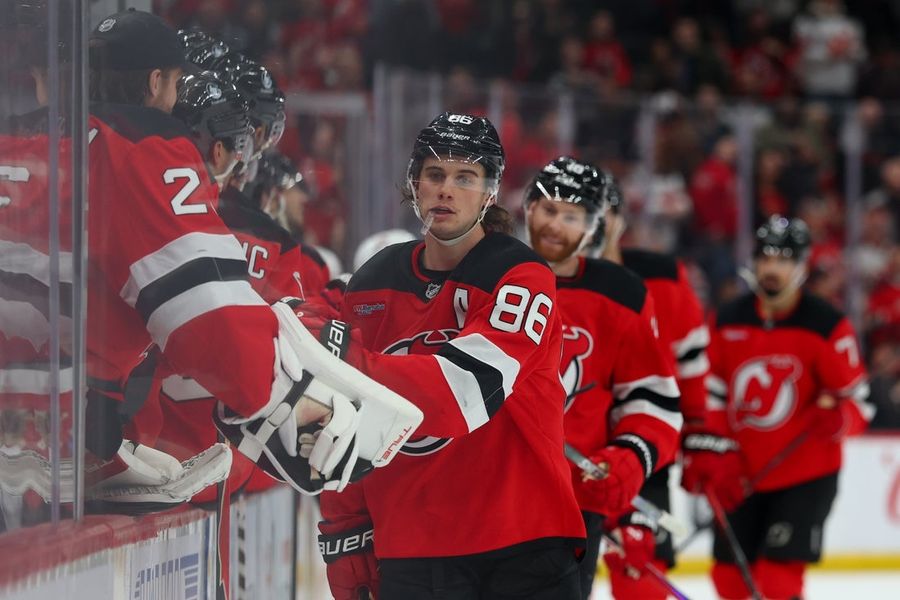
Deadspin | Flyers, Devils both focused on reaching playoffs in crowded Metro  Apr 2, 2026; Newark, New Jersey, USA; New Jersey Devils center Jack Hughes (86) celebrates his goal against the Washington Capitals during the third period at Prudential Center. Mandatory Credit: Ed Mulholland-Imagn Images   The Philadelphia Flyers have picked the right time to get hot. With five games remaining, they sit in a playoff spot and start a three-game road trip Tuesday against the rival New Jersey Devils in Newark, N.J.  The Flyers (39-26-12, 90 points) find themselves in third place in the Metropolitan Division after Sunday’s 2-1 overtime win against the visiting Boston Bruins. Coach Rick Tocchet’s team has won two straight and eight out of 11.  Since play resumed after the Olympic break, the Flyers are 14-6-1, and Tocchet said his team cannot become transfixed on how its fortunes have changed.  “When you’re chasing somebody, it’s still hard, but when you’re getting hunted, it’s harder,” he said after Sunday’s win. “We’re going to have to learn that. We can only worry about tomorrow’s practice … and then we worry about the Devils. That’s the only way you can do it. We can’t worry about it.”  Sunday was a breakout game for Porter Martone. The sixth overall pick in last year’s draft joined the club last Tuesday. He assisted on the Flyers’ first goal by Christian Dvorak, then scored the overtime winner, which also happened to be his first NHL goal.  Tocchet said that Martone has impressed him in his first week as a pro, noting how he’s talked to his veteran teammates about positioning on power plays.  “I like that. A young kid like that doing that?” Tocchet added. “You can just tell he’s been around. He’s just a hockey player. Love the kid.”  New Jersey (40-34-3, 83 points) is one of the teams chasing the Flyers in the playoff race, but the Devils are seventh in the Metropolitan and would need a lot to fall their way over the final two weeks to sneak in.   Coach Sheldon Keefe’s squad has alternated wins and losses over its last six games (3-2-1). On Sunday, the Devils scored a 3-0 win over the Montreal Canadiens, another team trying to crash the playoffs in the Eastern Conference.  Keefe said players told one another after the win that they are not out of the playoff race.  “That’s what you like to see,” he said. “It’s shown up in different ways in the last few weeks, with how we played overall. The vibes and the energy, the team’s been really good and healthy. … But (against Montreal) it goes to another level in all regards.”  Jack Hughes set up two of New Jersey’s goals in the win at Montreal, continuing a hot streak he’s been on since play resumed in late February. The center — the top overall draft pick in 2019 — has 36 points (13 goals, 23 assists) in the 20 games since the Olympic break. He’s been held without a point in just four games in that span.  Despite missing 21 games this season, Hughes, 24, leads the team in points with 72. He’s second behind Nico Hischier (26) with 25 goals and one behind Jesper Bratt’s team-best 48 assists.  On Monday, Hughes earned the NHL’s Second Star of the Week honor, after scoring three times and posting six assists in four games.  –Field Level Media   #Deadspin #Flyers #Devils #focused #reaching #playoffs #crowded #Metro

Deadspin | Flyers, Devils both focused on reaching playoffs in crowded Metro
Deadspin | Flyers, Devils both focused on reaching playoffs in crowded Metro  Apr 2, 2026; Newark, New Jersey, USA; New Jersey Devils center Jack Hughes (86) celebrates his goal against the Washington Capitals during the third period at Prudential Center. Mandatory Credit: Ed Mulholland-Imagn Images   The Philadelphia Flyers have picked the right time to get hot. With five games remaining, they sit in a playoff spot and start a three-game road trip Tuesday against the rival New Jersey Devils in Newark, N.J.  The Flyers (39-26-12, 90 points) find themselves in third place in the Metropolitan Division after Sunday’s 2-1 overtime win against the visiting Boston Bruins. Coach Rick Tocchet’s team has won two straight and eight out of 11.  Since play resumed after the Olympic break, the Flyers are 14-6-1, and Tocchet said his team cannot become transfixed on how its fortunes have changed.  “When you’re chasing somebody, it’s still hard, but when you’re getting hunted, it’s harder,” he said after Sunday’s win. “We’re going to have to learn that. We can only worry about tomorrow’s practice … and then we worry about the Devils. That’s the only way you can do it. We can’t worry about it.”  Sunday was a breakout game for Porter Martone. The sixth overall pick in last year’s draft joined the club last Tuesday. He assisted on the Flyers’ first goal by Christian Dvorak, then scored the overtime winner, which also happened to be his first NHL goal.  Tocchet said that Martone has impressed him in his first week as a pro, noting how he’s talked to his veteran teammates about positioning on power plays.  “I like that. A young kid like that doing that?” Tocchet added. “You can just tell he’s been around. He’s just a hockey player. Love the kid.”  New Jersey (40-34-3, 83 points) is one of the teams chasing the Flyers in the playoff race, but the Devils are seventh in the Metropolitan and would need a lot to fall their way over the final two weeks to sneak in.   Coach Sheldon Keefe’s squad has alternated wins and losses over its last six games (3-2-1). On Sunday, the Devils scored a 3-0 win over the Montreal Canadiens, another team trying to crash the playoffs in the Eastern Conference.  Keefe said players told one another after the win that they are not out of the playoff race.  “That’s what you like to see,” he said. “It’s shown up in different ways in the last few weeks, with how we played overall. The vibes and the energy, the team’s been really good and healthy. … But (against Montreal) it goes to another level in all regards.”  Jack Hughes set up two of New Jersey’s goals in the win at Montreal, continuing a hot streak he’s been on since play resumed in late February. The center — the top overall draft pick in 2019 — has 36 points (13 goals, 23 assists) in the 20 games since the Olympic break. He’s been held without a point in just four games in that span.  Despite missing 21 games this season, Hughes, 24, leads the team in points with 72. He’s second behind Nico Hischier (26) with 25 goals and one behind Jesper Bratt’s team-best 48 assists.  On Monday, Hughes earned the NHL’s Second Star of the Week honor, after scoring three times and posting six assists in four games.  –Field Level Media   #Deadspin #Flyers #Devils #focused #reaching #playoffs #crowded #MetroApr 2, 2026; Newark, New Jersey, USA; New Jersey Devils center Jack Hughes (86) celebrates his goal against the Washington Capitals during the third period at Prudential Center. Mandatory Credit: Ed Mulholland-Imagn Images

The Philadelphia Flyers have picked the right time to get hot. With five games remaining, they sit in a playoff spot and start a three-game road trip Tuesday against the rival New Jersey Devils in Newark, N.J.

The Flyers (39-26-12, 90 points) find themselves in third place in the Metropolitan Division after Sunday’s 2-1 overtime win against the visiting Boston Bruins. Coach Rick Tocchet’s team has won two straight and eight out of 11.

Since play resumed after the Olympic break, the Flyers are 14-6-1, and Tocchet said his team cannot become transfixed on how its fortunes have changed.

“When you’re chasing somebody, it’s still hard, but when you’re getting hunted, it’s harder,” he said after Sunday’s win. “We’re going to have to learn that. We can only worry about tomorrow’s practice … and then we worry about the Devils. That’s the only way you can do it. We can’t worry about it.”

Sunday was a breakout game for Porter Martone. The sixth overall pick in last year’s draft joined the club last Tuesday. He assisted on the Flyers’ first goal by Christian Dvorak, then scored the overtime winner, which also happened to be his first NHL goal.

Tocchet said that Martone has impressed him in his first week as a pro, noting how he’s talked to his veteran teammates about positioning on power plays.

“I like that. A young kid like that doing that?” Tocchet added. “You can just tell he’s been around. He’s just a hockey player. Love the kid.”


New Jersey (40-34-3, 83 points) is one of the teams chasing the Flyers in the playoff race, but the Devils are seventh in the Metropolitan and would need a lot to fall their way over the final two weeks to sneak in.

Coach Sheldon Keefe’s squad has alternated wins and losses over its last six games (3-2-1). On Sunday, the Devils scored a 3-0 win over the Montreal Canadiens, another team trying to crash the playoffs in the Eastern Conference.

Keefe said players told one another after the win that they are not out of the playoff race.

“That’s what you like to see,” he said. “It’s shown up in different ways in the last few weeks, with how we played overall. The vibes and the energy, the team’s been really good and healthy. … But (against Montreal) it goes to another level in all regards.”

Jack Hughes set up two of New Jersey’s goals in the win at Montreal, continuing a hot streak he’s been on since play resumed in late February. The center — the top overall draft pick in 2019 — has 36 points (13 goals, 23 assists) in the 20 games since the Olympic break. He’s been held without a point in just four games in that span.

Despite missing 21 games this season, Hughes, 24, leads the team in points with 72. He’s second behind Nico Hischier (26) with 25 goals and one behind Jesper Bratt’s team-best 48 assists.

On Monday, Hughes earned the NHL’s Second Star of the Week honor, after scoring three times and posting six assists in four games.

–Field Level Media

#Deadspin #Flyers #Devils #focused #reaching #playoffs #crowded #Metro

Apr 2, 2026; Newark, New Jersey, USA; New Jersey Devils center Jack Hughes (86) celebrates his goal against the Washington Capitals during the third period at Prudential Center. Mandatory Credit: Ed Mulholland-Imagn Images

The Philadelphia Flyers have picked the right time to get hot. With five games remaining, they sit in a playoff spot and start a three-game road trip Tuesday against the rival New Jersey Devils in Newark, N.J.

The Flyers (39-26-12, 90 points) find themselves in third place in the Metropolitan Division after Sunday’s 2-1 overtime win against the visiting Boston Bruins. Coach Rick Tocchet’s team has won two straight and eight out of 11.

Since play resumed after the Olympic break, the Flyers are 14-6-1, and Tocchet said his team cannot become transfixed on how its fortunes have changed.

“When you’re chasing somebody, it’s still hard, but when you’re getting hunted, it’s harder,” he said after Sunday’s win. “We’re going to have to learn that. We can only worry about tomorrow’s practice … and then we worry about the Devils. That’s the only way you can do it. We can’t worry about it.”

Sunday was a breakout game for Porter Martone. The sixth overall pick in last year’s draft joined the club last Tuesday. He assisted on the Flyers’ first goal by Christian Dvorak, then scored the overtime winner, which also happened to be his first NHL goal.

Tocchet said that Martone has impressed him in his first week as a pro, noting how he’s talked to his veteran teammates about positioning on power plays.

“I like that. A young kid like that doing that?” Tocchet added. “You can just tell he’s been around. He’s just a hockey player. Love the kid.”

New Jersey (40-34-3, 83 points) is one of the teams chasing the Flyers in the playoff race, but the Devils are seventh in the Metropolitan and would need a lot to fall their way over the final two weeks to sneak in.

Coach Sheldon Keefe’s squad has alternated wins and losses over its last six games (3-2-1). On Sunday, the Devils scored a 3-0 win over the Montreal Canadiens, another team trying to crash the playoffs in the Eastern Conference.

Keefe said players told one another after the win that they are not out of the playoff race.

“That’s what you like to see,” he said. “It’s shown up in different ways in the last few weeks, with how we played overall. The vibes and the energy, the team’s been really good and healthy. … But (against Montreal) it goes to another level in all regards.”

Jack Hughes set up two of New Jersey’s goals in the win at Montreal, continuing a hot streak he’s been on since play resumed in late February. The center — the top overall draft pick in 2019 — has 36 points (13 goals, 23 assists) in the 20 games since the Olympic break. He’s been held without a point in just four games in that span.

Despite missing 21 games this season, Hughes, 24, leads the team in points with 72. He’s second behind Nico Hischier (26) with 25 goals and one behind Jesper Bratt’s team-best 48 assists.

On Monday, Hughes earned the NHL’s Second Star of the Week honor, after scoring three times and posting six assists in four games.

–Field Level Media

Source link
#Deadspin #Flyers #Devils #focused #reaching #playoffs #crowded #Metro

Previous post

Former World Anti-Doping Agency chief Craig Reedie dies aged 84 <div id="content-body-70832805" itemprop="articleBody"><p>Craig Reedie, the former World Anti-Doping Agency (WADA) president whose position on the Russian doping scandal a decade ago brought him into conflict with the IOC where he was a vice president, has died. He was 84.</p><p>The International Olympic Committee (IOC) confirmed his death on Monday without stating the cause.</p><p>Reedie played key roles in London’s unexpected win in bidding to host the 2012 Olympics and in getting his own sport badminton on to the Olympic program for the 1992 Barcelona Games.</p><p>“Craig was my mentor, wise counsel, passionate advisor, and great friend,” said Sebastian Coe, who worked alongside Reedie in bidding for and organizing the London Summer Games.</p><p>“He was the distinguished elder statesman with a reservoir of Olympic knowledge and experience which he shared willingly and to great effect,” Coe wrote in a social media post on Monday.</p><p>Reedie’s standing in Olympic politics helped to elevate him to lead the global anti-doping watchdog in 2013, when the presidential nomination was effectively the turn of the IOC to decide.</p><p>Three years later, the lead-in to the Rio de Janeiro Summer Games was dominated by the scandal of learning the scale of Russia’s state-backed doping program at the 2014 Sochi Winter Games.</p><p>The push by Reedie’s WADA to remove the entire Russian team from Rio was fiercely resisted by the IOC and its president Thomas Bach. Both men sat on the IOC’s 15-member executive board that ultimately decided to let governing bodies of Olympic sports decide their entry policy for Russian athletes.</p><p>The public pressure put on Reedie by influential Olympic figures continued for months until he and Bach met to clear the air. Since Rio, no Russian team has competed at an Olympics with its own country name, flag and anthem.</p><p>Current IOC president Kirsty Coventry said on Monday that Reedie’s contribution “to the Olympic Games, to clean sport and to the development of athletes worldwide will endure for generations to come.” “He was a steadfast guardian of integrity, guiding the global sporting community through some of its most challenging moments with dignity and resolve,” Coventry added in an IOC statement.</p><p>Coe described Reedie, a Scotsman who was knighted in 2006, as the “epitome of a gentleman.” “He was equal parts opinionated, wise, canny, and, most of all, loyal to those who legitimately wanted to serve sport,” the World Athletics president said. “He certainly did not suffer fools gladly, was authentic, and would speak his mind.” Reedie was elected as an IOC member in 1994 and became an honorary member in 2021.</p><p>The IOC said its flag would fly at half-staff for three days at its headquarters in Lausanne, Switzerland.</p><p class="publish-time" id="end-of-article">Published on Apr 07, 2026</p></div> #World #AntiDoping #Agency #chief #Craig #Reedie #dies #aged

Next post

A Strategy milliárdos vesztesége mellett uralja a BTC piacot

Nyck de Vries has seen everything there is to see in motorsport.

From rising up the karting ranks, to winning a championship in Formula E, to competing in Formula 1, and now winning at the 24 Hours of Le Mans, the driver has experienced the highs and the lows of the racing world. He knows what it takes to win, both inside and outside the car, and has his eyes set on a strong finish to the 2025-2026 Formula E season.

Ahead of the upcoming Formula E race, the Sanya ePrix, SB Nation caught up with the veteran driver to talk about what it takes to win, on and off the track.

Note: This was conducted prior to de Vries, Mike Conway, Kamui Kobayashi, and the #7 Toyota Hypercar winning the prestigious endurance race in Le Mans.

The 2026 Formula E season

As noted above, de Vries secured a title back in the 2020-2021 season, as he won the Drivers’ Championship and was part of the Mercedes-EQ team that secured the Teams’ Championship. During that season, de Vries secured wins in Saudi Arabia and Spain, and secured enough points over the season to claim his first title.

This season has seen some mixed results for the veteran driver, now in his third season with Mahindra Racing. He secured a win at the Monaco ePrix, taking the first race of the double-header on that famous circuit for his first victory in the series since 2022. As the Formula E grid heads to Sanya for this weekend’s ePrix, he sits in tenth place in the Drivers’ Championship standings, with Mahindra third in the Teams’ Championship race.

We began with a discussion of the 2026 Formula E season so far.

“The beginning of the season was challenging on my side of the garage, but overall the team’s performance has been very strong. It was always encouraging to see Edoardo [Mortara] scoring points and showing the pace we had as a team,” began the driver.
“We’ve had a few bumps in the road and found ourselves on the receiving end of some unfortunate circumstances, but that’s part of racing, especially in a championship as competitive as Formula E. Despite that, our overall performance level has been consistently good.
“Executing races remains one of the biggest challenges in Formula E, but as a team we should be pleased with where we are. Of course, I would have liked to score more points personally, but there are still plenty of races left and Monaco was a positive step forward. Hopefully we can carry that momentum through the rest of the season.”

As for that win in Monaco, de Vries indicated it was “special,” for several reasons.

“Winning in Monaco is special for many reasons. It was our first victory together as a team, the team’s first win of the GEN3 era, and my first Formula E win since returning to the championship,” outlined de Vries.

“If there’s one race every driver wants to win during a season, it’s Monaco. Being able to do it there made it even more meaningful. It’s also a place that feels like home to me, so having family, friends, and many of our team guests there to share the moment made it incredibly special for all of us.”

MONTE-CARLO, MONACO - MAY 16: Race winner Nyck de Vries of the Netherlands and Mahindra Racing and Frederic Bertrand, CEO of Mahindra Racing celebrate on the podium during the Monaco E-Prix, Round 9 of the 2026 FIA Formula E World Championship at Circuit de Monaco on May 16, 2026 in Monte-Carlo, Monaco. (Photo by Joe Portlock/LAT Images)

MONTE-CARLO, MONACO – MAY 16: Race winner Nyck de Vries of the Netherlands and Mahindra Racing and Frederic Bertrand, CEO of Mahindra Racing celebrate on the podium during the Monaco E-Prix, Round 9 of the 2026 FIA Formula E World Championship at Circuit de Monaco on May 16, 2026 in Monte-Carlo, Monaco. (Photo by Joe Portlock/LAT Images)

What it takes to be a race car driver

Every chance I get to interview a driver, I make sure to ask this question.

“What is the hardest thing about being a race car driver?”

That led to one of my favorite pieces during my time at SB Nation, which is this from a few years ago. But I still ask that question, as I did with de Vries.

He pointed to “consistency” in his answer.

“The hardest thing is consistency,” replied de Vries. “Like anything at the highest level, the competition is incredibly strong and everyone is pushing very hard. Performing consistently, and performing consistently at the highest level, is what makes the difference. That’s probably the biggest challenge in our sport.”

We then turned to training, both offseason and in-season. With a schedule that includes both Formula E and driving in the World Endurance Championship, how does de Vries prepare in the offseason?

“I feel very privileged to do what I love for a living. During the offseason, a big part of my focus is simply trying to improve in every area, whether that’s physically, mentally, or working more closely with the team and engineers,” started the driver.

But then, perhaps in the spirit of Formula E, he outlined what he does to “recharge” away from the track.
“I enjoy the process of always looking for those small gains and improvements. That’s what motivates me. At the same time, I do make room for things outside racing. I enjoy playing golf and I’ve been taking piano lessons when I’m home, which helps me recharge,” added de Vries.

With a schedule that can take a toll, recovery is important.

For de Vries, that starts with your best friend.

“Recovery is extremely important, especially with the amount of travel we do. For me, sleep is your best friend,” started de Vries.
“It sounds simple, but if you take care of your sleep and recovery, you can handle a lot physically and mentally. With such a busy schedule, it requires some discipline and planning, but it’s a critical part of being able to perform consistently throughout the year.”

Finding the right balance is important as well. Drivers are tasked with a lot during the season, from their duties off the track — including interviews like this one — as well as their time on the track. For de Vries, while the “work-life balance” is personal, the fact that he loves what he does makes it easy.

“For me, work-life balance is very personal. I don’t need a lot of time away from racing to recharge because I genuinely enjoy the process,” shared de Vries.
“During the season, it’s about staying physically fit, continuing to work with the team, and always looking for ways to improve. Between racing, simulator work, travel, media obligations, and engineering meetings, there’s always something going on, but when you’re passionate about what you do, it doesn’t really feel like work.”

We also discussed, of all things, neck strength. Anyone who has followed motorsport has probably seen footage of drivers training their necks, to handle the G-forces inside the car. That includes training with neck harness devices, that look more like medieval torture devices than anything else.

As a brief aside, I inquired with a Formula 1 team about using one of those devices at a race for a story, and they politely declined, for liability reasons. Even with my offer to sign any waivers they put in front of me. So, take that for what it is worth …

De Vries outlined for me why that training is critically important, and how “physically demanding” it is inside the car.

“The G-forces in Formula E aren’t quite as extreme as they are in Formula One, but neck strength is still incredibly important,” started de Vries.

“Your neck is one of the few parts of your body that isn’t really supported in the car, so drivers spend a lot of time training it. There are various devices and exercises we use throughout the year to keep our necks strong enough to handle the loads we experience during racing.

“It’s definitely demanding, and I don’t think most people fully appreciate how physically challenging those forces can be. But like anything, once you’re accustomed to it and train regularly, your body adapts.”

We also talked about jet lag, a hidden hurdle in the world of motorsport. At the 2024 United States Grand Prix I spoke with Tom Clark, Esteban Ocon’s performance coach, about how he helps the Formula 1 driver handle jet lag, among other topics. It applies in the Formula E world as well, thanks to a schedule that takes drivers and teams from Miami to China and spots in between.

De Vries described his approach as “fairly simple.”

“There’s no real secret to jet lag. Everyone has their own approach, but mine is fairly simple,” started the Dutch driver.

“As soon as I get on the plane, I try to adjust mentally to the time zone of wherever we’re going next. Physiologically, your body can only adapt so quickly, so you’re always fighting the odds a little bit.

“For flyaway races, I use melatonin to help with sleep, and I try to exercise as soon as possible after arriving. Beyond that, I don’t have any magic tricks. It’s mostly about adapting quickly and staying disciplined with your routine.”

Finally, what about the mental side of the sport?

To hear de Vries tell it, the entire preparation process, including the physical training, creates a “positive cycle” once you climb into the car.

“A lot of the preparation starts long before we arrive at the track. We spend time in the simulator, review previous events, work through upcoming challenges with the engineers, and go through extensive preparation meetings.

“I don’t have a specific mental-training routine, but I consider that entire preparation process to be part of my mental preparation,” continued de Vries.

“Formula E race days are intense because everything happens in a single day. Personally, I like that because it doesn’t leave much room for distractions. If you’ve prepared properly, you arrive confident and focused, and that creates a positive cycle heading into competition.”

I did have one final question for de Vries on this general topic.

What would he say to those who assert that drivers are not athletes?

De Vries outlined that while people are certainly entitled to their opinion, he knows the physical demands of the sport, and he knows the work that is required to perform at his level.

“Honestly, it doesn’t bother me,” started de Vries.

“I know what we do and I know the physical demands of the sport. Most people understand that racing drivers are athletes, but if someone thinks differently, that’s their opinion and they’re entitled to it.

“For me, the important thing is knowing the work that goes into performing at this level.”

MONTE-CARLO, MONACO - MAY 16: Race winner Nyck de Vries of the Netherlands and Mahindra Racing celebrates on the podium during the Monaco E-Prix, Round 9 of the 2026 FIA Formula E World Championship at Circuit de Monaco on May 16, 2026 in Monte-Carlo, Monaco. (Photo by Simon Galloway/LAT Images)

MONTE-CARLO, MONACO – MAY 16: Race winner Nyck de Vries of the Netherlands and Mahindra Racing celebrates on the podium during the Monaco E-Prix, Round 9 of the 2026 FIA Formula E World Championship at Circuit de Monaco on May 16, 2026 in Monte-Carlo, Monaco. (Photo by Simon Galloway/LAT Images)

As the interview drew to a close, we turned to the rest of the Formula E season.

This weekend, the grid is in China, for the Sanya ePrix. That is the first of two race weekends in China, as the grid will head to Shanghai for the Shanghai ePrix in early July.

Following that, two more race weekends remain, one in Tokyo and the season finale in London.

What are de Vries’ expectations for the rest of the Formula E season?

The driver hopes both he and the team are “competitive” as the season draws to a close.

“In Formula E, it’s always difficult to have firm expectations because the championship is so competitive and things can change very quickly from race to race. Different teams and drivers tend to perform better at different circuits, and we’ve seen throughout the season that even starting near the back doesn’t necessarily prevent you from fighting for a strong result,” began de Vries.

“Looking ahead to Sanya, Shanghai, Tokyo, and London, our objective is simply to remain competitive at the front and continue scoring strong points for the team championship. We know we have a quick car, and Monaco showed what we’re capable of when everything comes together.

“If we can continue executing well and maximizing opportunities, I’m optimistic about what we can achieve over the remainder of the season.”

#Formula #champion #Nyck #Vries #explains #takes #win #motorsport">Formula E champion Nyck de Vries explains what it takes to win in motorsport  Nyck de Vries has seen everything there is to see in motorsport.From rising up the karting ranks, to winning a championship in Formula E, to competing in Formula 1, and now winning at the 24 Hours of Le Mans, the driver has experienced the highs and the lows of the racing world. He knows what it takes to win, both inside and outside the car, and has his eyes set on a strong finish to the 2025-2026 Formula E season.Ahead of the upcoming Formula E race, the Sanya ePrix, SB Nation caught up with the veteran driver to talk about what it takes to win, on and off the track.Note: This was conducted prior to de Vries, Mike Conway, Kamui Kobayashi, and the #7 Toyota Hypercar winning the prestigious endurance race in Le Mans.The 2026 Formula E seasonAs noted above, de Vries secured a title back in the 2020-2021 season, as he won the Drivers’ Championship and was part of the Mercedes-EQ team that secured the Teams’ Championship. During that season, de Vries secured wins in Saudi Arabia and Spain, and secured enough points over the season to claim his first title.This season has seen some mixed results for the veteran driver, now in his third season with Mahindra Racing. He secured a win at the Monaco ePrix, taking the first race of the double-header on that famous circuit for his first victory in the series since 2022. As the Formula E grid heads to Sanya for this weekend’s ePrix, he sits in tenth place in the Drivers’ Championship standings, with Mahindra third in the Teams’ Championship race.We began with a discussion of the 2026 Formula E season so far.“The beginning of the season was challenging on my side of the garage, but overall the team’s performance has been very strong. It was always encouraging to see Edoardo [Mortara] scoring points and showing the pace we had as a team,” began the driver.“We’ve had a few bumps in the road and found ourselves on the receiving end of some unfortunate circumstances, but that’s part of racing, especially in a championship as competitive as Formula E. Despite that, our overall performance level has been consistently good.“Executing races remains one of the biggest challenges in Formula E, but as a team we should be pleased with where we are. Of course, I would have liked to score more points personally, but there are still plenty of races left and Monaco was a positive step forward. Hopefully we can carry that momentum through the rest of the season.”As for that win in Monaco, de Vries indicated it was “special,” for several reasons.“Winning in Monaco is special for many reasons. It was our first victory together as a team, the team’s first win of the GEN3 era, and my first Formula E win since returning to the championship,” outlined de Vries.“If there’s one race every driver wants to win during a season, it’s Monaco. Being able to do it there made it even more meaningful. It’s also a place that feels like home to me, so having family, friends, and many of our team guests there to share the moment made it incredibly special for all of us.”MONTE-CARLO, MONACO – MAY 16: Race winner Nyck de Vries of the Netherlands and Mahindra Racing and Frederic Bertrand, CEO of Mahindra Racing celebrate on the podium during the Monaco E-Prix, Round 9 of the 2026 FIA Formula E World Championship at Circuit de Monaco on May 16, 2026 in Monte-Carlo, Monaco. (Photo by Joe Portlock/LAT Images)What it takes to be a race car driverEvery chance I get to interview a driver, I make sure to ask this question.“What is the hardest thing about being a race car driver?”That led to one of my favorite pieces during my time at SB Nation, which is this from a few years ago. But I still ask that question, as I did with de Vries.He pointed to “consistency” in his answer.“The hardest thing is consistency,” replied de Vries. “Like anything at the highest level, the competition is incredibly strong and everyone is pushing very hard. Performing consistently, and performing consistently at the highest level, is what makes the difference. That’s probably the biggest challenge in our sport.”We then turned to training, both offseason and in-season. With a schedule that includes both Formula E and driving in the World Endurance Championship, how does de Vries prepare in the offseason?“I feel very privileged to do what I love for a living. During the offseason, a big part of my focus is simply trying to improve in every area, whether that’s physically, mentally, or working more closely with the team and engineers,” started the driver.But then, perhaps in the spirit of Formula E, he outlined what he does to “recharge” away from the track.“I enjoy the process of always looking for those small gains and improvements. That’s what motivates me. At the same time, I do make room for things outside racing. I enjoy playing golf and I’ve been taking piano lessons when I’m home, which helps me recharge,” added de Vries.With a schedule that can take a toll, recovery is important.For de Vries, that starts with your best friend.“Recovery is extremely important, especially with the amount of travel we do. For me, sleep is your best friend,” started de Vries.“It sounds simple, but if you take care of your sleep and recovery, you can handle a lot physically and mentally. With such a busy schedule, it requires some discipline and planning, but it’s a critical part of being able to perform consistently throughout the year.”Finding the right balance is important as well. Drivers are tasked with a lot during the season, from their duties off the track — including interviews like this one — as well as their time on the track. For de Vries, while the “work-life balance” is personal, the fact that he loves what he does makes it easy.“For me, work-life balance is very personal. I don’t need a lot of time away from racing to recharge because I genuinely enjoy the process,” shared de Vries.“During the season, it’s about staying physically fit, continuing to work with the team, and always looking for ways to improve. Between racing, simulator work, travel, media obligations, and engineering meetings, there’s always something going on, but when you’re passionate about what you do, it doesn’t really feel like work.”We also discussed, of all things, neck strength. Anyone who has followed motorsport has probably seen footage of drivers training their necks, to handle the G-forces inside the car. That includes training with neck harness devices, that look more like medieval torture devices than anything else.As a brief aside, I inquired with a Formula 1 team about using one of those devices at a race for a story, and they politely declined, for liability reasons. Even with my offer to sign any waivers they put in front of me. So, take that for what it is worth …De Vries outlined for me why that training is critically important, and how “physically demanding” it is inside the car.“The G-forces in Formula E aren’t quite as extreme as they are in Formula One, but neck strength is still incredibly important,” started de Vries.“Your neck is one of the few parts of your body that isn’t really supported in the car, so drivers spend a lot of time training it. There are various devices and exercises we use throughout the year to keep our necks strong enough to handle the loads we experience during racing.“It’s definitely demanding, and I don’t think most people fully appreciate how physically challenging those forces can be. But like anything, once you’re accustomed to it and train regularly, your body adapts.”We also talked about jet lag, a hidden hurdle in the world of motorsport. At the 2024 United States Grand Prix I spoke with Tom Clark, Esteban Ocon’s performance coach, about how he helps the Formula 1 driver handle jet lag, among other topics. It applies in the Formula E world as well, thanks to a schedule that takes drivers and teams from Miami to China and spots in between.De Vries described his approach as “fairly simple.”“There’s no real secret to jet lag. Everyone has their own approach, but mine is fairly simple,” started the Dutch driver.“As soon as I get on the plane, I try to adjust mentally to the time zone of wherever we’re going next. Physiologically, your body can only adapt so quickly, so you’re always fighting the odds a little bit.“For flyaway races, I use melatonin to help with sleep, and I try to exercise as soon as possible after arriving. Beyond that, I don’t have any magic tricks. It’s mostly about adapting quickly and staying disciplined with your routine.”Finally, what about the mental side of the sport?To hear de Vries tell it, the entire preparation process, including the physical training, creates a “positive cycle” once you climb into the car.“A lot of the preparation starts long before we arrive at the track. We spend time in the simulator, review previous events, work through upcoming challenges with the engineers, and go through extensive preparation meetings.“I don’t have a specific mental-training routine, but I consider that entire preparation process to be part of my mental preparation,” continued de Vries.“Formula E race days are intense because everything happens in a single day. Personally, I like that because it doesn’t leave much room for distractions. If you’ve prepared properly, you arrive confident and focused, and that creates a positive cycle heading into competition.”I did have one final question for de Vries on this general topic.What would he say to those who assert that drivers are not athletes?De Vries outlined that while people are certainly entitled to their opinion, he knows the physical demands of the sport, and he knows the work that is required to perform at his level.“Honestly, it doesn’t bother me,” started de Vries.“I know what we do and I know the physical demands of the sport. Most people understand that racing drivers are athletes, but if someone thinks differently, that’s their opinion and they’re entitled to it.“For me, the important thing is knowing the work that goes into performing at this level.”MONTE-CARLO, MONACO – MAY 16: Race winner Nyck de Vries of the Netherlands and Mahindra Racing celebrates on the podium during the Monaco E-Prix, Round 9 of the 2026 FIA Formula E World Championship at Circuit de Monaco on May 16, 2026 in Monte-Carlo, Monaco. (Photo by Simon Galloway/LAT Images)As the interview drew to a close, we turned to the rest of the Formula E season.This weekend, the grid is in China, for the Sanya ePrix. That is the first of two race weekends in China, as the grid will head to Shanghai for the Shanghai ePrix in early July.Following that, two more race weekends remain, one in Tokyo and the season finale in London.What are de Vries’ expectations for the rest of the Formula E season?The driver hopes both he and the team are “competitive” as the season draws to a close.“In Formula E, it’s always difficult to have firm expectations because the championship is so competitive and things can change very quickly from race to race. Different teams and drivers tend to perform better at different circuits, and we’ve seen throughout the season that even starting near the back doesn’t necessarily prevent you from fighting for a strong result,” began de Vries.“Looking ahead to Sanya, Shanghai, Tokyo, and London, our objective is simply to remain competitive at the front and continue scoring strong points for the team championship. We know we have a quick car, and Monaco showed what we’re capable of when everything comes together.“If we can continue executing well and maximizing opportunities, I’m optimistic about what we can achieve over the remainder of the season.”  #Formula #champion #Nyck #Vries #explains #takes #win #motorsport

MONTE-CARLO, MONACO - MAY 16: Race winner Nyck de Vries of the Netherlands and Mahindra Racing and Frederic Bertrand, CEO of Mahindra Racing celebrate on the podium during the Monaco E-Prix, Round 9 of the 2026 FIA Formula E World Championship at Circuit de Monaco on May 16, 2026 in Monte-Carlo, Monaco. (Photo by Joe Portlock/LAT Images)

MONTE-CARLO, MONACO – MAY 16: Race winner Nyck de Vries of the Netherlands and Mahindra Racing and Frederic Bertrand, CEO of Mahindra Racing celebrate on the podium during the Monaco E-Prix, Round 9 of the 2026 FIA Formula E World Championship at Circuit de Monaco on May 16, 2026 in Monte-Carlo, Monaco. (Photo by Joe Portlock/LAT Images)

What it takes to be a race car driver

Every chance I get to interview a driver, I make sure to ask this question.

“What is the hardest thing about being a race car driver?”

That led to one of my favorite pieces during my time at SB Nation, which is this from a few years ago. But I still ask that question, as I did with de Vries.

He pointed to “consistency” in his answer.

“The hardest thing is consistency,” replied de Vries. “Like anything at the highest level, the competition is incredibly strong and everyone is pushing very hard. Performing consistently, and performing consistently at the highest level, is what makes the difference. That’s probably the biggest challenge in our sport.”

We then turned to training, both offseason and in-season. With a schedule that includes both Formula E and driving in the World Endurance Championship, how does de Vries prepare in the offseason?

“I feel very privileged to do what I love for a living. During the offseason, a big part of my focus is simply trying to improve in every area, whether that’s physically, mentally, or working more closely with the team and engineers,” started the driver.

But then, perhaps in the spirit of Formula E, he outlined what he does to “recharge” away from the track.
“I enjoy the process of always looking for those small gains and improvements. That’s what motivates me. At the same time, I do make room for things outside racing. I enjoy playing golf and I’ve been taking piano lessons when I’m home, which helps me recharge,” added de Vries.

With a schedule that can take a toll, recovery is important.

For de Vries, that starts with your best friend.

“Recovery is extremely important, especially with the amount of travel we do. For me, sleep is your best friend,” started de Vries.
“It sounds simple, but if you take care of your sleep and recovery, you can handle a lot physically and mentally. With such a busy schedule, it requires some discipline and planning, but it’s a critical part of being able to perform consistently throughout the year.”

Finding the right balance is important as well. Drivers are tasked with a lot during the season, from their duties off the track — including interviews like this one — as well as their time on the track. For de Vries, while the “work-life balance” is personal, the fact that he loves what he does makes it easy.

“For me, work-life balance is very personal. I don’t need a lot of time away from racing to recharge because I genuinely enjoy the process,” shared de Vries.
“During the season, it’s about staying physically fit, continuing to work with the team, and always looking for ways to improve. Between racing, simulator work, travel, media obligations, and engineering meetings, there’s always something going on, but when you’re passionate about what you do, it doesn’t really feel like work.”

We also discussed, of all things, neck strength. Anyone who has followed motorsport has probably seen footage of drivers training their necks, to handle the G-forces inside the car. That includes training with neck harness devices, that look more like medieval torture devices than anything else.

As a brief aside, I inquired with a Formula 1 team about using one of those devices at a race for a story, and they politely declined, for liability reasons. Even with my offer to sign any waivers they put in front of me. So, take that for what it is worth …

De Vries outlined for me why that training is critically important, and how “physically demanding” it is inside the car.

“The G-forces in Formula E aren’t quite as extreme as they are in Formula One, but neck strength is still incredibly important,” started de Vries.

“Your neck is one of the few parts of your body that isn’t really supported in the car, so drivers spend a lot of time training it. There are various devices and exercises we use throughout the year to keep our necks strong enough to handle the loads we experience during racing.

“It’s definitely demanding, and I don’t think most people fully appreciate how physically challenging those forces can be. But like anything, once you’re accustomed to it and train regularly, your body adapts.”

We also talked about jet lag, a hidden hurdle in the world of motorsport. At the 2024 United States Grand Prix I spoke with Tom Clark, Esteban Ocon’s performance coach, about how he helps the Formula 1 driver handle jet lag, among other topics. It applies in the Formula E world as well, thanks to a schedule that takes drivers and teams from Miami to China and spots in between.

De Vries described his approach as “fairly simple.”

“There’s no real secret to jet lag. Everyone has their own approach, but mine is fairly simple,” started the Dutch driver.

“As soon as I get on the plane, I try to adjust mentally to the time zone of wherever we’re going next. Physiologically, your body can only adapt so quickly, so you’re always fighting the odds a little bit.

“For flyaway races, I use melatonin to help with sleep, and I try to exercise as soon as possible after arriving. Beyond that, I don’t have any magic tricks. It’s mostly about adapting quickly and staying disciplined with your routine.”

Finally, what about the mental side of the sport?

To hear de Vries tell it, the entire preparation process, including the physical training, creates a “positive cycle” once you climb into the car.

“A lot of the preparation starts long before we arrive at the track. We spend time in the simulator, review previous events, work through upcoming challenges with the engineers, and go through extensive preparation meetings.

“I don’t have a specific mental-training routine, but I consider that entire preparation process to be part of my mental preparation,” continued de Vries.

“Formula E race days are intense because everything happens in a single day. Personally, I like that because it doesn’t leave much room for distractions. If you’ve prepared properly, you arrive confident and focused, and that creates a positive cycle heading into competition.”

I did have one final question for de Vries on this general topic.

What would he say to those who assert that drivers are not athletes?

De Vries outlined that while people are certainly entitled to their opinion, he knows the physical demands of the sport, and he knows the work that is required to perform at his level.

“Honestly, it doesn’t bother me,” started de Vries.

“I know what we do and I know the physical demands of the sport. Most people understand that racing drivers are athletes, but if someone thinks differently, that’s their opinion and they’re entitled to it.

“For me, the important thing is knowing the work that goes into performing at this level.”

MONTE-CARLO, MONACO - MAY 16: Race winner Nyck de Vries of the Netherlands and Mahindra Racing celebrates on the podium during the Monaco E-Prix, Round 9 of the 2026 FIA Formula E World Championship at Circuit de Monaco on May 16, 2026 in Monte-Carlo, Monaco. (Photo by Simon Galloway/LAT Images)

MONTE-CARLO, MONACO – MAY 16: Race winner Nyck de Vries of the Netherlands and Mahindra Racing celebrates on the podium during the Monaco E-Prix, Round 9 of the 2026 FIA Formula E World Championship at Circuit de Monaco on May 16, 2026 in Monte-Carlo, Monaco. (Photo by Simon Galloway/LAT Images)

As the interview drew to a close, we turned to the rest of the Formula E season.

This weekend, the grid is in China, for the Sanya ePrix. That is the first of two race weekends in China, as the grid will head to Shanghai for the Shanghai ePrix in early July.

Following that, two more race weekends remain, one in Tokyo and the season finale in London.

What are de Vries’ expectations for the rest of the Formula E season?

The driver hopes both he and the team are “competitive” as the season draws to a close.

“In Formula E, it’s always difficult to have firm expectations because the championship is so competitive and things can change very quickly from race to race. Different teams and drivers tend to perform better at different circuits, and we’ve seen throughout the season that even starting near the back doesn’t necessarily prevent you from fighting for a strong result,” began de Vries.

“Looking ahead to Sanya, Shanghai, Tokyo, and London, our objective is simply to remain competitive at the front and continue scoring strong points for the team championship. We know we have a quick car, and Monaco showed what we’re capable of when everything comes together.

“If we can continue executing well and maximizing opportunities, I’m optimistic about what we can achieve over the remainder of the season.”

#Formula #champion #Nyck #Vries #explains #takes #win #motorsport">Formula E champion Nyck de Vries explains what it takes to win in motorsport

Nyck de Vries has seen everything there is to see in motorsport.

From rising up the karting ranks, to winning a championship in Formula E, to competing in Formula 1, and now winning at the 24 Hours of Le Mans, the driver has experienced the highs and the lows of the racing world. He knows what it takes to win, both inside and outside the car, and has his eyes set on a strong finish to the 2025-2026 Formula E season.

Ahead of the upcoming Formula E race, the Sanya ePrix, SB Nation caught up with the veteran driver to talk about what it takes to win, on and off the track.

Note: This was conducted prior to de Vries, Mike Conway, Kamui Kobayashi, and the #7 Toyota Hypercar winning the prestigious endurance race in Le Mans.

The 2026 Formula E season

As noted above, de Vries secured a title back in the 2020-2021 season, as he won the Drivers’ Championship and was part of the Mercedes-EQ team that secured the Teams’ Championship. During that season, de Vries secured wins in Saudi Arabia and Spain, and secured enough points over the season to claim his first title.

This season has seen some mixed results for the veteran driver, now in his third season with Mahindra Racing. He secured a win at the Monaco ePrix, taking the first race of the double-header on that famous circuit for his first victory in the series since 2022. As the Formula E grid heads to Sanya for this weekend’s ePrix, he sits in tenth place in the Drivers’ Championship standings, with Mahindra third in the Teams’ Championship race.

We began with a discussion of the 2026 Formula E season so far.

“The beginning of the season was challenging on my side of the garage, but overall the team’s performance has been very strong. It was always encouraging to see Edoardo [Mortara] scoring points and showing the pace we had as a team,” began the driver.
“We’ve had a few bumps in the road and found ourselves on the receiving end of some unfortunate circumstances, but that’s part of racing, especially in a championship as competitive as Formula E. Despite that, our overall performance level has been consistently good.
“Executing races remains one of the biggest challenges in Formula E, but as a team we should be pleased with where we are. Of course, I would have liked to score more points personally, but there are still plenty of races left and Monaco was a positive step forward. Hopefully we can carry that momentum through the rest of the season.”

As for that win in Monaco, de Vries indicated it was “special,” for several reasons.

“Winning in Monaco is special for many reasons. It was our first victory together as a team, the team’s first win of the GEN3 era, and my first Formula E win since returning to the championship,” outlined de Vries.

“If there’s one race every driver wants to win during a season, it’s Monaco. Being able to do it there made it even more meaningful. It’s also a place that feels like home to me, so having family, friends, and many of our team guests there to share the moment made it incredibly special for all of us.”

MONTE-CARLO, MONACO - MAY 16: Race winner Nyck de Vries of the Netherlands and Mahindra Racing and Frederic Bertrand, CEO of Mahindra Racing celebrate on the podium during the Monaco E-Prix, Round 9 of the 2026 FIA Formula E World Championship at Circuit de Monaco on May 16, 2026 in Monte-Carlo, Monaco. (Photo by Joe Portlock/LAT Images)

MONTE-CARLO, MONACO – MAY 16: Race winner Nyck de Vries of the Netherlands and Mahindra Racing and Frederic Bertrand, CEO of Mahindra Racing celebrate on the podium during the Monaco E-Prix, Round 9 of the 2026 FIA Formula E World Championship at Circuit de Monaco on May 16, 2026 in Monte-Carlo, Monaco. (Photo by Joe Portlock/LAT Images)

What it takes to be a race car driver

Every chance I get to interview a driver, I make sure to ask this question.

“What is the hardest thing about being a race car driver?”

That led to one of my favorite pieces during my time at SB Nation, which is this from a few years ago. But I still ask that question, as I did with de Vries.

He pointed to “consistency” in his answer.

“The hardest thing is consistency,” replied de Vries. “Like anything at the highest level, the competition is incredibly strong and everyone is pushing very hard. Performing consistently, and performing consistently at the highest level, is what makes the difference. That’s probably the biggest challenge in our sport.”

We then turned to training, both offseason and in-season. With a schedule that includes both Formula E and driving in the World Endurance Championship, how does de Vries prepare in the offseason?

“I feel very privileged to do what I love for a living. During the offseason, a big part of my focus is simply trying to improve in every area, whether that’s physically, mentally, or working more closely with the team and engineers,” started the driver.

But then, perhaps in the spirit of Formula E, he outlined what he does to “recharge” away from the track.
“I enjoy the process of always looking for those small gains and improvements. That’s what motivates me. At the same time, I do make room for things outside racing. I enjoy playing golf and I’ve been taking piano lessons when I’m home, which helps me recharge,” added de Vries.

With a schedule that can take a toll, recovery is important.

For de Vries, that starts with your best friend.

“Recovery is extremely important, especially with the amount of travel we do. For me, sleep is your best friend,” started de Vries.
“It sounds simple, but if you take care of your sleep and recovery, you can handle a lot physically and mentally. With such a busy schedule, it requires some discipline and planning, but it’s a critical part of being able to perform consistently throughout the year.”

Finding the right balance is important as well. Drivers are tasked with a lot during the season, from their duties off the track — including interviews like this one — as well as their time on the track. For de Vries, while the “work-life balance” is personal, the fact that he loves what he does makes it easy.

“For me, work-life balance is very personal. I don’t need a lot of time away from racing to recharge because I genuinely enjoy the process,” shared de Vries.
“During the season, it’s about staying physically fit, continuing to work with the team, and always looking for ways to improve. Between racing, simulator work, travel, media obligations, and engineering meetings, there’s always something going on, but when you’re passionate about what you do, it doesn’t really feel like work.”

We also discussed, of all things, neck strength. Anyone who has followed motorsport has probably seen footage of drivers training their necks, to handle the G-forces inside the car. That includes training with neck harness devices, that look more like medieval torture devices than anything else.

As a brief aside, I inquired with a Formula 1 team about using one of those devices at a race for a story, and they politely declined, for liability reasons. Even with my offer to sign any waivers they put in front of me. So, take that for what it is worth …

De Vries outlined for me why that training is critically important, and how “physically demanding” it is inside the car.

“The G-forces in Formula E aren’t quite as extreme as they are in Formula One, but neck strength is still incredibly important,” started de Vries.

“Your neck is one of the few parts of your body that isn’t really supported in the car, so drivers spend a lot of time training it. There are various devices and exercises we use throughout the year to keep our necks strong enough to handle the loads we experience during racing.

“It’s definitely demanding, and I don’t think most people fully appreciate how physically challenging those forces can be. But like anything, once you’re accustomed to it and train regularly, your body adapts.”

We also talked about jet lag, a hidden hurdle in the world of motorsport. At the 2024 United States Grand Prix I spoke with Tom Clark, Esteban Ocon’s performance coach, about how he helps the Formula 1 driver handle jet lag, among other topics. It applies in the Formula E world as well, thanks to a schedule that takes drivers and teams from Miami to China and spots in between.

De Vries described his approach as “fairly simple.”

“There’s no real secret to jet lag. Everyone has their own approach, but mine is fairly simple,” started the Dutch driver.

“As soon as I get on the plane, I try to adjust mentally to the time zone of wherever we’re going next. Physiologically, your body can only adapt so quickly, so you’re always fighting the odds a little bit.

“For flyaway races, I use melatonin to help with sleep, and I try to exercise as soon as possible after arriving. Beyond that, I don’t have any magic tricks. It’s mostly about adapting quickly and staying disciplined with your routine.”

Finally, what about the mental side of the sport?

To hear de Vries tell it, the entire preparation process, including the physical training, creates a “positive cycle” once you climb into the car.

“A lot of the preparation starts long before we arrive at the track. We spend time in the simulator, review previous events, work through upcoming challenges with the engineers, and go through extensive preparation meetings.

“I don’t have a specific mental-training routine, but I consider that entire preparation process to be part of my mental preparation,” continued de Vries.

“Formula E race days are intense because everything happens in a single day. Personally, I like that because it doesn’t leave much room for distractions. If you’ve prepared properly, you arrive confident and focused, and that creates a positive cycle heading into competition.”

I did have one final question for de Vries on this general topic.

What would he say to those who assert that drivers are not athletes?

De Vries outlined that while people are certainly entitled to their opinion, he knows the physical demands of the sport, and he knows the work that is required to perform at his level.

“Honestly, it doesn’t bother me,” started de Vries.

“I know what we do and I know the physical demands of the sport. Most people understand that racing drivers are athletes, but if someone thinks differently, that’s their opinion and they’re entitled to it.

“For me, the important thing is knowing the work that goes into performing at this level.”

MONTE-CARLO, MONACO - MAY 16: Race winner Nyck de Vries of the Netherlands and Mahindra Racing celebrates on the podium during the Monaco E-Prix, Round 9 of the 2026 FIA Formula E World Championship at Circuit de Monaco on May 16, 2026 in Monte-Carlo, Monaco. (Photo by Simon Galloway/LAT Images)

MONTE-CARLO, MONACO – MAY 16: Race winner Nyck de Vries of the Netherlands and Mahindra Racing celebrates on the podium during the Monaco E-Prix, Round 9 of the 2026 FIA Formula E World Championship at Circuit de Monaco on May 16, 2026 in Monte-Carlo, Monaco. (Photo by Simon Galloway/LAT Images)

As the interview drew to a close, we turned to the rest of the Formula E season.

This weekend, the grid is in China, for the Sanya ePrix. That is the first of two race weekends in China, as the grid will head to Shanghai for the Shanghai ePrix in early July.

Following that, two more race weekends remain, one in Tokyo and the season finale in London.

What are de Vries’ expectations for the rest of the Formula E season?

The driver hopes both he and the team are “competitive” as the season draws to a close.

“In Formula E, it’s always difficult to have firm expectations because the championship is so competitive and things can change very quickly from race to race. Different teams and drivers tend to perform better at different circuits, and we’ve seen throughout the season that even starting near the back doesn’t necessarily prevent you from fighting for a strong result,” began de Vries.

“Looking ahead to Sanya, Shanghai, Tokyo, and London, our objective is simply to remain competitive at the front and continue scoring strong points for the team championship. We know we have a quick car, and Monaco showed what we’re capable of when everything comes together.

“If we can continue executing well and maximizing opportunities, I’m optimistic about what we can achieve over the remainder of the season.”

#Formula #champion #Nyck #Vries #explains #takes #win #motorsport

Post Comment