×
Deadspin | Giants, Phillies to play Thursday doubleheader after postponement  Jun 21, 2023; Philadelphia, Pennsylvania, USA; Tarp covers the infield during rain delay before start of game Philadelphia Phillies and Atlanta Braves at Citizens Bank Park. Mandatory Credit: Eric Hartline-Imagn Images   Wednesday’s scheduled game between the San Francisco Giants and Phillies in Philadelphia has been postponed due to inclement weather in the forecast.  The game will be made up as part of a split doubleheader on Thursday. The first game is slated to begin at 12:35 p.m. ET, with the nightcap scheduled for 5:35 p.m.  Right-handers Adrian Houser (0-3, 7.36 ERA) of San Francisco and Andrew Painter (1-2, 5.25) of Philadelphia are set to start the first game. The starting pitchers for the nightcap have yet to be announced.   In Tuesday’s series opener, the Phillies shut out the Giants, 7-0, behind seven sharp innings from Jesus Luzardo (2-3), who allowed two hits and struck out eight in Don Mattingy’s debut as interim manager after the firing of Rob Thomson.  –Field Level Media   #Deadspin #Giants #Phillies #play #Thursday #doubleheader #postponement
Deadspin | Giants, Phillies to play Thursday doubleheader after postponement
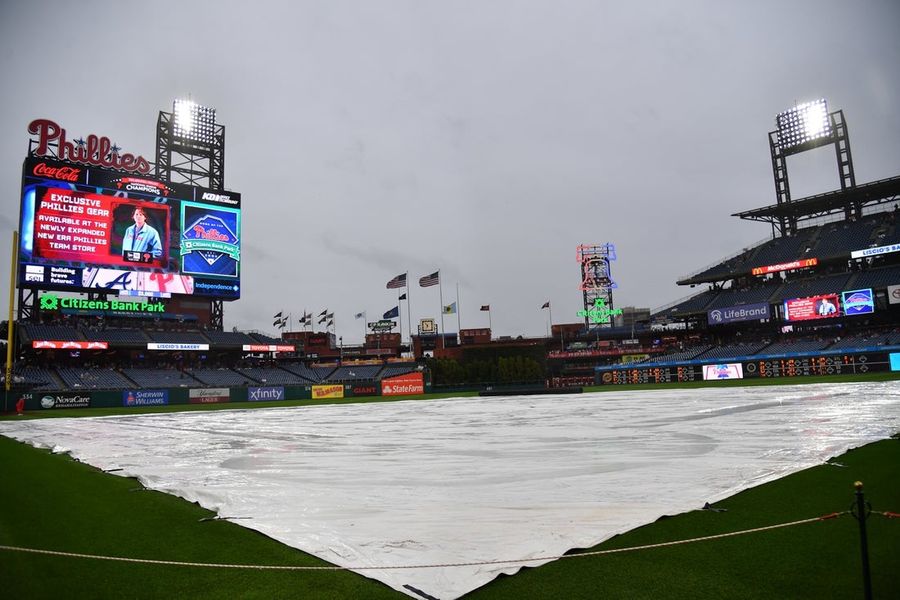
Deadspin | Giants, Phillies to play Thursday doubleheader after postponement  Jun 21, 2023; Philadelphia, Pennsylvania, USA; Tarp covers the infield during rain delay before start of game Philadelphia Phillies and Atlanta Braves at Citizens Bank Park. Mandatory Credit: Eric Hartline-Imagn Images   Wednesday’s scheduled game between the San Francisco Giants and Phillies in Philadelphia has been postponed due to inclement weather in the forecast.  The game will be made up as part of a split doubleheader on Thursday. The first game is slated to begin at 12:35 p.m. ET, with the nightcap scheduled for 5:35 p.m.  Right-handers Adrian Houser (0-3, 7.36 ERA) of San Francisco and Andrew Painter (1-2, 5.25) of Philadelphia are set to start the first game. The starting pitchers for the nightcap have yet to be announced.   In Tuesday’s series opener, the Phillies shut out the Giants, 7-0, behind seven sharp innings from Jesus Luzardo (2-3), who allowed two hits and struck out eight in Don Mattingy’s debut as interim manager after the firing of Rob Thomson.  –Field Level Media   #Deadspin #Giants #Phillies #play #Thursday #doubleheader #postponementJun 21, 2023; Philadelphia, Pennsylvania, USA; Tarp covers the infield during rain delay before start of game Philadelphia Phillies and Atlanta Braves at Citizens Bank Park. Mandatory Credit: Eric Hartline-Imagn Images

Wednesday’s scheduled game between the San Francisco Giants and Phillies in Philadelphia has been postponed due to inclement weather in the forecast.

The game will be made up as part of a split doubleheader on Thursday. The first game is slated to begin at 12:35 p.m. ET, with the nightcap scheduled for 5:35 p.m.


Right-handers Adrian Houser (0-3, 7.36 ERA) of San Francisco and Andrew Painter (1-2, 5.25) of Philadelphia are set to start the first game. The starting pitchers for the nightcap have yet to be announced.

In Tuesday’s series opener, the Phillies shut out the Giants, 7-0, behind seven sharp innings from Jesus Luzardo (2-3), who allowed two hits and struck out eight in Don Mattingy’s debut as interim manager after the firing of Rob Thomson.

–Field Level Media

#Deadspin #Giants #Phillies #play #Thursday #doubleheader #postponement

Jun 21, 2023; Philadelphia, Pennsylvania, USA; Tarp covers the infield during rain delay before start of game Philadelphia Phillies and Atlanta Braves at Citizens Bank Park. Mandatory Credit: Eric Hartline-Imagn Images

Wednesday’s scheduled game between the San Francisco Giants and Phillies in Philadelphia has been postponed due to inclement weather in the forecast.

The game will be made up as part of a split doubleheader on Thursday. The first game is slated to begin at 12:35 p.m. ET, with the nightcap scheduled for 5:35 p.m.

Right-handers Adrian Houser (0-3, 7.36 ERA) of San Francisco and Andrew Painter (1-2, 5.25) of Philadelphia are set to start the first game. The starting pitchers for the nightcap have yet to be announced.

In Tuesday’s series opener, the Phillies shut out the Giants, 7-0, behind seven sharp innings from Jesus Luzardo (2-3), who allowed two hits and struck out eight in Don Mattingy’s debut as interim manager after the firing of Rob Thomson.

–Field Level Media

Source link
#Deadspin #Giants #Phillies #play #Thursday #doubleheader #postponement

Previous post

Grindr — yes, Grindr — won the WHCD party circuit<div id="zephr-anchor"><div class="duet--article--article-body-component"><p class="duet--article--dangerously-set-cms-markup duet--article--standard-paragraph _1ymtmqpi _17nnmdy1 _17nnmdy0 _1xwtict1"><em>Hello and welcome to </em>Regulator<em>, a </em>newsletter <em>for </em>Verge <em>subscribers about technology, politics, and technology learning how to politick. If you’re not a subscriber but would like to support our work, </em><a href="https://www.theverge.com/subscribe"><em>please subscribe here</em></a><em>. I promise that your money will not go toward paying for </em><a href="https://www.theverge.com/policy/918843/trump-whcd-attack-white-house-ballroom"><em>a drone-proof ballroom</em></a><em> for </em>The Verge<em> staff, no matter how much fun we’d have throwing parties there.</em></p></div><div class="duet--article--article-body-component"><p class="duet--article--dangerously-set-cms-markup duet--article--standard-paragraph _1ymtmqpi _17nnmdy1 _17nnmdy0 _1xwtict1">Speaking of parties: <em>The Verge</em> normally wouldn’t do a party report from the White House Correspondents’ Dinner week, also known as “Nerd Prom,” because it’s a bit too much Washington insider circle-jerking for normal people to stomach. (This year was weirder than most, considering that the dinner was targeted by an attempted shooter, it was immediately canceled, <a href="https://www.vanityfair.com/news/story/whcd-shooting-parties?srsltid=AfmBOoqxijQ82ygIxXyg1NiMd4IuT3bqneGvL2KYKQro8zHBMxT5XFGc">and the media insiders kept partying anyway</a>.) But I will make an exception for the party thrown by Grindr — “a midsize tech company that happens to be gay,” as <strong>Joe Hack</strong>, Grindr’s head of global government affairs — which took place the night <em>before </em>the dinner and can therefore stand on its own. And really, there’s a lot to unpack with this event: In an era of resurgent LGBTQ panic, why did a gay dating app with a reputation for facilitating hookups decide to throw a house party for those Washington insiders? Why did they do it this year, during peak Washington insider social season? And why did they let the media cover it?</p></div><div class="duet--article--article-body-component"><p class="duet--article--dangerously-set-cms-markup duet--article--standard-paragraph _1ymtmqpi _17nnmdy1 _17nnmdy0 _1xwtict1"><strong><em>Before we answer that question, as always, send any tips, notices, etc. to </em></strong><a href="https://www.theverge.com/column/920845/mailto:tina.nguyen+tips@theverge.com"><strong><em>tina.nguyen+tips@theverge.com</em></strong></a><strong><em>.</em></strong></p></div><div class="duet--article--article-body-component"><p class="duet--article--dangerously-set-cms-markup duet--article--standard-paragraph _1ymtmqpi _17nnmdy1 _17nnmdy0 _1xwtict1">If someone had said that lobbyists for a publicly traded tech company were hosting a cocktail party on the eve of the White House Correspondents’ Dinner, no one would pencil it on the calendar. But when <em>Grindr</em> began sending out invites, Washington immediately convulsed with thirst: Grindr? The “<a href="https://www.washingtonblade.com/2026/04/16/grindr-to-host-first-ever-white-house-correspondents-dinner-party/">gay dating and hookup app</a>”? Throwing a <em>party</em>? The scandal-hungry <a href="https://www.tmz.com/2026/04/23/grindr-executive-says-trump-officials-interested-in-dc-party/">TMZ interviewed Hack for a segment</a> and sent their Congress reporters <a href="https://x.com/KaivanShroff/status/2047064728007045275">to ask Republican officials for their opinions</a>. The <em>Advocate </em>wrote about <a href="https://www.advocate.com/politics/national/grindr-whcd-party-georgetown">the power jockeying inside LGBTQ circles</a> to get a ticket. Writer <strong>Josh Barro</strong> tweeted that he <a href="https://x.com/jbarro/status/2047649387094892630">couldn’t RSVP in time.</a> <a href="https://theonion.com/grindr-to-host-white-house-correspondents-dinner-party/"><em>The Onion </em>wrote an article</a> about the “poppers lobbyists” expected to attend. DC seemed to vibrate with a hope that this party would be somehow different from the usual fare.</p></div><div class="duet--article--article-body-component"><p class="duet--article--dangerously-set-cms-markup duet--article--standard-paragraph _1ymtmqpi _17nnmdy1 _17nnmdy0 _1xwtict1">But even if they were horny for, well, horniness, they’d be temperamentally incapable of expressing it. Washingtonians, Republicans and Democrats alike, are too afraid to ever break decorum in social settings, because their coworkers, bosses, or <strong>James O’Keefe</strong> might be lurking around the corner with a camera. (James O’Keefe later insinuated that he <a href="https://x.com/JamesOKeefeIII/status/2048052023870791724">sent an undercover mole to the party</a>.) By the time everyone was kicked out at midnight, the most risqué thing I’d witnessed was one passionate kiss (no tongue). The shenanigans were pretty much limited to people thinking about jumping into the pool fully clothed in suits and cocktail dresses — but <em>only</em>, they shrieked, if people put away their cameras. “Please, god, I hope someone jumps in,” muttered a <em>Washington Post </em>reporter with a notebook, as his photographer colleague snapped pictures of the free spirits brave enough to stick their feet in the pool.</p></div><div class="duet--article--article-body-component"><p class="duet--article--dangerously-set-cms-markup duet--article--standard-paragraph _1ymtmqpi _17nnmdy1 _17nnmdy0 _1xwtict1">Still, this was <em>the </em>Grindr party, the hottest ticket of Nerd Prom, and every journalist, senior administration official, politician, publicist, staffer, lobbyist, influencer, you name it, had been trying to get on the invite list for the past week. For once, the social order was flipped: Sure, a tech company was throwing a party to curry influence in Washington. But this time, influence was begging to be let in. By 9PM, when I arrived, the line was already out the door, and well-connected people arriving in black cars were directed to the end of the street. “We’re at capacity,” the PR assistants at the front told me, frowning at their iPads, and for a moment I wondered whether they were strategically implementing artificial scarcity.</p></div><div class="duet--article--article-body-component"><p class="duet--article--dangerously-set-cms-markup duet--article--standard-paragraph _1ymtmqpi _17nnmdy1 _17nnmdy0 _1xwtict1">It turned out that the party <em>was </em>at capacity. I just had to do some aggressive name-dropping to get in and go past the foyer.</p></div><div class="duet--article--article-body-component"><p class="duet--article--dangerously-set-cms-markup duet--article--standard-paragraph _1ymtmqpi _17nnmdy1 _17nnmdy0 _1xwtict1">There’s a general slate of high-end fancy places that party planners fight over for the week— Meridian House! The Four Seasons! The French ambassador’s residence! — but this unassuming Georgetown mansion, built in 1840, was new to the scene. In 2022, a luxury real estate group purchased the mansion for just under $9 million, gutted the 11,000-square-foot Federal-style interior, and reopened it in late 2024 as a high-end rental aimed at the modern, discreet billionaire or Saudi royal: soothing beige walls, designer statement chandeliers, massive tables for huge floral arrangements and pyramids of boxes of burgers and french fries. But the gardens. Oh, the <em>gardens. </em>Somehow, over the past two centuries, the owners had carved out a full half acre of real estate in Georgetown and transformed it into a lush paradise of wandering pathways among boxwoods and trees, burbling fountains and marble statues, terraces enclosed in hedges, hidden greenhouses, and a swimming pool behind ivy-covered walls about two stories tall.</p></div><div class="duet--article--article-body-component"><p class="duet--article--dangerously-set-cms-markup duet--article--standard-paragraph _1ymtmqpi _17nnmdy1 _17nnmdy0 _1xwtict1">And the gardens were packed with hundreds of DC’s “power gays” (<a href="https://unherd.com/2026/04/my-night-with-the-republican-power-gays/?edition=us">as <em>UnHerd</em>’s <strong>John Maier</strong> put it</a>) from across the political spectrum, all of whom had been working in Washington for decades and knew the traditional party spots, but had never known this mansion even existed until now.</p></div><div class="duet--article--article-body-component"><p class="duet--article--dangerously-set-cms-markup duet--article--standard-paragraph _1ymtmqpi _17nnmdy1 _17nnmdy0 _1xwtict1">Not that it was a party strictly for the power gays, mind you — but their allies had to be powerful and connected, too. “I had 10,000 people message me about this,” Hack told me (a straight woman) once I got in. The intrigue over a Grindr party may have done a bit of the heavy lifting, but this was supposed to be just a cocktail party, just one stop on the Friday evening party circuit between the <em>Washingtonian</em> party at the Four Seasons and the UTA event at Isla. Except people weren’t leaving. It might have taken five minutes to get a glass of wine, to say nothing of a made-to-order espresso martini, and getting up the stairs required too much crowd navigation. They <em>wanted </em>to stay, even when the liquor ran out well before midnight.</p></div><div class="duet--article--article-body-component"><p class="duet--article--dangerously-set-cms-markup duet--article--standard-paragraph _1ymtmqpi _17nnmdy1 _17nnmdy0 _1xwtict1">“Obviously there’s a huge number of Democrats in this country who have done a lot of incredible work on behalf of gay rights, and we work very closely with them,” Grindr CEO <strong>George Arison</strong> told me, yelling over Daft Punk blasting on the outdoor speakers. “But there are also plenty of Republicans we work with as well, and they are both on the Hill and in the administration. It is a fact that there are a lot of very powerful gay Republicans in this administration. If you probably add up them in total, they have more power than gays have ever had. I mean, one of the four most powerful people in the world right now is a gay man.” US Treasury Secretary <strong>Scott Bessent</strong> — the gay man who “runs the economy,” as Arison described him, laughing — had been invited, and though he didn’t attend, <strong>Shane Shannon</strong>, one of his senior officials, did show up, according to Hack. In Washington insider terms, that’s basically tacit approval.</p></div><div class="duet--article--block-placement _1o279nj1 _1o279nj0 duet--article--article-body-component"><div style="position:relative"><div class="_1ymtmqpj"><div class=""><div style="background-image:none" class="duet--media--content-warning ucljxw0"><div class="duet--article--image-gallery-image kqz8fh0" style="aspect-ratio:1.499268" id="dmcyOmltYWdlOjkyMDk3Nw=="><a class="kqz8fh1" href="https://platform.theverge.com/wp-content/uploads/sites/2/2026/04/gettyimages-2273020766.jpg?quality=90&strip=all&crop=0,0,100,100" data-pswp-height="5464" data-pswp-width="8192" target="_blank" rel="noreferrer"><img alt="WASHINGTON, DC - APRIL 24: General atmosphere during Grindr White House Correspondents’ Dinner Weekend Party 2026 at LXIV DC on April 24, 2026 in Washington, DC. (Photo by Tasos Katopodis/Getty Images for Grindr Inc.)" data-chromatic="ignore" loading="lazy" decoding="async" data-nimg="fill" class="x271pn0" style="position:absolute;height:100%;width:100%;left:0;top:0;right:0;bottom:0;color:transparent;background-size:cover;background-position:50% 50%;background-repeat:no-repeat;background-image:url("data:image/svg+xml;charset=utf-8,%3Csvg xmlns='http://www.w3.org/2000/svg' %3E%3Cfilter id='b' color-interpolation-filters='sRGB'%3E%3CfeGaussianBlur stdDeviation='20'/%3E%3CfeColorMatrix values='1 0 0 0 0 0 1 0 0 0 0 0 1 0 0 0 0 0 100 -1' result='s'/%3E%3CfeFlood x='0' y='0' width='100%25' height='100%25'/%3E%3CfeComposite operator='out' in='s'/%3E%3CfeComposite in2='SourceGraphic'/%3E%3CfeGaussianBlur stdDeviation='20'/%3E%3C/filter%3E%3Cimage width='100%25' height='100%25' x='0' y='0' preserveAspectRatio='none' style='filter: url(%23b);' href='data:image/png;base64,iVBORw0KGgoAAAANSUhEUgAAAAEAAAABCAQAAAC1HAwCAAAAC0lEQVR42mN8+R8AAtcB6oaHtZcAAAAASUVORK5CYII='/%3E%3C/svg%3E")" sizes="(max-width: 639px) 100vw, (max-width: 1023px) 50vw, 700px" srcset="https://platform.theverge.com/wp-content/uploads/sites/2/2026/04/gettyimages-2273020766.jpg?quality=90&strip=all&crop=0%2C0%2C100%2C100&w=256 256w, https://platform.theverge.com/wp-content/uploads/sites/2/2026/04/gettyimages-2273020766.jpg?quality=90&strip=all&crop=0%2C0%2C100%2C100&w=376 376w, https://platform.theverge.com/wp-content/uploads/sites/2/2026/04/gettyimages-2273020766.jpg?quality=90&strip=all&crop=0%2C0%2C100%2C100&w=384 384w, https://platform.theverge.com/wp-content/uploads/sites/2/2026/04/gettyimages-2273020766.jpg?quality=90&strip=all&crop=0%2C0%2C100%2C100&w=415 415w, https://platform.theverge.com/wp-content/uploads/sites/2/2026/04/gettyimages-2273020766.jpg?quality=90&strip=all&crop=0%2C0%2C100%2C100&w=480 480w, https://platform.theverge.com/wp-content/uploads/sites/2/2026/04/gettyimages-2273020766.jpg?quality=90&strip=all&crop=0%2C0%2C100%2C100&w=540 540w, https://platform.theverge.com/wp-content/uploads/sites/2/2026/04/gettyimages-2273020766.jpg?quality=90&strip=all&crop=0%2C0%2C100%2C100&w=640 640w, https://platform.theverge.com/wp-content/uploads/sites/2/2026/04/gettyimages-2273020766.jpg?quality=90&strip=all&crop=0%2C0%2C100%2C100&w=750 750w, https://platform.theverge.com/wp-content/uploads/sites/2/2026/04/gettyimages-2273020766.jpg?quality=90&strip=all&crop=0%2C0%2C100%2C100&w=828 828w, https://platform.theverge.com/wp-content/uploads/sites/2/2026/04/gettyimages-2273020766.jpg?quality=90&strip=all&crop=0%2C0%2C100%2C100&w=1080 1080w, https://platform.theverge.com/wp-content/uploads/sites/2/2026/04/gettyimages-2273020766.jpg?quality=90&strip=all&crop=0%2C0%2C100%2C100&w=1200 1200w, https://platform.theverge.com/wp-content/uploads/sites/2/2026/04/gettyimages-2273020766.jpg?quality=90&strip=all&crop=0%2C0%2C100%2C100&w=1440 1440w, https://platform.theverge.com/wp-content/uploads/sites/2/2026/04/gettyimages-2273020766.jpg?quality=90&strip=all&crop=0%2C0%2C100%2C100&w=1920 1920w, https://platform.theverge.com/wp-content/uploads/sites/2/2026/04/gettyimages-2273020766.jpg?quality=90&strip=all&crop=0%2C0%2C100%2C100&w=2048 2048w, https://platform.theverge.com/wp-content/uploads/sites/2/2026/04/gettyimages-2273020766.jpg?quality=90&strip=all&crop=0%2C0%2C100%2C100&w=2400 2400w" src="https://platform.theverge.com/wp-content/uploads/sites/2/2026/04/gettyimages-2273020766.jpg?quality=90&strip=all&crop=0%2C0%2C100%2C100&w=2400"/></a></div></div></div><p><figcaption class="duet--article--dangerously-set-cms-markup _1xwtict2 qama0ia">WASHINGTON, DC – APRIL 24: General atmosphere during Grindr White House Correspondents’ Dinner Weekend Party 2026 at LXIV DC on April 24, 2026 in Washington, DC. (Photo by Tasos Katopodis/Getty Images for Grindr Inc.)</figcaption> <cite class="duet--article--dangerously-set-cms-markup _1xwtict2 qama0i5">Getty Images for Grindr Inc.</cite></p></div></div></div><div class="duet--article--article-body-component"><p class="duet--article--dangerously-set-cms-markup duet--article--standard-paragraph _1ymtmqpi _17nnmdy1 _17nnmdy0 _1xwtict1">When he started planning the event, Hack, a political strategist who’d worked the WHCD circuit for two decades straight, made a deliberate choice: Grindr would <em>not </em>partner with a media organization for the event, bucking the trend of companies collaborating with news outlets for a proper <em>celebration of the free press </em>pretext. Instead, Grindr was celebrating the First Amendment right to freedom of expression, which <em>does </em>count as a pretext to slot the party into Nerd Prom week — but also, Hack emphasized, allowed Grindr’s priorities to take center stage. “I wanted this to be clear that this was our event. I didn’t want to dilute that attention.”</p></div><div class="duet--article--article-body-component"><p class="duet--article--dangerously-set-cms-markup duet--article--standard-paragraph _1ymtmqpi _17nnmdy1 _17nnmdy0 _1xwtict1">Several Washington outlets published articles focused on Grindr’s political priorities, in the very staid way that Washington outlets tend to do. <a href="https://www.vanityfair.com/news/story/grindr-white-house-correspondents-dinner?srsltid=AfmBOoruvODfB3nr-mI7OPLHvCrEGS8cbPjF1K1FkUQFuG-nQs_YutEj"><em>Vanity Fair </em>reported</a> that Hack, a Republican and former chief of staff to Sen. <strong>Deb Fischer </strong>(R-NE), had built Grindr’s relationships with House Republicans to shape the App Store Accountability Act, which placed the responsibility for age verification requirements on the app stores rather than the apps themselves. <a href="https://www.politico.com/news/2026/04/22/grindr-washington-trump-congress-00886347"><em>Politico</em> noted</a> that Grindr had “poured $1.6 million into its influence operation since it registered to lobby federal lawmakers in April 2025,” and was now working on a slate of hard policy issues beyond the App Store Accountability Act: kids’ online safety within the national AI framework, IVF and surrogacy access, and its biggest goal, federal funding for HIV prevention. (Hack told me that they were about to announce the hiring of his Democrat counterpart.)</p></div><div class="duet--article--article-body-component"><p class="duet--article--dangerously-set-cms-markup duet--article--standard-paragraph _1ymtmqpi _17nnmdy1 _17nnmdy0 _1xwtict1">But there was more to the party’s objectives than the lobbying disclosures. Without a second brand involved, Grindr had full control of the party’s atmosphere and how to present itself. It was <em>Grindr’s </em>decision to host the party in <em>this</em> mansion, to opt for burgers and oyster shuckers over passed canapes, to curate the guest list and select their invitees and set the tone of the evening: somewhere between networking event and tie-loosening “having a good time,” as one Republican told me, but well short of anything that could give conservatives ammo in the culture wars.</p></div><div class="duet--article--article-body-component"><p class="duet--article--dangerously-set-cms-markup duet--article--standard-paragraph _1ymtmqpi _17nnmdy1 _17nnmdy0 _1xwtict1">In short: Grindr was a good political partner for Democrats <em>and </em>Republicans, even in <strong>Donald Trump’s</strong> administration. And while several big names did show up to the party — <strong>Don Lemon, Ken Martin, David Urban, Keith Edwards, Jon Lovett</strong> (<a href="https://youtu.be/KW0v13vo8XU?si=KmkCw_NNxs_sdrHV&t=161">who ribbed the alcohol situation on <em>Jimmy Kimmel Live</em> the next day</a>) — the vast majority of people at the party were arguably more important to win over. It was senior political staffers, journalists, lobbyists, advisers at interest groups, pollsters, and everyone with some hand in drafting the laws before the electeds vote on them.</p></div><div class="duet--article--article-body-component"><p class="duet--article--dangerously-set-cms-markup duet--article--standard-paragraph _1ymtmqpi _17nnmdy1 _17nnmdy0 _1xwtict1">Was it typical quote-unquote allyship? Not in the public sense, and don’t expect Trump officials marching hand in hand with the progressive caucus during Pride. But Hack emphasized that while Grindr was “in many ways, just another midsize tech company that happens to be gay,” company leadership felt an urgent responsibility to protect their user base. The upfront way to do that was through policy wins and shaping laws, but he also felt like Grindr had to go one step further than other dating apps: “It’s also a moment where you see a lot of corporations stepping back from their commitments to our community.”</p></div><div class="duet--article--article-body-component"><p class="duet--article--dangerously-set-cms-markup duet--article--standard-paragraph _1ymtmqpi _17nnmdy1 _17nnmdy0 _1xwtict1">Implicit in his statement was a painful reality: After a decade of advances, LGBTQ rights are slowly being eroded across the country. Several Republican states are petitioning the US Supreme Court to <a href="https://www.newsweek.com/list-of-states-with-proposals-to-undo-supreme-court-gay-marriage-precedent-11666827">overturn <em>Obergefell v. Hodges</em></a>, the landmark ruling that legalized same-sex marriage nationwide. <a href="https://www.hrc.org/press-releases/new-hrc-report-house-republicans-hijacked-by-radical-anti-lgbtq-members-use-critical-appropriations-bills-to-further-divisive-culture-war">Funding has been stripped</a> from health services for LGBTQ Americans. <a href="https://www.kff.org/lgbtq/overview-of-president-trumps-executive-actions-impacting-lgbtq-health/">The federal government is quietly eliminating benefits for same-sex couples</a>. And if certain online safety laws pass and the anonymity of the internet disappears, the possibility of a Grindr user being outed and punished for expressing their sexuality is all but a given.</p></div><div class="duet--article--article-body-component"><p class="duet--article--dangerously-set-cms-markup duet--article--standard-paragraph _1ymtmqpi _17nnmdy1 _17nnmdy0 _1xwtict1">And that is what the politicking is for. “We feel, I think, even more of an urgent need to have a seat at the table,” said Hack. “There’s an old saying in Washington: that if you don’t have a seat at the table, you’re on the menu.”</p></div><div class="duet--article--article-body-component"><p class="duet--article--dangerously-set-cms-markup duet--article--standard-paragraph _1ymtmqpi _17nnmdy1 _17nnmdy0 _1xwtict1">The boys were also there:</p></div><div class="tly2fw0"><span class="tly2fw2"><strong>Follow topics and authors</strong> from this story to see more like this in your personalized homepage feed and to receive email updates.</span><ul class="tly2fw3"><li id="follow-author-article_footer-dmcyOmF1dGhvclByb2ZpbGU6NjE4NTE4"><span aria-expanded="false" aria-haspopup="true" role="button" tabindex="0"><span class="gnx4pm0 _4hoiss4 _1xwtict5 _1618ekm0"><span class="_1ajq89k1 _1ajq89k0"><svg xmlns="http://www.w3.org/2000/svg" class="_1ajq89k4 _1ajq89k3 _1lp96da0" width="9" height="9" viewbox="0 0 9 9" fill="none" aria-label="Follow"><path d="M5 0H4V4H0V5H4V9H5V5H9V4H5V0Z"/></svg></span><span class="_1618ekm8">Tina Nguyen</span></span></span><aside id="popover-dmcyOmF1dGhvclByb2ZpbGU6NjE4NTE4-article_footer" style="position:absolute;left:0;top:0;visibility:hidden" class="_1wu3rm0 _6ytxv90" aria-hidden="true"><div class="_1wu3rm1"><button class="_1wu3rm3"><svg xmlns="http://www.w3.org/2000/svg" class="_1wu3rm4" width="16" height="16" viewbox="0 0 20 19" fill="none"><title>Close</title><line x1="1.70711" y1="0.831956" x2="18.6483" y2="17.7731" stroke="currentColor" stroke-width="2"/><line x1="1.35149" y1="17.7734" x2="18.2927" y2="0.832185" stroke="currentColor" stroke-width="2"/></svg></button><div class="_1bw37384"><img alt="Tina Nguyen" data-chromatic="ignore" loading="lazy" decoding="async" data-nimg="fill" class="_1bw37385 x271pn0" style="position:absolute;height:100%;width:100%;left:0;top:0;right:0;bottom:0;color:transparent;background-size:cover;background-position:50% 50%;background-repeat:no-repeat;background-image:url("data:image/svg+xml;charset=utf-8,%3Csvg xmlns='http://www.w3.org/2000/svg' %3E%3Cfilter id='b' color-interpolation-filters='sRGB'%3E%3CfeGaussianBlur stdDeviation='20'/%3E%3CfeColorMatrix values='1 0 0 0 0 0 1 0 0 0 0 0 1 0 0 0 0 0 100 -1' result='s'/%3E%3CfeFlood x='0' y='0' width='100%25' height='100%25'/%3E%3CfeComposite operator='out' in='s'/%3E%3CfeComposite in2='SourceGraphic'/%3E%3CfeGaussianBlur stdDeviation='20'/%3E%3C/filter%3E%3Cimage width='100%25' height='100%25' x='0' y='0' preserveAspectRatio='none' style='filter: url(%23b);' href='data:image/png;base64,iVBORw0KGgoAAAANSUhEUgAAAAEAAAABCAQAAAC1HAwCAAAAC0lEQVR42mN8+R8AAtcB6oaHtZcAAAAASUVORK5CYII='/%3E%3C/svg%3E")" sizes="125px" srcset="https://platform.theverge.com/wp-content/uploads/sites/2/2025/02/Tina_BLURPLE-2.jpg?quality=90&strip=all&crop=0%2C0%2C100%2C100&w=16 16w, https://platform.theverge.com/wp-content/uploads/sites/2/2025/02/Tina_BLURPLE-2.jpg?quality=90&strip=all&crop=0%2C0%2C100%2C100&w=32 32w, https://platform.theverge.com/wp-content/uploads/sites/2/2025/02/Tina_BLURPLE-2.jpg?quality=90&strip=all&crop=0%2C0%2C100%2C100&w=48 48w, https://platform.theverge.com/wp-content/uploads/sites/2/2025/02/Tina_BLURPLE-2.jpg?quality=90&strip=all&crop=0%2C0%2C100%2C100&w=64 64w, https://platform.theverge.com/wp-content/uploads/sites/2/2025/02/Tina_BLURPLE-2.jpg?quality=90&strip=all&crop=0%2C0%2C100%2C100&w=96 96w, https://platform.theverge.com/wp-content/uploads/sites/2/2025/02/Tina_BLURPLE-2.jpg?quality=90&strip=all&crop=0%2C0%2C100%2C100&w=128 128w, https://platform.theverge.com/wp-content/uploads/sites/2/2025/02/Tina_BLURPLE-2.jpg?quality=90&strip=all&crop=0%2C0%2C100%2C100&w=256 256w, https://platform.theverge.com/wp-content/uploads/sites/2/2025/02/Tina_BLURPLE-2.jpg?quality=90&strip=all&crop=0%2C0%2C100%2C100&w=376 376w, https://platform.theverge.com/wp-content/uploads/sites/2/2025/02/Tina_BLURPLE-2.jpg?quality=90&strip=all&crop=0%2C0%2C100%2C100&w=384 384w, https://platform.theverge.com/wp-content/uploads/sites/2/2025/02/Tina_BLURPLE-2.jpg?quality=90&strip=all&crop=0%2C0%2C100%2C100&w=415 415w, https://platform.theverge.com/wp-content/uploads/sites/2/2025/02/Tina_BLURPLE-2.jpg?quality=90&strip=all&crop=0%2C0%2C100%2C100&w=480 480w, https://platform.theverge.com/wp-content/uploads/sites/2/2025/02/Tina_BLURPLE-2.jpg?quality=90&strip=all&crop=0%2C0%2C100%2C100&w=540 540w, https://platform.theverge.com/wp-content/uploads/sites/2/2025/02/Tina_BLURPLE-2.jpg?quality=90&strip=all&crop=0%2C0%2C100%2C100&w=640 640w, https://platform.theverge.com/wp-content/uploads/sites/2/2025/02/Tina_BLURPLE-2.jpg?quality=90&strip=all&crop=0%2C0%2C100%2C100&w=750 750w, https://platform.theverge.com/wp-content/uploads/sites/2/2025/02/Tina_BLURPLE-2.jpg?quality=90&strip=all&crop=0%2C0%2C100%2C100&w=828 828w, https://platform.theverge.com/wp-content/uploads/sites/2/2025/02/Tina_BLURPLE-2.jpg?quality=90&strip=all&crop=0%2C0%2C100%2C100&w=1080 1080w, https://platform.theverge.com/wp-content/uploads/sites/2/2025/02/Tina_BLURPLE-2.jpg?quality=90&strip=all&crop=0%2C0%2C100%2C100&w=1200 1200w, https://platform.theverge.com/wp-content/uploads/sites/2/2025/02/Tina_BLURPLE-2.jpg?quality=90&strip=all&crop=0%2C0%2C100%2C100&w=1440 1440w, https://platform.theverge.com/wp-content/uploads/sites/2/2025/02/Tina_BLURPLE-2.jpg?quality=90&strip=all&crop=0%2C0%2C100%2C100&w=1920 1920w, https://platform.theverge.com/wp-content/uploads/sites/2/2025/02/Tina_BLURPLE-2.jpg?quality=90&strip=all&crop=0%2C0%2C100%2C100&w=2048 2048w, https://platform.theverge.com/wp-content/uploads/sites/2/2025/02/Tina_BLURPLE-2.jpg?quality=90&strip=all&crop=0%2C0%2C100%2C100&w=2400 2400w" src="https://platform.theverge.com/wp-content/uploads/sites/2/2025/02/Tina_BLURPLE-2.jpg?quality=90&strip=all&crop=0%2C0%2C100%2C100&w=2400"/></div><p>Tina Nguyen</p><div class="_1bw37381"><p>Senior Reporter, Washington</p></div><p class="fv263x1">Posts from this author will be added to your daily email digest and your homepage feed.</p><button class="duet--cta--button _1f7jm891 _1f7jm890 fv263x2 _1f7jm89g"><span><svg xmlns="http://www.w3.org/2000/svg" width="20" height="20" viewbox="0 0 21 20" fill="none" class="" aria-label="Follow"><title>Follow</title><path d="M11.5 3H9.5V8.99999H3.5V11L9.5 11V17H11.5V11L17.5 11V9H11.5V3Z" fill="currentColor"/></svg></span><span>Follow</span></button><p class="fv263x4"><a class="fv263x5" href="https://www.theverge.com/authors/tina-nguyen">See All by <!-- -->Tina Nguyen</a></p></div></aside></li><li><div id="follow-category-article_footer-dmcyOmNhdGVnb3J5OjE2MzI="><button aria-expanded="false" aria-haspopup="true"><span class="gnx4pm0 _4hoiss4 _1xwtict5 _1618ekm0"><span class="_1ajq89k1 _1ajq89k0"><svg xmlns="http://www.w3.org/2000/svg" class="_1ajq89k4 _1ajq89k3 _1lp96da0" width="9" height="9" viewbox="0 0 9 9" fill="none" aria-label="Follow"><path d="M5 0H4V4H0V5H4V9H5V5H9V4H5V0Z"/></svg></span><span class="_1618ekm8">Column</span></span></button><aside id="popover-dmcyOmNhdGVnb3J5OjE2MzI=-article_footer" style="position:absolute;left:0;top:0;visibility:hidden" class="_1wu3rm0 _6ytxv90" aria-hidden="true"><div class="_1wu3rm1"><button class="_1wu3rm3"><svg xmlns="http://www.w3.org/2000/svg" class="_1wu3rm4" width="16" height="16" viewbox="0 0 20 19" fill="none"><title>Close</title><line x1="1.70711" y1="0.831956" x2="18.6483" y2="17.7731" stroke="currentColor" stroke-width="2"/><line x1="1.35149" y1="17.7734" x2="18.2927" y2="0.832185" stroke="currentColor" stroke-width="2"/></svg></button><p>Column</p><p class="fv263x1">Posts from this topic will be added to your daily email digest and your homepage feed.</p><button class="duet--cta--button _1f7jm891 _1f7jm890 fv263x2 _1f7jm89g"><span><svg xmlns="http://www.w3.org/2000/svg" width="20" height="20" viewbox="0 0 21 20" fill="none" class="" aria-label="Follow"><title>Follow</title><path d="M11.5 3H9.5V8.99999H3.5V11L9.5 11V17H11.5V11L17.5 11V9H11.5V3Z" fill="currentColor"/></svg></span><span>Follow</span></button><p class="fv263x4"><a class="fv263x5" href="https://www.theverge.com/column">See All <!-- -->Column</a></p></div></aside></div></li><li><div id="follow-category-article_footer-dmcyOmNhdGVnb3J5OjEwNg=="><button aria-expanded="false" aria-haspopup="true"><span class="gnx4pm0 _4hoiss4 _1xwtict5 _1618ekm0"><span class="_1ajq89k1 _1ajq89k0"><svg xmlns="http://www.w3.org/2000/svg" class="_1ajq89k4 _1ajq89k3 _1lp96da0" width="9" height="9" viewbox="0 0 9 9" fill="none" aria-label="Follow"><path d="M5 0H4V4H0V5H4V9H5V5H9V4H5V0Z"/></svg></span><span class="_1618ekm8">Policy</span></span></button><aside id="popover-dmcyOmNhdGVnb3J5OjEwNg==-article_footer" style="position:absolute;left:0;top:0;visibility:hidden" class="_1wu3rm0 _6ytxv90" aria-hidden="true"><div class="_1wu3rm1"><button class="_1wu3rm3"><svg xmlns="http://www.w3.org/2000/svg" class="_1wu3rm4" width="16" height="16" viewbox="0 0 20 19" fill="none"><title>Close</title><line x1="1.70711" y1="0.831956" x2="18.6483" y2="17.7731" stroke="currentColor" stroke-width="2"/><line x1="1.35149" y1="17.7734" x2="18.2927" y2="0.832185" stroke="currentColor" stroke-width="2"/></svg></button><p>Policy</p><p class="fv263x1">Posts from this topic will be added to your daily email digest and your homepage feed.</p><button class="duet--cta--button _1f7jm891 _1f7jm890 fv263x2 _1f7jm89g"><span><svg xmlns="http://www.w3.org/2000/svg" width="20" height="20" viewbox="0 0 21 20" fill="none" class="" aria-label="Follow"><title>Follow</title><path d="M11.5 3H9.5V8.99999H3.5V11L9.5 11V17H11.5V11L17.5 11V9H11.5V3Z" fill="currentColor"/></svg></span><span>Follow</span></button><p class="fv263x4"><a class="fv263x5" href="https://www.theverge.com/policy">See All <!-- -->Policy</a></p></div></aside></div></li><li><div id="follow-category-article_footer-dmcyOmNhdGVnb3J5OjEyMw=="><button aria-expanded="false" aria-haspopup="true"><span class="gnx4pm0 _4hoiss4 _1xwtict5 _1618ekm0"><span class="_1ajq89k1 _1ajq89k0"><svg xmlns="http://www.w3.org/2000/svg" class="_1ajq89k4 _1ajq89k3 _1lp96da0" width="9" height="9" viewbox="0 0 9 9" fill="none" aria-label="Follow"><path d="M5 0H4V4H0V5H4V9H5V5H9V4H5V0Z"/></svg></span><span class="_1618ekm8">Politics</span></span></button><aside id="popover-dmcyOmNhdGVnb3J5OjEyMw==-article_footer" style="position:absolute;left:0;top:0;visibility:hidden" class="_1wu3rm0 _6ytxv90" aria-hidden="true"><div class="_1wu3rm1"><button class="_1wu3rm3"><svg xmlns="http://www.w3.org/2000/svg" class="_1wu3rm4" width="16" height="16" viewbox="0 0 20 19" fill="none"><title>Close</title><line x1="1.70711" y1="0.831956" x2="18.6483" y2="17.7731" stroke="currentColor" stroke-width="2"/><line x1="1.35149" y1="17.7734" x2="18.2927" y2="0.832185" stroke="currentColor" stroke-width="2"/></svg></button><p>Politics</p><p class="fv263x1">Posts from this topic will be added to your daily email digest and your homepage feed.</p><button class="duet--cta--button _1f7jm891 _1f7jm890 fv263x2 _1f7jm89g"><span><svg xmlns="http://www.w3.org/2000/svg" width="20" height="20" viewbox="0 0 21 20" fill="none" class="" aria-label="Follow"><title>Follow</title><path d="M11.5 3H9.5V8.99999H3.5V11L9.5 11V17H11.5V11L17.5 11V9H11.5V3Z" fill="currentColor"/></svg></span><span>Follow</span></button><p class="fv263x4"><a class="fv263x5" href="https://www.theverge.com/politics">See All <!-- -->Politics</a></p></div></aside></div></li><li><div id="follow-category-article_footer-dmcyOmNhdGVnb3J5OjM2MDU3"><button aria-expanded="false" aria-haspopup="true"><span class="gnx4pm0 _4hoiss4 _1xwtict5 _1618ekm0"><span class="_1ajq89k1 _1ajq89k0"><svg xmlns="http://www.w3.org/2000/svg" class="_1ajq89k4 _1ajq89k3 _1lp96da0" width="9" height="9" viewbox="0 0 9 9" fill="none" aria-label="Follow"><path d="M5 0H4V4H0V5H4V9H5V5H9V4H5V0Z"/></svg></span><span class="_1618ekm8">Regulator</span></span></button><aside id="popover-dmcyOmNhdGVnb3J5OjM2MDU3-article_footer" style="position:absolute;left:0;top:0;visibility:hidden" class="_1wu3rm0 _6ytxv90" aria-hidden="true"><div class="_1wu3rm1"><button class="_1wu3rm3"><svg xmlns="http://www.w3.org/2000/svg" class="_1wu3rm4" width="16" height="16" viewbox="0 0 20 19" fill="none"><title>Close</title><line x1="1.70711" y1="0.831956" x2="18.6483" y2="17.7731" stroke="currentColor" stroke-width="2"/><line x1="1.35149" y1="17.7734" x2="18.2927" y2="0.832185" stroke="currentColor" stroke-width="2"/></svg></button><p>Regulator</p><p class="fv263x1">Posts from this topic will be added to your daily email digest and your homepage feed.</p><button class="duet--cta--button _1f7jm891 _1f7jm890 fv263x2 _1f7jm89g"><span><svg xmlns="http://www.w3.org/2000/svg" width="20" height="20" viewbox="0 0 21 20" fill="none" class="" aria-label="Follow"><title>Follow</title><path d="M11.5 3H9.5V8.99999H3.5V11L9.5 11V17H11.5V11L17.5 11V9H11.5V3Z" fill="currentColor"/></svg></span><span>Follow</span></button><p class="fv263x4"><a class="fv263x5" href="https://www.theverge.com/regulator-newsletter">See All <!-- -->Regulator</a></p></div></aside></div></li></ul></div></div>#Grindr #Grindr #won #WHCD #party #circuitColumn,Policy,Politics,Regulator

Next post

Live Updates: U.S. aircraft carrier in Iran war expected to leave Middle East with conflict’s estimated cost at $25 billion

Bunting in Major League Baseball is the ultimate tool of confirmation bias, stretching from the most anti-analytics “he’s got a great swing” truthers to those who watch baseball on a spreadsheet — all of them can love the bunt.

Traditionalists will enjoy the old-school approach of bunting as a way to advance runners into scoring position. Some who hate the pitcher-dominant game will delight in the refusal to indulge the swing-and-miss world by just not swinging. Others, who love analytics and Moneyball, will point out that bunting in 2026 could be the ultimate edge in a world that has embraced strikeout-embracing power hitting. There’s something for everyone with the bunt.

But is that something actually there? With the 2026 MLB Bunting Revolution very much taking place, we must investigate if the success of the American League-leading Tampa Bay Rays is actually due to a statistically significant increase in bunts, or if the Buntassiance is actually a Bunt Mirage. In short: I’m team Bunt Mirage.

First, some rudimentary statistics about bunting in our postmodern society: bunting has increased overall this year, though it would be incorrect to say teams are bunting more across the board. Plenty of MLB teams have actually been bunting less than in 2025, including some powerhouses like the New York Yankees, Atlanta Braves and the sport’s hottest team: the Philadelphia Phillies. All three essentially never bunt. Meanwhile, the San Diego Padres, who were the MLB’s top bunting team last year at .30 sacrifice bunts per game, have cut that down by two-thirds amid their bid to win the National League West over the Los Angeles Dodgers. It is, however, true that the Tampa Bay Rays are bunting more than any team since pitchers stopped hitting in 2021 and the most period since the 2017 Colorado Rockies.

As of this writing, the Rays are 32-15, and hold a three game lead over the bunt-avoidant Yankees in the American League East. This has led to some discussions about if high-contact teams that skimp on power might be the next thing, and it has been heralded with much rejoicing by the bunt community. But I am supremely skeptical.

First and foremost, we are talking about 17 bunts here. Tampa Bay is fourth in the MLB in hits with 416, so right off the bat (pun moderately intended) we are hit with a sample size problem: any suggestion that bunts are correlated with wins relies on a problematically low number of events relative to other data we could be using. Saying “bunting” is why the Tampa Bay Rays are winning is like saying you and your neighbor’s lawn signs specifically swung the local school committee race. Like … maybe, but there were probably more powerful forces at work.

Using data that is sufficiently large, the Rays simply do not have the underlying analytics of the best team in the American League. Offensively, they have the largest positive difference between expected and actual average, slugging, and contact quality. Their pitching has enjoyed similar aberrations, with the best of those expected versus actual metrics from opposing hitters save for slugging, in which they are second-best.

That’s a mouthful, but all any of that really means is that the Rays have been hitting far better and their opponents have been hitting far worse than the data suggests they should be. In short, they’ve been lucky with whatever cosmic, intergalactic soup controls how baseballs fly on any given day. None of those metrics are influenced significantly by their 17 sacrifice bunts, which do not actually count against the hitters on base percentage for some completely unknown reason.

As for bunting itself, I’m not breaking new ground here when I tell you that bunting is almost-always bad for your baseball team. Using fancy-schmancy, albeit a tad-outmoded run-expectancy metrics, we find that all but the most specific sacrifice bunts reduce your chances of scoring runs. When Brad Pitt said “no bunting whatsoever” in Moneyball, that’s what he was talking about.

Using slightly more in-moded win probability metrics and this wonderful thing call the Game Strategy explorer on BaseballSavant.com, we discover that there are sacrifice bunts that increase your win probability, but only hyper specific ones: if there is a runner on second with zero outs and the game is tied in the bottom of the 8th, top of the 9th, bottom of the ninth or bottom of the 10th inning, a sacrifice bunt increases your probability of winning. That is it. It is literally never good when you are winning, it is literally never good if you are losing, it is literally never good anytime before the 8th inning or with more than zero outs, heck it is literally never good when the game is tied in the top of 10th inning. And all of that still implies that the bunt is successful, which is by no means a guarantee. Are you starting to see where I’m coming from?

Most notably, the beloved “bunt with a man on first with no outs” is never a good idea under any circumstances, but I think it’s better to unpack this one intuitively rather than just tell you it’s bad. Why would a manager bunt with a man on first? Because it puts a runner in scoring position roughly 65 percent of the time (the success rate of your average sac bunt attempt). Seems good right? Sure, but that also implies there is a radically better chance of getting an RBI hit in the next at bat rather than the current one, often why you see nine-hole hitters bunt to bring up the top of the order.

And perhaps there is, under extremely specific circumstances, an opportunity to raise your chances of an RBI hit by five to eight percent by bringing up a hitter with a better batting average. But it does not raise your chances of scoring a run, just that of an RBI hit in the next at-bat. And that is not, under any circumstances, worth an entire out. Bunting with a man on first with no outs is an effort by managers to control a game that often feels like a progression of random events. But no data or intuitive explanation supports that strategy.

Much has been written about the specific situations when bunting is good (tied, man on second, no outs, late innings), but just because those situations exist does not mean bunting is broadly a good strategy. In the big picture, laying down these ultra-specific bunts is too rare an occurrence to suggest they are the reasons for wins and losses. It’s just too small a data set and too specific an ask.

I concede that the Rays are constructed basically to ignore power hitting in favor of making contact to keep runners moving, but I do not concede that has anything to do with bunting now being a good idea. The argument for bunting put forth by Rays Manager Kevin Cash that “hitting is (bad word) hard” does not mean bunting has somehow gotten easier — sac bunt success rates has improved since pitchers stopped hitting, but only marginally.

There are specific instances when bunting is good, but I do not believe those instances are common enough nor statistically significant to suggest that bunting is somehow the great edge in Major League Baseball and everyone needs to follow the Rays to bunting Valhalla. It can be surprising and even effective if it results in a bunt-hit, but the skill set required to do that is so rare and esoteric that it is never worthwhile to invest in. I’d rather my hitters just swing the bat, which is cooler, more exciting and, wonderfully, just analytically better.

#MLBs #bunting #boom #mirage">Why MLB’s bunting boom is a mirage  Bunting in Major League Baseball is the ultimate tool of confirmation bias, stretching from the most anti-analytics “he’s got a great swing” truthers to those who watch baseball on a spreadsheet — all of them can love the bunt.Traditionalists will enjoy the old-school approach of bunting as a way to advance runners into scoring position. Some who hate the pitcher-dominant game will delight in the refusal to indulge the swing-and-miss world by just not swinging. Others, who love analytics and Moneyball, will point out that bunting in 2026 could be the ultimate edge in a world that has embraced strikeout-embracing power hitting. There’s something for everyone with the bunt.But is that something actually there? With the 2026 MLB Bunting Revolution very much taking place, we must investigate if the success of the American League-leading Tampa Bay Rays is actually due to a statistically significant increase in bunts, or if the Buntassiance is actually a Bunt Mirage. In short: I’m team Bunt Mirage.First, some rudimentary statistics about bunting in our postmodern society: bunting has increased overall this year, though it would be incorrect to say teams are bunting more across the board. Plenty of MLB teams have actually been bunting less than in 2025, including some powerhouses like the New York Yankees, Atlanta Braves and the sport’s hottest team: the Philadelphia Phillies. All three essentially never bunt. Meanwhile, the San Diego Padres, who were the MLB’s top bunting team last year at .30 sacrifice bunts per game, have cut that down by two-thirds amid their bid to win the National League West over the Los Angeles Dodgers. It is, however, true that the Tampa Bay Rays are bunting more than any team since pitchers stopped hitting in 2021 and the most period since the 2017 Colorado Rockies.As of this writing, the Rays are 32-15, and hold a three game lead over the bunt-avoidant Yankees in the American League East. This has led to some discussions about if high-contact teams that skimp on power might be the next thing, and it has been heralded with much rejoicing by the bunt community. But I am supremely skeptical.First and foremost, we are talking about 17 bunts here. Tampa Bay is fourth in the MLB in hits with 416, so right off the bat (pun moderately intended) we are hit with a sample size problem: any suggestion that bunts are correlated with wins relies on a problematically low number of events relative to other data we could be using. Saying “bunting” is why the Tampa Bay Rays are winning is like saying you and your neighbor’s lawn signs specifically swung the local school committee race. Like … maybe, but there were probably more powerful forces at work.Using data that is sufficiently large, the Rays simply do not have the underlying analytics of the best team in the American League. Offensively, they have the largest positive difference between expected and actual average, slugging, and contact quality. Their pitching has enjoyed similar aberrations, with the best of those expected versus actual metrics from opposing hitters save for slugging, in which they are second-best.That’s a mouthful, but all any of that really means is that the Rays have been hitting far better and their opponents have been hitting far worse than the data suggests they should be. In short, they’ve been lucky with whatever cosmic, intergalactic soup controls how baseballs fly on any given day. None of those metrics are influenced significantly by their 17 sacrifice bunts, which do not actually count against the hitters on base percentage for some completely unknown reason.As for bunting itself, I’m not breaking new ground here when I tell you that bunting is almost-always bad for your baseball team. Using fancy-schmancy, albeit a tad-outmoded run-expectancy metrics, we find that all but the most specific sacrifice bunts reduce your chances of scoring runs. When Brad Pitt said “no bunting whatsoever” in Moneyball, that’s what he was talking about.Using slightly more in-moded win probability metrics and this wonderful thing call the Game Strategy explorer on BaseballSavant.com, we discover that there are sacrifice bunts that increase your win probability, but only hyper specific ones: if there is a runner on second with zero outs and the game is tied in the bottom of the 8th, top of the 9th, bottom of the ninth or bottom of the 10th inning, a sacrifice bunt increases your probability of winning. That is it. It is literally never good when you are winning, it is literally never good if you are losing, it is literally never good anytime before the 8th inning or with more than zero outs, heck it is literally never good when the game is tied in the top of 10th inning. And all of that still implies that the bunt is successful, which is by no means a guarantee. Are you starting to see where I’m coming from?Most notably, the beloved “bunt with a man on first with no outs” is never a good idea under any circumstances, but I think it’s better to unpack this one intuitively rather than just tell you it’s bad. Why would a manager bunt with a man on first? Because it puts a runner in scoring position roughly 65 percent of the time (the success rate of your average sac bunt attempt). Seems good right? Sure, but that also implies there is a radically better chance of getting an RBI hit in the next at bat rather than the current one, often why you see nine-hole hitters bunt to bring up the top of the order.And perhaps there is, under extremely specific circumstances, an opportunity to raise your chances of an RBI hit by five to eight percent by bringing up a hitter with a better batting average. But it does not raise your chances of scoring a run, just that of an RBI hit in the next at-bat. And that is not, under any circumstances, worth an entire out. Bunting with a man on first with no outs is an effort by managers to control a game that often feels like a progression of random events. But no data or intuitive explanation supports that strategy.Much has been written about the specific situations when bunting is good (tied, man on second, no outs, late innings), but just because those situations exist does not mean bunting is broadly a good strategy. In the big picture, laying down these ultra-specific bunts is too rare an occurrence to suggest they are the reasons for wins and losses. It’s just too small a data set and too specific an ask.I concede that the Rays are constructed basically to ignore power hitting in favor of making contact to keep runners moving, but I do not concede that has anything to do with bunting now being a good idea. The argument for bunting put forth by Rays Manager Kevin Cash that “hitting is (bad word) hard” does not mean bunting has somehow gotten easier — sac bunt success rates has improved since pitchers stopped hitting, but only marginally. There are specific instances when bunting is good, but I do not believe those instances are common enough nor statistically significant to suggest that bunting is somehow the great edge in Major League Baseball and everyone needs to follow the Rays to bunting Valhalla. It can be surprising and even effective if it results in a bunt-hit, but the skill set required to do that is so rare and esoteric that it is never worthwhile to invest in. I’d rather my hitters just swing the bat, which is cooler, more exciting and, wonderfully, just analytically better.  #MLBs #bunting #boom #mirage

that bunting in 2026 could be the ultimate edge in a world that has embraced strikeout-embracing power hitting. There’s something for everyone with the bunt.

But is that something actually there? With the 2026 MLB Bunting Revolution very much taking place, we must investigate if the success of the American League-leading Tampa Bay Rays is actually due to a statistically significant increase in bunts, or if the Buntassiance is actually a Bunt Mirage. In short: I’m team Bunt Mirage.

First, some rudimentary statistics about bunting in our postmodern society: bunting has increased overall this year, though it would be incorrect to say teams are bunting more across the board. Plenty of MLB teams have actually been bunting less than in 2025, including some powerhouses like the New York Yankees, Atlanta Braves and the sport’s hottest team: the Philadelphia Phillies. All three essentially never bunt. Meanwhile, the San Diego Padres, who were the MLB’s top bunting team last year at .30 sacrifice bunts per game, have cut that down by two-thirds amid their bid to win the National League West over the Los Angeles Dodgers. It is, however, true that the Tampa Bay Rays are bunting more than any team since pitchers stopped hitting in 2021 and the most period since the 2017 Colorado Rockies.

As of this writing, the Rays are 32-15, and hold a three game lead over the bunt-avoidant Yankees in the American League East. This has led to some discussions about if high-contact teams that skimp on power might be the next thing, and it has been heralded with much rejoicing by the bunt community. But I am supremely skeptical.

First and foremost, we are talking about 17 bunts here. Tampa Bay is fourth in the MLB in hits with 416, so right off the bat (pun moderately intended) we are hit with a sample size problem: any suggestion that bunts are correlated with wins relies on a problematically low number of events relative to other data we could be using. Saying “bunting” is why the Tampa Bay Rays are winning is like saying you and your neighbor’s lawn signs specifically swung the local school committee race. Like … maybe, but there were probably more powerful forces at work.

Using data that is sufficiently large, the Rays simply do not have the underlying analytics of the best team in the American League. Offensively, they have the largest positive difference between expected and actual average, slugging, and contact quality. Their pitching has enjoyed similar aberrations, with the best of those expected versus actual metrics from opposing hitters save for slugging, in which they are second-best.

That’s a mouthful, but all any of that really means is that the Rays have been hitting far better and their opponents have been hitting far worse than the data suggests they should be. In short, they’ve been lucky with whatever cosmic, intergalactic soup controls how baseballs fly on any given day. None of those metrics are influenced significantly by their 17 sacrifice bunts, which do not actually count against the hitters on base percentage for some completely unknown reason.

As for bunting itself, I’m not breaking new ground here when I tell you that bunting is almost-always bad for your baseball team. Using fancy-schmancy, albeit a tad-outmoded run-expectancy metrics, we find that all but the most specific sacrifice bunts reduce your chances of scoring runs. When Brad Pitt said “no bunting whatsoever” in Moneyball, that’s what he was talking about.

Using slightly more in-moded win probability metrics and this wonderful thing call the Game Strategy explorer on BaseballSavant.com, we discover that there are sacrifice bunts that increase your win probability, but only hyper specific ones: if there is a runner on second with zero outs and the game is tied in the bottom of the 8th, top of the 9th, bottom of the ninth or bottom of the 10th inning, a sacrifice bunt increases your probability of winning. That is it. It is literally never good when you are winning, it is literally never good if you are losing, it is literally never good anytime before the 8th inning or with more than zero outs, heck it is literally never good when the game is tied in the top of 10th inning. And all of that still implies that the bunt is successful, which is by no means a guarantee. Are you starting to see where I’m coming from?

Most notably, the beloved “bunt with a man on first with no outs” is never a good idea under any circumstances, but I think it’s better to unpack this one intuitively rather than just tell you it’s bad. Why would a manager bunt with a man on first? Because it puts a runner in scoring position roughly 65 percent of the time (the success rate of your average sac bunt attempt). Seems good right? Sure, but that also implies there is a radically better chance of getting an RBI hit in the next at bat rather than the current one, often why you see nine-hole hitters bunt to bring up the top of the order.

And perhaps there is, under extremely specific circumstances, an opportunity to raise your chances of an RBI hit by five to eight percent by bringing up a hitter with a better batting average. But it does not raise your chances of scoring a run, just that of an RBI hit in the next at-bat. And that is not, under any circumstances, worth an entire out. Bunting with a man on first with no outs is an effort by managers to control a game that often feels like a progression of random events. But no data or intuitive explanation supports that strategy.

Much has been written about the specific situations when bunting is good (tied, man on second, no outs, late innings), but just because those situations exist does not mean bunting is broadly a good strategy. In the big picture, laying down these ultra-specific bunts is too rare an occurrence to suggest they are the reasons for wins and losses. It’s just too small a data set and too specific an ask.

I concede that the Rays are constructed basically to ignore power hitting in favor of making contact to keep runners moving, but I do not concede that has anything to do with bunting now being a good idea. The argument for bunting put forth by Rays Manager Kevin Cash that “hitting is (bad word) hard” does not mean bunting has somehow gotten easier — sac bunt success rates has improved since pitchers stopped hitting, but only marginally.

There are specific instances when bunting is good, but I do not believe those instances are common enough nor statistically significant to suggest that bunting is somehow the great edge in Major League Baseball and everyone needs to follow the Rays to bunting Valhalla. It can be surprising and even effective if it results in a bunt-hit, but the skill set required to do that is so rare and esoteric that it is never worthwhile to invest in. I’d rather my hitters just swing the bat, which is cooler, more exciting and, wonderfully, just analytically better.

#MLBs #bunting #boom #mirage">Why MLB’s bunting boom is a mirage

Bunting in Major League Baseball is the ultimate tool of confirmation bias, stretching from the most anti-analytics “he’s got a great swing” truthers to those who watch baseball on a spreadsheet — all of them can love the bunt.

Traditionalists will enjoy the old-school approach of bunting as a way to advance runners into scoring position. Some who hate the pitcher-dominant game will delight in the refusal to indulge the swing-and-miss world by just not swinging. Others, who love analytics and Moneyball, will point out that bunting in 2026 could be the ultimate edge in a world that has embraced strikeout-embracing power hitting. There’s something for everyone with the bunt.

But is that something actually there? With the 2026 MLB Bunting Revolution very much taking place, we must investigate if the success of the American League-leading Tampa Bay Rays is actually due to a statistically significant increase in bunts, or if the Buntassiance is actually a Bunt Mirage. In short: I’m team Bunt Mirage.

First, some rudimentary statistics about bunting in our postmodern society: bunting has increased overall this year, though it would be incorrect to say teams are bunting more across the board. Plenty of MLB teams have actually been bunting less than in 2025, including some powerhouses like the New York Yankees, Atlanta Braves and the sport’s hottest team: the Philadelphia Phillies. All three essentially never bunt. Meanwhile, the San Diego Padres, who were the MLB’s top bunting team last year at .30 sacrifice bunts per game, have cut that down by two-thirds amid their bid to win the National League West over the Los Angeles Dodgers. It is, however, true that the Tampa Bay Rays are bunting more than any team since pitchers stopped hitting in 2021 and the most period since the 2017 Colorado Rockies.

As of this writing, the Rays are 32-15, and hold a three game lead over the bunt-avoidant Yankees in the American League East. This has led to some discussions about if high-contact teams that skimp on power might be the next thing, and it has been heralded with much rejoicing by the bunt community. But I am supremely skeptical.

First and foremost, we are talking about 17 bunts here. Tampa Bay is fourth in the MLB in hits with 416, so right off the bat (pun moderately intended) we are hit with a sample size problem: any suggestion that bunts are correlated with wins relies on a problematically low number of events relative to other data we could be using. Saying “bunting” is why the Tampa Bay Rays are winning is like saying you and your neighbor’s lawn signs specifically swung the local school committee race. Like … maybe, but there were probably more powerful forces at work.

Using data that is sufficiently large, the Rays simply do not have the underlying analytics of the best team in the American League. Offensively, they have the largest positive difference between expected and actual average, slugging, and contact quality. Their pitching has enjoyed similar aberrations, with the best of those expected versus actual metrics from opposing hitters save for slugging, in which they are second-best.

That’s a mouthful, but all any of that really means is that the Rays have been hitting far better and their opponents have been hitting far worse than the data suggests they should be. In short, they’ve been lucky with whatever cosmic, intergalactic soup controls how baseballs fly on any given day. None of those metrics are influenced significantly by their 17 sacrifice bunts, which do not actually count against the hitters on base percentage for some completely unknown reason.

As for bunting itself, I’m not breaking new ground here when I tell you that bunting is almost-always bad for your baseball team. Using fancy-schmancy, albeit a tad-outmoded run-expectancy metrics, we find that all but the most specific sacrifice bunts reduce your chances of scoring runs. When Brad Pitt said “no bunting whatsoever” in Moneyball, that’s what he was talking about.

Using slightly more in-moded win probability metrics and this wonderful thing call the Game Strategy explorer on BaseballSavant.com, we discover that there are sacrifice bunts that increase your win probability, but only hyper specific ones: if there is a runner on second with zero outs and the game is tied in the bottom of the 8th, top of the 9th, bottom of the ninth or bottom of the 10th inning, a sacrifice bunt increases your probability of winning. That is it. It is literally never good when you are winning, it is literally never good if you are losing, it is literally never good anytime before the 8th inning or with more than zero outs, heck it is literally never good when the game is tied in the top of 10th inning. And all of that still implies that the bunt is successful, which is by no means a guarantee. Are you starting to see where I’m coming from?

Most notably, the beloved “bunt with a man on first with no outs” is never a good idea under any circumstances, but I think it’s better to unpack this one intuitively rather than just tell you it’s bad. Why would a manager bunt with a man on first? Because it puts a runner in scoring position roughly 65 percent of the time (the success rate of your average sac bunt attempt). Seems good right? Sure, but that also implies there is a radically better chance of getting an RBI hit in the next at bat rather than the current one, often why you see nine-hole hitters bunt to bring up the top of the order.

And perhaps there is, under extremely specific circumstances, an opportunity to raise your chances of an RBI hit by five to eight percent by bringing up a hitter with a better batting average. But it does not raise your chances of scoring a run, just that of an RBI hit in the next at-bat. And that is not, under any circumstances, worth an entire out. Bunting with a man on first with no outs is an effort by managers to control a game that often feels like a progression of random events. But no data or intuitive explanation supports that strategy.

Much has been written about the specific situations when bunting is good (tied, man on second, no outs, late innings), but just because those situations exist does not mean bunting is broadly a good strategy. In the big picture, laying down these ultra-specific bunts is too rare an occurrence to suggest they are the reasons for wins and losses. It’s just too small a data set and too specific an ask.

I concede that the Rays are constructed basically to ignore power hitting in favor of making contact to keep runners moving, but I do not concede that has anything to do with bunting now being a good idea. The argument for bunting put forth by Rays Manager Kevin Cash that “hitting is (bad word) hard” does not mean bunting has somehow gotten easier — sac bunt success rates has improved since pitchers stopped hitting, but only marginally.

There are specific instances when bunting is good, but I do not believe those instances are common enough nor statistically significant to suggest that bunting is somehow the great edge in Major League Baseball and everyone needs to follow the Rays to bunting Valhalla. It can be surprising and even effective if it results in a bunt-hit, but the skill set required to do that is so rare and esoteric that it is never worthwhile to invest in. I’d rather my hitters just swing the bat, which is cooler, more exciting and, wonderfully, just analytically better.

#MLBs #bunting #boom #mirage

Post Comment