×
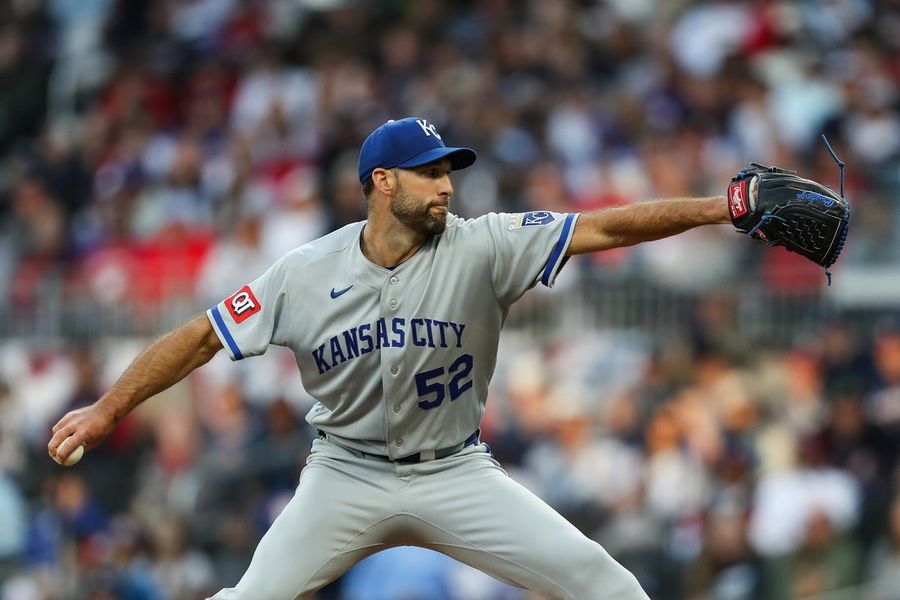
Deadspin | Guardians hope bats continue to come alive vs. Royals  Mar 28, 2026; Cumberland, Georgia, USA; Kansas City Royals starting pitcher Michael Wacha (52) throws against the Atlanta Braves in the first inning at Truist Park. Mandatory Credit: Mady Mertens-Imagn Images   Fresh off series wins against the Los Angeles Dodgers and Chicago Cubs, the American League Central-leading Cleveland Guardians begin divisional play Monday when they welcome the Kansas City Royals for a three-game set.  Those two series wins came after splitting four games in Seattle to start the season against the Mariners, a team many expect to contend for the AL pennant this season.  “We had a tough way to start, and it doesn’t get easier,” Cleveland manager Stephen Vogt said after his team won the tail end of Sunday’s doubleheader against the Cubs. “We have another tough week ahead of us, and I’m sure it doesn’t get easy after that. Every team in the big leagues is really good, but I couldn’t be more thrilled with where we are.”  Right-hander Tanner Bibee (0-1, 4.00 ERA) is slated to get the start in the series opener. He suffered the defeat in his last start, allowing just one run but lasting only four innings in a 4-1 Dodgers win on Tuesday in Los Angeles.  Bibee, 27, has fared well against the Royals. In eight career starts, Bibee is 4-0, with three of those victories coming in his last four starts against Kansas City. He has a 3.19 ERA against the Royals but has allowed 36 hits and 16 walks in 42 1/3 innings.  Offensively, the Guardians hope the bats that came alive late in Sunday’s second game against the Cubs can carry that momentum into Monday. After getting just one hit in a 1-0 loss in Sunday’s first game, the Guardians had just two hits in the first five frames of the nightcap.  However, they sent eight batters to the plate in both the sixth and eighth innings, allowing them to erase 3-0 and 4-3 deficits to win 6-5.  CJ Kayfus, who entered Sunday 0-for-10 on the season, recorded the Guardians’ lone hit in Sunday’s opener and followed that by coming off the bench to go 2-for-2 with two RBIs and two runs scored in the second game. That included his first home run of the season in the eighth inning to tie the game at 4.  Sunday’s action marked the first time the 24-year-old outfielder had played since last Tuesday in Los Angeles.   The Royals have lost three of their last four, with Sunday’s 8-5 home loss to the Milwaukee Brewers keeping them from claiming their second series of the season.  Veteran righty Michael Wacha (0-0, 0.00) gets the ball for the Royals on Monday. It will be just his second start of the season as manager Matt Quatraro’s team is using a six-man rotation.   Wacha threw six shutout innings on March 28 on the road against the Atlanta Braves. He allowed just three hits and a walk while striking out seven but did not get a decision.  Wacha is 2-2 in eight career starts against Cleveland, with a 2.49 ERA.  The Royals are hitting .251 for the season, but their best player, shortstop Bobby Witt Jr., has struggled to his standards in Kansas City’s first nine games.  Witt’s hitting just .242 this season. A two-time 30 home run hitter and 2024 AL batting champ who led the league in doubles last season and triples in 2023, he also has not gotten an extra-base hit this season.  “He’s in one of those spots right now where it seems like he’s got two strikes every time he goes up,” Quatraro told MLB.com.  –Field Level Media   #Deadspin #Guardians #hope #bats #continue #alive #Royals
Deadspin | Guardians hope bats continue to come alive vs. Royals
Deadspin | Guardians hope bats continue to come alive vs. Royals  Mar 28, 2026; Cumberland, Georgia, USA; Kansas City Royals starting pitcher Michael Wacha (52) throws against the Atlanta Braves in the first inning at Truist Park. Mandatory Credit: Mady Mertens-Imagn Images   Fresh off series wins against the Los Angeles Dodgers and Chicago Cubs, the American League Central-leading Cleveland Guardians begin divisional play Monday when they welcome the Kansas City Royals for a three-game set.  Those two series wins came after splitting four games in Seattle to start the season against the Mariners, a team many expect to contend for the AL pennant this season.  “We had a tough way to start, and it doesn’t get easier,” Cleveland manager Stephen Vogt said after his team won the tail end of Sunday’s doubleheader against the Cubs. “We have another tough week ahead of us, and I’m sure it doesn’t get easy after that. Every team in the big leagues is really good, but I couldn’t be more thrilled with where we are.”  Right-hander Tanner Bibee (0-1, 4.00 ERA) is slated to get the start in the series opener. He suffered the defeat in his last start, allowing just one run but lasting only four innings in a 4-1 Dodgers win on Tuesday in Los Angeles.  Bibee, 27, has fared well against the Royals. In eight career starts, Bibee is 4-0, with three of those victories coming in his last four starts against Kansas City. He has a 3.19 ERA against the Royals but has allowed 36 hits and 16 walks in 42 1/3 innings.  Offensively, the Guardians hope the bats that came alive late in Sunday’s second game against the Cubs can carry that momentum into Monday. After getting just one hit in a 1-0 loss in Sunday’s first game, the Guardians had just two hits in the first five frames of the nightcap.  However, they sent eight batters to the plate in both the sixth and eighth innings, allowing them to erase 3-0 and 4-3 deficits to win 6-5.  CJ Kayfus, who entered Sunday 0-for-10 on the season, recorded the Guardians’ lone hit in Sunday’s opener and followed that by coming off the bench to go 2-for-2 with two RBIs and two runs scored in the second game. That included his first home run of the season in the eighth inning to tie the game at 4.  Sunday’s action marked the first time the 24-year-old outfielder had played since last Tuesday in Los Angeles.   The Royals have lost three of their last four, with Sunday’s 8-5 home loss to the Milwaukee Brewers keeping them from claiming their second series of the season.  Veteran righty Michael Wacha (0-0, 0.00) gets the ball for the Royals on Monday. It will be just his second start of the season as manager Matt Quatraro’s team is using a six-man rotation.   Wacha threw six shutout innings on March 28 on the road against the Atlanta Braves. He allowed just three hits and a walk while striking out seven but did not get a decision.  Wacha is 2-2 in eight career starts against Cleveland, with a 2.49 ERA.  The Royals are hitting .251 for the season, but their best player, shortstop Bobby Witt Jr., has struggled to his standards in Kansas City’s first nine games.  Witt’s hitting just .242 this season. A two-time 30 home run hitter and 2024 AL batting champ who led the league in doubles last season and triples in 2023, he also has not gotten an extra-base hit this season.  “He’s in one of those spots right now where it seems like he’s got two strikes every time he goes up,” Quatraro told MLB.com.  –Field Level Media   #Deadspin #Guardians #hope #bats #continue #alive #RoyalsMar 28, 2026; Cumberland, Georgia, USA; Kansas City Royals starting pitcher Michael Wacha (52) throws against the Atlanta Braves in the first inning at Truist Park. Mandatory Credit: Mady Mertens-Imagn Images

Fresh off series wins against the Los Angeles Dodgers and Chicago Cubs, the American League Central-leading Cleveland Guardians begin divisional play Monday when they welcome the Kansas City Royals for a three-game set.

Those two series wins came after splitting four games in Seattle to start the season against the Mariners, a team many expect to contend for the AL pennant this season.

“We had a tough way to start, and it doesn’t get easier,” Cleveland manager Stephen Vogt said after his team won the tail end of Sunday’s doubleheader against the Cubs. “We have another tough week ahead of us, and I’m sure it doesn’t get easy after that. Every team in the big leagues is really good, but I couldn’t be more thrilled with where we are.”

Right-hander Tanner Bibee (0-1, 4.00 ERA) is slated to get the start in the series opener. He suffered the defeat in his last start, allowing just one run but lasting only four innings in a 4-1 Dodgers win on Tuesday in Los Angeles.

Bibee, 27, has fared well against the Royals. In eight career starts, Bibee is 4-0, with three of those victories coming in his last four starts against Kansas City. He has a 3.19 ERA against the Royals but has allowed 36 hits and 16 walks in 42 1/3 innings.

Offensively, the Guardians hope the bats that came alive late in Sunday’s second game against the Cubs can carry that momentum into Monday. After getting just one hit in a 1-0 loss in Sunday’s first game, the Guardians had just two hits in the first five frames of the nightcap.

However, they sent eight batters to the plate in both the sixth and eighth innings, allowing them to erase 3-0 and 4-3 deficits to win 6-5.

CJ Kayfus, who entered Sunday 0-for-10 on the season, recorded the Guardians’ lone hit in Sunday’s opener and followed that by coming off the bench to go 2-for-2 with two RBIs and two runs scored in the second game. That included his first home run of the season in the eighth inning to tie the game at 4.


Sunday’s action marked the first time the 24-year-old outfielder had played since last Tuesday in Los Angeles.

The Royals have lost three of their last four, with Sunday’s 8-5 home loss to the Milwaukee Brewers keeping them from claiming their second series of the season.

Veteran righty Michael Wacha (0-0, 0.00) gets the ball for the Royals on Monday. It will be just his second start of the season as manager Matt Quatraro’s team is using a six-man rotation.

Wacha threw six shutout innings on March 28 on the road against the Atlanta Braves. He allowed just three hits and a walk while striking out seven but did not get a decision.

Wacha is 2-2 in eight career starts against Cleveland, with a 2.49 ERA.

The Royals are hitting .251 for the season, but their best player, shortstop Bobby Witt Jr., has struggled to his standards in Kansas City’s first nine games.

Witt’s hitting just .242 this season. A two-time 30 home run hitter and 2024 AL batting champ who led the league in doubles last season and triples in 2023, he also has not gotten an extra-base hit this season.

“He’s in one of those spots right now where it seems like he’s got two strikes every time he goes up,” Quatraro told MLB.com.

–Field Level Media

#Deadspin #Guardians #hope #bats #continue #alive #Royals

Mar 28, 2026; Cumberland, Georgia, USA; Kansas City Royals starting pitcher Michael Wacha (52) throws against the Atlanta Braves in the first inning at Truist Park. Mandatory Credit: Mady Mertens-Imagn Images

Fresh off series wins against the Los Angeles Dodgers and Chicago Cubs, the American League Central-leading Cleveland Guardians begin divisional play Monday when they welcome the Kansas City Royals for a three-game set.

Those two series wins came after splitting four games in Seattle to start the season against the Mariners, a team many expect to contend for the AL pennant this season.

“We had a tough way to start, and it doesn’t get easier,” Cleveland manager Stephen Vogt said after his team won the tail end of Sunday’s doubleheader against the Cubs. “We have another tough week ahead of us, and I’m sure it doesn’t get easy after that. Every team in the big leagues is really good, but I couldn’t be more thrilled with where we are.”

Right-hander Tanner Bibee (0-1, 4.00 ERA) is slated to get the start in the series opener. He suffered the defeat in his last start, allowing just one run but lasting only four innings in a 4-1 Dodgers win on Tuesday in Los Angeles.

Bibee, 27, has fared well against the Royals. In eight career starts, Bibee is 4-0, with three of those victories coming in his last four starts against Kansas City. He has a 3.19 ERA against the Royals but has allowed 36 hits and 16 walks in 42 1/3 innings.

Offensively, the Guardians hope the bats that came alive late in Sunday’s second game against the Cubs can carry that momentum into Monday. After getting just one hit in a 1-0 loss in Sunday’s first game, the Guardians had just two hits in the first five frames of the nightcap.

However, they sent eight batters to the plate in both the sixth and eighth innings, allowing them to erase 3-0 and 4-3 deficits to win 6-5.

CJ Kayfus, who entered Sunday 0-for-10 on the season, recorded the Guardians’ lone hit in Sunday’s opener and followed that by coming off the bench to go 2-for-2 with two RBIs and two runs scored in the second game. That included his first home run of the season in the eighth inning to tie the game at 4.

Sunday’s action marked the first time the 24-year-old outfielder had played since last Tuesday in Los Angeles.

The Royals have lost three of their last four, with Sunday’s 8-5 home loss to the Milwaukee Brewers keeping them from claiming their second series of the season.

Veteran righty Michael Wacha (0-0, 0.00) gets the ball for the Royals on Monday. It will be just his second start of the season as manager Matt Quatraro’s team is using a six-man rotation.

Wacha threw six shutout innings on March 28 on the road against the Atlanta Braves. He allowed just three hits and a walk while striking out seven but did not get a decision.

Wacha is 2-2 in eight career starts against Cleveland, with a 2.49 ERA.

The Royals are hitting .251 for the season, but their best player, shortstop Bobby Witt Jr., has struggled to his standards in Kansas City’s first nine games.

Witt’s hitting just .242 this season. A two-time 30 home run hitter and 2024 AL batting champ who led the league in doubles last season and triples in 2023, he also has not gotten an extra-base hit this season.

“He’s in one of those spots right now where it seems like he’s got two strikes every time he goes up,” Quatraro told MLB.com.

–Field Level Media

Source link
#Deadspin #Guardians #hope #bats #continue #alive #Royals

Previous post

Rosie Huntington-Whiteley is ViX Paula Hermanny’s New Global Ambassador

Next post

Vatican: Francis stable, out of ‘imminent danger’ of death<img src="https://gdb.voanews.com/9637e9f0-f554-4997-0a41-08dd5c8b1668_cx0_cy3_cw0_w800_h450.jpg" /><br><div id="article-content"> <div class="wsw"> <p>The Vatican issued an update Saturday on the health of Pope Francis, who remains in Rome’s Gemelli hospital under the care of doctors, saying that while his prognosis remains “complex,” the pope is no longer in “imminent danger” of death.</p><p>On Friday, the Vatican’s Holy See Press Office announced that since Francis’ condition is now considered stable, barring any major developments, updates on his health will be less frequent. The 88-year-old pontiff has spent four weeks in the hospital and is receiving treatment for double pneumonia.</p><p>Medical bulletins from the pope’s doctors, which had been almost a daily occurrence since his admission to Gemelli hospital on Feb. 14, will be issued only when there is new information, the press office said Friday. The office emphasized that Francis’ recovery is progressing, but that it will require time to make sure the improvements continue.</p><p>This also means the Holy See’s daily morning update about how the pope spent the night will no longer be issued, which leaves only the evening news briefing for journalists.</p><p>The Vatican said that this is a “a positive sign” for the Catholic faithful, meaning that no news is essentially good news.</p><p>Francis is continuing his prescribed medical treatments, which included motor physiotherapy Friday. He alternates between noninvasive mechanical ventilation at night and high-flow oxygenation with nasal cannulas during the day, according to the Vatican.</p><p>Francis had part of a lung removed as a young man after a pulmonary infection and has in recent years battled recurring bouts of bronchitis.</p><p>On Thursday, the press office said Francis celebrated the 12th anniversary of his papal election surrounded by health care staff.</p><p>Part of the pope’s hospital stay comes during the Christian season of Lent. It is the annual 40-day period of prayer, fasting and almsgiving that begins on Ash Wednesday and ends at sundown on Holy Thursday. Lent began on March 5.</p> </div> <ul class="authors-highlights"> <li class="authors-highlights__item"> </li> </ul> </div>#Vatican #Francis #stable #imminent #danger #deathEurope, Americas, Pope Francis

Brendan Sorsby was one of college football’s highest-paid players in the transfer portal, and he was considered a possible first-round pick in the 2027 NFL Draft. The 6’3 quarterback left Cincinnati for Texas Tech after a tremendous junior season for a reported sum of $5 million. Just when the Red Raiders were celebrating the addition of one of the country’s top QBs, Sorsby was caught up in gambling allegations that sent him to rehab and likely ends his college career.

It now looks like the best bet for Sorsby’s immediate future is to turn pro through the NFL Supplemental Draft, which is expected to be held in mid July.

What is the Supplemental Draft? How much interest would Sorsby really draw? Let’s dive into the history of the NFL’s other draft, with more context on what makes Sorsby such an enticing prospect.

What is the NFL Supplemental Draft?

What, exactly, is the NFL Supplemental Draft?

Begun in 1977, the NFL Supplemental Draft is held for players that lost their remaining college eligibility after the league’s deadline to enter the NFL’s standard player entry draft. For those wondering, Al Hunter was the first player taken in an NFL Supplemental Draft in 1977, after the Notre Dame running back was suspended from the school for disciplinary reasons.

Perhaps the most notable NFL Supplemental Drafts have been in 1985 and 1989. In March of 1985, Miami (FL) quarterback Bernie Kosar announced that he planned on skipping his final two years of college to enter the 1985 NFL Draft.

But at that time, NFL rules only allowed college seniors and graduates to enter the NFL Draft. To work around this, Kosar had arranged an accelerated academic plan, where he would take 18 credits in the spring of 1985 and an additional six more in the summer, to meet the eligibility requirements.

During his announcement Kosar, who grew up in Ohio as a Cleveland Browns fan, made it clear he wanted to play for his hometown team.

However, Kosar was considered an elite prospect, and teams started angling for position in the first round for a shot at Kosar. Most notably the Minnesota Vikings executed a trade with the Houston Oilers to pick up a top pick in the first round, hoping to land Kosar.

Cleveland, however, quietly executed a trade with the Buffalo Bills, acquiring Buffalo’s first pick in the 1985 Supplemental Draft in exchange for first-round picks in 1985 and 1986, as wells as a third round selection in 1985 and a sixth-round pick in 1986.

Kosar did not meet the deadline to enter the 1985 NFL Draft, which came in April.

That is when the rest of the league learned about Cleveland’s trade with the Bills. The Oilers threatened to sue to stop the 1985 NFL Draft from taking place, as Houston also wanted a chance to draft Kosar. Teams implored NFL Commissioner Pete Rozelle to reverse the trade between the Browns and the Bills. The quarterback’s agent warned that he would sue the league if Kosar was forced to enter the traditional draft.

Ultimately, Rozelle gave Kosar the choice between the two drafts, and the quarterback announced he was skipping the 1985 NFL Draft and entering the Supplemental Draft, where the Browns used their first selection to draft the quarterback.

The 1989 NFL Supplemental Draft was notable for having three players selected in the first round — quarterbacks Steve Walsh and Timm Rosenbach, and running back Bobby Humphrey.

To date, 46 players have been selected in an NFL Supplemental Draft, with safety Jalen Thompson in 2019 the most recent selection. Of those 46 players only one, wide receiver Cris Carter, has made the Pro Football Hall of Fame. Carter was suspended before his senior season for signing with an agent.

How does the order work in the Supplemental Draft?

The chaos around Kosar in 1985 forced the league to adjust how the order is determined for the Supplemental Draft.

Previously, the order for the NFL Draft was the same as the order for the Supplemental Draft, but in the wake of Kosar, the league implemented the quasi-random ordering process that is in place today. Teams are divided into three pools — non-playoff teams with six or fewer wins, non-playoff teams with seven or more wins, and then the playoff teams — and teams “bid” on players, indicating in which round they would select that player. If no other team places a bid on a player in an earlier spot, then the team that placed the bid is awarded the player, and forfeits an equivalent pick in the next NFL Draft.

So when the Arizona Cardinals drafted Jalen Thompson in the fifth round of the 2019 NFL Supplemental Draft, they forfeited a fifth-round pick in the 2020 NFL Draft.

Why might Brendan Sorsby need the NFL Supplemental Draft?

All of this leads us to Brendan Sorsby.

Last year at Cincinnati, Sorsby completed nearly 62% of his passes for 2,800 yards and 27 touchdowns, against just five interceptions. He also added another 580 rushing yards and nine touchdowns for the Bearcats. But he announced in December of last year that he was transferring, and became one of the most sought-after players in the portal. In fact, ESPN rated Sorsby as the top player in the transfer portal.

In January, after visiting Texas Tech and LSU, Sorsby announced he was joining the Red Raiders, with projections indicating he might surpass $5 million in NIL money.

Even in a crowded quarterback class for the 2027 NFL Draft, Sorsby was one of the favorites for a first-round pick next year. Consider this list from the various “way too early” mock drafts:

Then came word in late April that Sorsby was stepping away from Texas Tech to enter into a residential treatment program for a gambling addiction. A report from ESPN outlined that Sorsby made “thousands” of online bets across various sports via a gambling app, including games on Indiana football while Sorsby was a reserve quarterback for the Hoosiers. ESPN reported that Sorsby’s bets in 2022 were on Indiana to win games, and those bets did not include the one game where Sorsby saw the field for the Hoosiers.

See if you can tell, courtesy of NFL Mock Draft Database, when this news emerged:

Sorsby has not been ruled ineligible for the 2026 college football season, and the NCAA said in a statement to USA Today that the governing body would not comment on an ongoing investigation. But if he is ruled ineligible by the NCAA in the coming weeks, then the NFL Supplemental Draft would be an option for him.

And as you can see from the above, there is still a belief that if Sorsby is allowed to play next year, he would be a first-round pick, based on the early mock drafts for next year.

However, the clock is ticking. Sorsby has until June 22 to apply for the 2026 Supplemental Draft, and then the league would review the circumstances regarding his application. As noted by ESPN’s Adam Schefter, Sorsby has hired attorney Jeffrey Kessler to try and maintain his college eligibility and perhaps speed up the process and/or negotiate a settlement on a suspension.

Which brings us to the latest development.

The injunction request, and what happens next

This story took another turn on Monday.

As first reported by ESPN Sorsby, through his attorneys, has filed for an injunction against the NCAA in Lubbock, Texas. In the filing, according to ESPN, Sorsby alleges that he is “currently ineligible to play for Texas Tech due to prior violations of the NCAA’s sports gambling rules” and that he would be “irreparably harmed” if the injunction were not granted.

It is worth noting that the NCAA has not issued any public statement, nor has the governing body made any penalty public. This would seem to indicate that Sorsby has been notified privately of a potential penalty from the NCAA.

In the injunction filing, which SB Nation has reviewed, Sorsby alleges that he suffers from a “clinically diagnosed” gambling disorder, and further states that is a “mental health condition.” The filing also alleges that the NCAA has “weaponized his condition to shore up a facade of competitive integrity, while simultaneously profiting from the very gambling ecosystem it policies.”

Furthermore, the filing states that:

When Mr. Sorsby took accountability for his NCAA gambling rules violations (which undisputedly did not raise any integrity issues, i.e., his bets did not threaten the fairness, honesty, and/or transparency of athletic competitions, or otherwise influence the outcome or athlete performance in those competitions), entered residential treatment, and offered to accept reasonable discipline (but not a full loss of eligibility for the upcoming season at Texas Tech), the NCAA responded not with the compassion its constitution (“Constitution” or “NCAA Constitution”) demands, but with stonewalling, pretextual information demands, delay, and silence. This is not what Texas law or common decency requires.

The filing also notes that “[t]ime is of the essence.” Specifically, Sorsby is in the final year of eligiblity, a “once-in-a-lifetime opportunity that, once lost, can never be recovered.”

Sorsby, through his attorneys, notes that:

If the NCAA refuses to reinstate him and he is not awarded temporary relief, Mr. Sorsby’s only alternative is the NFL Supplemental Draft, which requires him to opt in—and forgo any effort to restore his remaining college eligibility—by June 22, 2026. The NCAA has manufactured an impossible bind: it delays its reinstatement decision while the NFL deadline closes in, forcing Mr. Sorsby to choose between surrendering college eligibility he wants to retain, while risking the loss of a full year of competitive football entirely. This is not equity. Mr. Sorsby has diligently pursued every alternative avenue for relief, but he is not obligated to continue doing so in light of the irreparable harm he now faces. Only this Court can hold the NCAA to its own rules—and provide Mr. Sorsby and Texas Tech the timely relief they are owed.

The request for an injunction also seeks a hearing no later than June 15, so that “the Court has the opportunity to render a decision on his request for a temporary injunction prior to June 22, when Mr. Sorsby must determine whether to enter the NFL Supplemental Draft.”

#Brendan #Sorsbys #gambling #allegations #college #football #career #NFL #Supplemental #Draft">Brendan Sorsby’s gambling allegations could end his college football career. Is NFL Supplemental Draft next?  Brendan Sorsby was one of college football’s highest-paid players in the transfer portal, and he was considered a possible first-round pick in the 2027 NFL Draft. The 6’3 quarterback left Cincinnati for Texas Tech after a tremendous junior season for a reported sum of $5 million. Just when the Red Raiders were celebrating the addition of one of the country’s top QBs, Sorsby was caught up in gambling allegations that sent him to rehab and likely ends his college career.It now looks like the best bet for Sorsby’s immediate future is to turn pro through the NFL Supplemental Draft, which is expected to be held in mid July.What is the Supplemental Draft? How much interest would Sorsby really draw? Let’s dive into the history of the NFL’s other draft, with more context on what makes Sorsby such an enticing prospect.What is the NFL Supplemental Draft?What, exactly, is the NFL Supplemental Draft?Begun in 1977, the NFL Supplemental Draft is held for players that lost their remaining college eligibility after the league’s deadline to enter the NFL’s standard player entry draft. For those wondering, Al Hunter was the first player taken in an NFL Supplemental Draft in 1977, after the Notre Dame running back was suspended from the school for disciplinary reasons.Perhaps the most notable NFL Supplemental Drafts have been in 1985 and 1989. In March of 1985, Miami (FL) quarterback Bernie Kosar announced that he planned on skipping his final two years of college to enter the 1985 NFL Draft.But at that time, NFL rules only allowed college seniors and graduates to enter the NFL Draft. To work around this, Kosar had arranged an accelerated academic plan, where he would take 18 credits in the spring of 1985 and an additional six more in the summer, to meet the eligibility requirements.During his announcement Kosar, who grew up in Ohio as a Cleveland Browns fan, made it clear he wanted to play for his hometown team.However, Kosar was considered an elite prospect, and teams started angling for position in the first round for a shot at Kosar. Most notably the Minnesota Vikings executed a trade with the Houston Oilers to pick up a top pick in the first round, hoping to land Kosar.Cleveland, however, quietly executed a trade with the Buffalo Bills, acquiring Buffalo’s first pick in the 1985 Supplemental Draft in exchange for first-round picks in 1985 and 1986, as wells as a third round selection in 1985 and a sixth-round pick in 1986.Kosar did not meet the deadline to enter the 1985 NFL Draft, which came in April.That is when the rest of the league learned about Cleveland’s trade with the Bills. The Oilers threatened to sue to stop the 1985 NFL Draft from taking place, as Houston also wanted a chance to draft Kosar. Teams implored NFL Commissioner Pete Rozelle to reverse the trade between the Browns and the Bills. The quarterback’s agent warned that he would sue the league if Kosar was forced to enter the traditional draft.Ultimately, Rozelle gave Kosar the choice between the two drafts, and the quarterback announced he was skipping the 1985 NFL Draft and entering the Supplemental Draft, where the Browns used their first selection to draft the quarterback.The 1989 NFL Supplemental Draft was notable for having three players selected in the first round — quarterbacks Steve Walsh and Timm Rosenbach, and running back Bobby Humphrey.To date, 46 players have been selected in an NFL Supplemental Draft, with safety Jalen Thompson in 2019 the most recent selection. Of those 46 players only one, wide receiver Cris Carter, has made the Pro Football Hall of Fame. Carter was suspended before his senior season for signing with an agent.How does the order work in the Supplemental Draft?The chaos around Kosar in 1985 forced the league to adjust how the order is determined for the Supplemental Draft.Previously, the order for the NFL Draft was the same as the order for the Supplemental Draft, but in the wake of Kosar, the league implemented the quasi-random ordering process that is in place today. Teams are divided into three pools — non-playoff teams with six or fewer wins, non-playoff teams with seven or more wins, and then the playoff teams — and teams “bid” on players, indicating in which round they would select that player. If no other team places a bid on a player in an earlier spot, then the team that placed the bid is awarded the player, and forfeits an equivalent pick in the next NFL Draft.So when the Arizona Cardinals drafted Jalen Thompson in the fifth round of the 2019 NFL Supplemental Draft, they forfeited a fifth-round pick in the 2020 NFL Draft.Why might Brendan Sorsby need the NFL Supplemental Draft?All of this leads us to Brendan Sorsby.Last year at Cincinnati, Sorsby completed nearly 62% of his passes for 2,800 yards and 27 touchdowns, against just five interceptions. He also added another 580 rushing yards and nine touchdowns for the Bearcats. But he announced in December of last year that he was transferring, and became one of the most sought-after players in the portal. In fact, ESPN rated Sorsby as the top player in the transfer portal.In January, after visiting Texas Tech and LSU, Sorsby announced he was joining the Red Raiders, with projections indicating he might surpass $5 million in NIL money.Even in a crowded quarterback class for the 2027 NFL Draft, Sorsby was one of the favorites for a first-round pick next year. Consider this list from the various “way too early” mock drafts:USA TODAY Sports: No. 13 overall, Pittsburgh SteelersPro Football Focus: No. 8 overall, Pittsburgh SteelersCBS Sports: No. 8 overall, Pittsburgh SteelersBleacher Report: No. 10 overall, Atlanta FalconsNJ.com: No. 4 overall, Cleveland BrownsThen came word in late April that Sorsby was stepping away from Texas Tech to enter into a residential treatment program for a gambling addiction. A report from ESPN outlined that Sorsby made “thousands” of online bets across various sports via a gambling app, including games on Indiana football while Sorsby was a reserve quarterback for the Hoosiers. ESPN reported that Sorsby’s bets in 2022 were on Indiana to win games, and those bets did not include the one game where Sorsby saw the field for the Hoosiers.See if you can tell, courtesy of NFL Mock Draft Database, when this news emerged:Sorsby has not been ruled ineligible for the 2026 college football season, and the NCAA said in a statement to USA Today that the governing body would not comment on an ongoing investigation. But if he is ruled ineligible by the NCAA in the coming weeks, then the NFL Supplemental Draft would be an option for him.And as you can see from the above, there is still a belief that if Sorsby is allowed to play next year, he would be a first-round pick, based on the early mock drafts for next year.However, the clock is ticking. Sorsby has until June 22 to apply for the 2026 Supplemental Draft, and then the league would review the circumstances regarding his application. As noted by ESPN’s Adam Schefter, Sorsby has hired attorney Jeffrey Kessler to try and maintain his college eligibility and perhaps speed up the process and/or negotiate a settlement on a suspension.Which brings us to the latest development.The injunction request, and what happens nextThis story took another turn on Monday.As first reported by ESPN Sorsby, through his attorneys, has filed for an injunction against the NCAA in Lubbock, Texas. In the filing, according to ESPN, Sorsby alleges that he is “currently ineligible to play for Texas Tech due to prior violations of the NCAA’s sports gambling rules” and that he would be “irreparably harmed” if the injunction were not granted.It is worth noting that the NCAA has not issued any public statement, nor has the governing body made any penalty public. This would seem to indicate that Sorsby has been notified privately of a potential penalty from the NCAA.In the injunction filing, which SB Nation has reviewed, Sorsby alleges that he suffers from a “clinically diagnosed” gambling disorder, and further states that is a “mental health condition.” The filing also alleges that the NCAA has “weaponized his condition to shore up a facade of competitive integrity, while simultaneously profiting from the very gambling ecosystem it policies.”Furthermore, the filing states that:When Mr. Sorsby took accountability for his NCAA gambling rules violations (which undisputedly did not raise any integrity issues, i.e., his bets did not threaten the fairness, honesty, and/or transparency of athletic competitions, or otherwise influence the outcome or athlete performance in those competitions), entered residential treatment, and offered to accept reasonable discipline (but not a full loss of eligibility for the upcoming season at Texas Tech), the NCAA responded not with the compassion its constitution (“Constitution” or “NCAA Constitution”) demands, but with stonewalling, pretextual information demands, delay, and silence. This is not what Texas law or common decency requires.The filing also notes that “[t]ime is of the essence.” Specifically, Sorsby is in the final year of eligiblity, a “once-in-a-lifetime opportunity that, once lost, can never be recovered.”Sorsby, through his attorneys, notes that:If the NCAA refuses to reinstate him and he is not awarded temporary relief, Mr. Sorsby’s only alternative is the NFL Supplemental Draft, which requires him to opt in—and forgo any effort to restore his remaining college eligibility—by June 22, 2026. The NCAA has manufactured an impossible bind: it delays its reinstatement decision while the NFL deadline closes in, forcing Mr. Sorsby to choose between surrendering college eligibility he wants to retain, while risking the loss of a full year of competitive football entirely. This is not equity. Mr. Sorsby has diligently pursued every alternative avenue for relief, but he is not obligated to continue doing so in light of the irreparable harm he now faces. Only this Court can hold the NCAA to its own rules—and provide Mr. Sorsby and Texas Tech the timely relief they are owed.The request for an injunction also seeks a hearing no later than June 15, so that “the Court has the opportunity to render a decision on his request for a temporary injunction prior to June 22, when Mr. Sorsby must determine whether to enter the NFL Supplemental Draft.”  #Brendan #Sorsbys #gambling #allegations #college #football #career #NFL #Supplemental #Draft

Sorsby was caught up in gambling allegations that sent him to rehab and likely ends his college career.

It now looks like the best bet for Sorsby’s immediate future is to turn pro through the NFL Supplemental Draft, which is expected to be held in mid July.

What is the Supplemental Draft? How much interest would Sorsby really draw? Let’s dive into the history of the NFL’s other draft, with more context on what makes Sorsby such an enticing prospect.

What is the NFL Supplemental Draft?

What, exactly, is the NFL Supplemental Draft?

Begun in 1977, the NFL Supplemental Draft is held for players that lost their remaining college eligibility after the league’s deadline to enter the NFL’s standard player entry draft. For those wondering, Al Hunter was the first player taken in an NFL Supplemental Draft in 1977, after the Notre Dame running back was suspended from the school for disciplinary reasons.

Perhaps the most notable NFL Supplemental Drafts have been in 1985 and 1989. In March of 1985, Miami (FL) quarterback Bernie Kosar announced that he planned on skipping his final two years of college to enter the 1985 NFL Draft.

But at that time, NFL rules only allowed college seniors and graduates to enter the NFL Draft. To work around this, Kosar had arranged an accelerated academic plan, where he would take 18 credits in the spring of 1985 and an additional six more in the summer, to meet the eligibility requirements.

During his announcement Kosar, who grew up in Ohio as a Cleveland Browns fan, made it clear he wanted to play for his hometown team.

However, Kosar was considered an elite prospect, and teams started angling for position in the first round for a shot at Kosar. Most notably the Minnesota Vikings executed a trade with the Houston Oilers to pick up a top pick in the first round, hoping to land Kosar.

Cleveland, however, quietly executed a trade with the Buffalo Bills, acquiring Buffalo’s first pick in the 1985 Supplemental Draft in exchange for first-round picks in 1985 and 1986, as wells as a third round selection in 1985 and a sixth-round pick in 1986.

Kosar did not meet the deadline to enter the 1985 NFL Draft, which came in April.

That is when the rest of the league learned about Cleveland’s trade with the Bills. The Oilers threatened to sue to stop the 1985 NFL Draft from taking place, as Houston also wanted a chance to draft Kosar. Teams implored NFL Commissioner Pete Rozelle to reverse the trade between the Browns and the Bills. The quarterback’s agent warned that he would sue the league if Kosar was forced to enter the traditional draft.

Ultimately, Rozelle gave Kosar the choice between the two drafts, and the quarterback announced he was skipping the 1985 NFL Draft and entering the Supplemental Draft, where the Browns used their first selection to draft the quarterback.

The 1989 NFL Supplemental Draft was notable for having three players selected in the first round — quarterbacks Steve Walsh and Timm Rosenbach, and running back Bobby Humphrey.

To date, 46 players have been selected in an NFL Supplemental Draft, with safety Jalen Thompson in 2019 the most recent selection. Of those 46 players only one, wide receiver Cris Carter, has made the Pro Football Hall of Fame. Carter was suspended before his senior season for signing with an agent.

How does the order work in the Supplemental Draft?

The chaos around Kosar in 1985 forced the league to adjust how the order is determined for the Supplemental Draft.

Previously, the order for the NFL Draft was the same as the order for the Supplemental Draft, but in the wake of Kosar, the league implemented the quasi-random ordering process that is in place today. Teams are divided into three pools — non-playoff teams with six or fewer wins, non-playoff teams with seven or more wins, and then the playoff teams — and teams “bid” on players, indicating in which round they would select that player. If no other team places a bid on a player in an earlier spot, then the team that placed the bid is awarded the player, and forfeits an equivalent pick in the next NFL Draft.

So when the Arizona Cardinals drafted Jalen Thompson in the fifth round of the 2019 NFL Supplemental Draft, they forfeited a fifth-round pick in the 2020 NFL Draft.

Why might Brendan Sorsby need the NFL Supplemental Draft?

All of this leads us to Brendan Sorsby.

Last year at Cincinnati, Sorsby completed nearly 62% of his passes for 2,800 yards and 27 touchdowns, against just five interceptions. He also added another 580 rushing yards and nine touchdowns for the Bearcats. But he announced in December of last year that he was transferring, and became one of the most sought-after players in the portal. In fact, ESPN rated Sorsby as the top player in the transfer portal.

In January, after visiting Texas Tech and LSU, Sorsby announced he was joining the Red Raiders, with projections indicating he might surpass $5 million in NIL money.

Even in a crowded quarterback class for the 2027 NFL Draft, Sorsby was one of the favorites for a first-round pick next year. Consider this list from the various “way too early” mock drafts:

Then came word in late April that Sorsby was stepping away from Texas Tech to enter into a residential treatment program for a gambling addiction. A report from ESPN outlined that Sorsby made “thousands” of online bets across various sports via a gambling app, including games on Indiana football while Sorsby was a reserve quarterback for the Hoosiers. ESPN reported that Sorsby’s bets in 2022 were on Indiana to win games, and those bets did not include the one game where Sorsby saw the field for the Hoosiers.

See if you can tell, courtesy of NFL Mock Draft Database, when this news emerged:

Sorsby has not been ruled ineligible for the 2026 college football season, and the NCAA said in a statement to USA Today that the governing body would not comment on an ongoing investigation. But if he is ruled ineligible by the NCAA in the coming weeks, then the NFL Supplemental Draft would be an option for him.

And as you can see from the above, there is still a belief that if Sorsby is allowed to play next year, he would be a first-round pick, based on the early mock drafts for next year.

However, the clock is ticking. Sorsby has until June 22 to apply for the 2026 Supplemental Draft, and then the league would review the circumstances regarding his application. As noted by ESPN’s Adam Schefter, Sorsby has hired attorney Jeffrey Kessler to try and maintain his college eligibility and perhaps speed up the process and/or negotiate a settlement on a suspension.

Which brings us to the latest development.

The injunction request, and what happens next

This story took another turn on Monday.

As first reported by ESPN Sorsby, through his attorneys, has filed for an injunction against the NCAA in Lubbock, Texas. In the filing, according to ESPN, Sorsby alleges that he is “currently ineligible to play for Texas Tech due to prior violations of the NCAA’s sports gambling rules” and that he would be “irreparably harmed” if the injunction were not granted.

It is worth noting that the NCAA has not issued any public statement, nor has the governing body made any penalty public. This would seem to indicate that Sorsby has been notified privately of a potential penalty from the NCAA.

In the injunction filing, which SB Nation has reviewed, Sorsby alleges that he suffers from a “clinically diagnosed” gambling disorder, and further states that is a “mental health condition.” The filing also alleges that the NCAA has “weaponized his condition to shore up a facade of competitive integrity, while simultaneously profiting from the very gambling ecosystem it policies.”

Furthermore, the filing states that:

When Mr. Sorsby took accountability for his NCAA gambling rules violations (which undisputedly did not raise any integrity issues, i.e., his bets did not threaten the fairness, honesty, and/or transparency of athletic competitions, or otherwise influence the outcome or athlete performance in those competitions), entered residential treatment, and offered to accept reasonable discipline (but not a full loss of eligibility for the upcoming season at Texas Tech), the NCAA responded not with the compassion its constitution (“Constitution” or “NCAA Constitution”) demands, but with stonewalling, pretextual information demands, delay, and silence. This is not what Texas law or common decency requires.

The filing also notes that “[t]ime is of the essence.” Specifically, Sorsby is in the final year of eligiblity, a “once-in-a-lifetime opportunity that, once lost, can never be recovered.”

Sorsby, through his attorneys, notes that:

If the NCAA refuses to reinstate him and he is not awarded temporary relief, Mr. Sorsby’s only alternative is the NFL Supplemental Draft, which requires him to opt in—and forgo any effort to restore his remaining college eligibility—by June 22, 2026. The NCAA has manufactured an impossible bind: it delays its reinstatement decision while the NFL deadline closes in, forcing Mr. Sorsby to choose between surrendering college eligibility he wants to retain, while risking the loss of a full year of competitive football entirely. This is not equity. Mr. Sorsby has diligently pursued every alternative avenue for relief, but he is not obligated to continue doing so in light of the irreparable harm he now faces. Only this Court can hold the NCAA to its own rules—and provide Mr. Sorsby and Texas Tech the timely relief they are owed.

The request for an injunction also seeks a hearing no later than June 15, so that “the Court has the opportunity to render a decision on his request for a temporary injunction prior to June 22, when Mr. Sorsby must determine whether to enter the NFL Supplemental Draft.”

#Brendan #Sorsbys #gambling #allegations #college #football #career #NFL #Supplemental #Draft">Brendan Sorsby’s gambling allegations could end his college football career. Is NFL Supplemental Draft next?

Brendan Sorsby was one of college football’s highest-paid players in the transfer portal, and he was considered a possible first-round pick in the 2027 NFL Draft. The 6’3 quarterback left Cincinnati for Texas Tech after a tremendous junior season for a reported sum of $5 million. Just when the Red Raiders were celebrating the addition of one of the country’s top QBs, Sorsby was caught up in gambling allegations that sent him to rehab and likely ends his college career.

It now looks like the best bet for Sorsby’s immediate future is to turn pro through the NFL Supplemental Draft, which is expected to be held in mid July.

What is the Supplemental Draft? How much interest would Sorsby really draw? Let’s dive into the history of the NFL’s other draft, with more context on what makes Sorsby such an enticing prospect.

What is the NFL Supplemental Draft?

What, exactly, is the NFL Supplemental Draft?

Begun in 1977, the NFL Supplemental Draft is held for players that lost their remaining college eligibility after the league’s deadline to enter the NFL’s standard player entry draft. For those wondering, Al Hunter was the first player taken in an NFL Supplemental Draft in 1977, after the Notre Dame running back was suspended from the school for disciplinary reasons.

Perhaps the most notable NFL Supplemental Drafts have been in 1985 and 1989. In March of 1985, Miami (FL) quarterback Bernie Kosar announced that he planned on skipping his final two years of college to enter the 1985 NFL Draft.

But at that time, NFL rules only allowed college seniors and graduates to enter the NFL Draft. To work around this, Kosar had arranged an accelerated academic plan, where he would take 18 credits in the spring of 1985 and an additional six more in the summer, to meet the eligibility requirements.

During his announcement Kosar, who grew up in Ohio as a Cleveland Browns fan, made it clear he wanted to play for his hometown team.

However, Kosar was considered an elite prospect, and teams started angling for position in the first round for a shot at Kosar. Most notably the Minnesota Vikings executed a trade with the Houston Oilers to pick up a top pick in the first round, hoping to land Kosar.

Cleveland, however, quietly executed a trade with the Buffalo Bills, acquiring Buffalo’s first pick in the 1985 Supplemental Draft in exchange for first-round picks in 1985 and 1986, as wells as a third round selection in 1985 and a sixth-round pick in 1986.

Kosar did not meet the deadline to enter the 1985 NFL Draft, which came in April.

That is when the rest of the league learned about Cleveland’s trade with the Bills. The Oilers threatened to sue to stop the 1985 NFL Draft from taking place, as Houston also wanted a chance to draft Kosar. Teams implored NFL Commissioner Pete Rozelle to reverse the trade between the Browns and the Bills. The quarterback’s agent warned that he would sue the league if Kosar was forced to enter the traditional draft.

Ultimately, Rozelle gave Kosar the choice between the two drafts, and the quarterback announced he was skipping the 1985 NFL Draft and entering the Supplemental Draft, where the Browns used their first selection to draft the quarterback.

The 1989 NFL Supplemental Draft was notable for having three players selected in the first round — quarterbacks Steve Walsh and Timm Rosenbach, and running back Bobby Humphrey.

To date, 46 players have been selected in an NFL Supplemental Draft, with safety Jalen Thompson in 2019 the most recent selection. Of those 46 players only one, wide receiver Cris Carter, has made the Pro Football Hall of Fame. Carter was suspended before his senior season for signing with an agent.

How does the order work in the Supplemental Draft?

The chaos around Kosar in 1985 forced the league to adjust how the order is determined for the Supplemental Draft.

Previously, the order for the NFL Draft was the same as the order for the Supplemental Draft, but in the wake of Kosar, the league implemented the quasi-random ordering process that is in place today. Teams are divided into three pools — non-playoff teams with six or fewer wins, non-playoff teams with seven or more wins, and then the playoff teams — and teams “bid” on players, indicating in which round they would select that player. If no other team places a bid on a player in an earlier spot, then the team that placed the bid is awarded the player, and forfeits an equivalent pick in the next NFL Draft.

So when the Arizona Cardinals drafted Jalen Thompson in the fifth round of the 2019 NFL Supplemental Draft, they forfeited a fifth-round pick in the 2020 NFL Draft.

Why might Brendan Sorsby need the NFL Supplemental Draft?

All of this leads us to Brendan Sorsby.

Last year at Cincinnati, Sorsby completed nearly 62% of his passes for 2,800 yards and 27 touchdowns, against just five interceptions. He also added another 580 rushing yards and nine touchdowns for the Bearcats. But he announced in December of last year that he was transferring, and became one of the most sought-after players in the portal. In fact, ESPN rated Sorsby as the top player in the transfer portal.

In January, after visiting Texas Tech and LSU, Sorsby announced he was joining the Red Raiders, with projections indicating he might surpass $5 million in NIL money.

Even in a crowded quarterback class for the 2027 NFL Draft, Sorsby was one of the favorites for a first-round pick next year. Consider this list from the various “way too early” mock drafts:

Then came word in late April that Sorsby was stepping away from Texas Tech to enter into a residential treatment program for a gambling addiction. A report from ESPN outlined that Sorsby made “thousands” of online bets across various sports via a gambling app, including games on Indiana football while Sorsby was a reserve quarterback for the Hoosiers. ESPN reported that Sorsby’s bets in 2022 were on Indiana to win games, and those bets did not include the one game where Sorsby saw the field for the Hoosiers.

See if you can tell, courtesy of NFL Mock Draft Database, when this news emerged:

Sorsby has not been ruled ineligible for the 2026 college football season, and the NCAA said in a statement to USA Today that the governing body would not comment on an ongoing investigation. But if he is ruled ineligible by the NCAA in the coming weeks, then the NFL Supplemental Draft would be an option for him.

And as you can see from the above, there is still a belief that if Sorsby is allowed to play next year, he would be a first-round pick, based on the early mock drafts for next year.

However, the clock is ticking. Sorsby has until June 22 to apply for the 2026 Supplemental Draft, and then the league would review the circumstances regarding his application. As noted by ESPN’s Adam Schefter, Sorsby has hired attorney Jeffrey Kessler to try and maintain his college eligibility and perhaps speed up the process and/or negotiate a settlement on a suspension.

Which brings us to the latest development.

The injunction request, and what happens next

This story took another turn on Monday.

As first reported by ESPN Sorsby, through his attorneys, has filed for an injunction against the NCAA in Lubbock, Texas. In the filing, according to ESPN, Sorsby alleges that he is “currently ineligible to play for Texas Tech due to prior violations of the NCAA’s sports gambling rules” and that he would be “irreparably harmed” if the injunction were not granted.

It is worth noting that the NCAA has not issued any public statement, nor has the governing body made any penalty public. This would seem to indicate that Sorsby has been notified privately of a potential penalty from the NCAA.

In the injunction filing, which SB Nation has reviewed, Sorsby alleges that he suffers from a “clinically diagnosed” gambling disorder, and further states that is a “mental health condition.” The filing also alleges that the NCAA has “weaponized his condition to shore up a facade of competitive integrity, while simultaneously profiting from the very gambling ecosystem it policies.”

Furthermore, the filing states that:

When Mr. Sorsby took accountability for his NCAA gambling rules violations (which undisputedly did not raise any integrity issues, i.e., his bets did not threaten the fairness, honesty, and/or transparency of athletic competitions, or otherwise influence the outcome or athlete performance in those competitions), entered residential treatment, and offered to accept reasonable discipline (but not a full loss of eligibility for the upcoming season at Texas Tech), the NCAA responded not with the compassion its constitution (“Constitution” or “NCAA Constitution”) demands, but with stonewalling, pretextual information demands, delay, and silence. This is not what Texas law or common decency requires.

The filing also notes that “[t]ime is of the essence.” Specifically, Sorsby is in the final year of eligiblity, a “once-in-a-lifetime opportunity that, once lost, can never be recovered.”

Sorsby, through his attorneys, notes that:

If the NCAA refuses to reinstate him and he is not awarded temporary relief, Mr. Sorsby’s only alternative is the NFL Supplemental Draft, which requires him to opt in—and forgo any effort to restore his remaining college eligibility—by June 22, 2026. The NCAA has manufactured an impossible bind: it delays its reinstatement decision while the NFL deadline closes in, forcing Mr. Sorsby to choose between surrendering college eligibility he wants to retain, while risking the loss of a full year of competitive football entirely. This is not equity. Mr. Sorsby has diligently pursued every alternative avenue for relief, but he is not obligated to continue doing so in light of the irreparable harm he now faces. Only this Court can hold the NCAA to its own rules—and provide Mr. Sorsby and Texas Tech the timely relief they are owed.

The request for an injunction also seeks a hearing no later than June 15, so that “the Court has the opportunity to render a decision on his request for a temporary injunction prior to June 22, when Mr. Sorsby must determine whether to enter the NFL Supplemental Draft.”

#Brendan #Sorsbys #gambling #allegations #college #football #career #NFL #Supplemental #Draft

Brazil men’s national team head coach Carlo Ancelotti on Monday announced his squad that will participate in the upcoming FIFA World Cup 2026.

Forward Neymar Jr., who hasn’t played for Brazil since 2023, makes a return to the national team as he prepares to play in his fourth World Cup.

The 34-year-old is Brazil’s all-time top-scorer in internationals with 79 goals in 128 appearances.

Neymar’s inclusion in the squad by Ancelotti was met with huge roars from the supporters at the Museum of Tomorrow in downtown Rio de Janeiro.

Ancelotti’s announcement comes just days after the former Real Madrid manager extended his contract with the national team for four more years, until the 2030 FIFA World Cup.

Brazil has been grouped with Morocco, Haiti and Scotland for the tournament being hosted by the U.S., Canada and Mexico.

Brazil will begin its campaign against Morocco on June 13.

BRAZIL FIFA WORLD CUP 2026 SQUAD

  • Goalkeepers: Alisson, Ederson, Weverton
  • Defenders: Marquinhos, Gabriel Magalhaes, Bremer, Leo Pereira , Danilo, Wesley, Douglas Santos, Alex Sandro, Ibanez
  • Midfielders: Bruno Guimaraes, Casemiro, Danilo S., Lucas Paqueta, Fabinho
  • Forwards: Vinicius Jr, Raphinha, Gabriel Martinelli, Endrick, Igor Thiago, Matheus Cunha, Neymar, Luiz Henrique, Rayan

Published on May 19, 2026

#Brazil #squad #FIFA #World #Cup #Full #list #Neymar #Vinicius">Brazil squad for FIFA World Cup 2026: Full list; Neymar, Vinicius IN  Brazil men’s national team head coach Carlo Ancelotti on Monday announced his squad that will participate in the upcoming FIFA World Cup 2026.Forward Neymar Jr., who hasn’t played for Brazil since 2023, makes a return to the national team as he prepares to play in his fourth World Cup.The 34-year-old is Brazil’s all-time top-scorer in internationals with 79 goals in 128 appearances.Neymar’s inclusion in the squad by Ancelotti was met with huge roars  from the supporters at the Museum of Tomorrow in downtown Rio de Janeiro.Ancelotti’s announcement comes just days after the former Real Madrid manager extended his contract with the national team for four more years, until the 2030 FIFA World Cup.Brazil has been grouped with Morocco, Haiti and Scotland for the tournament being hosted by the U.S., Canada and Mexico.Brazil will begin its campaign against Morocco on June 13.BRAZIL FIFA WORLD CUP 2026 SQUADGoalkeepers: Alisson, Ederson, Weverton                    Defenders: Marquinhos, Gabriel Magalhaes, Bremer, Leo Pereira       , Danilo, Wesley, Douglas Santos, Alex Sandro, Ibanez                    Midfielders: Bruno Guimaraes, Casemiro, Danilo S., Lucas Paqueta, Fabinho                    Forwards: Vinicius Jr, Raphinha, Gabriel Martinelli, Endrick, Igor Thiago, Matheus Cunha, Neymar, Luiz Henrique, Rayan                    Published on May 19, 2026  #Brazil #squad #FIFA #World #Cup #Full #list #Neymar #Vinicius

Post Comment