×
Deadspin | Hector Herrera, Dynamo deal another shutout loss to Orlando City  Apr 18, 2026; Orlando, Florida, USA; Houston Dynamo FC midfielder Guilherme Santos (20) dribbles the ball against Orlando City SC midfielder Eduard Atuesta (20) during the first half at Inter&Co Stadium. Mandatory Credit: Mike Watters-Imagn Images   Hector Herrera’s goal in the 75th minute broke a scoreless stalemate and lifted the Houston Dynamo to a 1-0 victory over host Orlando City SC on Saturday night.  Herrera’s first goal of the season gave Houston (3-4-0, 9 points) its second consecutive victory across all competitions but snapped a three-match losing streak in MLS play. The Dynamo won their first game ever at Orlando, their first road win this season and secured three vital points as they try to avoid falling out of contention early.  It was Houston’s first shutout win in league play since Sept. 20, 2025, against Portland.  Orlando City (1-6-1, 4 points) is winless in its past four league games and has scored only one goal over that span. The Lions were blanked for the fourth time this season.  Herrera kicked home a rebound after a shot by Ezequiel Ponce was blocked by Orlando goalkeeper Maxime Crepeau. The scoring chance was created by a great advance downfield by Lawrence Ennali, who split Orlando’s defenders and put a close-range shot on goal that Crepeau also deflected.  Dynamo goalkeeper Jimmy Maurer entered the game after halftime in relief of starter Jonathan Bond and made a huge save in the second half to keep the game scoreless.   In the 66th minute, Orlando’s Braian Ojeda fired a corner kick in front of the goal that almost found the mark. Iago Teodoro’s attempt was blocked. Martin Ojeda then had another putback attempt blocked by a Dynamo defender to keep the game scoreless.  Orlando City’s other great chance came just before halftime when Tyrese Spicer delivered a long, accurate cross that traveled right in front of Bond. Tiago came sliding in and fired the ball quickly, but it hit the crossbar and ricocheted away.  It was one of multiple chances before the half for Orlando that didn’t find the mark.  Houston had only one official shot on target in the first half but ended up with a 6-3 edge in that department by game’s end and outshot Orlando 19-17. Crepeau finished with four saves while Bond and Maurer combined for three saves.  –Field Level Media   #Deadspin #Hector #Herrera #Dynamo #deal #shutout #loss #Orlando #City
Deadspin | Hector Herrera, Dynamo deal another shutout loss to Orlando City
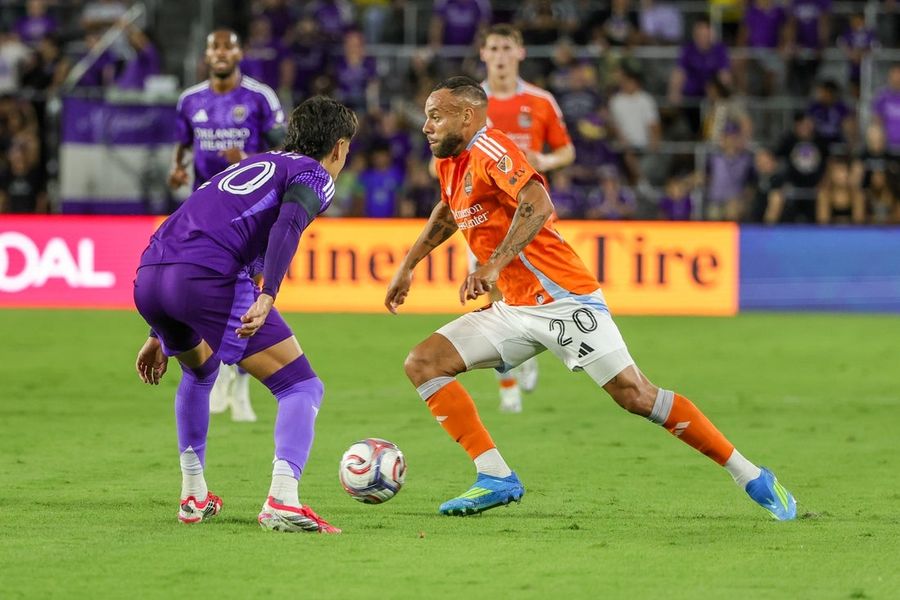
Deadspin | Hector Herrera, Dynamo deal another shutout loss to Orlando City  Apr 18, 2026; Orlando, Florida, USA; Houston Dynamo FC midfielder Guilherme Santos (20) dribbles the ball against Orlando City SC midfielder Eduard Atuesta (20) during the first half at Inter&Co Stadium. Mandatory Credit: Mike Watters-Imagn Images   Hector Herrera’s goal in the 75th minute broke a scoreless stalemate and lifted the Houston Dynamo to a 1-0 victory over host Orlando City SC on Saturday night.  Herrera’s first goal of the season gave Houston (3-4-0, 9 points) its second consecutive victory across all competitions but snapped a three-match losing streak in MLS play. The Dynamo won their first game ever at Orlando, their first road win this season and secured three vital points as they try to avoid falling out of contention early.  It was Houston’s first shutout win in league play since Sept. 20, 2025, against Portland.  Orlando City (1-6-1, 4 points) is winless in its past four league games and has scored only one goal over that span. The Lions were blanked for the fourth time this season.  Herrera kicked home a rebound after a shot by Ezequiel Ponce was blocked by Orlando goalkeeper Maxime Crepeau. The scoring chance was created by a great advance downfield by Lawrence Ennali, who split Orlando’s defenders and put a close-range shot on goal that Crepeau also deflected.  Dynamo goalkeeper Jimmy Maurer entered the game after halftime in relief of starter Jonathan Bond and made a huge save in the second half to keep the game scoreless.   In the 66th minute, Orlando’s Braian Ojeda fired a corner kick in front of the goal that almost found the mark. Iago Teodoro’s attempt was blocked. Martin Ojeda then had another putback attempt blocked by a Dynamo defender to keep the game scoreless.  Orlando City’s other great chance came just before halftime when Tyrese Spicer delivered a long, accurate cross that traveled right in front of Bond. Tiago came sliding in and fired the ball quickly, but it hit the crossbar and ricocheted away.  It was one of multiple chances before the half for Orlando that didn’t find the mark.  Houston had only one official shot on target in the first half but ended up with a 6-3 edge in that department by game’s end and outshot Orlando 19-17. Crepeau finished with four saves while Bond and Maurer combined for three saves.  –Field Level Media   #Deadspin #Hector #Herrera #Dynamo #deal #shutout #loss #Orlando #CityApr 18, 2026; Orlando, Florida, USA; Houston Dynamo FC midfielder Guilherme Santos (20) dribbles the ball against Orlando City SC midfielder Eduard Atuesta (20) during the first half at Inter&Co Stadium. Mandatory Credit: Mike Watters-Imagn Images

Hector Herrera’s goal in the 75th minute broke a scoreless stalemate and lifted the Houston Dynamo to a 1-0 victory over host Orlando City SC on Saturday night.

Herrera’s first goal of the season gave Houston (3-4-0, 9 points) its second consecutive victory across all competitions but snapped a three-match losing streak in MLS play. The Dynamo won their first game ever at Orlando, their first road win this season and secured three vital points as they try to avoid falling out of contention early.

It was Houston’s first shutout win in league play since Sept. 20, 2025, against Portland.

Orlando City (1-6-1, 4 points) is winless in its past four league games and has scored only one goal over that span. The Lions were blanked for the fourth time this season.

Herrera kicked home a rebound after a shot by Ezequiel Ponce was blocked by Orlando goalkeeper Maxime Crepeau. The scoring chance was created by a great advance downfield by Lawrence Ennali, who split Orlando’s defenders and put a close-range shot on goal that Crepeau also deflected.


Dynamo goalkeeper Jimmy Maurer entered the game after halftime in relief of starter Jonathan Bond and made a huge save in the second half to keep the game scoreless.

In the 66th minute, Orlando’s Braian Ojeda fired a corner kick in front of the goal that almost found the mark. Iago Teodoro’s attempt was blocked. Martin Ojeda then had another putback attempt blocked by a Dynamo defender to keep the game scoreless.

Orlando City’s other great chance came just before halftime when Tyrese Spicer delivered a long, accurate cross that traveled right in front of Bond. Tiago came sliding in and fired the ball quickly, but it hit the crossbar and ricocheted away.

It was one of multiple chances before the half for Orlando that didn’t find the mark.

Houston had only one official shot on target in the first half but ended up with a 6-3 edge in that department by game’s end and outshot Orlando 19-17. Crepeau finished with four saves while Bond and Maurer combined for three saves.

–Field Level Media

#Deadspin #Hector #Herrera #Dynamo #deal #shutout #loss #Orlando #City

Apr 18, 2026; Orlando, Florida, USA; Houston Dynamo FC midfielder Guilherme Santos (20) dribbles the ball against Orlando City SC midfielder Eduard Atuesta (20) during the first half at Inter&Co Stadium. Mandatory Credit: Mike Watters-Imagn Images

Hector Herrera’s goal in the 75th minute broke a scoreless stalemate and lifted the Houston Dynamo to a 1-0 victory over host Orlando City SC on Saturday night.

Herrera’s first goal of the season gave Houston (3-4-0, 9 points) its second consecutive victory across all competitions but snapped a three-match losing streak in MLS play. The Dynamo won their first game ever at Orlando, their first road win this season and secured three vital points as they try to avoid falling out of contention early.

It was Houston’s first shutout win in league play since Sept. 20, 2025, against Portland.

Orlando City (1-6-1, 4 points) is winless in its past four league games and has scored only one goal over that span. The Lions were blanked for the fourth time this season.

Herrera kicked home a rebound after a shot by Ezequiel Ponce was blocked by Orlando goalkeeper Maxime Crepeau. The scoring chance was created by a great advance downfield by Lawrence Ennali, who split Orlando’s defenders and put a close-range shot on goal that Crepeau also deflected.

Dynamo goalkeeper Jimmy Maurer entered the game after halftime in relief of starter Jonathan Bond and made a huge save in the second half to keep the game scoreless.

In the 66th minute, Orlando’s Braian Ojeda fired a corner kick in front of the goal that almost found the mark. Iago Teodoro’s attempt was blocked. Martin Ojeda then had another putback attempt blocked by a Dynamo defender to keep the game scoreless.

Orlando City’s other great chance came just before halftime when Tyrese Spicer delivered a long, accurate cross that traveled right in front of Bond. Tiago came sliding in and fired the ball quickly, but it hit the crossbar and ricocheted away.

It was one of multiple chances before the half for Orlando that didn’t find the mark.

Houston had only one official shot on target in the first half but ended up with a 6-3 edge in that department by game’s end and outshot Orlando 19-17. Crepeau finished with four saves while Bond and Maurer combined for three saves.

–Field Level Media

Source link
#Deadspin #Hector #Herrera #Dynamo #deal #shutout #loss #Orlando #City

Previous post

Formula One — FIA hails ‘invaluable input’ from drivers ahead of F1 rules meeting <div id="content-body-70883108" itemprop="articleBody"><p>Formula One’s governing body has ​hailed drivers for their ‘invaluable’ input ahead of a teams meeting on ‌Monday that will put forward proposed rule changes to ​improve racing.</p><p>The sport has undergone the biggest change in ⁠decades on the chassis and engine with new power units that are split roughly 50-50 between electric and combustion power.</p><p>Drivers have, however, complained about ‌the impact on racing and raised safety concerns from having to ease off the throttle early and coast ‌into high-speed corners so the combustion engine can recharge the ‌battery.</p><p>International ⁠Automobile Federation (FIA) president Mohammed Ben Sulayem said on social ⁠media on Sunday that there had been “constructive and collaborative discussion” between the governing body and drivers ahead of the meeting with team principals and F1 stakeholders.</p><p>“The ​drivers have provided invaluable input ‌on adjustments which they feel should be made, particularly in the areas of energy management to ensure safe, fair and competitive racing.”</p><p>Ben Sulayem said a series of meetings had also been ‌held with technical representatives of teams and engine manufacturers ​to discuss proposed changes.</p><p>“Safety and the best interests of the sport are the main focus of these discussions,” ⁠he added.</p><p>“Following the meeting tomorrow, the final proposals will be put before a FIA WMSC (World Motor Sport Council) e-Vote.”</p><p>Mercedes driver George Russell, ‌a director of the Grand Prix Drivers’ Association (GPDA), told reporters last week that the relationship between the drivers and FIA was “probably the closest” it had been in years and the governing body understood what needed to be done.</p><p>“There have been some very positive conversations with the FIA, and everybody is aligned with what ‌we’re trying to achieve,” he said. “I think the two headline points are flat-out ​qualifying, so no lift and coast, and then reducing the closing speeds.”</p><p>Haas driver Oliver Bearman crashed heavily in ⁠Japan last month in an incident that sparked calls for the ⁠FIA to make safety-related changes.</p><p>Bearman’s car hit the barriers with a force of 50G after approaching and swerving to ‌avoid Franco Colapinto’s Alpine with a 50-kph difference in speed between the cars as one deployed an electrical power boost ​while the other was low on battery and lacked power.</p><p class="publish-time" id="end-of-article">Published on Apr 20, 2026</p></div> #Formula #FIA #hails #invaluable #input #drivers #ahead #rules #meeting

Next post

Lyon beats PSG 2-1, gives Lens renewed hope in Ligue 1 title race <div id="content-body-70883131" itemprop="articleBody"><p>Brazil forward Endrick scored one goal and created another as Lyon won 2-1 against Paris Saint-Germain (PSG) to go third in Ligue 1 and boost its chances of Champions League qualification.</p><p>PSG’s fifth league defeat of the season left it one point ahead of second-placed Lens, with PSG having a game in hand. But PSG still has to travel to Lens in May, after the league postponed their game on April 11 due to PSG’s involvement in the Champions League.</p><p>Coach Paulo Fonseca’s Lyon leads fourth-placed Lille on goal difference with the top three gaining direct entry to the Champions League and the side in fourth entering qualifying.</p><h4 class="sub_head">Endrick responds in style</h4><p>Fonseca recently criticised Endrick following some mediocre performances and benched him against Lorient last weekend. Endrick came on and played a part in both goals in a 2-0 win.</p><p>He gave Lyon the lead on Sunday in the sixth minute. The livewire 19-year-old made a clever run behind the PSG defence to meet Afonso Moreira’s pass and score with a crisp shot past goalkeeper Matvei Safonov.</p><p>Lyon hit PSG with a classic counterattack in the 18th as Endrick sent Moreira clean through from halfway and the 21-year-old Portuguese forward hit a low shot into the left corner.</p><p>PSG striker Gonçalo Ramos had a penalty saved by Lyon goalkeeper Dominik Greif in the 33rd. Moments later PSG midfielder Vitinha limped off with a right ankle injury.</p><p>Safonov kept out a curler from Moreira in the second half.</p><p>Moreira was outstanding cutting in from the left flank and pushed his case for a first callup to the Portugal side. PSG midfielder Fabián Ruiz came on late in the game for his first appearance in three months following a knee injury.</p><p>Khvicha Kvaratskhelia pulled a goal back four minutes into stoppage time with a curler from 20 meters out, but Lyon was a worthy winner and PSG coach Luis Enrique hugged Fonseca.</p><h4 class="sub_head">Monaco draws with Auxerre; Metz slids closer to relegation</h4><p>Balogun’s run American forward Folarin Balogun scored for the eighth straight league game as Monaco rallied to draw 2-2 with Auxerre.</p><p>Seventh-placed Monaco is one of several sides chasing a Champions League place next season.</p><p>Balogun equalised with a penalty in the 59th after being knocked over by goalkeeper Donovan Léon. Former Barcelona midfielder Ansu Fati got Monaco’s other goal with a low drive from the edge of the penalty area three minutes earlier.</p><p>Midfielder Kévin Danois and striker Lassine Sinayoko had put Auxerre 2-0 up.</p><p>Monaco is three points behind fifth-placed Rennes, which won 3-0 at Strasbourg, and two behind Marseille in sixth. Marseille lost 2-0 at Lorient on Saturday, prompting a scathing attack on the players from the club’s sporting director.</p><p>Auxerre is in 16th place, the relegation-promotion playoff spot against the side finishing third in Ligue 2.</p><p>Lepaul scores again Esteban Lepaul opened the scoring for Rennes and moved top of the Ligue 1 charts with 17 goals.</p><p>Lepaul’s headed flick on set up striker Breel Embolo for 2-0 and Jordan’s Mousa Al-Tamari netted the third as Rennes won its seventh match in nine games.</p><p>Rock-bottom Metz slid closer to relegation after losing 3-1 at home to Paris FC and 17th-placed Nantes conceded deep into stoppage time in a 1-1 home draw with Brest.</p><p>In Friday’s game, Lens rallied from 2-0 down to beat Toulouse 3-2</p><p class="publish-time" id="end-of-article">Published on Apr 20, 2026</p></div> #Lyon #beats #PSG #Lens #renewed #hope #Ligue #title #race

Deadspin | Orioles spin 4-hitter to salvage finale against A’s  May 10, 2026; Baltimore, Maryland, USA; Baltimore Orioles pitcher Rico Garcia (50) and catcher Samuel Basallo (29) celebrate after defeating the Athletics at Oriole Park at Camden Yards. Mandatory Credit: Rafael Suanes-Imagn Images   Dylan Beavers hit a go-ahead single in the sixth inning and four Baltimore pitchers combined on a 4-hitter for a 2-1 victory over the visiting Athletics on Sunday afternoon that avoided a series sweep.  Chris Bassitt (3-2) struck out six and allowed one run over six innings. Rico Garcia worked the ninth and earned his third save despite issuing a walk.  Beavers and Gunnar Henderson had two hits apiece for the Orioles, who snapped a three-game skid by winning for the third time in their last 11 games.  Athletics leadoff man Nick Kurtz extended his on-base streak to 34 games, the longest active mark in the majors, with an eighth-inning walk. Tyler Soderstrom had a double to highlight the team’s four hits.  Athletics starter Luis Severino (2-4) was charged with two runs on six hits and four walks in 5 1/3 innings. He struck out four.  The Athletics were aiming for their second four-game winning streak this season.  The Orioles used Keegan Akin for one shutout inning as an opener, then Bassitt came in and worked through the seventh. Bassitt scattered four hits and one walk.   Baltimore’s Anthony Nunez pitched the eighth before Garcia, who notched one strikeout, again served as the closer with Ryan Helsley on the injured list. Orioles pitchers combined for 10 strikeouts and four walks.  The Athletics, who wrapped up their six-game road trip atop the AL West, went up 1-0 on Carlos Cortes’ second-inning sacrifice fly.  Henderson’s run-scoring infield single brought the Orioles even in the third.  The Orioles loaded the bases with two outs in the fifth and didn’t convert. They stranded eight runners in the game.  But in the next inning, Beavers came through on a nine-pitch at-bat with a go-ahead single. That marked the end of Severino’s outing.  Athletics reliever Justin Sterner worked out of a bases-loaded jam by recording two strikeouts.  –Field Level Media    #Deadspin #Orioles #spin #4hitter #salvage #finaleMay 10, 2026; Baltimore, Maryland, USA; Baltimore Orioles pitcher Rico Garcia (50) and catcher Samuel Basallo (29) celebrate after defeating the Athletics at Oriole Park at Camden Yards. Mandatory Credit: Rafael Suanes-Imagn Images

Dylan Beavers hit a go-ahead single in the sixth inning and four Baltimore pitchers combined on a 4-hitter for a 2-1 victory over the visiting Athletics on Sunday afternoon that avoided a series sweep.

Chris Bassitt (3-2) struck out six and allowed one run over six innings. Rico Garcia worked the ninth and earned his third save despite issuing a walk.

Beavers and Gunnar Henderson had two hits apiece for the Orioles, who snapped a three-game skid by winning for the third time in their last 11 games.

Athletics leadoff man Nick Kurtz extended his on-base streak to 34 games, the longest active mark in the majors, with an eighth-inning walk. Tyler Soderstrom had a double to highlight the team’s four hits.

Athletics starter Luis Severino (2-4) was charged with two runs on six hits and four walks in 5 1/3 innings. He struck out four.

The Athletics were aiming for their second four-game winning streak this season.


The Orioles used Keegan Akin for one shutout inning as an opener, then Bassitt came in and worked through the seventh. Bassitt scattered four hits and one walk.

Baltimore’s Anthony Nunez pitched the eighth before Garcia, who notched one strikeout, again served as the closer with Ryan Helsley on the injured list. Orioles pitchers combined for 10 strikeouts and four walks.

The Athletics, who wrapped up their six-game road trip atop the AL West, went up 1-0 on Carlos Cortes’ second-inning sacrifice fly.

Henderson’s run-scoring infield single brought the Orioles even in the third.

The Orioles loaded the bases with two outs in the fifth and didn’t convert. They stranded eight runners in the game.

But in the next inning, Beavers came through on a nine-pitch at-bat with a go-ahead single. That marked the end of Severino’s outing.

Athletics reliever Justin Sterner worked out of a bases-loaded jam by recording two strikeouts.


–Field Level Media

#Deadspin #Orioles #spin #4hitter #salvage #finale">Deadspin | Orioles spin 4-hitter to salvage finale against A’s  May 10, 2026; Baltimore, Maryland, USA; Baltimore Orioles pitcher Rico Garcia (50) and catcher Samuel Basallo (29) celebrate after defeating the Athletics at Oriole Park at Camden Yards. Mandatory Credit: Rafael Suanes-Imagn Images   Dylan Beavers hit a go-ahead single in the sixth inning and four Baltimore pitchers combined on a 4-hitter for a 2-1 victory over the visiting Athletics on Sunday afternoon that avoided a series sweep.  Chris Bassitt (3-2) struck out six and allowed one run over six innings. Rico Garcia worked the ninth and earned his third save despite issuing a walk.  Beavers and Gunnar Henderson had two hits apiece for the Orioles, who snapped a three-game skid by winning for the third time in their last 11 games.  Athletics leadoff man Nick Kurtz extended his on-base streak to 34 games, the longest active mark in the majors, with an eighth-inning walk. Tyler Soderstrom had a double to highlight the team’s four hits.  Athletics starter Luis Severino (2-4) was charged with two runs on six hits and four walks in 5 1/3 innings. He struck out four.  The Athletics were aiming for their second four-game winning streak this season.  The Orioles used Keegan Akin for one shutout inning as an opener, then Bassitt came in and worked through the seventh. Bassitt scattered four hits and one walk.   Baltimore’s Anthony Nunez pitched the eighth before Garcia, who notched one strikeout, again served as the closer with Ryan Helsley on the injured list. Orioles pitchers combined for 10 strikeouts and four walks.  The Athletics, who wrapped up their six-game road trip atop the AL West, went up 1-0 on Carlos Cortes’ second-inning sacrifice fly.  Henderson’s run-scoring infield single brought the Orioles even in the third.  The Orioles loaded the bases with two outs in the fifth and didn’t convert. They stranded eight runners in the game.  But in the next inning, Beavers came through on a nine-pitch at-bat with a go-ahead single. That marked the end of Severino’s outing.  Athletics reliever Justin Sterner worked out of a bases-loaded jam by recording two strikeouts.  –Field Level Media    #Deadspin #Orioles #spin #4hitter #salvage #finale

The order for the 2026 NBA Draft has finally been determined after the long-awaited lottery drawing. The Washington Wizards will have the first overall pick, while the Utah Jazz choose second, the Memphis Grizzlies pick third, and the Chicago Bulls will have the fourth selection. The first round of the draft will be held on Tuesday, June 23, while the second round will be the following day.

The Wizards entered the lottery with a 14 percent chance of landing the No. 1 overall pick. The stakes of this drawing were even higher with lottery reform coming to the NBA Draft next year to address the league’s purported tanking crisis. Every team that moved into the top-four should consider themselves a big winner thanks to the four elite prospects sitting at the top of this class.

Let’s do an instant mock draft with order settled. This is how we see the first-round playing out after the Wizards come on the clock at No. 1 overall.

1. Washington Wizards – AJ Dybantsa, F, BYU

NBA scouts dream about finding big wing shot-creators like Dybantsa. The 6’9 forward is an incredibly fluid athlete who puts consistent pressure on the rim with his long, coordinated strides attacking the basket. Dybantsa can create a good look for himself in a pinch with the bend to turn the corner on drives, the power to finish through contact, and the length to hit shots over contests. His shot profile is a bit mid-range heavy, but his ability to get to his spots and make tough turnarounds or touch finishes should have plenty of utility in the playoffs when the game slows down. He’s a capable three-point shooter, though teams will want to see him improve his volume once he enters the league. His defensive impact also feels muted for a player with such great physical tools. Dybantsa is built to stockpile points and come up with clutch buckets in the NBA for more than a decade.

2. Utah Jazz – Darryn Peterson, G, Kansas

Peterson failed to meet sky-high expectations entering Kansas this season due to lingering cramping and soft tissue strains in his lower body that often kept him out of close games late. As long as those aren’t long-term injuries, the 6’5 guard is still a fantastic prospect who brings scoring punch, volume three-point shooting, defensive playmaking, and some shot creation to any backcourt. Peterson can play on or off the ball and still put immense pressure on opposing defenses as a scorer. He offered real movement shooting as a freshman, zooming around screens and hitting three-pointers with volume and deep range. He showed he could still cook bigger and slower defenders off the bounce, but it often felt like he bailed out of drives to take mid-range shots. Peterson’s playmaking vision is a real question if he’s going to be used as a de facto point guard. Will the rim attacking he flashed in high school show up again when he gets fully healthy? Even with some questions, Peterson projects to be a plus on the defensive end with great three-point shooting, and that’s a valuable prospect in any context.

3. Memphis Grizzlies – Cameron Boozer, F, Duke

Boozer is the best prospect in the draft for my money due to his combination of lighting-quick processing, brute strength, shooting touch, and all-around offensive versatility. The 6’9, 250-pound forward can drive like a guard, space the floor beyond the arc like a wing, and clean the glass like a big. Giving Boozer the ball is a one-way ticket to creating a good look, whether he’s doing it himself or finding an open teammate. He’s a bit slow footed and doesn’t project to be a plus defensively, but his ability to create efficient offense every time the ball touches his hands overrides those questions. How many times is the smartest player on the floor also the strongest while being a 40 percent three-point shooter? He should be an All-NBA caliber player with brains, brawn, and skill.

4. Chicago Bulls – Caleb Wilson, F, North Carolina

Wilson combines elite athleticism and a non-stop motor to make jaw-dropping plays all over the floor. The 6’10 forward dunked absolutely everything around the rim this year with 67 slams in 24 games, but there’s more to his offensive game than that. He will be a threat in the post with the ability to hit tough mid-range turnarounds, and his passing is a major plus for someone so big and so athletic, too. Wilson’s defense will be his calling card early in his career, and he could be special on that end. His ground coverage is excellent, he has the length and bounce to offer secondary rim protection and be a plus on the defensive glass, and he consistently makes extra efforts. The big hole in Wilson’s game is his three-point shot, which is non-existent right now. Even with the outside shooting concerns, Wilson plays like a runaway freight train on both ends in the best way possible. He feels like a stronger prospect than the typical No. 4 overall pick, and it wouldn’t be too surprising if he goes even higher than that after recent reports that some front offices prefer him over certain members of the big-three.

5. Los Angeles Clippers – Keaton Wagler, G, Illinois

Wagler entered Illinois as the No. 150 recruit in the rankings, and left as a lock to be a top-10 draft pick after just one season. The freshman started to ascend once he was moved into an on-ball role mid-way through the season, which allowed him to flash his fantastic pull-up shooting chops, his capable playmaking, and his turnover avoidance. Wagler loves to get into his step-back three, especially when a big switches onto him, but he’s equally adept at spacing the floor and shooting it with range off the catch. He’s not exactly Tyrese Haliburton as a passer, but the Illini guard was able to hit his talented teammates in stride all year while avoiding costly live-ball turnovers. There are still moments where you can see why Wagler was so under-the-radar as a recruit. He’s not a great athlete, and ended the year with zeros — a shocking stat for a 6’6 one-and-done lottery pick. He didn’t do much on defense, though that could be partially explained with Illinois’ conservative scheme that finished dead-last in defensive turnover rate. Do teams trust him to drive and finish at the rim against NBA athletes? Wagler’s skill set still feels pretty malleable as a tall guard who can shoot and won’t make a bunch of mistakes. This is the best story in this draft class, and it keeps getting better.

6. Brooklyn Nets – Kingston Flemings, G, Houston

Flemings stood out in a loaded freshman guard class for his quick-twitch athleticism and two-way aptitude. The 6’3 guard plays bigger than his size with a strong chest, impressive lateral quickness, and disruptive hands on the defensive end. The Cougars star is so hard to contain as a driver with the standstill burst to get by the first defender, and awesome change of direction ability when he’s attacking off the bounce. Flemings is at his best as a scorer elevating for mid-range shots, but his driving is most dangerous because of his live-dribble passing ability. NBA teams will want to see Flemings up his three-point volume, prove he can finish over NBA rim protectors, and get to the line more often. He still has enough bankable NBA skills that he should be a good lead guard for a long time.

7. Sacramento Kings – Darius Acuff, G, Arkansas

John Calipari has had a lot of great freshman guards over the years, but I’m not sure any of them were more productive than Acuff. The Detroit native forced his way into national conversations with his takeover scoring ability and proficient playmaking against top competition all season. Acuff isn’t the biggest guard at 6’3, but he consistently found ways to beat the opposing defense, whether he was ripping three-pointers from deep, making tough shots off the bounce from the middle of the floor, or getting off the ball and spacing the floor for his teammates. Acuff carried such a huge offensive burden for his team this year that it makes sense that his defensive tape wasn’t too impressive. He also just doesn’t have good tools defensively, so he’ll remain a question on that end of the floor. His finishing over NBA length is also a concern after making only 59 percent of his rim attempts this season. If Acuff really is a 44 percent three-point shooter he showed this year, he should be able to overcome any other physical limitations. That just feels like a big bet this high in the lottery.

8. Atlanta Hawks – Mikel Brown Jr., G, Louisville

Brown was slowed down by a pesky back injury throughout the year, but he had some of the best flashes in the class when he was healthy. The 6’5 point guard combines high-volume three-point shooting, creative passing, and the ability to produce paint touches that gives him the chance to be an offensive engine at the next level if everything goes right. Brown doesn’t settle for mid-range shots like Flemings or Acuff, and while it can lead to more game-t0-game variance in performance, it could help him come out ahead over a longer sample. He can generate three-point looks out of thin air that sometimes go in, or can at least lead to offensive rebound chances. He surpassed expectations as a driver, and his playmaking is astounding in its best moments, finding passing angles few other players would see. Brown’s defensive tape wasn’t all that good, but he does have a little more height to fall back on than some of the other guards in this class. The back injury is scary and the shot-selection probably needs to be reigned in a tad, but the upside for an All-Star level offensive guard is there.

9. Dallas Mavericks – Brayden Burries, G, Arizona

Burries is a well-rounded shooting guard without an elite skill to fall back on. He fits the definition of a ‘two-way player’ as a strong 6’5 guard who can play through contact on both ends while also offering floor spacing with a 39 percent three-point shot. He’s a good transition player with a deep bag of scoring moves in the open floor, including pull-up threes. He can lock up at the point of attack on the defensive end, and his rebounding is better than most two guards with his offensive gifts. Two things appear to limit his upside right now: he lacks elite burst as a ball handler, and he’s not yet a good enough playmaker to demand super high usage. Burries is a one-and-one, but he’ll also be a 21-year-old rookie with a September 2005 birthday, making him a couple months older than junior wing Dailyn Swain out of Texas. Burries should be rock solid, but it’s fair to question his upside.

10. Milwaukee Bucks – Yaxel Lendeborg, F, Michigan

Lendeborg’s winding road in college basketball started at the JUCO level, made a stop at UAB, and concluded with a national championship run at Michigan where he looked like the best player in the NCAA tournament. He could have been a first-round pick in last year’s draft, but there’s no doubt the super-senior forward helped himself with one more year of school. Yes, Lendeborg will be a 24-year-old rookie, but he also offers a rare two-way skill set and tremendous physical profile worthy of top-10 consideration regardless of age. At 6’9, 240 pounds, with a 7’4 wingspan, Lendeborg has the length of an NBA center with the skill to play out on the perimeter. He made 37.2 percent of his threes (on 180 attempts) and 82.4 percent of his free throws this season to prove his shooting touch. He’s always been a good passer who won’t be a ball stopper. He’s awesome on the defensive end, showing wing stopper abilities at the point of attack while also rushing in for chasedown blocks and pick-sixes when he sees an opening. Lendeborg also seems to have the right mentality as he readies for the pros. His age caps his upside a bit, but this is should still be a really good player right away.

11. Golden State Warriors – Aday Mara, C, Michigan

We had Mara as a preseason one-and-done lottery pick when he first came over from Spain to enroll at UCLA, but instead he sat on Mick Cronin’s bench for two years. The whole world saw what Mara could do when he helped lead Michigan to a national championship, and it’s possible no player helped their NBA stock more during March Madness. Mara will be one tallest and longest players in the NBA from day one standing at 7’3 with a reported 7’7 wingspan. He has an easy translation as a rim protector who specializes in drop coverage, but he doesn’t have much ball screen versatility because of his slow feet. On the offensive end, Mara can juice transition opportunities with his excellent outlet passing, and also serve as a hub in the halfcourt who can zing the ball to open cutters. He’ll have scoring utility as a lob threat, and he has flashes of post moves and scoring touch inside. Mara doesn’t shoot the ball well from the perimeter, and was also a very bad free throw shooter before making strides in the second half of the season. This might seem a little high, but the success of multi-year college bigs in the lottery like Donovan Clingan and Zach Edey should give teams confidence that Mara can translate.

12. Oklahoma City Thunder – Jayden Quaintance, F/C, Kentucky

It requires a leap of faith to draft Quaintance. The big man tore his ACL in Feb. 2025, and it resulted in a lost season this year at Kentucky where he only played four uninspiring games. The last time we saw him healthy, though, Quaintance looked like an elite defender as a 17-year-old freshman at Arizona State. While he’s a tad short for a center, Quaintance has long arms, huge hands, a solid base, and a strong chest to play bigger than his size. His ground coverage is phenomenal and should give him maximum coverage versatility against the pick-and-roll. He can also wall up at the rim as a shot-blocker, and he’s a great rebounder on both ends. Aside from putbacks, there are real questions about how his game translates offensively. He’s not a shooter, and while there are some ball handling flashes on the tape, it shouldn’t be considered a strength. Quaintance might have been a top-5 pick if he was healthy this year. Instead, he feels like one of the riskier prospects available, but one that could turn into a major steal.

13. Miami Heat – Karim Lopez, F, New Zealand Breakers

Lopez has been on NBA radars for years as a big forward who offers ball handling, scoring upside, and some defensive versatility. A native of Mexico who spent this season playing in the Australian NBL, Lopez showed flashes of downhill attacks, active rebounding on both ends, and defensive playmaking. He’s not a great outside shooter (32.2 percent on three attempts per game) or decision-maker yet (57 assists to 46 turnovers), which are clear areas for improvement as he enters the NBA.

14. Charlotte Hornets – Nate Ament, F, Tennessee

Ament was top-5 in just about every preseason mock, but his freshman year at Tennessee left a little to be desired. The 6’10 forward struggled badly to finish at the rim (51.8 percent), never found consistency with his three-ball (33 percent), and didn’t always respond well to physicality. Ament feels like he’ll need a couple more years to develop, but there’s still an outline of a two-way forward who spaces the floor here if everything goes right. Ament was in a tough team context at Tennessee where he needed to take on significant usage on a cramped floor. He took too many off the dribble shots, which he was terrible at. It’s easy to see Ament one day having success as more of a fourth-option who can hit spot-ups, attack closeouts, and use his length to contest shots defensively. He should be one of the more polarizing prospects on draft night, but being this highly regarded out of high school usually makes you a lottery pick.

15. Chicago Bulls – Dailyn Swain, F, Texas

Swain intrigued in his first two college seasons at Xavier as a long and bouncy wing who brought it on the defensive end. Upon transferring to Texas this season, he exploded offensively as a slasher to become one of the more complete prospects in this class. Swain still took on the toughest defensive assignment most nights for the Longhorns, and showed he could still get into the passing lanes and disrupt the offense’s flow even when carrying a higher usage rate. With more offensive freedom, Swain unleashed an improved handle that helped him create space one-on-one and get to the parts of the floor where he could score efficiently. Swain finished well at the rim (64.3 percent) with 83 percent of those looks being self-created. His mid-range touch was also awesome at 47.6 percent on non-rim twos with 95 percent of them coming without an assist. His three-point shot remains a work in progress, but he’s made huge strides to go from 11 makes combined as a freshman and sophomore, to 32 made three-pointers this year at a 34.8 percent clip. If you want positional size and athleticism with two-way adaptability on the wing, Swain is your guy.

16. Memphis Grizzlies – Bennett Stirtz, G, Iowa

Stirtz is a skilled shot-creator as an efficient ball handler and shooter who scores well from all over the floor. The 6’4 guard can play on- or off-the-ball with a fantastic feel for reading ball screens as a handler, and he also has a quick trigger from three when he’s spacing the floor for his teammates. Stirtz does a good job of mapping the floor as a passer, and he’s also shined at suppressing turnovers. He’s a really good scorer both inside and outside the arc, showing mid-range pull-up shooting, crafty finishing, and accurate three-point shooting. He’s not super long or explosive, but he knows how to dictate pace and should be effective in the open floor after playing a very slow style at Iowa. He also played a ton of minutes for the Hawkeyes and showed he could still hit big shots at the end of games despite rarely ever hitting the bench. There are some defensive questions with Stirtz, but his high-IQ shows up at times on that end, too. Don’t write him off just because he’s a senior. He’s going to be a good pro for a long-time.

17. Oklahoma City Thunder – Hannes Steinbach, F, Washington

Steinbach is a monster rebounder with soft hands and tons of potential as a play-finisher. The Washington freshman is bit stuck in between positions at 6’11, 230 pounds without plus length, but he should have no problem playing in the two-big lineups that are suddenly more en vogue around the league. Steinbach’s rebounding is an elite skill after he posted a 14.3 percent offensive rebound rate and a 25 percent defensive rebound rate. Finishing so many putbacks aided his 63.6 percent true shooting on the season, but he does more than attack the glass. Steinbach can fly in transition for acrobatic finishes, and his ability to catch everything thrown at him often leads to easier chances around the basket. His outside shot is a bit of a question, but he did hit 34 percent of his threes on 53 attempts in 30 games this year. He’s not a natural rim protector defensively, so he’ll probably spend time at both frontcourt spots going forward. So long as Steinbach can keep making progress with his three and hold his own defensively, he should be a highly efficient finisher who also generates a lot of extra possessions for his team.

18. Charlotte Hornets – Labaron Philon, G, Alabama

Philon could have been a first-round pick in last year’s draft before being lured back to school for a big NIL bag, but there’s no question he improved his stock as a sophomore. Philon made major strides as a three-point shooter, going from 31.5 percent to 40 percent from deep while nearly doubling his volume. He feels like the shiftiest ball handler in the class, and his drive-and-kick game should be a natural fit in the NBA. He also has one of the best floaters in this class. Philon is pretty small for a guard, but he has the same standing reach as Tyrese Maxey, and he turned out okay. Playing in Alabama’s NBA system should only aid him as he makes the jump to the league.

19. Toronto Raptors – Chris Cenac Jr., C, Houston

Cenac is a long and athletic big man with a nice shooting stroke who needs to continue to work on his feel for the game and toughness. The fact that he committed to Houston and steadily improved throughout the year is a green flag in his favor. Kelvin Sampson holds his players to a high standard of grit, and Cenac earned his trust more and more as the season went on. Cenac’s 7’4 wingspan helps him challenge shots defensively and shoot over contests. He made 30-of-90 shots from three-point range this season. He was also excellent on the defensive glass with a 26 percent d-board rate. Cenac is raw, but the tools are undeniable. Give him a few years and you might have a valuable player.

20. San Antonio Spurs – Morez Johnson Jr., F/C, Michigan

Johnson may be a tad short for a big man at 6’9, but he makes up for it with length, strength, toughness, and efficiency as a scorer. He blossomed upon transferring to Michigan this season, where he showed he could play with other bigs and still impact the game as a rebounder, screen-setter, and play-finisher. Johnson was dominant at the rim by hitting 73 percent of his looks, and he makes his free throws when he gets fouled with a 78 percent stroke from the line. After not taking a three during his freshman season at Illinois, he made 34 percent of his triples on 35 attempts at Michigan, showing that he could have some shooting potential long-term. The biggest part of Johnson’s appeal comes on the defensive end, where he’s strong enough to guard bigs, quick enough to defend most guards and wings, and plays with a physicality that bumps opponents off their spots. There’s nothing flashy about his game, but he knows his role and executes it well. The NBA’s recent trend back to double-big lineups should only help Johnson’s stock.

21. Detroit Pistons – Cameron Carr, G, Baylor

Carr’s intersection of length and shooting gives him obvious appeal. The 6’5 wing reportedly has a 7’2 wingspan, and he made 37.6 percent of his threes on 10.6 attempts from deep per 100 possessions. Carr spent two years on the bench at Tennessee (partially because of a thumb injury) before blossoming at Baylor this season. He doesn’t offer much creation ability, and had almost as many turnovers (81) as assists (90) this season. Still, if you need an off-ball guard with a quick trigger and deep range from three, there are worse options than Carr.

22. Philadelphia 76ers – Allen Graves, F, Santa Clara

Graves came out of nowhere this season to become one of college basketball’s most productive and disruptive players on a per-minute basis. The 6’9 forward is an ultra-aggressive defender who tries to rip the ball away from his opponents at every opportunity, resulting in an unfathomable five percent steal rate and five percent block rate, and also a lot of fouls. Graves isn’t just a hacker: he also hit 40 percent of his threes, made connective passes without turning the ball over, and used his great hands to suction in rebounds at both ends. If he can tone down the fouling while maintaining his defensive playmaking, he could be a steal.

23. Atlanta Hawks – Christian Anderson, G, Texas Tech

Anderson is a high-volume three-point shooter and excellent playmaker who will have to overcome concerns about his size and defensive ability. The 6’2 guard made 41.5 percent of his threes on 12.1 attempts per 100 possessions from deep, with 56.5 percent of his makes coming on pull-ups without an assist. Anderson’s off-the-dribble shooting is even more valuable when mixed with his playmaking, where he posted an awesome 35.2 percent assist rate while struggling a bit with turnovers at times. He’ll need to prove his offensive skill level is high enough to keep him on the floor late in games where he could be targeted defensively.

24. New York Knicks – Henri Veesaar, C, North Carolina

Veesaar is one of the few stretch five options in this class. The North Carolina big man took 27.5 percent of his field goal attempts from three-point range this season, and knocked down those shots at a 42.6 percent clip. His poor free throw shooting (61.5 percent) is a signal that his long ball could be fake, but he does enough well on the court to still provide some value if the shot falls off. Veesaar is a good passer who avoids turnovers and an efficient overall scorer despite the struggles from the line. He’s not a defensive enforcer in the middle, and will have to be more of an offensively-slanted big.

25. Los Angeles Lakers – Joshua Jefferson, F, Iowa State

Jefferson is a big, strong forward who brings two-way ability and rare passing vision for someone his size. He made a nice leap as a shooter this year to get up to 34.5 percent frmo three (a career-best), but he’ll need to continue to grow in that area. He will add some toughness and rebounding to any frontcourt, and his ball handling and playmaking would let JJ Redick’s coaching staff get creative with his usage.

26. Denver Nuggets – Ebuka Okorie, G, Stanford

Okorie wasn’t even a top-100 recruit entering his freshman year at Stanford, but the guard immediately put the rest of the country on notice with his terrifying speed fueling his shot-creation ability. Okorie has a wicked first step and even better acceleration to create driving lanes to the rim. He’s not the best finisher, but he can hit touch finishes from mid-range, and his live dribble passing (while avoiding turnovers) is impressive. He hit 35.4 percent from three this year on nearly 180 attempts, which should give teams confidence in his shot going forward. If you want a downhill guard, Okorie is worth a pick even higher than this.

27. Boston Celtics – Zuby Ejiofor, C, St. John’s

Ejiofor is a great mover for someone with a 245-pound frame. The St. John’s senior big man isn’t super tall or long, but he adds a level of physicality to any frontcourt while also intriguing with his connective passing ability. Ejiofor is really good on the glass at both ends, and he can offer some rim protection while also having pick-and-roll coverage versatility. His rim finishing and playmaking are solid, but he might need to develop a three-point shot to stay in the NBA.

28. Minnesota Timberwolves – Tyler Tanner, G, Vanderbilt

Tanner deserves to be a first-round pick if he stays in the draft, but his lack of size could push him down the order. The 6-foot guard became one of college basketball’s best players as a sophomore by unleashing his athleticism at both ends and improving as a shooter. He plays with a rare physicality for someone under 175 pounds, which gives him some defensive utility despite his lack of size. Tanner is super fast, a smart playmaker, and a daring finisher off his drives. He’d be a steal in this range.

29. Cleveland Cavaliers – Isaiah Evans, G, Duke

There isn’t a better shooter running off screens in this class than Evans. The Duke sophomore hit 36 percent of his 280 threes, with many of them coming on difficult attempts that leveraged his movement shooting ability. Evans’ 86 percent stroke from the free throw is a better indicator of how good his touch really is. He’s a bit thin for a shooting guard and isn’t a natural creator, so there will be questions about his defensive translation.

30. Dallas Mavericks – Meleek Thomas, G, Arkansas

Thomas is a walking bucket who also makes good decisions with the ball. The 6’5 guard is at his best as a microwave scorer, but unlike many in that archetype, his shot selection and turnovers aren’t a cause for concern.

#NBA #mock #draft #Instant #projection #Wizards #win #lottery #Bulls #jump">NBA mock draft 2026: Instant projection after Wizards win lottery, Bulls jump to No. 4  The order for the 2026 NBA Draft has finally been determined after the long-awaited lottery drawing. The Washington Wizards will have the first overall pick, while the Utah Jazz choose second, the Memphis Grizzlies pick third, and the Chicago Bulls will have the fourth selection. The first round of the draft will be held on Tuesday, June 23, while the second round will be the following day.The Wizards entered the lottery with a 14 percent chance of landing the No. 1 overall pick. The stakes of this drawing were even higher with lottery reform coming to the NBA Draft next year to address the league’s purported tanking crisis. Every team that moved into the top-four should consider themselves a big winner thanks to the four elite prospects sitting at the top of this class.Let’s do an instant mock draft with order settled. This is how we see the first-round playing out after the Wizards come on the clock at No. 1 overall.1. Washington Wizards – AJ Dybantsa, F, BYUNBA scouts dream about finding big wing shot-creators like Dybantsa. The 6’9 forward is an incredibly fluid athlete who puts consistent pressure on the rim with his long, coordinated strides attacking the basket. Dybantsa can create a good look for himself in a pinch with the bend to turn the corner on drives, the power to finish through contact, and the length to hit shots over contests. His shot profile is a bit mid-range heavy, but his ability to get to his spots and make tough turnarounds or touch finishes should have plenty of utility in the playoffs when the game slows down. He’s a capable three-point shooter, though teams will want to see him improve his volume once he enters the league. His defensive impact also feels muted for a player with such great physical tools. Dybantsa is built to stockpile points and come up with clutch buckets in the NBA for more than a decade.2. Utah Jazz – Darryn Peterson, G, KansasPeterson failed to meet sky-high expectations entering Kansas this season due to lingering cramping and soft tissue strains in his lower body that often kept him out of close games late. As long as those aren’t long-term injuries, the 6’5 guard is still a fantastic prospect who brings scoring punch, volume three-point shooting, defensive playmaking, and some shot creation to any backcourt. Peterson can play on or off the ball and still put immense pressure on opposing defenses as a scorer. He offered real movement shooting as a freshman, zooming around screens and hitting three-pointers with volume and deep range. He showed he could still cook bigger and slower defenders off the bounce, but it often felt like he bailed out of drives to take mid-range shots. Peterson’s playmaking vision is a real question if he’s going to be used as a de facto point guard. Will the rim attacking he flashed in high school show up again when he gets fully healthy? Even with some questions, Peterson projects to be a plus on the defensive end with great three-point shooting, and that’s a valuable prospect in any context.3. Memphis Grizzlies – Cameron Boozer, F, DukeBoozer is the best prospect in the draft for my money due to his combination of lighting-quick processing, brute strength, shooting touch, and all-around offensive versatility. The 6’9, 250-pound forward can drive like a guard, space the floor beyond the arc like a wing, and clean the glass like a big. Giving Boozer the ball is a one-way ticket to creating a good look, whether he’s doing it himself or finding an open teammate. He’s a bit slow footed and doesn’t project to be a plus defensively, but his ability to create efficient offense every time the ball touches his hands overrides those questions. How many times is the smartest player on the floor also the strongest while being a 40 percent three-point shooter? He should be an All-NBA caliber player with brains, brawn, and skill.4. Chicago Bulls – Caleb Wilson, F, North CarolinaWilson combines elite athleticism and a non-stop motor to make jaw-dropping plays all over the floor. The 6’10 forward dunked absolutely everything around the rim this year with 67 slams in 24 games, but there’s more to his offensive game than that. He will be a threat in the post with the ability to hit tough mid-range turnarounds, and his passing is a major plus for someone so big and so athletic, too. Wilson’s defense will be his calling card early in his career, and he could be special on that end. His ground coverage is excellent, he has the length and bounce to offer secondary rim protection and be a plus on the defensive glass, and he consistently makes extra efforts. The big hole in Wilson’s game is his three-point shot, which is non-existent right now. Even with the outside shooting concerns, Wilson plays like a runaway freight train on both ends in the best way possible. He feels like a stronger prospect than the typical No. 4 overall pick, and it wouldn’t be too surprising if he goes even higher than that after recent reports that some front offices prefer him over certain members of the big-three.5. Los Angeles Clippers – Keaton Wagler, G, IllinoisWagler entered Illinois as the No. 150 recruit in the rankings, and left as a lock to be a top-10 draft pick after just one season. The freshman started to ascend once he was moved into an on-ball role mid-way through the season, which allowed him to flash his fantastic pull-up shooting chops, his capable playmaking, and his turnover avoidance. Wagler loves to get into his step-back three, especially when a big switches onto him, but he’s equally adept at spacing the floor and shooting it with range off the catch. He’s not exactly Tyrese Haliburton as a passer, but the Illini guard was able to hit his talented teammates in stride all year while avoiding costly live-ball turnovers. There are still moments where you can see why Wagler was so under-the-radar as a recruit. He’s not a great athlete, and ended the year with zeros — a shocking stat for a 6’6 one-and-done lottery pick. He didn’t do much on defense, though that could be partially explained with Illinois’ conservative scheme that finished dead-last in defensive turnover rate. Do teams trust him to drive and finish at the rim against NBA athletes? Wagler’s skill set still feels pretty malleable as a tall guard who can shoot and won’t make a bunch of mistakes. This is the best story in this draft class, and it keeps getting better.6. Brooklyn Nets – Kingston Flemings, G, HoustonFlemings stood out in a loaded freshman guard class for his quick-twitch athleticism and two-way aptitude. The 6’3 guard plays bigger than his size with a strong chest, impressive lateral quickness, and disruptive hands on the defensive end. The Cougars star is so hard to contain as a driver with the standstill burst to get by the first defender, and awesome change of direction ability when he’s attacking off the bounce. Flemings is at his best as a scorer elevating for mid-range shots, but his driving is most dangerous because of his live-dribble passing ability. NBA teams will want to see Flemings up his three-point volume, prove he can finish over NBA rim protectors, and get to the line more often. He still has enough bankable NBA skills that he should be a good lead guard for a long time.7. Sacramento Kings – Darius Acuff, G, ArkansasJohn Calipari has had a lot of great freshman guards over the years, but I’m not sure any of them were more productive than Acuff. The Detroit native forced his way into national conversations with his takeover scoring ability and proficient playmaking against top competition all season. Acuff isn’t the biggest guard at 6’3, but he consistently found ways to beat the opposing defense, whether he was ripping three-pointers from deep, making tough shots off the bounce from the middle of the floor, or getting off the ball and spacing the floor for his teammates. Acuff carried such a huge offensive burden for his team this year that it makes sense that his defensive tape wasn’t too impressive. He also just doesn’t have good tools defensively, so he’ll remain a question on that end of the floor. His finishing over NBA length is also a concern after making only 59 percent of his rim attempts this season. If Acuff really is a 44 percent three-point shooter he showed this year, he should be able to overcome any other physical limitations. That just feels like a big bet this high in the lottery.8. Atlanta Hawks – Mikel Brown Jr., G, LouisvilleBrown was slowed down by a pesky back injury throughout the year, but he had some of the best flashes in the class when he was healthy. The 6’5 point guard combines high-volume three-point shooting, creative passing, and the ability to produce paint touches that gives him the chance to be an offensive engine at the next level if everything goes right. Brown doesn’t settle for mid-range shots like Flemings or Acuff, and while it can lead to more game-t0-game variance in performance, it could help him come out ahead over a longer sample. He can generate three-point looks out of thin air that sometimes go in, or can at least lead to offensive rebound chances. He surpassed expectations as a driver, and his playmaking is astounding in its best moments, finding passing angles few other players would see. Brown’s defensive tape wasn’t all that good, but he does have a little more height to fall back on than some of the other guards in this class. The back injury is scary and the shot-selection probably needs to be reigned in a tad, but the upside for an All-Star level offensive guard is there.9. Dallas Mavericks – Brayden Burries, G, ArizonaBurries is a well-rounded shooting guard without an elite skill to fall back on. He fits the definition of a ‘two-way player’ as a strong 6’5 guard who can play through contact on both ends while also offering floor spacing with a 39 percent three-point shot. He’s a good transition player with a deep bag of scoring moves in the open floor, including pull-up threes. He can lock up at the point of attack on the defensive end, and his rebounding is better than most two guards with his offensive gifts. Two things appear to limit his upside right now: he lacks elite burst as a ball handler, and he’s not yet a good enough playmaker to demand super high usage. Burries is a one-and-one, but he’ll also be a 21-year-old rookie with a September 2005 birthday, making him a couple months older than junior wing Dailyn Swain out of Texas. Burries should be rock solid, but it’s fair to question his upside.10. Milwaukee Bucks – Yaxel Lendeborg, F, MichiganLendeborg’s winding road in college basketball started at the JUCO level, made a stop at UAB, and concluded with a national championship run at Michigan where he looked like the best player in the NCAA tournament. He could have been a first-round pick in last year’s draft, but there’s no doubt the super-senior forward helped himself with one more year of school. Yes, Lendeborg will be a 24-year-old rookie, but he also offers a rare two-way skill set and tremendous physical profile worthy of top-10 consideration regardless of age. At 6’9, 240 pounds, with a 7’4 wingspan, Lendeborg has the length of an NBA center with the skill to play out on the perimeter. He made 37.2 percent of his threes (on 180 attempts) and 82.4 percent of his free throws this season to prove his shooting touch. He’s always been a good passer who won’t be a ball stopper. He’s awesome on the defensive end, showing wing stopper abilities at the point of attack while also rushing in for chasedown blocks and pick-sixes when he sees an opening. Lendeborg also seems to have the right mentality as he readies for the pros. His age caps his upside a bit, but this is should still be a really good player right away.11. Golden State Warriors – Aday Mara, C, MichiganWe had Mara as a preseason one-and-done lottery pick when he first came over from Spain to enroll at UCLA, but instead he sat on Mick Cronin’s bench for two years. The whole world saw what Mara could do when he helped lead Michigan to a national championship, and it’s possible no player helped their NBA stock more during March Madness. Mara will be one tallest and longest players in the NBA from day one standing at 7’3 with a reported 7’7 wingspan. He has an easy translation as a rim protector who specializes in drop coverage, but he doesn’t have much ball screen versatility because of his slow feet. On the offensive end, Mara can juice transition opportunities with his excellent outlet passing, and also serve as a hub in the halfcourt who can zing the ball to open cutters. He’ll have scoring utility as a lob threat, and he has flashes of post moves and scoring touch inside. Mara doesn’t shoot the ball well from the perimeter, and was also a very bad free throw shooter before making strides in the second half of the season. This might seem a little high, but the success of multi-year college bigs in the lottery like Donovan Clingan and Zach Edey should give teams confidence that Mara can translate.12. Oklahoma City Thunder – Jayden Quaintance, F/C, KentuckyIt requires a leap of faith to draft Quaintance. The big man tore his ACL in Feb. 2025, and it resulted in a lost season this year at Kentucky where he only played four uninspiring games. The last time we saw him healthy, though, Quaintance looked like an elite defender as a 17-year-old freshman at Arizona State. While he’s a tad short for a center, Quaintance has long arms, huge hands, a solid base, and a strong chest to play bigger than his size. His ground coverage is phenomenal and should give him maximum coverage versatility against the pick-and-roll. He can also wall up at the rim as a shot-blocker, and he’s a great rebounder on both ends. Aside from putbacks, there are real questions about how his game translates offensively. He’s not a shooter, and while there are some ball handling flashes on the tape, it shouldn’t be considered a strength. Quaintance might have been a top-5 pick if he was healthy this year. Instead, he feels like one of the riskier prospects available, but one that could turn into a major steal.13. Miami Heat – Karim Lopez, F, New Zealand BreakersLopez has been on NBA radars for years as a big forward who offers ball handling, scoring upside, and some defensive versatility. A native of Mexico who spent this season playing in the Australian NBL, Lopez showed flashes of downhill attacks, active rebounding on both ends, and defensive playmaking. He’s not a great outside shooter (32.2 percent on three attempts per game) or decision-maker yet (57 assists to 46 turnovers), which are clear areas for improvement as he enters the NBA.14. Charlotte Hornets – Nate Ament, F, TennesseeAment was top-5 in just about every preseason mock, but his freshman year at Tennessee left a little to be desired. The 6’10 forward struggled badly to finish at the rim (51.8 percent), never found consistency with his three-ball (33 percent), and didn’t always respond well to physicality. Ament feels like he’ll need a couple more years to develop, but there’s still an outline of a two-way forward who spaces the floor here if everything goes right. Ament was in a tough team context at Tennessee where he needed to take on significant usage on a cramped floor. He took too many off the dribble shots, which he was terrible at. It’s easy to see Ament one day having success as more of a fourth-option who can hit spot-ups, attack closeouts, and use his length to contest shots defensively. He should be one of the more polarizing prospects on draft night, but being this highly regarded out of high school usually makes you a lottery pick.15. Chicago Bulls – Dailyn Swain, F, TexasSwain intrigued in his first two college seasons at Xavier as a long and bouncy wing who brought it on the defensive end. Upon transferring to Texas this season, he exploded offensively as a slasher to become one of the more complete prospects in this class. Swain still took on the toughest defensive assignment most nights for the Longhorns, and showed he could still get into the passing lanes and disrupt the offense’s flow even when carrying a higher usage rate. With more offensive freedom, Swain unleashed an improved handle that helped him create space one-on-one and get to the parts of the floor where he could score efficiently. Swain finished well at the rim (64.3 percent) with 83 percent of those looks being self-created. His mid-range touch was also awesome at 47.6 percent on non-rim twos with 95 percent of them coming without an assist. His three-point shot remains a work in progress, but he’s made huge strides to go from 11 makes combined as a freshman and sophomore, to 32 made three-pointers this year at a 34.8 percent clip. If you want positional size and athleticism with two-way adaptability on the wing, Swain is your guy.16. Memphis Grizzlies – Bennett Stirtz, G, IowaStirtz is a skilled shot-creator as an efficient ball handler and shooter who scores well from all over the floor. The 6’4 guard can play on- or off-the-ball with a fantastic feel for reading ball screens as a handler, and he also has a quick trigger from three when he’s spacing the floor for his teammates. Stirtz does a good job of mapping the floor as a passer, and he’s also shined at suppressing turnovers. He’s a really good scorer both inside and outside the arc, showing mid-range pull-up shooting, crafty finishing, and accurate three-point shooting. He’s not super long or explosive, but he knows how to dictate pace and should be effective in the open floor after playing a very slow style at Iowa. He also played a ton of minutes for the Hawkeyes and showed he could still hit big shots at the end of games despite rarely ever hitting the bench. There are some defensive questions with Stirtz, but his high-IQ shows up at times on that end, too. Don’t write him off just because he’s a senior. He’s going to be a good pro for a long-time.17. Oklahoma City Thunder – Hannes Steinbach, F, WashingtonSteinbach is a monster rebounder with soft hands and tons of potential as a play-finisher. The Washington freshman is bit stuck in between positions at 6’11, 230 pounds without plus length, but he should have no problem playing in the two-big lineups that are suddenly more en vogue around the league. Steinbach’s rebounding is an elite skill after he posted a 14.3 percent offensive rebound rate and a 25 percent defensive rebound rate. Finishing so many putbacks aided his 63.6 percent true shooting on the season, but he does more than attack the glass. Steinbach can fly in transition for acrobatic finishes, and his ability to catch everything thrown at him often leads to easier chances around the basket. His outside shot is a bit of a question, but he did hit 34 percent of his threes on 53 attempts in 30 games this year. He’s not a natural rim protector defensively, so he’ll probably spend time at both frontcourt spots going forward. So long as Steinbach can keep making progress with his three and hold his own defensively, he should be a highly efficient finisher who also generates a lot of extra possessions for his team.18. Charlotte Hornets – Labaron Philon, G, AlabamaPhilon could have been a first-round pick in last year’s draft before being lured back to school for a big NIL bag, but there’s no question he improved his stock as a sophomore. Philon made major strides as a three-point shooter, going from 31.5 percent to 40 percent from deep while nearly doubling his volume. He feels like the shiftiest ball handler in the class, and his drive-and-kick game should be a natural fit in the NBA. He also has one of the best floaters in this class. Philon is pretty small for a guard, but he has the same standing reach as Tyrese Maxey, and he turned out okay. Playing in Alabama’s NBA system should only aid him as he makes the jump to the league.19. Toronto Raptors – Chris Cenac Jr., C, HoustonCenac is a long and athletic big man with a nice shooting stroke who needs to continue to work on his feel for the game and toughness. The fact that he committed to Houston and steadily improved throughout the year is a green flag in his favor. Kelvin Sampson holds his players to a high standard of grit, and Cenac earned his trust more and more as the season went on. Cenac’s 7’4 wingspan helps him challenge shots defensively and shoot over contests. He made 30-of-90 shots from three-point range this season. He was also excellent on the defensive glass with a 26 percent d-board rate. Cenac is raw, but the tools are undeniable. Give him a few years and you might have a valuable player.20. San Antonio Spurs – Morez Johnson Jr., F/C, MichiganJohnson may be a tad short for a big man at 6’9, but he makes up for it with length, strength, toughness, and efficiency as a scorer. He blossomed upon transferring to Michigan this season, where he showed he could play with other bigs and still impact the game as a rebounder, screen-setter, and play-finisher. Johnson was dominant at the rim by hitting 73 percent of his looks, and he makes his free throws when he gets fouled with a 78 percent stroke from the line. After not taking a three during his freshman season at Illinois, he made 34 percent of his triples on 35 attempts at Michigan, showing that he could have some shooting potential long-term. The biggest part of Johnson’s appeal comes on the defensive end, where he’s strong enough to guard bigs, quick enough to defend most guards and wings, and plays with a physicality that bumps opponents off their spots. There’s nothing flashy about his game, but he knows his role and executes it well. The NBA’s recent trend back to double-big lineups should only help Johnson’s stock.21. Detroit Pistons – Cameron Carr, G, BaylorCarr’s intersection of length and shooting gives him obvious appeal. The 6’5 wing reportedly has a 7’2 wingspan, and he made 37.6 percent of his threes on 10.6 attempts from deep per 100 possessions. Carr spent two years on the bench at Tennessee (partially because of a thumb injury) before blossoming at Baylor this season. He doesn’t offer much creation ability, and had almost as many turnovers (81) as assists (90) this season. Still, if you need an off-ball guard with a quick trigger and deep range from three, there are worse options than Carr.22. Philadelphia 76ers – Allen Graves, F, Santa ClaraGraves came out of nowhere this season to become one of college basketball’s most productive and disruptive players on a per-minute basis. The 6’9 forward is an ultra-aggressive defender who tries to rip the ball away from his opponents at every opportunity, resulting in an unfathomable five percent steal rate and five percent block rate, and also a lot of fouls. Graves isn’t just a hacker: he also hit 40 percent of his threes, made connective passes without turning the ball over, and used his great hands to suction in rebounds at both ends. If he can tone down the fouling while maintaining his defensive playmaking, he could be a steal.23. Atlanta Hawks – Christian Anderson, G, Texas TechAnderson is a high-volume three-point shooter and excellent playmaker who will have to overcome concerns about his size and defensive ability. The 6’2 guard made 41.5 percent of his threes on 12.1 attempts per 100 possessions from deep, with 56.5 percent of his makes coming on pull-ups without an assist. Anderson’s off-the-dribble shooting is even more valuable when mixed with his playmaking, where he posted an awesome 35.2 percent assist rate while struggling a bit with turnovers at times. He’ll need to prove his offensive skill level is high enough to keep him on the floor late in games where he could be targeted defensively.24. New York Knicks – Henri Veesaar, C, North CarolinaVeesaar is one of the few stretch five options in this class. The North Carolina big man took 27.5 percent of his field goal attempts from three-point range this season, and knocked down those shots at a 42.6 percent clip. His poor free throw shooting (61.5 percent) is a signal that his long ball could be fake, but he does enough well on the court to still provide some value if the shot falls off. Veesaar is a good passer who avoids turnovers and an efficient overall scorer despite the struggles from the line. He’s not a defensive enforcer in the middle, and will have to be more of an offensively-slanted big.25. Los Angeles Lakers – Joshua Jefferson, F, Iowa StateJefferson is a big, strong forward who brings two-way ability and rare passing vision for someone his size. He made a nice leap as a shooter this year to get up to 34.5 percent frmo three (a career-best), but he’ll need to continue to grow in that area. He will add some toughness and rebounding to any frontcourt, and his ball handling and playmaking would let JJ Redick’s coaching staff get creative with his usage.26. Denver Nuggets – Ebuka Okorie, G, StanfordOkorie wasn’t even a top-100 recruit entering his freshman year at Stanford, but the guard immediately put the rest of the country on notice with his terrifying speed fueling his shot-creation ability. Okorie has a wicked first step and even better acceleration to create driving lanes to the rim. He’s not the best finisher, but he can hit touch finishes from mid-range, and his live dribble passing (while avoiding turnovers) is impressive. He hit 35.4 percent from three this year on nearly 180 attempts, which should give teams confidence in his shot going forward. If you want a downhill guard, Okorie is worth a pick even higher than this.27. Boston Celtics – Zuby Ejiofor, C, St. John’sEjiofor is a great mover for someone with a 245-pound frame. The St. John’s senior big man isn’t super tall or long, but he adds a level of physicality to any frontcourt while also intriguing with his connective passing ability. Ejiofor is really good on the glass at both ends, and he can offer some rim protection while also having pick-and-roll coverage versatility. His rim finishing and playmaking are solid, but he might need to develop a three-point shot to stay in the NBA.28. Minnesota Timberwolves – Tyler Tanner, G, VanderbiltTanner deserves to be a first-round pick if he stays in the draft, but his lack of size could push him down the order. The 6-foot guard became one of college basketball’s best players as a sophomore by unleashing his athleticism at both ends and improving as a shooter. He plays with a rare physicality for someone under 175 pounds, which gives him some defensive utility despite his lack of size. Tanner is super fast, a smart playmaker, and a daring finisher off his drives. He’d be a steal in this range.29. Cleveland Cavaliers – Isaiah Evans, G, DukeThere isn’t a better shooter running off screens in this class than Evans. The Duke sophomore hit 36 percent of his 280 threes, with many of them coming on difficult attempts that leveraged his movement shooting ability. Evans’ 86 percent stroke from the free throw is a better indicator of how good his touch really is. He’s a bit thin for a shooting guard and isn’t a natural creator, so there will be questions about his defensive translation.30. Dallas Mavericks – Meleek Thomas, G, ArkansasThomas is a walking bucket who also makes good decisions with the ball. The 6’5 guard is at his best as a microwave scorer, but unlike many in that archetype, his shot selection and turnovers aren’t a cause for concern.  #NBA #mock #draft #Instant #projection #Wizards #win #lottery #Bulls #jump

reform coming to the NBA Draft next year to address the league’s purported tanking crisis. Every team that moved into the top-four should consider themselves a big winner thanks to the four elite prospects sitting at the top of this class.

Let’s do an instant mock draft with order settled. This is how we see the first-round playing out after the Wizards come on the clock at No. 1 overall.

1. Washington Wizards – AJ Dybantsa, F, BYU

NBA scouts dream about finding big wing shot-creators like Dybantsa. The 6’9 forward is an incredibly fluid athlete who puts consistent pressure on the rim with his long, coordinated strides attacking the basket. Dybantsa can create a good look for himself in a pinch with the bend to turn the corner on drives, the power to finish through contact, and the length to hit shots over contests. His shot profile is a bit mid-range heavy, but his ability to get to his spots and make tough turnarounds or touch finishes should have plenty of utility in the playoffs when the game slows down. He’s a capable three-point shooter, though teams will want to see him improve his volume once he enters the league. His defensive impact also feels muted for a player with such great physical tools. Dybantsa is built to stockpile points and come up with clutch buckets in the NBA for more than a decade.

2. Utah Jazz – Darryn Peterson, G, Kansas

Peterson failed to meet sky-high expectations entering Kansas this season due to lingering cramping and soft tissue strains in his lower body that often kept him out of close games late. As long as those aren’t long-term injuries, the 6’5 guard is still a fantastic prospect who brings scoring punch, volume three-point shooting, defensive playmaking, and some shot creation to any backcourt. Peterson can play on or off the ball and still put immense pressure on opposing defenses as a scorer. He offered real movement shooting as a freshman, zooming around screens and hitting three-pointers with volume and deep range. He showed he could still cook bigger and slower defenders off the bounce, but it often felt like he bailed out of drives to take mid-range shots. Peterson’s playmaking vision is a real question if he’s going to be used as a de facto point guard. Will the rim attacking he flashed in high school show up again when he gets fully healthy? Even with some questions, Peterson projects to be a plus on the defensive end with great three-point shooting, and that’s a valuable prospect in any context.

3. Memphis Grizzlies – Cameron Boozer, F, Duke

Boozer is the best prospect in the draft for my money due to his combination of lighting-quick processing, brute strength, shooting touch, and all-around offensive versatility. The 6’9, 250-pound forward can drive like a guard, space the floor beyond the arc like a wing, and clean the glass like a big. Giving Boozer the ball is a one-way ticket to creating a good look, whether he’s doing it himself or finding an open teammate. He’s a bit slow footed and doesn’t project to be a plus defensively, but his ability to create efficient offense every time the ball touches his hands overrides those questions. How many times is the smartest player on the floor also the strongest while being a 40 percent three-point shooter? He should be an All-NBA caliber player with brains, brawn, and skill.

4. Chicago Bulls – Caleb Wilson, F, North Carolina

Wilson combines elite athleticism and a non-stop motor to make jaw-dropping plays all over the floor. The 6’10 forward dunked absolutely everything around the rim this year with 67 slams in 24 games, but there’s more to his offensive game than that. He will be a threat in the post with the ability to hit tough mid-range turnarounds, and his passing is a major plus for someone so big and so athletic, too. Wilson’s defense will be his calling card early in his career, and he could be special on that end. His ground coverage is excellent, he has the length and bounce to offer secondary rim protection and be a plus on the defensive glass, and he consistently makes extra efforts. The big hole in Wilson’s game is his three-point shot, which is non-existent right now. Even with the outside shooting concerns, Wilson plays like a runaway freight train on both ends in the best way possible. He feels like a stronger prospect than the typical No. 4 overall pick, and it wouldn’t be too surprising if he goes even higher than that after recent reports that some front offices prefer him over certain members of the big-three.

5. Los Angeles Clippers – Keaton Wagler, G, Illinois

Wagler entered Illinois as the No. 150 recruit in the rankings, and left as a lock to be a top-10 draft pick after just one season. The freshman started to ascend once he was moved into an on-ball role mid-way through the season, which allowed him to flash his fantastic pull-up shooting chops, his capable playmaking, and his turnover avoidance. Wagler loves to get into his step-back three, especially when a big switches onto him, but he’s equally adept at spacing the floor and shooting it with range off the catch. He’s not exactly Tyrese Haliburton as a passer, but the Illini guard was able to hit his talented teammates in stride all year while avoiding costly live-ball turnovers. There are still moments where you can see why Wagler was so under-the-radar as a recruit. He’s not a great athlete, and ended the year with zeros — a shocking stat for a 6’6 one-and-done lottery pick. He didn’t do much on defense, though that could be partially explained with Illinois’ conservative scheme that finished dead-last in defensive turnover rate. Do teams trust him to drive and finish at the rim against NBA athletes? Wagler’s skill set still feels pretty malleable as a tall guard who can shoot and won’t make a bunch of mistakes. This is the best story in this draft class, and it keeps getting better.

6. Brooklyn Nets – Kingston Flemings, G, Houston

Flemings stood out in a loaded freshman guard class for his quick-twitch athleticism and two-way aptitude. The 6’3 guard plays bigger than his size with a strong chest, impressive lateral quickness, and disruptive hands on the defensive end. The Cougars star is so hard to contain as a driver with the standstill burst to get by the first defender, and awesome change of direction ability when he’s attacking off the bounce. Flemings is at his best as a scorer elevating for mid-range shots, but his driving is most dangerous because of his live-dribble passing ability. NBA teams will want to see Flemings up his three-point volume, prove he can finish over NBA rim protectors, and get to the line more often. He still has enough bankable NBA skills that he should be a good lead guard for a long time.

7. Sacramento Kings – Darius Acuff, G, Arkansas

John Calipari has had a lot of great freshman guards over the years, but I’m not sure any of them were more productive than Acuff. The Detroit native forced his way into national conversations with his takeover scoring ability and proficient playmaking against top competition all season. Acuff isn’t the biggest guard at 6’3, but he consistently found ways to beat the opposing defense, whether he was ripping three-pointers from deep, making tough shots off the bounce from the middle of the floor, or getting off the ball and spacing the floor for his teammates. Acuff carried such a huge offensive burden for his team this year that it makes sense that his defensive tape wasn’t too impressive. He also just doesn’t have good tools defensively, so he’ll remain a question on that end of the floor. His finishing over NBA length is also a concern after making only 59 percent of his rim attempts this season. If Acuff really is a 44 percent three-point shooter he showed this year, he should be able to overcome any other physical limitations. That just feels like a big bet this high in the lottery.

8. Atlanta Hawks – Mikel Brown Jr., G, Louisville

Brown was slowed down by a pesky back injury throughout the year, but he had some of the best flashes in the class when he was healthy. The 6’5 point guard combines high-volume three-point shooting, creative passing, and the ability to produce paint touches that gives him the chance to be an offensive engine at the next level if everything goes right. Brown doesn’t settle for mid-range shots like Flemings or Acuff, and while it can lead to more game-t0-game variance in performance, it could help him come out ahead over a longer sample. He can generate three-point looks out of thin air that sometimes go in, or can at least lead to offensive rebound chances. He surpassed expectations as a driver, and his playmaking is astounding in its best moments, finding passing angles few other players would see. Brown’s defensive tape wasn’t all that good, but he does have a little more height to fall back on than some of the other guards in this class. The back injury is scary and the shot-selection probably needs to be reigned in a tad, but the upside for an All-Star level offensive guard is there.

9. Dallas Mavericks – Brayden Burries, G, Arizona

Burries is a well-rounded shooting guard without an elite skill to fall back on. He fits the definition of a ‘two-way player’ as a strong 6’5 guard who can play through contact on both ends while also offering floor spacing with a 39 percent three-point shot. He’s a good transition player with a deep bag of scoring moves in the open floor, including pull-up threes. He can lock up at the point of attack on the defensive end, and his rebounding is better than most two guards with his offensive gifts. Two things appear to limit his upside right now: he lacks elite burst as a ball handler, and he’s not yet a good enough playmaker to demand super high usage. Burries is a one-and-one, but he’ll also be a 21-year-old rookie with a September 2005 birthday, making him a couple months older than junior wing Dailyn Swain out of Texas. Burries should be rock solid, but it’s fair to question his upside.

10. Milwaukee Bucks – Yaxel Lendeborg, F, Michigan

Lendeborg’s winding road in college basketball started at the JUCO level, made a stop at UAB, and concluded with a national championship run at Michigan where he looked like the best player in the NCAA tournament. He could have been a first-round pick in last year’s draft, but there’s no doubt the super-senior forward helped himself with one more year of school. Yes, Lendeborg will be a 24-year-old rookie, but he also offers a rare two-way skill set and tremendous physical profile worthy of top-10 consideration regardless of age. At 6’9, 240 pounds, with a 7’4 wingspan, Lendeborg has the length of an NBA center with the skill to play out on the perimeter. He made 37.2 percent of his threes (on 180 attempts) and 82.4 percent of his free throws this season to prove his shooting touch. He’s always been a good passer who won’t be a ball stopper. He’s awesome on the defensive end, showing wing stopper abilities at the point of attack while also rushing in for chasedown blocks and pick-sixes when he sees an opening. Lendeborg also seems to have the right mentality as he readies for the pros. His age caps his upside a bit, but this is should still be a really good player right away.

11. Golden State Warriors – Aday Mara, C, Michigan

We had Mara as a preseason one-and-done lottery pick when he first came over from Spain to enroll at UCLA, but instead he sat on Mick Cronin’s bench for two years. The whole world saw what Mara could do when he helped lead Michigan to a national championship, and it’s possible no player helped their NBA stock more during March Madness. Mara will be one tallest and longest players in the NBA from day one standing at 7’3 with a reported 7’7 wingspan. He has an easy translation as a rim protector who specializes in drop coverage, but he doesn’t have much ball screen versatility because of his slow feet. On the offensive end, Mara can juice transition opportunities with his excellent outlet passing, and also serve as a hub in the halfcourt who can zing the ball to open cutters. He’ll have scoring utility as a lob threat, and he has flashes of post moves and scoring touch inside. Mara doesn’t shoot the ball well from the perimeter, and was also a very bad free throw shooter before making strides in the second half of the season. This might seem a little high, but the success of multi-year college bigs in the lottery like Donovan Clingan and Zach Edey should give teams confidence that Mara can translate.

12. Oklahoma City Thunder – Jayden Quaintance, F/C, Kentucky

It requires a leap of faith to draft Quaintance. The big man tore his ACL in Feb. 2025, and it resulted in a lost season this year at Kentucky where he only played four uninspiring games. The last time we saw him healthy, though, Quaintance looked like an elite defender as a 17-year-old freshman at Arizona State. While he’s a tad short for a center, Quaintance has long arms, huge hands, a solid base, and a strong chest to play bigger than his size. His ground coverage is phenomenal and should give him maximum coverage versatility against the pick-and-roll. He can also wall up at the rim as a shot-blocker, and he’s a great rebounder on both ends. Aside from putbacks, there are real questions about how his game translates offensively. He’s not a shooter, and while there are some ball handling flashes on the tape, it shouldn’t be considered a strength. Quaintance might have been a top-5 pick if he was healthy this year. Instead, he feels like one of the riskier prospects available, but one that could turn into a major steal.

13. Miami Heat – Karim Lopez, F, New Zealand Breakers

Lopez has been on NBA radars for years as a big forward who offers ball handling, scoring upside, and some defensive versatility. A native of Mexico who spent this season playing in the Australian NBL, Lopez showed flashes of downhill attacks, active rebounding on both ends, and defensive playmaking. He’s not a great outside shooter (32.2 percent on three attempts per game) or decision-maker yet (57 assists to 46 turnovers), which are clear areas for improvement as he enters the NBA.

14. Charlotte Hornets – Nate Ament, F, Tennessee

Ament was top-5 in just about every preseason mock, but his freshman year at Tennessee left a little to be desired. The 6’10 forward struggled badly to finish at the rim (51.8 percent), never found consistency with his three-ball (33 percent), and didn’t always respond well to physicality. Ament feels like he’ll need a couple more years to develop, but there’s still an outline of a two-way forward who spaces the floor here if everything goes right. Ament was in a tough team context at Tennessee where he needed to take on significant usage on a cramped floor. He took too many off the dribble shots, which he was terrible at. It’s easy to see Ament one day having success as more of a fourth-option who can hit spot-ups, attack closeouts, and use his length to contest shots defensively. He should be one of the more polarizing prospects on draft night, but being this highly regarded out of high school usually makes you a lottery pick.

15. Chicago Bulls – Dailyn Swain, F, Texas

Swain intrigued in his first two college seasons at Xavier as a long and bouncy wing who brought it on the defensive end. Upon transferring to Texas this season, he exploded offensively as a slasher to become one of the more complete prospects in this class. Swain still took on the toughest defensive assignment most nights for the Longhorns, and showed he could still get into the passing lanes and disrupt the offense’s flow even when carrying a higher usage rate. With more offensive freedom, Swain unleashed an improved handle that helped him create space one-on-one and get to the parts of the floor where he could score efficiently. Swain finished well at the rim (64.3 percent) with 83 percent of those looks being self-created. His mid-range touch was also awesome at 47.6 percent on non-rim twos with 95 percent of them coming without an assist. His three-point shot remains a work in progress, but he’s made huge strides to go from 11 makes combined as a freshman and sophomore, to 32 made three-pointers this year at a 34.8 percent clip. If you want positional size and athleticism with two-way adaptability on the wing, Swain is your guy.

16. Memphis Grizzlies – Bennett Stirtz, G, Iowa

Stirtz is a skilled shot-creator as an efficient ball handler and shooter who scores well from all over the floor. The 6’4 guard can play on- or off-the-ball with a fantastic feel for reading ball screens as a handler, and he also has a quick trigger from three when he’s spacing the floor for his teammates. Stirtz does a good job of mapping the floor as a passer, and he’s also shined at suppressing turnovers. He’s a really good scorer both inside and outside the arc, showing mid-range pull-up shooting, crafty finishing, and accurate three-point shooting. He’s not super long or explosive, but he knows how to dictate pace and should be effective in the open floor after playing a very slow style at Iowa. He also played a ton of minutes for the Hawkeyes and showed he could still hit big shots at the end of games despite rarely ever hitting the bench. There are some defensive questions with Stirtz, but his high-IQ shows up at times on that end, too. Don’t write him off just because he’s a senior. He’s going to be a good pro for a long-time.

17. Oklahoma City Thunder – Hannes Steinbach, F, Washington

Steinbach is a monster rebounder with soft hands and tons of potential as a play-finisher. The Washington freshman is bit stuck in between positions at 6’11, 230 pounds without plus length, but he should have no problem playing in the two-big lineups that are suddenly more en vogue around the league. Steinbach’s rebounding is an elite skill after he posted a 14.3 percent offensive rebound rate and a 25 percent defensive rebound rate. Finishing so many putbacks aided his 63.6 percent true shooting on the season, but he does more than attack the glass. Steinbach can fly in transition for acrobatic finishes, and his ability to catch everything thrown at him often leads to easier chances around the basket. His outside shot is a bit of a question, but he did hit 34 percent of his threes on 53 attempts in 30 games this year. He’s not a natural rim protector defensively, so he’ll probably spend time at both frontcourt spots going forward. So long as Steinbach can keep making progress with his three and hold his own defensively, he should be a highly efficient finisher who also generates a lot of extra possessions for his team.

18. Charlotte Hornets – Labaron Philon, G, Alabama

Philon could have been a first-round pick in last year’s draft before being lured back to school for a big NIL bag, but there’s no question he improved his stock as a sophomore. Philon made major strides as a three-point shooter, going from 31.5 percent to 40 percent from deep while nearly doubling his volume. He feels like the shiftiest ball handler in the class, and his drive-and-kick game should be a natural fit in the NBA. He also has one of the best floaters in this class. Philon is pretty small for a guard, but he has the same standing reach as Tyrese Maxey, and he turned out okay. Playing in Alabama’s NBA system should only aid him as he makes the jump to the league.

19. Toronto Raptors – Chris Cenac Jr., C, Houston

Cenac is a long and athletic big man with a nice shooting stroke who needs to continue to work on his feel for the game and toughness. The fact that he committed to Houston and steadily improved throughout the year is a green flag in his favor. Kelvin Sampson holds his players to a high standard of grit, and Cenac earned his trust more and more as the season went on. Cenac’s 7’4 wingspan helps him challenge shots defensively and shoot over contests. He made 30-of-90 shots from three-point range this season. He was also excellent on the defensive glass with a 26 percent d-board rate. Cenac is raw, but the tools are undeniable. Give him a few years and you might have a valuable player.

20. San Antonio Spurs – Morez Johnson Jr., F/C, Michigan

Johnson may be a tad short for a big man at 6’9, but he makes up for it with length, strength, toughness, and efficiency as a scorer. He blossomed upon transferring to Michigan this season, where he showed he could play with other bigs and still impact the game as a rebounder, screen-setter, and play-finisher. Johnson was dominant at the rim by hitting 73 percent of his looks, and he makes his free throws when he gets fouled with a 78 percent stroke from the line. After not taking a three during his freshman season at Illinois, he made 34 percent of his triples on 35 attempts at Michigan, showing that he could have some shooting potential long-term. The biggest part of Johnson’s appeal comes on the defensive end, where he’s strong enough to guard bigs, quick enough to defend most guards and wings, and plays with a physicality that bumps opponents off their spots. There’s nothing flashy about his game, but he knows his role and executes it well. The NBA’s recent trend back to double-big lineups should only help Johnson’s stock.

21. Detroit Pistons – Cameron Carr, G, Baylor

Carr’s intersection of length and shooting gives him obvious appeal. The 6’5 wing reportedly has a 7’2 wingspan, and he made 37.6 percent of his threes on 10.6 attempts from deep per 100 possessions. Carr spent two years on the bench at Tennessee (partially because of a thumb injury) before blossoming at Baylor this season. He doesn’t offer much creation ability, and had almost as many turnovers (81) as assists (90) this season. Still, if you need an off-ball guard with a quick trigger and deep range from three, there are worse options than Carr.

22. Philadelphia 76ers – Allen Graves, F, Santa Clara

Graves came out of nowhere this season to become one of college basketball’s most productive and disruptive players on a per-minute basis. The 6’9 forward is an ultra-aggressive defender who tries to rip the ball away from his opponents at every opportunity, resulting in an unfathomable five percent steal rate and five percent block rate, and also a lot of fouls. Graves isn’t just a hacker: he also hit 40 percent of his threes, made connective passes without turning the ball over, and used his great hands to suction in rebounds at both ends. If he can tone down the fouling while maintaining his defensive playmaking, he could be a steal.

23. Atlanta Hawks – Christian Anderson, G, Texas Tech

Anderson is a high-volume three-point shooter and excellent playmaker who will have to overcome concerns about his size and defensive ability. The 6’2 guard made 41.5 percent of his threes on 12.1 attempts per 100 possessions from deep, with 56.5 percent of his makes coming on pull-ups without an assist. Anderson’s off-the-dribble shooting is even more valuable when mixed with his playmaking, where he posted an awesome 35.2 percent assist rate while struggling a bit with turnovers at times. He’ll need to prove his offensive skill level is high enough to keep him on the floor late in games where he could be targeted defensively.

24. New York Knicks – Henri Veesaar, C, North Carolina

Veesaar is one of the few stretch five options in this class. The North Carolina big man took 27.5 percent of his field goal attempts from three-point range this season, and knocked down those shots at a 42.6 percent clip. His poor free throw shooting (61.5 percent) is a signal that his long ball could be fake, but he does enough well on the court to still provide some value if the shot falls off. Veesaar is a good passer who avoids turnovers and an efficient overall scorer despite the struggles from the line. He’s not a defensive enforcer in the middle, and will have to be more of an offensively-slanted big.

25. Los Angeles Lakers – Joshua Jefferson, F, Iowa State

Jefferson is a big, strong forward who brings two-way ability and rare passing vision for someone his size. He made a nice leap as a shooter this year to get up to 34.5 percent frmo three (a career-best), but he’ll need to continue to grow in that area. He will add some toughness and rebounding to any frontcourt, and his ball handling and playmaking would let JJ Redick’s coaching staff get creative with his usage.

26. Denver Nuggets – Ebuka Okorie, G, Stanford

Okorie wasn’t even a top-100 recruit entering his freshman year at Stanford, but the guard immediately put the rest of the country on notice with his terrifying speed fueling his shot-creation ability. Okorie has a wicked first step and even better acceleration to create driving lanes to the rim. He’s not the best finisher, but he can hit touch finishes from mid-range, and his live dribble passing (while avoiding turnovers) is impressive. He hit 35.4 percent from three this year on nearly 180 attempts, which should give teams confidence in his shot going forward. If you want a downhill guard, Okorie is worth a pick even higher than this.

27. Boston Celtics – Zuby Ejiofor, C, St. John’s

Ejiofor is a great mover for someone with a 245-pound frame. The St. John’s senior big man isn’t super tall or long, but he adds a level of physicality to any frontcourt while also intriguing with his connective passing ability. Ejiofor is really good on the glass at both ends, and he can offer some rim protection while also having pick-and-roll coverage versatility. His rim finishing and playmaking are solid, but he might need to develop a three-point shot to stay in the NBA.

28. Minnesota Timberwolves – Tyler Tanner, G, Vanderbilt

Tanner deserves to be a first-round pick if he stays in the draft, but his lack of size could push him down the order. The 6-foot guard became one of college basketball’s best players as a sophomore by unleashing his athleticism at both ends and improving as a shooter. He plays with a rare physicality for someone under 175 pounds, which gives him some defensive utility despite his lack of size. Tanner is super fast, a smart playmaker, and a daring finisher off his drives. He’d be a steal in this range.

29. Cleveland Cavaliers – Isaiah Evans, G, Duke

There isn’t a better shooter running off screens in this class than Evans. The Duke sophomore hit 36 percent of his 280 threes, with many of them coming on difficult attempts that leveraged his movement shooting ability. Evans’ 86 percent stroke from the free throw is a better indicator of how good his touch really is. He’s a bit thin for a shooting guard and isn’t a natural creator, so there will be questions about his defensive translation.

30. Dallas Mavericks – Meleek Thomas, G, Arkansas

Thomas is a walking bucket who also makes good decisions with the ball. The 6’5 guard is at his best as a microwave scorer, but unlike many in that archetype, his shot selection and turnovers aren’t a cause for concern.

#NBA #mock #draft #Instant #projection #Wizards #win #lottery #Bulls #jump">NBA mock draft 2026: Instant projection after Wizards win lottery, Bulls jump to No. 4

The order for the 2026 NBA Draft has finally been determined after the long-awaited lottery drawing. The Washington Wizards will have the first overall pick, while the Utah Jazz choose second, the Memphis Grizzlies pick third, and the Chicago Bulls will have the fourth selection. The first round of the draft will be held on Tuesday, June 23, while the second round will be the following day.

The Wizards entered the lottery with a 14 percent chance of landing the No. 1 overall pick. The stakes of this drawing were even higher with lottery reform coming to the NBA Draft next year to address the league’s purported tanking crisis. Every team that moved into the top-four should consider themselves a big winner thanks to the four elite prospects sitting at the top of this class.

Let’s do an instant mock draft with order settled. This is how we see the first-round playing out after the Wizards come on the clock at No. 1 overall.

1. Washington Wizards – AJ Dybantsa, F, BYU

NBA scouts dream about finding big wing shot-creators like Dybantsa. The 6’9 forward is an incredibly fluid athlete who puts consistent pressure on the rim with his long, coordinated strides attacking the basket. Dybantsa can create a good look for himself in a pinch with the bend to turn the corner on drives, the power to finish through contact, and the length to hit shots over contests. His shot profile is a bit mid-range heavy, but his ability to get to his spots and make tough turnarounds or touch finishes should have plenty of utility in the playoffs when the game slows down. He’s a capable three-point shooter, though teams will want to see him improve his volume once he enters the league. His defensive impact also feels muted for a player with such great physical tools. Dybantsa is built to stockpile points and come up with clutch buckets in the NBA for more than a decade.

2. Utah Jazz – Darryn Peterson, G, Kansas

Peterson failed to meet sky-high expectations entering Kansas this season due to lingering cramping and soft tissue strains in his lower body that often kept him out of close games late. As long as those aren’t long-term injuries, the 6’5 guard is still a fantastic prospect who brings scoring punch, volume three-point shooting, defensive playmaking, and some shot creation to any backcourt. Peterson can play on or off the ball and still put immense pressure on opposing defenses as a scorer. He offered real movement shooting as a freshman, zooming around screens and hitting three-pointers with volume and deep range. He showed he could still cook bigger and slower defenders off the bounce, but it often felt like he bailed out of drives to take mid-range shots. Peterson’s playmaking vision is a real question if he’s going to be used as a de facto point guard. Will the rim attacking he flashed in high school show up again when he gets fully healthy? Even with some questions, Peterson projects to be a plus on the defensive end with great three-point shooting, and that’s a valuable prospect in any context.

3. Memphis Grizzlies – Cameron Boozer, F, Duke

Boozer is the best prospect in the draft for my money due to his combination of lighting-quick processing, brute strength, shooting touch, and all-around offensive versatility. The 6’9, 250-pound forward can drive like a guard, space the floor beyond the arc like a wing, and clean the glass like a big. Giving Boozer the ball is a one-way ticket to creating a good look, whether he’s doing it himself or finding an open teammate. He’s a bit slow footed and doesn’t project to be a plus defensively, but his ability to create efficient offense every time the ball touches his hands overrides those questions. How many times is the smartest player on the floor also the strongest while being a 40 percent three-point shooter? He should be an All-NBA caliber player with brains, brawn, and skill.

4. Chicago Bulls – Caleb Wilson, F, North Carolina

Wilson combines elite athleticism and a non-stop motor to make jaw-dropping plays all over the floor. The 6’10 forward dunked absolutely everything around the rim this year with 67 slams in 24 games, but there’s more to his offensive game than that. He will be a threat in the post with the ability to hit tough mid-range turnarounds, and his passing is a major plus for someone so big and so athletic, too. Wilson’s defense will be his calling card early in his career, and he could be special on that end. His ground coverage is excellent, he has the length and bounce to offer secondary rim protection and be a plus on the defensive glass, and he consistently makes extra efforts. The big hole in Wilson’s game is his three-point shot, which is non-existent right now. Even with the outside shooting concerns, Wilson plays like a runaway freight train on both ends in the best way possible. He feels like a stronger prospect than the typical No. 4 overall pick, and it wouldn’t be too surprising if he goes even higher than that after recent reports that some front offices prefer him over certain members of the big-three.

5. Los Angeles Clippers – Keaton Wagler, G, Illinois

Wagler entered Illinois as the No. 150 recruit in the rankings, and left as a lock to be a top-10 draft pick after just one season. The freshman started to ascend once he was moved into an on-ball role mid-way through the season, which allowed him to flash his fantastic pull-up shooting chops, his capable playmaking, and his turnover avoidance. Wagler loves to get into his step-back three, especially when a big switches onto him, but he’s equally adept at spacing the floor and shooting it with range off the catch. He’s not exactly Tyrese Haliburton as a passer, but the Illini guard was able to hit his talented teammates in stride all year while avoiding costly live-ball turnovers. There are still moments where you can see why Wagler was so under-the-radar as a recruit. He’s not a great athlete, and ended the year with zeros — a shocking stat for a 6’6 one-and-done lottery pick. He didn’t do much on defense, though that could be partially explained with Illinois’ conservative scheme that finished dead-last in defensive turnover rate. Do teams trust him to drive and finish at the rim against NBA athletes? Wagler’s skill set still feels pretty malleable as a tall guard who can shoot and won’t make a bunch of mistakes. This is the best story in this draft class, and it keeps getting better.

6. Brooklyn Nets – Kingston Flemings, G, Houston

Flemings stood out in a loaded freshman guard class for his quick-twitch athleticism and two-way aptitude. The 6’3 guard plays bigger than his size with a strong chest, impressive lateral quickness, and disruptive hands on the defensive end. The Cougars star is so hard to contain as a driver with the standstill burst to get by the first defender, and awesome change of direction ability when he’s attacking off the bounce. Flemings is at his best as a scorer elevating for mid-range shots, but his driving is most dangerous because of his live-dribble passing ability. NBA teams will want to see Flemings up his three-point volume, prove he can finish over NBA rim protectors, and get to the line more often. He still has enough bankable NBA skills that he should be a good lead guard for a long time.

7. Sacramento Kings – Darius Acuff, G, Arkansas

John Calipari has had a lot of great freshman guards over the years, but I’m not sure any of them were more productive than Acuff. The Detroit native forced his way into national conversations with his takeover scoring ability and proficient playmaking against top competition all season. Acuff isn’t the biggest guard at 6’3, but he consistently found ways to beat the opposing defense, whether he was ripping three-pointers from deep, making tough shots off the bounce from the middle of the floor, or getting off the ball and spacing the floor for his teammates. Acuff carried such a huge offensive burden for his team this year that it makes sense that his defensive tape wasn’t too impressive. He also just doesn’t have good tools defensively, so he’ll remain a question on that end of the floor. His finishing over NBA length is also a concern after making only 59 percent of his rim attempts this season. If Acuff really is a 44 percent three-point shooter he showed this year, he should be able to overcome any other physical limitations. That just feels like a big bet this high in the lottery.

8. Atlanta Hawks – Mikel Brown Jr., G, Louisville

Brown was slowed down by a pesky back injury throughout the year, but he had some of the best flashes in the class when he was healthy. The 6’5 point guard combines high-volume three-point shooting, creative passing, and the ability to produce paint touches that gives him the chance to be an offensive engine at the next level if everything goes right. Brown doesn’t settle for mid-range shots like Flemings or Acuff, and while it can lead to more game-t0-game variance in performance, it could help him come out ahead over a longer sample. He can generate three-point looks out of thin air that sometimes go in, or can at least lead to offensive rebound chances. He surpassed expectations as a driver, and his playmaking is astounding in its best moments, finding passing angles few other players would see. Brown’s defensive tape wasn’t all that good, but he does have a little more height to fall back on than some of the other guards in this class. The back injury is scary and the shot-selection probably needs to be reigned in a tad, but the upside for an All-Star level offensive guard is there.

9. Dallas Mavericks – Brayden Burries, G, Arizona

Burries is a well-rounded shooting guard without an elite skill to fall back on. He fits the definition of a ‘two-way player’ as a strong 6’5 guard who can play through contact on both ends while also offering floor spacing with a 39 percent three-point shot. He’s a good transition player with a deep bag of scoring moves in the open floor, including pull-up threes. He can lock up at the point of attack on the defensive end, and his rebounding is better than most two guards with his offensive gifts. Two things appear to limit his upside right now: he lacks elite burst as a ball handler, and he’s not yet a good enough playmaker to demand super high usage. Burries is a one-and-one, but he’ll also be a 21-year-old rookie with a September 2005 birthday, making him a couple months older than junior wing Dailyn Swain out of Texas. Burries should be rock solid, but it’s fair to question his upside.

10. Milwaukee Bucks – Yaxel Lendeborg, F, Michigan

Lendeborg’s winding road in college basketball started at the JUCO level, made a stop at UAB, and concluded with a national championship run at Michigan where he looked like the best player in the NCAA tournament. He could have been a first-round pick in last year’s draft, but there’s no doubt the super-senior forward helped himself with one more year of school. Yes, Lendeborg will be a 24-year-old rookie, but he also offers a rare two-way skill set and tremendous physical profile worthy of top-10 consideration regardless of age. At 6’9, 240 pounds, with a 7’4 wingspan, Lendeborg has the length of an NBA center with the skill to play out on the perimeter. He made 37.2 percent of his threes (on 180 attempts) and 82.4 percent of his free throws this season to prove his shooting touch. He’s always been a good passer who won’t be a ball stopper. He’s awesome on the defensive end, showing wing stopper abilities at the point of attack while also rushing in for chasedown blocks and pick-sixes when he sees an opening. Lendeborg also seems to have the right mentality as he readies for the pros. His age caps his upside a bit, but this is should still be a really good player right away.

11. Golden State Warriors – Aday Mara, C, Michigan

We had Mara as a preseason one-and-done lottery pick when he first came over from Spain to enroll at UCLA, but instead he sat on Mick Cronin’s bench for two years. The whole world saw what Mara could do when he helped lead Michigan to a national championship, and it’s possible no player helped their NBA stock more during March Madness. Mara will be one tallest and longest players in the NBA from day one standing at 7’3 with a reported 7’7 wingspan. He has an easy translation as a rim protector who specializes in drop coverage, but he doesn’t have much ball screen versatility because of his slow feet. On the offensive end, Mara can juice transition opportunities with his excellent outlet passing, and also serve as a hub in the halfcourt who can zing the ball to open cutters. He’ll have scoring utility as a lob threat, and he has flashes of post moves and scoring touch inside. Mara doesn’t shoot the ball well from the perimeter, and was also a very bad free throw shooter before making strides in the second half of the season. This might seem a little high, but the success of multi-year college bigs in the lottery like Donovan Clingan and Zach Edey should give teams confidence that Mara can translate.

12. Oklahoma City Thunder – Jayden Quaintance, F/C, Kentucky

It requires a leap of faith to draft Quaintance. The big man tore his ACL in Feb. 2025, and it resulted in a lost season this year at Kentucky where he only played four uninspiring games. The last time we saw him healthy, though, Quaintance looked like an elite defender as a 17-year-old freshman at Arizona State. While he’s a tad short for a center, Quaintance has long arms, huge hands, a solid base, and a strong chest to play bigger than his size. His ground coverage is phenomenal and should give him maximum coverage versatility against the pick-and-roll. He can also wall up at the rim as a shot-blocker, and he’s a great rebounder on both ends. Aside from putbacks, there are real questions about how his game translates offensively. He’s not a shooter, and while there are some ball handling flashes on the tape, it shouldn’t be considered a strength. Quaintance might have been a top-5 pick if he was healthy this year. Instead, he feels like one of the riskier prospects available, but one that could turn into a major steal.

13. Miami Heat – Karim Lopez, F, New Zealand Breakers

Lopez has been on NBA radars for years as a big forward who offers ball handling, scoring upside, and some defensive versatility. A native of Mexico who spent this season playing in the Australian NBL, Lopez showed flashes of downhill attacks, active rebounding on both ends, and defensive playmaking. He’s not a great outside shooter (32.2 percent on three attempts per game) or decision-maker yet (57 assists to 46 turnovers), which are clear areas for improvement as he enters the NBA.

14. Charlotte Hornets – Nate Ament, F, Tennessee

Ament was top-5 in just about every preseason mock, but his freshman year at Tennessee left a little to be desired. The 6’10 forward struggled badly to finish at the rim (51.8 percent), never found consistency with his three-ball (33 percent), and didn’t always respond well to physicality. Ament feels like he’ll need a couple more years to develop, but there’s still an outline of a two-way forward who spaces the floor here if everything goes right. Ament was in a tough team context at Tennessee where he needed to take on significant usage on a cramped floor. He took too many off the dribble shots, which he was terrible at. It’s easy to see Ament one day having success as more of a fourth-option who can hit spot-ups, attack closeouts, and use his length to contest shots defensively. He should be one of the more polarizing prospects on draft night, but being this highly regarded out of high school usually makes you a lottery pick.

15. Chicago Bulls – Dailyn Swain, F, Texas

Swain intrigued in his first two college seasons at Xavier as a long and bouncy wing who brought it on the defensive end. Upon transferring to Texas this season, he exploded offensively as a slasher to become one of the more complete prospects in this class. Swain still took on the toughest defensive assignment most nights for the Longhorns, and showed he could still get into the passing lanes and disrupt the offense’s flow even when carrying a higher usage rate. With more offensive freedom, Swain unleashed an improved handle that helped him create space one-on-one and get to the parts of the floor where he could score efficiently. Swain finished well at the rim (64.3 percent) with 83 percent of those looks being self-created. His mid-range touch was also awesome at 47.6 percent on non-rim twos with 95 percent of them coming without an assist. His three-point shot remains a work in progress, but he’s made huge strides to go from 11 makes combined as a freshman and sophomore, to 32 made three-pointers this year at a 34.8 percent clip. If you want positional size and athleticism with two-way adaptability on the wing, Swain is your guy.

16. Memphis Grizzlies – Bennett Stirtz, G, Iowa

Stirtz is a skilled shot-creator as an efficient ball handler and shooter who scores well from all over the floor. The 6’4 guard can play on- or off-the-ball with a fantastic feel for reading ball screens as a handler, and he also has a quick trigger from three when he’s spacing the floor for his teammates. Stirtz does a good job of mapping the floor as a passer, and he’s also shined at suppressing turnovers. He’s a really good scorer both inside and outside the arc, showing mid-range pull-up shooting, crafty finishing, and accurate three-point shooting. He’s not super long or explosive, but he knows how to dictate pace and should be effective in the open floor after playing a very slow style at Iowa. He also played a ton of minutes for the Hawkeyes and showed he could still hit big shots at the end of games despite rarely ever hitting the bench. There are some defensive questions with Stirtz, but his high-IQ shows up at times on that end, too. Don’t write him off just because he’s a senior. He’s going to be a good pro for a long-time.

17. Oklahoma City Thunder – Hannes Steinbach, F, Washington

Steinbach is a monster rebounder with soft hands and tons of potential as a play-finisher. The Washington freshman is bit stuck in between positions at 6’11, 230 pounds without plus length, but he should have no problem playing in the two-big lineups that are suddenly more en vogue around the league. Steinbach’s rebounding is an elite skill after he posted a 14.3 percent offensive rebound rate and a 25 percent defensive rebound rate. Finishing so many putbacks aided his 63.6 percent true shooting on the season, but he does more than attack the glass. Steinbach can fly in transition for acrobatic finishes, and his ability to catch everything thrown at him often leads to easier chances around the basket. His outside shot is a bit of a question, but he did hit 34 percent of his threes on 53 attempts in 30 games this year. He’s not a natural rim protector defensively, so he’ll probably spend time at both frontcourt spots going forward. So long as Steinbach can keep making progress with his three and hold his own defensively, he should be a highly efficient finisher who also generates a lot of extra possessions for his team.

18. Charlotte Hornets – Labaron Philon, G, Alabama

Philon could have been a first-round pick in last year’s draft before being lured back to school for a big NIL bag, but there’s no question he improved his stock as a sophomore. Philon made major strides as a three-point shooter, going from 31.5 percent to 40 percent from deep while nearly doubling his volume. He feels like the shiftiest ball handler in the class, and his drive-and-kick game should be a natural fit in the NBA. He also has one of the best floaters in this class. Philon is pretty small for a guard, but he has the same standing reach as Tyrese Maxey, and he turned out okay. Playing in Alabama’s NBA system should only aid him as he makes the jump to the league.

19. Toronto Raptors – Chris Cenac Jr., C, Houston

Cenac is a long and athletic big man with a nice shooting stroke who needs to continue to work on his feel for the game and toughness. The fact that he committed to Houston and steadily improved throughout the year is a green flag in his favor. Kelvin Sampson holds his players to a high standard of grit, and Cenac earned his trust more and more as the season went on. Cenac’s 7’4 wingspan helps him challenge shots defensively and shoot over contests. He made 30-of-90 shots from three-point range this season. He was also excellent on the defensive glass with a 26 percent d-board rate. Cenac is raw, but the tools are undeniable. Give him a few years and you might have a valuable player.

20. San Antonio Spurs – Morez Johnson Jr., F/C, Michigan

Johnson may be a tad short for a big man at 6’9, but he makes up for it with length, strength, toughness, and efficiency as a scorer. He blossomed upon transferring to Michigan this season, where he showed he could play with other bigs and still impact the game as a rebounder, screen-setter, and play-finisher. Johnson was dominant at the rim by hitting 73 percent of his looks, and he makes his free throws when he gets fouled with a 78 percent stroke from the line. After not taking a three during his freshman season at Illinois, he made 34 percent of his triples on 35 attempts at Michigan, showing that he could have some shooting potential long-term. The biggest part of Johnson’s appeal comes on the defensive end, where he’s strong enough to guard bigs, quick enough to defend most guards and wings, and plays with a physicality that bumps opponents off their spots. There’s nothing flashy about his game, but he knows his role and executes it well. The NBA’s recent trend back to double-big lineups should only help Johnson’s stock.

21. Detroit Pistons – Cameron Carr, G, Baylor

Carr’s intersection of length and shooting gives him obvious appeal. The 6’5 wing reportedly has a 7’2 wingspan, and he made 37.6 percent of his threes on 10.6 attempts from deep per 100 possessions. Carr spent two years on the bench at Tennessee (partially because of a thumb injury) before blossoming at Baylor this season. He doesn’t offer much creation ability, and had almost as many turnovers (81) as assists (90) this season. Still, if you need an off-ball guard with a quick trigger and deep range from three, there are worse options than Carr.

22. Philadelphia 76ers – Allen Graves, F, Santa Clara

Graves came out of nowhere this season to become one of college basketball’s most productive and disruptive players on a per-minute basis. The 6’9 forward is an ultra-aggressive defender who tries to rip the ball away from his opponents at every opportunity, resulting in an unfathomable five percent steal rate and five percent block rate, and also a lot of fouls. Graves isn’t just a hacker: he also hit 40 percent of his threes, made connective passes without turning the ball over, and used his great hands to suction in rebounds at both ends. If he can tone down the fouling while maintaining his defensive playmaking, he could be a steal.

23. Atlanta Hawks – Christian Anderson, G, Texas Tech

Anderson is a high-volume three-point shooter and excellent playmaker who will have to overcome concerns about his size and defensive ability. The 6’2 guard made 41.5 percent of his threes on 12.1 attempts per 100 possessions from deep, with 56.5 percent of his makes coming on pull-ups without an assist. Anderson’s off-the-dribble shooting is even more valuable when mixed with his playmaking, where he posted an awesome 35.2 percent assist rate while struggling a bit with turnovers at times. He’ll need to prove his offensive skill level is high enough to keep him on the floor late in games where he could be targeted defensively.

24. New York Knicks – Henri Veesaar, C, North Carolina

Veesaar is one of the few stretch five options in this class. The North Carolina big man took 27.5 percent of his field goal attempts from three-point range this season, and knocked down those shots at a 42.6 percent clip. His poor free throw shooting (61.5 percent) is a signal that his long ball could be fake, but he does enough well on the court to still provide some value if the shot falls off. Veesaar is a good passer who avoids turnovers and an efficient overall scorer despite the struggles from the line. He’s not a defensive enforcer in the middle, and will have to be more of an offensively-slanted big.

25. Los Angeles Lakers – Joshua Jefferson, F, Iowa State

Jefferson is a big, strong forward who brings two-way ability and rare passing vision for someone his size. He made a nice leap as a shooter this year to get up to 34.5 percent frmo three (a career-best), but he’ll need to continue to grow in that area. He will add some toughness and rebounding to any frontcourt, and his ball handling and playmaking would let JJ Redick’s coaching staff get creative with his usage.

26. Denver Nuggets – Ebuka Okorie, G, Stanford

Okorie wasn’t even a top-100 recruit entering his freshman year at Stanford, but the guard immediately put the rest of the country on notice with his terrifying speed fueling his shot-creation ability. Okorie has a wicked first step and even better acceleration to create driving lanes to the rim. He’s not the best finisher, but he can hit touch finishes from mid-range, and his live dribble passing (while avoiding turnovers) is impressive. He hit 35.4 percent from three this year on nearly 180 attempts, which should give teams confidence in his shot going forward. If you want a downhill guard, Okorie is worth a pick even higher than this.

27. Boston Celtics – Zuby Ejiofor, C, St. John’s

Ejiofor is a great mover for someone with a 245-pound frame. The St. John’s senior big man isn’t super tall or long, but he adds a level of physicality to any frontcourt while also intriguing with his connective passing ability. Ejiofor is really good on the glass at both ends, and he can offer some rim protection while also having pick-and-roll coverage versatility. His rim finishing and playmaking are solid, but he might need to develop a three-point shot to stay in the NBA.

28. Minnesota Timberwolves – Tyler Tanner, G, Vanderbilt

Tanner deserves to be a first-round pick if he stays in the draft, but his lack of size could push him down the order. The 6-foot guard became one of college basketball’s best players as a sophomore by unleashing his athleticism at both ends and improving as a shooter. He plays with a rare physicality for someone under 175 pounds, which gives him some defensive utility despite his lack of size. Tanner is super fast, a smart playmaker, and a daring finisher off his drives. He’d be a steal in this range.

29. Cleveland Cavaliers – Isaiah Evans, G, Duke

There isn’t a better shooter running off screens in this class than Evans. The Duke sophomore hit 36 percent of his 280 threes, with many of them coming on difficult attempts that leveraged his movement shooting ability. Evans’ 86 percent stroke from the free throw is a better indicator of how good his touch really is. He’s a bit thin for a shooting guard and isn’t a natural creator, so there will be questions about his defensive translation.

30. Dallas Mavericks – Meleek Thomas, G, Arkansas

Thomas is a walking bucket who also makes good decisions with the ball. The 6’5 guard is at his best as a microwave scorer, but unlike many in that archetype, his shot selection and turnovers aren’t a cause for concern.

#NBA #mock #draft #Instant #projection #Wizards #win #lottery #Bulls #jump

Post Comment